
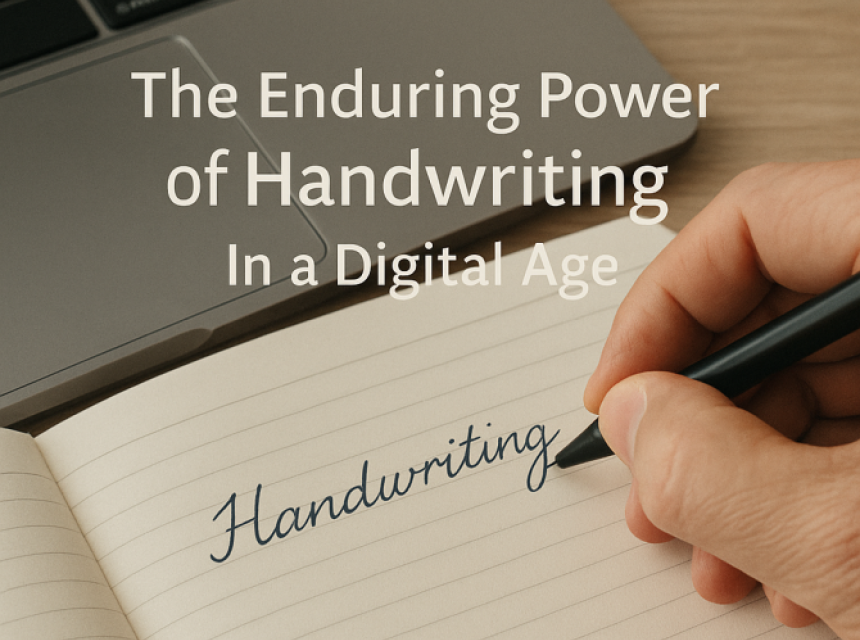
In an era defined by rapid technological advancement, artificial intelligence, and increasingly digital learning environments, handwriting may appear to be a fading art. Yet research across neuroscience, education, psychology, and child development continues to affirm that handwriting plays a vital role in how children think, learn, and communicate. Far from being an outdated skill, handwriting remains a foundational component of cognitive development and a powerful tool for strengthening self-expression, memory, and creativity.
A Brief History of Handwriting
Human beings have been writing for more than 5,000 years. Early scripts such as Sumerian cuneiform and Egyptian hieroglyphs required precise, intentional movements that connected physical motor skills with symbolic meaning. Over time, writing systems evolved: Roman cursive offered speed, medieval monks refined calligraphic forms, and Renaissance scholars developed the elegant italic scripts still used today.
By the 19th century, schooling systems formalized penmanship instruction. Methods such as Spencerian and Palmer emphasized fluid movement, rhythm, and uniformity. These skills are believed to reflect discipline, clarity, and character. While modern education shifted towards keyboards, touchscreens, and digital efficiency, the neurological and developmental benefits of handwriting remain as relevant as ever.
Why Handwriting Still Matters
Research consistently shows that handwriting engages the brain in unique and powerful ways. Studies using neuroimaging have found that writing letters by hand activates networks responsible for memory formation, attention, motor control, and language processing. These networks are less engaged when typing, where the same repetitive movements are used regardless of the letter produced.
Cognitive and Learning Benefits
- Stronger memory and comprehension: Students who handwrite notes retain information more effectively because handwriting requires deeper processing, summarizing, and reflection.
- Enhanced neural activation: Forming letters by hand integrates visual, motor, and cognitive pathways, supporting literacy development.
- Improved reading and spelling: The fine motor patterns of handwriting reinforce letter recognition, phonics, and decoding.
- Writing fluency: Cursive writing, once mastered, allows for faster and more fluid idea generation during timed tasks.
Emotional and Developmental Benefits
- Focus and attention: The slower pace of handwriting cultivates patience and concentration.
- Self-expression and identity: A child’s handwriting is personal and unique, contributing to confidence and ownership of learning.
- Motor skill development: Fine motor movements strengthen the muscles and coordination needed for drawing, crafting, and later academic tasks.
- Emotional regulation: The rhythmic nature of handwriting can calm the nervous system and support self-regulation.
Technology Is Essential but Not a Substitute
Digital tools are valuable and necessary, especially as students learn to navigate AI, online research, and modern communication. However, typing encourages speed, multitasking, and surface-level engagement. Handwriting encourages depth, reflection, and embodied learning.
A balanced educational approach integrates both:
- Handwriting for deep learning
- Technology for efficiency and access
- AI for exploration and extension
Ultimately, handwriting provides the cognitive foundation on which digital skills can be built. When children learn to think, summarize, imagine, and express through writing, they become more discerning users of technology.
Cursive Writing is a Skill Worth Keeping
Cursive writing, often debated in modern curricula, offers benefits that extend beyond aesthetic style:
- The continuous flow supports reading fluency and prevents letter reversals.
- Left-to-right motion reinforces directionality in writing and reading.
- Cursive encourages speed and reduces cognitive load during essay writing.
- It supports connections between auditory, visual, and motor processing.
While not every child will prefer cursive, introducing it provides an additional tool for literacy, expression, and independence.
Handwriting and Sovereignty in the Age of AI
As AI becomes more accessible to students, handwriting offers an anchor to personal sovereignty. When children rely solely on predictive text or AI-generated sentences, they risk losing the ability to form independent ideas. Handwriting slows the mind, clarifies thought, and ensures that expression originates from the individual, not the machine.
Handwriting is a declaration of agency. It reminds students that their mind, not the algorithm, is the origin of their creativity and understanding.
A Balanced Path Forward
The most effective learning environments are not anti-technology; they are pro-human. Handwriting, cursive, digital literacy, and AI awareness all have a place in modern education. The goal is not to choose one over the other, but to blend them in ways that strengthen the whole child.
Handwriting builds the brain.
Technology expands possibility.
Together, they form the foundation of future-ready learning.
If this topic resonates, listen to the 6th December 2025 podcast on All Learning Reimagined. See below for resources and ideas to promote handwriting in educational settings. Scroll down on this page for all archived shows and past articles and resources. Enjoy!
Handwriting Activities for Parents & Teachers
These activities are designed for ages 5–15, adaptable to various learning environments, and aligned with your nature-based, sovereignty-focused educational philosophy.
1. Nature Letter Tracing (Early Years - Primary)
Purpose: Develop fine motor skills, letter formation, and sensory grounding.
Instructions:
- Take children outdoors.
- Invite them to collect sticks, leaves, shells, stones, or petals.
- Use the objects to form letters, words, or names on the ground.
- Children then trace the letters with their finger or write them in a nature journal.
Why it works: Multisensory experience strengthens neural pathways for letter recognition.
2. Cursive Flow Paths (Primary - Lower Secondary)
Purpose: Develop rhythm, flow, and cursive patterning.
Instructions:
- On large paper, draw wide looping patterns (e.g., waves, spirals, hills).
- Students follow the loops with pencils or markers, practising smooth, continuous motion.
- Progress from patterns → connected letters → connected words.
Why it works: Builds kinesthetic memory needed for fluid cursive writing.
3. Slow Writing Practice (All Ages)
Purpose: Improve focus, attention, and deliberate letter formation.
Instructions:
- Choose a simple prompt (e.g., “Today I noticed…”).
- Students write slowly and intentionally for 5–10 minutes.
- Emphasize neatness, spacing, and mindfulness over speed.
Why it works: Supports emotional regulation and handwriting clarity.
4. Copy work from Nature-Inspired Texts (Primary - Secondary)
Purpose: Strengthen handwriting fluency and literacy simultaneously.
Instructions:
- Select short passages from poetry, nature writing, or the child’s own stories.
- Students copy the text by hand or in cursive, paying attention to flow and spacing.
Why it works: Copy work enhances vocabulary, spelling, and writing style.
5. Personal Handwriting Style Exploration (Secondary)
Purpose: Build identity, confidence, and expressive handwriting.
Instructions:
- Provide examples of handwriting styles (italic, cursive, modern script).
- Students experiment with letter shapes, spacing, and slant.
- Create a “signature page” showcasing their personal handwriting.
Why it works: Encourages autonomy and pride in their unique style.
6. Journaling with Mixed Tools (Upper Primary - Secondary)
Purpose: Develop versatility across handwriting and digital tools.
Instructions:
- Students journal by hand for 5 minutes.
- Then they switch to typing on a device for the next 5 minutes.
- Discuss the differences in thought process, speed, and depth.
Why it works: Builds awareness of how different tools affect cognition.
7. Handwriting Treasure Hunt (Early Years - Primary)
Purpose: Reinforce letter recognition and gross-to-fine motor development.
Instructions:
- Hide laminated letters around the yard or classroom.
- Children find a letter, bring it back, and write it on a whiteboard or page.
- Pair each letter with a movement (jump for J, skip for S, etc.).
Why it works: Movement strengthens retention and builds foundational literacy.
8. Cursive Signatures for Confidence (Primary - Secondary)
Purpose: Build ownership, responsibility, and personal identity.
Instructions:
- Teach students how to develop a cursive signature.
- Have them practise signing artworks, journal entries, or personal goals.
- Discuss the importance of personal agency and authorship.
Why it works: Strengthens sovereignty and a sense of identity.


