
Reclaiming Authenticity, August 12, 2026
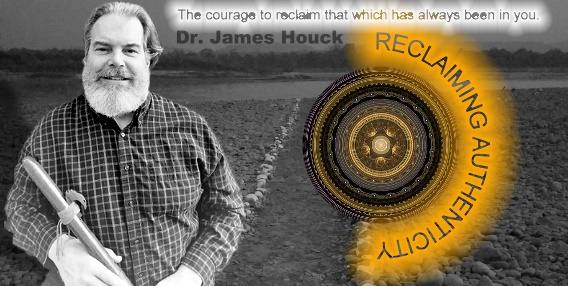

Reclaiming Authenticity with James Houck PhD, LPC, CCTP
Beyond Blood Ties: Ancestral Wounds, Soul Oneness, and Unconditional Love
Integrating Mental Health and Spirituality
Dr. James Halk opens by describing his longstanding focus on integrating mental health and spirituality and relating both to the way people understand themselves, others, and the Divine. He presents meditation as a way to quiet distractions, observe what arises without judgment, and deepen self-understanding. He also discusses spiritual and religious beliefs as possible sources of comfort, purpose, hope, meaning, confidence, and self-control during illness, change, or loss. Throughout the discussion, he emphasizes his belief that people already possess gifts, strengths, talents, and qualities that are essential to their authentic lives. His larger goal is to help people remember who they have always been at the level of the soul.
The Uniqueness of the Individual Soul
The host explores the idea that every person has an irreducible uniqueness, using the philosophical concept of “thisness” and the analogy of a thumbprint. Although people may share similar gifts and character traits, he argues that no two individuals express them in exactly the same way. From this perspective, authenticity is not about searching outside oneself for a missing identity, but about recognizing and expressing what is already present. He connects this realization with divine love, which he describes as eternal and unconditional rather than dependent on human emotional conditions. He summarizes the spiritual orientation of the program through the idea of recognizing the light or soul in oneself and then recognizing it in others.
Blood, Family Loyalty, and Ancestral Trauma
The central question of the episode grows out of the saying “blood is thicker than water” and the expectation that family loyalty should take precedence over other relationships. The host asks what happens when someone violates unwritten family rules by marrying outside a religion, culture, race, or nationality, and whether that person may be rejected, shunned, or disinherited. He then expands the meaning of blood to include ancestry, genealogy, family history, and what he describes as intergenerational trauma. In his account, unresolved trauma may be transmitted through learned behavior, family systems, and, as he believes, biological processes across generations. He argues that family and societal secrets can continue to reveal themselves through unhealed wounds long after the original events have passed.
Bloodstains, Violence, and the Wounds of History
The episode uses blood both literally and symbolically to discuss guilt, violence, historical atrocities, and emotional wounds that cannot simply be washed away. The host references biblical and literary examples involving Pilate, Lady Macbeth, and Hamlet to illustrate the idea that physical cleansing cannot necessarily remove guilt or inner torment. He extends that metaphor to atrocities and injustices committed against people and the land, including genocide, slavery, lynchings, forced starvation, encampments, and other forms of violence. In his spiritual framework, such events leave traumatic effects not only in individuals and descendants but also in the collective memory of communities and places. The host’s point is that attempts to conceal violence or family secrets do not necessarily prevent their consequences from appearing in later generations.
From Blood Connection to Soul Connection
A personal story involving the host’s Native American teacher becomes the turning point in the discussion. After cutting his finger, the host was asked not merely what he saw in the blood, but whom he saw, eventually leading him to think of everyone who came before him and everyone who would come after him. He says the lesson helped him understand the Lakota idea that “we are all related” and moved him beyond a purely biological understanding of connection. He describes a vision of interconnectedness that crosses race, gender, nationality, religion, language, culture, generation, time, and physical form. From this viewpoint, blood relationships are only one expression of a much broader relationship among souls.
Unconditional Love, Forgiveness, and Oneness
In the second half of the episode, the host contrasts conditional family acceptance with what he understands as the unconditional nature of soul connection and divine love. He discusses social stigma, exclusion, illness, mental health, and historical practices that marked certain people as unacceptable or unworthy of full participation in society. He then connects healing with understanding woundedness, forgiveness, and releasing bitterness, shame, humiliation, and other burdens. Rather than defining people primarily through family bloodlines, social categories, or external differences, he encourages listeners to see themselves and others as souls. He closes with the message that recognizing this shared soul presence can weaken the power of racism, sexism, ageism, stigma, prejudice, and conditional acceptance, while helping people become a more authentic and soulful presence in the world.
SEO Keywords / Key Phrases
intergenerational trauma, ancestral healing, blood ties and family loyalty, unconditional love, soul connection, mental health and spirituality, family trauma patterns, spiritual healing, forgiveness and emotional wounds, interconnectedness and oneness
Reclaiming Authenticity
Support my show
$5.99/mo or $9.99/mo
Click HERE
SUBSCRIBE TO TALK SHOW
A Subscription is NOT REQUIRED to listen to my shows,
but it is greatly appreciated!
Reclaiming Authenticity: The courage to reclaim that which has always been in you.
No matter who we are, where we were born, and into what family we were placed, ours is a world full of relationships. Indeed, we are social beings who spend our lives making sense of our world by trying to find our place in the world. As social beings, it is often within the context of relationships that we experience tremendous pain and suffering. From overt acts of betrayal and cruelty that someone may have inflicted against us or vice versa, to simply being in the wrong place at the wrong time, many people bear the scars of physical, psychological, emotional, and spiritual wounds. And yet ironically, just as we experience our woundedness in relationships, it is also within the context of healthy relationships that we find our healing and authenticity. The difficulty, then, is often finding the courage to discover that which has always been in you.
For over 25 years, Dr. James Houck has been helping people discover their authentic selves by integrating spirituality into their mental and emotional health. As people are able to integrate these disciplines, they often discover core issues that have been keeping them wounded in relationships.
Beyond Blood Ties: Ancestral Wounds, Soul Oneness, and Unconditional Love
Speaker Identification
Speaker 1 – Announcer / Prerecorded Promo Voice: This voice delivers the opening introduction identifying the host’s experience and books, and returns for the brief closing promotional announcement.
Speaker 2 – Host: Dr. James Halk. The host identifies himself during the program, introduces the subject matter, gives the call-in information, conducts the full monologue, and closes the main broadcast. The raw transcript also renders the surname as “Hough” in two places; because “Halk” appears more frequently in the source, “Halk” is used consistently here, but the exact spelling should be verified.
..................
Speaker 1 – Announcer: And now, with over 25 years of experience integrating mental health and spirituality, the author of Reclaiming Authenticity: When Ancestors Weep and Redeeming the Bereaved, here is Dr. James Halk.
Speaker 2 – Host: All right, everybody. Welcome, welcome, welcome.
It is Wednesday, August 12th, at 9:00 p.m.—a little past 9:00 p.m. That’s okay. Good evening, everybody, wherever you are in the world.
Welcome to Reclaiming Authenticity, helping you find your courage to reclaim that which has always been in you. In fact, let’s take it a little bit deeper: helping you reclaim that which you have always been.
I am very happy to be with you here tonight and every other Wednesday evening at 9:00 p.m. Eastern Time, or 6:00 p.m. Pacific Time.
If you’ve been following me for some time, you know that each and every one of these broadcasts is dedicated to integrating spirituality and our mental health through looking at various subjects and themes. They all relate to bringing us back to the context of our relationships with ourselves, others, and God or the Divine.
I’m Dr. James Halk, and if you would like more information about me, or if you just want to leave me your comments about tonight’s show, I invite you to visit those websites.
The first one is www.bbsradio.com/ReclaimingAuthenticity. All one word there.
And the second website is www.reclaiming-authenticity.com.
If you want to call in and be part of the show, that number is 888-627-6008. That’s 888-627-6008.
As you know, I’ll be taking your calls after the break, about halfway through.
And just in case you can’t spend the entire hour with me this evening, no worries. This broadcast will be posted on the BBS Radio website, so you can go back and listen again. Or you can go back into the archives on my page and check out previous shows that you might have missed.
And just a little FYI: these podcasts are also available for download on iTunes, Audible, Spotify, and Amazon Music.
Whenever I started this series—oh gosh, six years ago or so—I really wanted to emphasize the integration of spirituality and our mental health. It’s just something very near and dear to my heart.
Because one thing is for certain: I’ve not only seen through these broadcasts, but also through my clinical practice, that there is a growing awareness and a hunger for people to not only integrate their mental health with their spirituality, but also to apply their spiritual growth within the context of their relationships, especially healing from intergenerational traumatic experiences.
The benefit of healing from traumatic experiences is that we often dispel mental and emotional distortions, let’s just say, of who we think we are and come just a little bit closer to discovering the fullness of who we truly are as souls.
Now, if you’re a fan of Edgar Cayce, he was considered to be the father of holistic medicine back in his day. And I think he was also the most documented psychic of the 20th century.
Anyway, he once wrote that what is truly valuable in thought, activity, and experience is this sense of appreciation, or this inner realization and understanding of oneself—namely, the self in relation to others and the self in relation to God.
And meditation is a means to this end. This is something where we really quiet ourselves and we listen. We get rid of all the distractions, and whatever comes up during our meditation, we don’t judge.
We don’t judge. It’s just there. It’s there, but it’s there for a reason. So what can we learn from it?
As we go deeper and deeper and come to grips with all kinds of things about ourselves, knowing ourselves in a little bit more detail, we come to realize what gets in the way of just wanting to have that deeper relationship with God.
And he’s not the only one who thought this way, because there’s a Dr. Harold Koenig, whom I met—oh gosh, it’s probably going on 15 or 18, maybe 20 years ago. He’s the director of the Center for Spirituality, Theology and Health down there in North Carolina.
He also notes that a person’s religious and spiritual beliefs and practices are important resources for coping with illness. That was kind of his niche. That’s where he really spent a lot of time and focus, not only in his practice but also in his research.
Furthermore, he says there has been a lot of research in this particular area that demonstrates a connection between our beliefs and our sense of well-being, such as positive beliefs and the effect they have on our well-being.
A person’s religious and spiritual beliefs can also provide comfort during changing times or losses, and definitely inner strength gained from one’s religion and spirituality. It also assists in deeper meditation and contemplative prayer, and that’s just to name a few. There’s a whole host of positive reasons.
His research highlighted the belief that improving your spiritual health may not cure an illness. Many people pray for healing, okay? But he says that, overall, it may help with your well-being. You might feel a higher sense of purpose, peace, hope, or meaning.
You may not be able to change the outward, external circumstances, but you come to peace with that. You find a higher purpose. You discover a deeper level of hope and meaning throughout.
He also says you may experience more confidence or improved self-esteem and self-control. So there are many positive outcomes related to integrating our mental and spiritual health.
And this is where I come in, because I have a keen interest in helping people live authentic lives by helping them find the courage to reclaim what has always been in them and remember who they have always been and are as a soul.
I think you’ve heard me say many times on this show that I have a very solid belief that all of us come into the world already equipped and graced with everything we need for this life—in terms of our gifts, our skills or talents, our strengths, character traits, and so on and so forth—the very best of who we are.
And how we live out our giftedness is in and through various relationships.
This is a very important aspect when considering who we are because, although we may have similar gifts, skills, talents, strengths, and character traits, no two people express these identically.
In other words, each of us has this “thisness” about us that cannot be duplicated. People are going to try to imitate how we do things, but no one can duplicate us, because within us lies what the 20th-century scholar John Duns Scotus referred to as haecceitas.
It’s a “thisness.” It’s a uniqueness that we all have that’s different from one another.
I often explain this to kids because this can be a very abstract thought. I just say, “Look, kids, we all have a thumbprint. It’s something we all have in common, okay? But no two thumbprints are alike. Therefore, your ‘thisness,’ or your uniqueness, is all on you. Nobody else has this.”
Therein lies the importance of the realization of who we are.
So, in all honesty, don’t get trapped in this illusion that you have to go in search of something that you already are or that you already have, because certainly godly or divine love—or the language of the soul, let’s just say—isn’t entangled in the human emotions of the mind.
Divine love is eternal. It’s not conditional, as I’ll say more about later on.
And it also helps us purify our minds by recognizing only that which is divine in all. So discover who you are and be that soulful presence in the world.
In all honesty, folks, this is what Reclaiming Authenticity is all about.
It can be summed up in one word: Namaste, which roughly translated means that the fact that I see myself as a soul of light allows me to greet your light and the soul of who you are, even if you don’t see it in yourself.
Well, welcome to August 12th.
We just came through the dog days of summer, which I think run from July 3rd through August 11th, okay?
And you know, the dog days of summer have nothing to do with the droopiness and laziness of dogs during the summer months. In other words, it’s not that the weather is so hot and sultry that it’s just not fit for a dog.
Trust me on this one: I have two dogs that can be lazy all year long, regardless of the temperature. It doesn’t matter. They wake up tired, okay?
But anyway, this period of intense heat also coincides with the appearance of the Dog Star, which is actually part of the constellation Canis Major. I don’t know if you’ve ever seen that, but it’s there.
In ancient Greece, the Greeks believed in its brilliance. This star, the Dog Star, was the brightest star in the Canis Major constellation.
And the ancient Romans actually believed that the Dog Star gave off heat because, again, it was the brightest star in the constellation. They believed it gave off heat that intensified the summer sun. Even its name, Sirius, was associated with scorching.
And for the Egyptians—this is kind of interesting—Sirius signaled the annual flooding of the Nile, which was crucial for their agriculture and survival. It left this beautiful silt that really nurtured the land and vegetation, and they depended on the Nile flooding year after year.
The lore surrounding Sirius has endured for thousands of years. It’s quite interesting, the things you learn just by looking up at the stars.
Well, we’re not really going to talk about stars tonight. What we are going to talk about is this oneness—the oneness that we have that goes beyond blood and water.
I’m sure all of us have heard, at one time or another, the phrase “blood is thicker than water,” which means your family allegiance—your kin, your blood, your sangre—should take precedence over all other relationships, whether they be friendships, work colleagues, or any other connections we have.
This phrase is often heard when it comes down to choosing sides, especially when it comes to deciding where exactly your loyalties lie above all else.
Are you with us? Because after all, blood is thicker than water. Or does your allegiance lie elsewhere?
Well, I did a little checking on this phrase, “blood is thicker than water,” and I discovered something really fascinating.
It more than likely originated, as I understand it, from a medieval battlefield or alliance ritual in which warriors who were getting ready to fight together would often mix a drop of each other’s blood into a communal bowl of water, symbolizing that this new bond was thicker than the blood ties they might be forced to break.
In that context, it wasn’t really a celebration of family loyalty, but it was actually a legal contract. In other words, if you made such an oath, your new pledge would override family duties.
However, since then, this phrase, “blood is thicker than water,” has been a longstanding proverb that traditionally means familial bonds are stronger than other relationships.
Over time, that statement really came to refer to your overall commitment to your family above everything and everyone else.
But what about your blood connection to your ancestors—your lineage? Aren’t they blood relatives too? After all, their DNA flows through your blood and into future generations—everybody who has come before us and everybody who is going to come after us.
So just how far back do you have to trace that family obligation?
Do you trace it as far back as you can make out the names in the family Bible? Or does it go back as far as Ancestry.com can record? Or what about even further?
Well, let me ask you another question here, just to muddy the waters, so to speak.
What do you think happens if anybody in the family dares to cross that bloodline or to break those unwritten family rules that the blood represents?
For example, what happens when a blood relative wants to marry someone outside the family’s religion? Or they fall in love with somebody with different customs or from a different culture?
What happens when, again, they go against the family bloodline because they fell in love with somebody of a different race or nationality?
Would they be cut off from the family? Would they be disinherited or shunned? Would the family members feel betrayed and therefore not allow that member to join in any future reindeer games?
Well, do blood ties really carry that kind of emotional weight in families?
I’ll tell you what: hold that thought, because we’re going to come back to this, okay?
Let’s just dig a little deeper into the physical aspects of blood.
Most people I know don’t really like the sight of blood. Some people can deal with it. Other people are like, “Okay, no thank you.”
From its unpleasing odor to its many associations with violence, many people have a phobia of blood.
And true confession here, folks: I myself am not even fond of having my blood drawn for tests. I can look at it, but I’m like, “Okay, I’m good. Whatever. Pull the needle out. Come on, come on, pull the needle out.”
Nonetheless, I know that without blood, we wouldn’t exist. Our life wouldn’t continue. Blood is that powerful.
In fact, people who need transfusions know this all too well. Blood contains everything we need to sustain life. White blood cells fight off infections, red blood cells carry oxygen throughout the body, and platelets clot our blood whenever we bleed.
So, in a sense, our blood is kind of a liquid blueprint that carries our DNA, identifying who we are, who we’re related to, the present status of our health, and, yes, even the genealogy of our ancestors.
So yes, blood can tell us many things.
However, it’s kind of ironic that, despite its life-giving qualities, blood does have a shelf life. Red Cross blood donations are typically kept no longer than five to six weeks because after that time, the red blood cell membranes lose their flexibility and the quality of the blood begins to break down.
Furthermore, once blood is spilled, it leaves what appears to be an everlasting stain on our clothes and skin and can pollute the environment.
Moreover, blood is probably one of the most stubborn stains to remove. Even after a thorough scrubbing, there are still ways to detect bloodstains on all kinds of surfaces.
And this brings me to how blood affects how we perceive ourselves as a soul.
Try as we may to scrub and sanitize every inch of contamination, we eventually realize that when it comes to our soul, it takes a lot more than cleanser and bleach to bring us inner tranquility.
In the Bible, do you remember, at the trial of Jesus, the Roman governor Pilate made this public display in front of everybody? He made this public display of his innocence by washing his hands of Jesus’s blood, and yet he was troubled in his soul by his decision to execute Jesus.
And what about Shakespeare’s Lady Macbeth? She was so obsessed with scrubbing her hands that she couldn’t remove the blood guilt from her soul.
And even in Shakespeare’s Hamlet, the story begins with the guards anxiously reporting that they saw a ghostly figure. We later discover in the story that the ghost is the King of Denmark.
Hamlet also witnesses this ghost, who reveals that he’s unable to find peace and rest because he was secretly murdered.
As the story unfolds, Hamlet discovers more and more of the truth of his father’s death. And when he does this, the more his mother becomes tormented by her guilt because—spoiler alert—she was actually in on it.
In these and many more examples, the significance of one’s violent actions lies not so much in the stubborn removal of bloodstains from the crevices of our hands and fingers, but rather in the crevices of the human soul for both the victim and the offender.
Since the beginning of time, you know this as well as I do, humanity has tried to wash its hands of all kinds of atrocities and injustices that have been inflicted on the land and on each other.
Ironically, such crimes against humanity quite often seem to escalate, especially when they are done for and in the name of God.
In this sense, humanity is very creative with coming up with all kinds of justifications for shedding another’s blood, innocent or otherwise.
If you’ve ever watched the Disney movie Pirates of the Caribbean: The Curse of the Black Pearl, you might recognize the phrase “Dead men tell no tales,” as uttered by Mr. Cotton’s parrot.
Many people believe this was a phrase invented by pirates as they swashbuckled their way through perilous voyages in search of buried treasure. Even today, just hearing this phrase might make the hairs on the back of your neck stand up.
But neither Disney nor the pirates invented this expression. Instead, its origins can be traced back, as I understand it, to a proverb by the English reformer Thomas Becon, sometime around the mid-1500s. The basic idea was that the dead cannot reveal any secrets.
Although this saying has existed for a long time, it really gained popularity through pirate lore and, eventually, the Pirates of the Caribbean attraction.
Basically, “tell no tales” means to keep something quiet by ensuring that anyone who knows about it cannot reveal the secret. If the person is dead, it would be pretty much impossible for him or her to tell your secret.
Well, interestingly, family secrets and personal stories of injustices that were intended to be taken to the grave also live on in present generations.
Because, you see, in my understanding, blood also carries traumatic energy through intergenerational trauma.
Intergenerational trauma and the energy connected with it are not only passed down through generations in habits, behaviors, and everything else that was modeled because trauma has never been healed, but, as I understand it, trauma can also affect the body and be carried across generations.
If the trauma is intense enough, I believe it can affect DNA and be passed down. That’s why you can have, let’s say, great-great-grandchildren who are suffering from traumatic energy. They have this intergenerational trauma, but it didn’t start with them. It started with Grandpa, Great-Grandpa, Great-Great-Grandmother, whoever.
That’s how I understand intergenerational trauma to work.
So blood also carries this traumatic energy, as well as this belief that your overall commitment to your family is above everything and everyone else.
In fact, those so-called family and societal secrets are often revealed again and again through unhealed traumas that have been passed down through the language and genetics of blood and the voice of the soul.
For all of our feeble attempts at sanitizing human history, think about blood spilled in the name of murder, genocide, Manifest Destiny, cover-ups, the Doctrine of Discovery, slavery, forced starvation and encampments, lynchings, exterminations—and that’s just to name a few, folks.
All of these are still evident, in my view, in both the land that holds traumatic energy and wherever blood was spilled and soaked into the ground. It’s the traumatic energy behind it.
Regardless of geography, lands that witnessed humanity’s atrocities against one another have not only absorbed numerous blood-soaked traumas, but the energy from such traumas has also stained the souls of victims and perpetrators who have been unable to free themselves.
For me, I really learned this valuable lesson—and I’ve told this story many times—when I was visiting my Native American teacher and I cut my finger on his wicker chair.
Before I could get a Band-Aid, a handkerchief, or whatever, just to cover it up, he grabbed my hand and said, “What do you see?”
Again, I didn’t get the lesson until he said, “Who do you see?”
I thought I was giving him the correct answer by saying, “Oh, okay, I see my parents and my grandparents,” knowing that, well, they’re in there.
And he kept pressing me. It really started to irritate me, but he pressed me because he wanted me to get the deeper lesson.
He said, “Is that all? Is that all you see?”
And then it finally clicked.
I said, “No. I see everybody who has come before me.”
And then this is where the lesson really came home. He said, “Through that single drop of blood, if you are able to see everybody who has come before you, you’re going to be able to see everybody who will come after you.”
There is this connection—a very strong connection.
But he wasn’t just talking about blood. He was talking about the soul.
He started off by saying, “Just look at the blood.”
A very fine lesson indeed.
Suddenly, I had heard this Lakota phrase over and over again, but suddenly it made sense: “Mitakuye Oyasin”—we are all related.
That phrase really awakened in me a sense that all life is so intimately connected. And it cuts across all bloodlines, time, and space.
I became aware of the interconnectedness of all things on the level of the soul, beyond a simple linear dimension of past, present, future, and blood ties.
For me, this interconnectedness is more like a burst of light extending out into multidimensional, multigenerational soul relationships.
Because in that moment, I no longer saw people as being divided by generation, race, gender, nationality, religion, language, or culture. I saw all people as beautiful souls in physical bodies.
In fact, within a split second, everything—the created elements, vegetation, animals, minerals, water, fire, earth, stars, the universe, and so forth—formed this interconnected kaleidoscope in my mind.
The reality of this interconnected and interdependent relationship, which was once so incomprehensible to me, now resonated with a wave of clarity that also caused me to listen very carefully to the collective cries of the soul, as I had never listened before.
So, is blood thicker than water? Or is there a higher, stronger soul connection that we have?
Well, there’s a lot more to get into in this subject about blood and soul ties. But for now, I really want to hear what’s on your heart about this subject.
Again, I’m going to take a little break here. And if you’d like to call in, that number is 888-627-6008.
Like I said, I’ll be taking your calls after the break.
Again, you are listening to Reclaiming Authenticity, and I’m your host, Dr. James Halk. I’ll be back with you in one minute.
Break
Speaker 2 – Host: All right. Welcome back, everybody. I’m Dr. James Halk, and you’re listening to Reclaiming Authenticity, where we have been discussing the phrase “blood is thicker than water,” meaning your family allegiance—that is, your kin, your blood, your sangre—should take precedence over all other relationships, whether they be friendships, work colleagues, schoolmates, or any other connections out there.
But many theologians, scholars, and scientists down through the centuries have really struggled to espouse the most accurate definition of what the soul is, let alone exactly what our relationship is to the soul.
After reading and researching and contemplating, here’s my definition of the soul:
The soul is the purest essence of us that exceeds all physical, emotional, and psychological limitations. Because if you strip away everything else in our lives, it is our soul that is a divine mirror of the soul of the universe.
If you didn’t get all of that, shoot me an email or drop me a line, and I’ll be glad to give you the whole thing.
But it begs another question: Is there another relationship that has a stronger connection than the blood that connects you to everyone who has come before you and connects you to everybody who will come after you?
Well, there certainly is.
The soul is oneness. We come from God; we go back to God. Everything points to this oneness.
Even though we’re all composed of blood and water and muscle and bones and organs and so forth, there’s something else that really connects all of us, and that’s our soul.
Now, granted, throughout history, and even in recent history, we might think that if we spill enough blood and other life-giving resources, we’re going to get rid of troublemakers or problems will go away. The issues that have plagued us for a long time will just evaporate.
But that kind of thinking is what I like to call lower consciousness, because all those things are based on externals, and the soul is not.
Once we identify and embrace ourselves as souls, we hopefully also realize that there’s a more effective way to create change—to transform negative, destructive energy into a pure energy that heals on a soul level.
You see, the soul is not just something we have because of being created. The soul is who we are authentically.
I mean, we’re not merely bodies that have souls. We’re first and foremost formless divine souls who have the form of bodies.
In a sense, our mind and our bodies provide the form, okay? And the soul is formless.
But nonetheless, it’s really the cry of the soul in each of us and this full realization that we are souls, and that we long to have that connection and reconnection with God.
But that’s something we already have, because that’s something we already are.
Regardless of whether or not we’ve suffered trauma, really paying attention to ourselves as souls and listening to our inner cry moves us out of the illusion that a mind-and-body consciousness rules.
As important as they are, the mind and the body are merely vehicles to realize the higher consciousness of the soul.
And when we listen attentively to our soul’s cry—I mean really get in there and listen, not with our human ears, but with the intention of listening to the soul—we become aware that everything we truly desire can never be reached by the mind and the body alone.
These are always driven by ego, selfishness, fear, pain, pleasure, or whatever.
Now, this is not to say that the mind and body are all evil and the soul is all good.
That kind of dualistic thinking drove people in medieval times to punish themselves with physical wounds, believing they could suppress the ego and physical desires and become more righteous and holy. They would whip themselves until they bled.
But again, this is a misunderstanding of who we are as souls.
We can never attain higher levels of God-consciousness through the mind and body alone because these forms are limited. They’re limited.
So let’s return to the question that I posed earlier.
What happens if somebody in the family—anybody in the family—dares to cross that bloodline or break those unwritten family rules that blood represents?
Just a quick reminder: What happens when a blood relative wants to marry somebody outside of the family’s religion or falls in love with somebody of a different race or nationality?
Would they be cut off from the family? Would they be disinherited or shunned? Would the family members feel betrayed and therefore not allow that member to participate in any kind of family activities?
In all honesty, do blood ties really carry that kind of emotional weight in families?
Well, all of these scenarios are a possibility, as we know from history. In fact, you may be experiencing some of this treatment in your family today.
But still, is there a way back to the family? Or are you forever condemned in their eyes?
As long as oneness with your family is based on blood ties, your membership, let’s just say, will always be conditional, right?
If your acceptance and love in the family go only so far as your blood connection and adherence to family rules, then those relationships are based on conditions.
And conditional love is really nothing new. It’s been going on since the beginning of time.
In fact, throughout history, certain diseases have carried such a social stigma that they have often struck fear and contempt in the hearts and lives of people around the world.
It could be anything that people didn’t understand or feared. It’s like, “Okay, you’re not going to live with us. You’re going to live outside the community and see how you like that.”
Many afflicted people interpreted even a short-term quarantine as society’s way of displaying contempt for people who were sick.
As a result, many felt stigmatized by their illnesses, and they were shunned and alienated from fully participating in their communities as persons of value and worth.
I believe I shared in a couple of other broadcasts that Erving Goffman wrote that the Greeks actually coined the term “stigma” to refer to bodily signs that exposed something unusual and negative about a person—about their moral status.
And so the signs, to drive home a point of society’s contempt, were imposed by society. They were cut or burned into a person’s body, which clearly advertised his or her condition—whether they were a slave, a criminal, or a traitor.
What was that famous story from Hawthorne? The Scarlet Letter, right?
This act of branding signified to all that the recipient was a blemished person, ritually polluted, and was to be avoided, especially in public places.
Such markings not only spoiled a person’s social identity, but also cut that person off from society and really forced him or her to live in isolation in a very unaccepting world.
Just from this aspect alone, it appears as though there was no way to remove this outward sign, let alone recover from the emotional wounding from such harsh treatment.
And yet this wasn’t always the case.
According to the ancient Israelite purity laws, there’s this distinction made between people who are clean and unclean, or holy and unholy.
Cleanliness was considered the normal condition of most things and people. Anything else—death, sickness, disease, coming in contact with blood, and so forth—was considered a deviation from this cleanliness or from the norm.
Therefore, the person was separated from the community for a period of time to avoid further contamination.
Although this purity system was meant to impose a temporary isolation, the practice eventually became an acceptable way to expel people permanently who were perceived as polluting society by their conditions.
Now, this expulsion was not only true for people who had an identifiable condition.
But what about people who had a condition that was not so readily seen—maybe mental illness?
In today’s society, not all the signs of socially intolerable diseases or conditions are immediately visible.
And yet, once such a condition is disclosed, society’s overall contempt for what is deemed unacceptable behavior or flawed character can reduce that person from a whole and unique individual to a tainted, discredited one.
So when a society imposes its stigma on a person, this ultimately leads to disenfranchisement, placing a person in a context in which he or she is not accorded the social right, let’s just say, to have his or her voice heard or even their vote counted.
Such people may believe they have been relegated to second-class status and subjected to political suppression.
Now, in severe cases, as I mentioned, I believe trauma can be passed down genetically. It can attach itself to our DNA and often covertly disguise itself as harmful physical, psychological, emotional, and spiritual symptoms.
As I mentioned earlier, this is intergenerational trauma. It’s passed down through societies and families.
What we carry in our genes, or how we were raised in various social systems, can also galvanize harmful stereotypes.
Therefore, intergenerational trauma is not just limited to how it affects our families. It also affects all relationships, from the most intimate relationships to mere acquaintances in our lives.
But this realization is also a significant aspect of healing our relationships.
If we take a step back and are able to understand or consider what has so wounded another person, or what has so wounded ourselves, that we continuously act out of our woundedness and yet expect different results, then perhaps we can begin to see things differently.
I will have to say, from personal experience—okay, folks, and this is just me talking—that understanding the background of those who have hurt me has allowed me to take the necessary steps closer to forgiving and releasing the burdens of carrying around my wounds any longer.
I wanted to be unburdened by my bitterness, unforgiveness, shame, humiliation, or any other pain I was carrying around.
So I needed to ask for forgiveness, as well as offer forgiveness.
Sometimes this happens when people ask forgiveness from us and we grant them forgiveness by saying, “Yes, put that burden down. Yes, I accept your apology,” or through other ways of releasing that burden.
I say all of that just to really bring us back around here.
We often see ourselves as being separate from everyone else and all things.
It could be that we accidentally bump into another person and believe, “Well, I’ve got nothing in common with them because they’re not a blood relative.”
And that might seem true if all we did was focus on externals. We could say, “Yeah, nine times out of ten, we don’t have anything in common with them,” if we’re focused only on the externals.
But what if we allowed ourselves to see one another as souls?
Just what if?
Certainly, we would then understand the oneness or connection we share with others, regardless of race, class, creed, culture, stereotypes, prejudices, stigmas, language, or family blood ties.
And this is all the more reason why it’s so important to see the divine in everybody.
Because when we’re ready, God really opens up for us a profound understanding of who we are as souls.
When we look at each other as souls, as we understand each other as souls, we soon discover that we see ourselves more clearly as souls.
And we begin to realize that externals don’t matter—that there really is no more sexism, no more racism, no more ageism.
In fact, there are no more “isms” at all, because they simply can’t hold up to the standard that we are all souls, that we are all children of light, or that we’re all droplets of water returning to the ocean.
Pick your metaphor.
I mean, we’re no different from one another, albeit externally.
So whether or not you believe in reincarnation, destiny, or fate, really focus on the people in your life whom you may see day in and day out, especially the people whom you don’t really see.
You know the ones—the ones who work behind the scenes, the invisible people, as it were. We pass them by every day, but we really don’t want to take notice, or we just don’t take notice.
Do we have a connection with them? Do we ever consider ourselves one with them?
Absolutely.
How many of us perceive ourselves as lacking something we already possess?
How many of us put so much faith in a blood tie that we give in to those unwritten rules of, “Do not cross the family, for you’re blood, and blood is thicker than water”?
And after all, “Don’t go and get too big for your britches because we know where you come from, and we don’t want you to ever forget where you came from.”
So any talk of, “But I don’t see that person as evil. I don’t see that person as different. Yeah, they may not be part of the bloodline, but I see something stronger than a bloodline. I see their soul, and they see me as a soul.”
You are all loved out there by the Soul of the Universe—God—who loves you with an unconditional and everlasting love.
And once we recognize this soul presence in one another, once we embrace it, once we live it, we’re not going to settle for any other kind of conditions placed on another person’s acceptance of us based on what they want us to be for them.
I’m Dr. James Halk, and you’ve been listening to Reclaiming Authenticity.
Thank you for spending this hour with me.
If you do have any other questions or concerns, or just want to drop a line and chit-chat, do so through one of those two websites. I will read them and gladly reach out to you as we engage in a little bit more discussion about this subject tonight.
So in two weeks, we’ll talk again.
But in the meantime, everybody behave yourselves, everybody be safe, and everybody find yourself as that soul and be that soulful presence in this world.
Good night.
Speaker 1 – Announcer: For an answer, or just to leave your thoughts and comments, or browse around and buy a book by Dr. Halk, it’s all there. Just wander over to Reclaiming-Authenticity.com and click around.
And we’ll see you next Wednesday at 9:00 p.m. Eastern Time, 6:00 p.m. Pacific, on BBS Radio TV.
[Outro music / vocalization]