
Popp Talk, July 18, 2026


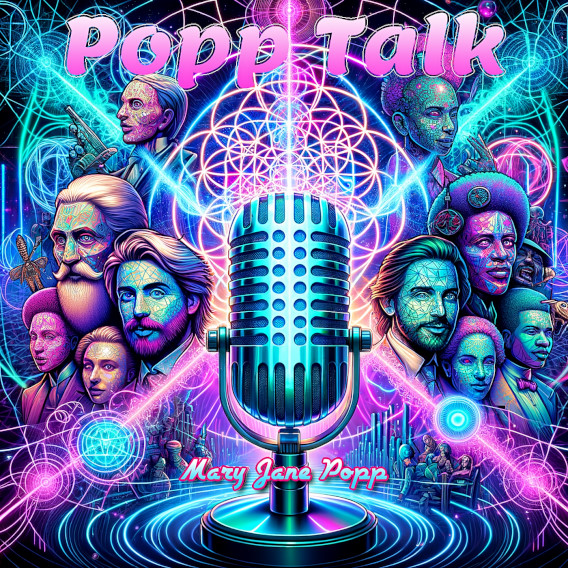
Popp Talk with Mary Jane Popp
Biotech Breakthroughs, Hidden Pain, and the Truth We Struggle to Tell
Guests, Tim Harris and Michelle May
A Potpourri of Health, Science, and Self-Understanding
In this episode of Popp Talk, host Mary Jane Popp introduces a wide-ranging “potpourri” show covering biotechnology, health, therapy, and the hidden struggles people sometimes carry beneath the surface. She begins by setting up an interview with Tim Harris, author of In Pursuit of Unicorns: A Journey Through 50 Years of Biotechnology, and later introduces Michelle May, psychotherapist and author of What I Couldn’t Tell My Therapist. The episode moves from the evolution of biotech and medical innovation to emotional repression, chronic pain, social media misinformation, and the importance of personal responsibility.
Tim Harris on Biotechnology and the Pursuit of Unicorns
Mary Jane’s first guest, Tim Harris, defines biotechnology as the combination of biology and technology, beginning with recombinant DNA and monoclonal antibodies. He explains that his book title uses the word “unicorns” because biotech companies can become billion-dollar enterprises, though some valuations may prove more mythical than real. Harris presents biotechnology not only as a scientific field but also as a business story shaped by companies, capital, invention, risk, and the long effort to turn scientific tools into useful products.
Recombinant DNA, Monoclonal Antibodies, and Gene Editing
Harris walks listeners through the development of recombinant DNA, explaining how scientists learned to combine pieces of DNA and use bacteria such as E. coli to produce important proteins like insulin and growth hormone. He also explains monoclonal antibodies as single antibodies made by cloned cells, first useful for diagnostics and later for therapies. The conversation then turns to gene editing, including CRISPR-Cas9 and its use in sickle cell disease, which Harris describes as life-changing for patients whose lives revolve around managing pain and disease.
Cancer, mRNA Vaccines, AI, and the Risks of Innovation
Mary Jane and Harris discuss why cancer remains difficult to treat, with Harris explaining CAR T-cell therapy, its success in certain leukemias and lymphomas, and the continuing challenge of solid tumors such as breast, prostate, and colon cancer. He also connects nanotechnology to COVID-19 mRNA vaccines, describing lipid nanoparticles as the delivery system for messenger RNA. The conversation expands into new COVID strains, vaccine updates, artificial intelligence, risk assessment, and the limits of prediction in biology. Harris emphasizes that while AI can help analyze data and predict viral changes, drug discovery and development remain experimental sciences.
Michelle May’s Story of Chronic Pain and Repressed Emotion
The second major interview features Michelle May, who shares that she woke up in 2007 with a headache that lasted six years. Doctors eventually found a Chiari malformation, and after two brain surgeries, her head pain improved dramatically. Still, some headaches remained, and May says she later learned through intensive dynamic therapy that repressed emotions also contributed to her pain. She explains that anger, grief, guilt, and love can be pushed out of awareness when people grow up in environments where certain feelings do not feel safe, but those emotions may still remain in the body.
What People Cannot Tell Their Therapist
May explains that the title What I Couldn’t Tell My Therapist has two meanings: the painful family stories she feared would feel like betrayal, and the truths she had not yet admitted to herself. She describes how patients may minimize or filter their experiences, especially when they love the people who hurt them. Mary Jane presses her on how therapy helps uncover those hidden barriers, and May explains that she watches for avoidance patterns, such as looking away, intellectualizing, minimizing pain, or struggling to stay connected while discussing intimacy and emotion.
Pain, Anxiety, Opioids, Social Media, and Responsibility
The interview broadens into the overlap between physical pain and emotional pain, with May stressing that medical causes should always be ruled out first before exploring emotional processes. She distinguishes between feelings and actions, explaining that anger is a bodily experience while harmful behavior is a choice. The conversation also covers chronic pain, opioid dependence, the mind-body connection, social media misinformation, fact-checking, political and cultural falsehoods, and the difficulty people have admitting they were wrong. The episode closes with May encouraging people to find a therapist they trust, while Mary Jane emphasizes comfort, accountability, and the need to stop blaming others when personal responsibility is required.
Popp Talk
Support my show
$5.99/mo or $9.99/mo or more
Click HERE
SUBSCRIBE TO TALK SHOW
POPP TALK! A fast-paced Magazine-style Show dedicated to keeping you on the cutting edge of today's hot button issues. The show is high energy, upbeat and entertaining. It gives you the tools to feel better, reach for that brass ring, and live longer and happier. It's Fun! It's Fascinating! It has guests from politics to health, to the stars from La La Land. It's Radio with sizzle!
Speaker Identification
Speaker 1 - Announcer
Speaker 2 - Mary Jane Popp, Host
Speaker 3 - Tim Harris, Guest
Speaker 4 - Public Service Announcement Voice
Speaker 5 - Michelle May, Guest
Speaker 1 - Announcer:
Are you ready for new dimensions and countless possibilities today and for the future? It is an exciting new time, and the answers are out there. So join Mary Jane Popp as she explores the unique and unusual for a better life on Popp Talk, in search of the truth. And here she is, Mary Jane Popp.
Speaker 2 - Mary Jane Popp:
Welcome to Popp Talk. We have a potpourri show for you today. There is something for everybody. I am going to be talking about your good health. Jim Meskimen, the son of Marion Ross, who played the mom on Happy Days, is a voice artist, sort of like what Rich Little and Frank Gorshin have done, and he has done a great number of things.
We will also talk about health, and we are going to be talking about therapy. Michelle May says there are some things people hold back in therapy. We will find out why.
But before we do that: biotechnology. Where are we today? It has been since, I believe, 1973, and now I want to find out what is coming. We have the person to give us that information. Stay with us on Popp Talk. You know we talk about just about everything that can affect your life.
Just what makes that little ant think he will move a big rubber tree plant? Anyone knows an ant cannot move a rubber tree plant, but he has high hopes. Well, I am sure there are high hopes in the world of biotechnology. So how far have we come, and what comes next? Genetic engineering, cell manipulation - that is just the beginning. It really took hold, as I mentioned, in 1973, and now it is just part of our daily living.
Tim Harris knows all about that. He has committed his life to the industry, and he has taken it upon himself to tell the history of biotechnology in his book, In Pursuit of Unicorns: A Journey Through 50 Years of Biotechnology. Tim is a molecular biologist and biochemist, so he has a lot of information to give us. Hi, Tim. How are you?
Speaker 3 - Tim Harris:
I am very well, thank you. Thank you for inviting me to be with you today.
Speaker 2 - Mary Jane Popp:
Absolutely. Define biotechnology for me. Can you?
Speaker 3 - Tim Harris:
It is really the two words: biology and technology. It is technology that is relevant to biology. As you said, it started with recombinant DNA, where you could combine bits of DNA. Then it was followed rapidly by making single antibodies themselves, so-called monoclonal antibodies. Those two things are a good reflection of the definition of biotechnology: biology and technology together.
Speaker 2 - Mary Jane Popp:
Why did you call your book In Pursuit of Unicorns?
Speaker 3 - Tim Harris:
It is a relatively long story, but I will keep it short. Unicorns, as you may or may not know, is a word given to companies that are worth a billion dollars. Sometimes biotech companies that are worth a billion dollars really are worth a billion dollars, and sometimes their valuation is a little overemphasized, and they are probably not worth a billion dollars.
So unicorns was in the title because the book is not just about technology. It is about the companies that were formed on the back of the different technologies that make up biotechnology. Some became unicorns, and some became unicorns that then disappeared. I quite like the mythological context of unicorns.
One of my children and I went to dinner, and we talked about it. We came up with In Pursuit of Unicorns as the starting phrase and then finished it with A Journey Through 50 Years of Biotechnology so people understood the context of the unicorn pursuit. It also allowed me to ask to use Dutch tapestries of unicorns as the dust cover for the book, which I think is really stunning.
Speaker 2 - Mary Jane Popp:
Oh, yes. As they say, do not judge a book by the cover - please read it - but the cover is pretty amazing. I love it. Back in 1973, what was the goal? Did they have a goal in mind, or did they not know what was going to happen until it happened?
Speaker 3 - Tim Harris:
I think it was more about trying to find out how gene expression was controlled. In order to work out how genes are expressed, it was necessary to get individual genes and look at them. Once people had decided that was what they needed to do, they looked for technologies that allowed them to do that. By a variety of routes, that turned into recombinant DNA technology, which is the ability to put different pieces of DNA together from E. coli and mammalian genes in the same plasmid vector, for example.
That is how it started. Then people realized that, because you could do that, you could get E. coli, the bacterium, to make important proteins like insulin and growth hormone and other important products that were difficult to get by other means.
Speaker 2 - Mary Jane Popp:
I remember, because I have been doing this for a long time, when cloning was the big thing. I do not know if it is anymore. When they first cloned the sheep - Dolly, I think her name was?
Speaker 3 - Tim Harris:
Yes, Dolly the sheep, exactly.
Speaker 2 - Mary Jane Popp:
Are they still even thinking about cloning? Is that still research?
Speaker 3 - Tim Harris:
Yes, very much so, but you have to be careful. There is the ability to change the genetic makeup of different embryos, whether animal embryos or, in fact, human embryos. But there is an embargo on manipulating human embryos, obviously. There is not an embargo on manipulating mouse embryos. In a way, you can make clonal mice that express different genes at different times, whether they are mouse genes or human genes. So yes, it is very much still used, and it is quite an important way of finding out how things work.
Speaker 2 - Mary Jane Popp:
When you say monoclonal antibodies, what does that mean?
Speaker 3 - Tim Harris:
Monoclonal means it is a clone that makes a single antibody. Once researchers had made a hybrid cell that made a monoclonal antibody - only one type of antibody - it became clear that you could use that technology to make antibodies that might be useful initially for diagnostic tests. You did not then have to make an antibody in animals, and it would be a single antibody with a single specificity, which was important.
From diagnostic tests, three or four companies turned themselves into not just diagnostic companies but companies with the ability to make antibodies useful for therapy. If you look at the top 20 drugs sold now, at least 75% of them are monoclonal antibodies of one type or another. If you watch CNN, you will see advertisements for antibodies for psoriasis numerous times during the evening.
Speaker 2 - Mary Jane Popp:
When you look at the technology, it has been great. Cell therapy, gene editing - so many of these things seem impossible, but they are happening, are they not?
Speaker 3 - Tim Harris:
It is absolutely amazing. If you think about sickle cell disease and ways of curing that disease, the new ways of using gene editing, the CRISPR-Cas9 system that the Nobel Prize was awarded for, have been used to change the mutation, the faulty amino acid in the globin chain, back to what it should be. When you manipulate the cells in the bone marrow of a person with sickle cell disease and put them back with the change you have made, you get a cure. It has been done for about 20 people.
I think that is totally mind-blowing because it changes the life of sickle cell patients. If you have that disease, your whole life revolves around managing the pain and managing the disease. Your whole family's life revolves around that as well. This technology is awe-inspiring in that respect.
Speaker 2 - Mary Jane Popp:
Why can they not do that for cancer? Whenever I have talked to researchers, they say there are so many different kinds of cancer that there is never going to be one cure for cancer. Well, if you can change the cells, why cannot it be done?
Speaker 3 - Tim Harris:
There are some approaches that have been taken that have been quite exceptionally effective. You may have heard of cells called CAR T-cells. They are T-cells taken from a person, manipulated outside the body, and then put back into the patient. Those CAR T-cells can be directed to kill tumor cells.
In some lymphomas and leukemias, the effect is amazing. You do not necessarily get a cure, although some people have been very fortunate and have lived for four or five years post-therapy. But you do get remissions that go on for some time. It is being used for cancer. It is not yet successful in solid tumors like breast cancer, prostate cancer, and colon cancer, but it is coming. That is something we should watch out for because I am quite enthusiastic about the possibility.
Speaker 2 - Mary Jane Popp:
Years ago, I had people talking about nanotechnology, where little nanites - sort of like Star Trek - could go into the body and change things, do away with cancer cells or other disease cells. You would not even know they were there because they are so tiny. Is that still being researched?
Speaker 3 - Tim Harris:
Yes. If you think about the COVID-19 vaccines, some are called messenger RNA vaccines. Those messenger RNA vaccines are messenger RNA wrapped in a lipid nanoparticle. They are nanoparticles made up of different kinds of lipids. That is what makes up the vaccine that is inoculated into the person, and you then make antibodies and T cells to, in this case, the COVID-19 spike protein.
Speaker 2 - Mary Jane Popp:
Which vaccines were the messenger RNA vaccines?
Speaker 3 - Tim Harris:
Moderna and the BioNTech vaccines. The Novavax vaccine was a protein-based vaccine, and the Chinese ones were predominantly attenuated virus vaccines, not subunit vaccines like the ones made here.
Speaker 2 - Mary Jane Popp:
Like Pfizer, you mean?
Speaker 3 - Tim Harris:
Pfizer was with BioNTech. They were the co-sponsor of the BioNTech messenger RNA vaccine.
Speaker 2 - Mary Jane Popp:
When the pandemic hit, I assume biotechnology really jumped in there.
Speaker 3 - Tim Harris:
Yes, and it was amazing how quickly that happened. It was fortunate because the lipid nanoparticle technology had already been discovered. The way to make messenger RNA last a long time when injected into animals had already been discovered. That was also a Nobel Prize awarded recently. It did not take long for people to put the two things together rapidly and make a messenger RNA vaccine wrapped in a lipid nanoparticle to become the spike-protein delivery mechanism. It took about 12 months. Like many people, I was sitting at home, locked down, waiting for my vaccine. I remember it well, March 2021, standing in line to get my vaccine and blessing people for doing it so quickly.
Speaker 2 - Mary Jane Popp:
Now there is a new strain of COVID, which I understand is worldwide. It is starting to come into this country, in California. I think there are only a few cases, but it starts someplace and grows. How do they keep up with new strains?
Speaker 3 - Tim Harris:
It is a little like flu. With the flu vaccine, they change every year to keep up with different variations in the flu viruses that circulate in the northern and southern hemispheres. The coronavirus that causes COVID-19 does much the same thing, but it does not seem to be seasonal in the way flu is. It has plenty of opportunity to continue to change, so new strains will continue to arise.
There will be partial protection based on vaccines people have had and partial protection based on having had COVID-19 before. Gradually it will probably end up being a little like the other common-cold coronavirus strains that circulate in populations anyway. If you have been vaccinated and have had COVID, the next time you have it you are usually not that unwell. You may get a sniffle, test positive, and keep to yourself for five or six days, but you are not particularly unwell. That is what was predicted to happen at the end of the pandemic.
Speaker 2 - Mary Jane Popp:
With flu, they would have a new vaccine that came out usually in the fall because that is when the season starts. But it was a guess. They were hoping they got the right strain. Is that going to be the same way with COVID?
Speaker 3 - Tim Harris:
It is not exactly a guess because you can use artificial intelligence to predict what you think the different changes in the spike protein might be. But viruses are cleverer than we are. Once they get into a person who has immunity mediated by T cells or antibodies, they will change to avoid it. You are not necessarily able to predict what the changes might be. Artificial intelligence, with all the data out there on different spike sequences, will help predict what changes might occur.
Speaker 2 - Mary Jane Popp:
Is that being done yet?
Speaker 3 - Tim Harris:
Yes, it is being done. There are so many sequences that it is tailor-made for the data analytics that make up artificial intelligence. You can do some prediction. But whether your predictions turn out to be true is the question, and we will find out. As often happens in biology, biology is more complicated and less predictable than you might think. That is something people need to think about when they say artificial intelligence will not only design drugs for you but develop them as well, and that you will not need much experimental science. That is not true. Drug discovery and development is an experimental science and always will be.
Speaker 2 - Mary Jane Popp:
AI can do wonders in the medical field, I understand that. But it can also mimic us, and it is not really us. So it is good and bad, right?
Speaker 3 - Tim Harris:
Yes, that is true. If you go back to the early days of recombinant DNA, you may have heard of the Asilomar Conference, where people involved in the technology got together on the West Coast and talked about the relative risks of doing the experiments. They came up with guidelines, which were adopted by the NIH, the UK, and other places, so people could continue to do the experiments in a safer way than they might have if they had not discussed the risks and assessed proper ways to mitigate them.
Speaker 2 - Mary Jane Popp:
There are risks to anything when it is new technology, right?
Speaker 3 - Tim Harris:
Totally. Humans generally are not particularly good at understanding risks, absolute risk and relative risk. It is very important that you do not cross the road without looking, for example, and that you understand the risks of smoking because it is clear that smoking causes cancer. Yet people continue to smoke because it is pleasurable. I understand that completely, but you have to be aware of the risks associated with what you are doing. I do not think humans are particularly good at risk assessment generally.
Speaker 2 - Mary Jane Popp:
Absolutely not. Also, the idea of business and biotechnology - when it comes to the almighty dollar, that makes a lot of difference too.
Speaker 3 - Tim Harris:
Yes. I often get asked what is different about biotechnology now compared to before. One of the things is access to capital. You cannot exploit these technologies without money. The venture-capital community and investors who invest in companies after they have gone public are an important source of capital to make sure these technologies get turned into products. That is really what biotechnology is about, and I know it will continue.
Speaker 2 - Mary Jane Popp:
It is like the cat is out of the bag. You are not going to be able to put it back.
Speaker 3 - Tim Harris:
No way. It is going to continue to evolve. In fact, I just flew over to California from Boston this morning, and I was reading a paper on the plane that was amazing. The materials and methods section was five pages, which is unusual. It is usually two. The reason it was five pages is that they used many clever methods to make the technology they were developing work. It was eye-opening to see how all the different parts of biotechnology and genetic engineering have evolved.
Speaker 2 - Mary Jane Popp:
When we think of biotechnology, we do not always think of everyday things that happen to us, like immunotherapy. Is that part of biotechnology?
Speaker 3 - Tim Harris:
Yes, definitely. CAR-T is immunotherapy. If you were unfortunate enough to have a cancer diagnosis, that is probably something you would talk to your doctor about. There are different ways becoming available to treat cancer, not necessarily just antibodies or small-molecule chemotherapy. There are different cellular approaches. Physicians will be aware of them and will talk to their patients about them.
I have to be honest: my husband passed away from lung cancer, and he went through three and a half years of trying different technologies. They did not keep him alive permanently, but they kept him alive for a while, and we were grateful. We have a lot of work to do yet. We need to turn three and a half years into ten or fifteen years.
The concept of curing cancer is difficult because cancer cells are a little like viruses. They are very good at changing their genetic makeup to avoid whatever you are using to kill them. We need to slow that process down so we can turn cancer into a chronic disease people can live with for a long time, or at least longer than they do now. Pancreatic cancer, for example, kills people on average in eight months. That is not good enough. We have to do better, and the technology biotechnologists are developing will help us do better.
Speaker 2 - Mary Jane Popp:
Where can people find In Pursuit of Unicorns?
Speaker 3 - Tim Harris:
You can find it on Amazon.com, on the Cold Spring Harbor Laboratory Press website, and I believe at Oxford University Press as well. I assume you can order it and it will come to you within three or four days, but I do not know that for sure.
Speaker 2 - Mary Jane Popp:
Do you have a website?
Speaker 3 - Tim Harris:
Personally, I do not have a website, but Cold Spring Harbor has a website where you can read about the book.
Speaker 2 - Mary Jane Popp:
Fantastic. Thank you so much for taking the time to be with us. I hope you will come back again. I try to keep up with some of the technology. Obviously I am not a molecular biochemist, but I try to at least keep apprised of what is happening out there because, in one way or another, it is going to hit every one of us somehow, whether it is us, a family member, or a friend.
If we can keep on top of some of the issues - and I figure, what the heck, if I am going to be a robot walking around with a lot of replaced parts, fine. Who cares, right?
Speaker 3 - Tim Harris:
You become acutely aware of one's mortality as one gets older, but I hope biotechnology can help make that inevitable time as far out as possible.
Speaker 2 - Mary Jane Popp:
You bet. Thank you, Tim. I hope you will come back and visit again.
Speaker 3 - Tim Harris:
Thank you very much for inviting me. I enjoyed it.
Speaker 2 - Mary Jane Popp:
Right back at you. Tim Harris, In Pursuit of Unicorns: A Journey Through 50 Years of Biotechnology. I am sure there is a whole lot more to come. Great interview. I love talking with him because he explains things in language we can understand. I always say, let's use the KISS method: keep it simple. Do not get so technical that I cannot understand what is going on. He is great.
Stay with us. We are going to find out what you could not tell your therapist and why.
Speaker 4 - Public Service Announcement Voice:
The Native community is big for me. It makes me feel good to pass on our Lakota traditions. My kids love going up to the Sundance. I like to tell people the Sundance is about family. It is about the tribe. It is not just about the dancer. It is kind of like life. As a Sundancer, I am just one spoke in the wheel. I need my family there. I need my role models. I need my people there, especially my children.
Now, coming in that door, my family is ready to see me, and they believe in me. Before, I had never seen that from my people. But now, when I walk in that door and see those smiling faces, and they are happy to see me, that is special. With my four kids, all I ask for them in a lot of ways is health and happiness. Nothing more and nothing less. Never stop being a dad. That is dedication. Find out more at fatherhood.gov. Brought to you by the U.S. Department of Health and Human Services and the Ad Council.
Speaker 4 - Public Service Announcement Voice:
To the big-hearted, the bold, the teachers, the growers, the builders, the changemakers, we need you. We are the Peace Corps. In more than 60 countries, we go the distance to make a difference. We are volunteers, partners, communities, bringing our experience, joy, and passion to building a better world together. When you are looking for more, we are looking for you. Join us at peacecorps.gov.
Speaker 2 - Mary Jane Popp:
Are we just dust in the wind? No, not really. I think we all understand that there are things that come up in life and problems arise. We sometimes need to reach out for help. But do we get in our own way at times?
Michelle May knows what can happen because she lived it. She is a psychotherapist and professor at the Washington School of Psychiatry. She is also the author of What I Couldn't Tell My Therapist, a groundbreaking approach to healing from depression, opioid dependence, and chronic pain.
Hi, Michelle. How are you?
Speaker 5 - Michelle May:
I am wonderful. Thank you so much for having me on.
Speaker 2 - Mary Jane Popp:
You bet. Let us get your story because you went through hell and back, right?
Speaker 5 - Michelle May:
Yes, that is correct. In 2007, I woke up in the middle of the night with a headache that did not go away for six years.
Speaker 2 - Mary Jane Popp:
Wow. Was there a diagnosis for it? You do not just get a headache and it stays with you for six years.
Speaker 5 - Michelle May:
Exactly. Doctors could not figure out what was going on. They thought maybe different things, but none of the treatments or medications they gave me ever worked. It was not until six years after the headache started that I saw a new doctor who said, I think I know what is causing your problem. The back part of your brain, called the cerebellum, was coming out of the back of my skull in what is called a Chiari malformation. I had two brain surgeries to get it fixed. After that, my head pain improved by about 90%.
Speaker 2 - Mary Jane Popp:
Oh, wow.
Speaker 5 - Michelle May:
It was sensational. However, the journey did not end there. I still got headaches every now and then and could not figure out what was wrong. It turned out - and I only learned this through intensive dynamic therapy - that my headaches were also due to repressed emotions.
Speaker 2 - Mary Jane Popp:
Wait a minute. If you improved because of surgery, then how can you say it was suppressed emotions?
Speaker 5 - Michelle May:
A lot of times, things are caused by multiple elements. In my case, I had three things causing consistent headaches. The biggest one was this brain abnormality that was fixed through surgery. There were also issues with nerves around my head, and those were also fixed through surgery. But the one issue that kept nagging even after those six years was headaches due to repressed emotions.
I could only learn that after going through intensive dynamic therapy and seeing for myself that when I held back anger, my head would start to hurt. When I held back grief, my head would start to hurt. I saw that over and over again until I was finally convinced.
Speaker 2 - Mary Jane Popp:
Why did you hold back? You are a psychotherapist. Just let it out. Get over it.
Speaker 5 - Michelle May:
I wish it were that easy. For those of us raised in a way where anger was not allowed or safe, or grief was not allowed or safe, we will, without realizing it, develop ways to remove those feelings from our awareness. But they get stuck in our bodies and cause other problems. If I could have just let it out, that would have saved me a lot of time and money. Unfortunately, that is not the case. These barriers take a lot of effort to bring down.
Speaker 2 - Mary Jane Popp:
Are we lying to ourselves about things we are trying to suppress and not let out? Or is it a woman-versus-man issue? What is the bottom line?
Speaker 5 - Michelle May:
It is a genderless issue. It happens to men, women, everybody. We are not consciously lying to ourselves, but our bodies have learned to take the truth inside of ourselves - such as anger, grief, guilt, love - and put those feelings away, then lie to us about whether or not they are there.
For example, suppose a father tells his son, you did not do well in this softball game. You really need to buck up and do better. The son, who wants to stay close to his father, is not going to say, no way, Dad, you are wrong. He is going to say, I see what Dad means, and I will try to do better. The anger and heartache go away and get translated into the son always trying to do better, always trying to be perfect. Those issues can lead to problems later on. We do not know we are doing it. It is outside of our awareness.
Speaker 2 - Mary Jane Popp:
What should Dad say? He did great when he did not do great? He is going to find a lot of things in life that he is going to have to face. He is not going to do great at everything.
Speaker 5 - Michelle May:
That is true. It depends. Let us say the son did not do very well. There is a big difference between a father saying, son, buck up, you need to do better, and then walking away from him, versus a father saying, hey, I noticed you did a good job getting to first base, but you struggled getting to second. How about you and I go out to the field sometime and work on helping you get to second?
That is a very different message to a little boy's body than the first message, which is: if you screw up, I am going to walk away from you.
Speaker 2 - Mary Jane Popp:
When he gets a real job, nobody is going to be that nice to him.
Speaker 5 - Michelle May:
Hopefully someone will be, but at least he will have developed skills with his father to deal with other people who have not been kind to him. Surely he will be exposed to people who are not kind, but when our parents are kind with us, it gives us skills to deal with all sorts of things later in life.
Speaker 2 - Mary Jane Popp:
The book is What I Couldn't Tell My Therapist. What could you not tell your therapist?
Speaker 5 - Michelle May:
I am a fan of double meanings. What I Couldn't Tell My Therapist refers to two things. One is the stories about my family that I felt, if I told them, I would betray my family. My patients in the book felt the same way. They felt, I cannot talk about my family; I love them so much; I do not want to blame them. Of course, good therapy is not going to blame parents. It is going to help someone learn what often leads to what.
One of the things I could not tell my therapist was some of the things that hurt me growing up. Eventually I got the bravery, and he helped me gain the strength, to share it. But it was hard to tell him.
Speaker 2 - Mary Jane Popp:
What would you have been betraying your family by telling?
Speaker 5 - Michelle May:
My beloved father, who I am very close to, was very hard on me, and that hurt me. I know that knowing that hurts my father, and I love my father, so I do not want to hurt him. This is the dynamic so many of us are caught in: I have anger toward someone I love. How do I reconcile that? We have guilt about that, and it makes it very difficult for us to feel free to feel what we feel.
Speaker 2 - Mary Jane Popp:
What I cannot understand is that a therapist is who you are there to tell and open up to.
Speaker 5 - Michelle May:
Absolutely. If only it were that easy. For people who find that easy, we do not usually meet them on the couch. There is another category of things we cannot easily tell our therapist: the things we have not so easily told ourselves.
For example, when I first wanted to tell my therapist about what happened with my headaches, I would have told the story through a shield or filter. It would have sounded something like: Yes, I had a headache. It was really bad. I got dependent on opioids, but it is not a big deal. Now my headaches are better anyway.
I would not have been able to tell him the real story because I was minimizing and dismissing and did not know how to take my pain seriously. What I should have said, and what I eventually did say over time, was: I have been through hell and back with chronic pain throughout my entire twenties, and I have these little round white pills that are my only savior, and I do not know what to do about it. I do not know what to do about the pain I am in. That is another thing we often cannot tell our therapist because we are not honest with ourselves.
Speaker 2 - Mary Jane Popp:
As a psychotherapist, how do you bring that out in a person?
Speaker 5 - Michelle May:
I have a specialty where I am trained to see the barriers people are putting up in front of me. Let us say someone comes into my office and says, I want help being closer to my girlfriend. As he says this, he is looking at my plants. I might say, okay, so you want help with intimacy, and yet I notice that as you are talking to me, you are sharing your story with my plant. What feelings do you notice coming up toward me that make you anxious and look away?
I am testing the hypothesis that this person is anxious about closeness even with me and looks at the plant as a way to make himself more comfortable. Maybe he shifts in his chair, finally looks at me, and says, I do not know. I never know my feelings. We have already uncovered one way somebody hides, which is by looking away and not making eye contact. There are countless ways we avoid the truth inside our bodies.
Speaker 2 - Mary Jane Popp:
How do you know the difference between physical pain and emotional pain? They are kind of mushed together.
Speaker 5 - Michelle May:
They definitely are. First, you always want a doctor to rule things out. If you have something physical going on, you want to see a doctor and see what they say. But let us say they say, no, we do not know what it is, or they call it IBS, which really just means your bowels are irritable, and you are lost. That is when you might want to go to a specialist like me who can tease them apart.
You do not want to go to a doctor for a problem a therapist can treat, and you do not want to go to a therapist for a problem a doctor can treat. One way to tease it out, for example with my headaches, was that when I suppressed feelings, the pain went up. When we regulated my anxiety down, my pain went down. That is how we can tell if physical pain is caused by emotional processes. It is not fake pain. It is real pain in the body, but caused by something different.
Speaker 2 - Mary Jane Popp:
So the patient is sitting there. How do you make them emotionally in a bad place so you can figure out what is going on? Do you force them to be mad at you?
Speaker 5 - Michelle May:
No, that would be terrible. If a therapist ever forces you to be mad at them, it is time to find a new therapist. Each patient walks into the office already holding all of their emotional history. There is nothing I need to bring up. It is more a matter of seeing what barriers are there and helping them see those barriers. Then, as we slowly peel back those layers, the emotional life naturally rises to the surface.
Speaker 2 - Mary Jane Popp:
I am trying to figure out the difference between stress, emotional condition, and anxiety. What about anxiety? We are a very anxious society these days. We went through a pandemic, which was anxiety-driven, and now we have elections and so many things going on. Anxiety is piling higher and deeper on everyone.
Speaker 5 - Michelle May:
That is so true. The anxiety I treat is anxiety or stress about something internal to us that we are uncomfortable with. You could use stress and anxiety interchangeably here. For example, a client's anger toward a beloved father might make them anxious. They think it is a threat inside themselves, and so they get anxiety, maybe tension.
Then there is the kind of anxiety that is about external life: I cannot pay my bills; I do not know what my medical results are going to be. That is something we deal with because we are alive. Sometimes it is hard to tell whether anxiety is being caused by life being objectively hard, such as elections or the pandemic, or whether there are elements inside us we are not comfortable with. Seeing someone who specializes in telling the difference can be very helpful.
Speaker 2 - Mary Jane Popp:
Sometimes you have to control your emotions. Whether it is anger or grief, you cannot just blurt out all the time. You have to live in society. You cannot do that.
Speaker 5 - Michelle May:
You are absolutely right. One of the most common misconceptions is that feelings mean actions. Feelings are purely experiences in the body, like hunger or needing to go to the bathroom. Anger is an experience in the body: heat, power rising, an urge to maybe lash out. But anger is not an action. Actions are punching, yelling, swearing, being cruel or mean. Those are almost never helpful. Control of the impulses that emotions cause is crucial. One thing I do is help people get more comfortable with their emotions so their body is more used to them and they are less likely to act out on them.
Speaker 2 - Mary Jane Popp:
What about relationships? One person may be emotional and let their emotions out, while the other person cannot do that. How do you match those two people, or is that a no-match?
Speaker 5 - Michelle May:
It depends on what they want. If they come in and say they want help being closer, I first listen to their wish because they do not have to be any way I think they should be. They tell me what works for them.
Then if they say they want to be closer, I ask what gets in the way. Maybe one says, he blows up at me. I might ask him, do you want to learn how to feel your anger without blowing up? If he says no, I cannot help them. I am not going to force anybody into anything. But if he says yes, then we learn to help him feel anger inside without blowing up.
If he says she does not share anything and is like a stone, I would ask her the same kind of question to understand whether they are willing to learn different ways to be with each other and with their emotions, because what they are doing is currently not working.
Speaker 2 - Mary Jane Popp:
Where do drugs come in, where people are turning to fentanyl or opioids? That is not going to help, is it?
Speaker 5 - Michelle May:
No, definitely not. Pure recreational opioid use is a much bigger, deeper problem. But then we also have people who have been suffering from chronic pain, and the only thing that works for them is opioids. In my case, the only medication that ever worked for me was opioids, and I always stayed within the doctor's prescribed dose. That was never what we would call abuse. Abuse is when you use them inappropriately.
With me, though, once my brain surgeries were over and I realized I had this issue with letting my emotions up, I learned that my head would create a headache so I would have permission to take an opioid. It was amazing. We can develop these kinds of relationships with substances too, even with having a drink. I can make myself feel more stressed if that means I get to reward myself with a drink at the end of the day. Our bodies can do amazing things.
Speaker 2 - Mary Jane Popp:
Is it the body or the mind doing that?
Speaker 5 - Michelle May:
They are the same thing, if we really get down to it. The differentiation between the two is misleading because they are completely interconnected.
Speaker 2 - Mary Jane Popp:
What about social media? I think it is the most wonderful thing in the world and the worst thing that has ever happened to us.
Speaker 5 - Michelle May:
Well said. I completely agree. I love it, and I hate it. I am a newer person on social media. I resisted it for a long time. I have been pleasantly surprised by some things and horrified by others.
As a therapist looking at social media about mental health, there is an alarming amount of misinformation. The problem is that patients may come into therapy and say, I know we have been working on anger, but I saw this account say something else about anger. Have we been doing the wrong thing? Social media is not tailored to them. Every person needs the most tailored therapeutic experience, and social media can never offer that. Overgeneralized and oversimplified information can be detrimental. But every now and then, someone will say, I found something really helpful, and that is great.
Speaker 2 - Mary Jane Popp:
People do not have to be honest on social media. That is the problem. People can lie. They can put anything they want there, and you cannot take it down. You cannot prove they are not telling the truth. It may be the truth; I do not know. But that is what worries me. The internet, social media, AI - it is the wild, wild west of communication.
Speaker 5 - Michelle May:
That is totally true. It is pretty terrifying. I see some measures being taken, like Instagram having an ability to change how fact-checked you want your information to be, but there is still so much they cannot do. Like you said, it really is the wild, wild west.
Speaker 2 - Mary Jane Popp:
Who fact-checks? Other than maybe you because you are a therapist and me because I am on the air and like to fact-check because I know people lie. During the debate between Harris and Trump, people were putting the anchors down for fact-checking. Well, I am glad they were.
Speaker 5 - Michelle May:
Not a lot of people go through the effort of fact-checking. I think it is incredibly rare.
Speaker 2 - Mary Jane Popp:
Why? Do we want to be lied to? What is the matter with us?
Speaker 5 - Michelle May:
It is one of the most uncomfortable things for humans to discover that we were wrong. We have a bias toward things that already make us feel correct. If we can grow the capacity to be wrong without shaming ourselves, and in fact congratulate ourselves for learning we were wrong, something could shift over time.
Speaker 2 - Mary Jane Popp:
When you have people attacking other people, like what is happening in Springfield, Ohio, with people claiming Haitians are eating pets - come on. Do you not think law enforcement, the mayor, or the governor would be on top of that? They are saying it does not exist, and people still believe it.
Speaker 5 - Michelle May:
A statement saves you from going through the labor of fact-checking, does it not?
Speaker 2 - Mary Jane Popp:
But how can you believe something just because somebody says it? If it is someone you totally trust, that is different. You trust people close to you, and if they lie, they are not going to be close anymore. But I have had young people say, I saw it on the internet, so it has to be true. No, it does not. How do you explain that to people?
Speaker 5 - Michelle May:
It is a terrifying reality that anyone can post anything. We have to go through more effort than ever to make sure what we are hearing is correct. Add to that what you said earlier: we are also more stressed than ever, which means we do not always have the time and energy to do it. It is very difficult. Sometimes we can only do the best we can to find unbiased news sources, remove certain stressors from our lives, or, if it feels right, go to therapy to remove stressors inside ourselves. There is often only so much we can do.
Speaker 2 - Mary Jane Popp:
What upsets me is that if people follow someone who tells them what to do, how to do it, and when to do it - and this goes across the board, not only politics but religion and everything else - it is easier than doing it because you truly believe and have checked things to make sure they are true. It is easier to follow and not have to check because you do not have to be responsible. If something goes wrong, you have somebody to blame. If you do it because you checked, because you truly believe, and you go forward as a result, there is only one person you can blame: the one you look at in the mirror. That is hard.
Speaker 5 - Michelle May:
That is absolutely the hardest because blaming other people can be one of the most delicious feelings. But it is so rarely the whole picture.
Speaker 2 - Mary Jane Popp:
Where do we begin so we do not lie to ourselves and can open up? First, you have to find a therapist you believe in, right?
Speaker 5 - Michelle May:
That is absolutely true. You have to find a person you believe in. It is also difficult because you have to find a therapist you can afford. Thankfully, many therapists take insurance, in network or out of network, and some offer sliding-fee scales. Even with a specialty like mine, there are sometimes options for a reduced fee.
It can be very difficult to find someone with the right training and the right fit. Usually you need to ask someone you trust, see if they know anyone, get several names, and prepare yourself to do the work to find the right person. It is similar to dating.
Speaker 2 - Mary Jane Popp:
A lot of people say, they are the experts, they probably know more. But if you do not feel comfortable with someone, what are you gaining? Get out. Go find somebody else.
Speaker 5 - Michelle May:
If you do not feel comfortable with someone, you are not gaining anything. If you are sometimes a little uncomfortable with someone, you can be gaining a lot. There is a mixture of learning to deal with discomfort and comfort and learning to communicate.
For example, someone came into my office yesterday and said, I am angry with you that you did not recommend this book to me that I heard of. What a wonderful thing for this person to do. She had been so uncomfortable sharing those things, and she turned discomfort into communication. But you are absolutely right: if you are with a therapist who is making you constantly uncomfortable, you probably have a problem.
Speaker 2 - Mary Jane Popp:
Sometimes you have to face the problems yourself. Be strong enough to take responsibility. I know some people go through very bad times, and I get that. But you have to understand you are still responsible for yourself and stop blaming everybody else.
Speaker 5 - Michelle May:
Exactly.
Speaker 2 - Mary Jane Popp:
Do you have a website?
Speaker 5 - Michelle May:
Yes. You can find me at MichelleMMayLPC.com, or on Instagram at MichelleMMayLPC.
Speaker 2 - Mary Jane Popp:
Terrific. The book itself is available everywhere, I assume. What I Couldn't Tell My Therapist, right?
Speaker 5 - Michelle May:
Yes, that is correct.
Speaker 2 - Mary Jane Popp:
Terrific. Thank you so much. Keep up the good work.
Speaker 5 - Michelle May:
Thank you. This was my pleasure.
Speaker 2 - Mary Jane Popp:
Right back at you. After the news, we have a sweet story to keep you healthy.