
Moga - Mercies of God Association, August 23, 2026

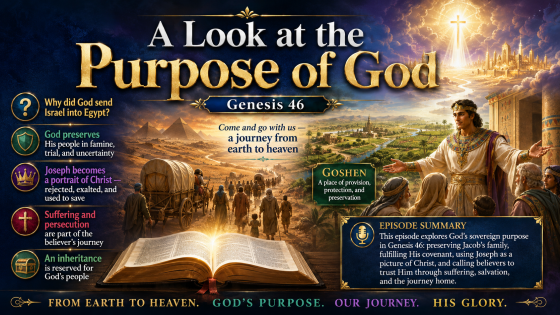

Moga - Mercies Of God Association with Dr. Peter Nortier
A Look at the Purpose of God
God's Purpose in Preservation, Suffering, and the Journey Home
Summary
God's Sovereign Purpose
The preacher centers the sermon on the conviction that God acts with purpose and is neither frustrated nor hurried. Using Genesis 46, he argues that Jacob's move into Egypt was not merely permitted by God but directed by God. He presents the journey as part of a plan established long before the events unfolded. This theme is applied personally to believers, with the preacher urging them to view difficult circumstances as events through which divine purpose may be worked out. He also frames judgment and salvation as parts of God's larger purpose, while repeatedly calling listeners to take their relationship with God seriously.
Israel Preserved in Egypt
The sermon explains that Israel was sent into Egypt during famine for preservation. Joseph's position under Pharaoh becomes central to the preacher's argument because Joseph had authority to provide food, protection, and a place for his family. The land of Goshen is described as a specially secured place where Jacob's household could live despite the Egyptians' disdain for shepherds. The preacher interprets these circumstances as evidence that God's directive will was being fulfilled. He emphasizes that what might appear unfavorable from a human perspective could still serve a protective purpose within God's plan.
Purpose Through Trial
The preacher applies Israel's experience to personal hardship, especially illness, stress, and unwanted changes in circumstances. He suggests that suffering may draw believers closer to God, create opportunities to witness to others, or demonstrate faith to people watching them endure difficulty. The story of Grandma Waller serves as the main personal illustration: despite advanced age and placement in a rest home, she is described as accepting her circumstances and continuing to attend church and encourage others. The preacher contrasts her attitude with complaining and self-pity. His larger point is that believers should look for purpose rather than assume adversity means God has abandoned them.
Joseph as a Portrait of Christ
A major section of the sermon treats Joseph as a picture of Jesus Christ. The preacher compares Joseph's rejection, suffering, elevation, and role in preserving his family with Christ's rejection, death, resurrection, exaltation, and role in salvation. He says that, just as Joseph secured an inheritance and protection for his relatives, Christ guarantees an eternal inheritance for believers. Passages from Acts, 1 Peter, and Hebrews are used to support the themes of resurrection, exaltation, covenant, preservation, and inheritance. The preacher presents this parallel as a central portrait of the gospel contained within the Genesis account.
Affliction, Persecution, and the Believer's Journey
The sermon rejects the idea that Christian faith guarantees constant comfort, prosperity, health, or ease. Drawing from John 16, Philippians 1, and 1 Peter 4, the preacher says affliction and persecution are part of the believer's lot. At the same time, he distinguishes suffering for Christ from trouble caused by dishonesty, gossip, meddling, or other personal wrongdoing. Believers are described as pilgrims passing through the world on a journey from earth to heaven. The preacher contrasts temporary worldly wealth and popularity with the spiritual riches and satisfaction he says belong to those who are in Christ.
Invitation to Come and Go with God's People
The sermon closes with the account of Moses inviting Hobab to journey with Israel in Numbers 10. The preacher uses "come and go with us" as an evangelistic invitation to listeners who have not surrendered to Christ. He warns that the people of God are moving forward and will not turn back, so each listener must choose whether to join the journey or return to what the preacher describes as death and destruction. The closing appeal calls for repentance, trust in Christ, and identification with God's people. The final prayer asks God to move on unbelieving hearts, strengthen believers, and help the congregation remain faithful as it continues its journey.
Moga - Mercies of God Association


The Mercies of God Association, otherwise known as MOGA, has been involved in radio since 1961. What started off as a radio program evolved into a Full-Time 501C-3 Ministry in 1995. The Founder of MOGA was Dr. Peter Nortier. Upon his passing, the Ministry has continued the radio broadcast on some radio stations and through various social media sites.
Our mission is to help create safe places for those who are dealing with mental health issues by building homes, or safe places, especially for our younger generation between the ages of 18 and 30.
This generation will know there is hope and they can conquer their pain through the hope that is brought through God's Mercies.
Speaker Identification
Speaker 1 - Preacher: The recording contains one principal male speaker delivering a sermon, reading Scripture, leading prayers, addressing the congregation, and referring to himself as the preacher or pastor. His personal name is not stated clearly enough in the supplied transcript to identify him by name.
Speaker 1 - Preacher: America wants to put to death as many babies as it can, and we've already killed the entire population of Canada. Think of it: well over 27 million babies have been aborted in this country.
There are three things we need to leave with you, and we'll tell you again: three things that God will always judge a nation for. Number one is homosexuality. I don't care who they are; homosexuals are perverts. Put it down. And when God allows a man to do that, nine times out of ten God gives him up. You read the first chapter of Romans; it'll tell you about homosexuality.
The second reason God judges a nation is because of the killing of its children. America's certainly been doing that, as Egypt did, and as the Israelites did when they offered their children to their god Moloch.
And then the third thing God judges a nation for is its violence. Right here in our country, we have become one of the most violent countries on the face of the earth. It means very clearly that America is ripe for judgment.
Now, are you ready to meet the Lord? If you're not, turn to Genesis chapter 46. Today we're going to look at the purpose of God as set forth in this portion of the Word of God. Our subject is a look at the purpose of God.
People today don't understand that whatever God does, God does with a purpose. I was listening to an advertisement the other night about Prudential life insurance. It said that if you can put $300 away a month at the age of 23, by the time you're 65 you'll be a millionaire. Well, I don't know how many 23-year-olds can put $300 away a month unless they're making good money. But the point of the advertisement was that people fail to purpose to do these things.
The average believer today seems to think that God doesn't have a purpose. Beloved, you and I serve a God who is never thwarted, a God who is never frustrated, a God who never has a crisis, and a God who is never in a hurry, but He's always on time. That's the God we serve, and you and I need to recognize that.
We always have to remember one thing: when things take place in your life, there's a purpose behind them. If you're a believer, God has a purpose for you. For a few moments we're going to look at Genesis chapter 46, and we're going to see the purpose God had in sending the children of Israel down to Egypt.
If you've got a Scofield Bible, there is a note at the bottom of the page that talks about God's permissive will and God's directive will. I'm going to tell you right now, they're wrong in this case. This was not merely God's permissive will; it was also His directive will. It was God's purpose that they go down into the land of Egypt, and we're going to show you why.
God being sovereign, we recognize very clearly that He works all things after the counsel of His own will. Back yonder in eternity, God planned this all out. Back yonder in eternity, He planned you out. You're going to fulfill His purpose, whether you get saved or whether you die and go to hell. You're going to fulfill the purpose of God.
If you die and go to hell, put it down - and a lot of people don't like to hear this - you'll go to hell to the praise and glory of God's justice. You say, "Preacher, do you mean that God gets glory in judging people?" He does. If you haven't done so, sit down sometime and read the 14th chapter of the book of Exodus. It talks about the glory of God in the damnation of the Egyptians.
You and I are going to fulfill His purpose. So, as we look at the children of Israel this morning, we're going to see the purpose of God concerning the Israelites. Secondly, in this portion of the Word of God, we will also see a portrait of the gospel of the Lord Jesus Christ.
As I was meditating these last couple of weeks on this portion of Scripture, I kept asking myself, "Lord, I've got to give my people something they can sink their teeth into." It's not enough just to sit down and talk about God's purpose concerning Israel. There's something here for every one of us as believers. And if you're here today without the Lord Jesus Christ, there's something here for you too.
First of all, you've got to come to know Christ as your Lord and Savior. Nothing else can help you until that work is started. In other words, in the eyes of God, an unbeliever is dead in trespasses and sins. You don't start living until God saves you. If God has never saved you, you're still dead before God. You're helpless before God. You're hopeless before God. You can't believe until and unless God gives you the ability to believe Him.
Now, it's your responsibility to seek mercy and seek the Lord. You have no excuse for not doing so. If you don't do it and you die without the Lord Jesus Christ, I'll tell you again: you will fulfill God's purpose even though you die and go to hell.
Now let's look at Genesis chapter 46 for just a few moments:
"And Israel took his journey with all that he had, and came to Beersheba, and offered sacrifices unto the God of his father Isaac. And God spake unto Israel in the visions of the night, and said, Jacob, Jacob. And he said, Here am I. And he said, I am God, the God of thy father: fear not to go down into Egypt; for I will there make of thee a great nation: I will go down with thee into Egypt; and I will also surely bring thee up again: and Joseph shall put his hand upon thine eyes.
"And Jacob rose up from Beersheba: and the sons of Israel carried Jacob their father, and their little ones, and their wives, in the wagons which Pharaoh had sent to carry him. And they took their cattle, and their goods, which they had gotten in the land of Canaan, and came into Egypt, Jacob, and all his seed with him: his sons, and his sons' sons with him, his daughters, and his sons' daughters, and all his seed brought he with him into Egypt."
Now skip down to verse 26, if you will:
"All the souls that came with Jacob into Egypt, which came out of his loins, besides Jacob's sons' wives, all the souls were threescore and six; and the sons of Joseph, which were born him in Egypt, were two souls: all the souls of the house of Jacob, which came into Egypt, were threescore and ten."
How many is that, Sunday school class? That's 70. You know that, don't you? All right.
"And he sent Judah before him unto Joseph, to direct his face unto Goshen; and they came into the land of Goshen."
Shall we bow in prayer?
Our Lord, this morning we're here at Thy disposal. We're here to carry out Thy truth. We're here to set it forth, Lord, and we ask Thee to enable us to set it forth in language so plain that no one can fail to understand it. Then we ask Thee to send forth Thy Word in power and apply it to the hearts of each one Thou hast brought here this morning.
We thank Thee for every individual that's in this room at this hour, and we pray again: Lord, give them listening ears and attentive hearts. Speak to them individually and collectively, and Lord, meet with us this morning. Forgive us where we fail Thee. Teach us and feed us, and Lord, fasten our attention upon that which Thou hast for us to learn.
But above everything else, we ask Thee, Lord, to bring glory and honor to Thyself in all that's said and done. We ask it now for Christ's sake. Amen.
I'm encouraged, dear friends, this morning because the Holy Spirit is in charge of this service. "Preacher, how do you know?" Well, I had this message all fixed up by last Thursday, and nobody knew what I was going to preach about. Even my secretary didn't know, unless she went into my drawer and found out what my message was on.
But when they sang that song this morning, "Jesus Saves! Jesus Saves!" it tied in exactly with what I'm going to bring out, proving again that the Holy Spirit of God is in charge of this service. I'm glad it's that way. I hope you are.
I look for that, because without the unction of the Holy Spirit upon this endeavor, it'll only be foolishness in God's sight, and I'll tell you right now, it'll be an abomination of the flesh.
Now let's look at the purpose of God this morning. First of all, regarding the nation of Israel, look at Genesis chapter 46, if you will, verses 2 through 4:
"And God spake unto Israel in the visions of the night, and said, Jacob, Jacob. And he said, Here am I. And he said, I am God, the God of thy father: fear not to go down into Egypt; for I will there make of thee a great nation: I will go down with thee into Egypt; and I will also surely bring thee up again: and Joseph shall put his hand upon thine eyes."
All right, here's God's purpose concerning Jacob and the nation of Israel. First of all, they were sent into Egypt to preserve them. You have to remember very clearly that they were already two years into the famine, and there were yet five more years of famine to come. People from Canaan and surrounding lands were coming down into Egypt because Egypt was the place where they could buy food. Food had been stored there during the seven years of plenty that preceded the famine.
God was protecting the nation of Israel. He sent them down into Egypt to preserve them. This was not God's permissive will; it was His directive will.
Go right across the page, if you will, to Genesis chapter 45 and look at verses 8 through 11. Here's Joseph speaking:
"So now it was not you that sent me hither, but God: and he hath made me a father to Pharaoh, and lord of all his house, and a ruler throughout all the land of Egypt. Haste ye, and go up to my father, and say unto him, Thus saith thy son Joseph, God hath made me lord of all Egypt: come down unto me, tarry not: and thou shalt dwell in the land of Goshen, and thou shalt be near unto me, thou, and thy children, and thy children's children, and thy flocks, and thy herds, and all that thou hast: and there will I nourish thee; for yet there are five years of famine; lest thou, and thy household, and all that thou hast, come to poverty."
So here you have God's purpose regarding the nation of Israel. First of all, He sent them into Egypt to preserve them.
The second thing He did was secure them a place by the hand of the governor. Genesis chapter 46, verses 27 and 28:
"And the sons of Joseph, which were born him in Egypt, were two souls: all the souls of the house of Jacob, which came into Egypt, were threescore and ten. And he sent Judah before him unto Joseph, to direct his face unto Goshen; and they came into the land of Goshen."
What do you have here? The second part of God's purpose with regard to the nation of Israel was this: He not only sent them into Egypt to preserve them, but He also secured them a place by the hand of the governor.
This would not seem favorable on the surface. You see, the Israelites were shepherds, and Genesis tells us very clearly that shepherds were an abomination to the Egyptians. The Israelites were shepherds, and yet what did God do? God preserved them a place in the land of Egypt. Incidentally, it was the best place in the land of Egypt. It wasn't the worst one; it was the best one, and it was secured for them by the governor.
This was God's purpose. It wasn't merely His permissive will, as some would have you believe. In other words, some say, "Well, God lets you have second best." No, beloved. God always works out His purpose after the counsel of His will and for His glory. Keep that in mind.
If you go to the hospital this week and face a tremendous operation or something like that, don't lift up your hands and cry, "Oh, why is God doing this to me?" No. Recognize clearly that God has a purpose in it.
What is that purpose? Number one, it'll probably bring you a lot closer to the Lord than ever before, because I'm going to tell you right now: we're closer to the Lord when we're going through stress than when we're having prosperity. It always works that way.
The second thing is that God may put you down in that hospital so you can witness to somebody there who will never hear the Word of God except through you.
Now, preacher, wait a minute. God doesn't do those things? What did He do with Paul and Silas? He sent them to Philippi. What happened? They preached the gospel at Philippi, and a multitude rose up against them. They falsely accused Paul and Silas. What did they do? They beat them and put them in prison.
They were put in prison for a purpose. At midnight, while they were singing and praising the Lord, God sent an earthquake. That awakened the jailer. They were sent to that jail for the purpose of reaching that jailer and his household. Isn't He fine? God has a purpose for us to fulfill.
As I've said before, perhaps you're in the hospital. The Lord may use it not only to bring you closer to Him and give you an opportunity to witness to somebody, but there may be a third reason: He may use your testimony to show those around you how a believer can take stress.
What am I talking about? I was telling my church Wednesday night, when I think of something like this, I think of old Grandma Waller. Grandma Waller is 95 years of age. Her hair is just as black as it can be; she hardly has a gray hair in her head. She's 95 and she has no teeth, so when you talk to her you see her gums. She's as cute as she can be, and she can't be but about this high.
She's in the rest home now. Up until a few weeks ago, she was living by herself. Then she began to pass out, and they found they couldn't leave her alone because there was danger of her setting something on fire. So they put her in the rest home.
Now, what did she do? She didn't cry and carry on like some do, even some believers. She said very clearly, "This is not my home. It's not my home, but it's the best place for me right now." Isn't that something?
Listen, she's not done. Every Sunday morning, at 95 years of age, rain or shine, she goes to church. You know what she said? She said, "I'd like to help these old people if they'd let me."
This is what stood out: she didn't cry. She didn't complain. She didn't feel sorry for herself. What did she do? She accepted what God gave her, and she's making the best of it. I'm going to tell you right now, she sets a testimony before those around her. How come? Because God's working out His purpose, and she knows it.
She said, "Well, I planted all these flowers, but I'll probably never see them bloom. But that's all right. That's all right." Then when I left her, I said, "Grandma, am I going to see you again?" And she said, "No, you never know." Isn't that marvelous?
When God brings something on you like that - and He may - what's your reaction going to be? You have to recognize that God has a purpose. He had a purpose for Israel. He sent them into Egypt to preserve them. He secured a place for them by the hand of the governor.
Now go back, if you will, to Genesis chapter 15, and you'll find out that all God did to the Israelites by sending them into the land of Egypt was a sure fulfillment of God's covenant with Abraham. In Genesis chapter 15, verses 13 through 15, we read:
"And he said unto Abram, Know of a surety that thy seed shall be a stranger in a land that is not theirs, and shall serve them; and they shall afflict them four hundred years; and also that nation, whom they shall serve, will I judge: and afterward shall they come out with great substance."
Here again you have the purpose of God. Notice it is a sure fulfillment of God's covenant with Abraham. This took place years after Abraham was gone, but as I said this morning, God is never in a hurry, but He's always on time. What's true with Abraham and the Israelites is also true with you and me.
There's a fourth thing we need to look at. In Genesis chapter 15, it is not only the sure fulfillment of God's covenant with Abraham, but we also find that suffering and persecution were to be the portion of the children of Israel.
God didn't tell Jacob that, did He? He didn't tell Joseph that, but God's purpose for the nation of Israel was that suffering and persecution were to be their portion. Where do you find that? Genesis chapter 15 again, verse 13:
"Know of a surety that thy seed shall be a stranger in a land that is not theirs, and shall serve them; and they shall afflict them four hundred years. And also that nation, whom they shall serve, will I judge: and afterward shall they come out with great substance."
What do you have here? Suffering and persecution were to be their portion. Last of all, we find that the salvation of Israel and the judgment upon Egypt were guaranteed by the Lord God of Heaven. Genesis chapter 15, verses 13 through 16, sets that forth.
Here you have God's purpose concerning the nation of Israel. Someone might say, "All right, that's historical evidence. That sounds pretty good. But what about us?"
I want to tell you very clearly today that in this portion of the Word of God we also find a portrait of the gospel of the Lord Jesus Christ. In the gospel of the Lord Jesus Christ there are five things that stand out, and they're similar to what happened to the children of Israel.
What did God do? The first thing He did was send Joseph into the land of Egypt for the purpose of preserving the nation of Israel. How does that apply today? We find the same thing. The Lord Jesus Christ was sent by God the Father to preserve and save us.
Are you here today as a believer? Why are you saved? I'll tell you why: because God sent the Lord Jesus Christ ahead of you to preserve and save you. Our Lord, like Joseph, was hated, killed, and resurrected.
Anybody who doesn't believe in the resurrection of the Lord Jesus Christ - I'll tell you right now - doesn't believe the heart of the gospel. It's like an individual who says, "I don't believe in electricity." Well, you'd find out in a hurry. Put your hand in an empty socket that's live without a bulb in it, and you'll find out whether you believe in electricity, won't you?
Beloved, the Lord Jesus Christ went ahead of us. What happened to Him? He was hated. He was killed. He was resurrected. The same pattern happened to Joseph. Joseph was hated. Joseph was put in prison, and Joseph was raised out of prison. The Lord Jesus Christ was hated, He was killed, and He was resurrected.
What did God do with regard to Joseph? He exalted and empowered him for the preservation of his people. Are you listening? The Lord Jesus Christ is in the same category.
Take your Bibles now and turn to Acts chapter 2, verses 32 through 36. Here is Peter preaching:
"This Jesus hath God raised up, whereof we all are witnesses. Therefore being by the right hand of God exalted, and having received of the Father the promise of the Holy Ghost, he hath shed forth this, which ye now see and hear. For David is not ascended into the heavens: but he saith himself, The Lord said unto my Lord, Sit thou on my right hand, until I make thy foes thy footstool. Therefore let all the house of Israel know assuredly, that God hath made that same Jesus, whom ye have crucified, both Lord and Christ."
Beloved, this is part of God's purpose for the preservation of His people.
Now there's the second thing. Joseph gave the children of Israel an inheritance in the land of Goshen. What about us? In this portrait of the gospel, there is also an inheritance guaranteed by Christ, reserved in glory for everyone who ever gets converted.
If you're converted today, you have an inheritance. What is that inheritance? It's a spiritual inheritance. Number one, God has made you His child. Number two, He's guaranteed to take care of you. Number three, He has reserved in heaven for you an inheritance that is incorruptible.
Take your Bible and turn to 1 Peter chapter 1. Beginning with verse 2, we read:
"Elect according to the foreknowledge of God the Father, through sanctification of the Spirit, unto obedience and sprinkling of the blood of Jesus Christ: Grace unto you, and peace, be multiplied. Blessed be the God and Father of our Lord Jesus Christ, which according to his abundant mercy hath begotten us again unto a lively hope by the resurrection of Jesus Christ from the dead, to an inheritance incorruptible, and undefiled, and that fadeth not away, reserved in heaven for you, who are kept by the power of God through faith unto salvation ready to be revealed in the last time."
Here's the portrait of the gospel. What does the gospel preach? It preaches that Jesus Christ has gone before us to preserve and save us. That's number one.
Do you know Jesus Christ? Do you know Him as your Redeemer? Is He your Lord and your Savior? If He's not, then I've got some good news for you. Christ Jesus came to seek and to save that which was lost, and the Lord Jesus Christ was sent by God to preserve and save you.
Some of you in this room have perhaps already had a close call, maybe more than one, with death. Yet you've been preserved. Why? Because of God's claim upon you. You don't know that, and you won't know it until you get converted.
My friend, the message for you is this: I've got good news for you. Christ Jesus came to seek and to save that which was lost. If you're a lost sinner here today, Jesus Christ has gone ahead to preserve and save you.
Coupled with that, when you come to know Him, there's an inheritance guaranteed for you. That inheritance is so far above our comprehension we can't even begin to understand it. Have you ever read Revelation chapters 21 and 22? You ought to sit down and read them.
Have you ever stopped to realize the wealth and the glory and the glitter of that city we're going to dwell in? Think of it. It's 1,500 miles wide, 1,500 miles long, and 1,500 miles high. Imagine, if you will, a single highway running from [unclear place name] to Dallas, Texas, and that highway completely paved with gold. Try to imagine that. In our city they'd try to dig it up because they'd be so greedy for it. But it's reserved in heaven for you and me, and it's guaranteed by the power and ability of the Lord Jesus Christ.
When the Israelites came into Egypt, they didn't sneak into the land. They came with the horses, chariots, and wagons that were provided by Pharaoh. That meant there was quite a caravan. When they came into Egypt, what did Joseph do? Joseph mounted his chariot and drove to the land of Goshen, and there he met his brothers and his father.
No Egyptian could stop them from coming. They couldn't even complain, because when Joseph would ride down the street the cry would go out, "Bow the knee! Here comes Joseph!" Joseph's family was protected, provided for, and preserved in the land of Egypt because of Joseph's ability and power.
You and I who have an inheritance in the Lord Jesus Christ have it reserved in glory for us. That word "reserved" in 1 Peter 1 means kept under guard. The only way we could be kept from inheriting the inheritance guaranteed to us by the Lord Jesus Christ would be for somebody greater than God to take it away - and there is nobody greater than God.
Beloved, that's part of the good news of the gospel. Jesus Christ has been sent ahead of us to preserve and save us. The second thing is that we have an inheritance guaranteed by the Lord Jesus Christ awaiting us.
The third thing is that it is a positive fulfillment of God's covenant of redemption. Where do you find that? Turn to Hebrews chapter 13, verses 20 and 21:
"Now the God of peace, that brought again from the dead our Lord Jesus, that great shepherd of the sheep, through the blood of the everlasting covenant, make you perfect in every good work to do his will, working in you that which is wellpleasing in his sight, through Jesus Christ; to whom be glory for ever and ever. Amen."
What do you have here? It is a positive fulfillment of the covenant of grace. God has a purpose, and the purpose of God set forth in the book of Genesis is a portrait of the purpose of God set forth in the gospel.
All of this is yours and mine if you're a believer, but it's contingent upon one thing: are you united to our great Governor?
You say, "Wait a minute. What are you talking about?" The Israelites had no inheritance there except through Joseph. In Genesis 46 you read the names of the people who came with Jacob into Egypt. Every one of them was a blood relation to Joseph.
Are you related by blood to the Lord Jesus Christ? I am by His blood. I'm under His blood. This inheritance that has been promised to me is promised to you, but it's contingent upon one thing: you've got to be part of the family of God. The only way you can be is to be born again by the Spirit of God and washed in the blood of the Lamb. I'm going to ask you a question: are you?
You see, this is the gospel. Then we find the fourth thing. What's the fourth thing? Affliction and persecution are the lot of believers.
Too many people today want all the benefits of the gospel, but they don't want the difficult part. Turn to John chapter 16. Beginning with verse 1, the Lord Jesus Christ tells us what's in store for believers. He was speaking to His disciples, but these words speak to every believer:
"These things have I spoken unto you, that ye should not be offended. They shall put you out of the synagogues: yea, the time cometh, that whosoever killeth you will think that he doeth God service. And these things will they do unto you, because they have not known the Father, nor me. But these things have I told you, that when the time shall come, ye may remember that I told you of them. And these things I said not unto you at the beginning, because I was with you. But now I go my way to him that sent me; and none of you asketh me, Whither goest thou? But because I have said these things unto you, sorrow hath filled your heart."
I'm saying right now, you're not only going to have the good things; you're also going to have affliction and persecution.
"Preacher, wait a minute. That isn't preached today." It ought to be. The gospel that's usually preached today says, "Come and join the bandwagon. Get on the bandwagon with Christ. He doesn't want you sick. He doesn't want you poor. He doesn't want you out of a job. He wants you to be happy all the time." You don't find that in the Bible.
I'll tell you what you will find. Turn to Philippians chapter 1 and look at verse 29: "For unto you it is given in the behalf of Christ, not only to believe on him, but also to suffer for his sake." That's not the bandwagon, is it?
Now turn to 1 Peter chapter 4, verses 12 through 16. Peter warns believers:
"Beloved, think it not strange concerning the fiery trial which is to try you, as though some strange thing happened unto you: but rejoice, inasmuch as ye are partakers of Christ's sufferings; that, when his glory shall be revealed, ye may be glad also with exceeding joy. If ye be reproached for the name of Christ, happy are ye; for the spirit of glory and of God resteth upon you: on their part he is evil spoken of, but on your part he is glorified. But let none of you suffer as a murderer, or as a thief, or as an evildoer, or as a busybody in other men's matters. Yet if any man suffer as a Christian, let him not be ashamed; but let him glorify God on this behalf."
Have you ever had people come up to you and say, "I like you as an individual, but I don't like your Christ. The trouble with you is you're just too religious"? Is that so? Well, I'm going to tell you right now: if you don't like Christ, you don't like me, because I'm identified with Christ.
I've had people tell me over and over again, and they've told my wife, "You know, we think your husband is a fine man, but we just can't stand his preaching." Well, you don't separate the two. When you do, you get a lot of problems.
As a believer, I'm going to tell you right now, you and I are not going to have it easy here on this earth. But there's one thing we need to make sure of: if we suffer, we suffer as believers, not as meddlers.
What am I talking about? Again, verse 14 says, "If ye be reproached for the name of Christ, happy are ye." Verse 15 says, "But let none of you suffer as a murderer, or as a thief, or as an evildoer, or as a busybody in other men's matters."
You see it lots of times. Believers get out of sorts with each other because somebody has meddled in somebody else's business. Then they get their noses burned and cry, "Why does this happen to me?" Peter says that if you suffer reproach as a Christian, happy are you. But you're not suffering reproach as a Christian if you're meddling around.
If you've ever read anything about meddling, you ought to read the book of Proverbs, because it's full of warnings about it.
This is what we need to understand. I'm going to ask some of you believers a question today: are you being reproached for the name of Christ, or are difficulties coming upon you because of your own foolishness and your own meddling? You ought to think about that.
If we're being reproached for the name of Christ, happy are we. It doesn't bother me one bit if people tell me point-blank, "You're no good." I know that. But if they tell me I'm dishonest, it does bother me, because I'm not dishonest. I try to be as honest as I possibly can be.
If they say, "You're nothing but a slanderer and a gossip," that's not true, because I don't believe in doing that, and you don't either if you're a believer. If you do get caught in it, then you have to repent and get straightened out.
We need to understand very clearly that our life as believers is not going to be easy. It's not going to be. I'll tell you right now, some of the worst persecutors you're going to have may be those of your own household. "A man's foes shall be they of his own household," the Scripture says.
Yet we find that this is reserved for us. This is part of the gospel, and we need to preach that today, because a lot of people have come down the aisle and said, "Oh, I've accepted Jesus as my Savior," but there's no change whatever.
How about you today? Has there been a change in your life since you got converted, or are you still the same? You need to examine yourself and find out, because the gospel includes this: affliction and persecution are the lot of the believer.
Our persecution will come from the world, as I read to you. We also need to recognize very clearly that, as pilgrims and believers, we are not part of this world. We're on a journey. What kind of journey? A journey from earth to heaven.
I'm passing through this world, and I've been passing through it for several years. I hope to continue if the Lord tarries, and if He doesn't, my time will be gone and I'll be gone to glory. But I'm telling you right now, I'm not going back. I'm on my way up. I'm on a journey, and the Israelites were also on a journey.
You say, "Pastor, what are you talking about?" The Israelites journeyed from Canaan into the land of Egypt. Our Canaan is this earth at this hour. It's a place of famine. It's a place of death. It's a place of tribulation. It's also a place of domination by the devil, and it's a place that doesn't offer any satisfaction.
How many of you would like to be in the shoes of Michael Jackson today, that pop star? He had everything that money could buy and thought he could do anything. Go on and look at others with wealth and fame and see the same thing.
Then I invite you to compare them with old Grandma Waller. She doesn't have hardly anything. She lives in that rest home, but I'm going to tell you right now, she's got far more riches than all the money, wealth, prestige, popularity, and everything else we could possibly give. Not only that, God has made her satisfied even though she's not in her own home.
Do you know why? We're on a journey - a journey from earth to heaven. I'm going to ask you a question: are you going with us?
There's one more thing. As the Israelites entered into their preservation and exaltation, there was a guaranteed future. The same thing is true with us.
Turn back to Romans chapter 8 and look at verses 37 through 39:
"Nay, in all these things we are more than conquerors through him that loved us. For I am persuaded, that neither death, nor life, nor angels, nor principalities, nor powers, nor things present, nor things to come, nor height, nor depth, nor any other creature, shall be able to separate us from the love of God, which is in Christ Jesus our Lord."
Here's our guarantee. Nothing could separate the children of Israel from Joseph. Why? Because it was God's purpose. Nothing can separate us from the Lord Jesus Christ once we know Him. Why? Because it is God's purpose.
Go back in Romans chapter 8 to verse 18. Here again you have preservation and exaltation as our guaranteed future. What am I talking about? I want to tell you point-blank that the world right now is waiting for the manifestation of the sons of God.
Romans 8 says:
"For I reckon that the sufferings of this present time are not worthy to be compared with the glory which shall be revealed in us. For the earnest expectation of the creature waiteth for the manifestation of the sons of God. For the creature was made subject to vanity, not willingly, but by reason of him who hath subjected the same in hope, because the creature itself also shall be delivered from the bondage of corruption into the glorious liberty of the children of God. For we know that the whole creation groaneth and travaileth in pain together until now."
You want to know why there are earthquakes and hurricanes and tornadoes? I'll tell you what it is: this earth is groaning and travailing, as it were, in birth, waiting for the manifestation of the sons of God. That's us.
Beloved, if that doesn't thrill your heart, then you've never been converted. That's a fact. This is our guarantee. Like the Scripture says in 1 John chapter 3: "Beloved, now are we the sons of God, and it doth not yet appear what we shall be: but we know that, when he shall appear, we shall be like him; for we shall see him as he is."
Let's go back and look at Joseph. When Joseph brought his family into Egypt, what did he do? He put them in the best of the land. Everything in Egypt was at their disposal. Not only that, he took them and presented them before Pharaoh.
When our Lord finishes His work and comes after us, He will take everyone for whom His soul has travailed and for whom He has died, and He will present every one of us before God the Father and say, "Here they are," just like Joseph presented his family before Pharaoh.
Pharaoh looked upon them with pleasure, and the Lord God of Heaven will look upon us one day with pleasure because we are in Christ Jesus. Are you still listening? This is the message of the gospel.
What about you today? As a believer, I want to tell you point-blank, our journey is one of trial and tribulation. You're not going to have it easy, so don't expect it.
People call me and say, "How's the work going in the church?" I say, "The devil hasn't left us alone. He's always trying to split the work up if he can, but we're not going to let him." Well, join the crowd. That's right. Come on in; the water is fine.
When you have a difficult time, something may happen to you this week. I don't know. Something may happen to me. But I'm going to tell you, we will experience these things because this is part of the lot God has provided for us, and this is all part of His purpose.
We have no right to grumble and complain, because if we do, we'll be like the children of Israel in the desert.
But what about you here today without Christ? Turn to Numbers chapter 10. I'll show you how this applies to every individual here without Christ.
The Lord God of Heaven is gracious to you today. He's brought you here not only to hear what the gospel is and what some of its ramifications are, but He's also brought you here to let you know that we're on a journey, and we believe it's an onward journey.
In Numbers chapter 10, verses 29 and 30, here's an invitation Moses gave, and we give it to you in the same spirit:
"And Moses said unto Hobab, the son of Raguel the Midianite, Moses' father in law, We are journeying unto the place of which the Lord said, I will give it you: come thou with us, and we will do thee good: for the Lord hath spoken good concerning Israel. And he said unto him, I will not go; but I will depart to mine own land, and to my kindred."
What do you have here? Will you listen, sinner, you who are here today? We give you this invitation: come and go with us. We'll do you good. We're going to a land of which the Lord has spoken, and the Lord has spoken good concerning us.
You're like Hobab the Midianite. You're sitting under the sound of the gospel. You're seeing with your own eyes and experiencing in your own heart some of these things God has been doing in this church and continues to do.
Are you going to be like Hobab and say, "No, I'm not going to go. I'll go back to my own land"? All right, then you go back to death and destruction.
What's the gospel saying? Come and go with us. We'll do you good. Throw your lot in with us. What's that involve? Surrender to the Lord Jesus Christ as your Lord and Savior. Cast yourself upon Him, resting in Him for all eternity. He'll not turn you down.
Then you will be going with us and with the people of God as we journey from earth to heaven.
Now let me close. Notice that Moses told Hobab, "Come with us." Hobab said, "No, I'm not going to go." Follow me now. The Israelites journeyed through that land. They gave him every opportunity to throw his lot in with them. He wouldn't do it. But I want you to notice that the Israelites didn't go back.
The message for you today is: surrender to Christ, sinner. Repent and trust Christ. That's your obligation. Why? Because I'm going to tell you this: we're not coming back. We're passing by.
God will bring you to the place where you'll be like Hobab. You'll either say yes, or you'll say no. He said, "I will not go; but I will depart to mine own land, and to my kindred."
I'm going to ask you this question: what do you want most? The riches, the exaltation, and the glory for eternity with Christ, or do you want the paltry, temporal, silly things of this earth that don't satisfy, and then wind up in hell for all eternity?
Come and go with us. We're on a journey. We'll do you good. The Lord Jesus Christ invites you today: come and go with the people of God. Will you do it? If you haven't done so, may you trust Him.
Shall we stand?
Father, today we thank Thee for this opportunity and privilege, and we ask now Thy blessing upon this congregation as we go our various ways. Thou dost know each one. Thou dost know the condition of every heart here.
We ask Thee, our Lord, as we sing that song, "God Be with You Till We Meet Again," that this will be a reality, and that, Lord, Thou wilt allow this congregation to meet again in the same capacity in which it has met this morning.
We pray, our Lord, that Thou wilt work upon these hearts. Some, Lord, are just like Hobab. They're under the influence of Israel like Hobab was. He saw what God did with the Israelites. He saw, Lord, what Thou didst with Moses. He saw Thy hand upon them. People are here like that. They can't deny it.
But, O our God, we pray: move upon their hearts and cause them to cast themselves at Thy feet in surrender and repentance, crying out for mercy to be bestowed upon them. Cause them, Lord, to cast themselves upon Thee to be saved. O our God, bring it to pass as Thou alone art able.
Then strengthen Thy people and lead us as we're going on this journey. Help us, Lord, to realize anew and afresh that it's almost over. It won't be long. It may be soon, and You're coming after us. Help us, Lord, to be about Thy business until You do come.
We ask it now for Christ's sake. Amen.


