LaGrave Live, August 2, 2026
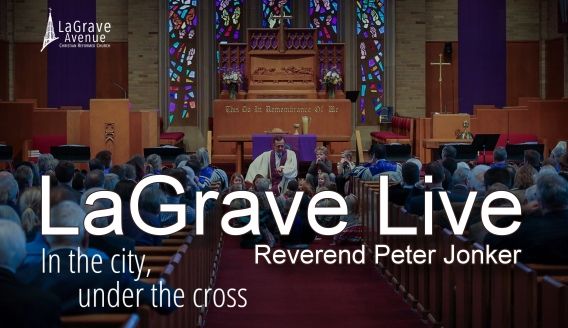

LaGrave Live
LIVE Evening Worship Service - Getting Our Houses in Order
Pastor Jonker leads a LaGrave evening worship service on being rooted in Christ, weaving together John 15, missionary testimony from Scott Miedema and Young Life, prayer for the church and world, and a sermon from Haggai 1 about rebuilding God’s house, rejecting spiritual self-sufficiency, and finding the deepest blessing in God’s promise: “I am with you.”
About The Service:
Pastor Jonker will preach on Haggai 1:1-15. His sermon is titled Getting Our Houses in Order.
Order of Worship:
https://lagrave.org/wp-content/uploads/2026-8-2-PM-Order-of-Worship.pdf
About Us:
We are a traditional CRC church in the middle of Downtown Grand Rapids, MI, worshipping at 8:40am, 11:00am, and 6:00pm. (10:00am and 6:00pm during the summer months)
We'd love to hear from you:
Connection: https://www.lagrave.org/contact
Let us pray for you:
Prayer: https://www.lagrave.org/prayerrequest/
Giving: https://www.elexiogiving.com/App/Giving/lagr107178
The August special offering is for Covenant House. Covenant House Michigan (CHMI) provides shelter and hope to young people aged 18-24 who are experiencing homelessness or victims of trafficking in Grand Rapids and Detroit. Their mission is to serve all youth who come to their doors with unconditional love, absolute respect, and relentless support.
Listen on the go:
Amazon Music: https://bit.ly/LGPodAmazonMusic
Apple Podcast: https://apple.co/3tuOdwQ
Google Podcast: https://bit.ly/LGPodGoogle
Soundcloud: / lagravecrc
Spotify: https://spoti.fi/3yXDFaT
Follow us!
Facebook: / lagravecrc
Instagram: / lagravecrc
Website: https://www.lagrave.org
#LaGrave #LaGraveCRC
Detailed Summary:
LaGrave Evening Worship and the Theme of Rootedness
This LaGrave evening worship service is centered on the theme “Rooted in Christ.” Pastor Jonker welcomes worshipers and explains that the evening will focus on roots and foundation, beginning with Jesus’ words in John 15 about the true vine and the branches. The corrected transcript identifies Pastor Jonker as the worship leader, Scott Miedema as the Young Life missionary speaker, and the congregation as participating through responses, prayer, and worship cues.
John 15: The True Vine and the Branches
Pastor Jonker introduces John 15 by connecting Jesus’ vine-and-branches language to Old Testament vineyard imagery, especially the image of Israel as God’s vineyard. He explains that in the Old Testament, God grieves over an unfruitful vineyard, and in the Gospel, Jesus presents himself as the true vine. The reading emphasizes that branches cannot bear fruit by themselves; they must remain in the vine. Pastor Jonker frames the service around this truth: apart from Christ, God’s people can do nothing, but when they remain in Christ, they bear much fruit.
Scott Miedema and Young Life in the Caribbean
Scott Miedema then shares about his family and their work with Young Life in the Dominican Republic and beyond. He introduces his wife, Jen, and their children, Caroline, Mara, and Reid, then explains that Young Life is active across the Caribbean, including Haiti, the Dominican Republic, Cuba, Puerto Rico, and English-speaking islands. Scott says the ministry hopes to take 8,000 kids to camp during the summer so they can hear and respond to the gospel. He also describes his role helping equip leaders internationally, supporting thousands of staff and volunteer leaders who walk with teenagers and disciple them in faith.
Jonathan’s Story and the Need for More Calebs
Scott illustrates Young Life’s work through the story of Jonathan, a teenager in the Dominican Republic who fell in with friends involved in smoking, vaping, and selling vapes at school. Jonathan went to a Young Life camp, where a leader named Caleb came alongside him and helped him begin to understand the message of Jesus. Later, when Jonathan felt frightened and physically burdened in the night, he remembered Caleb’s words that he could pray, and he experienced a sense of relief. Scott says Jonathan has since been discipled by Caleb and returned to camp to serve by washing dishes, cleaning toilets, and helping his friends hear the gospel.
Prayer for Mission, LaGrave, and a Troubled World
After Scott’s remarks, Pastor Jonker leads the congregation in prayer, naming Jesus as cornerstone, solid ground, true vine, and the source of life for the branches. He prays for Scott and Jen Miedema’s ministry, asking that their work with young people be fruitful, joyful, and energized by the Holy Spirit. He also prays for LaGrave Church after 139 years of service in the city, asking that the church remain rooted in Christ as it considers future building and ministry plans. The prayer widens to the world, naming uncertainty, fear, instability, wars in Ukraine, Sudan, and Iran, and divisions between political parties, races, and classes.
Haggai 1 and the Ruined House of the Lord
The sermon turns to Haggai 1, set in 520 B.C., after the Jewish people had returned from Babylonian exile and were trying to rebuild Jerusalem. Pastor Jonker explains that the people were struggling to survive after the devastation caused by Nebuchadnezzar: poor harvests, weak shelter, economic hardship, and the exhausting work of rebuilding life from rubble. Their mindset was understandable: first food, shelter, and security, then the temple. But Haggai challenges them, saying they are busy building their own houses while the Lord’s house remains in ruins, and he calls them to “give careful thought” to their ways.
Beyond Maslow: The Deeper Foundation of God
Pastor Jonker reflects on why Haggai’s message can sound harsh, especially because the people’s survival concerns seem reasonable. He compares Haggai’s challenge with Deuteronomy’s blessings and curses, then warns against misunderstanding this as a health-and-wealth or tit-for-tat view of God. Using a childhood soccer-coaching analogy, he explains that biblical blessing-and-curse language is not mere threat but a description of how life works when people are, or are not, rooted in God’s ways. He then says Haggai does not agree with Maslow’s hierarchy of needs, because beneath physiology and security lies something deeper: being rooted in God, his Spirit, and his people.
Building the Living Temple and Hearing “I Am With You”
Pastor Jonker applies Haggai to the church by saying the call is not primarily to build a physical church building, but to build the deeper temple of God’s people. Drawing from Ephesians and 1 Peter, he reminds the congregation that the people rooted in God are the temple, living stones being built together into a dwelling place for God’s Spirit. He challenges the church to consider whether it spends more energy building wealth, reputation, careers, children’s success, bodies, vacations, and plans than building relationship with God and the community of faith. The sermon closes with the central blessing of Haggai: not guaranteed prosperity, but God’s promise, “I am with you.” Pastor Jonker illustrates this through Helmut Thielicke’s story of two dogs on ocean voyages, one terrified without its master and one calm because its master was present, concluding that when believers are anchored in Christ, they know they will be brought home.
LaGrave Live
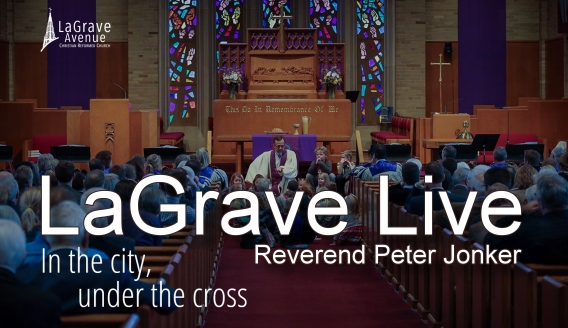

If you’re looking for a warm church that commits to an intensely pertinent Gospel in the Reformed tradition of the Christian faith, we invite you to worship with us. Our 1,800 members come from across West Michigan and gather weekly in our sanctuary for relevant Biblical preaching, beautiful music, and inspiring worship. We expand our worship through intentional outreach in our community and world, attentive care for our members, and plenty of spiritual enrichment and social opportunities for everyone.
We focus on a living Savior who provides genuine solutions to the deep needs of a hurting world. We are committed to need-meeting ministry in His name, and we are committed to being real people who enjoy real life and who cry real tears. Because we are a fairly large and diverse group in terms of age, occupation, marital status, lifestyle, and physical ability; our members create many accessible opportunities for community service, Bible study, and small social groups.
We worship God, the Almighty Creator of heaven and earth, and we enjoy expressing our vision of His holiness through traditional music and formal liturgy.
Music plays an integral part of our weekly worship gatherings. Congregational singing—of both traditional hymns and newer ones—is typically supported by our pipe organ. Vocal choirs, handbell choirs, small ensembles, instrumentalists, and vocal soloists provide additional music offerings.
Led by the Holy Spirit, we seek to worship and serve God in all of life, transforming His world and being transformed to reflect the character of Christ.
Founded by 36 Dutch immigrants on February 24, 1887, LaGrave Avenue Christian Reformed Church has always been deeply committed to both this local community and worldwide missions. God has seen fit to guide and bless these commitments with sustained growth, spiritual gifting, and a continual stream of new work for our members.
Speaker Identification
Speaker 1 - Pastor Jonker
Speaker 2 - Scott Miedema, Young Life Missionary
Congregation - Congregational responses, prayer, and worship cues
[Opening worship music]
Speaker 1 - Pastor Jonker: Congregation, Jesus Christ is your cornerstone and your solid ground, and he is in this place tonight to bless you and to give you strength. That begins with his greeting: grace, mercy, and peace to you from God the Father, from Christ his Son, through the mighty and powerful work of his Holy Spirit.
Congregation: Amen.
Speaker 1 - Pastor Jonker: Welcome, everyone, to our worship this evening at LaGrave Avenue Christian Reformed Church. Welcome to all of you members and all of you visitors sitting here bathed in the sun in this beautiful place. We are glad that we are here together to worship our Lord.
A special welcome to some visitors with us, the Miedema family. Scott and Jen are here, our sponsored missionaries. Later in the service Scott will come up and tell us a little bit about his work for Young Life in the Dominican Republic. After the service there is a meal, and Scott and Jen will tell us more about their work, including some possibilities for how we may partner with them in the future. It is a free meal, and anyone and everyone here is welcome to join us and hear more about their work.
Tonight's service is about our roots and our foundation. As part of that, I want to read John 15. These are familiar words, but it helps to hear them more deeply if you know some of the Old Testament background. In the Old Testament, in a place like Isaiah 5, Israel is compared to God's vineyard. "I planted a vineyard," says the Lord. Sometimes God is grieved by that vineyard because it does not bear fruit, and sometimes he says, "I am going to come and uproot that vineyard."
That same imagery appears in the Gospel. Remember that hard story where Jesus comes and curses a fig tree. The fig tree, like the vineyard, is an image of fruitful Israel - or, in that case, unfruitful Israel. Israel is struggling with its fruitfulness. So along comes Jesus, and this is what he says:
"I am the true vine, and my Father is the gardener. He cuts off every branch in me that bears no fruit, while every branch that bears fruit he prunes so that it will be even more fruitful. You are already clean because of the word I have spoken to you. Remain in me, as I remain in you. No branch can bear fruit by itself; it must remain in the vine. Neither can you bear fruit unless you remain in me.
"I am the vine; you are the branches. If you remain in me and I in you, you will bear much fruit. Apart from me, you can do nothing. If you do not remain in me, you are like a branch that is thrown away and withers. Such branches are picked up, thrown into the fire, and burned. But if you remain in me and my words remain in you, ask whatever you wish, and it will be done for you. This is to my Father's glory, that you bear much fruit, showing yourselves to be my disciples."
Thanks be to God.
[Worship music]
Speaker 1 - Pastor Jonker: At this time I would like to ask Scott Miedema to come forward and share a little bit about his work.
Speaker 2 - Scott Miedema: Good evening. Thank you. It is good to be with you. I am Scott. I am here with my wife, Jen, and our kids are here too. Caroline is 18 and just graduated from high school. You can pray for us because in a few weeks she starts university at Taylor University in Indiana, so for the first time we are going to be living in a different country than one of our kids. That will be a challenge for us, probably not as much for her. Mara is in high school, and Reid is 11 and going into seventh grade, but tomorrow he turns 12, so he wanted to make sure I got that in there - he is almost 12.
It is good to be with you. We live in the Dominican Republic, and we get to work with the ministry of Young Life. Both Jen and I have roles that reach even beyond the Dominican Republic. Jen is the executive administrator for our friend Rafa. Rafa is a Dominican leader who now leads Young Life's ministry in all the islands of the Caribbean. That includes Haiti, the Dominican Republic, Cuba, Puerto Rico, and many of the English-speaking islands people like to visit on vacation. Young Life is present in all those different places.
When Jen's team meets, they are operating in three different languages: Spanish, Haitian Creole, and English, with leaders across that part of the world. This summer that group is hoping to take 8,000 kids to camp. They are almost at that goal: 8,000 kids who have a chance to hear the gospel and respond to it. That is really what Young Life is all about - giving teenagers a chance to hear the gospel, understand it, and respond to it with a leader who is discipling them.
My role is to help lead the international learning and leadership team. This is a group of people thinking about how we equip leaders across the world. Young Life is active in more than 110 countries around the world. There are about 6,000 staff people in those places, but the bigger number is 80,000 volunteer leaders who are doing what I just described: walking with teenagers, helping them understand the gospel, and discipling those kids in the faith. The group I work with does that with leaders in Africa, Asia, and Europe, and thinks about how we train volunteer leaders who get to impact these kids' lives.
One example is a teenager from the neighborhood right next door to us in the Dominican Republic. His name is Jonathan. When Jonathan was a young teenager, he fell in with a group of friends who were doing some things he was not so sure were good, but he wanted to fit in. He was running around with that group and started smoking and vaping. Then he started selling vapes at school and finally got in deep trouble and almost got kicked out of school because he was selling vapes on school property.
At that point Jonathan felt a little lost. This was what all his friends did. He did not want to leave his friends behind, but he knew he was on a path that was not leading anywhere good. Then a few of his friends from school invited him to go to a Young Life camp. Jonathan said, "Okay, I will go to camp. That sounds fun."
While he was at camp, he was really struggling, trying to figure out who his friends really were and what he should do with all of this. At camp he started to hear the gospel, but he did not really grasp it. There was a Young Life leader there named Caleb who came alongside Jonathan and helped him begin to understand the message about Jesus and what it meant for him.
A few weeks later, Jonathan woke up one night and said his chest felt really heavy, like he could not breathe. He was not sure what to do, and he got really scared. Maybe everything was catching up to him. Then he remembered Caleb had told him, "You can always pray. God is there for you."
So Jonathan started praying, and he said that all of a sudden it felt like the weight lifted and he could breathe again. That was when Jonathan realized, "God is doing something in my life."
Caleb has discipled Jonathan for the last year. This summer Jonathan worked to get his friends - the ones who had gotten him in trouble before - to go to Young Life camp and hear the gospel. Jonathan went back to camp, this time to wash dishes, clean toilets, and do whatever he could do to help his friends be able to go.
Jonathan needed Jesus to find freedom and direction in his life, but he needed Caleb to help him understand what that meant and how to live it out. So thank you for supporting us. We want thousands more Calebs around the world, and that is what we get to do with the ministry of Young Life. Thank you for being part of this and for supporting us and leaders like Caleb.
Speaker 1 - Pastor Jonker: Thank you, Scott and Jen. Let us come before our Lord in prayer and lift up the Miedemas and all our concerns to him, knowing that he hears us. Let us pray.
Lord Jesus, you are our cornerstone and solid ground. Lord Jesus, you are the true vine, and we are the branches. When we dwell in you, your life flows into us. It makes us alive and vibrant. It makes us fruitful. It roots us in your abundant life, which is where we want to be. We want to be rooted in you, Lord Jesus, because in this world there is death, struggle, and the winds of trouble blow hard. But when we are rooted in you, we are strong and stable, even when the winds blow, because we are anchored in eternity.
Lord Jesus, tonight we are branches open to you. We ask that you let your Spirit flow through us as we give you what is in our hearts. Send your life, Holy Spirit, into the work of Scott and Jen Miedema as they serve you in the Dominican Republic. We thank you for their work in raising up leaders who will affect the lives of young people. Father, reaching young people with the gospel is so challenging and so needed, so send your Spirit upon them. Make their work fruitful. Make them joyful. Give them energy as they do this ministry.
Lord Jesus, we also lift up to you today the mission of LaGrave Church. We are thankful for 139 years of service in our city. For 139 years, Lord, you have rooted us here in this place and made us fruitful. I pray that we will continue to abide in you as we move into the future. Let your word and your Spirit live deeply in our hearts. Let your praise live in our mouths. Let your love and your service flow through our hands to our neighbors.
We pray, Father, that you would give us discernment as we try to figure out how to proceed with our building next door and the ministry plans we are considering there. Lord Jesus, we pray that you would make your church fruitful everywhere in the world. This world is full of uncertainty, fear, and instability. Wars continue in Ukraine, in Sudan, and in Iran. Divisions continue in our streets: divisions between political parties, between races, and between classes. Father, sometimes these things feel much bigger than us, but we know they are not bigger than you. We know that when you live in us, even our small efforts and words can beat back the tide of darkness.
Finally, Lord, we pray for your Holy Spirit to flow into the lives of some of our most needy members. We pray for Sandy DeStrimpe, who is just this weekend settling into a new life in Grand Rapids. We pray for stability for her. I pray for Carol Hoffman and Dave VanderArke, who are trying to find strength so that they can continue to serve you and enjoy the gift of life. I pray the same for Grace Cheer, who is just now beginning her journey of rehabilitation. Lord, renew her strength.
I pray for Steve Palazzolo, who is once again in the hospital and separated from the people he loves most because of his cancer. Lord, he has been fighting so hard. Please give him victory over this cancer. I pray the same for Renee Kuiper, who is still weak after her surgery. Lord, you know that she had this surgery so that the cancer would loosen its hold on her. We pray that may be the case, and that she would be granted many more days, months, and years with her family.
Lord, these are only a few of our prayers. There are so many more in our hearts, and you know everything that we are holding there and the weight of it. Hear those unspoken prayers too, and hear them as we pray the words you taught us to pray, saying:
Congregation: Our Father, who art in heaven, hallowed be your name. Thy kingdom come, thy will be done on earth as it is in heaven. Give us this day our daily bread, and forgive us our debts as we forgive our debtors. Lead us not into temptation, but deliver us from evil. For thine is the kingdom and the power and the glory forever. Amen.
Speaker 1 - Pastor Jonker: Our Bible reading tonight is from a little less common place to go. It is from the book of Haggai, one of the minor prophets of the Old Testament, Haggai chapter 1. I will be reading verses 1 through 15.
Congregation Member: What page is Haggai chapter 1?
Speaker 1 - Pastor Jonker: Well, I do not know. This is an unusual request. Okay. All right, let us read this together.
"In the second year of King Darius, on the first day of the sixth month, the word of the Lord came through the prophet Haggai to Zerubbabel, son of Shealtiel, governor of Judah, and to Joshua, son of Jozadak, the high priest. This is what the Lord Almighty says: 'These people say the time has not yet come to rebuild the Lord's house.'
"Then the word of the Lord came through the prophet Haggai: 'Is it time for you yourselves to be living in your paneled houses, while this house remains a ruin?'
"Now this is what the Lord Almighty says: 'Give careful thought to your ways. You have planted much but harvested little. You eat but never have enough. You drink but never have your fill. You put on clothes but are not warm. You earn wages, only to put them in a purse with holes in it.'
"This is what the Lord Almighty says: 'Give careful thought to your ways. Go up into the mountains and bring down timber and build my house, so that I may take pleasure in it and be honored,' says the Lord. 'You expected much, but see, it turned out to be little. What you brought home I blew away. Why?' declares the Lord Almighty. 'Because of my house, which remains a ruin, while each of you is busy with your own house. Therefore, because of you, the heavens have withheld their dew and the earth its crops. I called for a drought on the fields and the mountains, and on the grain, the new wine, the olive oil, and everything else the ground produces - on people and livestock, and on all the labor of your hands.'
"Then Zerubbabel, son of Shealtiel, Joshua, son of Jozadak, the high priest, and the whole remnant of the people obeyed the voice of the Lord their God and the message of the prophet Haggai, because the Lord their God had sent him. And the people feared the Lord.
"Then Haggai, the Lord's messenger, gave this message of the Lord to the people: 'I am with you,' declares the Lord. So the Lord stirred up the spirit of Zerubbabel, son of Shealtiel, governor of Judah, the spirit of Joshua, son of Jozadak, the high priest, and the spirit of the whole remnant of the people. They came and began to work on the house of the Lord Almighty, their God, on the twenty-fourth day of the sixth month."
This is the word of the Lord.
Congregation: Thanks be to God.
Speaker 1 - Pastor Jonker: We know pretty precisely when this story takes place. The year is 520 B.C., and God is starting something new in Jerusalem. The Israelites, the Jews, have come back from Babylon. They had been in exile for 70 years, and they are finally home. They are starting to rebuild their city.
If you remember your Israelite history, you know that in 587 B.C., roughly 70 years before this, Nebuchadnezzar had come into Jerusalem and totally devastated the town. He knocked down the walls, burned down the temple, took all the valuable things out of the temple, melted them down, took the people back to Babylon, and enslaved them. He had absolutely destroyed things.
But now the people had come home, and they were trying to build up Jerusalem again. They were trying to scratch out a living in the city, literally scratching a living out of the rubble. In 520 they had been doing this for just one year. They had only spent one year trying to rebuild the city, and as I think you heard, after one year it was not going very well.
They were struggling. They were clearly poor. Their harvests were not very good. Their crops were not yielding. Their houses were just shanties. Now, apparently some people were living in paneled houses - probably Zerubbabel and Joshua - but for most of the people, they were living in the barest of shelters. They were just trying to eke out a living and get the economy going again after being gone so long.
In their minds, these were the basics. These were survival matters. It is like Maslow's hierarchy of needs, which I think many of you know. What is at the bottom of Maslow's hierarchy of needs? Physiology: you have to feed yourself. Then security. Everything needs to be built on that. You have to get your food and shelter, and then you can start thinking about other things.
That was the mindset of the people. "We are going to get our living going, then we will worry about building the temple. Right now we just need to get a roof over our heads and feed our children." That sounds all right. But according to the prophet Haggai, it was also very wrong.
Do you know why you are planting and not reaping? Do you know why you drink and are still thirsty? Do you know why you eat and are still hungry? Do you know why you wear clothes and yet are still cold? It is because you are busy, busy, busy building your own house while my house lies in ruins. Now go up to the mountains, get timber, get stone, and build me a house, and then you will know my blessing. That is what Haggai says.
I think we hear a question: do Haggai's words sound a little harsh to you? There are two reasons why that might be true. First, intuitively, it feels to me like I might be with the Israelites. I might be building my house and trying to get my shelter and food in place before I built the temple. That does not seem so crazy.
Second, what exactly is the picture of God that Haggai is showing us here? What is he saying about the way God operates? Is he saying God says, "I am not going to bless you unless you do something for me first. I am not going to give you good things unless you give me good things first. I am not going to make your crops grow until you build me a temple"? Is Haggai saying that God is a tit-for-tat God?
Haggai 1 is not the only place where you have this kind of language that can be unsettling. This language has deep roots in the Old Testament, and it comes from Deuteronomy. Deuteronomy 28 is the root chapter for that. In fact, scholars call it a Deuteronomistic way of thinking, and it talks about blessings and curses.
The people are just about to enter the promised land, and God says, "If you obey me, I will bring blessings. If you disobey me, I will bring curses." If you obey, you will be blessed in the city and in the country. The fruit of your womb will be blessed, and the crops of your land and your livestock, your basket and your kneading trough, will be blessed. You will be blessed when you come in and blessed when you go out.
However, if you do not obey the Lord, you will be cursed in the city and cursed in the country. Your basket and your kneading trough will be cursed. The fruit of your womb will be cursed, and the crops of your land and the calves of your herds will be cursed. You will be cursed when you come in and cursed when you go out. Blessings and curses. Blessings for obedience, curses for disobedience.
So what is going on here? How do we understand this? Does this make God a tit-for-tat God? No, I do not think so. But it is important that we understand how to hear this language in Scripture, because people misunderstand it. This is the misunderstanding of the health-and-wealth gospel. The health-and-wealth gospel essentially says God is a tit-for-tat God: you have to give something to God, and if you give to God, he will pour blessings down on you, take care of all your debts, and fix all your family problems. Give to God, and he will give back to you. That is not how to understand these words.
So what are we talking about here? Maybe something like this. When I was seven years old, soccer was my sport. I was learning to play soccer, and I still remember the day my coach taught me how to properly kick a ball. He said, "Peter, when you kick a ball, if you are right-footed, you have to put your left foot beside the ball and then swing your weight through the ball. When you kick, your left foot has to go beside the ball, and you have to use the top of your laces. You do not kick with your toe. You use the top of your laces. That is how you generate power and accuracy."
He told me how to kick, and he also told me how not to kick. He said, "Do not keep your feet behind the ball, because then when you kick, you lose all the power. If you kick with your toe, you may get some power, but there is no accuracy. The ball will go all over the place. This is how you do it."
Now, my soccer coach did not speak like a prophet. He did not speak like Haggai. But if he did, he could have said, "Do you want to know why you kick and are never satisfied? Do you want to know why you kick and never score any goals? It is because you do not heed the words of my teaching. You kick with your toe, and therefore the ball goes all over the place. You need to heed my words and kick with your laces, and verily, you will score many goals. You will score without ceasing."
By identifying those blessings and curses, my soccer coach was not threatening me. He was just saying, "This is how it is in soccer. This is how it is when you play soccer. This is just how it goes."
In the New Testament, Jesus tells blessing-and-curse stories. He told us about two men who built two houses. One built on the rock, and the other built on the sand. When the rain came down and the floods came up, the one on the sand went crashing down. So Jesus said, "Build your house on the rock. Build your house on the Word of God. That will bring stability." It is not really a threat by Jesus. It is a warning. It is just how it is. If you are not rooted in me, it is not going to go well.
He also told the story of the vine and the branches, which we read earlier. You are branches. If you are in my vine and my sap is flowing up through you, you will be fruitful. If you try to do it by yourself, and my Spirit is not in you, it is just not going to go well. You are going to be thrown away. That is the way things go with vines and branches.
So it is with Haggai. Do you want to know why your life is empty and why you struggle? Do you want to know why you are having a hard time? You are not rooted in the Lord's ways.
Haggai does not agree with Maslow's hierarchy of needs. Haggai is saying that underneath security and physiology there is something deeper: to be rooted in God, in his Spirit, and in his ways. Without being rooted in his people and his ways, when we try to do all that other stuff by ourselves, we will flounder.
So the words may seem harsh, but they are born out of love. They are trying to anchor us in the thing that is most important in this world: the life of God and the life of his people. God wants to quench our thirst. God wants to fill our deepest hungers. This is how he does it. That is just how the world works - the world God has made.
Now that is what Haggai is saying. How does that prophecy translate into our lives? If we had to listen to what Haggai says to the people coming back from Babylon and ask what it means for us, what is the answer?
I do not think he is asking us to build a new church, because we have a pretty nice one here, and we are considering doing more building pretty soon. It is not a question of physical building. But I wonder if he would challenge us to do more building of that other, more central temple.
Remember in the New Testament, what is the temple of the Lord? It is the people rooted in God. Ephesians 2 says you are being built together to become a dwelling in which God lives by his Spirit. First Peter says you are like living stones being built into his temple. We are the temple of the Lord.
I wonder if Haggai were here, he would say something more like this: "You know, all you church people - and myself, I am standing under this too - you spend a lot of time building your wealth, building your reputation, building your professional career, building the success of your children, taking them to music and sports, building your bodies, building your vacation portfolio, building your next plans, building all this stuff. But are you building your relationship with me and this people? Is all that building over there keeping you from building this central work of standing on the foundation of God, doing his things, practicing his disciplines, letting his life flow into you, and building your connection to this community?"
This is the place where you meet God. I know that you can meet God anywhere out there, but this place is special. God has promised to be here in a special way: in the water of that font, the bread and wine of that table, the words people like me speak, and the fellowship of this group. God has promised to be here in a special way and calls us to build those things with our energy and our time.
I have to admit I feel funny telling you this because it feels self-serving. You could very well look at me and say, "Of course that guy is going to say that. He is a minister. What else is he going to say? It is in his best interest that we all give the first fruits of our attention to God and to his people." That is right, of course. But remember, this is not me talking. This is Haggai. This is the bottom rung of the true hierarchy of needs that he is calling you to build.
If we listen to Haggai here and get a little more serious about building our life into his community and making it more central - and let me say this for a second: I also feel a little bad for saying this to you as evening-service people, because you are the least likely to have this problem, but you can hear this too - if we do this, if we build our life more deeply, if we build our foundation and let that become rich, what will happen? Will we suddenly become rich and prosperous? Will we suddenly have success in every area of our life? Absolutely not.
That is not what happened when they built the temple. If you know the story, they did not become rich and prosperous. It was still a struggle for them. They were still occupied. But now they were rooted. They were rooted when trouble came, rooted enough that God was able to fruitfully bring forth the Messiah from this little struggling group of people.
It is the same with you. The blessing when we put God firmly at the center of our life is best contained, I think, in verse 13, where God says, "I am with you." That is the blessing. I am with you.
It reminds me of a story that a preacher named Helmut Thielicke told. This is old school, back in the 1940s. He tells a story of a trip he took from Germany, where he preached, to the U.S. and back. Back then he had to take a boat both ways.
He said that on both legs of his journey there was a dog. On the way out there was a sheepdog that had been put on the boat, and his master had taken one of the early flights to New York City to meet him there. Thielicke said this poor dog was absolutely miserable. The dog was whining, crying, barking, shaking, and completely inconsolable.
Here is what he says exactly: "This dog was in a strange world and didn't know how his adventure would end. For all he knew, his familiar doggy world was gone forever. No fields, no forests. Everything smelled unfamiliar. On every side the world ended with a railing and water as far as the eye could see. Beyond was only enemy country, and he had no idea if he would ever see his master again. He thought he was in for endless torment."
On the way back to Europe, once again there was a dog on board, and once again there were the strange smells and the rolling sea and the railing, and no fields, and all the familiar things were gone. But this dog was much more calm. Can you guess why? His master was with him. Even when he looked out at the rolling sea, even when he smelled the strange smells, and even when he felt afraid, when he looked at his master, he knew he would be okay and that his master would get him home.
The difference on our journey when we anchor ourselves at the very bottom in Christ is that whatever happens out there - all the shaking, all the stuff that is going to happen - when you are anchored in Jesus, you know you will be home.
Congregation: Amen.
Speaker 1 - Pastor Jonker: Thank you, Lord, for this convicting word. We love you, Lord, and we keep our eyes on you, our Master. We know that in this world we get distracted by many things. There is always so much to do. We are so busy, and Father, some of this stuff feels so necessary to us. Help us, though, always to know what is the one thing needful, which is to be rooted in you and your life. Lord, this week may we be rooted in you and your life. In Christ's name, amen.
[Closing worship music]