
The King Is Coming, August 30, 2026

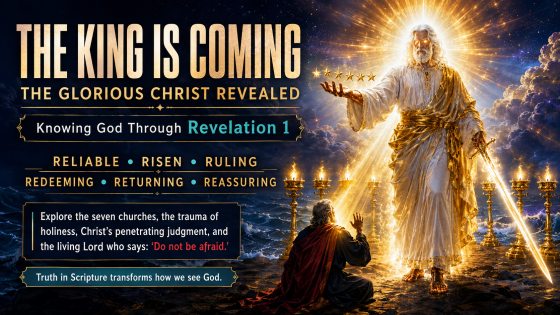

The King Is Coming with Jeff Kinley
Revelations Guide To Knowing God - Episode 1
The Glorious Christ Revealed: Knowing God Through Revelation 1
Summary
Revelation as a Guide to Knowing God
Jeff Kinley begins a new series that approaches Revelation as more than a forecast of end-times events. He presents the book as an unveiling of Jesus Christ and a guide to knowing God's character. The teaching surveys Revelation chapter 1 and identifies a series of attributes revealed through its descriptions of Christ. Kinley emphasizes that scriptural truth shapes a person's understanding and experience of God.
The Reliable, Risen, and Ruling Christ
The message describes Jesus as the faithful witness who is reliable, trustworthy, and authoritative. Kinley interprets "the firstborn from the dead" as a declaration that Christ is risen, living, and preeminent. He also points to Christ as the ruler of the kings of the earth, whose authority surpasses that of every human leader. These descriptions establish the foundation for the rest of the chapter's portrait of Jesus.
Redemption, Worship, and Christ's Return
Kinley explains that Christ releases believers from sin through His blood because of His love for them. He connects this redemption with believers' access to God as a kingdom of priests and says worship is the natural response to salvation. Turning to Revelation 1:7, he distinguishes the Second Coming from the rapture and describes a visible return witnessed by every person. He says those who oppose the returning King will mourn with dread as Christ comes to claim what is His.
John's Vision of the Glorified Christ
The episode explores John's vision of Christ among the seven golden lampstands. Kinley interprets the robe and golden sash as imagery of a royal, righteous high priest, while the white head and hair signify wisdom and brilliance. The fiery eyes represent Christ's penetrating ability to see the condition and motives of the churches. His burnished-bronze feet and powerful voice are presented as images of divine authority, refinement, and judgment.
The Reproving and Reassuring Christ
Kinley explains the seven stars and lampstands as symbols connected to the churches and their messengers or pastors. He interprets the sharp, two-edged sword from Christ's mouth as a picture of His Word bringing judgment, beginning with the church. Christ's radiant face overwhelms John, who falls at His feet as though dead in what Kinley calls the trauma or terror of holiness. The scene then becomes reassuring when Jesus touches John, tells him not to fear, and declares that He is alive forevermore and holds the keys of death and Hades.
A Life-Changing Encounter with Scripture
The closing teaching argues that encountering Christ through the truth of Scripture is a genuine experience of God, even when it is not accompanied by heightened emotion. Kinley challenges listeners to reconsider whether their view of Jesus reflects the glorious Christ revealed in Revelation. The episode concludes that knowing God is serious, transformative, and capable of awakening believers from spiritual complacency. Additional promotional segments invite listeners to obtain Kinley's books and support World Prophetic Ministries through monthly partnership.
The King Is Coming


World Prophetic Ministry teaches Bible Prophecy in these End-Time days. Through our outreaches of books, videos, and our highly acclaimed telecast, The King is Coming, we proclaim the Good News that Christ died for our sins and is coming again soon.
Speaker Identification
Speaker 1 - Announcer / Prerecorded Promotional Voice
Identified by the program teaser, third-person descriptions of Jeff Kinley's books, donation requests, ministry information, and transitions into the teaching segment. The transcript does not provide the announcer's name.
Speaker 2 - Jeff Kinley / Host and Bible Teacher
Identified because the speaker explicitly says, "Hi, I'm Jeff Kinley," refers to books he has written, introduces the new teaching series, and delivers the main exposition of Revelation chapter 1.
Speaker 1: Today on The King Is Coming.
Speaker 2: Truth, as we see it in the Word of God, determines and drives our experience with God. And so Revelation radically impacts, even from the very beginning, our very view of God. Who said Revelation wasn't a relevant book, right? It is right where we are living.
And as I just wrote, our view of God determines everything about us. How can we encounter this Jesus in Scripture and still remain asleep?
Speaker 1: The book of Revelation is the last book of the Bible and the last written word God would ever give us. But did you know that, in addition to telling us about the future, He also tells us about Himself? That's next on The King Is Coming.
We're living in an era defined by global unrest, natural disasters, political strife, and ever-shifting morality. Though we may feel tempted to question God's presence, these trends actually signal the nearness of Christ.
For your gift of $20 or more to World Prophetic Ministries today, you will receive a copy of Jeff Kinley's book Aftershocks. Learn how to live in this chaotic world with complete confidence in God's plan. Call today.
Speaker 2: I'm very excited to tell you about a brand-new book I've written called God's Grand Finale: Wrath, Grace, and Glory in Earth's Final Days. This book is so exciting because I basically take you through the entire book of Revelation, but from a slightly different perspective.
What we discover is that the book of Revelation was not just written to tell us what's going to happen in the end times, but God wrote His last-ever book to tell us about Himself. And so Revelation becomes not just a book about the future, but a book to help you encounter God. I go through it and highlight 13 amazing attributes of God that really rise out of the book of Revelation and help us become more intimate in our relationship with Him.
Speaker 1: For a gift of $20 or more to World Prophetic Ministries, you will get your copy of Jeff's newest book, God's Grand Finale. You will be inspired and challenged as you learn about God's wrath, grace, and glory. To get your copy today, visit thekingiscoming.com or call 1-800-622-2767.
Speaker 2: Well, we're starting a new series today called Revelation's Guide to Knowing God. It's very interesting because, when most people study the book of Revelation, they study it to try to figure out what's going to happen in the future. But as it turns out, God wrote Revelation not just to give us a heads-up on history, but also to tell us who He is. And so Revelation essentially becomes a guide to knowing God.
We're going to dive into that today by looking at the God who is glorious. You know, the Bible begins here in the book of Revelation - the very first verse, rather - by saying that it's the revelation of Jesus Christ. That means it's an unveiling or revealing of who Jesus Christ is. What John goes on to record next are about 13 different attributes of Jesus Christ that we see.
So we're going to take a sort of jet tour through Revelation chapter 1. Let's find out who our God is and who Jesus Christ is.
He begins by telling us in verse 5 that He is reliable. He says in verse 5 that this book is from "Jesus Christ, the faithful witness." What that means is that Christ is the one who is going to tell us the truth. Christ is the one who is reliable. He is trustworthy. He is credible. How do we know this? Because He has proved Himself to be reliable, credible, and authoritative. And so Christ is reliable.
He goes on to say in verse 5 that He has risen. It says, "He is the firstborn from the dead." That means He is the preeminent One who has been resurrected. So we're talking about a living Christ here. We're not venerating some dead teacher or some sort of religious leader. We're talking about the living Lord. So He is the risen Christ. He is the preeminent One.
Then he says that He is also the ruler in verse 5. He says, "He is the ruler of the kings of the earth." Now, this is a very important theme that John is going to pick up later, at the end of Revelation, when Christ comes back with the crowns that He is wearing on His head to conquer the kings of the earth. He is called there, as we shall see, the King of Kings and the Lord of Lords.
This establishes Jesus Christ's preeminent rulership over all the premiers, presidents, popes, prime ministers, kings, despots, and queens who have ever lived. Christ rules over them all.
Then John gets more personal and tells us that He is the redeeming Christ. We read this again in verse 5. Verse 5 is a dense verse that is packed with so much meaning. It says, "To Him who loves us and released us from our sins by His blood." This word "released" means to unshackle someone, and it says that He did this because He loved us.
You see, the love of God is what motivated Him to free us from the chains and bondage of sin and to transfer us into the kingdom of His beloved Son. Isn't it great to know that you've been redeemed, you've been set free, and the power of sin no longer has any control over us?
He says in verse 6 that we've been made to be a kingdom of priests. This speaks of our unfettered access to God through Jesus Christ. I love what the book of Hebrews tells us in chapter 4, verse 16: that we have perpetual access to this great throne of grace. It's only because of the shed blood of Jesus Christ, not based on anything any of us has done, but solely upon what He has done. He is a redeeming Christ.
Now, as we reflect on that salvation, there is a response. He says here in verse 6, "To Him be the glory and the dominion forever and ever. Amen." You know, anytime we think about our salvation and what Christ has done for us, the natural response is worship. That's what we want to do. We want to worship God based upon what He has done for us. What He has done for us is what motivates virtually everything we do for Him.
Based on that natural response of giving Him glory and all dominion forever, John now turns and says that this Jesus is also coming back one day. He is a returning Christ. In fact, look at verse 7. It says, "Behold, He is coming with the clouds, and every eye will see Him, even those who pierced Him; and all the tribes of the earth will mourn over Him. Even so. Amen."
This is a promise that Jesus Christ is coming back. It is not speaking about the rapture here; it is speaking about the Second Coming. It tells us that Jesus Christ will return to this planet one day. We're going to talk about that in this series on Revelation's Guide to Knowing God. But it tells us here that He is coming back, and it says that every single eye will see Him.
Now, we don't know how God is going to accomplish this supernaturally at the Second Coming. It could be because of modern technology. Certainly, at this event of the Second Coming at Armageddon, which we'll talk about later, the event is going to be broadcast to the whole world because the entire planet is going to be in anticipation of this great war in which the nations are coming against God.
But it says every eye will see Him, so nobody is going to be left out. Every person is going to witness it, and it says they are going to mourn over this coming King. That doesn't mean they are going to feel sorry for Him. It means they are going to have a great sense of dread because the King has come back to claim what is His. So He is a returning Christ.
He goes on to say that He is also a regal Christ in chapter 1, verse 11. Jesus is telling John to take this vision, and He gives this instruction to him with a loud voice. It says the voice was like the sound of a trumpet. So there is a sense of regality, splendor, and majesty in this trumpet-like voice.
It says, "Write in a book and send it to the seven churches: to Ephesus, Smyrna, Pergamum, Thyatira, Sardis, Philadelphia, and Laodicea." He is a person who is regal.
Back in verse 8, we see even more about this. He says, "I am the Alpha and the Omega, the One who is and who was and who is to come." So Christ is the beginning and He is the end. He is the point of human history.
One thing we need to understand is that the Bible portrays Christ as the very reason for our existence. In other words, the reason you and I were created in this world is so that we might know, serve, and enjoy our great God. Isn't it great to know that God created each of us for a purpose? We're not simply accidents of nature. We're not just products of evolution. We're the creation of a loving God, and that's something we need to keep in mind.
Then He says again in verse 11 that John is to write these things to the seven churches. The word "Revelation" means to reveal. It means to uncover. It doesn't mean to hide. So there is not some hidden code in Revelation that we need to try to uncover. No, it's already there for us. We do need to study it. God wants us to dive into His Word, but He is not hiding it from us.
Now, something very interesting happens in the next few verses. Instead of merely hearing what Christ has done for us and hearing a little about who He is, John actually sees this risen Christ with his own eyes. This is a vision. Just keep in mind that it's a vision John is receiving on the Lord's Day. It is a spiritual vision, a supernatural revelation that God is directly giving the apostle John.
Here in verse 13, we see the first thing we learn about this risen, glorified Christ. It says that in the middle of these lampstands - these seven golden lampstands that represent the seven churches - there was "One like a Son of Man, clothed in a robe reaching to the feet, and girded across His chest with a golden sash."
This garment that Christ is wearing, I believe, pictures the high priest of the Old Testament. In fact, when you read the Septuagint, which is the Greek translation of the Old Testament, this is the same word used for the garment that describes the Old Testament high priest's robe.
Jesus Christ has suddenly traded in His carpenter's robe. He has traded in His first-century robe. He is not passing out fish. He is not healing people of diseases now. What Christ is doing now is presenting Himself as the royal, righteous Christ.
Verse 14 describes His head. It says His head and hair were white like wool and like snow. This tells us about the glowing white brilliance of the countenance of Jesus Christ. In the Old Testament, in Proverbs 16:31, we read about how a gray head is a crown of glory. There is a sense of wisdom and legacy associated with that white hair, a sense of knowing the ages. That is what Christ is showing us here when it says that His head and hair are white like wool. It means that He has pure wisdom and that we ought to respect Him.
In fact, Colossians 2, verses 2 and 3, says that in Christ are hidden all the treasures of wisdom and knowledge. This is simply pictured for John. Why is it important that He does that here? Because He is about to reveal the entire Apocalypse to John, as we're going to see.
Jesus wants John to know that within Christ is the repository of all the wisdom of the ages. The reason this is important is because this vision John is going to receive about Revelation is going to get bizarre, folks. John needs to know that this is true knowledge and, again, that it is coming from the faithful and true witness that Christ is. He is going to give him complete wisdom about what is going to happen in the end times.
It goes on to say that His eyes are like a flame of fire. Now, this is not the Jesus you normally picture when you think of Christ teaching on the hillside, healing a leper, or sitting in Mary and Martha's house and teaching about the Word of God. No, this is a different Christ here. He is risen. He is glorified. He is seated at the right hand of the Father. And it says His eyes are like blazing fire. What does that mean?
We believe that it means He has a penetrating gaze. In other words, He is about to peer into the very soul of the church and of these seven churches that we're going to examine here in the book of Revelation.
Several years ago, I wrote an autobiography of a man named Dr. Raymond Damadian. Dr. Damadian is the man who invented the MRI. I learned through researching with him that the MRI can see beyond what X-rays and CAT scans can see. It can see through bone. It can see fluids and things in the body that nobody else can see and no other instrument can see.
Jesus is essentially saying to John, "John, I'm about to perform an MRI on the seven churches. I'm about to evaluate what's going on with My churches here." Jesus sees everything. He even sees our motives. First Corinthians 4 says that He sees even our very motives. That's what these eyes represent.
Now, we're going to see these eyes again because, at the end of Revelation, it says in Revelation 19:12 that Jesus Christ comes back to the earth with these same eyes. These are eyes that are penetrating with great judgment on those who have gathered at Armageddon. So this is an incredible vision that John is receiving of Christ.
Now he moves on in verse 15, and we learn something else about our God. He says, "And His feet were like burnished bronze." What does that mean? It means that Christ is refining.
This burnished bronze could refer to the bronze altar in the tabernacle. When the altar was heated, it glowed white-hot. Some commentators and Bible scholars believe that this is what he is talking about here: His feet are glowing in white-hot, divine judgment. He is standing ready to judge. Now, He is going to judge in two ways. He is going to judge the church, and He is going to judge the nations, as we'll see.
Previously, in verse 10, it said that His voice was like a trumpet. But now John hears His voice differently because the announcement and preliminary introduction have been made. It says in verse 15 that His voice was like the sound of many waters. In other words, Christ's voice sounds like waves crashing against the rocks by the ocean.
Maybe you've been to the ocean sometime and seen those waves crashing against the rocks. There is a sense of authority about that and a sense of respect that you have for that kind of voice. And so John is seeing this.
This whole idea shows that Christ is a reproving Christ, that He is about to reprove His seven churches. How do we know that? In verse 16, it says that in His right hand He held seven stars. Now, who could those seven stars be? You know, people say the book of Revelation is just a book about symbolism, but in this very chapter He actually tells us who the seven stars are over in verse 20.
He says the seven stars are the angels of the seven churches, and the seven lampstands are the churches themselves. And so we know that the stars represent the pastors of the churches. This letter of Revelation - this whole book of Revelation - was to be given to the pastors of these seven churches, and it was to circulate across all the churches, not just those churches in Asia Minor.
So the seven churches receive the Word. Now, what are they going to get? The next thing we see is what comes out of Christ's mouth in verse 16. We're moving through this pretty quickly, but I want to give us an overview and a big picture of who this Jesus is. John does the same thing.
Verse 16 says that out of His mouth came a sharp, two-edged sword. This is very interesting because we see this again in Revelation 19. There are two words used for "sword" in the book of Revelation and the New Testament.
One refers to a dagger-like sword. It's the kind of sword Peter used when he cut off the high priest's slave's ear in the Garden of Gethsemane. I believe the slave's name was Malchus, and Jesus put that ear back on. That's more of a dagger-like sword; it's the word machaira.
But this is another word. It is the Greek word rhomphaia, which refers to a long, broad sword. Think of a Braveheart sword. That's exactly what Christ has coming out of His mouth. A long Braveheart sword doesn't have the purpose of performing fine surgery; it is used to do battle.
Jesus is saying, "I'm coming here to do battle, to wage war, and to bring judgment. I'm going to begin with My own church because My own church needs to get its act together." This sword penetrates as He evaluates His church.
Christ has this sword coming out of His mouth. Now it tells us not only that something is coming out of His mouth, but we also see something about His actual face. You begin to see the picture of who this Jesus is. It says in verse 16 that "His face was like the sun shining in its strength."
Remember, as a child, your parents told you never to look at the sun. If you look at the sun for more than a second, it can actually burn the retina and cornea of your eye. That's why we don't look at the sun. Well, John says the face of Jesus Christ was just like the sun in its strength. This picture is really the great glory of Jesus Christ.
Now, let's pause for a second to contemplate that. You know, we don't think about the glory of Christ very much. We think about His mercy and grace. We think about His tenderness, kindness, and compassion. We think about His teaching and the great things that Jesus Christ did. But we don't think about His glory.
Sometimes people say, "Well, hey, I bumped my head and went to heaven. I saw Jesus, crawled up in His lap, and just gave Him a big hug," or whatever. But when John sees the glorified Christ as He is in heaven right now, guess what? He is seeing this glory, and it's a glory that is hard to understand and take in. John really is experiencing the glory of God.
When we encounter the truth of Scripture about our great God, then we are experiencing God. Sometimes we think we have to have some sort of emotional experience with God in order for it to be real. We sometimes equate that with worshiping in church, raising our hands, or singing loudly, and certainly that's legitimate. But there are other ways to experience God. When we simply see, hear, and read His truth, it produces a response in us. We experience God, and we should have some sort of reaction when we see who God is.
That's what is happening to John here. It's so traumatizing to John. Look what happens next in verse 17. It says, "When I saw Him, I fell at His feet like a dead man." Wow.
John has seen the head, hair, eyes, mouth, feet, and robe of Jesus Christ. This vision of Christ causes John's internal nervous system to basically shut down, and he simply passes out. He falls at His feet as if he is not even alive anymore.
This is what I call the trauma of holiness, or the sensory overload that comes to us - really, the terror of holiness at times. We realize that God is so incredibly holy. We'll look at this more next time. But God is so holy that seeing this kind of Christ should, in a sense, wreck us. It should traumatize us. It should cause us to say, "Is this the Christ I claim to know?"
John is simply on his face, but look what happens next. It says that He laid His right hand upon him, saying, "Do not be afraid. I am the First and the Last, and the Living One; and I was dead, and behold, I am alive forevermore, and I have the keys of death and of Hades."
What we finally see is the reassuring Christ. In other words, by placing His hand on John, Jesus tells him, "Look, John, I'm alive. I'm alive. This Christ that you've seen - it's really Me. But I want you to know it's okay because I love you. I'm here for you. I was dead, but I am alive."
Why is that important? Because a dead Christ can't do anything for us. A dead Christ can't give a revelation; only a living Christ can.
You know what else it tells us? It tells John the apostle that everything he had done in serving Christ and sacrificing for Christ was legitimate. It was all worth it. How do we know that? Well, John went through a lot. Early Church fathers wrote that John was boiled alive in oil, yet he came out of the oil praising God.
Knowing that Jesus is God, that He is alive, and that He is in charge assures us that He is going to take care of us. He lays His hand upon us when we see this chapter and these truths.
Meeting Jesus Christ and knowing God is not a flippant encounter. It is a very serious and impactful thing, and it ought to shake us to our core. Knowing God involves seeing this glorified Christ and encountering Him. That's the way God begins the book of Revelation. He wants us to see His Son before anything else.
Truth, as we see it in the Word of God, determines and drives our experience with God. Let me say that again: truth, as we see it in the Word of God, determines and drives our experience with God.
Revelation radically impacts, even from the very beginning, our very view of God. Who said Revelation wasn't a relevant book, right? It is right where we are living. And as I just wrote, our view of God determines everything about us. How can we encounter this Jesus in Scripture and still remain asleep?
Well, that's the beginning of this series: the glorified Christ, the God who is glorious. We'll pick it up again next time on The King Is Coming. Don't miss it.
Speaker 2: Hi, I'm Jeff Kinley. We've been talking on The King Is Coming about this man named Noah. "As it was in the days of Noah" is the basis of a book that I wrote a few years ago called As It Was in the Days of Noah: Warnings from the Bible About the Coming Global Storm.
In this book, we talk about how the days Noah experienced are like the days we're experiencing right now and how we can navigate these difficult times. I think this is a very relevant message for the world today, just as it was when the book originally came out in 2014.
It immediately went to number one and became the number-one prophecy book in America. It rose to the number 94 spot out of eight million books on Amazon and got me on programs like Fox & Friends, The Glenn Beck Show, The Ben Shapiro Show, and hundreds of other radio and TV shows. I think it's mainly because it just struck a nerve.
Well, today we're living in those days as well. We've now updated and republished the book. I've added two new chapters and a great deal of new content in the back. I want you to get a copy of As It Was in the Days of Noah. It will not only open your eyes to what's going on in the world around you, as the Bible predicts, but also equip you to walk through these difficult times. Pick up a copy of As It Was in the Days of Noah.
Speaker 1: For over 45 years, The King Is Coming has provided sound biblical teaching and encouragement. This has been possible because of our monthly financial partners. Join us today and commit to becoming a monthly partner. Your support is vital during these crucial and ominous times. Go to thekingiscoming.com. God bless your partnership.
World Prophetic Ministries is recognized as a church and religious organization by the Internal Revenue Service. Thus, all donations to World Prophetic Ministries are recognized as charitable contributions under the IRS code. Thank you for your support.