Speaker Identification
Speaker 1 - Announcer / Prerecorded Promo Voice
The opening introduction, commercial-break promotions, and closing station announcement are presented in a polished promotional style distinct from the live host narration.
Speaker 2 - Host: Alan J. Cook
The live speaker identifies himself repeatedly as Alan Cook and is introduced in the prerecorded material as Alan J. Cook, founder of 1-800 Junk Refund.
Speaker 1 - Announcer / Prerecorded Promo Voice:
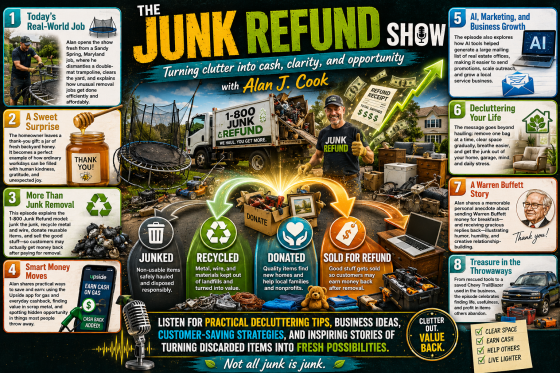
Welcome to the Junk Refund Show, hosted by Alan J. Cook, founder of 1-800 Junk Refund.
Have you ever paid one of those expensive junk removal companies to take away some of your stuff, only to say to yourself as the truck drove off down the street, "Some of that stuff wasn't junk"?
Did they try to sell it for you and give you some money back? No.
Well, now there is a company that can do just that. Listen to our weekly Junk Refund Show on BBS Radio TV to learn how one woman spent $375 on junk removal and got $3,200 back.
1-800 Junk Refund represents the next generation of junk removal. Learn how not only to save money on junk removal, but also to get some money coming back. Plus, purchase one of our radio vouchers during the show to save even more on your junk removal.
Let's get the junk out of your home and out of your life. Now, here is your host, Alan J. Cook.
Speaker 2 - Host: Alan J. Cook:
Hello, everybody, and welcome to the Junk Refund Show. I'm your host, Alan Cook.
I am just pulling out of a driveway in Sandy Spring, Maryland. I finished a job there literally at 2:58, and sure as shooting, our producer, Don, called me at 2:59. We are off and running and doing the show. I'm literally pulling out of this guy's driveway right now.
I just took apart a trampoline. Interestingly enough, it was what I'm going to call a double trampoline because it had one mat on the trampoline and another mat about a foot below the first mat, which I have never seen before. I don't know what you call those, and I'm not sure what the purpose is, but it was a double-mat trampoline that I just took apart.
The guy's yard is now perfectly clean, with no old trampoline sitting there. He had netting running up the sides so the kids wouldn't fall off and break their necks, so to speak. Anyway, that is now all gone. It took about an hour and a half to do it. We charged him $200, which I think is a really good price. The job was referred to us by a realtor named Karen Rawlings, a top-notch realtor here in Maryland. It was fun. The customer received 10 percent off because he was referred by a realtor, and that is a common practice for us.
Let me tell you how you take one of these things apart. The trampolines with netting have vertical poles and springs. I'm going to guess there were maybe 80 springs attached to the edge of the mat and to little slots around the trampoline.
You have to get what I'm going to call wire cutters, although they're more like snips - perhaps aluminum snips or large commercial scissors. You use them to cut the material holding each foot-long spring to the mat. You go all the way around the trampoline, cut those connections, and then the mat falls to the ground. After that, you detach the foot-long springs from the rail. Pretty soon, you have a bucket full of heavy springs and the rails separated from the mat. Then you roll up the mat and take it away.
You also have to take down the netting. There are vertical poles attached to the horizontal poles, and you remove those with a cordless drill and the proper attachments. I'm thrilled to say that nearly all the tools I use in this business were thrown away by somebody else on another job. I have the cordless drill and all the attachments I need, and everything worked out beautifully. You just go around and take the whole thing apart.
Here is the cool thing about all this: you haul away the metal and the mats, and the guy's old, frankly ugly, worn-down, beaten-up trampoline is gone from his backyard in a neighborhood with multimillion-dollar homes. It's a terrific neighborhood in Sandy Spring, Maryland, that I had not visited before, so I discovered a new neighborhood. It is a beautiful home, and now the yard looks great.
Here is what made the customer an outstanding person. Before I arrived, he sent me a text saying, "I won't be home when you come, but that's okay. I'll tape a check to the trampoline." I thought, "Okay." I got there, and sure enough, there was a check in an envelope. I haven't opened it yet; I have it here in the truck.
Directly below the check, lying on its side, was a small jar of honey, maybe 10 ounces. On the lid, it said, "Enjoy," and then, "Bottled 6/26." I thought, "This is some fresh honey that was bottled last month. I wonder why it's out here." That was my first thought.
I kept cleaning up the trampoline, and then I realized that the bottle of honey was directly below the check. I thought, "Wait a minute. He's giving you a gift." This guy was giving me freshly made honey.
I looked toward the back of the yard. He has a very deep yard, and sure enough, there were about 10 beehives in the back, maybe 50 or 60 yards away, with a whole bunch of bees flying around on the other side. I thought, "What a classy guy." He left the check, I was able to take care of the job while he wasn't there, which was convenient for me, and now I get to go home with a 10-ounce jar of freshly made honey that I cannot wait to eat.
I'm probably going to buy a Kentucky Fried Chicken meal, or some kind of meal with a nice biscuit, and order an extra biscuit just to enjoy this guy's honey that he left me on the job.
I took before-and-after pictures to use on social media and show that we take down trampolines. That is a great idea for your business if you are in the kind of business I'm in, or if your work lends itself to before-and-after shots. That's the thing that makes plastic surgeons famous, I guess - before-and-after shots. Take those pictures and use them in your business. That's a good idea.
I had hoped to start this job at about noon, finish by about 1:30, head home with plenty of time, grab something to eat, and then do the radio show. As it turned out, I got some extra rest this morning, and I want to mention that too.
One way to get some of the junk out of your life is to clear your mind, and one of the best ways to clear your mind is to stop, slow down, and get some rest.
I did something fun this morning. I made a house payment. The payment is current and everything is up to speed, and I thought, "You know what? I should celebrate that just for fun." I decided to get breakfast at a hotel close by. I went over there, had breakfast, and it was fabulous. I rewarded myself with an eight-dollar, all-you-can-eat breakfast, and it was great.
I went back to my place at around 8:00 in the morning. I had visions of emptying the truck of the metal I picked up last night and making a few bucks, but I also thought, "There is nowhere else I need to go today until about noon." I lay down on the bed, rolled over, and pretty soon it was 9:15.
I thought, "Okay, that feels pretty good," and I tried it one more time. This time, I woke up at about 11:00, and I felt really refreshed. I thought, "Okay, I'm ready to go again. I'm ready to have at it and see what damage I can do today."
The dilemma is that one part of you feels guilty for not starting earlier in the day. That's what self-employed people go through all the time. The other part says, "Now I'm ready. Now I feel good. I'm ready to go, and this should be a great day. It doesn't matter what time it is."
I went to the scrap metal yard and emptied about $150 worth of metal and other material. Then I took off to do the trampoline job. Now I'm probably going to find a little park or some other place to park and do the show. I would love to get something to eat, but I don't think I have time while I'm doing the show. We'll work on that. Maybe I'll go through a drive-through.
Getting some sleep is a great thing to do. We live in a rush-rush world, especially in the Washington, D.C., area, with all the Type A personalities here - of which I am one, by the way. There are demanding people, time is precious, and people are smart.
I think a census, perhaps in 2000, determined that Bethesda, Maryland, a suburb of Washington, D.C., was the best-educated city in America, with 75 percent of its adult residents having a college degree and 49 percent having a graduate degree. I am the college-degree guy; I am not the graduate-degree guy. I did one semester in law school and decided, "No, I don't think this is really what I'm cut out to do." That's the closest I came to getting a graduate degree.
You are surrounded by smart people who, frankly, don't want anybody to get in their way. They are in a rush to get wherever they are going next. If you're in their way, it's obviously your fault, not theirs, and if they are running late, it is still your fault, not theirs.
When you spend time in that kind of society, it is a great idea to slow down, catch your breath, clear your mind, and relax a little. That's what I did this morning, and here I am feeling just fine. It is completely irrelevant to me what time I started this morning. Nobody is paying me by the hour.
I went back to bed after a full breakfast, which I rarely do. I got a couple more hours of sleep, and now I'm feeling great. There you go.
Now we're doing the radio show. After the show, I'll have a break of a couple of hours, maybe three or four, and then at 7:00 tonight I'm taking a group of about 10 people to dinner at Panda Express. These are young missionaries from The Church of Jesus Christ of Latter-day Saints whom I work with in my church calling.
Every six weeks, some new missionaries transfer in and others transfer out. Next Wednesday, two of our veteran missionaries will finish their two years of service and head home. Tonight is the only night between now and next Wednesday when I can take these folks out to eat.
I like to do this once every six weeks at Panda Express. We usually have about eight people, but tonight we might have 10 or 12. It is a wonderful thing. I'm excited about it, and it will be a blast. I'll be well rested, and I won't feel as though I'm arriving at the end of a long, stressful day after working 10 or 11 hours.
There is a great YouTube video by a singer whose name, I believe, is Sissel - S-I-S-S-E-L. I think she is from Norway. She is a beautiful singer who performed with the Mormon Tabernacle Choir, now known as The Tabernacle Choir at Temple Square, maybe six or seven years ago. I believe it was at a summer concert, and the song she sang was called "Slow Down."
You need to watch that video, listen to the song, and feel the spirit of it, because I'm here to tell you it is tremendous. That's a little tip I can give you - something I have seen that I think many people should see. It is worth watching, and the message is worth receiving: sometimes, slowing down is a good thing.
So, I have taken apart a trampoline and received some fresh honey, which I'm really excited about. I don't think I have ever had fresh honey from somebody's backyard. I'm excited to see how it tastes, and I can't wait to find something soft, like a biscuit, to put it on.
I want to talk about the Upside app. I'm going to try to do this each week. It is a free app that you download and put on your phone. The next time you buy gas, open the app and see whether there are gas stations in its network that will give you cash back when you purchase gas from them.
I have been doing this for about two and a half years. I have $1,125 in my Upside account, and I can have the money sent to me through PayPal, transferred to my bank, or issued in gift cards whenever I want.
Whenever I buy gas, which is pretty much daily, I make a point of opening the app. It is easy. If you use a credit or debit card to pay for gas, you can enter that card information in the app. It then asks whether you used that card, and you say yes. That's all you have to do. If you don't have the card entered in the app, you take a picture of the receipt and upload it. About 48 hours later, the money appears in your account.
We are all buying gas, going to grocery stores, visiting convenience stores, or eating at restaurants. You might as well get cash back at those places rather than getting nothing back. That is the whole point of the Upside app.
My goal is to use this money to take a cruise to Bermuda. My aunt and uncle, who have taken cruises all over the world, say that the beaches in Bermuda are probably the finest they have ever seen. I'm excited about that, but I plan to have the Upside people pay for the cruise once I schedule it and determine what it will cost.
This month, the app is offering a special bonus. If you use it 21 times, you get an additional 30 cents per gallon in cash back on your next gasoline purchase. The normal amount I receive is probably 10 to 15 cents per gallon. Once I reach 21 uses, I will get an additional 30 cents. I plan to fill up one of my vehicles and probably receive 45 to 50 cents per gallon in cash back.
I'm currently at 19 uses out of 21. Today is the 30th, tomorrow is the 31st, and I still have about 36 hours to use the app twice and receive the bonus on my next gasoline purchase.
There is also a promotional code that can give you extra money back. It is a code made for golfers, based on the phrase, "Don't slice a nine iron or a pitching wedge." The code is DS9PW. If you use that promotional code with the Upside app, you will receive additional savings.
If you use the app, tell other people about it, and they use your promotional code, you receive a little money back when they make gas purchases too. Everybody benefits. Remember the Upside app. It is free. Download it, put it on your phone, and use the promotional code DS9PW for additional savings.
Again, I have been using it for two and a half years and have made almost $1,200. According to commercials on radio stations in this area, people often say they have made $200 to $300 in a year from the app. I'm making about twice that, if not a little more.
Use it. It will give you money back. If you are buying gas, going to restaurants, shopping at grocery stores, or doing similar things, you might as well use it. It is available nationwide. Look it up in your area, see what is available, and save some money. I think that's a good move.
I'm here at a stoplight. We're going to take a break for about a minute. That will give me time to look at my notes and put together some more thoughts for today's show, which I didn't have much time to do because I just finished taking apart a trampoline. But we got the trampoline apart, things are good, and you're listening to the Junk Refund Show. I'm your host, Alan Cook, and we'll be back here on the BBS Radio Network in about one minute.
Speaker 1 - Announcer / Prerecorded Promo Voice:
Have you ever hired one of those expensive junk removal companies and then wondered what they did with the stuff - especially the good stuff?
At 1-800 Junk Refund, we junk the junk, recycle materials such as metal and wire, donate items and get you receipts, and put the good stuff up for sale. If it sells, you get some money back.
Cynthia paid $375 for junk removal and got $3,200 back. Would you like to know how she did it?
Tune in to the Junk Refund Show with your host, Alan J. Cook, every Thursday at 3:00 p.m. Eastern Time to get the junk not only out of your home, but also out of your life.
Speaker 2 - Host: Alan J. Cook:
Welcome back to the Junk Refund Show. I'm your host, Alan Cook. I am in the truck, headed to a quiet place where I can concentrate and focus on the show.
Something I have noticed here in Montgomery County is that an awful lot of commercial buildings have "For Lease" signs out front. I think that, coming out of COVID, people working at home and the changes technology has made in our society have basically said, "You don't really need to go into an office anymore. If you can work from home, do that and save the cost of the office."
There are a lot of vacant office spaces around here and a lot of landlords who took it on the chin during COVID. I know that, as a guy who lived in an apartment during those times, landlords couldn't take a tenant to court if the tenant fell behind on rent. They couldn't sue for the rent or evict the tenant, yet they still had to make payments on the building.
I didn't realize it at the time, but I think a lot of commercial property owners also took it on the chin. I'm turning now to go to my little "fortress of solitude," as a buddy of mine used to say back in college. There is a massive "Office Space for Lease" sign here, another one there, and still another one on both sides of the street. I think many of these places are struggling.
That is good news for somebody looking for office space. You want a landlord who has plenty of space and is motivated to rent it. I just pulled into a large office complex. There is nobody on the left, and the landscaping in front of the office building has grass almost a foot high. There is nobody on the right side of the street either. There is a massive parking lot and a big building, but no one appears to be in this complex.
There are plenty of shade trees, so I can come over here, hang out, and do the radio show. Nobody knows I'm here. I'm in the shade, it is nice and quiet, and nobody will bother me. That's kind of cool.
Let me share a couple more thoughts about jobs we have done this past week. I removed scrap metal from a media business near Dupont Circle in Washington, D.C. Over the course of four days, that job did not make me rich, but I probably made $600 or $700 doing it.
They have a lot of other material there that could become a $5,000 job, and we have submitted a bid. If we get it, everything is great. If we don't get it, that's okay too. We hauled away a lot of metal, made some cash, and earned a few bucks. That's a good thing.
I also have some general business tips. I have about 90 postcards with me that advertise a special deal for half a truckload of junk removal in honor of America's 250th birthday. Normally, half a box-truck load of junk costs $395. We are offering it for $250 to celebrate America's birthday, and I had postcards made for the promotion.
About two weeks ago, I started using artificial intelligence - specifically Microsoft Copilot - to create a spreadsheet of real estate offices in the area that I could mail to. It did exactly that. I worked city by city and played Monopoly while the computer pulled up the information.
I entered a request such as, "Create a spreadsheet of real estate offices in Rockville, Maryland, separating the suite number, city, state, and ZIP code into columns." It produced about 35 offices already arranged in a spreadsheet. I copied and pasted the information into my master spreadsheet, then repeated the process for another city and another city.
I did it city by city. I probably could have done it county by county and gathered the information even faster, but I was a rookie at this. The bottom line is that, over the course of about a week, I created a spreadsheet of roughly 800 real estate offices in the Washington, D.C., area without having to look up the addresses one at a time.
I used to find these offices individually on the web, write the addresses down, type them into a spreadsheet, and try to complete 10 a day so I could send 10 postcards a day. Now I'm sending 90 postcards a day, and that is a joy.
All I need is for one percent of those cards - basically one response a day - to bring me a house cleanout worth about $3,000. At that pace, I could do more than a million dollars in business over the course of a year.
I plan to mail these offices every month with a different offer or special deal. The second time I go through the list, it will be easy because everything will already be alphabetized. I can print mailing labels for all 800 names.
I also pay a man from our church who is out of work to put the labels and stamps on the postcards, so he benefits too. Then we mail them.
You can use the same approach for leasing companies, apartment buildings, storage facilities, gas stations, restaurants, and places that dispose of metal. You may find businesses getting rid of large commercial freezers that contain copper, condensers, and other recyclable materials. That is a smart way to find opportunities.
Artificial intelligence created all of this for me. I am finally beginning to jump on the AI bandwagon and learn what it can do for me and how I can benefit from it. That is tremendous.
I have BBS Radio to thank because they incorporated AI into what they are doing and continually use it to improve their services for people like me who record shows on their network. Now I'm using it in my own business. It is making my business better and faster, and I think it is wonderful. Everybody wins. That's a pretty good deal.
Let me explain a little about what we do. Our company is 1-800 Junk Refund. The word "refund" means money you get back after you first pay for something. Sometimes people think we buy their junk. We don't. You pay us to haul away your material.
Almost anything is fair game. We cannot commercially haul hazardous waste such as paint and gasoline, but nearly everything else is fair game. We haul it away and then do four things with it.
First, we take the actual junk to the local dump. Second, we recycle materials such as metal and wire at a scrap metal yard, where we get paid for them. We love doing that because it produces extra cash. Third, we donate usable items such as clothing, hangers, and furniture, and we obtain donation receipts for the customer.
The fourth thing, which sets us apart, is that we put the good material up for sale. If it sells, the customer receives some of the money back as a refund. That is where the word "refund" comes into play. No other junk removal business I know of sells customers' items and returns money to them the way we do.
That idea came from my 10 years of working for FranklinCovey and learning from Stephen Covey's The 7 Habits of Highly Effective People. One of those habits is to think win-win.
When somebody pays you to haul away a china cabinet, you could turn around, sell it, make money, and never tell the customer. That is a victory for you and a major loss for the customer. If you instead give the customer some of the proceeds, it becomes a win for both of you.
That customer then starts talking about your service and advertising it for free because you gave some money back. That's a great deal.
We make a special voucher available through the radio show. If you call 888-627-6008 and leave your name and phone number with our producer, Don, you will not be placed on the show. You will not be live or recorded. You are simply calling to give us your name and number.
After the show, Don will email or call me with that information, and I will send you a link that allows you to purchase vouchers for a pickup-truck load of junk removal for $79, which normally costs $229.
Other than my annual birthday special, this is the best deal we make available throughout the year. All you have to do is call the show.
The offer is valid only in the Washington, D.C., metropolitan area. If you are in Lexington, Kentucky, God bless you, but we cannot travel from Washington to Lexington for $79 to haul away a pickup-truck load of material. We offer other specials during the year, but this year-round offer is limited to the Washington metropolitan area.
Call 888-627-6008, give us your name and number, and we will send you a link. You can purchase a couple of vouchers if you want and receive a pickup-truck load of junk removal for $79 instead of the normal price of $229.
I want to talk a little about Warren Buffett. Warren is a friend of mine, and I mean that when I say it. We exchange handwritten Christmas cards every year, and we have done so for seven or eight years.
I was listening to one of his lectures, given perhaps 10 years ago at a university in Atlanta, where Coca-Cola is headquartered. Warren is a major shareholder in Coca-Cola stock. Let me share a couple of points about his business that I have tried to model in my own.
I spent the first 10 years of my career as a stockbroker, so I became interested in Warren Buffett. I am a big fan of his wit, humor, and integrity. I love reading the letters to shareholders that he writes as chairman at the end of Berkshire Hathaway's annual reports. In my view, those letters are the best source of investment advice on the planet.
A few years ago - perhaps as many as 10 - he was talking to college students. His format was simple: "Ask me a question, and I'll be happy to answer it."
Somewhere along the line, he said that Berkshire Hathaway was generating $5 billion in cash every year. Then he pointed out that this was $100 million a week.
Think about that, folks. Imagine owning a business that brings in $100 million in cash every week. What in the world are you going to do to deploy that cash and make it grow? Can you imagine that much money coming in every week?
Here is how I became a friend of his. About 10 years ago, I read that his wife put exactly $2.87 in his car every morning so he could stop at McDonald's during his five-minute commute and buy a Sausage Egg McMuffin for breakfast.
I thought that was a cool story. Here was a multibillionaire whose breakfast depended on the exact amount of change his wife put in the car. I thought, "You know what I'm going to give him for Christmas? I'm going to give his wife the day off and cover his breakfast that morning."
I sent him $3 in a Christmas card. I explained that I was in Washington, D.C., an area where he had spent some time growing up and where he had business interests, particularly The Washington Post.
I introduced myself and wrote something like, "I want to give your wife the day off for Christmas. Here are $3. Use them to get yourself breakfast at McDonald's. Merry Christmas, and thank you for all you do."
Two weeks later, I received an official letter from Berkshire Hathaway's headquarters in Omaha, Nebraska. I opened it, and there was a full-page letter on the chairman's letterhead.
It said, "Dear Alan, thank you very much for your kind and generous gift of $3, which I spent this morning at McDonald's on my way to work." He went on to say a few other things, but then he made a brilliant statement for a multibillionaire who did not know me and was responding to my first introduction. He wrote, "It was great of you to remember me."
This is a man who apparently receives 300 letters a day from people around the world and does not have time to answer them all. Imagine 300 pieces of fan mail every day, and there was my little Christmas card with $3 inside. He took the time to write back on corporate letterhead, thank me, and express his enjoyment of the breakfast I had purchased while giving his wife the day off.
Every year since then, I have sent him $3 for Christmas. One year, I had bought and sold a stock that made some pretty good money. I told him a little about it in the letter and sent him $6.
I wrote, "Here are $3 for your breakfast and $3 to send your wife on a shopping spree. Given that she's married to you, I'm sure she will buy at least $10 worth of merchandise with the $3. Merry Christmas to both of you, and I hope you have a wonderful New Year."
Over the years, the responses went from official letterhead to handwritten notes. I received a handwritten note from Warren that said, "Dear Alan, thank you very much for the $6 contribution. It was greatly needed this year."
Remember, this is a man whose remaining balance, if he withdrew $40 in cash from an ATM using a business debit card, might show more than $100 billion - somewhat higher than the remaining balance on my receipt when I withdraw $40. Yet he told me that the $6 was greatly needed that year.
He also wrote, "Don't worry about my wife's ability to stretch $3 into $10. She's even cheaper than I am."
That is brilliant humor from a man who, year after year, was arguably among the wealthiest people on the planet until people such as Jeff Bezos and Elon Musk came along with public companies. Now people even talk about trillionaires.
The point is that you can have some really interesting friends, even among the richest people in the world, if you reach out in a fun and creative way.
All my notes to Warren have been handwritten Christmas cards. One year, I told him how much I appreciated everything he had taught me and millions of other people, as well as his integrity, cleverness, and wit.
He sent me a handwritten note that said, "Alan, thank you for your kind words. It made my day."
How would you like to receive a handwritten note from Warren Buffett telling you that you had just made his day? That's my life, folks.
When I host a junk refund or junk removal radio show and try to teach people how to get the junk out of their homes and their lives, I'm here to tell you, in all humility, that I know a little about how to do it and a little about how to make it fun.
With that, we'll take another break here on the BBS Radio Network. We'll be back in about a minute for the last segment of the show during my favorite time of the week: Thursday afternoons from 3:00 to 4:00 p.m. Eastern Time. We'll be back in just a minute.
Speaker 1 - Announcer / Prerecorded Promo Voice:
Have you ever hired one of those expensive junk removal companies and then wondered what they did with the stuff - especially the good stuff?
At 1-800 Junk Refund, we junk the junk, recycle materials such as metal and wire, donate items and get you receipts, and put the good stuff up for sale. If it sells, you get some money back.
Cynthia paid $375 for junk removal and got $3,200 back. Would you like to know how she did it?
Tune in to the Junk Refund Show with your host, Alan J. Cook, every Thursday at 3:00 p.m. Eastern Time to get the junk not only out of your home, but also out of your life.
Speaker 2 - Host: Alan J. Cook:
Welcome back to the Junk Refund Show. This is the world's longest-running junk removal radio show. I'm your host, Alan Cook.
We are in our fourth year. I did the first year on CBS Radio, and I have been with BBS Radio for approximately three years. It has been a lot of fun.
Let me give you a couple of tips for getting some of the junk out of your home. One is to remove it at about the same pace that you brought it in. It did not all arrive at once; it accumulated gradually over time.
Instead of pushing yourself to clean the entire garage in three hours, set a goal to take out one trash bag this week, then do the same thing for the next eight weeks. You will be surprised by how quickly the garage gets cleaned up when you put time on your side instead of fighting against it. Slow and steady is the key.
The best trash bags I know of, and the ones we use, are contractor bags from Home Depot. You can buy a box of about 32 bags for roughly $25. They are large, heavy-duty, 30-gallon construction bags, so you can put a lot of material in them.
Even in your home, you can commit to filling one bag per week from anywhere in the house. One week it can be trash. The next week it can be clothing, pots and pans, or other items you want to donate.
Another week it could be metal that you take to a local scrap yard, where they may pay you based on the type of scrap metal you have. Another week it could be material you want to sell. Find a local eBay seller, use Facebook Marketplace, or locate a nearby auction house that will put the items up for sale.
I love taking items from our jobs and giving them to somebody else to sell. Then, out of the blue, I receive a text saying, "Your items sold, and here is how much money we have for you." Leverage yourself and let somebody else handle that work.
Think of a four-week month: one week for trash, one week for recyclable material such as metal, wire, and cardboard, one week for donatable items, and one week for items you want to sell. Repeat that process for six months. You will be surprised by how quickly your place becomes organized and cleaned up.
We have been cleaning out a home that we started working on a few months ago. A realtor referred us - a man named Mike Parent with Weichert Realtors here in Montgomery County, Maryland. He is a great realtor and a great guy, and we have had him on the show before.
We are cleaning out a house that a man inherited from his father. The father and grandfather have both passed away, and the grandson, who now lives in Philadelphia, has the house and is trying to prepare it for the market. The two generations before him never got rid of anything.
When you walk into the house, material is piled in every hallway and every room. There is not a clear counter anywhere. You cannot sit down and have breakfast at the kitchen table because items cover the table, the chairs, and the floor leading to it.
We are cleaning the house in stages. We started with the basement, then cleaned out the entryway and living room so estate-sale professionals could bring valuable items into the newly cleared room. That room can hold the important material while they decide what should be sold, and then they can turn us loose to clean out the rest of the house.
Going in stages is important. Unless you take time to remove some of this material, it will continue to build up. You may pass away before it is cleaned out, and then your children or grandchildren will have to pay a company like ours to do work that was never completed in advance.
If you want to save yourself and your family a lot of money, be proactive and clean it up a little at a time. That is all you have to do. It is simple, it works, and it does not have to cost much beyond the price of trash bags.
You can also call organizations such as Purple Heart, Goodwill, and Habitat for Humanity. Depending on what you have and how backlogged they are, some organizations may come to your house and pick up usable items.
That is one tip. Here is another: if you are going to hire a junk removal company, ask how large its trucks are, how many cubic feet they hold, and how much the company charges for a truckload. That information tells you how much you are paying per cubic foot to have your material hauled away. You may be surprised by the difference in pricing.
We recently completed a job for $700 after 1-800-GOT-JUNK? estimated that it would cost $1,000 or perhaps $1,200.
We also handled the scrap metal job near Dupont Circle, where we saved the company thousands of dollars. 1-800-GOT-JUNK? is a great company, by the way; it is simply expensive. The company estimated that the job would cost between $6,000 and $13,000, depending on the number of truckloads.
I think its pricing was based on roughly $1,000 per truckload. Our standard price is $695 per truckload, with discounts depending on how the customer heard about us, whether the customer was referred, and other factors.
We hauled away about four truckloads of metal and were paid hundreds of dollars for doing it. We did not get rich, but we earned something. We also saved the company roughly $2,800 compared with what it would have paid us for those truckloads, and approximately $4,000 compared with what it might have paid the larger company.
For the junk still inside, our remaining estimate is about $4,000, at roughly $550 per truckload, because the customer now qualifies for a 20 percent scrap-metal-client discount. Another company might charge closer to $8,000 to remove the same material.
If the company hires us for the second half, its total out-of-pocket cost may be about one-third of what one of the larger junk removal companies would have charged.
That is a great deal. It is part of what we do to save people money, perform good work, identify items that should be sold, sell them, and return some of the proceeds.
I have to talk a little about my SUV because I am having so much fun with it. I have a 2007 Chevrolet TrailBlazer, a four-wheel-drive SUV in a dark gray-green color. It was discarded during a hauling job about five years ago.
We were cleaning out a home rented by a very nice French woman who had to move because the owner had decided to sell the property. The renter's daughter came in from Flagstaff, Arizona, and said, "By the way, my son has that SUV in the backyard. It has been sitting there for four years. Can you take that too?"
I said yes, but explained that we would have to charge about $300 because that was probably what it would cost to have somebody tow it from Northern Virginia back to Maryland so we could examine it. She agreed and gave us the signed title.
When we looked at it, the right-front tire was flat. Remember, it had been sitting for four years, so all the brakes were rusted. However, the tire tread was still very good.
We opened the hood and found that the battery needed to be replaced. We replaced it, and the engine started and purred like a kitten. It was as soft and quiet as could be, which was a very good sign.
We took it in for an inspection. We paid $800 for new brakes because the old ones were rusted. The inspector said it needed new windshield wipers and an oil change, but otherwise it was a very good vehicle.
For approximately $1,100 in out-of-pocket costs - minus the $300 we had been paid to tow it away - I acquired an SUV.
Lo and behold, depending on the type of material, you can fit almost as much in the back of an SUV as in a pickup truck. I started using it for small hauling jobs, and over the next couple of years the SUV made about $4,000 for us. It easily paid for itself.
About a year ago, some of our workers were driving it behind me while I drove a truck. Suddenly, they texted and said, "Something happened. I think the transmission just gave out."
Sure enough, the transmission had failed. The vehicle had about 160,000 miles on it, and a rebuilt transmission cost $4,700.
The only reason I paid to have that work done was because of the story behind the vehicle. I love taking vehicles, equipment, and tools that other people have thrown away, fixing them up, and using them in my business to make money and pay for themselves.
Remember, I often do not have to pay to acquire these things. I get paid to take them.
When I did the trampoline job this morning, I used a RIDGID cordless drill with a battery and several attachments. All of that equipment had been discarded by a man from Guatemala who was apparently a tool hoarder in Reston, Virginia. A couple of years ago, his daughter hired us to clean out his house, and we ended up with a boatload of tools.
Now I am using tools that I was paid to take away to complete additional jobs for which I am also getting paid. I love that scenario. It is a wonderful thing and makes a great story.
I have the SUV back now, and thank God for AAMCO Transmissions here in Rockville, Maryland. Those people not only completed the work; they allowed the vehicle to sit there for several months before I had the money to pay the entire bill.
They could have charged storage fees of as much as $75 a day, but a wonderful man there named Ethan did not do that. He simply charged me the regular repair bill.
We got it fixed, and now we're off to the races. I am driving around in the SUV and taking it to church instead of using my 16-foot stake-body rental truck, which is what I had been driving.
It is a great story, and it is fun for me. I love that little vehicle. I could have taken $5,000 and used it as a down payment on something else, but then I would have had a car payment, and I did not want that.
I love the story of driving something that somebody else threw away. It puts a smile on my face. I encourage you to look for those kinds of opportunities in your business and your life. It is fun to make money from something that somebody else discarded.
Given the rest of my schedule today, I think I'm going to call it good. I'm going to get some lunch, visit the scrap metal yard, go home, and get ready to take 10 or 12 people to dinner tonight.
I hope you are having a wonderful time in your life. I hope this show and podcast are giving you ideas, motivation, and faith to act, because life is great.
There has never been a better time in the history of the world to be alive than now. I do not care how many problems you see in the world. If you are in America, you are still in the greatest country in the world, you still have reasons to celebrate, and you still have a boatload of opportunities ahead of you.
Artificial intelligence is making it even easier to turn those opportunities into reality.
With that, I will leave my little oasis, go to the scrap metal yard, make a few more bucks, and get on with my day. I hope everybody out there has a wonderful day.
Remember, it pays to get the junk out of your home, your garage, and your life. Life is better when you do that.
Email us at junkrefund@gmail.com, or visit 1-800-JUNK-RE-FUN.com and let us know what we can do to help you. We service the entire United States. We have not done anything in Alaska or Hawaii yet, but anything is possible, and we would be happy to help in any way we can.
Have a great day. I'm your host, Alan Cook. Get the junk out of your life, and you'll be in great shape. Talk to you next week.
Speaker 1 - Announcer / Prerecorded Promo Voice:
Thank you for listening to the Junk Refund Show, the longest-running junk removal radio show on the air.
Join us next week as we discuss innovative ways to declutter your home, your business, and your life using 20 years of junk removal experience.
Find out why we give free ice cream gift cards to our clients. In upcoming shows, we will explore how to get the junk out of your relationships, your spiritual life, your waistline, and even your travel life.
Call in with questions and situations you would like help with, or visit 1-800-JUNK-RE-FUN.com.
At 1-800 Junk Refund, we are committed to bringing you the next generation of junk removal, because not all junk is junk.
See you next week on the Junk Refund Show, every Thursday afternoon at 3:00 p.m. Eastern Time, right here on BBS Radio TV.