
The Care Compass, August 27, 2026
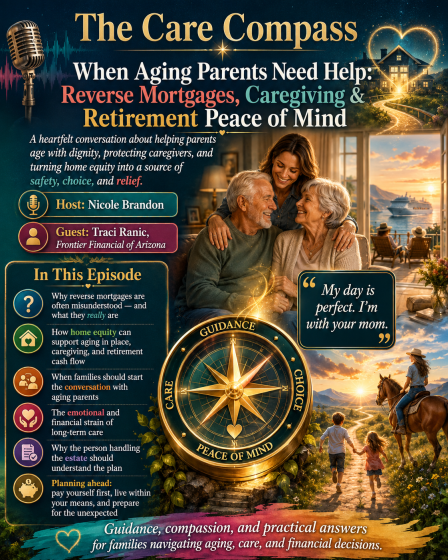

The Care Compass with Nicole Brandon
Guest, Traci Ranic – Frontier Financial of Arizona
Turning Home Equity Into a Retirement Safety Net: Reverse Mortgages, Caregiving, and Aging With Choice
Summary
A Family Journey Into Aging and Care
Nicole Brandon opens with a personal update about her parents, who have been reunited after several years apart because of health issues and are together again after 66 years of marriage. She frames the episode through the emotional realities of helping aging parents while simultaneously recognizing that the lessons being learned today will eventually apply to her own later life. Nicole introduces Traci Ranic as someone she trusts to bring clarity and hope to a subject many families find intimidating. Their discussion connects financial planning with caregiving, family communication, and the desire to preserve dignity and choice as people age. The conversation repeatedly returns to the idea that education can replace fear with options.
Planting the Seeds of Retirement Planning
Traci explains that her father planted an early financial seed by asking her, when she was a child, why people save for retirement. She came to understand retirement not as a destination people simply reach, but as something they deliberately prepare for throughout life. She compares long-term planning to nurturing bamboo: progress may be invisible for years, yet patient preparation can eventually produce significant results. That lesson became foundational to how she thinks about homeownership, savings, and financial security. She encourages people to begin planning early instead of waiting for a crisis to force a decision.
Understanding Reverse Mortgages as a Financial Tool
A major portion of the episode is devoted to demystifying reverse mortgages. Traci describes a reverse mortgage as a loan secured by a home and explains that, unlike a traditional mortgage, it does not require the borrower to make regular monthly mortgage payments. She says the program has evolved substantially over time and now serves a wide range of older homeowners and household situations. She emphasizes that home equity can be viewed as another retirement resource, much like savings accumulated in an IRA or 401(k). Rather than presenting reverse mortgages as appropriate for everyone, she stresses education, evaluating alternatives, counseling, and matching the loan to a person's specific needs and future plans.
Caregiving, Long-Term Care, and Financial Pressure
Traci's personal connection to reverse mortgages grew out of her own family's caregiving crisis. Her mother experienced a series of strokes, and her father began paying for increasing levels of care until the expense threatened the retirement security he had spent a lifetime building. Although he had a pension, a trust, and a mostly paid-off home, he did not have long-term-care coverage, and the recurring cost of care forced increasingly frequent withdrawals from his retirement assets. A reverse mortgage became part of the solution, and Traci says her father later wished he had considered the strategy earlier. The experience showed her how quickly an unexpected health event can expose gaps in even a carefully prepared retirement plan.
Protecting Caregivers and Including the Right People
The discussion broadens beyond mortgages to the emotional and practical burden placed on family caregivers. Traci and Nicole both describe how caring for a loved one can consume a person's attention until their own life, health, and well-being are pushed aside. Traci believes there is value in paying for excellent care when possible so that a spouse or family caregiver does not have to provide every aspect of that care personally. She also recommends making sure the person who will eventually settle an estate knows about major financial arrangements, even if that person is not part of the original decision. Both speakers emphasize trusted professionals, relationships, and ongoing support as crucial parts of navigating aging, caregiving, and financial transitions.
Practical Financial Lessons for the Next Generation
The episode closes with advice that reaches beyond reverse mortgages. Traci encourages listeners not to wait too long to repair family relationships and to address misunderstandings while there is still time. She recommends teaching children and grandchildren to pay themselves first, save consistently, live within their means, and avoid treating credit cards as supplemental income. She also cautions against allowing expensive vehicles or lifestyle purchases to consume an excessive share of household income. Nicole closes by encouraging listeners to seek information, ask questions, and find trusted people who can help them evaluate their options. The overall message is that thoughtful preparation, honest conversation, and early education can create more freedom and fewer crises later in life.
The Care Compass

Support my show
$5.99/mo or more
Click HERE
SUBSCRIBE TO THE SHOW
The time has come to tell my story and to open my heart. Its been a crazy four years with my parents care. I have learned so much. I have learned about senior living and I have learned about myself. I never knew the true definition of care. I now truly know what the word care means. I could never have imagined deep love. I have loved before. Not like this, love is a deep well that never ends and always there is the light shining through. The smile, the laugh, the touch, the wink, the hand held tightly, fingers wrapped and never letting go. It is the unspoken thanks you-s and the tears behind the fears. It is the angels that surround you and the breath, and the kiss that seem like the first kiss and the last kiss at the very same time. It's appreciating each moment, each second, each day, each sunset, each nightfall, each song, each memory in a brand new way. It is life appreciated and a life of gratitude that we are together. I have stepped outside myself for this journey, I actually stepped away from my life, yet I dove in without question, inside this world I never knew called parents and child love. It has been extraordinary and many of you have been by my side for the ride. Thank you.
So many days and nights I would talk to myself inside my head, questions, no answers, no one to talk to, no where to turn. My Dad's Cancer, my uncle's Parkinson's, my mom's Alzheimer's and her stroke, the uphill battle to keep them together, the journey thru home health and hospice, hospitals and assisted living, caregivers and therapists, doctors and heroes. My friends that sang to my parents, those that came by to say hello, those that sat in the hospital next to me, and said close your eyes, rest, I've got this and knew when I was ready to fall. Each mountain; insurance, Medicare, long term health, feeding tubes, oxygen, wheelchairs and walkers, medical supplies, transportation and days to just cherish another milestone - birthday, anniversary, and new year.
Lately I have been compelled to share. I'm heading back on the radio. To create a podcast for other me-s. Other children my age whose parents are aging and need help. I wish someone, anyone would have given me some direction or help. I have been my own compass and guide. If I can help even one person not have the tears I shed, or the sleepless nights, and the fears I endured, then I have gifted my journey and shared that little light. I now want to share what I've learned and open doors and ease hearts in anyway that I can. It's an extraordinary journey. This thing called Life.
My new Podcast "The Caring Compass" The Aging Parent's Survival Guide, will launch next week. If you would like to be a sponsor, or a guest please reach out to me directly. If you are on this journey and you have a question, feel free to reach out. Anything that I can share or anyway that I can help, I have reached the top of the mountain and I can say, this is how you climb.
For those looking for miracles, my mom is back with my Dad. Yes, I moved her in on Wednesday. She fought her way back to him. (For those that remember; two years ago she spent months in the hospital - unable to move, walk, or to talk) she was in limbo and we would talk to her and whisper in her ear trusting she was inside. Her love for my dad brought her home. This week, the miracle, Now she has returned. She’s walking, and talking, laughing, and hugging, and she can tell you she loves you. That’s the power my parents have together. When she came through the door, she kept saying; Oh God! Thank You! Thank You! Thank You! Oh God! Thank You! There wasn't a dry eye in the house, the entire facility was crying happy tears. It is a path, it is a journey, it is one step and then the next. Hold my hand and I will walk with you. Steady and together we will stand. See the light, it's there, ….just one step forward. Yes! …. and together we will walk towards love.
*****
"It is with pride and pleasure that I submit this letter of endorsement for Nicole Brandon. For more than two years I have witnessed her demonstration of caring, dedication, commitment and advocacy for her parents' geriatric increasing needs and care, as well as for their peers, at two seperate assisted-living communities.
Nicole would be an asset to any entity fortunate to gain her employ."
Rochelle S. Stephens, Reitired Executive Director of Public Houstin Authority.
*****
"I have had the opportunity to witness Nicole in her role as a caregiver to her parents over the past two years, and her commitment to their well-being has been nothing short of extraordinary. She has made significant personal sacrifices, including putting her professional speaking and travel on hold, in order to be fully present for their care. These sacrifices have come at great personal, financial, emotional, and physical cost.
Despite the strain, Nicole continues to show up for her parents with unwavering dedication. She routinely cancels appointments, business opportunities, and social engagements at a moment’s notice to drive the seven hours from Prescott, Arizona—where she lives part-time—to Newport Beach to attend medical appointments, coordinate insurance matters, hire and supervise caregivers, manage household and medical bills, and advance funds when payments were delayed or interrupted. She has also spent countless hours advocating for her parents on the phone with doctors, providers, and insurance companies.
As a caregiver myself, I recognize the level of responsibility and emotional endurance this requires. Nicole has gone far beyond what is expected to ensure her parents receive the highest possible standard of care. Her devotion, integrity, and selflessness are unmistakable, and I am proud to offer my full support and testimony on her behalf."
Claudia Hartman
*****
"To Whom It I am in awe of Nicole’s ability to care so deeply for her parents, she literally changed her mother’s prognosis. When I initially observed her mother, she had no sitting balance and was dependent on her aide for all self-care. Through Nicole’s guidance the treatment team continued to pursue goals that seemed unreachable. As a result, her mother is fully ambulatory and able to assist in all self-care and feeding herself. I have never seen so much progress as an OT for over forty years!
Nicole is simply amazing at encouraging her mother’s treatment team in all aspects and her mother’s progress is the result."
Kim Binder, Occupational Therapist
*****
"I am writing to recommend Nicole Brandon to host a radio show in senior care, or in any space in the senior community.
Nicole is a great example of someone who is compassionate, caring, and dedicated.
You will find Nicole to be someone who not only is dedicated to any role she is given, but she displays professionalism, passion, and true selflessness.
We had the opportunity to work together when I held a Walk to End Alzheimer's event last October. Nicole was eager to help and so kind throughout the process. As our Keynote Speaker Nicole made an impact with those attending by her heartfelt personal connection to Alzheimer's. Her profound commitment to her parent’s care was inspirational to others especially to those who are facing similar challenges, life changes, and triumphs.
I am honored to know Nicole and all that she brings to our community in so many ways. This is evident in public speaking, supporting others, or just being a great example of being a kind individual."
Malena Peraza, Community Engagement Coordinator
*****
"I am writing to offer my recommendation for Nicole. As her father’s physical therapist, I have had the opportunity to work closely with her and to witness firsthand the dedication and advocacy she brings to every aspect of his care.
Nicole is proactive and persistent in coordinating her father’s medical needs. She advocates on his behalf. She is determined when navigating through insurance issues. Which, anyone who has dealt with insurance companies knows how necessary that trait is to get anything done. Her determination and follow-through have made a meaningful difference in his access to services and overall quality of care.
Beyond medical coordination, Nicole ensures that her father’s daily needs are consistently met. She oversees his caregiving support, maintains his schedule, and remains closely involved in his social and emotional well-being. Her approach is thoughtful, organized, and compassionate, reflecting a holistic understanding of what quality elder care truly entails."
Maria Valencia PT, DPT, Clinic Director
*****
"I've had the pleasure of knowing Nicole Brandon for over a decade. Year after year, I have watched her walk through the clinic doors, expertly navigating the complexities of caring for her aging parents. Her level of patience and empathy is truly admirable. In a world that often moves too fast for our seniors, Nicole is the person who slows down.
In our clinic, Nicole is more than just a daughter. She is her parents' fiercest advocate who ensures her parents are never overlooked or unheard. Whether she is meticulously managing their medications or providing a gentle word of comfort, she does it all with grace.
Nicole is the embodiment of what it means to honor our elders. Her reliability is the bedrock of her family's well-being. Nicole is a beautiful exan1ple of selfless care. I am honored to recommend her for this recognition and her dedication deserves to be celebrated. Thank you for your consideration. Please do not hesitate to contact me."
Gregg Feinerman, M.D. F.A.C.S.
*****
"On Behalf of Coastal Heights Senior Living Community, I would like to express my sincere gratitude and appreciation for the exceptional care, compassion, and dedication that Nicole Brandon consistently shows towards her aging mother and father within our community.
It is evident that in every interaction that she surrounds them with genuine care, and unwavering support, and deep love. As an adult daughter, the responsibility of caring for an agin parent can carry significant emotional and personal weight. It is a role that often requires strength, patience, and selflessness, and she embodies these qualities with grace.
While this journey can be challenging, having the support of a compassionate community and devoting varegivers helps ease that burden. Her partnership withour team allows her mother to feel safe, valued, and truly at home, while also offering the peace of mind that comes from knowing she is surrounded by people who care deeply about her well-being.
We are honored to be part of this journey with Nicole and are grateful for the trust she places in our community. Her devotion does not go unnoticed, and it is a privilege to witness the love and advocacy you provide each and every day."
Catherine Ratelle, Executive Director, Coastal Heights Senior Living
*****
Speaker Identification
Speaker 1 - Nicole Brandon, Host. The speaker identifies herself near the beginning as Nicole Brandon and introduces the program before interviewing the guest.
Speaker 2 - Traci Ranic, Guest. Nicole introduces her as Traci, and the guest later identifies herself as Traci Ranic, broker and owner of Frontier Financial of Arizona.
Speaker 3 - Prerecorded Theme Vocal. The opening and closing sung lines function as the program's theme music. The transcript does not establish the vocalist's identity.
Speaker 3 - Prerecorded Theme Vocal:
Yeah, you are the Care Compass,
Pointing hearts back home,
Turning quiet, lonely rooms into places they belong.
To the elderly, the wise, you give your steady light,
Careful care, caring compassion,
In the soft hours of the night.
Speaker 1 - Nicole Brandon, Host:
Hi, it's Nicole Brandon with The Care Compass, and welcome back. It is always, I want to say, such a joy to do this show, but it's also such a fragility and such a transparency when I do this show.
For those of you who have been following my parents' journeys, I always give you an update. After several years of being apart because of health issues, we finally were able to bring my mom back with my dad. It's like this incredible miracle that they are back together after 66 years of marriage. When I call and ask my dad how he's doing, he says, "My day is perfect. I'm with your mom." So today's update is a good one. It's a great day to celebrate and enjoy.
As I've been going through this journey of my parents' health, their future, their life, as well as my own life and future in the middle of this story, one of the guests I've really been eager and longing to bring on is with me today. I'm so excited. Traci Ranic is incredibly special. You really are. You exude joy, light, and energy, and at the same time, there is a knowingness when I talk to you. When I see you, you have all this wisdom and knowledge in certain areas, and you immediately allow people to trust you.
I think what you say rings something inside a person that makes them say, "That's true. I don't know why it's true, but I know it feels right. I know it's something I should be listening to." It's an area that a lot of people don't know about, and I think that's extraordinary. Your company, Frontier Financial of Arizona, is wonderful in so many ways because you've expanded into what I would call such a specialty area. It's special because it gives people an option they may never have thought about or even known existed, and it also gives people hope. How do you serve hope? I think that's such a gift.
I was reading your bio, and a little tear came down my eye because you were talking about your dad. On this show, we're talking about parents who are aging and how we help navigate that, as well as ourselves. We're in an age bracket where, in 10 or 20 years, that's us. Everything we're learning to help them, we're also learning to help ourselves in the process.
I've heard the term "reverse mortgage," but when you were a kid, tell me what it was that your dad said.
Speaker 2 - Traci Ranic, Guest:
I was maybe six, seven, or eight years old, sitting on his lap one day, and he said, "Why is it that you save for retirement?" I had no idea. Dad worked for Ford Motor Company and retired from there, so the natural thing I thought was, well, we save for retirement so we have money to put gas in our car, food on the table - the simple things a kid would think of when a parent asks that question.
But as I've gone through my adult life, I realized that what he did back then was plant a seed. Retirement isn't necessarily something we get to as much as it's something we plan for. That is a seed that has to be continuously nurtured throughout our lives. The younger we start, the more opportunities we have to make that journey into retirement much more comfortable.
I remember it like it was yesterday. There are so many things we can forget, but that one thing he said, I hung on to. I still hang on to it today.
I was telling somebody last night that we were having a conversation about bamboo trees. One thing I've learned about bamboo trees is that you put the seed in, and it can take years - years - for the little bamboo seed to break ground. But once it does, they just grow and grow and grow. I always think about the person who nurtures that seed all those years when nothing appears to be happening. We still have to be present with what our ultimate goal is.
Speaker 1 - Nicole Brandon, Host:
I'm in that in-between. I have two parents who are in their 80s, and so many of us have always been taken care of by our parents. We never expect the day when some sort of flip happens and we are now taking care of them and protecting them - fiercely wanting the best for them, their wellness, and for them to have everything they've ever wanted in every moment.
Where do you begin? When do you start? How does this work, and when does somebody find you?
Speaker 2 - Traci Ranic, Guest:
Regrettably, it's often at the last minute, which is why, especially in the last seven or eight years of my career, I've been on a mission to get people educated. The reverse mortgage is a highly misunderstood topic of conversation. In my early years of talking about it with people, some people simply would not call me back because I mentioned the words "reverse mortgage." For some reason, people were not very open to it, and I think it was because of a lack of information.
I always believe people make better decisions when they have the right education. By approaching reverse mortgages from an educational standpoint, I now have a much better way of getting people comfortable enough with the idea to at least think about it. There is a learning curve. Some people realize the benefit within a couple of months; for others it takes two or three years, until a major life event happens and they say, "Gosh, now I think I need it."
That's what I try to do with the lunch-and-learns and the education I provide about reverse mortgages. As early as I can, I want to get children, financial advisors, CPAs, estate planners, and anyone who is an integral part of a senior's wellness as they age into that conversation. That makes it easier to talk about, instead of making it something nobody wants to broach until it's the last opportunity for financial wellness.
Speaker 1 - Nicole Brandon, Host:
Okay, so "reverse mortgage" can sound like this really big, complicated thing. What is it?
Speaker 2 - Traci Ranic, Guest:
Great question. It is a loan. Your home is collateral, just like with a traditional loan that you make payments on. The difference is that you don't have to make monthly mortgage payments on it.
The very first reverse mortgage, as I understand it, was written for a woman in Kansas back in 1989. If we think about the demographic this program was designed for, it was a widow - usually a woman whose husband had passed away. Typically, she had very little or no income. Women often had not been in the workforce very long, so they themselves weren't necessarily receiving Social Security. But what most people did have back then was a house free and clear of any mortgage.
The deal back then was that the bank would pay her expenses - not just property taxes and homeowners insurance, but money for groceries and utilities - so she could age in place in the home where she had lived and raised her kids. At the end of her life, the arrangement back then was that the bank got the house.
Since that time, the program has evolved tremendously, mostly because people's lives have evolved. Women now have their own pensions and retirement accounts. They don't necessarily have to rely on what their husband did to set them up financially when he passed away.
No longer does the bank simply take your house. No longer does a spouse under 62 simply get thrown out when the borrowing spouse passes. The program has evolved to fit the demographics we have today: dual-income households, remarried couples who may each have lost a spouse, and people coming into later-life relationships with their own assets.
In my lunch-and-learns, I like to talk about that evolution because a lot has changed with the program, and a lot is going to continue to change as people's lives change.
Speaker 1 - Nicole Brandon, Host:
I love that. I was reading in your bio that you were from New York - Boston, New York - and now you're here in Arizona. Those places feel vastly different. I think about apartments, condominiums, or townhouses in New York, and here there is all this land.
Does it matter where people have their homes if they get a reverse mortgage? Is it more beneficial in one area than another?
Speaker 2 - Traci Ranic, Guest:
It really doesn't matter, because what I've found is that people who live in a single-wide manufactured home can be just as well off as a person in a multimillion-dollar home. It's all about how they have approached their overall financial well-being.
We sometimes think we just have to save in our 401(k)s or IRAs, but there's more to financial wellness than that. There's the long-term-care insurance piece. There are life-insurance policies and all kinds of other financial instruments we need to consider when having a well-rounded approach to our financial future.
We finance everything from single-wide manufactured homes in rural parts of Arizona to multimillion-dollar homes in Scottsdale. The need for this type of program covers all financial spectrums.
Speaker 1 - Nicole Brandon, Host:
That's awesome. When people come in to talk to you, what are their major questions and greatest fears?
Speaker 2 - Traci Ranic, Guest:
There is a pride that comes with owning your home without a mortgage. That's what my dad taught me: strive to retire without a house payment.
What I have found is that people's biggest fear is not having enough safety nets for whatever might happen. At the same time, they often seem concerned about using the equity in their home as one of those safety nets.
The money we've paid into our home should be looked at the same way as the money we invest in an IRA or 401(k). At some point, after 20, 30, or 40 years of investing in an IRA, we start drawing from it. Our house needs to be looked at in a similar way. Breaking through to individuals who have a huge nest egg in their home but are fearful of converting some of that equity to cash again takes planting seeds.
Most everybody has some type of hole in their retirement planning. My job, I feel, is to find out what that is and plant the proper seeds so I can help them be prepared for whatever might come down the road.
Speaker 1 - Nicole Brandon, Host:
That's wonderful. So who is this for?
Speaker 2 - Traci Ranic, Guest:
It is for homeowners 62 years or older who have concerns about their financial well-being. Maybe they're short every month and not what I call cash-flow positive. Maybe they don't have enough savings if a major unexpected event occurs, such as needing a new car, a new air conditioner, a new roof, or deferred maintenance on their house.
Or maybe they simply want to take a trip. There are so many people living in retirement paycheck to paycheck, and they have a brand-new great-grandbaby they want to go see, but they can't afford to go. So it isn't always a negative event. It can be something positive that they're simply not financially capable of experiencing.
Speaker 1 - Nicole Brandon, Host:
I love that you say that. It could be taking a vacation or seeing a grandchild. There can be such a longing there.
I know for myself, being an adult child with aging parents, there are conversations that feel impossible - like the car keys: "You should not be driving. You're running over mailboxes and small children," or beautiful lawns and gardens that somebody took time to plant. Meanwhile, they may still think they can drive anywhere.
I remember the last time I drove with my dad. I said, "I am driving moving forward. Any time I'm around you, I drive." I wasn't taking his keys away, so it actually went well. But those are hard, difficult conversations. Maybe I'll write a manual on how to have them.
So how do adult children - how do all the other "me's" out there listening - start conversations with their parents about a reverse mortgage?
Speaker 2 - Traci Ranic, Guest:
That is a tough question to answer. I feel fortunate because I have six siblings, and my dad always felt comfortable talking to me about finances. I don't know what allowed him that comfort in talking with me, but we had that respect. It made it a little easier for me to have the conversation with him when the time finally came for him to pursue a reverse mortgage.
Some people simply don't have anybody. I've found that a lot. They don't have kids, or if they do, they're estranged. In those cases, I become a person they have an opportunity to talk with.
If you don't have that kind of relationship with your family or with your parents, find a trusted person. You might say, "Maybe you're not comfortable talking with me about this, but I've got someone you can open up to and simply explore other options with."
Speaker 1 - Nicole Brandon, Host:
That's so important. I remember seeing you speak about what you do, and you were sharing that even if somebody doesn't do this now - even if it may be a couple of years away - you want to educate them.
There is something very comforting about talking to you. You feel safe, protected, seen, heard, and understood. For myself, I would want that, and I would certainly want that for my parents or anyone I love. I would skywrite your name and shout it from the mountaintops because I really believe you're helping people in a way they may not be able to help themselves.
You're offering people something they may not have realized was possible. It can feel like suddenly finding money under the mattress or like an unexpected windfall that you didn't even know was available.
You were sharing that you came from traditional lending. What was that transition like for you?
Speaker 2 - Traci Ranic, Guest:
I still do traditional loans, of course, but the transition occurred around 2013, when my dad made a call to all of us siblings and said, "I think I'm going to go broke, and I need all of you to help me with your mom's care."
I sat back and thought, "How is that possible?" This was a man who retired with a pension, paid off all of his debts, had a trust, put all of his assets into the trust, and pretty much had his house paid off. He just had a small line of credit, which was a little bit of his safety net.
What he did not have was long-term-care coverage. My mom had a series of strokes. He was paying people to come help her at home, and he eventually reached a point where he just couldn't do it at home anymore. He said, "I need to find a place for her." He found this wonderful three-bedroom, two-bath house with a few other residents and affordable rent, but the cost was bleeding him financially.
Once a year, around September or October, he would get all those annual bills that come up for all of us: car insurance, vehicle registration, property taxes, homeowners insurance. For some reason, that time of year really hit him hard. It was the time of year he always had to go to his IRA and make a sizable withdrawal. But in the last year, he had been doing that monthly because he was helping cover my mom's care.
When I found out the reason behind his call for financial help, I said, "Okay, I think now is the time to start having that conversation about what it means for a house to be a retirement account." We started exploring the reverse mortgage, and it was the solution we were looking for.
What was really beautiful about the whole process was that when it was done and he had the reverse mortgage in place, he said, "You know what, Trace? I should have done this 10 years ago." He understood the concept and said, "I would have had so much more money to deal with today had I planned better."
That was my first experience in learning how we can feel so confident in everything we've done to prepare, and then life throws us a curveball that we had no plans for. That's what made me add this program to my toolbox of options for people. It came from my own personal experience.
Speaker 1 - Nicole Brandon, Host:
My heart is with you because I grew up with a father who was a financial wizard, and very much the same thing happened: my mom went down this rabbit hole with her health. So I have a personal connection to that.
Speaker 2 - Traci Ranic, Guest:
I find most couples experience something like that, where one of them is healthy and has to take care of the other. Even that by itself is so draining on the caregiver.
People like my dad hung in there so much longer than they probably should have because, for that generation, it feels like an obligation: through good times and bad times, you're there.
The way I see it now is that I want to pay for the absolute best care for my spouse, not necessarily be the one personally providing all of it, because that can take away from my quality of life and put me at risk of not being able to care for them because I'm not caring for myself.
I think we're going to see a generational shift where people begin to realize the value of paying for care and giving ourselves a break, both financially and spiritually. That's a lot on the soul - to take care of somebody and forget about ourselves.
Speaker 1 - Nicole Brandon, Host:
It is. I've been on that journey, and I'm in that journey, as I think many people listening and watching are right now. It's so easy, because all you think is, "I have to take care of this other person. I have to make sure they survive. I have to make sure they're protected."
It's everything - picking up the dry cleaning, paying bills, remembering all the details. Your own life gets pushed so far aside.
Speaker 2 - Traci Ranic, Guest:
It does. That becomes your primary focus. If there is something that can provide support and allow you space to have your own life while also helping the person you love, there's real value in that.
Speaker 1 - Nicole Brandon, Host:
There's sheer magic in that. How long does the process take? Let's say I want a reverse mortgage. What's the first step?
Speaker 2 - Traci Ranic, Guest:
First, I'm going to dive into your situation because the program can absolutely be used in a good way or a bad way. I tell people it's not the loan that's bad; it's the application of the loan that can be bad.
I like to really understand a person's situation - what's happening for them today as well as what they're planning for in the future. We review different scenarios and make sure they understand the options and why one may be better than another.
Once a person feels comfortable that they want to put the loan in place, counseling is the next step. Counseling is designed to make sure the person has given thought to how they're going to use the program, but also to review what other options are available. Sometimes the right option is, "I need to sell my house and downsize," so let's look at what that entails. There are other loan programs, too. Sometimes a reverse mortgage is not the right answer today. Maybe something else is the right answer.
Because I also have a traditional-lending background, I can help somebody understand the different types of programs available to them. Counseling is going to go over those issues as well. They're going to ask you to prepare a budget, because they also want to understand your situation so they can properly prepare you.
The other big thing is that, like all real-estate and mortgage transactions, if you are not of sound mind, you should not be entering into an agreement like this. Counseling is also a gauge for determining whether a person appears able to understand the transaction. If they're not, we need to have a conversation about questions such as: Do you have a power of attorney in place? Is there an estate planner we need to bring into the conversation?
This is a big deal. It's not like a conventional 30-year fixed loan that people may refinance and change over time. I view this as part of a retirement plan, so making sure you're ready for it is the first step.
From there, it's a normal loan process - roughly 30 days. You get an appraisal done and work with the title company. It's pretty straightforward after the counseling.
Speaker 1 - Nicole Brandon, Host:
That's great. And it really is counseling - just a phone conversation. I made it sound like it was something where you had to go take a test.
Speaker 2 - Traci Ranic, Guest:
It's nothing like that. It's just a phone conversation, generally around an hour and a half.
Speaker 1 - Nicole Brandon, Host:
People live, right? They go to the theater. They travel. What do they want out of retirement? They may want to see grandchildren, go on a Disney cruise, or do any number of other things.
Speaker 2 - Traci Ranic, Guest:
That's the beauty of it. You can use the equity in your home for many different purposes. It goes back to the question of why this can be relevant to so many people.
Some people work their tails off their entire lives - W-2 employees working 70 hours a week - and then they retire, but not really. They just want to go do something else. This can be a way for them to fund whatever that next thing is.
I've known people who started nonprofit organizations because they were finally ready to give back and had so much they wanted to contribute. It can be travel, a vacation home, or something else they want to do. But at the end of the day, it's also about being prepared for the things that come up that we weren't prepared for. It's all of it.
Speaker 1 - Nicole Brandon, Host:
I want to come back to that, but I want to step briefly to the side and talk about you. You have six brothers and sisters. Was there a conversation within the family about your dad doing this? Would you recommend bringing other family members in, or just the primary caretaker? Are there best practices?
Speaker 2 - Traci Ranic, Guest:
I do think it's important for parents to bring into the conversation any child who will be responsible for settling or liquidating their estate.
I have six siblings. Dad didn't feel it was everybody's business, which I agree with. This was a big financial decision, and it was his responsibility. Many of my siblings were not in Arizona, and many had not been present during the evolution of my mom's illness, so their feedback was not necessarily going to be valuable in that decision.
But I have found that the person who is set to handle the settlement of the estate should at least be aware of what's happening. They don't need to be part of the decision; they simply need to know what's happening so that when the time comes, they understand why my business card is stapled to the folder and know to call me so I can help them through the next steps.
Regrettably, I went through that same thing when my dad ultimately passed away. I had to make the call to the bank and say, "What is it that you need? My dad has passed on. This is what we intend to do with the house."
So I know exactly what the next person is going to go through, and all of my clients know that I am the person their heir can call so I can help them.
I like to say that my job starts when the loan is closed, which is one reason I tell people to choose wisely who they work with, because they're going to need that person later. I don't get paid beyond the transaction when it closes, but the reason I do this is why I feel I have to continue that relationship.
Speaker 1 - Nicole Brandon, Host:
One of the things I love about what you're saying is that it doesn't have to be about fear. Someone may use the opportunity to see their grandkids, take a vacation, go on a cruise, start a charity, or step into a passion.
A lot of people step into their passions at that time - philanthropy, golf, flying planes, horses. You grew up around Boston, New York. Was it the land and the Southwest that brought you to Arizona?
Speaker 2 - Traci Ranic, Guest:
Boston, New York, is actually where I grew up. Not many people know where that is, but if you're a football fan, we're outside Orchard Park, so I'm a big Bills fan. Boston is a tiny little town in the hills of upstate New York.
I grew up in a rural environment. There were horses around, but I personally didn't ride horses. In the 1980s, when most people would go to Florida for spring break, Dad said, "We're going to go to a dude ranch in Tucson." We went to that dude ranch in Tucson, and I think I was 12 the first time we went.
I saw so many horses, and I never wanted to leave the paddock where the horses were being taken care of. They offered trail rides every day, so I was on every trail ride I could be on. I fell in love not only with horses, but with the scenery, the desert, and the Southwest.
After that first trip, Dad said, "When I retire, we're moving to Arizona," and he delivered on that promise in 1989. Every year up until that point, we went to the same dude ranch. We would see the same people from all over the country, and they became friends. Everybody planned their trip around when the other people would be there.
It was the best vacation a kid could ever ask for. We all had breakfast, lunch, and dinner together. It was like a huge family of 100 people who came out to this dude ranch every year. It was super cool.
Speaker 1 - Nicole Brandon, Host:
That's wonderful. As a little girl, your dad planted that seed about retirement. But you could have gone into horses or a million other things. What drove you into real estate and lending? Were you always helping people and taking care of people?
Speaker 2 - Traci Ranic, Guest:
I fell into it by chance. I graduated from the University of Arizona in Tucson in 1998. College for me was more about setting goals and achieving them. I needed some discipline because I wasn't the best kid during high school, but I absolutely got what I needed from the U of A.
I came from a restaurant background. I worked at a lot of five-star restaurants in Tucson and absolutely loved the industry, but with all the hours and hard work, I knew it wasn't going to be the career for me. What I did love was serving people.
I would have customers come into the restaurant and I'd say, "Let me come up with your whole meal plan. I'll pair the wine with it. Just tell me what you like." That's what I like to do. I like to serve people.
I left Arizona and went to Sacramento. I had saved a bunch of money and thought, "Okay, I'm ready to buy my first house," and it was a complete disaster. I never ended up buying the house. I spent money. I was shopping in a price range I didn't qualify for. My mortgage person wasn't licensed. My real-estate agent was new. Everything that could have gone wrong seemed to go wrong.
I remember thinking, "I feel like I'm pretty smart, and I failed at this."
I had recently met Larry. Larry had been selling mortgage leads - this was pre-social media for sure, almost pre-internet. The fax machine was popular back then, and the telephone was the primary form of communication. Larry had been selling mortgage leads to mortgage brokers and bankers across the country.
He said, "I can support you if you want to go do this as a profession." I said, "Hell yeah. I can do this better than I was treated, and I'm going to make sure that doesn't happen to anybody again."
That's how I found my calling. It was exactly what I was looking for in a career because it was right in line with what my dad said: invest in real estate and save for your retirement.
That was the conversation I started having with people way back then: "If you're going to buy a house, let's think about this like a retirement account. You want to be able to afford what you're getting into and still have money set aside to save. Don't be house-rich and everything-else-poor."
That's what got me into it, and I've never looked back. I've absolutely loved it ever since.
Speaker 1 - Nicole Brandon, Host:
That's awesome. You mentioned Larry. For those who don't know, who is Larry?
Speaker 2 - Traci Ranic, Guest:
Larry is my husband and my partner in the business. He has been an entrepreneur his whole life and has definitely taught me everything I needed to know about being a small-business owner.
He works with me in the business. He's our marketing guy, he networks, and he helps promote what I do.
Speaker 1 - Nicole Brandon, Host:
He does training as well, doesn't he?
Speaker 2 - Traci Ranic, Guest:
Yes. He does some amazing training for business owners on how to be better networkers.
This is a relationship business. I'm an expert in reverse mortgages and mortgages, but I need everybody else to help my clients. I need caregivers, notaries, document preparers, placement professionals, and other specialists.
My dad was placed into a care home for just the last six weeks of his life. We need specialty people we can trust, people we know are going to put our clients' interests ahead of their own.
It's all about networking and working with the absolute best people, because who you work with is an extension of who you are. I take it very seriously when somebody gives me a referral of one of their clients. That person has to be taken care of as perfectly as possible, because their reputation becomes connected with my reputation.
Larry teaches that philosophy, and that's how we conduct ourselves in our business.
Speaker 1 - Nicole Brandon, Host:
I'm so glad you were here today. Truly, for anybody who has the opportunity to meet Traci, talk to Traci, or work with Traci, you can begin to see the opportunities to make your dreams and visions come true - to have safety, relief, and confidence that things are being handled and taken care of.
I would highly recommend even just talking with her. Sometimes you simply need somebody to talk to and ask those "what if" or "how does that work?" questions.
I love the fact that you come from the family you come from. You learned communication, and you had a dad who instilled this incredible seed of wisdom in you about saving for retirement. I'm delighted to hear your story about the restaurant industry and wanting to create meals for everybody, because that shares even more about who you are. You want to fulfill people's needs and understand specifically what each person wants and likes. Those tiny, tiny details can make all the difference in the world and make everything special.
I also love the demystification of the term "reverse mortgage" and what it actually is. I was taught that fear is "false evidence appearing real." A kid says there are monsters in the closet, and you open the closet and explain, "Look, it's the air conditioning making that sound." When you have the right information, fear changes.
Whether the answer is retiring and downsizing or considering a reverse mortgage, when you have the right information, you can almost, like Star Trek or something, boldly go where no one has gone before. You have confidence, faith, knowledge, and understanding. You have somebody on your team who has really listened to the fact that you want to go on a Disney cruise with your grandchildren, have beautiful horses and spend your days on trails, start a foundation and help people, or pursue any of the other things we've talked about.
I think it's such a gift, and I am so honored and blessed that you are with me today.
That broader world is very important. I strive here to answer every question you have on this journey for yourself, your parents, and your family. If there is a subject you'd like me to cover, please write in. I will find the right guest for you. If you have questions for Traci, please write to us. We promise we'll get back to you. If you want a consultation or simply need to talk with her, let us know and we'll make that happen.
As we have just a couple of minutes left, since you have personally gone through this journey with your dad and mom, is there any life advice you would give our listeners who are going through what you or I have gone through?
Speaker 2 - Traci Ranic, Guest:
Don't wait until it's too late to reconnect with people.
As part of my journey, I had some siblings who, unfortunately, were pushed away by choices my dad made, for reasons I didn't fully understand. That in turn caused distance among siblings.
Life is very short, and we don't know when our time is up. I think it's important that if you have a misunderstanding with somebody, you talk with them about it and try to break through it, because you'll feel better on the other side. It can pay off in spades emotionally, especially after that person passes.
Speaker 1 - Nicole Brandon, Host:
That's great advice. I'm going to ask for one more little tidbit. Your dad instilled that seed in you. For people who have children or grandchildren listening, what seed or piece of advice would you suggest they give to a child or grandchild?
Speaker 2 - Traci Ranic, Guest:
Always pay yourself first. Even if it's 10 percent of your earnings that you can save every month, do it.
Paying ourselves first is one of the greatest things we can do for ourselves, especially when we're young, because it means we'll have more later. With everything becoming more expensive and people often living longer, we're going to need more and more resources as we get older to make sure we're well positioned for whatever life has to throw our way.
Speaker 1 - Nicole Brandon, Host:
That's really great advice. "Pay yourself first" reminds me of the book The Richest Man in Babylon. I think I learned that when I was a kid.
Speaker 2 - Traci Ranic, Guest:
I have a whole bunch of little principles like that. Live within your means. Credit cards are not supplemental income.
I think people fall into that because we want to have a better car than our friend does. We want the newest this or that. We want the toys.
For myself personally, I didn't have my first car payment until I was 40. I think a lot of us are living beyond our means instead of living within the income we have coming in.
That's a big piece of the puzzle. There are so many people I've interviewed for home loans or taken applications from who have an $800 or $1,000 car payment. I think, "That's two-thirds of a house payment right now. How can that be the biggest expense you have?"
There is education that needs to be done, in high school or wherever, to help people recognize that we can't live out of our car. A vehicle needs to be a much smaller percentage of our overall income in terms of expenses.
Speaker 1 - Nicole Brandon, Host:
Great advice. How can people find you?
Speaker 2 - Traci Ranic, Guest:
I'm a licensed mortgage broker in both Arizona and California. FrontierFinancialAZ.com is my main website, and ReverseMortgages.net is the reverse-mortgage website.
My name is Traci Ranic. I am the broker and owner of Frontier Financial of Arizona. If you search for me and the company online, you should be able to find us easily. We have reviews out there, and you can contact me by phone or email. All of my contact information is available online.
Speaker 1 - Nicole Brandon, Host:
Wonderful. I so appreciate you being here today. I had a lot of fun and learned so much. This is something I've been interested in since I first heard the term "reverse mortgage."
When I met you, there was something remarkably special. There are times you meet people and automatically know, "This is a wonderful person. I can trust this person," and you embody that. There is such a beautiful sense of safety in who you are.
I understand now, from your history - the restaurants, serving people, and your dad - that your whole life journey has been about helping, serving, giving, seeing people, and understanding them. It's fascinating, beautiful, and exciting to know there may be opportunities people didn't even realize were out there.
I'm very grateful that you're with us, and I'm sure our audience is grateful too. You learned something remarkable today, so tell everybody you know. This is doable. It's an answer, and I think that's why we're here: we're looking for answers. There are so many questions, and this can be one significant answer for the right person.
Allow Traci to help guide you and share with you what applies to your own personal journey. Let her help you through that, and hopefully things will be better on the other side.
I thank all of you for being with us today. It's been special to share my journey with you. Every week, I love taking whatever I'm learning and sharing it with you so hopefully you have one less sleepless night, one less problem to solve, and one more answer to a question you've been carrying.
If you need assistance, write in. We will make sure we find the right people for you. Know that you are not alone. We are walking with you, holding your hand, and we are walking in love.
We look forward to seeing you on our next Care Compass. Until then, you're doing a great job, and we are grateful for you.
Speaker 3 - Prerecorded Theme Vocal:
You are the Care Compass,
Pointing hearts back home,
Turning quiet, lonely rooms into places they belong.
To the elderly, the wise, you give your steady light,
Careful care, caring compassion,
Till the dark turns into white.