
Apple Pie Playground, August 9, 2026

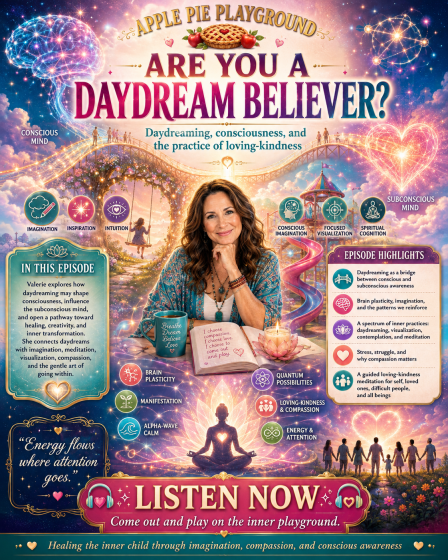

Apple Pie Playground with Valerie
Are you a daydream believer?
What practice produces an easy alignment between the conscious mind and the subconscious suitcases we talk about? Why does it matter? Let's talk.
The Inner Playground: Daydreaming, Consciousness, and the Practice of Loving-Kindness
Summary
Daydreaming as an Inner Creative Process
Valerie begins by shifting from a brief follow-up about missing and exploited children to the episode's primary subject: daydreaming. She describes children's pretending and make-believe as natural forms of daydreaming and presents the activity as a bridge between conscious and subconscious experience. In her spiritual framework, she also connects daydreaming to the etheric body, life-force energy, and the mind-body-spirit relationship. She argues that daydreams can carry memories, feelings, wishes, fears, desires, and intentions into a mental space where they can be recombined. This leads to her broader idea that daydreaming is not frivolous but potentially formative. The episode therefore treats imagination as an inner playground where consciousness can explore possibilities and reorganize experience.
Brain Plasticity, Manifestation, and Quantum Ideas
Valerie discusses research she attributes to Harvard and says it suggests that daydreaming may affect brain plasticity and future neural responses. She interprets this as a possible natural mechanism for what spiritual communities often call manifestation, because repeated imagery may influence patterns of thought and perception. She then compares daydreaming with her understanding of quantum superposition, in which multiple possible states exist until one state is observed or selected. From that comparison, she develops the idea that attention helps organize experience and repeats the principle that energy flows where attention goes. She also describes daydreaming as a conscious anchor that allows some awareness of the outer environment while the subconscious is permitted to drift and contribute imagery. These scientific and quantum connections are presented as Valerie's interpretation and were not independently verified for the transcript cleanup.
Imagination, Visualization, and Spiritual Cognition
The episode develops a spectrum of increasingly directed mental practices beginning with ordinary daydreaming. Valerie says children's pretending can support flexible thinking, problem-solving, emotional regulation, and social empathy, and she portrays make-believe as a natural mental workspace. Daydreaming can then become conscious imagination, in which a person deliberately shapes the images, memories, feelings, desires, and intentions that arise. Focused visualization narrows that process toward specific outcomes or goals. Valerie next describes spiritual cognition as contemplative meaning-making, such as revisiting an argument in the mind in order to seek deeper understanding or imagine a healthier response. Across these practices, she emphasizes imagination, inspiration, and intuition as important capacities of an integrated inner life.
Meditation and the Conscious-Subconscious Spectrum
Valerie places transcendental meditation at the more structured end of the spectrum she has built from daydreaming through conscious imagination, visualization, and spiritual cognition. She describes transcendental meditation as a mantra-centered practice aimed at creating a highly integrated mind-spirit-body experience. She says these different practices share an association with alpha-wave brain activity, which she describes as combining focus with deep restfulness. Her larger concern is the integration of conscious and subconscious aspects of the mind, which she views as part of expanding conscious and source awareness. She encourages listeners to explore these practices rather than dismiss daydreaming as wasted time. At the same time, she acknowledges that stress, anxiety, depression, fear, anger, and sensory overload can make free-flowing contemplation difficult.
Suffering, Acceptance, and Loving-Kindness
When daydreaming or focused meditation feels inaccessible, Valerie turns to loving-kindness as a practice of compassion. Drawing on teachings she attributes to Pema Chodrin, she defines suffering in simple terms as struggle and connects struggle to difficulty accepting circumstances as they are. Loving-kindness, in her presentation, is a way of sitting with pain without immediately resisting, fearing, or trying to change it. The practitioner notices sensations, allows them to exist, and responds with compassion rather than judgment. Valerie distinguishes this inward movement from spiritual practices that, in her view, direct energy outward through activities such as astral travel or channeling. Her stated goal is to call the spirit inward and cultivate a grounded presence within the body.
A Guided Practice of Compassion
The episode concludes with an extended guided loving-kindness meditation. Valerie first asks listeners to settle comfortably, return to the breath when attention wanders, and allow sensations to arise without judgment, fear, or resistance. The meditation begins by offering safety, happiness, freedom from suffering, and compassion to oneself. It then extends the same wishes to loved ones, to people who are especially challenging to one's peace, and finally to all sentient beings. The repeated language is intentional and forms part of the meditative structure, reinforcing acceptance and compassion at each stage. Valerie closes by thanking listeners for sharing the practice, encouraging both loving-kindness and daydreaming during the coming week, and returning to the program's recurring theme of healing the child within.
Apple Pie Playground


Support my show
$5.99/mo or $9.99/mo or more
Click HERE
SUBSCRIBE TO TALK SHOW
Apple Pie Playground, a show serving up slices of remembrance of who we are as sacred children of the spark, where friends gather for a little levity, add in some fun and self-reflection as we use play self-therapy tools that reawaken our authentic selves on this human journey together. Can you come out and play today?
Speaker Identification
Speaker 1 – Prerecorded Announcer / Opening Voice. The first three lines introduce the program in a polished promotional style before Valerie begins speaking.
Speaker 2 – Valerie, Host. Valerie identifies herself by first name at the beginning of the episode and delivers the entire discussion and guided meditation.
Speaker 3 – Prerecorded Announcer / Closing Voice. The final station-style lines give the next broadcast time, website, subscription invitation, and social-media references. The transcript does not establish whether this is the same individual as the opening announcer.
Speaker 1 – Prerecorded Announcer / Opening Voice
Welcome to Apple Pie Playground, where we serve up slices of healing for the heart. Stay tuned for a journey of transformation back to the divine in our child. Can you come out and play today?
Speaker 2 – Valerie, Host
Welcome, everyone, to Apple Pie Playground. I'm your host, Valerie. It's so good to be on the playground this afternoon, and thank you, BBS, for being here with us.
Before I forget, we inquired together last week about a truly unsettling reality in the human experience, and that was the horrific nature of missing and exploited children across the world. I mean, the numbers that we shared together were staggering.
I want to follow up briefly to encourage everybody to find your way over to YouTube for this week's Roseanne Barr podcast, where she interviews Kathy O'Brien. Kathy O'Brien is an MK-Ultra survivor from childhood, sold into the program and used at the highest levels in the United States government in ways we just could not believe are true.
Her story is horrifying, but it's also beautifully inspiring. The interview is really one of the best I have ever watched on the subject. I don't really use the word "should." Okay? I don't use that word very often. But if I did, I would say we all should watch this video: Kathy O'Brien on the Roseanne Barr podcast over on YouTube. The conversation is absolutely mind-blowing.
So please take some time to grow in your truth and pass the recommendation on to others, right? The interview threads together so many different topics that flow into the greater scheme of what's been a very dark world order. It's unbelievable to the ears, actually, and it's something of a must-watch. Please, please share as well.
If you are a survivor of abuse or exploitation, there are materials for you that Kathy O'Brien offers on her own website, which can help immensely. So check the interview out for yourself. It's over on YouTube, on the Roseanne Barr podcast, or do it for somebody else that you may know and love.
So, everybody, welcome to the playground. I want to talk about something that I love, and I hope I don't lose my listeners because this particular topic is a little deceptive.
I want to talk about daydreams today. That's sort of deceptive because we kind of throw our hands up and say, "In this day and age, in this time, look around you at what's going on. You're supposed to be sharing important information to change the world." And then I say, "Well, that's all about daydreams." I hope by the end of the show you believe me.
Children play out their daydreams, right? It's called pretending and make-believe, and it's as real to them as anything else in their world.
Daydreaming is actually an etheric activity. Well, what is that? The etheric body is what's referred to as a subtle body, or the body's energy field. That's called the etheric body. It's described as holding the energy of our life force and carrying the spirit's energetic blueprint. That's our etheric body.
So daydreaming, as a phenomenon, is an experience that bridges the spirit with the body as a process of consciousness. It's a process that lies just in between the conscious mind and the subconscious. We'll talk about that, because such are the things ascension is made of, friends.
There's new research out of Harvard. I know we take everything out of Harvard with a grain of salt. I am so hopeful that good things are coming out of our research. We're going to cross our fingers because the research is very provocative and very interesting, and I want to share it.
Research out of Harvard suggests that daydreaming can actually remodel the brain as part of brain plasticity. Now that's a big comment, right? So what is brain plasticity anyway?
One of the theories formed from the research is that daydreams can shape the brain's future response to what it sees, to what it integrates. Well, what does that mean?
It means, theoretically, that a brain can help shape reality in alignment with the patterns created in a daydream. So daydreams re-pattern the subconscious mind - its memories, its feelings, its intentions, what it wants, what it desires, what it fears - to respond to what is within the conscious environment of the mind in a way that coincides with a daydream we're having. What about that?
I want us to think about the opposite of that. What might be the opposite of a daydream? Maybe mind control: how patterns of information are artificially put into the brain to photographically align memory with the specific forced reality that's desired. That's mind control.
Well, apparently daydreams can help the brain naturally reinforce a desired reality in a similar way, only we're doing it to ourselves. We're reinforcing patterns of imagery that we choose. Does that make sense?
It happens through brain plasticity, and that's when neural pathways reorganize themselves as changes in brain patterns. Brain plasticity does this with daydreaming in a way that strikes me as a much more natural explanation for what we call manifestation than some of the other explanations that we get.
That's fascinating for me, to put that idea together with the idea of manifestation in a very natural process in the mind, just from something like a daydream.
So what are daydreams? Have you ever thought about it? Did we know that quantum mechanics actually deliberates on the idea of daydreams? From what I understand, a daydream is a very close parallel to what energy does in the quantum in informing a reality. It's kind of fun to think about it, right?
In quantum mechanics, there's what's called superposition. We've talked about this quite a few times. Superposition is the ability for particles to exist in many states of potential form - many, many states - as a combination of all possible outcomes, until one single state is chosen or observed. Then particles collapse into that state. Superposition.
The key for me is the idea that daydreams bridge the conscious and subconscious minds as new neural pathways are formed. So we're essentially pulling together different sets of cognitive data into a single reality and rewiring a state of consciousness, all by having a daydream.
So superposition is the basis of how we form our reality according to quantum mechanics, right? And this is where we can say, "Energy flows where attention goes." So wouldn't it make sense that our attention is focused on the beautiful unfolding of daydreams? Where will our energy flow but to those beautiful daydreams that we're having?
That reminds me of something of a famous Q quote. It's expressed this way: "There's simply nothing behind you until you turn around. And what you find behind you is your own creation."
So when we daydream, we exist consciously just in between the conscious and the subconscious mind, right there in between the conflagration of those two parts of our working mind, where things flow from each direction into our daydream and out in each direction from our daydream.
We are patterning our subconscious with the images we're holding, and we're redirecting our neural pathways consciously as we daydream. In other words - and this is a quote - "Daydreams act as a bridge between active waking awareness and deeper inner processing."
What are the implications of that, friends? Daydreams act as what's called a conscious anchor, where we're still attached to our conscious environment even while we are allowing what's called subconscious drift.
We're drifting off into our daydream. We are allowing the subconscious to impress memories and feelings and wishes and desires and intentions as something like colors on a mental canvas. Do we see that? We paint our daydream, and our stream of thought is detached just enough not to be distracted by our outer environment.
So you might be wondering, why are we spending so much time on a Sunday afternoon on daydreams? Well, did you know there are meditative practices that do exactly what daydreaming does for the mind? It's interesting that we cultivate meditation, but not necessarily daydreaming. That's fascinating to me.
Let's think about it. Kids don't meditate, right? They pretend. They make-believe, which means they are building neural pathways that do a few key things for them. Pretending creates greater capacity for flexible thinking, problem-solving, emotional regulation, and social empathy.
Psychology calls the mind that is pretending a mental workspace for integrating sensations. No meditation required. Kids get on the playground. They build their neural pathways. They do it easily. They pretend. They make-believe. All of these extraordinary things are happening in this mental workspace.
Does that make sense, friends? When daydreaming is modified as a meditative practice, even just a little bit, the same thing happens.
Daydreaming and meditation practices offer the same three things for the mind that expand us in really powerful ways. What are those three things? Imagination, inspiration, and intuition.
When we focus our daydreaming into what's called conscious imagination, the passive nature of daydreaming becomes more controlled, into what's called pictorial cognition, or the vivid image-making and contouring of images with memories and feelings and desires and intentions.
Now we're beginning to exert a little more control over this kind of daydreaming process. For those of us who use focused visualization, that comes out of conscious imagination. It's a subset of conscious imagination.
Focused visualization just super-streamlines its practice toward very specific outcomes or goals. We can sit and allow ourselves to daydream and then learn to enter the daydream very carefully and begin to direct what we're seeing and feeling and experiencing the way that we want to pattern the experience as a meditative state.
If we want to add some flavor to that practice, we can take the daydream into what's called spiritual cognition. Now it's a practice of contemplation that is meaning-making, or constructs purpose and order around a specific thing being contemplated. Spiritual cognition.
There's even a cognitive therapy that follows this kind of practice. Look it up if you're so inclined. Cognitive therapy follows this idea of spiritual cognition. It's a spiritually integrated cognitive behavioral therapy. It's a specific kind of cognitive behavioral therapy.
Spiritual cognition might be allowing ourselves, for example, to quietly relive an experience that we've had or form one in the mind's eye.
Let's say, for example, maybe we exchanged harsh words with somebody. We sit with the intent of informing ourselves of how to experience the scenario a little differently, or form an outcome around this experience we've had a little differently.
We'd sit with the scene in our mind to achieve what's called a direct illumination, or understanding of what happened and how to achieve a more desired state, a deeper understanding, or spiritual insight into that particular experience. Does that make sense?
By the way, fun fact: Thomas Aquinas supposedly used this particular method to contemplate universal truths that he could apply to physical human experiences as a spiritual practice. That's super interesting.
So when our children are pretending and playing make-believe and daydreaming, they're actually aligning their conscious and subconscious minds as an etheric process. It's an etheric process of integrating life-force energies into the body, into the mind, into the mind-body-spirit flow.
Do we see that? This integration of life-force energy into the mental process of the brain and into consciousness itself is not just a lovely expression of what spirits like to do - because it is lovely - but it's a profoundly effective way to create energy flow in the body.
It's deeply etheric, or spiritual if you want to use that term. You can use energetic if you want to. Children are working with their energies all the time, every day, in the most healthy way they possibly could.
Do we see that? And we are too, friends, even as adults. We don't want to forget that.
Just as an aside, when you think about it, when we sort of expand this idea out, it's probably why art and music and dance and probably even physical education, all of those things, have been taken out of school settings - as ways of achieving a deeply energetic experience that bridges the conscious mind with the subconscious and trains them both to work together. That's what we're talking about here.
The reason I am so excited to share this information is because that's exactly what we are trying to do, friends, whether we know it or not. Our expression of conscious awareness runs into a multitude of barriers and hurdles in the effort of integrating our conscious mind with our subconscious suitcases.
Do we see that? It is a heart's good work. It's a spirit's good work to find ways to help us better bridge these two aspects of our mind so that we can pull in greater conscious awareness and greater source consciousness.
On the far side of our spectrum, as we look at integrating the conscious and subconscious mind, is transcendental meditation. This is a meditation hyper-focused with sharp attention to a physical experience, and this is the meditation that uses a mantra or a sound that's repeated out loud during meditation, just in case we're not sure what that is.
There's no focus on breath or trying to empty the mind. None of that. The mantra is the key.
We're talking about folks who enter a highly trained, highly integrated mind-spirit-body experience. If it sounds interesting, try it out. Give it a try. Lots of videos online for that type of meditation.
It is most profoundly successful for creating alpha-wave activity in the brain and harnessing a great many physical controls that can be experienced during a meditation of that kind. The goal is what's called high internal coherence between conscious and subconscious parts of the mind.
We've talked about something of a spectrum of practices - increasingly self-controlled mental methods of integrating the conscious mind with the subconscious mind.
We've talked about daydreaming, which is sort of a loose effort of allowing what enters the mind to feel good and directing those sensations in a way that is pleasing, very loosely and freely created. That's on one side of the spectrum.
Then we move a little farther with conscious imagination or visualization. We exert a little more control over our efforts. Then we move a little farther across the spectrum with spiritual cognition, where we are maybe creating a particular scene or an experience that we can focus on.
Then we're moving to the other end of our spectrum with something highly ordered and concentrated, like transcendental meditation.
The beautiful thing about all of these things - daydreaming, conscious imagination, visualization, spiritual cognition, transcendental meditation - is that all of them create alpha-wave brain activity.
Like we like to talk about, alpha waves allow the brain to experience deep focus while at the same time experiencing complete restfulness. We're talking about brain waves that allow the mind to function in a very focused way while at a very deep rest. It is most healthy for our souls, friends, most healthy for our souls.
Try these things out. Do a little research. Let's give a little daydreaming to our downtime. What do you say?
Along with that idea, I want to recognize that sometimes - or maybe even a lot of the time - our spirits can't quite get to that degree of levity or openness or capacity to allow the mind to freely flow without things that interrupt those beautiful experiences. I get it.
I want to talk about times when things may get in the way of our daydreaming and our capacity to achieve contemplation and meditative states.
There are lots of things that invade the mind and prohibit free association and energy flow. We get it. There's stress. There's anxiety. There's sensory overload. There's depression. There's fear. There's anger. The list goes on and on.
So what then? What then when we want to experience these particular practices, but we're just not ready? We just can't go there. What happens when we can't get to a quiet, calm state of alpha brain, maybe?
There are practices that walk us through compassion for ourselves and for others when life is a struggle and we aren't able to enjoy a daydream. We can't visualize something we would choose to manifest for ourselves. Maybe we're suffering, and we don't know what to do or where to start. We don't even know how long we can manage to hold that frame of mind. I get it.
I'd like to walk through a particular practice today that is not exactly any of these practices that we've talked about, but it's a time-honored meditation called loving-kindness. It is a beautiful practice that helps build compassion for ourselves and others in times when focus and restful alertness or attentiveness might be hard for us.
This meditation is very old. It is an old practice, an old form. It's been reproduced many, many different ways with the same purpose: to achieve peace through acceptance. Peace through acceptance as the way of compassion. We call this loving-kindness.
Maybe you've heard of it. I hope you have.
We use this word "suffering" a lot. It just seems to capture the experience that we have in a dark world that we are just now moving ourselves out of in our efforts of liberation.
We understand suffering, and sometimes we have integrated this idea so much that it's just sort of a turn of phrase. Maybe we don't even think anymore about what this idea of suffering may actually mean for us. It's something of a catchphrase, but maybe we don't know for what anymore.
There's a special teacher who explains what suffering is so beautifully, and I want to recommend any and all of her meditations and lectures. Many of them are on YouTube. Her name is Pema Chodrin. Pema Chodrin. She is of a Buddhist persuasion.
She describes suffering simply as struggle. Struggle. When we struggle with anything, we suffer. It's as simple as that, friends.
Why do we struggle? Because we cannot accept things as they are, whatever they are. Rather, we feel we must change what is. Because we feel we must, and perhaps we can and perhaps we can't. Either way, we suffer the situation.
This meditation of loving-kindness is a way to learn how to allow what is and to call that compassion for ourselves and for others.
As we offer loving-kindness to those we truly love, and also to those who are challenges to our peace, we learn to offer loving-kindness without resistance, without longing, without fear, without hesitation or dread.
We learn to sit with what we might be feeling as pain - the pain of our struggle - and hold compassion for it. We observe it and allow it and love it with kindness in our hearts. Our growth allows us to do that for others too.
So be invited this week to practice the meditation.
New Age spirituality, all right? We've seen the rise of New Age spirituality, and it's sort of refocused meditation in the direction of the outer self. We go into meditation, and as soon as we have gone within and we are inside and our spirit is coming to us and located there, we just want to move right on out of the body.
We want to do all of these things. We want to astral travel. We want to go out into the ether. We want to channel stuff. We want to visit planets. We want to go through vortexes. We want to do all kinds of stuff outside of ourselves, friends.
But we know what the show is all about. Our goal is to go within. It's the same for meditation. If you are sitting down in quiet contemplation, you are going within.
We are directing our spirit energy within ourselves. We aren't sending it out anywhere. We're not sending it out. We don't want it hijacked. We don't want it taken over. We don't want it disabused and maligned, or whatever kinds of dark stuff goes on. Lots of dark stuff goes on, friends.
We don't want to do any of that. Our job is to go within, and that means meditation as well.
So we're going to relax a little bit and go within, pull our energy inside ourselves, call our spirit to be present inside our body, and get ourselves to turn our attention to the compassion of loving-kindness.
If you'd like to join, allow me to offer a short contemplation. It's a very old practice for evoking loving-kindness. We will recognize a lot of repetition of language that we might remember as we adopt the meditation for our own this week, if we choose to.
Now let's find a place to sit and get comfortable. We may choose to close our eyes.
We'll remember our breath and return to it whenever our focus shifts away from observing our practice. If emotion arises, we return to breath. Always return to breath as we focus inward, allowing the mind to clear away, allowing simply being as we sit.
We are allowing what is to be in this moment, allowing all sensations to exist as they are, without judgment, without fear, without resistance.
Noticing what is transforms it into compassion for ourselves, for others, for every sentient being.
We allow what is to be within ourselves, simply noticing the sensations we feel. We allow what comes in. We allow what moves out while we evoke a presence of spirit within us.
We are present and able to receive the gift of loving-kindness that we give ourselves today.
We offer loving-kindness to our being, holding it in our hearts with true compassion for who we are, allowing sensations of struggle to transform into deep love for ourselves.
May we feel safety and happiness. May we experience freedom from suffering and the root of all suffering, as we hold true gratitude for what we are receiving.
We are allowing what is to be, allowing all sensations to exist as they are. Noticing what is transforms it into compassion for ourselves, for others, for every sentient being.
We offer loving-kindness to others we love and cherish, holding in our hearts a true compassion for those we love the most.
We wish for them the transformation of sensations of struggle into deep love for themselves and their divine nature.
May they feel safety and happiness. May they experience freedom from suffering and the root of all suffering, as we hold true gratitude for what they are receiving.
We are allowing what is to be in this moment, allowing all sensations to exist as they are. Noticing what is transforms it into compassion for ourselves, for others, for every sentient being.
We allow what is to be within ourselves, simply noticing the sensations we feel.
We offer loving-kindness to those most challenging to our spirits.
As we allow what is to be without judgment, we sit noticing what comes in and what moves out while we evoke a presence of spirit once again.
We are present and able to receive the gift of loving-kindness that allows us to hold deep compassion for those most challenging to our peace.
We offer that same loving-kindness to them.
We wish for them the transformation of sensations of struggle into deep, abiding love for themselves and their divine nature.
May they feel safety and happiness. May they experience freedom from suffering and the root of all suffering, as we hold gratitude for what they are receiving.
We are allowing what is to be in this moment, allowing all sensations to exist as they are, without judgment, without fear, without resistance, for ourselves, for others, for every sentient being.
We offer loving-kindness to all sentient beings, holding in our hearts a true compassion for all living things.
We wish for them the transformation of sensations of struggle into deep love for themselves and their divine nature.
May they feel safety and happiness. May they experience freedom from suffering and the root of all suffering, as we hold true gratitude for what they are receiving.
Allowing what is to be in this moment, noticing what is as it transforms into compassion for ourselves, for others, and all sentient beings.
We return to the physical room with well-being.
That is our meditation in loving-kindness, friends. It guides us into compassion for ourselves, into an equanimity between ourselves and others, for those we love the most, for those who challenge us the most, and for all sentient beings around us.
I want to thank you so much for sitting with me today in sangha. Maybe loving-kindness will be your contemplation this week, and maybe a little daydreaming too. I would wish that for everybody.
I want to thank you for being here, for being brave enough to try something new, and kind enough to share your generosity of sitting with us all and adding your beautiful spirit to our contemplation.
I want to thank you, BBS, for daydreaming with us like you always do. You are daydream believers of the highest kind, and we're so grateful.
So, until next time, friends, I'm going to head home. Thanks for being a part of today's journey.
Speaker 3 – Prerecorded Announcer / Closing Voice
We'll see you back on the playground next Sunday at 1 p.m. Central Time on BBSRadio.com. Make sure to subscribe if you enjoyed the show. Find us on Telegram and X to share your insights on today's topics. Your input heals the child in us all.