
Apple Pie Playground, August 30, 2026

Apple Pie Playground with Valerie
Light at the End of the Tunnel: Salvation?
Can we have a difficult conversation on the nature of salvation? Let's talk.
Breaking the Red Rover Line: Sovereignty, Conscious Creation, and the Courage to Know Yourself
Summary
The Reflexive Universe and Conscious Creation
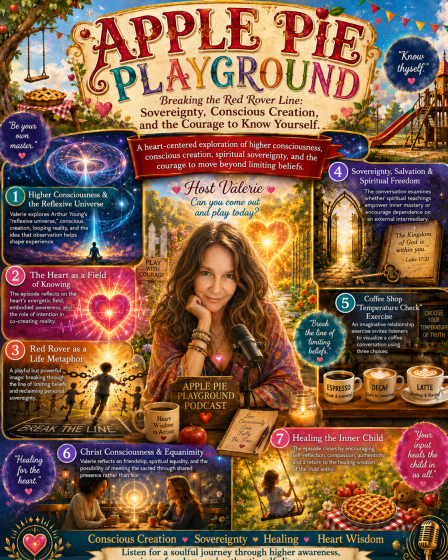
Valerie begins by continuing the previous week's exploration of higher consciousness and a philosophical model she calls the reflexive universe. She describes reality as a self-observing loop in which consciousness moves outward into new experience and then bends back to integrate what has been learned. Drawing on ideas attributed to Arthur Young and a lecture from the Vesica Institute, she connects this model with toroidal energy, the electromagnetic field of the heart, observation, intention, manifestation, and the higher self. Her central point is that human beings participate uniquely in co-creation and possess a form of sovereignty within a larger field of cosmic interaction. She presents the universe as something that comes to know itself through conscious beings and through the feedback between experience, observation, and creation.
Red Rover, Limiting Beliefs, and the Present Moment
The childhood game Red Rover becomes Valerie's primary metaphor for the challenge of breaking through limiting beliefs and claiming personal sovereignty. She asks listeners to imagine themselves confronting the line that separates the limitations of physical life from what she describes as the boundlessness of true essence. Rather than waiting for one dramatic event to transform humanity, she argues that reality changes through ordinary thoughts, observations, choices, lessons, and acts in the present moment. She emphasizes that memories of yesterday and expectations of tomorrow can pull attention away from the only moment in which people can exercise their co-creative power. In this framing, spiritual awakening is not merely a future cosmic event but a minute-by-minute practice of integrating one's highest sense of self.
God, Source Consciousness, and Human Agency
Valerie expands the discussion into the relationship between God, source consciousness, and everyday human action. She describes the divine not as something waiting outside humanity to intervene at a later time, but as something expressed through breath, heartbeat, awareness, compassion, kindness, love, service, and conscious choice. She argues that God does not wait to change political, healthcare, educational, or social systems because, in her view, those changes are worked through human beings. The episode repeatedly returns to the idea that people are vehicles through which a larger consciousness experiences, learns, and acts. Valerie uses this framework to encourage listeners to take their present choices seriously and to recognize their own role in shaping a shared reality.
Salvation, Slavery, and Questions of Spiritual Sovereignty
The most challenging philosophical section examines teachings about salvation, particularly Valerie's interpretation of the Apostle Paul's language concerning slavery to sin, righteousness, Christ, and divine mercy. She contrasts ideas of salvation that depend upon an external savior or intermediary with a model of inward spiritual sovereignty and self-knowledge. She also introduces a Buddhist comparison, referring to a tradition associated with the belief that people in a spiritually degenerate age may be too bound by ignorance to attain enlightenment through unaided effort. Valerie is careful to frame this as a question for reflection rather than an attack on anyone's faith, repeatedly asking listeners not to feel offended. The underlying issue she raises is whether spiritual teachings encourage people to surrender sovereignty or can instead be understood in ways that lead them toward greater freedom, responsibility, and direct connection with source consciousness.
Mastery, the Tunnel Metaphor, and Knowing Yourself
Valerie develops a metaphor of a dark tunnel to ask whether people can learn their way toward freedom by continuing to move, observe, and choose rather than standing still. She argues that knowledge alone is insufficient if understanding never becomes action, and she returns to Red Rover as an image of deciding whether to remain behind inherited barriers or break through them. Her conclusion is that the natural world and quantum mechanics, as she interprets them, do not reveal a hierarchy of masters but a coordinated expression of energies participating in a cosmos that seeks to know itself. From that idea she arrives at the phrase “Know thyself” and encourages listeners to become their own masters through self-mastery. She also reminds the audience to take what is meaningful from the discussion, leave what is not, and preserve love and respect while considering difficult ideas.
The Coffee Temperature Check and a Conversation with Christ
To close on a lighter and more experiential note, Valerie guides listeners through a coffee-shop visualization called “Temperature Check.” Listeners imagine sharing coffee with someone close to them and choose among espresso for an intense truth, decaf for a calm and lighthearted conversation, or a latte for something emotionally sensitive. She then connects the exercise to a social-media visualization about having coffee with Christ and asks whether a person who worships Christ could feel fully relaxed, equal, heard, and authentically themselves in such a conversation. Valerie extends the thought experiment into the idea of Christ consciousness, asking listeners to imagine sovereign spirits meeting one another with equanimity rather than hierarchy. The episode ends by encouraging wonder, thoughtful contemplation, open-hearted dialogue, and continued participation when the show returns the following Sunday.
Apple Pie Playground


Support my show
$5.99/mo or $9.99/mo or more
Click HERE
SUBSCRIBE TO TALK SHOW
Apple Pie Playground, a show serving up slices of remembrance of who we are as sacred children of the spark, where friends gather for a little levity, add in some fun and self-reflection as we use play self-therapy tools that reawaken our authentic selves on this human journey together. Can you come out and play today?
Speaker Identification
Speaker 1 - Valerie, Host. She explicitly introduces herself as Valerie near the beginning of the episode and delivers the full live monologue and guided exercise.
Speaker 2 - Prerecorded Announcer / Show Intro and Outro Voice. The opening invitation and final promotional sign-off are stylistically separate from Valerie's live monologue and function as prerecorded show-identification material.
Speaker 2 - Prerecorded Announcer / Show Intro and Outro Voice:
Welcome to Apple Pie Playground, where we serve up slices of healing for the heart. Stay tuned for a journey of transformation back to the divinity of your child. Can you come out and play today?
Speaker 1 - Valerie:
Welcome, everyone, to Apple Pie Playground. I'm your host, Valerie. It's so good to be on the playground this afternoon, and thank you, BBS, for being here with us.
Let's dare our authentic selves to be out on the playground together today against the backdrop of what I call a game of Red Rover. Even when the line is really tough and you've got to break free, limiting beliefs kick in, right? Metaphorically. We'll talk about my least favorite game in just a bit, but let's start where we left off last week, exploring the idea of higher consciousness as something of a transcendent experience explained by the way energies work all around us. So let's do that before we deal with the Red Rover traumas.
Okay. Have we heard of the postulation of what's called the reflexive universe? It's an idea coming out of the 1970s, a philosophical view proposed by Arthur Young that uses quantum mechanics as the basis for his theory about the manner of a conscious universe. The idea suggests that reality is a closed loop in the mechanics of conscious creation, if you can imagine that.
This loop pushes out and pulls back in on itself, creating what's novel or newly learned and then pulling what's already known into that novelty. The idea is that reality bends back on itself, or loops back around on itself, to observe itself more consciously with every loop it makes.
And so we get models like a fourth-dimensional sphere bending back into a third-dimensional toroidal energy field and pulling what is in 3D into 4D as a vortex motion that's shifting energy into a higher-dimensional rotation or loop. Right? Can you imagine that?
That was just one example given by the lecture we've been talking about. We talked a lot about a particular lecture from the Vesica Institute last week. That's just one example that was given. But we don't have to guess about that explanation, right? We know that the rhythmic field of the heart, with its chambers, is a double vortex that circulates energy in and out and creates an electromagnetic field, right?
And so we are seeing this idea in real time. We feel it in the body, right? We aren't finding our way into higher levels of consciousness willy-nilly, so to speak. For the most part, we have physical attributes that we can feel and look to and understand as true, even as we build these really big, complex models and project those out into quantum mechanics. Does that make sense?
We can use a set of natural laws intrinsic within the everything of all cosmic interactions. But the extraordinary thing is that we are completely unique in our co-creation practices within this aspect of cosmic interaction. You are completely unique in your co-creation practices, as am I, as is every single person on this planet.
We are sovereign as creator beings in a cosmos of interactions. We are that free, that able to form reality at our own choosing. Isn't that extraordinary? And yet we can't find our way to that kind of power most days, right?
But it's how quantum mechanics can explain observation, or what we call setting intention, as the tool for manifesting in a physical realm because of what's called a dimensional reflexive feedback loop, bending back on itself. That's what we just described. It's connecting what would be with what has already been manifested as a matter of conscious creation and its own observation of itself.
Okay, can we imagine that? The reflexive loop is self-referencing, or self-observing, and aware of the changes in its state. Arthur Young called it a grand arc, where light descends into matter and then pulls self-knowing in as an integrative or reflexive process or loop - as the way the universe studies itself, the way God experiences itself. It's basically a conscious-creation feedback loop, friends. Does that make sense?
Input and output are pathways formed by what creates consciousness, and that consciousness looks back to observe itself. So we create by observing the manifestation that looks back to see what has been created. Does that make sense?
Let me give a couple of examples of how that works for us. We focus on our intentions to create a future reality by acting as if it is already manifested, which it is as a spiraled reality bending back in as the manifestation comes to us. And we experience the higher self as being the part of us that already knows what we're learning and helps us remember what we know that it already knows. Right?
So those are two examples of reflexive reality: manifestation, and then the concept of the higher self guiding us.
Do we see the extent of sovereignty required for those examples to occur the way they do? Do we see that requirement in a cosmos where God - and that's whatever that is to us, right? - looks in on itself and what it's learning, and helps itself remember what it already knows so we can build in more knowing and more experiencing?
And it does that in each and every one of us as a vehicle of itself, as the mechanics of its own knowing. That's extraordinary, isn't it? Source lets us take the wheel, and we drive together to parts unknown. That's just an extraordinary thing.
So this is where our game of Red Rover comes in: the strategy involved in the game of life that butts up against consciously choosing to be sovereign and responsibly co-creating as the cosmos expects us to be. It can be really hard in a game where we're being sized up by everyone and every single thing around us, right? This game of life, this game of Red Rover that we're playing.
Going to co-create from personal power is like a fairly tough game of Red Rover. We've got to break the line of limiting beliefs, and that means figuring out where the weak links are, doesn't it? Right? “Red Rover, Red Rover, send Valerie right over.” And that's where we are, taking on the barrier between the limitations of this physical realm and the freedoms of our true essence, as boundless as they are.
And, you know, we're getting pretty close to the climax of our human story in this age, friends. I think we can all feel it - the energy that just radiates in. I mean, it is just full-blown energetics.
Can we be brave enough to trust our place in a cosmos that makes us co-creators with duties to our sovereign spirits as a minute-by-minute journey, and not just a someday event or a single occurrence that is growing with great anticipation?
If we were learning every day, in small ways and in large ways, how to integrate our God-self beingness through all of the experiences coming our way - the lessons we're learning, the things we are observing, the choices we are making, the growth that we are creating for ourselves - what would we be like at the very, very, very end of all of those lessons? Have we ever thought about it? Where would we be at the very, very, very end of all of that training? Have we thought about it?
Now, we know there's never an end. There's simply no end. However, we do know that humanity has experienced extreme barriers - lots of barriers - to our evolution of consciousness that could take us out to sensing the end of an age and the beginning of a true ascension point, right?
And what would that be like at the end of everything we're trying to learn? Really, really think about what we could be at our greatest evolution, as far as we can see it. If there were a threshold for such things, we're getting close to it, friends.
We are entering an experience of humanity unlike other ages. And we've been here before. We've had some hits and some misses. It may be our very last round. But we are entering a momentum of life-force energies in the cosmos that resonate with nothing but our higher calling - what many might call our awakening, our rebirth, our transcendence, our deliverance, maybe?
We are being called forth to participate in our spirit's integration with the expansion of a universal web of beingness into its next level in a multitude of ways. And we see that we are walking into the mystery of God evolving itself. We are armed only with the preparations of the heart.
We go with what we've got when you think about it: with what we know, with the strengths we've built and the weaknesses we've babied along the way. Whatever is us, whatever our progress and our peace, that's what goes. It's what decides the mystery as it unfolds for us. Right?
Many of us are waiting for a single shifting event that catapults us into a new reality. We're waiting for the next big thing to happen that changes everything. We're on the edge of our seats expecting big things, earth-shattering things, when all of reality - every single bit of it - actually changes with every single little thought that we have and every single choice that we make, every single decision. Right?
These little things, friends, are as big as it can ever get. Reality changes with every observation we make. We bend time and space in quantum fields by making those observations. And we share fields of reality along with lots of other folks doing the exact same thing, culminating in a shared reality.
We pull in what will become reality as a fluid daydream with hardly any effort. Each lesson, each understanding, each heartbeat coaxes that ever-flowing reality, because each and every one signifies the only thing that is true: our present moment of all that we are and are capable of.
We needn't mourn the idea that we didn't do a better job yesterday at being kind, because there is no yesterday, friends. And we can't plan to be more loving tomorrow, because there is no tomorrow, friends. There are thoughts of tomorrow and memories of yesterday, and both of them have us missing our now.
And it's not a bad thing. It's just a choice of where we choose to reside, where our co-creation powers are focused. It's a now in which God emanates from each breath, each heartbeat. That is the now where God lives.
Waiting for a cosmic flash of spiritual expansion that makes us into higher beings is so, so, so exciting. It's so thrilling. But God doesn't wait to flash, friends. God doesn't wait. It beats with the heart and breathes in awareness as your heart and your awareness. God offers compassion and kindness and love and light in the ever-present experience of your true self - your eternal now.
The source consciousness of all beingness presses in for its opportunity to serve a magnanimous purpose. And what is that purpose? The source of all consciousness presses in to be one with us, with our hands and our hearts and our service, one to another.
And friends, God doesn't wait to change the political system, to change the healthcare system, to change the education system. God doesn't wait to build a new Earth, because, you know, God's been trying to do that since time immemorial through us, for us, as us, friends. That's the name of the whole game.
Do we understand? Do we realize the depth of what this moment holds, this one right now? Do we realize its expansiveness? Do we realize all that is contained within our perpetual natures in this present moment? Do we take every advantage to know ourselves as deeply, choose to be evolved as if it is already true? Because it is, friends. We just can't conceive of that idea maybe just yet.
And all of this is leading to my next comment. There's a reason why, maybe for many of us, we can't necessarily conceive of these ideas. Maybe it's a reason embedded in the very thing we cling to the most. Maybe. Maybe the thing that gives us the most comfort, even as it creates the greatest fear and avoidance and striving.
And I wonder: can we talk about it? What might enslave us by its own merits, friends? What might keep us just weak enough to be willing to wait for God to return to us instead of being ever-present in a constant evolution of spirit, a continual joining of consciousness?
So what takes away our sovereignty as a spirit's truest dignity and its only true state of being? I want to use an example to keep the focus on an idea and not on an argument. This example is an observation that I invite us to consider with great care, friends, for our hearts and our belief systems and the relationship that we've developed together.
Do we know what holds us back in our lives, or what propels us forward? What makes us whole? Have we studied our lives and the beliefs that inspire our behaviors? Have we offered ourselves as much grace to look into ourselves that closely? Have we investigated the luxury of how sovereignty feels to our spirit, to our mind, to our bodies? Are we free enough to be sovereign in the Age of Aquarius? I'm asking that to see if we are willing to test that idea.
What do the teachings of sacred writings we might hold dear say about such things? What is salvation to us? What is it to our spirit? What is it to God's source being? What is salvation to us?
Maybe we can think of it by framing that in a different question. What was it to the early biblical apostles of Christ? Salvation - this idea - what was it to the Apostle Paul?
Do we know that in his evangelizing of what became written into the biblical gospel of Christ, the Apostle Paul almost always, without fail, expressed our human condition in terms of slavery? The Bible records many, many instances of his sermonizing that we are, as humans, slaves to somebody one way or the other by our design, by what we are intrinsically, by who we are naturally, as a natural state. We are either slaves to sin or slaves to righteousness.
Now, did we know that the word “slave,” coming through the Greek as a translation, is used at least 120 times in the New Testament? Not the Old Testament - in the New Testament. Paul is recorded as saying that Christ purchased the freedom of man and claims ownership of the faithful.
What is salvation, friends, as a lesson in our churches, but the exchanging of masters - the exchanging of one master for another? And, you know, why would it even matter as long as we are raptured? But friends, doesn't it matter?
Paul is famous for saying that the Christian is both, at the same time, the Lord's freed man and Christ's slave, as a matter of righteous duty to God, as a matter of righteousness. In letters like Romans, Paul argued that people cannot save themselves or choose God by their own unaided fallen nature. Instead, the human will is bound to a desire for sin until God intervenes. Salvation depends on God's mercy rather than human will or effort.
Now let me reframe this idea in a very, very different way so that we don't feel picked on or disabused, which is not where we want to be together right now. There is a Buddhist sect that believes much the same way. Shinran Buddhists argue that human beings in this degenerate age of man are just too deeply bound by ignorance to achieve enlightenment through their own effort.
Therefore, they too see a true decline in humanity's ability to save itself as spirits, as energy bodies, as transcending beings. It can be argued that spiritual teachings reflect a wave of change in the nature of man as sovereign beings over time. That wave of teaching looks outside itself for answers to connecting to source consciousness in an increasing way over the ages of spiritual humanity, as beliefs that man cannot connect to his own source consciousness without an intermediary.
But is there another way to see ourselves, a way that revives traditions of an inwardly focused salvation? Are we separated from our source, or necessarily entangled with it? Can we not be what we observe ourselves as?
We might ask ourselves: is there, in fact, a way out of a metaphorically dark tunnel that gets longer and more harrowing with every religious doctrine composed by man? So please, please don't let me offend, friends. Is there light at the end of this tunnel that our religions are building? Or are we stuck in the dark, fixated on the fear of our spiritual failure instead of its inherent coaxing from the heart?
Who of us would choose to remain inside the tunnel of another's making, even though it has an entrance and it has an exit? And it's true, friends, that we may never get out of a tunnel that is pitch black, without the slit of light in the distance in front of us, if we never try to.
But am I a slave to the dark? Am I able to find my way? Or does every step in one direction or the other move me into a better knowing? Can I not know the end of this tunnel if I keep learning which direction to walk? And will I not reach the end by my own steps, in my own time, unless I stand still and refuse any other option? All other impulses are going to move me forward, except stopping.
And a slave cannot secure his own freedom being what he is, not by any knowing that he would possess, nothing he would learn, no amount of mental expansiveness, because his understanding takes no action. He must simply choose to become absolutely what freedom is, whatever that means to him, and act as a matter of his own sovereignty. Do we see that?
Seek, friends, and you shall find absolutely all that you are. So who would make us a slave to our own righteousness and never liberated, not even through Christ?
Maybe this is the simple key to our game of Red Rover, friends, as a metaphor. In this day and age, deciding if we even want to play this game or not, are we evolving into our sovereignty or into greater servitude? What is the master of a higher mind, of a co-creating heart, of a being that evokes a God-self as part of the mystery of the cosmos? Where do we stand? How do we choose to play?
And you know what? It's not for me to say, friends. It's not for me to say. All I know is quantum mechanics has this methodology that we are learning to use right now in this time and space, and it teaches us one true thing at the very least: there are no masters in quantum mechanics.
There are no masters in the natural world, the natural laws of a cosmos that we know of. There is only a finely coordinated expression of energies functioning on behalf of a cosmos that would know itself. Know thyself, friends. Be your own master. And this is called mastery. This is called mastery of the self that we are.
I hope that made sense, friends, and not to offend anyone. Please forgive me if I did. I so hope that we can have conversations that allow us to observe certain viewpoints and reflect on those with the capacity that we have to consider those things that we talk about.
So I think it would be fun to do a quick proposal together that will set us up for something of a short expressive activity before we close today. We're not closing on something of a heavy-duty kind of conversation, because that was kind of heavy. We walked through it together, and we'll take from it our own viewpoint, and our hearts will mull it over in their own way.
We will take what was meaningful, and we'll leave the rest. I hope we always choose to do that together, friends. It's what I love about us: that we can come together and chew on some things, as it were, and take what we will and leave the rest, and still love each other. That's the important thing.
So I'm wondering if we can sit for a minute in this little activity and observe what our minds might do in a particular scene that I want to share with us. Let's create a scene where we are sitting in a coffee shop, having a nice cup of coffee with someone really, really great to be with.
Can we imagine for just a minute what that scene would look like? Can we feel into it for just a minute? What would make us feel super comfortable sitting there? What would let our guards down most readily as we are sharing that cup of coffee? What would help us feel heard in our conversation and give us a sense that the time was enjoyable to the other person as much as it was to us?
Let's fill in the imagery here in this scene. How do we feel? What are we doing? What is our body language saying as we're watching ourselves sit there? Why do we enjoy this time we're spending with this particular person so much? Okay, do we have the scene in our mind's eye?
Let's do a brief expressive-play exercise with this scene. We may want to use our notebooks for this activity, but we don't especially need them today. We don't especially need pencil or paper. We're just going to use our mind's eye and visualize a little bit to walk us through this activity.
It's a really popular activity, and I think we'll probably really like it. I thought it was super fun. It's super expressive. So let's stay with the coffee-shop scene. Let's start to fill in more details of our surroundings as we imagine what's taking place.
Now let's choose the person who is joining us for coffee. Choose somebody with whom you are in something of an intimate relationship, whatever that means to you. That means somebody with whom you can have meaningful discussions and with whom you may have very different kinds of conversations.
All right, do we have our coffee partner in mind? It may be that we might want to imagine having a first coffee with somebody we'd like to spend time with, but maybe we haven't yet. So feel free to practice a conversation with somebody you may want to sit down with for a conversation but just haven't yet.
The name of this exercise is “Temperature Check,” and it's used a lot in relationship play. The idea is that you have a coffee menu right in front of you, as does the other person you're with. On that menu, there are three different coffee choices you can order. You're going to make your choice, and then your coffee partner will make their choice. Each coffee suggests a specific piece of information to be shared between the two of you.
You'll decide what information you'll ask your partner from the list, depending on the coffee that you order. So here's the list of coffees on your menu.
First, you can order an espresso, which means, “I need to share a quick, direct, fairly intense truth with you, my coffee partner.” Choosing an espresso means that you'll imagine sharing an intense truth with your coffee partner.
The next coffee choice on the menu is decaf. Ordering decaf means, “I need a calm, relaxed talk with zero stress or problem-solving.” I need a calm conversation. Choosing a decaf coffee means you will imagine sharing a diversion of sorts with your coffee partner.
And the last coffee on the menu is a latte, which means, “I am sharing something sensitive with you right now with a lot of emotion attached.” Choosing a latte means you'll imagine feeling safe enough to share an emotional idea or information with your coffee partner.
So take a minute and choose which coffee you're going to order. Espresso is an intense truth that you'll share. Decaf is a lighthearted comment. A latte is an emotional topic that you may want to share with your coffee partner. Allow yourself to imagine how that sharing goes in your mind's eye. What do you need to share?
Take a minute and visualize sharing with your coffee partner. Allow your visualization to unfold. What is the conversation? What's the topic? How is it going? Are you able to visualize how your coffee partner will respond to what you're saying? Are you getting some insights through this conversation that you're having? Are you satisfied with the conversation that you are imagining in your mind's eye?
There's a lot to think about here. Hopefully, sometime this week, it would be kind of fun to sit down and rethink this conversation. You can even visualize which coffee your partner might order and the conversation they might wish to have with you. So give it a try. See how it goes.
I searched out this activity because of something of a popular visualization that's going around social media right now. It's a thing now: visualizing having a coffee, sitting down and having a cup of coffee with Christ. That's the thing going around social media right now. It's the thing.
Is it possible for folks who idolize Christ to really enjoy that cup of coffee with him? I'm wondering what you think about that. Is that really possible? Would it be pleasant to have a cup of Joe with somebody that we actually worship? Have we ever thought about what that would feel like?
We're not judging. We're just imagining and getting a sense of our feelings here. Could we truly be ourselves, our true selves, completely comfortable in the presence of someone we thought was specially different somehow from us? Somebody who was so very special and important and magnificent, somebody the heavens made greater than us?
Let's think about that, and I mean really, really think about it. How impossible a thing to consider that God could make anything greater or lesser than itself. Or would we rather engage a Christ who could sit down and have a coffee with us, who could have a really, really good conversation, who would listen to our point of view, who would lean in and look at us and understand where we're coming from?
Can we even imagine complete comfort with such a man? Would we recognize our own beautiful spirit coming through? Would it magnify one heart to another? Could we find commonality? Could we feel like we were celebrated over that cup of coffee? Would we ooh and faint and be afraid? Or would we get into the idea that it felt good to sit and be with somebody who feels so natural?
What would it feel like for us to be considered maybe a friend, or a brother, or a sister - somebody worthy of time and attention from Christ? How good might it feel to be sought out for such a conversation, to be that important?
So why don't we feel that important? Why can't there be two of us sitting there as Christs, imbued with natural, inherent, intrinsic Christ consciousness, Christos energies coming from a quantum field served by source consciousness itself? Both of us sitting there in that kind of energy, having coffee together. Maybe in a coffee shop full of Christs sitting everywhere, at every table. How about that, friends?
Are we ashamed to consider such a thing? Is it improper or maybe vulgar to imagine that kind of thing in our mind? Doesn't it even integrate into our view of a higher-dimensional experience? Doesn't it resonate on a deeper level of conscious awareness?
That means we are experiencing equanimity in our relationships among all beings. And isn't that the resonance we're creating as we move from a controlled world of our current lives into the magic and extraordinary experience of feeling equanimity between sovereign spirits of a higher order?
I mean all of us, of all sorts, who are here in this place together, sharing the eternal together, who will come and go and experience time and space in different ways over and over again, eternally, throughout universes of incarnations together. Can we think about it? For that to be true, isn't there an equanimity required?
Moving ourselves from this physical realm of comparing and contrasting and separation into a higher realm of self, into a higher mental plane, into a place where spirits coexist in sovereignty and equanimity - is it not necessary to consider these things as we evolve? Is it not a requirement of our own evolution?
Is it not the way of natural law to move ourselves into equanimity and leave behind ideas like worship that may not belong in a realm shared by a cosmos of like hearts and sovereign spirits?
I hope it's something worth thinking about. I hope it's good food for thought and that it fills us with wonderment and joy at its contemplation. And, you know, it's my contemplation as much as it is yours, friends.
I want to thank you for daring thoughts like those. I want to thank you for staying with me and sharing a Sunday afternoon of supposals that may not be easy to consider. It's so brave of you for trying. I'm so grateful we could be together today. Thank you so much for coming along and coming my way, and I'm so grateful I could join you.
But now, friends, it is time for us all to head home, I suppose, off the playground. Time to head home to BBS. And thank you so much for being here with us, BBS. We do love you. So, until next time.
Speaker 2 - Prerecorded Announcer / Show Intro and Outro Voice:
Time to head home, friends. Thanks for being a part of today's journey. We'll see you back on the playground next Sunday at 1:00 p.m. Central Time on bbsradio.com. Make sure to subscribe if you enjoy the show. Find us on Telegram and X to share your insights on today's topics. Your input heals the child in us all.