
Apple Pie Playground, August 23, 2026


Apple Pie Playground with Valerie
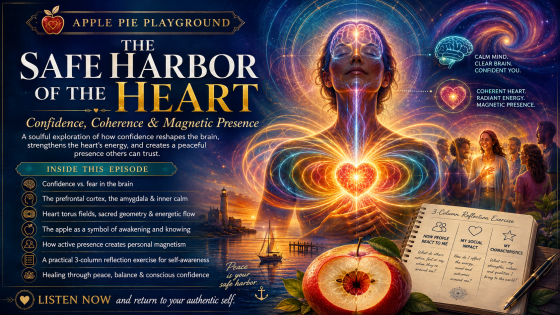
The Safe Harbor of the Heart
The heart is a mysterious realm served best by a confidence of spirit. How so? Let's talk.
Magnetic Presence: Confidence, Coherence, and the Energy of the Heart
Summary
Confidence as a Brain Pattern
Valerie explores confidence as more than a social performance, describing it as a state that can influence the brain's expectations about safety, success, and failure. She distinguishes between simply faking confidence and acting as if confidence is already present, arguing that the latter can become integrated into one's mental experience. She connects confidence to the prefrontal cortex, self-concept, decision-making, and the calming of threat responses associated with the amygdala. Failure, in this framing, can be reinterpreted as learning rather than danger so the brain is less likely to brace for defeat. The discussion emphasizes consciously building a predictable internal story of resilience, self-assurance, and rational response.
Peace as a Safe Harbor
The episode links inner confidence with peace and the effect that peace may have on relationships. Valerie reflects on the idea that personal peace can function as a safe harbor for other people, making one's presence feel steadier and more trustworthy. She argues that love may feel less reliable when it is accompanied by fear, insecurity, or chronic internal instability. Confidence, in her view, helps align mind, body, and spirit around a stronger sense of safety. This makes peacemaking not only a personal goal but also something that can shape how other people experience us.
The Heart, the Torus, and Sacred Geometry
Valerie then moves from psychology into an energetic interpretation of the heart, describing the torus or toroidal field as a recurring geometric form associated with the heart's pulsing. She references a lecture from the Vesica Institute and attributes to it ideas about cardiac research, electromagnetic patterns, sacred geometry, and concentric tori. The apple becomes a visual model for the torus because of its rounded form and central axis. She presents the torus as a form that preserves its basic structure while expanding and uses that idea to discuss energy moving through and beyond the body. These scientific and metaphysical connections are presented as the host's interpretation of the material she studied.
Consciousness, Balance, and Coherence
The episode expands the toroidal model into a broader discussion of consciousness, life force, higher dimensions, and what Valerie calls source consciousness. She describes balanced inward and outward energy flow as a way of reducing polarity and creating a more optimized state. Positive emotion is connected in the discussion to physiological coherence, confidence, and a stronger heart-centered energetic pattern. Valerie also relays a model from the lecture suggesting that electromagnetic influence may extend far beyond the body. From there, she asks listeners to imagine how their internal state might affect a room, a relationship, or even a much larger field of people.
The Apple, Knowledge, and Spiritual Interpretation
Returning to the Garden of Eden imagery introduced at the beginning, Valerie reconsiders the apple as a possible symbol of the torus and of growing into knowledge. She questions why Adam and Eve would be forbidden to grow in their knowing and connects the story to self-awareness and higher consciousness. She interprets their awareness of nakedness as a possible recognition of the distinction between spirit and material flesh. The episode also introduces esoteric ideas involving the serpent, Sophia, Christos, and the spark of God. These are presented as speculative spiritual questions for reflection rather than as established historical or theological conclusions.
Magnetic Personality Through Active Presence
The final portion turns the theme into a practical reflection exercise about personal magnetism. Listeners are asked to evaluate how people react to them, what social impact they have, and what characteristics they bring into group settings. Questions focus on eye contact, attentiveness, body language, confidence, ease, and whether others appear to relax, engage, or seek connection. Valerie identifies active presence and genuine engagement as the strongest indicator of personal magnetism in a social environment. She closes by encouraging listeners to choose confidence over fear and doubt, suggesting that a confident, peaceful presence can give others a sense of safe harbor.
Apple Pie Playground


Support my show
$5.99/mo or $9.99/mo or more
Click HERE
SUBSCRIBE TO TALK SHOW
Apple Pie Playground, a show serving up slices of remembrance of who we are as sacred children of the spark, where friends gather for a little levity, add in some fun and self-reflection as we use play self-therapy tools that reawaken our authentic selves on this human journey together. Can you come out and play today?
Speaker Identification
Speaker 1 - Announcer / Prerecorded Promo Voice (probable). The brief opening invitation and final promotional sign-off have the structure of a prerecorded show introduction/outro. Because the transcript does not explicitly name this voice, this identification remains probable rather than certain.
Speaker 2 - Valerie, Host. The speaker explicitly says, "I'm your host Valerie," and then delivers the main monologue, reflective exercise, and closing remarks.
Speaker 1 - Announcer / Prerecorded Promo Voice: Welcome to Apple Pie Playground, where we serve up slices of healing for the heart. Stay tuned for a journey of transformation back to the divine inner child. Can you come out and play today?
Speaker 2 - Valerie, Host: Welcome, everyone, to Apple Pie Playground. I'm your host, Valerie. We are inviting our divine inner child out to play, as always, which means we are guided by our authentic self. And we like it that way. We love to be guided by you, BBS, and thank you for doing what you do best on the other side of the microphones. Thank you so much, BBS.
You know, friends, we are a world in contact. I want to thank you for being here, everyone, on a wonderful Sunday afternoon. I have had occasion to reflect on a few vocabulary words that I've used over the last few Sundays, but I'm realizing that there's so much more behind those words. There are ideas we can navigate together that truly prove a 21st-century convergence of science, spiritualism, and truth-telling in what we're talking about when we discuss the energetics of the human spirit.
I want to prove out the science of a few ideas, like the torus functions of our hearts, and how the heart is a vortex. I want to put that idea together to discuss the vortices of space-time that kind of connect our reality to higher dimensions. Then I want to share a little bit of a fun insight into what it might really mean to exude a magnetic personality. So, if we're in, let's get started.
I want to start by asking us all to try to visualize in our mind's eye the scene in the Garden of Eden when a serpent gave Eve an apple and told her that it, in fact, would not kill her but give her the wisdom of God. Can we picture that scene in our minds? Maybe we're thinking about what we learned a long time ago in Sunday school, and that's okay. The Bible narrates that Adam was told not to eat of the tree of knowledge. And here comes Eve with an apple, and oh boy, what does she do? Do we see that in our mind's eye? Okay. We're going to come back to that scene in just a little while.
I want to tempt you with that imagery because of what the apple, and actually many fruits for that matter, represent energetically. We'll come back to the image that we have in our minds a little later.
Recently, I have been thinking about what it takes to be a confident person, to be self-assured with a magnetism that draws things to us - people and opportunity. And I'm not talking about manifestation. I'm not talking about manifestation. I'm talking about the bioelectric magnetism that our body's energy field operates with. I'm talking about the energy we create and send out and the energy we receive from others. I've been wondering how that connects to ideas like confidence, curiosity, self-love, and self-assurance. I want to talk about it for a minute.
It all goes back to the heart's energy, its torus, and our internal vortex that connects us vibrationally to levels of what folks actually call dimensionality. So that's where we're going. But I want to start in the brain. Let's start with the brain and its operating system, [unclear phrase in source: "Stare motion bodies"], and what we do when we optimize the energies in positive ways throughout our bodies.
So what does confidence look like in our brains? What's going on up there to produce what we feel as confidence? Here's the thing: it's a Catch-22. The truth is, we have to act confident in order to help the brain believe it and replicate it as a mental experience. And I don't mean act like it or fake it. I mean acting as if we are, in fact, confident. There's a difference here. I did not know that this difference existed, but there is a difference between those two things: faking it and acting as if we are, in fact, confident.
Faking it is noble. It's a brave thing to do. It's a brave, brave thing to do, but it's not integrative. When we fake it, it's not integrative. Well, what does that mean? In other words, if we don't believe it's true, then the brain won't believe it. Does that make sense?
Rather than faking it, we engage our goal as if we are already it. We are already confident. Now, that's not easy sometimes. That first shaky step toward confidence can be a real game changer. When we act as if something is already true for us, then what happens is the brain takes over. It's like, "Yeah, you did the hard part. Here, I'm going to take over now," and it reconstructs the intention in a few key ways.
First, the brain synchronizes the logical parts of itself. It synchronizes all of those critical-thinking parts, the planning centers of the brain. The prefrontal cortex fires up, and this is where our self-concept is formed and reinforced. It's what's called the executive center, the executive control center of the rational part of the brain.
Conceptually, we are telling the control center that we are confident, calm, and self-assured enough to make good choices that are reasonable and responsible. And this calms the nervous system down chemically, energetically, and emotionally. It allows the brain to lower its defenses against threats of harm.
That's a lot going on when we make one decision, when we decide that we are going to feel confident, which is most certainly not always easy. As a matter of fact, I'm going to go out on a limb and say it might be one of the hardest things humans have to do, if for no other reason than having been traumatized and trained away from using the prefrontal cortex in favor of keeping us in fight-or-flight mode, in the reptilian brain down in the back and the bottom of the brain, instead of the top front. It seems to be that the dark systems of control want to keep us in the back at the bottom. Does that make sense?
What happens is that our amygdala is a part of the brain responsible for threat control, and we've talked about this. When we presume to be confident, we quiet the amygdala down. Otherwise, our worry, fear, and frustration keep it firing and keep it ready for all of the possible threats that could come its way. When we lack confidence, that's exactly what's happening in our brain. The brain is bracing for our failure. That's what's going on.
So the brain is either helping us produce success or helping us produce failure, friends. It's one or the other. I wish there were other nuances of our mental state, but not so much, friends. So does it make sense that we might want to reconsider what we call our experiences of failure as a matter of ensuring our brains maintain evidence of confidence?
A positive mindset means our failure equals something different to the brain. It means that our failure equals learning to the brain. It equals an interesting challenge for the prefrontal cortex rather than a matter of falling into fear, into threat, into that sort of red-light warning that sets the brain off. It pulls us out of the rational, self-assuring, self-soothing part of the brain.
That self-concept, or identity, is linked to our mindset. The brain is triggered by what we think of ourselves through expressions of confidence or expressions of fear and doubt. It's one or the other. The brain builds a story around those expressions, whichever one we choose, as a matter of protecting itself. That's its number one job. And that story it creates builds predictability in the mind.
We've talked about this. Predictability is key for the brain. The brain perpetuates a consistent storyline. Identity matters. Now, the brain doesn't necessarily care if we are traumatized to the point of constant, consistent fear as long as it can create a predictable storyline. It's a prediction machine. The brain is a prediction machine.
If it senses we are confident, it can trust us to pull our focus into the logical part of the brain. We're able to predict outcomes better, which means we're able to make better decisions, think things through, and prove to the brain that we are ensuring our safety through our confidence.
When you think about it, it's how folks like firefighters, emergency medical technicians, rescue personnel, and military forces are able to do what they do. They learn confidence first, and they integrate it into a subconscious program so that confidence is automatic for the brain. The mind stays in success mode, in confidence, even through hazard, danger, and risk.
So let's think about this. Isn't a big part of confidence how we deal with failure? It means dealing with failure in ways that don't damage our self-concept, our identity, and move us out of our rational mental processes. Through a lot of conscious awareness, we can automate the experience of safety, success, and confidence in the subconscious mind. It does take work, and we know this.
We're doing the good work of pairing our conscious selves with our subconscious through mindfulness, introspection, and lifestyles of conscious awareness, contemplation, getting quiet, and sitting still. We're learning to synchronize the conscious and the subconscious, to understand the synchronicities, the signs, and the symptoms, and to interpret what comes through and use it in a positive way - to understand what we are receiving as information from the subconscious and build it into the conscious mind.
Pairing that means we are learning to observe our lives without a tug-of-war of sensory input that pushes and pulls us in and out of our peace. We are learning to maintain a balance of mind, body, and spirit. We are replacing fears of failure with confidence, creating resilience and flexibility in the way we problem-solve, so the brain sees it as the normal course of business. Do we see that?
And yes, that's a lot of work. That's the good work that we're doing, friends. That is the good work that we are doing. We are building a foundation on which to attract and integrate conscious awareness. That's what we're doing - the good work we're doing.
I was listening this week to a presentation suggesting that one's peace is not just important for ourselves, but for others who would trust us. In relationships, our peace creates a safe harbor. We want to believe that love is enough for a relationship, but if we aren't projecting the confidence of our own peace and its value, then are we serving others with a love that is fearful and maybe unreliable?
I sat and thought about that because confidence is foundational for our peace, as it turns out. It produces a lasting peace, which is an immovable peace. Not because we learned to always be right, never to fail, or never to have doubt, but because we are aligning ourselves - mind, body, and spirit - with a physical process that resonates success as safety, rationality, and trustworthiness in the brain.
Therefore, when our heart moves its energy up and down our nervous system and connects it with the brain - which desperately needs the heart's guidance and desperately needs to regulate the nervous system - we can use confidence as a beautiful tool in that alignment. This is what I listened to in a very intriguing presentation this week. It's all about the signals that we send ourselves that command our reality.
I suppose that the same might be said of relationships. Human relations function on the basis of confidence, just like the brain. We are either confident or we are fearful. It's sort of a pendulum swing, isn't it? Eventually, we are going to be in one place or the other, and wherever we are is going to attract or repulse. Our peace, then, is the deciding factor. That's what frees us, and it's a matter of confidence. It's a matter of confidence.
So why is it that I'm talking about confidence when I started the show describing things like torus fields and vortices? Is that a little bit curious, anybody? Well, as energy bodies, we create a flow inside of us that integrates a resonance around us. We know this. We are essentially energies bumping into each other all day long, and we are deciding how to interpret that and how to integrate it. We are either colliding or integrating with the life force all around us and with each other.
The energy we emit creates a pulse pattern. The more that we know about the idea of source consciousness, the more that we understand that life force is a matter of patterning - the repetition of patterning that pulls from possibility predictable behaviors, manifestations, and events. Knowing that helps us understand that it fires at a certain strength and force.
These patterns of energy that we produce in our heart space, for example, are like the idea of confidence boosting the brain to fashion a reality of success and safety. [The next clause is partially reconstructed from a garbled source.] This helps optimize the process in the brain toward its fullest function. Well, our energy bodies do the same thing. We radiate our internal reality outward. Does that make sense? We are generating, in a broader field, a signature of what's going on inside of us. And we can't help it. Everything is energy, and energy doesn't lie. We know this.
With that in mind, I watched a lecture on sacred geometry this week presented by the Vesica Institute. The lecture is called The Torus and the Spiral, presented by Dr. Robert Gilbert of the Vesica Institute. You can find lots of stuff online from the Vesica Institute.
It turns out that research exists on the heart all the way back to the seventies that suggests an energetic responsibility in the function of the heart - not just a physical one, but an energetic responsibility of the heart to do what it does. This research wasn't any kind of spiritual research. It was purely medical. It was research on cardiac arrhythmia, and it generated some really provocative results about the energy of the heart.
The research discovered that every time the heart pulses, it creates a biogeometrical pattern that we call a torus field. And this is mainstream scientific research. The heart's pulsing creates a biogeometric pattern, an observable pattern that we call a torus field. We call it a toroidal field. The literature of the day called it a torus field, and the torus field is made up of a lot of concentric tori functioning together in a pattern that produces the rhythmic electromagnetic pulse of our hearts by firing themselves off in a pattern.
So what does that mean? Well, a torus is most easily described as a donut-shaped energy field. If you can think of a donut and then visualize it with many, many, many circles framing the donut shape, that's a simple image of a torus, or a toroidal field. We're used to calling it a toroidal field as we talk about it.
We can think of an apple as a torus form. Imagine an apple. You cut the apple in half and we have the circular arc of the fruity flesh that radiates around its seed bed, where the axis is there in the middle of the apple. This torus shape is a biogeometric form that keeps its shape and its function even when it expands. So no matter how big the apple grows, it is going to keep its biogeometric form. It's going to keep its shape, and it's going to continue to perform its energetic function, no matter how small it gets or how big it gets.
We find these torus fields in every living thing, every subatomic atom, right up to the defining nature of the cosmos itself. That's how large we get. Imagine that. The torus is a primary form in sacred geometry. It integrates energy flow into the creation process itself, and we'll talk about that.
The torus of our hearts is electromagnetic in nature. With every heartbeat, energy moves in and out as a pattern of pulses, which keeps its form and its function as it extends or radiates out from the body. Now, this is important when you think about other ideas like connecting physicality to higher-dimensional grids or dimensional places or spaces in our conscious environment, in our quantum environment, because we need something that is going to maintain its energetic form and its energetic function to stay materially dependable. Does that make sense?
The interesting thing is, science is moving ever closer to this idea. And I want to quote: "We can bring in a divine essence and circulate it through an energetic field." That's what we were just talking about. We can use what is a dependable torus in form and function as a primary building block of every single thing in existence, and we can move that out into other dimensional experiences outside of the material realm.
The exciting thing about that is that we can begin to talk about consciousness as a driving force in this energetic expression of our material world. And that's exciting. So, you know, is that what we can point to as intelligent design? Can we say that? Is this evidence of source consciousness entering the physical realm? Are we able to begin talking about what that looks like mathematically, what that looks like in the realm of science, physics, and quantum? Can we make the quote-unquote quantum leap?
Well, I think we can. I think we do already, honestly, but that's a different topic. So let's think about it. Can we imagine God as the quantum fields of all that is flowing through our hearts? We align with the field and resonate with it, and it fills us energetically. It's an infinite loop of energy, an endless flow of life force. Does that make sense?
Our energy field is a closed system, and as a closed system, it flows through us. But it's also connected to everything around it because it can adopt the form and function in a consistent pattern. Does that make sense?
When we optimize our energy, when we produce a robust pattern of flow, just think of a heartbeat. We've got good rhythm in our heart. It's nice, it's healthy, it's flowing, and it is beating the way it needs to. There's a vortex in there moving energy in and out - a double vortex moving energy in and out - creating a robust pattern of flow.
What is going on is a representation of what we can call balancing the polarity of our energy. We are balancing the opposing forces at work in our field, which means we're keeping a balance between the inward contraction of our torus field and the outward expansion of it. That keeps the form and function of our flow of energy.
The balance is energy without polarity. It is optimal energy flow in our body. When we experience an energy flow that is completely, perfectly balanced, it is optimized energetically. We are experiencing energy without polarity. Do we see how balance is the key to everything, friends?
So why the conversation on confidence when we're talking about this idea of removing polarity through a perfection in our energy flow? Because we increase our toroidal field or decrease it - it can go either way - depending on how we use our energy, the strength and patterning of our energy flow.
Positive emotion in the body creates what is called physiological coherence. Physiological coherence. Let me get that word right. Physiological coherence. It's a thing. I can't say it very well, but it's a thing.
The greater our physical positivity, the better our brains are at being assured of safety, success, and predictability. The more confident we are, the more optimized our heart's torus field is, and the better it patterns a consistent energy flow. The stronger our electromagnetic field, the more that field radiates outward.
According to the lecture that I listened to, this electromagnetic field can stretch hundreds and possibly thousands of miles. In fact, it can roll out immeasurably, if you can imagine that. That was the model presented. So imagine this: we affect a planet of people with our energies. Imagine it. Imagine what we do to a room of people when we walk in or when we walk out.
Do you remember when I said we would return to the apple in the biblical Adam and Eve story? What do we think of the apple now and what it might have been in that story? Maybe Adam and Eve were told not to eat from the tree of knowledge. And knowledge, etymologically, means growing into knowing. So why were Adam and Eve never to grow into their knowing? How can that be? How can the first man and first woman in human creation not be expected or allowed to grow in their knowing?
Let's think about ourselves. We ourselves are trying to grow in our knowing, and we equate our efforts to remembering who we are as divine beings. Does it make sense that Adam and Eve would be forbidden to do the same thing? And what does the apple represent in the story? To receive an apple, of all things - it's a perfect representation of a torus, or a toroidal field. When you think about it, it's a perfect example of how to use energy to evolve into higher consciousness.
So why could they not avail themselves of the knowledge of energy fields that would create higher conscious awareness inside of them? Does it make sense? And when they did eat the apple, they realized they were naked. Did they not, for the first time, realize the manifest difference between what was spirit and what was flesh of a material world? Did they not become self-aware, maybe as newly conscious beings?
And, you know, what if I told you that the story goes that they were gifted this knowledge as beings who received the spark of God out of a higher love for the creation of man, even if man were not initially intended to have it? And what if we believe the first stories about the serpent as a seraphim of the throne of God, maybe dispatched by Sophia to the garden as the bringer of Christos to man? What do we think about that? Maybe there's more to think about.
So what does it really mean to have a magnetic personality? At the beginning, we talked about how we would end our time together thinking about all of the things that we have discussed today and how it results in the confidence that creates a magnetic personality. What does that mean - to be able to draw people in? What is it all about, anyway?
In quantum terminology, there's actually a term for it that's called ferromagnetic exchange interaction. And I'm not even kidding about that. Ferromagnetic exchange interaction. It means when you enter a room and your energy is in a highly coherent state - it's stabilized, optimized, balanced, synchronized - then your energy is like a magnet that pulls the energy of everybody else into alignment closer to yours, or into greater coherence or resonance.
So it's why maybe a room of grumpy folks is not so fun. It's why, when we're grumpy, it's not so fun for the folks around us, and we could all lose resonance together if we're not very, very careful.
Do you want to test the idea of a magnetic personality together a little bit before we have to go? Do you want to play a little bit? Let's test this. All we need is something to write on and something to write with. We need a little bit of paper, maybe a pen or a pencil. Some of us like to use our notebooks so we can return to the exercises and reflect a little bit, but we don't have to.
If we're doing this exercise on paper, we want to take a minute and draw three columns down the page. That might just be a couple of lines you draw down the page to make sure you get three columns, and we'll be putting information in each of those three columns. If you have your paper, go ahead and make your three columns, and let's label them.
Let's label column one: "How people react to me." That's column one. The heading for column two is: "My social impact." And the heading for column three is: "My characteristics." Do we have it? Three columns, three headings.
Now let's think back to the last time you were in a room with other people in an organized way - a memorable time that you were in a group of people. It doesn't really matter how many people were there, but you want a group. You want enough of a group to be able to sort of measure what was going on in social terms.
Let's get that memory in our mind. Let's try to visualize it as specifically as we can - a memorable time of being in a group of folks. Maybe it was a conference, a meeting, a training, something at work, or something you were doing during downtime or an activity with friends, or what have you. Just a group of people. Let's try to think of how it felt. Let's remember how we felt.
Let's remember as much as we can about the kinds of interactions we engaged in, and let's try to see what we can remember about this gathering as specifically as we can. We might have some emotions popping up about it, too, and that's okay. It could be really informative if we do. Folks might pop up - maybe people we remember, personalities, or whatever the case may be. That can all be very informative.
So do we have a scene in our mind? Let's work with it. We're going to reflect, and we're going to try to be as clear as we can about the experience. We're not going to worry if we can't remember a lot. Let's just use our overall impressions. If we can, that'll go a long way.
We're going to turn our attention to column one. The heading is, "How people reacted to me." We're going to jot down a few notes based on some questions that I'm going to ask. Are we ready?
Did people in the room walk up to us and introduce themselves? Did people hold conversations with us? Did they confide in us in some way? Were there ways that folks were confiding information in us? We can jot some things down if memory serves. Do we remember anyone sharing an opinion about something or somebody? Did folks look to see what our reactions to their comments were? Did they want our approval? Did anybody remember us as a new acquaintance from somewhere? Those are the questions for column one.
We're going to move to column two. That heading is, "My social impact." Let's think about this. Did the stress or excitement around us calm down when we sat down or went to stand with a group? What was our effect on the group? Maybe we were at a table of people. Did people relax with us being there at the table or in the setting we were in? Did they have a heightened attentiveness to us? Did people stop talking and listen to us when we spoke?
Did people offer us a seat, pull up a chair for us, or maybe make a space for us to stand together with them in a group? Did people touch us on our arm, elbow, shoulder, or back? Did people find our eyes and try to hold our attention? What do we remember?
Last column: column three, "My characteristics." First question: Did we feel comfortable in our own skin? Did we feel confident in ourselves that day? Were we at ease? Were we smiling at folks, maybe as they spoke or as we looked around at the crowd? Were we engaging with others? Did we touch anyone on the arm, shoulder, or back?
Did we offer others our undivided attention, maybe when they were talking or when there was a presentation, or were we preoccupied? Maybe we were reading something, on our phones, or eating something. Do we remember where our attention was? Did we try to make eye contact with everybody at the table or in the group at one point or another? Did we use body language to show interest in what was going on, like leaning in, leaning forward, or nodding our heads? And did we feel like our authentic selves? That was for column three.
Let's take a minute and think about what we've written, what we remember, and what we've observed about our particular memory. Let's ask ourselves, on a scale of one to ten, how magnetic we think we might have been at this one particular event or this one particular time. A scale of one to ten.
We want to stay away from judging. We don't really want to judge. We're just trying to get a sense here. We're taking a look at our pattern of behavior to see what we remember, and that's important because we're going to ask ourselves a final question. Try to think of an answer. I'm going to give you some space to think of an answer before I say it, to see what you come up with.
Do we know the single greatest indicator of our magnetism? Do we know what that is? The single greatest indicator of our magnetism in any environment, in a group, or as we are out and about in a public place - do we know? What decides how magnetic we are at any given time?
Well, I'll tell you. The greatest indicator that personal magnetism will work in a room of people is our level of active presence - our engagement with the people that we're around. Because we are activating our energy. We are sending it out to resonate, and we are activating other folks' energy, and it bounces back in the reflexive loop that we're talking about today. It takes us actively sharing our energy to create that magnetism. That's an interactive experience.
I'm wondering if your answer was sort of along the same lines. We can always learn to do that better or more mindfully, to engage people and vibe with them better and better as we go. I thought that was a fun and really instructive exercise for me, and I hope it was for you, too. We haven't played in a while, and so that was super fun for me. I really, really hope you enjoyed it. I always love when we can get into a little expressive play. I think it's always helpful, beneficial, and super fun.
For myself, friends, I think it could be true that one of the most pressing goals for humanity is to pull people back into their confidence. I think many of us are unsettled, anxious, struggling, and doubtful, and we can't find a confident footing, which means our peace is not so easy much of the time. I think healing our world may actually be an act of building confidence again. Building confidence again.
Our good work, at least, is choosing confidence over our doubt and our fear. It's very, very instructive for me. I've been doing a lot of contemplation on that. And, you know, that choice changes everything every single time we make it.
So can we decide to be more confident, to prioritize our peacemaking? Really, that forms a certain kind of energy, so that everyone around us can trust our energetic magnetism - that creates a peace everyone around us can trust. It puts them at ease, and it gives them safe harbor for their own peace. And that's the work of magnetic personalities like yours, friends. So maybe that's something to think about this week.
But how time flies. I want to thank you so much for being with me this week. I really, really enjoyed our time together. And thank you, BBS, for being on the playground with us this week. As always, we love you, BBS. And until next time, I'm going to head home, friends.
Speaker 1 - Announcer / Prerecorded Promo Voice: Thanks for being a part of today's journey. We'll see you back on the playground next Sunday at 1 p.m. Central Time on bbsradio.com. Make sure to subscribe if you enjoyed the show. Find us on Telegram and X to share your insights on today's topics. Your input heals the child in us all.