
Apple Pie Playground, August 2, 2026

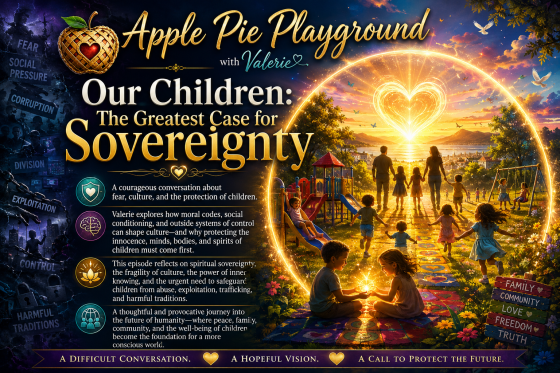

Apple Pie Playground with Valerie
Our Children: the Greatest Case for Sovereignty
There are eight million reasons to insist on sovereignty as a standard of care for human liberty. Don't know the eight million reasons? Let's talk.
The Measure of a Civilization: Sovereignty Begins with Our Children
Summary
A Difficult Question for Humanity
Valerie opens by acknowledging that the episode addresses a sensitive subject and asks listeners to approach it with compassion rather than judgment. Building on a previous discussion about the limits of fixed moral codes, she asks what single change would most improve the world for the human spirit. Her answer develops around fear, external control, and the loss of personal sovereignty. She frames the episode as an inquiry into whether humanity can evolve by relying more on inner spiritual knowing than on imposed systems of morality.
The Playground as a Picture of Culture
A lunchtime visit to a children's indoor play area becomes the episode's central metaphor. Valerie describes younger children peacefully absorbed in imaginative self-play until an older child enters and tries to organize everyone around his own game. His frustration, pushiness, and effort to control the group alter the emotional atmosphere. She interprets the scene as a small example of how fragile cultures can be when an outside force attempts to replace established patterns through pressure and control.
Morality, Culture, and External Control
Valerie expands the playground image into a broader discussion of cultural disruption, civil unrest, genocide, and what she calls cultural ethnocide. She questions whether moral language can be used not only as a guide to conduct but also as a weapon that pits communities against one another. In her view, family structures, religion, government, education, law, workplaces, and policing may all participate in systems that encourage compliance. She argues that cultures can lose their identities when people fear resisting outside narratives or surrender their decision-making to institutions.
Religion, Fear, and Inner Sovereignty
The episode then turns toward organized religion and its relationship to fear. Valerie argues that worshiping an external image of Christ can distract people from what she calls the Christ within and from their own spiritual power. She questions whether fear of death, condemnation, or separation from God makes people surrender their liberties and inner knowing. In her interpretation, limiting beliefs create a society that polices itself, while genuine sovereignty requires individuals to reclaim conscious choice and resist systems that manipulate morality or spirituality.
Children as the Measure of Civilization
Returning to the play center, Valerie says the innocence, creativity, and present-moment joy of the children reveal what humanity must protect. She proposes that the sovereignty of children's minds, bodies, and spirits should become a universal standard of care. The host then cites figures she says she found online concerning child marriage, childhood sexual abuse, missing children, and child trafficking. These figures are presented as reasons to confront cultural practices and institutions that permit harm, although the transcript does not independently establish or verify the statistics.
A Shared Commitment to Protection and Change
Valerie concludes by calling for a worldwide culture centered on family, peace, sovereignty, and the protection of children. She asks whether humanity can release painful histories, evolve together, and build common principles that do no harm. The episode presents conscious service, mindful decision-making, and heart-centered community as practical ways to create change. Listeners are encouraged to identify the issue at the top of their own list for a better humanity and to invest their energy in becoming part of the solution.
Apple Pie Playground


Support my show
$5.99/mo or $9.99/mo or more
Click HERE
SUBSCRIBE TO TALK SHOW
Apple Pie Playground, a show serving up slices of remembrance of who we are as sacred children of the spark, where friends gather for a little levity, add in some fun and self-reflection as we use play self-therapy tools that reawaken our authentic selves on this human journey together. Can you come out and play today?
Speaker Identification
Speaker 1 - Announcer / Prerecorded Program Voice: Identified by the polished program introduction and closing promotional language.
Speaker 2 - Valerie, Host: She identifies herself by first name near the beginning and delivers the full episode commentary.
Speaker 1: Welcome to Apple Pie Playground, where we serve up slices of healing for the heart. Stay tuned for a journey of transformation back to the divine in your child. Can you come out and play today?
Speaker 2: Welcome, everyone, to Apple Pie Playground. I'm your host, Valerie. Let's hit the playground running this afternoon. What do you say? We're going to talk about something that might be a little tough to discuss today. But first, I want to thank BBS for being on the playground with us and always being willing to have those difficult conversations. We're so grateful you're here with us. Thank you so much, BBS.
Speaker 2: I have to tell you that I've been doing a lot of thinking about a particular subject that I have avoided for about a year. It's a sensitive topic, and I don't want to offend anyone. I guess it's not the best way to start a show when you come on and immediately feel that you have to apologize because you don't want to cause offense. But I think we can manage it if we offer ourselves compassion and an opportunity to think deeply about some ideas today, if you're willing to go there with me. I'd love to go there with you.
Speaker 2: We set the stage last week with a few ideas. If you haven't listened to last week's show, it might be helpful to go back and give it a listen. We were talking about the limitations of a fixed morality, or a moral code, as a standard of behavior for spiritual beings such as ourselves. If it's helpful to this week's conversation, take a listen. Today, let's talk about something that stems from the idea of choosing to live by moral codes rather than by inner knowing.
Speaker 2: This conversation takes the pulse of humanity, and we are humanity. Believe it or not, we are together on the edge of extraordinary things and exceptional abundance. I know so many of us don't feel that, but if we sat with it for a while and allowed it to be true, the possibilities would be endless. Beautiful, exceptional abundance and prosperity may be coming our way if we do our part. This conversation might matter as we consider how to live in a world that nurtures spirit.
Speaker 2: If you look around right now, there isn't much in our world that nurtures spirit. But I can tell you that the old is falling away, friends: government systems, banking systems, medical systems, and legal systems. It is falling away, and we can do our part. I have to tell you, Fauci is the tip of the iceberg. Disclosure is here on every level. For those of us with eyes to see, we are already looking past the rubble toward a new and better Earth experience. It's exciting if we let the sense of a new Earth rising live in our hearts, neighborhoods, families, and faith. The interesting thing is that we can feel it deep down inside, even though we don't necessarily see it in our realities.
Speaker 2: We are hearing a lot about different kinds of civil unrest around the world this week, and I've been wondering about it. In that light, I have a question for all of us this afternoon. Even though your list may be long, and choosing what belongs at the top may be difficult, what is the one thing that must change to make the world as a whole a better place for spirit - our spirit? What must change to usher in an age of spirit for every one of us here in our beautiful Earth realm? What is your number-one response? What first popped into your mind? I'd love to know.
Speaker 2: What one thing needs to be corrected, extinguished, or created across humanity for us to evolve into a level of alignment that changes everything? I want to talk about my answer, which is at the top of my list, and it will be interesting to see whether it made your list too. Let's dive in and compare our top answers.
Speaker 2: Do we all agree that there are some human behaviors we simply must shed if we're heading upward as humanity - upward in vibration, frequency, conscious awareness, peace, joy, and remembrance? If we're headed toward the stars, so to speak, or back to the stars galactically, we can't take certain kinds of true dysfunction with us. I wonder whether we agree that some unhelpful or corrupted patterns of behavior - perhaps dark cultural norms - don't align with where we're going. Can we talk about that?
Speaker 2: The last thing I want to do is give a lecture, even though I do love giving lectures and a good speech. That aside, I don't want to lead us into a war of judgments today. I want to approach the topic carefully by posing questions I'm having as I daydream about living a sovereign life in an elevated, enlightened world together. Let's consider this an inquiry we can ponder together.
Speaker 2: I want to share an observation I made over a quick lunch this week at a restaurant with an indoor play center for children. Our group happened to be seated directly in front of a large window attached to the play center. We were eating lunch on one side of a glass wall while the children played directly on the other side. I couldn't help watching them for a while because the energy in there must have been off the charts. They were animated, joyful, and deeply engaged in make-believe. It caught my attention, and I sat with them from the other side of the glass and shared in their pretending. I remembered how it used to feel to play the way those children were playing.
Speaker 2: Then I noticed a shift in the room. An energetic shift seemed to take place in the play center, and a visceral change occurred in the playroom's dynamic. What do you think would cause a noticeable energy shift among a group of children playing on a playground? What happened was that a much older child entered the play center, and things changed fairly quickly for everyone.
Speaker 2: This young boy was perhaps seven or eight years old, while the room was full of children who were probably four or five. If you've watched very young children play, they tend toward self-play. Everyone is involved in individual make-believe, playing around one another while acting out their own imaginings. At times, they may all come together briefly. In this case, everyone might climb up the slide and take a turn sliding down, and then they would eventually move back into their own play.
Speaker 2: That was the scene until the older child joined them. He apparently wanted everyone's attention so they would play his game and follow his lead in a specific activity he wanted to organize. Can you see that in your mind's eye? The boy became frustrated when the younger children wandered in different directions and returned to their own pretending. He became pushy and then loud, and his frustration grew by leaps and bounds.
Speaker 2: I'm not certain, but I think his parent pulled him from the room because he left abruptly, and I believe his mother directed him back to the table. Perhaps she saw the dynamic and what was happening because he was much older and his presence had made things strained. What I saw stayed with me throughout the week, and I found myself thinking about the culture I had watched in the playroom - a culture that was created and then recreated there. Its social balance changed with the arrival of the eight-year-old boy.
Speaker 2: What I had been watching was an eight-year-old's preconscious mind attempting to reorganize the cultural norms of a group of five-year-olds through force of will and a real effort to exert external control. That little boy gave me a new view of the fragility of culture, especially for unsuspecting groups of people who would rather ignore the elephant in the room - the push of outside forces into the group - than fight those forces.
Speaker 2: The younger children ran away from the older boy and returned to their own private worlds, while he stood there deciding how he would push his interests on a group of unsuspecting younger children. It made me think about how fragile culture can be, no matter how old it is. I thought about countries and communities around the world wrestling with the moral question of trying to be good neighbors, respecting equal rights and religious beliefs, and then being trampled in the process. We're seeing it in the news everywhere. Societies have lost their cultures to external forces of control, and we know that, historically, in almost every case, it has happened by dark design.
Speaker 2: We are learning these habits by dark design. I'll give you an example: genocide exists in the human world. How is that possible? It tells on the dark. What a brilliant ploy it is when the dark can destroy us by getting us to destroy ourselves. Even worse is the use of morality or a moral code as a weapon of mass destruction against cultures that don't want to offend outsiders who may have different cultural orientations, traditions, or skin colors.
Speaker 2: Cultures that rely on moral codes of acceptance and equality can become caught in the violence of cultural coups at their doorsteps. There is a lot of that going on. Through the lens of the fragility of human cultural norms, does morality look as though it can be designed as a weapon as much as a code of proper conduct? Have we stopped to consider the maddening effects of deliberately pitting people against one another by using a moral code? Who is complicit in that effort? It takes many moving parts to get communities of human beings to attack one another aggressively.
Speaker 2: I would venture to say that it is a fairly large dragnet. Think about what it takes for people to enter a culture, devastate it, enrage it, and commit truly violent acts against it in the name of a moral code of equality and equal rights. Then we have this concept of Christian humility. What a nightmare for the mind. When you think about it, it feels like the derision of every Sunday school lesson ever taught.
Speaker 2: This dragnet implicates many things: family dynamics, religious influence, government control, educational agendas, the legal system, workplaces, and the police. Is anyone not complicit in the violence committed in our streets? Think about it. It may all be engaged by the dark design of cultural ethnocide.
Speaker 2: What is ethnocide? I had to look it up. It is described here as the violent overthrow of a community's culture. What is culture? Honestly, you could earn college degrees on the topic. But what is a simple definition? In fairly pedestrian academic terms, we might say that culture is what we do around here. Our culture is what we do around here.
Speaker 2: You may be thinking, why does this matter? How did this topic make it to the top of my no-no list for humanity? I'm glad you asked. One day, when we're ready, we'll see ourselves as a race called humanity. We may call ourselves something extraordinary, like Terrans - all of us together on this big blue marble. Those who arrive at a new Earth experience will be unified as a new Earth culture within a galaxy of cultures, all of us adapting to higher powers.
Speaker 2: Here is the question: from where we are now, with everything we see on television - which I do not recommend watching - how do we get from here to there? Turn it off. But if you are watching, how do we move from here to there? Not through violence that offends our histories, preferences, and even our DNA. Hostility is not the way to evolve into who we want to be.
Speaker 2: Let me give an example of what might be slowing us down. It is only one of many. When we are willing to kill one another because a moral code insists on it, don't we have some thinking to do? I return to my standard every time, although I haven't gone there in a while. I probably don't want to go there today, but it is guiding me in.
Speaker 2: It never ceases to amaze me that the one thing Christ commanded most precipitously is the one thing everyone ignores completely. We have made Christ a martyr. We have sacrificed the Christ we love by allowing religions to manipulate his truth, ruin his message, and malign his work. We end up worshiping the man instead of his message and instead of our own inner Christs, which he worked so hard to introduce us to or remind us of.
Speaker 2: That inner presence gives us the power of God's own being - all the power we could ever need to create any reality we wish and fill it with any magnificence we could want. But we lose those powers because of what we choose to worship. Organized religion takes those powers away from us because we give them up. Testaments to that fact are hanging on crosses on the walls of almost every church in the Western world. Religions have used the martyrdom of a good man to their advantage, putting fear in us and having us relive a fearful story every season of every year of our lives.
Speaker 2: If moral codes overriding our inner knowing are not a problem, then why are there no-go zones in some of the world's most advanced societies? Why are rape, murder, and violence at the doorsteps of peace-loving people around the world? What has religion taught us that keeps us from taking back our streets, communities, liberties, and sovereignty? What do we fear so much that we would allow the destruction of a loving way of life?
Speaker 2: What do we fear so much that a dark government, using a dark police force and dark legal system, can produce unquestioned compliance with laws that confound, undermine, and control us? There were many laws during the COVID years that created so much fear that we allowed our own destruction from the inside out. The question at the top of my list is this: what do we fear? What do we truly fear that allows us to be so easily enslaved by what controls us in every way, every day of our lives?
Speaker 2: Is that fear at the top of the list we made today? Maybe it's only on mine, and that's okay. But what do we fear so much that we capitulate to stress, pressure, disease, and death? It must be something extraordinary - a fear so terrifying that we would allow our own demise and kill ourselves instead of letting it kill us. What is this fear?
Speaker 2: I have a suggestion. Maybe it is the fear that we are not truly eternal, that there is nothing more, and that we are not good enough to be what God is. Is it possible that religion has manipulated us with the fear that we must either worship a Christ hanging on a cross or become enemies of the Christ we love, dying lost to heaven as mortal sinners if we choose the wrong answer? Is it possible that we have been horribly misdirected? Maybe we have been misled, and it is worth thinking about.
Speaker 2: I wonder whether religion is revealing itself as the eight-year-old boy who wanted everyone to play a new game instead of enjoying their own beautiful, magical, sacred imaginings of the heart. Can we see how easily religion can take over the cultures of spiritual communities, as it has done in every age of humanity? Can we see how a narrative celebrating the Christ within each of us can be controlled and replaced with an external crucifixion story that dares us to be our true selves - to be our Christs - on pain of shunning, shaming, demoralization, and death? What does that narrative do?
Speaker 2: Our greatest downfall may have been organized religion's determined ethnocide of spiritual communities everywhere. It begins at our doorstep: in how we defend the home we love, the home within us, and the doorstep leading to our families and communities. Even worse is the mass genocide of whole peoples who dared to insist on a different narrative - genetic genocides, I would say. But perhaps that is for another day.
Speaker 2: Something feels amiss when you think about it. People have their own viewpoints, and why would we want to persuade anyone to think in a way they would not choose? We wouldn't. But I believe our choices are our greatest defenders of sovereignty. The problem is relinquishing decision-making to other people, institutions, entities, and systems of control that pollute our liberties. That may be one of the most devastating offenses against our sovereignty.
Speaker 2: It gets crazy when our greatest offenses against humanity are committed for the purpose of controlling morality - controlling what God is or is not - and getting us to worship what is outside ourselves. That is the one thing assured to keep us lost to ourselves, easily manipulated, and readily compliant. Worshiping anything outside ourselves affords only one outcome: it captures us in limiting beliefs. It makes us earthbound as egos instead of living as spirits. There is no better social control than a society that controls itself through limitations of the mind.
Speaker 2: I understand why someone might ask whether any of this really matters, or why we should have a difficult conversation that may offend someone. My apologies if it does. But it matters because of the children in the play center - because of the magnificent perfection and lovely joyfulness in that playroom. It was a joy to behold. There was harmony among creative hearts living in an eternal present moment. The children gathered together in a perfect manifestation of creativity and peace. It was beautiful. It was the natural way of innocence and the natural way of the human heart in its innocence. Perhaps what we need is a return to that innocence.
Speaker 2: If this conversation matters at all, it is because the children running up and down the slides in that little play center are our very best future - if we can protect them and protect that future. How dedicated are we to creating a world that safeguards our children's sovereignty and guards their right to uncorrupted minds, bodies, and spirits? In the tender years, as the body develops and the mind learns to align with the energy flowing through our hearts, the spirit makes itself at home. Isn't that the time to protect most closely the perfect Christos energies of our children?
Speaker 2: As the race of humanity living on Earth, can we create a unified culture in which what we do around here is protect and inspire the best of our evolution? Isn't that best represented by our children? There may be difficult conversations to have and difficult questions to ask of every one of us. Would that mean asking cultures with longstanding, impure associations involving children to abandon accepted norms and old habits that harm children's health, so those practices can be extinguished from life on Earth? What if such practices are ancient, deeply embedded, and treated as part of a culture? What if some cultures do not recognize the harm to their children in the same way others do? What must that conversation look like? How do we convince ourselves that evolution and consciousness begin with the youngest among us - our children?
Speaker 2: What if a few facts could convince you, or at least prompt you to study the situation more closely? What if I told you that 21 percent of young women around the world today are married as children? That is almost one-fourth of the planet's young female population. One figure I found online that appeared most often was 650 million girls and women married as children before the age of majority. Another figure suggested that 23 girls are married every minute somewhere in the world.
Speaker 2: How do we lovingly shift entrenched cultures away from practices when those cultures may not recognize any offense against their children? Who are we to insist on such changes, and by what measure? What measure could establish a universal standard of care for the people of Earth - specifically, for the children of Earth? We talked last week about a possible standard. Is it a measure of sovereignty that raises the standard of care for children to a higher vibrational and energetic level, a higher standard of law, and a measure universal to all of us?
Speaker 2: The practice of child marriage, and I quote, “cuts through every region across the world,” including North America. How about that? Beyond child brides, what about pedophilia? If we're going to have this difficult conversation, don't we have to include pedophilia and its offense against human sovereignty - against the sovereignty of the spirit?
Speaker 2: I found a quotation concerning worldwide statistics on childhood sexual abuse. I quote: “Global reviews estimate that roughly 7.9 percent of males and 19.7 percent of females worldwide experience sexual abuse of some form before the age of majority,” before turning 18. Do we feel okay hearing those numbers? What if we pair them with estimates concerning missing children around the world? Conservatively, around 8 million children are said to go missing every year. What in the name of God is happening to that many children? What natural occurrence could cause that kind of horror, or does that number represent something dark and unnatural?
Speaker 2: What about child-trafficking figures? Disclosure concerning child trafficking has taken a long time to surface as a global issue, in large part because it is entrenched in the misconduct of ruling families and world politics. One day, what we find out may shock us. It is a difficult topic, but more information is coming out, and one day we may know the whole truth. How horrified will we be when we face unconscionable truths about who is taking our children and why? One rough estimate found online is that about 1.2 million children are trafficked each year. That is staggering.
Speaker 2: Something is happening to our planet's children en masse. They are being inundated by trauma, abuse, and neglect on this prison planet - this world that destroys its greatest godliness by dark design throughout the history of who we are. Let's review: 21 percent of young women worldwide are said to be married as children; roughly 7.9 percent of males and almost 20 percent of females are said to experience sexual abuse before the age of majority; around 8 million children are said to go missing globally each year; and at least 1.2 million children are said to be trafficked annually. Those numbers are staggering.
Speaker 2: What is happening to our greatest energetic, spiritual, and human resource - our greatest love and the greatest joy a mother can know? Why are we allowing these atrocities to occur as a planet of spiritually conscious beings? Can we see the error in choosing a standard of care external to the spirit, outside its control, and manipulated by someone else's moral codes - codes that somehow make it acceptable for children to marry, for sexual abuse and pedophilia to occur, for children to disappear from their families, and for children to be trafficked away from home?
Speaker 2: Can we see the damage being done to a planet of people trying to ascend without the beautiful way of its children? Do we see the dark demise of it all, and can we choose differently for our prosperity? Can we begin to think in terms of human sovereignty in how we order our world - our thinking, hearts, families, governance, courts, communities, and churches? Can we insist on a common understanding and a common law shared around the world that protects sovereignty as a way of life?
Speaker 2: Can we return to an inner religion flowing from our hearts as sacred energy of the spirit? Can we broaden our practices of community and begin thinking as a planetary family of brothers, sisters, mothers, fathers, and children, with children as our first priority? Can we become a culture that focuses on family and puts the care of children first? Times are difficult, especially in many places where histories have been very hard, but now is ripe for change if we can do it together, step by step.
Speaker 2: Can we let a sad history go without holding it against anyone willing to evolve as a neighbor, ascending together under the common cause of sovereignty? Can we carve out a present experience so potent that we keep choosing it for its power to engage us as co-creators who do no harm and live as a decidedly peaceful people? As a unified race on an evolutionary path to greatness, can we meditate on a shift in consciousness that changes us for the better - one in which abundance, peace, and mindful decision-making return to the world?
Speaker 2: Can we anchor these interests in our hearts, practice the energy such dreams require, and teach them to our children? Can we be the change? Of course we can. I'm so glad we spent the afternoon together discussing what could be a very difficult issue. Whatever made it to the top of your list for a better humanity, perhaps you can be part of the solution. Maybe there is service there. By putting energy into that issue, you may help make a difference for an entire planet and its evolution.
Speaker 2: It is what we always say: the good work we do makes the change we want to see. We can do it together. I look forward to being back on the playground with you next week, alongside BBS, which keeps us connected every Sunday. We're so grateful, BBS. Friends, there is a lot to think about. Until next time, I'm headed home.
Speaker 1: Thanks for being part of today's journey. We'll see you back on the playground next Sunday at 1:00 p.m. Central Time on bbsradio.com. Make sure to subscribe if you enjoyed the show. Find us on Telegram and X to share your insights on today's topics. Your input heals the child in us all.