
All Learning Reimagined, June 5, 2026

All Learning Reimagined with Teresa Songbird
Episode 1 of new series on Embodied Intelligence
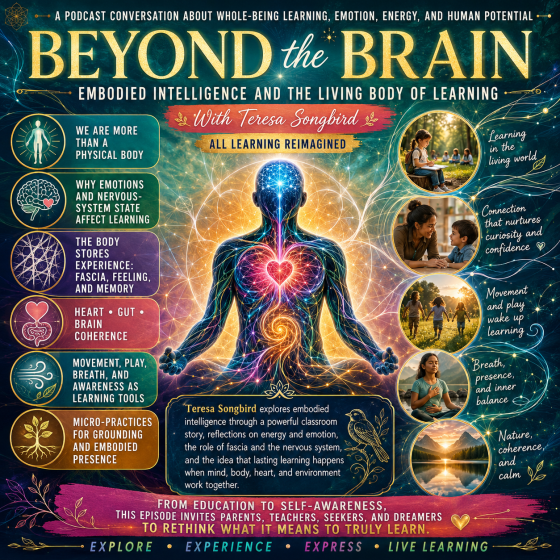
We are more than a physical body
Embodied Intelligence and the Living Body of Learning
Introducing Embodied Intelligence
Teresa opens the episode by welcoming listeners back to All Learning Reimagined and announcing a new nine-part podcast series on embodied intelligence. She explains that the series grew naturally out of her previous work and was inspired by the teachings and questions of Catherine Russell. The episode begins with the idea that learning is not limited to the brain, but is connected to the body, energy, emotion, and lived experience.
A Classroom Story About Safety and Focus
Teresa shares a story from her teaching life about a young student who could not focus during an otherwise engaging outdoor lesson. Later, Teresa discovered that the child had experienced a serious family argument earlier that morning. The story became a turning point for Teresa because it showed her that a child’s nervous system can continue carrying emotional stress long after the original event, directly affecting readiness to learn.
The Body as a Living Communicator
The episode explores fascia, the nervous system, and the idea that the body stores and communicates emotional experience. Teresa describes the body as more than a machine, saying it is electrical, chemical, biological, emotional, and relational. She suggests that posture, energy, movement, and emotional history all influence how people show up in learning environments.
Learning Beyond the Brain
Teresa challenges the common assumption that learning happens only in the head. She discusses the gut, heart, brain, bioelectricity, and the importance of coherence between different parts of the body. She also connects this view to ancient wisdom traditions and Indigenous understandings of land, body, community, and spirit, framing embodied learning as something both newly explored by science and long understood by older wisdom traditions.
Practical Ways to Reconnect With the Body
The episode offers a simple micro-practice designed to help listeners return attention to the body. Teresa invites listeners to place their feet on the floor, breathe, notice sensations, feel the heartbeat, observe tension or ease, and ask what the body is communicating. She emphasizes that the goal is not to fix anything, but to develop awareness and reconnect with the body’s signals.
Living Learning as a Whole-Being Experience
Teresa closes by explaining that lasting learning involves the whole being: mind, body, emotions, relationships, environment, and lived experience. She previews future topics in the series, including the nervous system, fascia, emotion, and how the body shapes reality. Her final message invites listeners to explore, experience, express, and live learning rather than simply consume information.
All Learning Reimagined

Please help support this show!
Support this show by subscribing
$5.99/mo or $9.99/mo or more
Click HERE
All Learning Reimagined: Where passion meets possibility, one story at a time.
All Learning Reimagined is a global podcast exploring the many ways we learn, grow, create, and contribute throughout life. A gathering place for people who know that the future is something we learn, create, and steward together.
While education is often where the conversation begins, this podcast reaches far beyond classrooms and curriculum. Together, we explore learning as a living process that unfolds through relationships, community, nature, creativity, curiosity, experience, and the pursuit of what brings us alive. Through inspiring conversations with parents, educators, authors, visionaries, community leaders, and everyday people, we share stories that expand what learning can be and how it shapes our families, communities, and world.
Drawing from diverse perspectives, indigenous wisdom, practical experience, emerging ideas, and timeless principles, each episode offers insights that nurture self-direction, discernment, contribution, and a deeper connection to what matters most.
Whether you are a parent, educator, learner, creator, community builder, or simply curious about what is possible, All Learning Reimagined invites you to explore meaningful questions, fresh perspectives, and inspiring stories from around the world. Because learning is a living journey to nurture.
Cultivating self-trust. Nurturing wisdom. Inspiring contribution. Strengthening community.
Speaker Identification
Speaker 1 – Prerecorded Theme Song / Music Voice
Identified by the opening and closing lyrical segments introducing and ending All Learning Reimagined.
Speaker 2 – Host, Teresa Songbird
Identified from the opening introduction, where the speaker welcomes listeners to All Learning Reimagined and identifies herself as Teresa. The show theme also refers to “Teresa Songbird.”
Speaker 1 – Prerecorded Theme Song / Music Voice:
There is another way to learn.
Questions open doorways,
Where wonder leads us home,
Where every heart remembers
The wisdom it has known.
All Learning Reimagined,
Where passion meets possibility.
With Teresa Songbird,
Come explore what learning can be.
For parents, teachers, seekers, and dreamers,
Learning comes alive.
Speaker 2 – Host, Teresa Songbird:
Hello. Welcome to All Learning Reimagined. I’m your host, Teresa, bringing you a little ray of sunshine as together we’re reimagining the future of education, one inspired story at a time.
Welcome back, everybody. It’s so wonderful to be with you again. A big shout-out to my regular listeners and those who have been emailing in and giving me fantastic feedback around the articles and the activities that I share each week on BBS Radio.
It’s just wonderful to hear from you, and it warms my heart to know that there are people out there doing amazing things for our beautiful children. It really is. We live in incredible times right now.
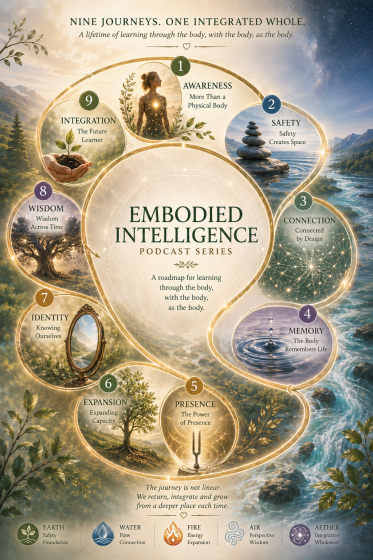
I did want to share with you some wonderful news. I have created a new podcast series. It will be nine shows, and it’s about embodied intelligence. It has really made me think. After the last series that I did, I wanted to have a natural continuation of those shows, but I wanted to go deeper into different sections.
I have to give a shout-out to an amazing woman who inspired me, because this series was inspired by the work of Catherine Russell. I’ve been following Catherine on YouTube for quite a while now, and every time I hear her speak, she is so grounded and inspiring. I have paradigm shifts, and it really makes me stop and wonder what’s going on.
Her explorations into fascia, capacity, identity, and embodiment have really encouraged me personally to look deeper into the relationship between the body, learning, and human potential.
What I’ve been sitting with is this: how can I take what I’m learning, and what is making such a profound impact on my personal life, and translate this into a learning environment so that other adults and mentors are self-aware? How can we thread this through what we’re doing?
That is what sparked this series, and I’m so excited about it. It’s a game changer, as far as I’m concerned. It’s a really different way of thinking and feeling energetically, rather than just focusing on living life through default.
This is truly living learning. When you know yourself, everything around you is created by you. We are world creators. We have our own little universes, and our thoughts, energy, and actions really do have massive ripple effects in our lives. So it is very important that we come back to these questions: Who are we? What are we? Because we are the central point of everything that happens within our lives.
Episode one’s topic is: we are more than a physical body. I wanted to start with the basics, and we’re going to explore this. There are so many fantastic micro-practices that I can share with you, along with reflection questions and, of course, weekly integrations and activities that I will share on BBS Radio when I publish my article each week.
For those new listeners, if you go to bbsradio.com/alllearningreimagined, you will be able to find all of my archived shows and access all of my articles and activities for free. Take it, use it, and spread the word. Share it. This is my passion. This is my hobby.
Okay, so let me get straight into this. I wanted to start with a very small story, an entirely true story. It happened a couple of years ago, and there are many instances when things like this have probably happened before, but this one has really stuck with me. It actually shifted the way that I teach, mentor, coach, and speak publicly today. It made me make sure that I am aware of the energy moving around me.
I’m sure that at some stage in your life, you have walked into a room and immediately felt something. It might have been that there had been an argument or a tense discussion in that room just before you walked in, and you could feel it. No one had to say anything. You just knew. You could sense it. You could pick it up. Animals sense this. Children sense this.
Or it might have been the butterflies that you have in your stomach before doing a public talk. I’ve done many, many public talks. I love public speaking. It’s one of my passions. There have been many conferences where I’ve spoken, and before I speak, my hands are shaking because of the energy and electricity coursing through my body. I’m not nervous, not at all. I’m excited. So it makes you wonder how this sort of fits in.
Coming back to my story, there was one day when I had planned a really exciting lesson. It was engaging. It was a nice experiment. It was outside. The class was extremely engaged. It was fantastic, and I was really happy.
But I had one student, one young little girl, who was normally highly involved, really involved in her learning, and very self-directed. She just couldn’t focus. She could not focus at all.
I was very kind to her. I was trying to draw her in and engage her, and it just didn’t work at that stage. It wasn’t until later on, when I was able to catch her by herself, because obviously I was busy with a whole class of children, that I was able to have a conversation with her.
That was when I came to the realization that she had had a massive argument with someone in her family at breakfast time, and she was reeling from this. She didn’t feel safe. Even though the environment was a different environment, her body was still carrying the energy. Her nervous system was still carrying that argument hours later, and it compromised her learning. It compromised her ability to focus.
We are not only our minds. Our body is very central to learning. It wasn’t until that day that it actually made me stop and think: are our children ready to learn?
This was decades ago, of course, that I’m sharing, but it was a nodal point for me. I started exploring what I could do to set children up for learning, and what we can do to help them have the strategies to ground themselves and bring their own nervous systems back.
There is no point in me doing it for them. I don’t want to step on their sovereignty. I really want to teach them the strategies so they can do it for themselves. That is where this comes from.
It also inspired me to stop and think: if our thoughts only existed in the brain, why does the body respond so strongly?
Here I am decades later, and I start listening to Catherine Russell, this amazing woman who talks about fascia, and all of the pieces just clicked together. Bang, bang, bang, bang, bang. She is really cementing things for me, because our body is not a machine. It communicates with us. It is constantly communicating with us.
We know we are not just this physical body. We are not just this physical meat suit. We have a soul. We have a spirit. But how does that work?
When you hear “fascia” and someone says, “What’s fascia?” Well, it is the continuous web of connective tissue that surrounds muscles, organs, and nerves. But it’s more than that. It’s more than the scientific explanation that we have given.
What Catherine has inspired me to consider, because she’s not telling me what’s true, she’s giving me questions and making me curious, is that the light we carry inside ourselves, our spirit, our light, is embedded into the fascia.
When you have trauma, or when you experience something with wonderful joy in a moment of play, or when something has happened in your life, it is also stored within the fascia of our body. We hold it within us.
For some people, that can eventually send a signal. For others, it can be something completely different. But if we don’t move our body and help release what is stored, the energy and the emotions that are stored in our fascia, then it really shapes our posture. It shapes how we show up. It actually shapes our energy. I wouldn’t say it blocks our energy, but it does interrupt the flow of where it actually goes.
Science and medicine today, I’m so excited to say, are really revisiting old assumptions about thoughts, emotions, our experiences, and how they influence us beyond the brain, because they are stored in our bodies.
I don’t want to overuse the word fascia, so I’m also going to use the word body. But what if we are more than just our physical body? This is what gives us the big question.
For generations, we have been taught to see ourselves through a mechanical lens: your body as a machine, your brain as a computer. We have all of these metaphors and analogies that are thrown at us. We have been told, and I believed this for the longest time, that learning all happened in my head and that emotions were secondary.
But science is beginning to reveal that this is not separate. It’s interconnected. Our living body is not just flesh and bone and blood and muscles and organs. It is electrical. It is chemical. It is biological, of course. It is emotional, and it is relational.
This is what we’re going to be exploring over the next nine weeks. I have lots of fantastic micro-practices, integrations, and activities that you can explore as an adult and with children, so that we can feel very present in our body.
From lived experience, I can tell you this can shift things in an amazing, profound way in your life. It is definitely worth exploring. It is so much more than what I believe we currently understand, because we are a living electrical network. Really, we are.
The brain does not control everything. Learning does not primarily happen only in our mind. Emotions can get in the way of our thinking. The body actually follows the instructions of the brain, which is what we were led to believe, or what some currently believe. But I’m starting to question all of this. I’m questioning everything.
Is it true? Is it not true? What do I observe? Am I going to take the time to stop and experiment for myself? What is true for me, rather than the perspective that I have been led to believe? Because I just don’t know.
So this is the exploration, and I would invite you to come and explore it with me. I don’t have all of the answers, but I do have some big questions and curiosities, and I’m happy to share what I’m observing.
Here’s a question for you: what if emotions, experiences, and memories are not only stored in the brain? I always thought memories were stored in the brain, but what I have come to realize is that they are actually stored throughout the body, not just the brain. There are other places where they are stored as well, and that was easily within our fascia.
That then led me to the question: what happens when we see ourselves as energetic, electrical, and biological beings simultaneously? Doesn’t that shift the way that we see things, how we present information, and how we learn?
Sitting in a room with four walls and sitting still is not conducive to learning. We need movement. But we also need to consider ourselves as a whole, and we need to consider what our whole body actually needs.
Every cell has electrical activity. Our body is electric. This is something that we’re beginning to explore a little bit further. Every thought we have involves electrical activity. Neuroscience is telling us this, and that is becoming quite popular in the education field.
Every heartbeat relies on electrical impulses. There are actually people out there now talking about the fact that the heart is not just a pump. It’s almost like a portal, and it has a lot more uses. I would really like to explore that. That is a whole other show, exploring that possibility.
The heart generates measurable electromagnetic fields, up to 5,000 times stronger than the brain. The HeartMath Institute has incredible research in this space, and I urge you to check them out if you are curious and would like to know more. It is mind-blowing and heart-warming stuff when you have a look at it.
It really does shift the way, particularly if you are a science teacher out there, that you are teaching and considering everything that we are teaching and presenting.
Every movement in our muscles depends upon electrical communication. Every nerve in our body transmits electrical signals. We are not merely biochemical. We are bioelectrical.
Logically, I already knew this. In a logical space, I thought, yes, I’ve heard this before. That’s fine. But as an educator and as a mother, when have I sat back and actually thought about us being electrical? When have I thought about the amount of voltage that I’m carrying, the life force that I’m carrying, and what I’m doing when that is running low?
Am I having enough salt? The water in my body needs that for the electrical currents, so that translates to the diet and how I am actually feeding my body. Life depends, my life, your life, our lives depend, on these electrical exchanges. Without them, the body literally ceases to function. Bioelectricity is essential for life, and this alone is worth considering and pondering.
Do we have these conversations with children, even young children? We often think of ourselves as solid, and yet beneath the surface of what feels solid in our bodies, there is movement, communication, and energy occurring every moment of the day.
We are in the process of getting out of our own way and considering what is there beyond the brain when it comes to learning environments. We are all over the brain. We are all over neuroscience. We can consider this. But it is also coming back to the gut and the heart, and the coherence between the gut, the heart, and the brain. This is where the magic happens.
Personally, I experience this coherence when I’m in play, when I’m in a playful mood, when I’m resting and relaxing, and certainly when I am in nature. If you are in a beautiful natural environment and you’re feeling that energy and that peace, that is where my coherence all seems to melt together. It is very interesting.
I would ask: are you aware of coherence between these spaces within you?
The gut is starting to be talked about in the medical industry as containing millions of neurons, and it is often called the second brain. Many people out there think that neurons are only in the brain. No, the gut has neurons as well. Check it out. It produces serotonin, and it is a very important part of our body, which means it is also a very important part of our learning experience.
If you have a child guzzling Coca-Cola and eating junk food on the way to school, how can you expect that what is going on in their gut region is not going to affect their learning?
A lot of children today have ADHD, they can’t concentrate, and they have all of these labels that they have been given. When you really stop and have a look at what is going on in the body, I am quite sure that there would be some way of pointing toward solutions for them to consider. What do these supposed labels actually mean, and what can you do?
I’ve seen people reverse these things purely through the way that they are actually treating their body, not just with food, but also on an energetic and emotional level.
So, do you trust your gut? Do you listen to your gut feelings? Have you ever felt heartache? Have you ever known something deep within your heart that your logical brain can’t understand, but your heart knows?
This is the heart brain. The heart also contains its own intricate neural network. That is a bit of a tongue twister, I know.
Between these three, it is almost like we have three brains in our body, or operating systems in our body, if you like the analogy of computers. Perhaps these expressions really emerged from observation long before science was investigating them, because the body appears to be communicating with us constantly. Not just the brain, but the whole system.
When there is internal chaos, and I’ve experienced this as well, it can lead to burnout. For some people, it leads to chronic fatigue. When you are in coherence, this regulates stress. It enhances emotional resilience. It improves our health, and, of course, it puts us in that field of gratitude, that frequency.
Breath work certainly helps. Stillness certainly helps. But it is also about noticing what our body is communicating. What is it telling us?
Ancient wisdom really knew about this. When you look at all the ancient wisdom around chi, prana, life-force energy, breath, and spirit, you can see this. I know the Aboriginal peoples, the First Nations of Australia, have long understood the deeply interconnected relationships between the land, the body, community, and spirit.
This is nothing new. Many Indigenous cultures understood that knowledge is not just acquired through the brain. It is experienced. It is felt. It is lived.
That is what this podcast is all about: living learning. It is not about having something imported into your brain and consuming information. No, we are living learning. That is meant to be the whole point. We are embodying it, and that is why this series, Embodied Intelligence, is being birthed right now. I’m creating it because this feels so important.
Today, science is starting to ask questions that are really, in my opinion, echoing what the ancients already knew. It’s like we’re remembering. We’re going back.
It is wonderful to see the rise and reassertion of things like qigong and movement to release that trapped life force that is in your fascia. If you’re really interested in checking out more on what you can do for this, I would check out Human Garage, a fantastic YouTube channel. It gives you very simple exercises and movements to release trapped and stored energy and emotions that are in your fascia.
It is well worth exploring, and children love it. It’s really fun. I get the giggles sometimes because I’m not the most coordinated woman, but it can be really fun. It does bring us back to cellular work, sound therapy, vibration, frequency, and all of this wonderful material to explore. Don’t get me started on water and what these things do for that as well.
You could possibly create an inquiry project with children, students, adults, or yourself, and really explore, investigate, notice, and observe. What is this like for you? It really opens the door to explore and inquire, and I highly invite you to consider this.
This really does matter when it comes to learning. If learning only happens in the brain, then information should be enough. But we know that this is not the truth. So why are we still teaching the way that we’re teaching, just through the brain? Why are we not considering the body?
How many times have we known something and failed to live it? How many times over the decades have I seen children, and done this myself, memorize information and forget it weeks later because they were memorizing it for an exam?
Or adults attend a workshop, and they get inspired by this workshop, but weeks later, days later, possibly hours later, they return straight back to their old habits. That is because learning becomes lasting when the whole being is involved, not just the mind. It is the body, the emotions, the relationships, the experience, and the environment, which is the learning environment.
This is what embodied learning invites us to consider.
When you think about things like the double-slit experiment, if you haven’t heard of the double-slit experiment, research it. Search for it on any search engine. I don’t like to say Google, because I don’t like to promote just one way of searching. But research it, because it’s really like an observer effect. It is talking about consciousness and the observer, and how it changes what is in the unified field around us based on who the observer is.
Quantum entanglement and many other experiments are things I will come back to another time to talk about. But the observation of matter really does lend us the consideration that we are more than just our minds when it comes to learning.
So, quick micro-practice of the day. I invite you to consider this. Spend a couple of minutes exploring something together.
If you are driving right now, or doing something where it is not safe for you to sit and settle, then I invite you to come back and listen to this later. Or remember to make sure your eyes are open if you are on the road.
But if you are in a place where you have the opportunity to place both feet on the floor, just take a deep breath in, and then slowly breathe out. This is a great practice.
Notice your feet. Notice your breathing. Can you feel your heartbeat? Is your skin registering the temperature of the room or the space where you are? If you’re outside, can you feel the breeze caressing your skin? What sounds are there around you? Notice whether there is any tension in your body. Notice any ease in your body.
Without changing anything, without trying to fix anything, simply sit and observe. Ask yourself: what is my body communicating to me right now?
Then sit for about 30 seconds. Just sit quietly. You don’t really have the chance on a radio show or podcast to do this at the pace that I would normally do it, but explore this and really notice it.
You’ll notice that sometimes your body might get a twinge in a knee or in a shoulder, or your stomach starts gurgling. It is communicating with you. Really consider what it is trying to say. What does this mean for me?
Ask yourself these questions: when do I feel most alive? What helps me feel connected to myself? Do I even spend time in my body? Am I constantly in my mind, overthinking and trapped in my thoughts?
When you’re sitting in your head, drop into your body. This is a really important practice. Children naturally do this when they are in a play state, but as we get older, we really start to get into that abstract thinking. It is very easy to come home at the end of the day and still be living in your mind.
A very simple practice like this can help you get out of your mind and back into your body. Notice what signals your body is regularly sending you that you could possibly be overlooking.
This is a very, very simple micro-practice, but I would try to do this at least once a week. It’s almost like a weekly integration. Pause, take a breath, and notice: what am I noticing in my body right now? Just awareness. You don’t have to do anything about it.
Stretching, releasing fascia, and all of these things are wonderful practices that we are going to explore over the next few weeks.
As we continue this journey together, we’re going to explore the nervous system, fascia, emotion, learning, and the fascinating ways that our bodies actually shape the experience of our reality. Isn’t that what it’s all about? This is really, really important.
Intelligence exists through the whole being, not just the brain.
So I would like to leave you with that thought today and invite you to come back next week to join me on this journey.
Please reach out at bbsradio.com/alllearningreimagined. There is a way for you to email me and contact me. If you have any questions or would like to share your experiences, I would love to hear from you. It would be wonderful.
Thanks for joining me on All Learning Reimagined, everybody. Until next week, explore, experience, express, and go out and live learning.
Speaker 1 – Prerecorded Theme Song / Music Voice:
Carry the wonder with you.
Carry the questions home.
Every seed of understanding
Has a life of its own.
All Learning Reimagined,
Where learning comes alive
With heart, with hope, with courage,
We help the future rise.
With Teresa Songbird,
Until next time,
Keep exploring,
Keep creating,
Keep remembering.