
All Learning Reimagined, June 19, 2026


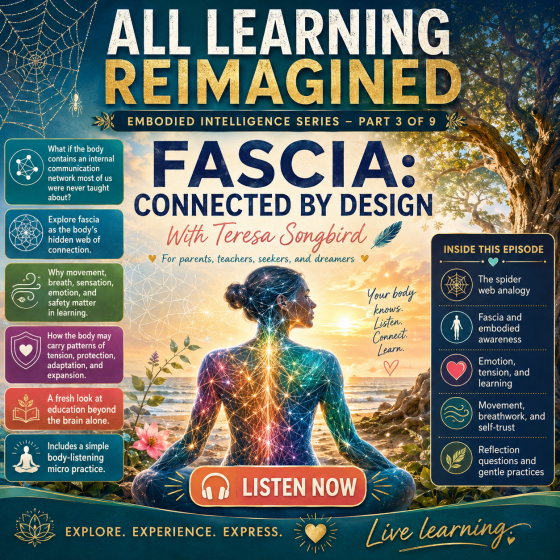
All Learning Reimagined with Teresa Songbird
Episode 3 of series on Embodied Intelligence
Fascia: Connected by Design
Fascia, Embodiment, and the Living Web of Learning
A Hidden Web Beneath Learning
Teresa opens part three of the Embodied Intelligence series by introducing fascia as a hidden web of connection throughout the body. After recapping earlier episodes on the physical body and the nervous system, she explains that this episode asks whether the body contains an internal communication network that education has largely ignored. She frames the conversation as an invitation rather than a fixed doctrine, encouraging listeners to explore what resonates with them.
The Body as a Spiderweb of Communication
Using the image of a spider’s web, Teresa describes the body as an interconnected system where tension or change in one area can influence another. She explains fascia as a continuous web of connective tissue surrounding muscles, bones, organs, nerves, and blood vessels. She suggests that fascia may be part of the body’s communication system and invites listeners to consider its relationship to capacity, identity, consciousness, and learning.
Emotion, Safety, and Somatic Experience
The episode connects fascia to emotional experience by considering how stress, grief, uncertainty, and overwhelm can show up in the jaw, stomach, chest, shoulders, or other areas of the body. Teresa clarifies that she is not claiming emotions are stored in one fixed place for everyone, but she does suggest that lived experience may influence bodily patterns of tension, protection, and movement. She also links fascia to the nervous system and the felt sense of safety needed for expansion and learning.
Why Learning Cannot Be Brain-Only
Teresa challenges the idea that learning happens only through the brain, especially in mainstream schooling. She argues that children learn through movement, sensation, emotion, environment, relationships, breath, comfort, and safety. From this perspective, sitting still for long periods and treating movement as a brief interruption rather than a central part of learning can disconnect education from the body’s natural intelligence.
Questioning Conformity in Education
Reflecting on her own decades as an educator, Teresa questions how the industrial model of schooling measures success through grading, productivity, and conformity. She contrasts that with qualities such as complexity, creativity, innovation, and pattern recognition, asking where the body fits into a system that mainly champions the mental plane. She connects this concern to the law of oneness and the law of harmony, describing health and growth as whole-system processes.
A Practice for Listening to the Body
The episode closes with a simple body-listening practice in which listeners sit or stand comfortably, roll the shoulders back, open the chest, reach the arms overhead, and gently twist from side to side. Teresa invites listeners to notice where the body feels free, where it feels restricted, and what it may be communicating. She encourages adults and children to build self-trust through interoception, gentle movement, reflection, grounding, and a deeper relationship with the body.
All Learning Reimagined

Please help support this show!
Support this show by subscribing
$5.99/mo or $9.99/mo or more
Click HERE
All Learning Reimagined: Where passion meets possibility, one story at a time.
All Learning Reimagined is a global podcast exploring the many ways we learn, grow, create, and contribute throughout life. A gathering place for people who know that the future is something we learn, create, and steward together.
While education is often where the conversation begins, this podcast reaches far beyond classrooms and curriculum. Together, we explore learning as a living process that unfolds through relationships, community, nature, creativity, curiosity, experience, and the pursuit of what brings us alive. Through inspiring conversations with parents, educators, authors, visionaries, community leaders, and everyday people, we share stories that expand what learning can be and how it shapes our families, communities, and world.
Drawing from diverse perspectives, indigenous wisdom, practical experience, emerging ideas, and timeless principles, each episode offers insights that nurture self-direction, discernment, contribution, and a deeper connection to what matters most.
Whether you are a parent, educator, learner, creator, community builder, or simply curious about what is possible, All Learning Reimagined invites you to explore meaningful questions, fresh perspectives, and inspiring stories from around the world. Because learning is a living journey to nurture.
Cultivating self-trust. Nurturing wisdom. Inspiring contribution. Strengthening community.
Speaker Identification
Speaker 1 - Announcer / Opening Voice: Identified by the poetic show-opening and show-closing promotional language introducing All Learning Reimagined and Teresa Songbird.
Speaker 2 - Teresa / Host: Identified by the direct self-introduction, “I’m your host, Teresa,” and by the first-person narration throughout the episode.
Speaker 1 - Announcer / Opening Voice: There is another way to learn, where questions open doorways, where wonder leads us home, where every heart remembers the wisdom it has known.
All Learning Reimagined, where passion meets possibility, with Teresa Songbird. Come explore what learning can be. For parents, teachers, seekers, and dreamers, learning comes alive.
Speaker 2 - Teresa / Host: Good day, and welcome to All Learning Reimagined. I’m your host, Teresa, bringing you a little ray of sunshine as together we reimagine the future of education, one inspired story at a time.
Welcome back, everybody. It’s so lovely to be with you again in part three of our Embodied Intelligence series. This is part three of nine. Episode one was about how we are more than the physical body. Last week, in episode two, we looked at how safety creates space. We explored the nervous system and how that aligns with learning.
Today we are going to dive into fascia, which is really the hidden web of connection everywhere. I do want to give a big shout-out to an amazing woman called Catherine Mussell. If you have not heard of Catherine Mussell, go and find her on YouTube. Her YouTube clips and her courses are just amazing. She is certainly ahead of her time, and it was her ideas around the relationships and the explorations of fascia, capacity, identity, and embodiment that actually inspired this entire series for me.
It felt so important. It felt like a missing link that I have not seen anywhere when it comes to the learning and education space. I really wanted to explore this. Everything that I share in this series is not me telling anybody, “This is how it is.” I am inviting you to explore, sit with it, and feel into what you resonate with.
The central question for today’s show is this: what if the body contains an internal communication network that most of us were never taught about, and that network is our fascia?
In education, in my experience, and I have over three decades of experience, we really treat the body as secondary. In the mainstream system today, when it comes to learning, it is all about the mind, the mental, and neuroscience. Yet the body is not separate from the mental. Our body translates what the conscious mind cannot register. It is all interconnected, and that is what I would love for us to explore today.
I want you to imagine pulling on the corner of a spider’s web. That movement does not stay where you touched the spider’s web, because the entire web responds. Every single strand, every connection, every point within that system responds. Imagine that your body is very similar.
Many of us think that the body has separate parts, and it sort of does. You might have a shoulder problem, a sore knee, a tight neck, or a stiff back, but the body functions more like a spider’s web. What if everything is connected? We know that Chinese medicine and a lot of ancient medicine understood this. They knew this. This is not new information. But why are we not translating it into our education space?
You might feel tension in one area, but it actually influences another area within your body. What if the body is communicating through that network that we rarely acknowledge in the education space?
That is what we are exploring today: fascia, which I really love to call aliveness in form, because that is exactly what it is. It is a system that many people have never heard of. It is starting to become popular. I am certainly seeing things pop up with fascia more and more these days. It is definitely something that we want to understand a little bit more.
For generations, we have been learning about muscles and bones, organs and blood, nerves and the nervous system. Yet fascia rarely appears in conversations about health, learning, and well-being. I really feel like this could be something that we are missing, and I am inviting it to come up into our awareness today.
In my experience with education, I know that when children, adults, and certainly I myself are faced with change, that change does not register only mentally. The body is registering it. Somatically, the body is absorbing the experience of being perceived. It is more than cognitive and certainly more than emotional. It is also the soma, the body. It is all of the layers, which is fascinating. Don’t you think? I think this is fascinating.
We picture the body like separate parts, yet it is not. So what is fascia? I went and did some research, and I found lots of conflicting information out there. I personally do not know the exact answer. I feel like it is still coming forward. The true meaning and use of fascia within the body is still being revealed.
For the sake of simplicity today, fascia is really like a continuous web of connective tissue, and it surrounds and connects pretty much everything in our body. It surrounds your muscles, your bones, your organs, your nerves, and even your blood vessels.
Many practitioners describe fascia as the body’s internal communication network. Some people thought that was the nervous system, but the fascia is there as well. Some researchers today, I am discovering, are now exploring the role of fascia as a sensory organ in its own right. When you have an operation, and they just cut through the layers of fascia thinking it is nothing, some medical practices are now starting to view it as something completely different.
Then I invite you to consider this: what if fascia is an intelligent interface with consciousness, with all there is? We have that spirit, that soul, that consciousness within our body, and we have this connected web everywhere throughout us. What if it is a three-dimensional web woven through the body, but it is living? It is not static. It is responsive, and it adapts. That is certainly something to stop and ponder on.
It might seem as though all of that sounds absolutely ridiculous, but really, in today’s day and age, anything is possible. I am willing to explore anything that may come forward and shift my paradigm. The most dangerous words anyone could ever say are, “I already know that,” because you are closing your mind off to things.
When it came to exploring the whole Embodied Intelligence series that I have created, so many questions came up for me. More and more questions came up, and I thought, “This is just so much fun.” It is so much fun because I feel like I am expanding just by having these conversations.
What if your fascia is what holds the experience of expansion within your body? That certainly translates to learning when you think about it. What if fascia is also protection, guarding you against the shock of the new or the shock of change?
Think about the nervous system, the regulation of the nervous system, and feeling safe in order to learn. Could the fascia be part of this as far as knowing and feeling that it is safe to expand? It does link to our identity as well.
The body’s perception comes before the mind does. The mind is an interface, but the body certainly has its own intelligence. It speaks a different language from the mind, because life is literally moving through us. I am open to receive, and I am open to question.
Think about this, particularly with the spiderweb analogy. Imagine a spider sitting in the middle of a web. The spider does not even see every insect. It feels the vibrations through the web. The information is traveling through the connection. The body, according to fascia, appears to work in a similar way. When tension develops in one area, the effects can actually ripple somewhere else. It is an interesting concept.
Ancient wisdom meets modern science. Many traditional healing systems have never viewed the body as separate parts. This is nothing new. Indigenous perspectives, traditional Chinese medicine, Ayurveda, and traditional yoga movements have all carried understandings of the body as interconnected. I am not talking about all the different variations of yoga we have today, which I cannot keep up with because there are so many of them. I am talking about the traditional movement systems.
The body is translating through the fascial intelligence and the nervous system. Anything that you do is secondary to who you are. We are not human doings; we are beings. Who you are and how you are being matter, and the body is definitely part of this.
Then I question, what about emotion? As an educator, we are always thinking about emotional regulation. This is definitely part of learning, and it is something to consider.
Most of us experience a tight jaw during stress. Some people might grind their teeth. You might feel a knot in your stomach during uncertainty, certainly around exam time in a schooling setting. You might feel that heavy feeling in your chest if you are going through grief, or tight shoulders if you have had a really difficult week and feel the weight of the world on your shoulders.
The body clearly responds to emotional experiences as well. The fascinating question that I am pondering is this: how much of our lived experience is carried not only in our thoughts, but through the body itself? Fascia is certainly part of the interface for that.
That does not mean emotions are physically trapped like objects. I have seen people talk about things like, “If you are angry, it must be stored in your liver.” Well, I have seen anger stored in jaws and in teeth. Some of these perceptions that are publicly put out there are not necessarily 100 percent accurate. Emotions can be stored in many different ways. Everybody is a little bit different.
I invite us to consider that experiences can influence patterns of tension, movement, or protection through our body. If you are interested in exploring how to release some of that, there are very gentle movements that you can do to release stored energy, and possibly some emotions, within your body. I invite you to go and check out Human Garage. They have a fantastic YouTube channel.
Some of their activities, movements, and exercises are extremely simple but very effective. I can put my hand on my heart and say, from direct experience, that it has been really great. So check out Human Garage. It is definitely something fun to do with the kids, but as an adult, it is a game changer when it comes to considering how you actually see your body and your own relationship with your body. That is definitely important.
Why does all of this matter when it comes to learning? I guess you can see the connections already. I know you are an amazing audience already connecting the dots.
Children do not learn through their brains alone. So why, in schools today, particularly in Australia where I am, is everyone banging on about neuroscience and the brain, thinking that the brain is all there is? It is simply not true. We have to look at ourselves, and we have to look at the children, the environment around them, the biofield around them, and all aspects of themselves, not just the brain.
We learn through movement. We learn through sensation. We learn through emotion, because we know that emotion helps. It is like the glue to learning, really. We learn through the environment, and we certainly learn through relationships. All of these things are interconnected.
A child who spends all day sitting might be learning intellectually, although that can be debatable quite frankly, but their body is also part of the learning process. Movement matters. I do not mean, “Let’s just take a brain break and move for 30 seconds and then sit down again for another full hour, still in place.” That is not practical. That is not natural. That is not the way education used to be. Teaching was not even called education or teaching. It was literally just learning and life.
Breathing matters. Breathwork matters. It is so essential. Physical comfort matters, and emotional safety matters. All of these things are really important, and the body is central to all of them, because the body is participating in the learning whether we recognize it or not.
That really made me stop and say, “Okay, I need to give myself some room to explore this and try to stay neutral about it.” It was really quite challenging as an educator, looking back over the years at some of the ways I have been teaching and thinking, “Wow, how did I get it so wrong?” But when you know better, you do better, right? You are doing the best you can at the time.
Then, when you stop and reflect, it is like, “Oh, I must have known it, though, because we did do a lot of movement, and I did do a lot of things that were different.” Still, it is quite confronting to take a good look at yourself and ask, “What have I been doing?”
In my own life, particularly over the last 10 years since technology has exploded and everyone has a laptop or a device attached to them, especially at work, I have spent so many hours sitting in front of a screen and not moving. I am not living it myself. It is like, “What am I doing? This just does not seem natural to myself.”
To create self-trust within myself and my own self-understanding, I have to explore my own relationship with my own fascia. That is the journey I have been on for a couple of months now. It has only recently come into my awareness, and I am certainly keen to explore it further.
What has come forward for me when I am sitting is that I go to the beach. This is what I do. I go to the beach, I become totally present, and then I journal sometimes. Often, I just sit and reflect and see what comes up. I feel it. Sometimes I notice a twinge in my body, and I have books that I can look up. I will put a couple of those books in my article this week. I cannot remember them off the top of my head, but I can look up what my left foot might represent or what my right shoulder might mean. What is it telling me? I can look in the book and see whether it resonates with the message my body could be giving me.
In the last few weeks, I have really been stopping and wondering about the conformity of our school system, the industrial system that we have inherited, which is really breaking down today. You can see it in real time. It is breaking down.
Schools today measure success, and there is a lot of judgment there when it comes to grading. But what are they measuring? They are measuring conformity. They are not measuring complexity, creativity, innovation, or even pattern recognition. It is all mental, and it is all conformity. Where does the body fit into this?
It really makes me feel quite sad that this whole industrial complex system is there for productivity and to help create compliance within society when you think about it. Some people might argue that this is a deliberate agenda, and others might say, “Well, it is just the way that it is.” I am not here to judge. I am just observing what I am seeing.
What I am seeing is the rise of mediocrity. The mediocrity is quite alarming. No one wants to stand out. No one needs to be different. Do not be creative. Where do the body and fascia fit into all of these things we are doing that champion the mental plane?
The mind can be a trap, particularly when you are overthinking too much. You have to consider how the body fits into all of this, particularly with growth. Growth is not only a mental process. The body is learning too, and expansion is really important.
This also links to our universal law, the law of oneness. The body functions as an interconnected whole rather than isolated parts. It links to the law of harmony as well. Our health emerges through balance and communication across the whole system. Our body is part of that. All of this aligns with natural and universal law.
For today’s micro practice, I want to give a big shout-out to any new listeners. The micro practice I would like to share today will certainly be in this week’s article. For those who are new, I publish an article every week that aligns with whatever the topic of the week is. I often put in activities that you can pick up and use at any given time with adults or children. You can adapt them or adopt them, whatever you feel called to do with them.
It is my joy. This is my hobby. I do not watch Netflix. I barely ever watch TV. This is what I do. I love to create. I do not want to consume information; I love to create information. You can find those articles, all of them, because I have been doing this every single week for well over a year now, at bbsradio.com/all-learning-reimagined. Check them out with all the different shows and all the different articles.
This week’s micro practice is very simple. It is a body listening practice. It might seem extremely simple, but sometimes something that is so simple is actually difficult to do. Getting children to sit still can be difficult. Getting yourself to stop and feel into the awareness of your own body, your own interoception, can also be difficult.
Interoception is a new word I discovered recently. It means being aware of myself and my own body. It is like perception, but within. I just love that word. That is what this is. This is a game changer, because I often stop and tap into what my body is telling me. When I am making decisions, it is part of my discernment process now.
I cannot always trust the information outside of myself. With the energetic weather in society today, I often have to sit still, breathe into my body, and ask, “Okay, how does this resonate for me? How does this feel within me? What is my body telling me?” It is part of the process and part of picking up things that my conscious mind does not necessarily yet register or see.
This is what you need to do if you choose to do this. If not, sit back and just listen. If you are driving, you probably will not want to do this right now. You might want to listen to the replay.
Sit comfortably or stand comfortably. You can roll back your shoulders and open up the chest. Reach your arms over your head and gently twist from side to side. The body loves to twist and move. Twist slowly from the waist.
As you are slowly and gently moving, ask yourself: where does my body feel free? What feels loose and free? Where does my body feel restricted, contracted, or tight? What is my body communicating today?
Those are three very simple questions. This is something you can do anytime, at any given time. You do not have to fix anything. You are just noticing. You are simply observing, but it is building self-trust within you and deepening your own relationship and communication with your body.
The books I was talking about, which I have just grabbed from my bookshelf while talking to you, are The Secret Language of the Body by Inna Segal, one of my favorite books as a go-to resource when something comes up and I want more information about it. The other one is called Messages from the Body by Michael J. Lincoln. It is also a fantastic book. Both of these give so much insight and help me with my own direction if I need to go deeper into something my body is communicating to me. You can check them out.
There are definitely reflection questions I can sit with as well. Where do I commonly hold tension? Do I need to go and get a massage there? Do I need to go and lie flat on my back on the ground and just ground?
People might think I am really weird, but I often go and find a huge tree, a big grandfather tree or grandmother tree, and I sit on the ground with my back to the tree. I just sit. I do not have to do anything. The tree communicates with my field, and I feel so much better. It is as if it is balancing and recalibrating my energetic system. I know it is definitely communicating with the fascia in my system as well.
It is also about reflecting on what situations tend to create tension in my body. If I am aware of these situations, then I can be proactive before going into them. I can prepare myself. Knowing yourself is really important, and teaching children how to do this and self-regulate without having an adult do it for them is giving them such a gift as a life skill.
When do I feel relaxed and fluid? How often am I listening to my body signals? All of these are really great reflection questions to have conversations with.
What I have been doing recently is a weekly integration. This is personal, and I am sharing something personal right now. I spend five minutes, probably even three minutes some days, each day exploring gentle movement. It is not exercise. I am not puffing, and I am not getting my heart rate up. It is just gentle movement. I am not performing anything. I am alone, and it is just exploration.
I notice how I am moving. I notice how I am breathing. Has my breathing gone back into shallow breathing? Am I deep breathing from my belly? I am observing what is happening with my body. Some days I might feel sluggish and heavy, as if I am walking underwater. Other days I am so light, it is like I am full of helium, and people are like, “What are you on?” I say, “I do not know. I am high on life. I just cannot stop smiling. I am so high. It is fantastic.”
Life is great. It is so fun. How can it be so different from day to day, and why is that? I am getting to know myself. I have been on this planet for decades and decades, and I am still learning to get to know myself. I have been so distracted, particularly over the last couple of decades. I have been so distracted, and it is time to come back to self. Fascia is definitely part of it.
While I am moving in my weekly integration, not that this is what I call it, but that is basically what it is, I notice what tension appears. What am I going to do about it? I make a choice and a decision about that. I notice where ease appears, and I approach that part of my body without judgment. I approach it with curiosity.
It has been really interesting, because quite often I might ask myself a question and the answers come. They come from within. They come up, and it is like, “Oh, okay, maybe I need a bit more magnesium.” Or, “I am craving this type of food.” I am noticing what my body is communicating with me.
This is really important. We are not separate. Sometimes I have to get out of my mind to get out of the way. Yes, I am used to dropping out of my mind and into my heart space, but what about the rest of my body and feeling into that?
That is really the main message of today for the Body Intelligence series. It is about noticing that we are fully connected as a whole. The body is not a collection of separate parts. It is a living web of connection, and it is dynamic. It is just so amazing. It is constantly communicating, adapting, and responding to us.
The body is amazing. The more I am learning and listening, the more I am discovering that our bodies have been speaking to us all along. I have been speaking to myself all along; I just have not been listening. Well, I sometimes do, but I was not listening to the depth that I am choosing to now.
Perhaps embodied intelligence does not begin with changing the body. Perhaps it begins with developing a deeper relationship with the body. I am inviting you to consider your own relationship with your body, and to consider any children or learners you might work with if you are a parent, grandparent, or educator. How does this fit into your little universe, into your world right now?
I am going to leave it there. Thank you so much for joining me on All Learning Reimagined. Until next week, when we have series episode number four: explore, experience, express. Go out and live learning. Thank you, everybody.
Speaker 1 - Announcer / Closing Voice: And when learning comes alive with heart, with hope, with courage, we help the future rise. With Teresa Songbird, until next time, keep exploring, keep creating, keep remembering.