All Learning Reimagined, June 12, 2026
Embodied Intelligence Roadmap
Show Headline
All Learning Reimagined
Show Sub Headline
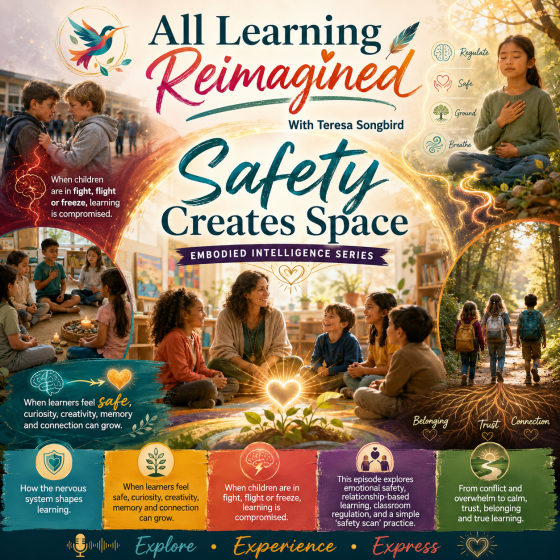
Safety Creates Space - Ep2 of Embodied Intelligence

All Learning Reimagined with Teresa Songbird

Episode 2 of series on Embodied Intelligence
Safety Creates Space

Safety Creates the Space Where Real Learning Can Begin

Safety as the Gateway to Learning
Teresa Songbird opens the episode by introducing the second part of the Embodied Intelligence series, focusing on how safety creates the internal space needed for learning. She explains that while education often emphasizes intelligence, attention, effort, and brain-based learning, the nervous system plays a central role in determining whether a learner can remain curious, engaged, and open to growth. The episode frames safety not only as physical security, but also as calm, ease, trust, and psychological readiness.

A Classroom Fight That Changed the Teaching Lens
Teresa shares a story from her teaching career about two grade-seven boys who returned to class after a serious lunchtime fight. Although the conflict had been treated as resolved by the playground teacher, the boys’ bodies were still carrying the energy of the incident. During a science activity, they struggled to focus, withdrew, and could not engage normally. Teresa later realized that their nervous systems were still in protection mode, and this experience changed how she approached post-lunch transitions, class discussions, circle time, breathing, yoga, and emotional repair.

The Nervous System Is Always Scanning
The episode explains that the nervous system constantly scans for danger, often without conscious thought. Teresa says that in modern classrooms, children may not be scanning for physical dangers like saber-toothed tigers, but they are often scanning for psychological safety. Criticism, rejection, embarrassment, conflict, uncertainty, and untrusted feedback can all trigger a threat response. When learners do not feel safe, attention narrows, thinking becomes rigid, and the body prioritizes protection overgrowth.

Relationship, Belonging, and Ancient Wisdom
Teresa connects modern nervous system awareness with ancient wisdom and Indigenous understandings of learning through relationship. She emphasizes that learning is built through relationship with self, family, community, nature, land, and the surrounding environment. She says belonging helps regulate the nervous system and that story, observation, participation, and connection have long been central to meaningful learning. She also links the nervous system to the universal law of rhythm, describing cycles of activation, recovery, expansion, and contraction.

Compassion for Learners in Different States
Teresa contrasts two learners receiving the same lesson under the same conditions, with one feeling safe and the other anxious. She argues that their outcomes may differ not because of intelligence, but because their nervous systems are operating from different states of being. She encourages educators and parents to shift their interpretation of resistance, laziness, or lack of motivation, because those behaviors may actually signal overwhelm or a nervous system asking for safety. She also stresses that adults’ own groundedness affects the learning environment.

Practical Examples and a Safety Scan
The episode closes with real-life examples of students freezing during exams, Teresa’s childhood encounter with a growling dog, and her experience teaching children in difficult living conditions in London. She explains that learners need practice feeling safe under pressure and that basic needs must be acknowledged before academic expectations can be realistic. Teresa offers a simple safety scan involving breath, posture, grounding, sensory noticing, and appreciation. She ends by noting that a child’s own voice can feel safe to the body, making self-talk a useful tool for regulation.

All Learning Reimagined
All Learning Reimagined with Teresa (Aussie educator)
Show Host
Teresa (Aussie educator)

Please help support this show!
Donate to All Learning Reimagined - Thank you

Support this show by subscribing
$5.99/mo or $9.99/mo or more
Click HERE
 

All Learning Reimagined: Where passion meets possibility, one story at a time.

All Learning Reimagined is a global podcast exploring the many ways we learn, grow, create, and contribute throughout life. A gathering place for people who know that the future is something we learn, create, and steward together.

While education is often where the conversation begins, this podcast reaches far beyond classrooms and curriculum. Together, we explore learning as a living process that unfolds through relationships, community, nature, creativity, curiosity, experience, and the pursuit of what brings us alive. Through inspiring conversations with parents, educators, authors, visionaries, community leaders, and everyday people, we share stories that expand what learning can be and how it shapes our families, communities, and world.

Drawing from diverse perspectives, indigenous wisdom, practical experience, emerging ideas, and timeless principles, each episode offers insights that nurture self-direction, discernment, contribution, and a deeper connection to what matters most.

Whether you are a parent, educator, learner, creator, community builder, or simply curious about what is possible, All Learning Reimagined invites you to explore meaningful questions, fresh perspectives, and inspiring stories from around the world. Because learning is a living journey to nurture.

Cultivating self-trust. Nurturing wisdom. Inspiring contribution. Strengthening community. Y

BBS Station 1
Weekly Show
3:00 pm CT
3:29 pm CT
Friday
1 Following
Show Transcript (automatic text, but it is not 100 percent accurate)

Speaker Identification

Speaker 1 - Announcer / Prerecorded Intro and Outro Voice
Identified by the opening and closing promotional language, music-style phrasing, and third-person reference to Teresa Songbird.

Speaker 2 - Teresa Songbird, Host
Identified by the line, “I’m your host, Teresa,” and by the program branding that names Teresa Songbird in the intro and outro.



Speaker 1 - Announcer / Prerecorded Intro Voice:
There is another way to learn, where questions open doorways, where wonder leads us home, where every heart remembers the wisdom it has known.

All Learning Reimagined, where passion meets possibility. With Teresa Songbird, come explore what learning can be. For parents, teachers, seekers, and dreamers, learning comes alive.

Speaker 2 - Teresa Songbird, Host:
G’day, g’day, g’day, and welcome to All Learning Reimagined. I’m your host, Teresa, bringing you a little ray of sunshine as, together, we’re reimagining the future of education, one inspired story at a time.

Welcome back, everybody. It’s so wonderful to be here, and thank you again to all of those people who have been reaching out and really enjoying the first episode we did last week on Embodied Intelligence.

I’m very excited about this series. There is so much in it, and I feel like, as I’m designing the podcast, I’m learning myself. I’m literally embodying the knowledge that I am gathering for you to share with you.

For those of you who missed it, last week we did episode one of nine for our Embodied Intelligence series. It really is like a road map for learning through the body, with the body, as the body. It is something that I feel is a missing link, something that traditional education doesn’t necessarily seem to have a lens on at the moment.

Last week, we looked at awareness, and at the idea that we are more than a physical body. There are so many different layers to our beautiful bodies. Today, our topic is going to be safety. Safety creates space. It is really more about the nervous system, because that is the gateway to learning.

There is a lot of information coming out about the nervous system. Some of it I agree with; other parts I don’t really resonate with. But I do know that this is a secret ingredient, and it is something many educators and parents out there might not even be aware that they already know. You do know that when children feel safe, they are free to allow themselves to grow and to learn. When they are not feeling safe, and they are in fight, flight, or freeze, then learning is compromised. That is basically what the whole topic is about today.

I’m going to start with a story, because that is what we do here. We tell stories. That is how we learn, of course. This was an experience I had many years ago. It was well over a decade ago, but it has stuck with me, and it actually shaped and changed the way I was teaching at the time. It seems like lifetimes ago now.

There were two boys outside at lunchtime on the oval, playing football, and they got into it. They had a massive fight. It was a big punch-up. One of them almost got suspended, and it was really quite intense. There was a lot of swearing, feelings were hurt, and punches were thrown.

When lunch ended, whoever the playground teacher was on duty thought they had dealt with the issue. They sent the boys back to class. They sent them back into my classroom, and I did not know what had happened at lunchtime that day. I wasn’t aware, because I wasn’t there. This incident is part of why I started doing circle time after lunch, checking back in, doing yoga, breathing, and all sorts of different activities. Many things came from this one incident that happened that day.

Both of these boys would have been in grade seven, so they were probably about 12 years old. One of them was physically larger than me. He was taller than me. We were doing science experiments, really great science experiments, and we had them set up all around the classroom. The boys were working in a group together, in a team together, because they were mates.

From my perspective, I didn’t know that anything had happened. From the perspective of the teacher who was on playground duty, as far as that teacher was concerned, the situation was over. The boys came back to class, and everything first appeared normal. Yes, they looked hot and sweaty, but that is what happens when you come in from lunch after running around, which is great.

But they really struggled to focus. One boy became very quiet. He withdrew. He was very distracted, quite defensive, and he just withdrew, which was not like him. He avoided my eye contact. He didn’t want to contribute to the task. He just sort of sat there.

I was wondering, “Why isn’t he engaging? Why are both boys not concentrating? Why aren’t they participating?” The question, though, was not really about attention. It was more about motivation, because their nervous systems were still responding to what had happened at lunchtime. I know that now. At the time, it didn’t really occur to me.

The body does not always move as quickly as the timetable does. Logically, the issue might have been dealt with and moved on, but their physical bodies were still carrying the energy of the incident that had happened at lunchtime. The lesson had started, the learning task was ready, the activities were there, I was ready, and everyone else in the class was having a great time. We were doing lots of fantastic things that ordinarily these boys would have really gotten into.

But those boys did not feel safe being together in such close proximity. Their nervous systems were more focused on protection, including psychological protection, and their curiosity and learning just took a back seat.

It wasn’t until later, when everything came to light, that I sat down with them and we came up with strategies. I shifted a lot of things I did while teaching in a classroom. We had many discussions with the class around what we could do about this. This was our space. How could we go forward? We did a lot of circle time, discussion, and negotiation. This one incident really shifted how I saw things.

This is something I carry forward even as a parent. I know that, as a parent, when you have a discussion with your son or daughter, it does not mean they move on quickly. Their nervous system still needs to integrate, and they need to feel safe.

In this world today, with uncertainty and turmoil globally, now is the time to really have self-awareness about what our nervous system is telling us. It is communicating with us.

For generations, we have focused heavily in education, particularly on intelligence. It is all in the mind. It is neuroscience, getting ready to learn, and all those sorts of things. How smart is the learner? How capable are they? How much information can they retain?

But this story, this lived experience I am sharing with you, really had me wondering whether I was asking the wrong question. I started asking myself, “Does this learner feel safe enough to learn?” Safe might not even be the right word. It could be calm or at ease, but I am going to use safe today so that we all know what I am communicating.

Traditional education models assume that learning happens primarily in the brain, that attention is a choice, that behavior reflects motivation, and that more effort, pushing, pushing, pushing, will produce better results.

There was no way I could have asked those boys for more effort and really pushed them. Their nervous systems were in overdrive. The state of the nervous system was a powerful factor that I had overlooked that day, and it completely redefined the way I look at and feel into things, including myself.

I am now very self-aware of my energetic state and when I need to regulate myself. There are lots of tools, which, of course, I’ll put in this week’s article, activities that you can use in order to get yourself back into that state.

I have taught myself that we are usually taught to focus on the how, and not necessarily the solution. The solution to this state is us. We are the solution. Feeling safe is part of the solution. I do not mean that in a victim-archetype or martyr-archetype way. I am not into any of that sort of rubbish. I am talking about the physical body and understanding and comprehending our nervous system.

My brain at the moment is really whirring. I have all these ideas and thoughts coming through, so I am actually feeling a little scattered. I am just going to take a deep breath, ground myself, and bring myself back into presence so that I can better navigate the flow of this conversation for you.

Okay, that’s better.

I really wanted to lead into the nervous system. It is constantly scanning our environment. Yes, back in what people call caveman days, we talk about the era of saber-toothed tigers and having to worry about physical threats at any given time. I understand there is a lot of history there. But in today’s society, we do not have a saber-toothed tiger around the corner. Well, you might, possibly, but in my environment, there is not one there.

When I go into classrooms today, or into any sort of learning setting, it is more psychological safety that I can see children’s energy scanning for, and it is more psychological safety that I can feel from children. The nervous system is not asking, “What can I learn today?” It is asking, “Am I safe?”

This goes for people who are healers, too. All types of healers, not just physical healers. If the man, woman, or being is not feeling safe, they are not going to release. They are not going to heal. They are not going to shift. The body will only allow us to learn, shift, heal, move, transform, or transcend when it feels safe to do so, because the body is doing its job. It is doing what we have asked it to do.

This scanning happens automatically, without conscious thought, thousands of times every day. You are doing it right now, wherever you are. Your nervous system is designed to protect you. This is not a flaw. This is amazing. It is a gift. It is a brilliant survival mechanism that humans have had for most of human history. Detecting danger quickly helped us survive, literally.

The challenge, though, is that the nervous system often responds to emotional, social, and psychological threats in very similar ways. If someone makes a critical comment, or if a child is rejected from something, that can trigger a threat state. Sometimes even receiving feedback on their work sets children into a threat state if they do not trust the teacher or mentor.

There needs to be a relationship there, a feeling of trust, and a knowing that the feedback we are giving is because we care and we really want them to be able to improve. Children or teenagers who have ever been embarrassed can have their nervous systems kick in straight away. Conflict, as you can tell by the memory I shared with you, can do the same thing. And then, of course, there is uncertainty.

We know, as teachers, that it is very important at the beginning of a lesson to let children know what to expect. I always had a visual timetable, something that children who struggled to focus could go back to and say, “Okay, what’s next? What’s coming next?” When they do not have that unknown, when they know what is happening and they know the routine, particularly younger children love this. The uncertainty goes away, and the nervous system can settle because they feel safe to learn.

The body can then react as if it is calm enough to learn. The body is not reacting as though danger could possibly be present.

There is something I have learned as an adult over the years. Sometimes I have to discern within my body what I am picking up. Is this even mine? I pick up on other people’s energies very, very quickly, and I often have to tune in and ask, “Was this my feeling, or am I sensing something else around me?”

That discernment really helps me have my own coherence within myself. When you have coherence, then you have self-trust. When you have self-trust, I feel safe to contribute, learn, experience life, and explore.

I hope this is resonating for you. This really is something that I know is not discussed very often in academic circles, at least not in a formal setting. But I really feel that the nervous system needs to be front and center. It cannot just be about neuroscience in the brain, because our body is part of the learning, and it remembers as well.

When we feel safe, curiosity expands. Creativity definitely increases. I know it does for me. That means memory will improve, and our problem-solving will strengthen. You have seen many movies where they are in the climax, and something exciting is going to happen. Maybe they are going to defuse a bomb. Maybe they are going into battle. They have to center themselves, breathe, come back, and center themselves before they move. Their mind becomes clear, and they are able to problem-solve.

Connection deepens, and it is not just connection with themselves. It is connection with the unified field around us, the elements around us, which are part of our biofield that blends with us. We are all connected in that way.

When we are feeling unsafe, or when learners are feeling unsafe, attention really narrows. Thinking becomes rigid, because the body goes back to old programming that it knows. What the body knows feels safe. So if you are trying to change paradigms, explore, or introduce new concepts or skills, learning will decrease because the survival response has increased. The body prioritizes protection over growth.

Our mind and our body sometimes do not align. The intention might be there, but the body is telling you something different. That is why we need coherence within our body.

This definitely applies to children. It absolutely applies to adults. I know it applies to me, and it also applies to every learning environment. If you have children who are going to a learning environment and they do not feel safe there, then they are not going to have the depth of true learning that they are seeking, or that we are seeking.

The learning environment is also part of this. It is not just people. It is also the relationship with the world around us. Consider a country that is at war. Those children do not want to go to a classroom and learn. They are in survival mode. The danger and threat are definitely sometimes physical. It is not always psychological.

That got me curious about ancient wisdom, because I like to look at ancient wisdom meeting the modern science of today. Many Indigenous cultures understood something that science today is increasingly validating, and that is that learning occurs through relationships.

Think about real estate. It is all about location, location, location. When you think about learning, it is all about relationship, relationship, relationship. Relationship with yourself, of course, comes first and foremost. Know thyself is the most important thing you can do. Investing in yourself matters because you have to live with yourself for the rest of your life, so it is an absolute investment.

There is also the relationship with your family and your community. The community could be the schooling community, the homeschooling community, the home community, or any type of community you are in, including groups and sporting clubs. All of them are small communities, and having relationships, a sense of belonging, and a sense of safety is really important in that space.

There is also the relationship with the land and the relationship with nature. If there is a storm, a flood, or some sort of natural disaster coming, then that is going to affect feeling safe as well, as will knowing what to do when any of these things happen.

Knowledge is rarely separated from belonging, and I feel like belonging is a huge part of regulating our nervous systems. It is essential, in my opinion.

Observation, story, participation, and connection are all things that ancient wisdom really champions. They had them at the forefront. It was embedded in everything they did and every conversation they had. The connection had to be there. The learning happened within a field of safety and within a field of relationship, because that was simply the way it was.

Today, nervous system science, if I can even say it that way, is helping us understand the why. Humans learn best when they feel connected. End of story.

This also ties into universal law, and that would be the universal law of rhythm. Nature moves through cycles. You breathe in. You breathe out. It is like activation and recovery, expansion and contraction. The nervous system does all of that as well. So the law of rhythm fits in with the nervous system.

You might be thinking, “Oh gosh, she’s rabbiting on a bit today.” I do like to rabbit on. I totally get that. But what does this mean for learning? That is why we are here at All Learning Reimagined, of course.

Think about two learners. Take two learners receiving the exact same lesson. They have the same teacher, the same resources, the same curriculum, and the same environment. But one learner feels safe. This is in their comfort zone, and they are feeling safe. The other learner is feeling anxious and worried.

The outcome between these two learners becomes dramatically different. It is not because one learner is more intelligent. It is because their nervous systems are operating from different states of being. The state of being is really at the forefront.

This is what shifted the way I was teaching way back then. It was not simply about being ready to learn, as in having all of your equipment and having your mind open and ready with your intentions. It was also about the state of being, and not just the state of the learners, but my own state as well.

I knew that if I was not grounded and ready energetically, they would be picking up on my emotions, my feelings, and my moods. I can change moods just by walking into a room. I have seen it happen time and time again. When I am feeling in a really good, grounded state, the lesson and the learning go so much better. Having that self-awareness as an adult is a vital part of learning as well.

When I think about those two learners, one anxious and one feeling safe, this understanding really invites compassion, for ourselves, for children, and for each other. Sometimes you might look at a child, and I have heard other adults say, “Oh, they’re just lazy.” Maybe they are not lazy. Maybe they are just in overwhelm. Maybe they are so overwhelmed that they do not know where to start.

What might appear to be resistance could possibly be that child’s protection. I am choosing to shift my own lens in the way I see people and release the judgment I used to have as an educator many, many years ago. I very rarely find myself in that state anymore. I see things so differently. Sometimes what might appear as a lack of motivation could possibly be the nervous system asking for safety.

That is the main message I really wanted to share today. In this series on body intelligence, last week we looked at awareness and the idea that we are more than just the physical body. This week, we are looking at safety creating space. It creates that space. Next week, we are going to move on to connection, and how we are connected by design. We have nine episodes in the series, and they are really good because they build on each other.

I did want to share with you a couple of real-life examples, and I also want to give you a micro-practice, something you can do right now. It is very simple, and you can do it every day. You can take this and do it with others, or you can do it with yourself.

For those of you who are new listeners, hello and welcome. I write an article each week, and I usually put activities at the end of the article. They are lived-experience activities. They are things I have experienced myself or observed over my 30-plus years of being an educator in this space and a parent. I really love to share that. If you are interested, you can find the article and then take it, explore it, and embed it.

It is all free. You can go to bbsradio.com/alllearningreimagined. You will find all of the archived shows there, and every single show, if you scroll farther down the page, has an archived article that matches it. I invite you to go and investigate.

Here are a couple of examples to put this into context. First, there are students, and possibly adults, who freeze during exams, even though you know they know the content. They know it backwards, but they go into an exam and freeze because fear kicks in.

Regulating emotions can be challenging sometimes. Being exposed to circumstances and practicing learning under those circumstances helps. Learners need to become comfortable going into exam conditions, which means they need practice. They need to feel safe in that environment.

Life is not a walking exam, but there are situations where you do need to refine, know, and act under pressure. For example, a doctor in an emergency ward needs to learn how to act under pressure and not freeze.

I remember going camping when I was young. I wandered out, of course, because I was looking for a waterfall, and a huge dog came at me. It was growling at me, and I thought it was going to attack. I was so scared at the time. I think I might have been about six or seven years old. I was very young.

That situation had me thinking under pressure. I needed to think clearly and determine what I was going to do. I did handle it quite well at the time, basically. The dog was fine. It turned around, and I walked away. I didn’t react. I just spoke very calmly and gently.

I taught in London for three years, and I worked in what you could call the ghettoes, really, the areas in London where they could not get teachers. Some of those schools had permanent supply teachers because teachers just would not stay. The environment possibly did not feel safe to them. It was really quite a crazy world back then, and this was over 20 years ago.

I taught children in London who used to come to school when they had no food. Sometimes they had slept on the floor in their apartment block, or hidden under the bed because their parents might have been entertaining people, and they did not feel safe.

I had one young girl who always used to say that the other children did not like her. She used to say they told her she smelled. My heart just went out to this young girl. So I had a fruit bowl, I bought washers, I bought toothbrushes, and I had a whole little area in the classroom where she could come in before school, get clean, have something to eat, and be acknowledged.

She really shifted how she saw herself, and her behaviors changed. She came out of her shell, and her whole learning and her relationships with others shifted and changed. She thrived because she felt safe in that environment. She might not have felt safe in the home environment, and that was a whole other conversation.

These sorts of stories, environments, and situations are happening all the time. I cannot expect children who are living in these conditions to turn up and simply be academic. It comes back to Maslow’s hierarchy of needs, of course.

Now, here is the safety scan. Basically, this is where you take deep breaths. You get your spine straight, your neck long, your feet flat on the floor, and your ground connection to the earth. Your shoulders come back, and you open up your chest.

We are not going to do it in depth right now, because I do not have time, but the instructions will be written in the article. Basically, you get the children, the learner, or yourself to notice things and observe. Notice how your body feels. Notice five things you can see, hear, touch, or smell, and one thing you can appreciate.

It might be five things you see, four things you hear, three things you can touch, two things you can smell, and one thing you appreciate. This simple practice brings you into awareness and into the present moment. Safety begins with noticing where you are, and the body really responds to it.

Unfortunately, I have run out of time. I have so much more to share. I am going to leave you with this last comment. When you speak to yourself, your own voice feels safe to you.

I often get children to talk to themselves out loud. If I am talking to them, it is different from them talking to themselves. The body responds: “Oh, this is a voice I know, a resonance, a frequency, a vibration that I know. This feels safe.” So that is another little tip you can choose to use as well. It is very important.

Okay, I am going to have to leave it there. Thank you so much for joining me on All Learning Reimagined. Until next week: explore, experience, express. Go out and live learning.

Speaker 1 - Announcer / Prerecorded Outro Voice:
Carry the wonder with you. Carry the questions home. Every seed of understanding has a life of its own.

All Learning Reimagined, where learning comes alive, with heart, with hope, with courage. We help the future rise.

With Teresa Songbird, until next time, keep exploring, keep creating, keep remembering.