
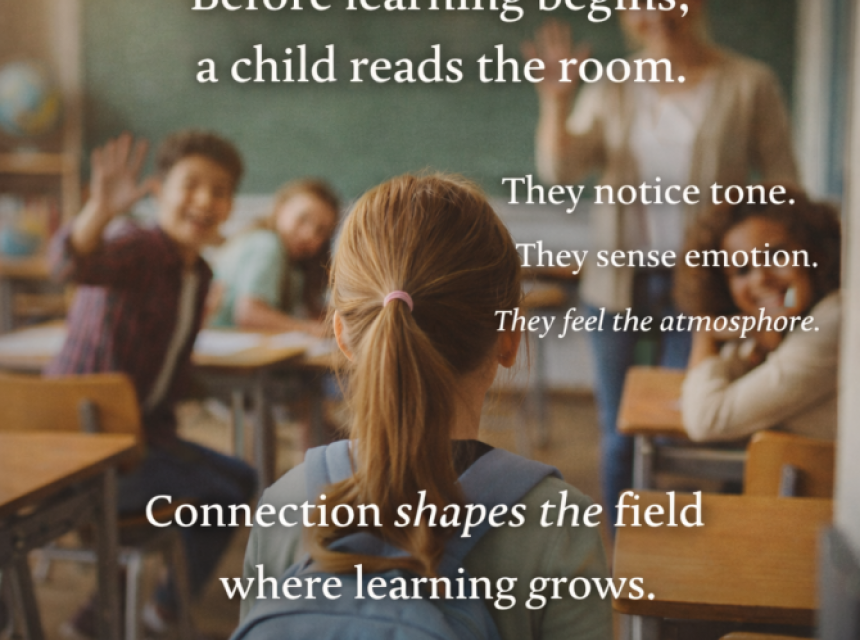
Shaping the environment where learning comes alive
Learning is often spoken about as the transfer of knowledge from one person to another. A teacher explains. A learner listens. Information moves from one mind to the next. Yet anyone who has spent time with children knows that learning rarely works this way.
Before a lesson begins, something else is already happening. Individuals entering a learning space are sensing the environment. They notice tone of voice, facial expressions, posture, emotional atmosphere, and how they are received. In other words, learning begins in relationship.
Educational research has long supported the idea that knowledge develops through interaction. The theory of Social Constructivism suggests that understanding grows through dialogue, collaboration and shared exploration rather than passive instruction. But beyond theory, this is something we can feel.
Walk into a room where the atmosphere is tense, impatient or disconnected, and participation quickly closes down. Walk into a space where there is warmth, curiosity and presence, and people naturally lean in. This is what we might call the relational field.
The relational field is the invisible yet powerful atmosphere created by the people within a learning environment. It is shaped not only by what is taught, but by how individuals show up.
Presence matters.
Tone matters.
Attitude matters.
Awareness matters.
Children are especially perceptive to these cues. They quickly sense whether they are welcomed, tolerated or judged. Educator Rita Pierson captured this truth simply when she said: “Kids don’t learn from people they don’t like.” Her message was not about popularity, but about relationship. When individuals feel respected, seen and valued, trust develops. And trust creates the conditions where learning can flourish. This means educators and parents are not only guides of information. They are stewards of the learning environment.
Through their presence, they influence the emotional and relational atmosphere of the space. A calm and attentive adult often creates calm in the room. A curious mindset invites curiosity in others. Patience encourages persistence. In this way, the environment is not separate from learning. It is the learning field.
When we begin to recognise this, the focus of education expands. Instead of asking only “What am I teaching?” we also begin to ask:
- What kind of space am I creating here?
- Do individuals feel safe and valued in this environment?
- How does my presence influence the learning atmosphere?
When connection comes first, learning becomes more than the acquisition of information. It becomes a shared process of discovery. And in that kind of space, curiosity, confidence and understanding grow naturally.
Practical Ways to Strengthen the Relational Field
1. Begin with Presence
Before starting a lesson or activity, pause and take a breath. Arrive fully in the space.
When adults are calm and present, the atmosphere of the room often settles with them.
Simple actions can help:
- greet each individual
- make eye contact
- acknowledge their presence
These small gestures signal that each person matters.
2. Notice the Energy of the Space
Pause occasionally and observe the atmosphere. Ask yourself:
- Does the space feel relaxed or tense?
- Are individuals open to participating?
- Do people feel comfortable contributing ideas?
If the room feels rushed or pressured, slowing down briefly can shift the entire field.
3. Lead with Curiosity
When challenges arise, curiosity can transform the interaction. Instead of asking:
“Why are you doing that?”
Try: “I notice something is happening here. What’s going on?”
Curiosity opens communication and invites understanding.
4. Shape Tone and Language
Tone carries meaning beyond words. A calm voice, patient pace and respectful language communicate safety and trust. When individuals feel safe to participate without fear of judgement, learning deepens.
5. Invite Participation
Learning becomes richer when individuals feel their voice matters. Encourage contributions by asking open questions such as:
- What do you think about this idea?
- Does anyone see this differently?
- What possibilities do you notice here?
These invitations strengthen both confidence and collaboration.
6. Reflect on the Learning Environment
At the end of a session, take a moment to reflect. Consider:
- Did individuals feel welcomed and respected today?
- Did curiosity and participation grow?
- What helped the space feel open and supportive?
These reflections help strengthen relational awareness over time.
Reflection for Educators and Parents
Learning environments are shaped moment by moment through presence, tone and intention. A helpful question to carry into any learning space is:
“What kind of field am I creating here?”
Because when individuals feel safe, respected and connected, something powerful happens. Learning no longer needs to be forced as it begins to flow.
 To listen to an interesting podcast on The learning field go to https://bbsradio/alllearningreminaged.
Recorded on to the 14th March 2026. See below for ideas to promote a relational field use in any educational settings. Enjoy!