
Sound Pathways, September 2, 2026

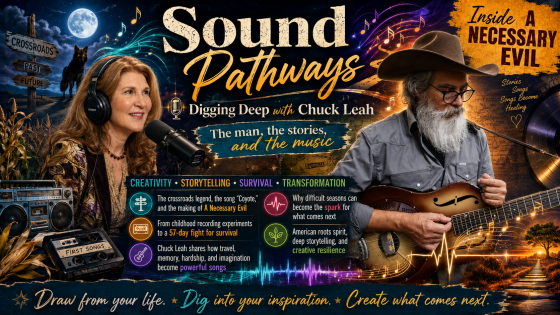

Sound Pathways with Dr. Karen Olson
DIGGING DEEP with Chuck Leah
The Man, the Stories & the Music
Chuck's Website: https://www.chuckleahfyc.com/
Texas troubadour, songwriter, storyteller and paleontologist Chuck Leah has built alife—and a body of music—around digging beneath the surface. His songs weave history, imagination, lived experience and richly detailed stories into worlds that feel remarkably real.
On this episode of Sound Pathways, Karen Olson goes Digging Deep with Chuck to explore what first drew him to music, where those captivating stories come from, and how seemingly different chapters of our lives can overlap, inspire one another and ultimately become part of our creative voice.
At the heart of the conversation is Chuck’s new release, A Necessary Evil, emerging from a profound chapter in his life that he has publicly described as a near-death experience. Together, Karen and Chuck explore creativity, survival, resilience and renewal—and how what we live through can become inspiration for what we create next.
And perhaps the digging comes full circle when what an artist uncovers and gives meaning through music is shared with others—allowing listeners to discover their own meaning in the song, and perhaps something meaningful in their own lives as well.
Draw from life. Dig into inspiration. Create what comes next.
From the Crossroads to Coyote: Survival, Storytelling, and the Making of A Necessary Evil
Summary
The Meaning Behind A Necessary Evil
Chuck Leah explains that the concept for A Necessary Evil grew out of his longstanding fascination with the Robert Johnson crossroads legend and his own reflections on the difficult compromises people make in ordinary life. He interprets "necessary evil" less as a supernatural bargain and more as the jobs, hardships, responsibilities, and circumstances people endure in order to take care of family and move forward. His own serious medical crisis gave the phrase a more personal meaning because he had to accept help when he was accustomed to being the person who helped others. He describes the record as a concept album built from his own stories, with gospel voices, harmony, symbolism, and a recurring tension between good and bad. The host connects this idea to transformation through hardship, and Leah agrees that difficult experiences can make a person stronger, more resilient, and less afraid. The album's title therefore becomes a framework for understanding survival, sacrifice, and the creative meaning that can emerge from adversity.
A Childhood Built Around Sound and Experimentation
Leah traces his musical life back to early childhood, when his father's garage band, broad listening tastes, and small cassette recorder introduced him to both performance and experimentation. He says he first picked up a three-quarter-size bass after the band's bass player died and felt almost immediately as though he already knew how to play. Although he had little formal instruction and did not study music theory until later, he became absorbed in making music and recording ideas. A small Sony recorder and a large boombox led him to invent a primitive overdubbing method, layering instruments by recording from one machine into another through a single microphone. He remembers arranging instruments physically around the room and thinking like a producer long before entering a professional studio. His earliest songwriting also came through experimentation, beginning with songs he admired and gradually changing melodies and lyrics until the material became his own.
Storytelling, Memory, and the Coyote Experience
The conversation turns to Leah's storytelling instinct and the way his songs blur lived experience, memory, and imagination. He says he learned from great storytellers and values voices that communicate truth even when they are not conventionally pretty. Inspiration, for him, can come from almost anything: a stranger, a smile, nature, heartbreak, travel, geography, or difficult times. He describes the song "Coyote" as rooted in a real experience at a crossroads, where he waited at midnight as a songwriting exercise and encountered a coyote that seemed to stare and sway in front of him before disappearing. Years later, during a severe medical crisis, he says he saw the coyote again while under heavy medication, and the song formed in his mind even though he was too weak to write or play. That connection between the crossroads encounter and his near-death experience made "Coyote" a central doorway into the larger concept of A Necessary Evil.
Illness, Recovery, and the Love of Community
Leah recounts an extended hospitalization in Hollywood in which he says he spent 57 days in the hospital, nearly died twice, underwent multiple blood transfusions and surgeries, and temporarily lost the ability to walk and play music. He describes rebuilding his playing through relentless practice after months of weakness and sending an early version of "Coyote" to co-producer Larry Campbell while still recovering. He also speaks emotionally about the support he received from the Americana music community, saying that he had never felt so much love and that the experience made him feel important. The illness left lasting physical effects, including a limp, balance problems, and the risk of falling, but he repeatedly rejected the idea of surrendering to those limitations. His humor remains evident as he jokes about not wanting his life to end through something as unglamorous as an injury from a rusty bed frame. For listeners facing overwhelming circumstances, his example centers on fighting forward, accepting help when necessary, and continuing to write the next part of one's story.
Letting Songs Develop on Their Own Time
A major creative theme in the interview is Leah's refusal to force songs before they are ready. He says he has been writing for roughly 50 years and does not think of himself as someone who experiences traditional writer's block; when a song will not come together, he assumes it needs more time to simmer. He stores images, place names, memories, and musical ideas in his mind until they mature, then tends to write an entire song in one sitting after much internal preparation. By the time the lyrics are finished, he often already hears the key, tempo, arrangement, drum fills, organ parts, and other instrumentation. He compares songwriting to solving a puzzle and says inspiration is everywhere if a person looks from the right angle. Rather than shaping songs to fit viral trends or predetermined formulas, he lets each song go where it wants to go. His priority is not whether a track becomes popular or gets covered by someone else, but whether he has made a good record.
Finding an Artistic Voice and Creating What Comes Next
Near the end of the interview, Leah reflects on how a near-death experience changed his appreciation for everyday life, invoking the advice to "enjoy every sandwich" and describing how ordinary tastes, smells, and experiences now feel different. He also says he has little interest in wasting time arguing with negative people and prefers to be around people he likes and do what makes him happy. Looking ahead, he is already writing another project and imagines a traditional 1940s-style country record made from original songs, recorded with musicians gathered around a single microphone. His advice to emerging artists is to protect an idea, let it grow, share it with people, listen to reactions, and keep developing a distinctive voice rather than imitating someone else's identity. He compares his own influences to ingredients in a gumbo, combining country, blues, folk, rock, and songwriting traditions until the mixture becomes his own recipe. The episode closes with the host encouraging listeners to choose a buried story or spark from their own lives, dig into that inspiration, and create what comes next.
Headlined Show, Sound Pathways September 2, 2026
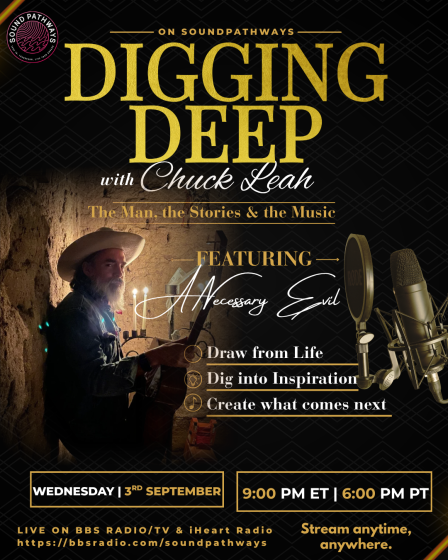
DIGGING DEEP with Chuck Leah
The Man, the Stories & the Music
Texas troubadour, songwriter, storyteller and paleontologist Chuck Leah has built alife—and a body of music—around digging beneath the surface. His songs weave history, imagination, lived experience and richly detailed stories into worlds that feel remarkably real.
On this episode of Sound Pathways, Karen Olson goes Digging Deep with Chuck to explore what first drew him to music, where those captivating stories come from, and how seemingly different chapters of our lives can overlap, inspire one another and ultimately become part of our creative voice.
At the heart of the conversation is Chuck’s new release, A Necessary Evil, emerging from a profound chapter in his life that he has publicly described as a near-death experience. Together, Karen and Chuck explore creativity, survival, resilience and renewal—and how what we live through can become inspiration for what we create next.
And perhaps the digging comes full circle when what an artist uncovers and gives meaning through music is shared with others—allowing listeners to discover their own meaning in the song, and perhaps something meaningful in their own lives as well.
Draw from life. Dig into inspiration. Create what comes next.
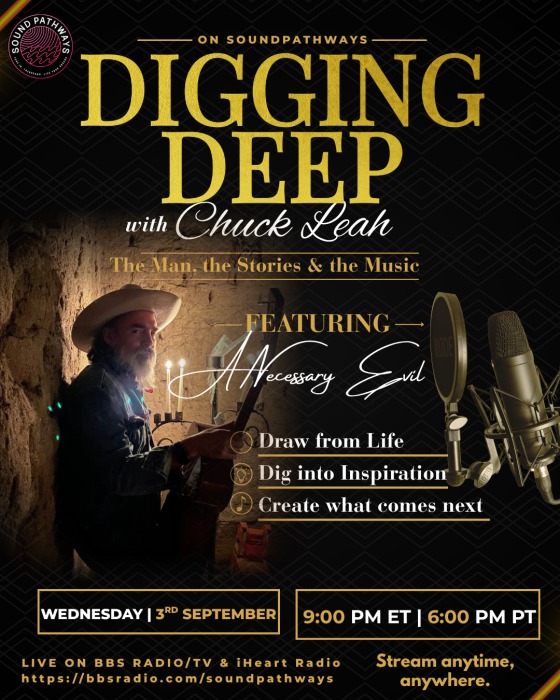
Sound Pathways

Sound Pathways is an inspiring and groundbreaking journey into the healing power of sound, creativity, and connection, exploring the profound link between Mind, Body, and Spirit. Hosted by Karen Olson, Ph.D., the show features captivating conversations with composers, musicians, sound healers, and inspirational thought leaders who share pioneering insights into how creativity and vibration shape our lives.
Each episode invites you to explore the magic of sound and energy as powerful tools for healing, self-discovery, and achieving your dreams. With special guests, uplifting stories, live call-ins for personalized sound healings, and unique teachings, Sound Pathways inspires you to tune in, align with your inner self, and elevate your life.
Speaker Identification
Speaker 1 - Announcer / Prerecorded Promo Voice
The opening voice introduces Sound Pathways in the third person and identifies Dr. Karen Olson as the host, indicating a prerecorded show introduction rather than the host's live interview voice.
Speaker 2 - Dr. Karen Olson - Host
The speaker identifies herself by name at the start of the live program and conducts the interview throughout the episode.
Speaker 3 - Chuck Leah - Guest
The host introduces the guest as Chuck Leah. He discusses his music, album A Necessary Evil, the song "Coyote," his childhood, songwriting process, medical crisis, recovery, collaborators, and future recording plans. The precise spelling of the guest's surname and some digital handles should be verified from an authoritative source because the raw transcript contains inconsistent or garbled spellings in a few places.
Speaker 4 - Recorded Song Vocal / "Coyote" Excerpt
A recorded song plays after the interview closes. The raw automated transcript captures portions of the sung lyrics, but several lines are too garbled to reconstruct confidently without checking the audio or an official lyric source.
Speaker 1 - Announcer / Prerecorded Promo Voice:
Have you ever wondered how sound can heal, inspire, and transform your life? What if the vibrations around you could unlock your true potential and guide you to a deep presence of harmony?
Welcome to Sound Pathways, the groundbreaking journey into the healing power of sound, creativity, and connection with your host, Dr. Karen Olson. In each episode, she explores the profound link between your mind, body, and spirit, from composers and musicians to sound healers and visionary leaders. She'll dive into captivating conversations that reveal how sound shapes your reality, heals our wounds, and helps us manifest our dreams.
And guess what? You're part of the conversation. Call in, ask questions, experience personalized sound healing live, and let your sound be your guide to the life you've always dreamed of.
Speaker 2 - Dr. Karen Olson - Host:
Hi, I'm Dr. Karen Olson, and welcome to Sound Pathways, where every note is a heartbeat and every story becomes a song of transformation, healing, and possibility.
Tonight, we are digging deep with Chuck Leah - the man, the stories, and the music. We'll explore A Necessary Evil and how life becomes inspiration for what comes next. This is his eighth studio album, and he draws from his life, digs into his inspiration, and helps create what comes next. We're going to explore all of that tonight.
We are going to draw from our lives and dig into our inspiration, because it is about creating what comes next. So let's begin by looking at this powerful new release. Chuck, welcome. Thank you so much for being here.
Speaker 3 - Chuck Leah - Guest:
Thank you for having me.
Speaker 2 - Dr. Karen Olson - Host:
It's amazing. It's so exciting. I have to say that I've been fortunate to see Chuck in person, and especially when we're talking about his stories, there's just nothing like hearing them in person. You're sitting there thinking, "How does that happen?" I even had to ask, "Did that really happen?"
Well, it did really happen, because for you it happened. You created it, and it happened. That's what I want to talk about.
With this new release, it's also Grammy voting season, which is kind of like Christmas time for me because we get to hear these amazing creations made by magnificent people and celebrate them. It's a big party, right? And Chuck, you just performed in L.A.
Speaker 3 - Chuck Leah - Guest:
Yeah, we had a little get-together last night.
Speaker 2 - Dr. Karen Olson - Host:
That must have been amazing. I wish I could have been there. What is this album saying that you did not need to say before? Why the title, and what does the idea of a necessary evil mean to you?
Speaker 3 - Chuck Leah - Guest:
I had a different title originally. After I finished the album and was listening to all the songs, it came back to the original story.
As a child, I was obsessed with Robert Johnson, the blues singer. I discovered him on a little record and started doing all kinds of research. For those who don't know, Robert Johnson was supposedly a mediocre musician who, in the 1930s, ended up going to the crossroads and selling his soul to the devil, and all of a sudden changed music forever. A lot of people, like Eric Clapton and Keith Richards from the Rolling Stones, have high regard for Johnson and his influence on their music.
First of all, I don't believe in the devil, right? But I was completely consumed by this whole story. What would make a person do that?
About five years ago, I found that there are a few places where people say this happened. I went to all of them, but there was one spot that was a little different from the others, and I believe that was the true crossroads.
The story starts with him being booed offstage at Dockery Farms in Mississippi. About a block down the road is where his wife, who died in childbirth, is buried, and then about two blocks from there are the crossroads. So it kind of makes sense. He's booed offstage, he's beaten down, he stops at the grave, and then he sells his soul to the devil. He's kind of given up on it, right?
I came up with the title when I was talking with a friend of mine. I was telling him that I couldn't understand what Johnson was going through. For us, maybe it isn't selling your soul to the devil, but it's having to work a job that you don't like. It's having to live through circumstances you wish were different, but it's part of paying the bills. It's part of taking care of your family. It's part of moving on to the next step of your life.
So I think we all have to deal with a necessary evil of some kind. For me, medically, that was kind of tough. I'm not someone who's used to accepting help. I like to help people. It's very awkward for me to accept help. Last year, I got so sick that I couldn't have survived without that help. That's kind of the background of the title.
Since all of the stories are my stories put into that situation, the whole record is kind of a concept album. We have a wonderful gospel quartet that sings through almost every song, and we have a lot of harmony and some wonderful singers. You can hear the good-versus-bad tension going on. There's a lot of symbolism.
Speaker 2 - Dr. Karen Olson - Host:
Do you feel that the word "necessary" is there because, in order to dig deep and really find our purpose, we need to go through something very difficult like that - going through the flames, like a phoenix?
Speaker 3 - Chuck Leah - Guest:
Absolutely. I think that purifies you, makes you stronger, makes you resilient and tougher. When you go through something like that, you're not really afraid of anything afterward.
Speaker 2 - Dr. Karen Olson - Host:
Right. Wow. I want to come back to that story because it's certainly not finished, but let's move back to your early days. What did your earliest musical life look like? Who inspired you, influenced you, and helped give you permission - or helped you give yourself permission - to become an artist?
Speaker 3 - Chuck Leah - Guest:
I started playing very young. When I was about two years old, my dad had a little garage band. One of the musicians, the bass player, passed away. He had injuries from Vietnam and a lot of PTSD. He had a three-quarter-size bass, and the guys did not want to replace him because he was a very important part of the band.
Every time they would play, I'd come into the room and watch them. I was fascinated by the music. Even though my dad wasn't a very good musician, he loved a lot of great music. He curated wonderful music for me. It was everything from Mozart to Stevie Wonder to Led Zeppelin - all over the place.
One of the guys in the band, the guitar player, said, "Do you think Chuck should take his place?" It was very strange, because the first time I picked up the bass, it kind of felt like I already knew how to play it. I remember my dad telling me, "You're going to play this," and I was like, "I got it. I got it. I got it." I became fairly proficient very quickly.
It took several years before I had any formal music theory. I've never had a guitar lesson. I've never had a piano lesson. I've never had a violin lesson. It wasn't until I was 11 or 12 and in band that I learned much music theory. But I started creating at a very young age.
My dad was a police officer and then an investigator. He gave me a little tape recorder after he upgraded to a better cassette recorder. It was a small Sony with a separate microphone. He said, "You can record your songs here - your song ideas."
I remember recording a song and thinking, "I wish I could add something on top of that." I could play along with the recording, but I couldn't record what I was adding. Then, for Christmas, my grandmother gave me one of those huge, ridiculous boomboxes.
I figured out that if I recorded on the small recorder, put that cassette into the boombox, and placed the microphone between me and the boombox, I could overdub. I kept overdubbing, and pretty soon I had some elaborate demos with multiple guitars, bass, drums, and keyboards.
I think that was preparing me to go into a studio. You start thinking, "The bass is too loud. I need to turn it down. I need to move the drums ten feet back." I remember having duct tape on the floor: "The bass amp needs to be here. The guitar needs to be here." I only had one microphone, that little Sony mic.
Speaker 2 - Dr. Karen Olson - Host:
Do you have some of those recordings?
Speaker 3 - Chuck Leah - Guest:
I probably do. I don't know. They're probably in my mom's house. Or I probably don't.
Speaker 2 - Dr. Karen Olson - Host:
I'd love to hear that. That's so cool.
Speaker 3 - Chuck Leah - Guest:
I think those were the very early days of me learning how to create. I told a friend recently that I didn't know how to write a song. Nobody ever showed me how.
I went to a friend's house, and he played a KISS record for me. I had never heard it. I heard the song "Beth," and I thought, "Boy, that guy has a similar voice to me. It's really raspy." I loved the song, but I didn't have the record. I heard it one time.
When I got home, I wanted to figure out how to play it. I figured out the basic melody on a little organ I had, a very primitive arrangement, and then I made lyrics to that melody. I started tweaking it and tweaking it, and finally it didn't even sound like that song anymore.
With the first songs I wrote, that was kind of the formula because I didn't know how to write. I used songs I liked and kept adjusting them until pretty soon it was my own composition. I don't do that anymore. That's not what I want to do now.
I think I learned from the very best - the Bob Dylans and the Jackson Brownes - and pretty soon I had a very direct idea of where I wanted to go and where I am now.
Speaker 2 - Dr. Karen Olson - Host:
I love that you were an organic prodigy, and how your dad put that love of investigating in you. I think that kind of sums it up: you're an investigator, and you put it all together in your own way through story.
Something that fascinates me is that I've had the enormous pleasure and honor of listening to your stories in person. When you tell them, you encapsulate them. You become the people in the story. I'm sitting there thinking, "Did that happen?" The blurring between reality and imagination is so complete that you almost can't tell.
One time I asked, "Did that really happen?" It did really happen, but it also happened in your creation and your mind, and you brought it all together for the listeners. Where do you think that storytelling instinct comes from that's so deep in you?
Speaker 3 - Chuck Leah - Guest:
I think it comes from people I looked up to. Guy Clark, and a lot of wonderful songwriters like that - including [name unclear in source, rendered approximately as "Sean Phamp"] - are some of the best storytellers in the world. He just got inducted into the Songwriters Hall of Fame, and we're all very proud of him. Of course, he's played on several of my records.
Those are the kind of people I learned to tell stories from. My voice is strange, and it's not for everybody. It's a storyteller's voice. [Reference to one or more artists is unclear in the raw transcript], along with John Prine and Bob Dylan. I believe there are a lot of pretty voices out there if you want to hear pretty, but sometimes you find truth in other places.
Speaker 2 - Dr. Karen Olson - Host:
Yes, and they come from within. Do your songs begin with a person, a place, an image, a phrase, or a personal experience? Does each song come from a different place?
Speaker 3 - Chuck Leah - Guest:
Each song comes from a different place. Inspiration could be somebody's pretty smile, a stranger on a bus, nature, heartbreak, tough times - anything in life.
There's a very elemental and authentic way of telling the story and being honest in the song. I can say that almost every single song of mine comes from an honest place.
Speaker 2 - Dr. Karen Olson - Host:
That makes me want to think more deeply about my own experiences and how I could share them and let them come naturally from an authentic place. You do that so magically because you've really lived these things, and your imagination is so rich.
How does it feel to you when something really happened versus when you imagine it and then it still really happens within you? Is it pretty much the same thing in a certain way?
Speaker 3 - Chuck Leah - Guest:
By the time I'm finished with the composition, I feel like that is the truth. It's like if you were on a jury in court: that's the way I remember it. That's the way the event happened.
For example, "Coyote" sounds like a strange tale, but that is 100 percent factual. I told you I went to the crossroads, right? What's supposed to happen is that you show up at midnight, the devil shows up, you sign in blood, and he tunes your guitar a special way. All of a sudden, you become whatever you wish in exchange for your soul.
Well, none of that happened, of course. But I'm sitting in this pitch-black area surrounded by cornfields at midnight with only the moon above me. After about 40 minutes, I got tired of waiting. I went there as a songwriting exercise.
I started to get up, and when I moved my guitar so I could stand, I saw this coyote behind me. He was doing this weird thing, swinging his head back and forth, almost like a pendulum trying to hypnotize me.
I stood up, and he was about ten feet away. I took two steps closer and hyper-focused on his eyes. I was so focused on his eyes that I didn't notice a truck coming from behind me. The truck sped past and scared me because I wasn't expecting it. I flinched, and when I opened my eyes, the coyote was gone.
Fast-forward five years. Last year, I got sick in Hollywood. I ended up in the hospital for 57 days. I almost died twice. I had four blood transfusions and seven surgeries. My skin was green. I remember [two visitors' names unclear] coming to see me. I was so embarrassed because my skin was green.
The first time I almost died - and we can probably blame the morphine for this - as soon as I opened my eyes, I swear I saw the coyote at my door. Even though I was in a strange mental state with all those drugs going through me, that song was pretty much written.
I didn't even have the strength to write it on paper. I couldn't play for six months. I couldn't walk. I couldn't do anything.
A few months later, I remember being in a wheelchair and sending a rough idea to Larry Campbell, who co-produced this record with me, and asking, "What do you think of this?" I was probably playing like somebody who had only played for two months - just horrible - but it was enough for him to understand what I was trying to do. He said, "I think we should record it once you're better."
Then I just kept pushing myself, playing, well, 16 hours a day. I didn't have anything else to do. I was trying to rebuild my endurance, flexibility, and all of that.
Speaker 2 - Dr. Karen Olson - Host:
That's just amazing. I remember when you were going through that, and everyone was so worried and praying. You're such a part of the community, and you offer so much love and inspiration.
Speaker 3 - Chuck Leah - Guest:
Before we move on, I do want to say that when I was sick, our Americana music community came to me, and never in my life had I felt so much love. I could never express how much it meant to me or how grateful I am for everybody in this community. It made me feel important. It made me feel really important.
Speaker 2 - Dr. Karen Olson - Host:
Thank you. It was a beautiful experience for all of us. There really aren't words.
For people who might be going through something that feels insurmountable, could you share something from your experience that they might be able to hold on to, beyond what you've already shared?
Speaker 3 - Chuck Leah - Guest:
Karen, I think I've had a really good run. If I had died at that moment, I don't think I would have complained. I've had a great run. I've traveled a lot. I've been married to beautiful people. I have wonderful children. I feel like I've had a rich life.
I think the only reason I didn't die is because I didn't want to die of something stupid, like stubbing my toe on a rusty bed frame. That just didn't seem like the right way to die. It made me fight harder. I was like, "I can't let this be. I can't let this be."
Speaker 2 - Dr. Karen Olson - Host:
You had to keep writing your story.
Speaker 3 - Chuck Leah - Guest:
Yeah. If I'm going to die, I want it to be something memorable, like my life - not stubbing my toe.
Speaker 2 - Dr. Karen Olson - Host:
Because then it went into sepsis. Is that what it was?
Speaker 3 - Chuck Leah - Guest:
Yeah. I got MRSA and sepsis. It went into my bone marrow. I think it's something I'm probably going to live with, including antibiotics, for the rest of my life.
I have a horrible limp. I'm very self-conscious about that. It really bugs me. I'm supposed to be on a cane. I was supposed to be in a wheelchair for six or eight months. After about six weeks, I was like, "This isn't going to work." Then I went to a walker. I hated the walker even more. Then I got crutches and hated those even more. I got on a cane, and I just didn't see myself as the kind of person who should be on a cane.
I fall down all the time. The other day I was walking with my guitar player, Scott, in Hollywood, and I just fell down on my face for no reason. It was my balance. I think it's just something I have to deal with.
My doctor said, "What I'm concerned about is that you fall down and split your head open somewhere. That could be very dangerous." I hadn't thought about that, but I'm hoping my cowboy hat will save it.
Speaker 2 - Dr. Karen Olson - Host:
I love that you keep getting up and you're not afraid of falling. That's amazing.
Speaker 3 - Chuck Leah - Guest:
I grew up in a place where you had to be tough or you weren't going to make it. I know how to take my licks, and I'm a sore loser.
Speaker 2 - Dr. Karen Olson - Host:
That's a good motto. One of the themes of the show that I love is creativity and how we can create our lives. One thing you show us is how you can take all these different parts of your life - your travel, your history, the people, the places, your memories - and bring them together so they speak to each other. Out of that comes your music.
When did you know you had this gift for storytelling and putting it into music, and for having this whole-life creative voice?
Speaker 3 - Chuck Leah - Guest:
I think it comes from being a daydreamer. When I was a little kid, I would daydream all the time. I think I could have been a writer and written books, but my attention span was about three minutes at a time. I try to tell my story in a short, concise way, and then I move on to the next story.
I like geography a lot. I mention a lot of towns. I see a town name and think, "What in the world is going on there?" [Wyoming town name unclear in source.] I just like the way names roll off the tongue. Truth or Consequences. Lolo, Montana. They're places.
I remember the first time I drove to Lolo, Montana, I thought, "If I ever wanted to get away from the law or anybody, I'd come to Lolo, Montana. Nobody would ever find me." That's kind of the whole concept of the song: nobody is ever going to find you in Lolo, Montana.
I keep little ideas like that in the back of my head and wait for them to mature. I know a lot of songwriters will write pieces of songs, but I can't do that. I have to write a song all in one sitting.
By the time I finish a song, it's been percolating in my head for a while. I know the melody. I know most of the lyrics. I know what key we're going to be in. I know the tempo. By the time I write the last word, I know, "All right, at the 45th measure there's going to be a big, massive drum fill, and a Hammond organ is going to come in here." It's pretty close to the way it comes out after we record.
Speaker 2 - Dr. Karen Olson - Host:
That sounds like a lot of fun going on in your head. I have this image of you having a kind of 3D library in your head with all these capsules filed away. Then you take one out, and here comes the song.
Speaker 3 - Chuck Leah - Guest:
Yeah, I like that. I like that a lot. The cost of that is that the house could be on fire and I won't respond. I have to finish the song right there and then. There could be anything going on, and I won't know what's happening.
Speaker 2 - Dr. Karen Olson - Host:
You're in a world.
Speaker 3 - Chuck Leah - Guest:
I'm horrible at a lot of things, but songs are pretty easy. Songs are like a puzzle. You're thinking about the arrangements: "Oh, it'll fit right here, right in this spot, and mandolin right here." It's definitely a puzzle.
Speaker 2 - Dr. Karen Olson - Host:
That's so cool. Another thing you've explained is how your professional work in paleontology feeds into your music and your concepts - the way you weave together history, discovery, place, and all these buried fragments that you uncover, really looking beneath the surface. It fascinates me how that has become part of who you are.
I also want to encourage people. When you stop separating all the parts of yourself or judging them - thinking, "Should I be this way? What if people knew I did this or that when I'm supposed to be doing something else?" - you can simply live with all those parts because they're all you, and you can create from there.
What inspiration could you share for people who feel stuck and think, "It's great for him, but I could never do that"?
Speaker 3 - Chuck Leah - Guest:
People who get stuck probably aren't looking at it from the right angle. Inspiration is everywhere. The painting behind you - it could be anything.
I don't think I've really had writer's block in my life, and if you count the very early recordings, that's 50 years of writing. When I can't get through a song, I feel like it's not time. It's not time for that song to be out yet. I could love it, but maybe I'm stuck on one verse.
Now that I'm older, I know it just needs to simmer for a while. When it's ready to come out, it'll come out. Then it can go very quickly.
I'm not one of those songwriters - and I know a lot of guys who do this - who sit in circles and go one line after another, boom, boom, boom, boom. I have to think about it. I have to think about it for a long time. Then, when I'm writing, it can happen fast. I think I wrote the whole album in about a week.
Speaker 2 - Dr. Karen Olson - Host:
But you're writing it throughout your life, really.
Speaker 3 - Chuck Leah - Guest:
Yeah. They're like little golden nuggets here and there. I keep them in a safe place until it's time to share them.
Speaker 2 - Dr. Karen Olson - Host:
I think that's a great way of living and not forcing things through our own will - insisting that it's supposed to go a certain way - but instead hearing those whispers and guidance and being able to go with the flow. Sometimes we do have to work at it, and it takes discipline, too. But anxiety and judgment can work against creativity in our lives.
Speaker 3 - Chuck Leah - Guest:
I feel like a lot of people say, "I have to write the song. I have to write this. I have to write that." But sometimes you want to let the song write itself.
I could never say, "Oh, I'm going to write a song about subject A," because sometimes that's not where the song ends up. It can come around to subject Z.
Now, after doing this for a long time, I have a system where I let the song go where it wants to go. I'm not going to force it. I'm not going to say, "It has to be this long or this short or this tempo because that's what's popular on TikTok." I let the song go where it wants to go, and that's what has worked for me.
I don't really care whether a song is going to go viral or whether somebody is going to cover it. Maybe I should care about that more, but I just want to make good records.
Speaker 2 - Dr. Karen Olson - Host:
And you certainly do that. Do you feel that your near-death experience changed what you felt was worth saying, or did it deepen everything in general so that it comes through that way?
Speaker 3 - Chuck Leah - Guest:
One of my heroes growing up was Warren Zevon. I remember that, just before he died of cancer, he was on the David Letterman show. David Letterman asked him if there was anything he'd like to tell the world, and he said, "Enjoy every sandwich."
I enjoy every sandwich now. Everything tastes different. Everything smells different. I appreciate things I didn't appreciate before.
Speaker 2 - Dr. Karen Olson - Host:
Is it easier to let people who might have been annoying, or whatever, just go by?
Speaker 3 - Chuck Leah - Guest:
Things like that never really did bug me. If somebody is so negative that I can't be around them, I just don't be around them. I'm old, and I don't really have time for that.
I'm not going to fight with somebody and say, "I'm right, you're wrong." It doesn't matter, because in this person's head they're right, and in that person's head they're right. Why argue about it? Just move on. Be around people you like. Do what makes you happy.
Speaker 2 - Dr. Karen Olson - Host:
I feel like your compelling song "Coyote," and the story you've explained, opens the door into the heart of A Necessary Evil. Do you feel that way?
Speaker 3 - Chuck Leah - Guest:
Yeah. That was the first song I wrote, and I think it's definitely what it should be. You're opening the door and entering the room where the record is living. "Coyote" is the front door.
I think when people understand the story, they understand the song and the whole concept. When there's that big organ part and the drums kick in and the guitar parts come in, that's supposed to represent [word unclear in source; possibly a symbolic figure]. There's this big buildup at the end.
Speaker 2 - Dr. Karen Olson - Host:
Thank you for generously offering to share the video with us at the end. What a treat to be able to hear and see you playing it.
Speaker 3 - Chuck Leah - Guest:
My wonderful friends [video-production names unclear in source] and my [production-team reference unclear] did that. We had fun doing it in [Texas location unclear].
But I was still very bothered by the way I looked, because I can't stand up straight. I walk funny. It still bugs me when I watch it, but they did such a great job.
Speaker 2 - Dr. Karen Olson - Host:
You had to practice really hard to pull that off, right?
Speaker 3 - Chuck Leah - Guest:
It was really hard for me to walk with the guitar and not tip over forward. I was thinking, "I hope I don't fall there. That's my favorite guitar."
Speaker 2 - Dr. Karen Olson - Host:
It's really something - a real treat to be able to see that. There's so much that you've shared. The more I listen to your music, the more I feel like I know you because you really share your life and experiences, and so much of what you do helps and inspires others.
Before we close, how can people follow your music and stories, your upcoming releases, and support A Necessary Evil?
Speaker 3 - Chuck Leah - Guest:
It's on all the platforms. "Coyote" is [release wording unclear], and the album will come out in October. I'm on social media. I'm pretty easy to find.
Speaker 2 - Dr. Karen Olson - Host:
What's your handle?
Speaker 3 - Chuck Leah - Guest:
"Chuck Leah 7" is how the transcript renders one handle. There's also "Chuck Leah Music," which is mine as well, but I'm not as active on that one. [Additional handle spelling is garbled in the source.] It should be pretty much anywhere you listen to music, and on YouTube, too.
Speaker 2 - Dr. Karen Olson - Host:
And a website?
Speaker 3 - Chuck Leah - Guest:
The transcript renders it as "ChuckLeah.com." For Grammy members, there's also an FYC website [exact address unclear in source] that gives a little more story on the song.
I told the L.A. Times recently that this was a record I was dying to make.
Speaker 2 - Dr. Karen Olson - Host:
That's a beautiful article. I hope everyone can read that.
Speaker 3 - Chuck Leah - Guest:
They're really great folks.
Speaker 2 - Dr. Karen Olson - Host:
Your life shows that inspiration comes from everywhere, helps create who we are, and shows how creativity can turn what we live through into a work of art. With all these discoveries, and as you keep becoming more and more, what do you feel is ahead?
Speaker 3 - Chuck Leah - Guest:
I've already started writing material for the next record. I'd like to make a very traditional 1940s-style country record. I want it to sound like it was written in the 1940s, but with all original material, and everybody recording around one microphone. Brian Vibberts is going to hate that, but that's what I'd like to do.
Speaker 2 - Dr. Karen Olson - Host:
Could you briefly tell everyone what the Americana category is? Is that the category officially?
Speaker 3 - Chuck Leah - Guest:
Officially, it is American Roots Performance. We're just submitting the single for this season, and then we'll push the album for the rest of the [sentence incomplete in source].
Speaker 2 - Dr. Karen Olson - Host:
I see. American Roots Performance. That's great. What would you say to someone with a story that's still waiting to become art?
Speaker 3 - Chuck Leah - Guest:
Don't give up on it. Don't turn your back on it. Love it. Nurture it.
Speaker 2 - Dr. Karen Olson - Host:
What if they don't recognize that it's waiting to come out?
Speaker 3 - Chuck Leah - Guest:
They should probably share it with friends. Share it with people who like the same kind of thing you're doing, people who could like what you're doing, and even people who don't like that kind of thing. Use that as a barometer of the general consensus.
People who like good music will like any kind of good music. I always say there are two types of music: good music and bad music. I love classical as much as I love rock and roll, bluegrass, and blues. It's the caliber of musicianship and creativity that goes into those records.
So if you have an idea, don't give up on it. Let it grow. Let it simmer.
I always say that I have this big pot - I'm a gumbo, right? I put in a little bit of Hank Williams, a little bit of Muddy Waters, a little bit of Bob Dylan, a little bit of Bruce Springsteen and Tom Petty, and all these great songwriters, including [Jimmy Rogers / Jimmie Rodgers - spelling requires verification]. I stir it all up, and pretty soon I have my own recipe of gumbo.
I think the hardest thing about becoming an artist is finding your own voice and finding your own place - who you are and who you identify as. That's the hardest part about becoming an artist.
I was in my 40s before I realized, "Wait, I'm where I want to be." Throughout my whole life, I had good songs, but they were kind of everywhere.
When I recorded [album title unclear in source, rendered approximately as "my stakes"], which was the first record that I produced, I thought: whether you like that record or not, it's my fault. If you hate it, it's my fault. If you like it, it's my fault. I arranged it all. I produced it. I wrote everything.
That was the first time I thought, "Okay, this is Chuck Leah. That's it." That's pretty much the formula I've used since that album came out.
I like to use a lot of the same musicians because they are some of the finest in the world, and they've played on many of my favorite records. Larry Campbell, who produced this with me, had recorded with me before. He's played on many of my favorite records and won Grammys with Bob Dylan and Levon Helm. He was with so many of the artists and bands that inspired me.
Speaker 2 - Dr. Karen Olson - Host:
That's great. It's very special to be part of his creative process. It's also good to notice that we can find people who inspire us and not be shy about reaching out to them.
Thank you so much for letting us dig deep beneath your songs and explore your stories. Thank you for being such a light in our community.
Speaker 3 - Chuck Leah - Guest:
Thank you so much. Thank you for having me.
Speaker 2 - Dr. Karen Olson - Host:
Your mind and your work are so much about creativity, survival, hope, and imagination. Thank you.
For everyone listening, choose one buried story or spark from your own life this week. Draw from your life, dig into your inspiration, and create what comes next. Love and blessings.
Speaker 3 - Chuck Leah - Guest:
Thank you.
Speaker 4 - Recorded Song Vocal / "Coyote" Excerpt:
[The automated transcription of the sung lyrics is substantially garbled. The following preserves the phrases that are reasonably intelligible while marking uncertain lines rather than inventing lyrics. Intentional musical repetition is retained.]
Oh, four words.
[Unclear lyric line.]
While that coyote [unclear] at home,
To drag me from your [unclear] home,
Into the darkest part of the night [unclear].
To the old [unclear],
To the old [unclear].
As I take the lead and [unclear],
They run in each [unclear],
Or whatever time it holds me.
I should have been home long ago.
I guess it's just the way it goes.
I don't need [unclear].
I'm gonna be what it's gonna be.
I won't [unclear].
Go, go, go.
Go, go, go.
Go, go, go.
[Unclear phrase], can't save me now.
I don't need [unclear] in the wind.
[Unclear lyric line.]
Looks like I'm out of time.
Go, go, go.
Go, go.
Go, go, go, go.
[Unclear phrase], can't save me now.
[Unclear phrase], can't save me now.
Oh, oh, go, go, go.
Oh, oh, go.
[Unclear phrase], can't save me now.
Oh, oh, go, go, go.
Oh, oh, go, go.
Go, go, go, go.
Go, go, go, go.
Go, go, go, go.
Go, go, go.