
Sound Pathways, April 29, 2026

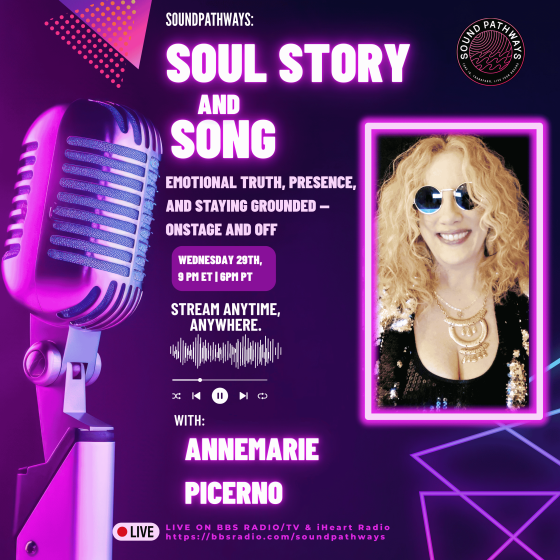

Sound Pathways with Dr. Karen Olson
Guest, Annemarie Picerno
SOUL STORY AND SONG, EMOTIONAL TRUTH, PRESENCE, AND STAYING GROUNDED - ONSTAGE AND OFF: A Conversation with Annemarie Picerno
Sound Pathways: SOUL STORY AND SONG
A deep dive with Annemarie Picerno on reclaiming the human element in music.
Core Arguments & Insights
In this episode of Sound Pathways, host Dr. Karen Olson sits down with award-winning multi-genre artist Anne Marie Picerno to explore the profound connection between honesty, vocal technique, and the creative process. The discussion highlights Picerno’s journey through Americana, blues, and rock, while serving as a passionate defense of human imperfection in an increasingly digital world.
The Stand for Authenticity in the Age of AI
Picerno emphasizes that honesty and authenticity are the core pillars of her identity as an artist. She voices a strong dissent against the rising use of Artificial Intelligence (AI) in music production, arguing that tools like Suno often mask a lack of critical thinking and genuine performance skill. For Picerno, the true value of music lies in its "raw elements" and "imperfections." She cites her recent Grammy entry—a simple combination of keyboard and voice—as a testament to the power of a performance that is intentionally not computer-generated or artificially altered.
The Authenticity Philosophy
"I want to go back to the raw elements, the real elements of music... my last Grammy entry was just a keyboard and a voice, in all its authenticity, rawness, and imperfections."
The Science and Discipline of the Voice
Drawing from her background in musical theater and the mentorship of the late Jan Sullivan, Picerno views the voice through a scientific and disciplined lens. She describes the technicality of vocal production, explaining how the position of the larynx affects tone and the importance of "marking" music to distinguish between chest, belt, and head voices. Her training was rooted in perseverance; she was taught to perform even when ill to learn how to adapt her range and maintain consistency under pressure. This foundation allows her to perform live exactly what listeners hear on her recordings, a rarity in an era of heavy studio manipulation.
Songwriting as Storytelling and Metaphor
Picerno’s songwriting often begins with a single phrase or the perspective of a character rather than her own direct point of view. She structures her songs to lead the listener through a narrative arc: verses provide the setup, the chorus delivers the core message, and the bridge often serves as a moment of revelation or conflict resolution. Her recent work, "Dreams and Wings," utilizes visual metaphors like birds, lighthouses, and the ocean to explore themes of selfless support and spiritual hope. By avoiding "perfect" computer-generated rhymes, she focuses on messages that allow listeners to project their own personal experiences onto the music.
Songwriting Framework
- 📍 The Setup (Verses): Establishing the character, conflict, and environment.
- 📢 The Message (Chorus): The emotional core and central theme of the piece.
- 💡 The Revelation (Bridge): A shift in perspective or "devil's advocate" moment.
- 🌊 The Metaphor: Using nature (birds, storms, lighthouses) to invite listener interpretation.
Community and the Journey of the Artist
The conversation concludes with a reflection on the importance of the artistic community, specifically the Recording Academy (Grammys). Picerno discusses the balance between celebrating the success of others and navigating her own challenges with depression and the high costs of promotion. She views art as a way to lift others up, even if it means watching them "fly away" to greater heights. Her current focus is on quality over quantity, choosing projects that resonate with her authentic self rather than chasing industry trends.
To-Do / Next Steps
- Collaborate as a featured artist on Sameer Badhi’s upcoming New Age album.
- Transition toward sync licensing, focusing on getting original music into films and commercials.
- Develop a one-woman show for Broadway that integrates her original music and the personal stories behind them.
- Maintain the official digital archive at annemariepicerno.com to host her history of videos, interviews, and multi-genre music.
Conclusion
Anne Marie Picerno’s artistic philosophy is a reminder that the most impactful music is not the most "perfect," but the most human. By embracing technical mastery and emotional honesty, she continues to create a body of work that serves as a beacon of authenticity in a digital age.
Sound Pathways
Sound Pathways is an inspiring and groundbreaking journey into the healing power of sound, creativity, and connection, exploring the profound link between Mind, Body, and Spirit. Hosted by Karen Olson, Ph.D., the show features captivating conversations with composers, musicians, sound healers, and inspirational thought leaders who share pioneering insights into how creativity and vibration shape our lives.
Each episode invites you to explore the magic of sound and energy as powerful tools for healing, self-discovery, and achieving your dreams. With special guests, uplifting stories, live call-ins for personalized sound healings, and unique teachings, Sound Pathways inspires you to tune in, align with your inner self, and elevate your life.
[00:00] Speaker 1: (music) Have you ever wondered how sound can heal, inspire, and transform your life? What if the vibrations around you could unlock your true potential and guide you to a deeper sense of harmony? Welcome to Sound Pathways, the groundbreaking journey into the healing power of sound, creativity, and connection with your host, Dr. Karen Olson. In each episode, she explores the profound link between your mind, body, and spirit from composers and musicians to sound healers and visionary leaders. She'll dive into captivating conversations that reveal how sound shapes your reality, heals our wounds, and helps us manifest our dreams. And guess what? You're part of the conversation. So call in and ask questions and experience personalized sound healing live, and let your sound be your guide to the life you've always dreamed of.
[01:15] Speaker 2: Welcome to Sound Pathways, where we explore the stories behind the music. We listen for the creative process behind a life in the arts, we look for what keeps a dream alive through many seasons, and we carry that inspiration into our own lives. I'm Karen Olson, and today I am so excited to welcome Anne Marie Picerno. She's an award-winning singer, songwriter, performer, and composer. She's also a filmmaker, collaborator, and gifted storyteller, and her work blends heart, power, and a remarkable versatility. Anne Marie wears many creative hats, and each one feels deeply lived. Her music moves through Americana, country, blues, rock, and soul. Yet, what ties it all together is her honesty, passion, and presence. And that makes her sound unmistakably her own. So welcome. Welcome, it's so great to have you today.
[02:18] Speaker 3: Yes. Hi, Karen and Dawn.
[02:20] Speaker 2: Hello.
[02:20] Speaker 3: I'm thrilled that she invited me on this. I really appreciate it.
[02:24] Speaker 2: Thank you. Thank you so much. So to begin, what feels most central to you and who you are as an artist?
[02:33] Speaker 3: Definitely honesty and authenticity in the creation of the music or the video or combination of both, because, and I've been really passionate about this over the last year or so, with the increasing use of AI, artificial intelligence, Suno and all the millions that you see pop up in your social media feeds these days, and everybody jumping on board, I wanna go back to the raw elements, the real elements of music in its creation, its presentation. And I don't mean to go on and on, but this is a loaded question, so just bear with me one second on this one, okay? If we all remember, and I'm kinda old, when we were kids, right, we had a, I had a little electronic organ, and it had the little buttons for A, B, C, G, the chords, right? It would play the chord. Was that AI? Then all of a sudden people had Photoshop to erase wrinkles. Was that AI?
[03:54] Speaker 3: And I think, you know, the more we get into everything looking and sounding so perfect and things being done for you through computers is that these days, kids can't spell, they lack critical thinking. And when it comes to artistry and the creation of art and music, now we've got not only body dysmorphia from people that think they look like all that Photoshopped photos that give perfect bodies and perfect wrinkleless face, if that's even a name. Uh, and then you get into the creation of music where now we have individuals that use Suno or use artificial intelligence not only to make the music sound better, but some of these are just songwriters. They're not the performer. That is my biggest, biggest dissent against AI, is for individuals that put into distribution and music stores songs, and they put it under their name like they're the performer. They are not the performer. And I don't know if they put a little voice sample in, but some of these people I know personally can't sing.
[05:12] Speaker 3: And so, I feel it's even more important now more than ever to go back to the basics, where, remember in the old days, before computers, people had a guitar or handmade instruments, and they brought them to the campfires, and they told stories, and they played and shared music. And if you look into folk songs, these folk songs traveled just by people becoming familiar at these gatherings and sharing, right, their instrumentation and their music and their stories and songwriting. So for me, I kind of right now am, uh, gravitating to single instruments and vocals that are mine that are not perfect.... that are not, uh, computer generated or artificially altered. And, uh, that was my last Grammy entry, was just a keyboard and a voice, and that was me in all its authenticity, its rawness and imperfections.
[06:20] Speaker 2: Mm, that's beautiful. I just wrote a blog on perfection, and it is such a trap because it's not obtainable. Like, who is gonna finally give you that award of being perfect? And it- and it-
[06:32] Speaker 3: (laughs)
[06:32] Speaker 2: ... is that humanism and the connection that- that makes it really impact us the most. I remember falling in love with original recordings, like of Heifetz and Brahms' voice, and there was so much realness in it, and the flaws and the notes that weren't quite perfect that were left. And now, when you go in the studio and you're mixing, which is a really fun process, it's almost like you're playing it again because you can fix it in a certain way. But everyone's used to it sounding perfect without any errors, and that is a really different experience in the creation process and in our lived lives, in every area of our lives. So that's a really big- that's a big way to, um, start out, and a big thing for us all to think about, and to dig deeper in our creativity. And I know when I use AI, I- it sparks... 'Cause I'm very intuitive, it sparks so much more in me, especially if I'm writing something, and it falls so short of really that deeper connection.
[07:46] Speaker 2: And, I mean, it's amazing, it- it- it's very, very limited. But it has- it can have a purpose, but not in place of our own intelligence, our own personalities, and- and what we share. And I do know that people feel that, 'cause I really believe in the energy and the frequency and- and all that's passed through, and really can become healing. So, and another thing, I know- I'm- I'm just getting to know you more, and it was fun when I would see you at different events. But one thing th- that comes across is how much fun you have with life and what you do, and- and just in your spirit, and that's something we- we can all, um, have more of.
[08:29] Speaker 3: Thank you.
[08:30] Speaker 2: Yeah.
[08:30] Speaker 3: Um, I don't know which performances you may have seen, because as a multi-genre artist, I've done everything from rapping out to Led Zeppelin, to blues, where I'm like, "Hey, I'm just gonna-"
[08:44] Speaker 2: (chuckles)
[08:44] Speaker 3: "... pull this microphone two feet away and people are gonna hear the power of my voice." And then, uh, most recently got back on the piano, trying to go back to the roots of simplicity. And I don't claim to be a great piano player, or even a great guitar player, but, um, I think, you know, when it comes to songwriting, even lyricists that put song ideas into, so, you know... If you're a great songwriter, it's about the message, the story, and there's usually a moral to the end of a story, or some message of hope, or whatever the theme is. And, um, I find that it just gets into, like, people that use rhyming catalogs, and they're just unusual and weird words. That's how I can usually tell. It's just badly written in some cases. Now, yeah, it's great how they can put all the music together, but it's collecting all most commonly heard musical themes and arrangements. So, with that said, when I write, I always try and write from a perspective. It might not always be my perspective.
[09:57] Speaker 3: I try and think of a character, or who is that person that's singing the song that's the character, and what's their... It might not exactly be my point of view, but I find that interesting as a songwriter. And then the story, and is there a twist to that story presenting, say, the conflict? And that's all writer... Even in literary and books, and writing a theatrical show or movie, it's going to have a theme, it's gonna have conflict, and then hopefully resolution, or at least some sort of ending. So, I write that way. And then when it comes to performing, a lot of times I've chosen those uptempo songs because so many people choose ballads or pop or rap, and I wanna show them a voice. And I learned how to sing in a two, 3,000 seat theater. Back in college, I was a musical theater major, and we just had those little boom mics hanging from the ceiling.
[11:05] Speaker 2: Mm.
[11:05] Speaker 3: And you had to learn with vocal technique how to breathe, support, and point your voice towards the back wall of the theater. And so I learned a lot in my musical theater training. And back then, Dreamgirls was really big, and I was a big Aretha Franklin fan, and Etta James. And, you know, obviously learned a lot of Broadway, and then learned how to mix different sounds in my voice, because I had a wonderful, uh, vocal instructor that taught a lot of great technique, and how you made belt and used chest and then go up into head voice, and how she would actually have you mark the music on each individual note, "Well, this is chest, this one is belt."
[11:51] Speaker 2: Ah.
[11:51] Speaker 3: "This is modulated, this is this, this." And so you, in your brain, understood the technicality of how you were physically producing, um, these sounds. And that training has carried me through-... so many difficult situations. She even made you show up when you were sick so you could learn. (laughs) If you had, say, uh, strep throat or a cold and you only had three notes to your range-
[12:22] Speaker 2: Mm-hmm.
[12:22] Speaker 3: ... and, uh, y- and you had to sing a high pop dance song-
[12:27] Speaker 2: (laughs)
[12:29] Speaker 3: ... and you only had, oh, well, then you modified. << Everybody dance now >> and you did the gig. And she taught you, uh, not only how to be perseverant, but how to be consistent, how to show up, and how to adapt in any difficult situation and still do a show. And that training has carried me through so many years of difficult situations, and I loved her, I loved her. She was the wonderful instructor who has since passed away. Her name was Jan Sullivan.
[13:03] Speaker 2: Hmm.
[13:03] Speaker 3: And, uh, she taught me a lot about my voice, how to use it, and how to adapt such in life. So, that is all transferred into my music and how I present it.
[13:17] Speaker 2: Oh, that's beautiful. She must be so proud of you.
[13:21] Speaker 3: Yes. She was, she was definitely a mentor, a mother-
[13:24] Speaker 2: (coughs)
[13:24] Speaker 3: ... a friend, so many things. She did write a book and a video to show how, uh, people produce different sounds, and I taught a lot of her students. Um, people don't realize, you know, there's a myth, "Oh, drink hot sauce or, uh, lemon in this and it will soothe your vocal cords." Well, it might soothe the back of your throat, but your vocal chords are in your airway passage. They are nowhere near esophagus or your digestive system. It is your trachea, which is the name of Adam's apple. And a lot of people don't realize when they have vocal issues, trying to get high notes, is when your larynx or your voice box is lowered, your voice is deeper. And then if you are kinda, uh, bringing your tongue up and forward against your lower cheek, your voice box is raising up and your voice is going to be thinner than it actually is.
[14:24] Speaker 3: The very tip of your vocal folds, where in classical there's a rounder sound and maybe the voice box is dropped lower and it's using all the folds of your vocal chords. And she was a voice scientist.
[14:40] Speaker 2: Hmm.
[14:40] Speaker 3: But just like with the bell of a trumpet, if, if it was stuffed with something, then your physical posture and breathing and technique helps open up and let your voice flow naturally. If you stuffed an instrument, it's not gonna produce. So, so many people have so many physical bad habits and things they do with their mouth and their jaw, or collapsed chest, or they don't breathe while singing. I'm very in tune to all that and, um, learned so much. So, definitely it does come out in my performance, my training. And, um, I do, I do love to, you know, blow out a great blues tune (laughs) and, uh, see the audience go, "Wow, she doesn't even need a microphone. Wow!" Um, you know.
[15:34] Speaker 2: Wow. That's, that's, it is beautiful.
[15:36] Speaker 3: It's, it's fun. But then there's a sensitivity too. And also recording is a very different technique. You have to really dial back when you record.
[15:47] Speaker 2: Mm-hmm.
[15:47] Speaker 3: The microphone does pick up everything, but it's a different technique. But the most, um, I feel authentically is the emotion, as you mentioned, behind a song and the lyrics. And really if somebody was to close their eyes and not see what you're doing physically, they can feel what you're singing about. And even there's a color to choosing a character and singing the song that will change your vocal tone a little bit. So I employ all these techniques that I have acquired since being young and dumb at age 19 and going to school and being shaped and molded, but I've carried everything I've ever learned, I just keep trying to layer and layer. And I think that's how ba- I became multi-genre, because I love all styles of music.
[16:39] Speaker 2: That's amazing. So, your music, it does, it moves through so many styles, and e- just with so much ease. And how did that blend become your own voice? And does one kind of resonate with you more than another?
[16:56] Speaker 3: Um, a- my music styles probably have changed a little through the years, because first I started off in musical theater, so obviously I wanted to sing like Jennifer Holliday in Dreamgirls (laughs) because that was super popular when I was a musical theater major, and Fats Waller and, um, you know, I think any young artist or young individual's always going to be influenced by what trends are out there. Then, you know, '80s classic rock and Journey and Styx and Billy Joel, and so y- I started getting my rock edge. And then I came across a little cassette tape of Aretha Franklin in a gas station, which is my favorite album of all time.
[17:42] Speaker 2: Mm-hmm.
[17:42] Speaker 3: It was one of her Decca, I wanna say, recordings. And it had everything from Dr. Feelgood on it to, um, It Won't Be Long, to some gospel, to Love Me Like A Man, and, and just, and Bonnie Raitt. And, you know, I started hearing those bluesy things, and the thing about blues, um, people that use auto-tune, you know, if you put a bend to a note-
[18:11] Speaker 2: Yeah.
[18:11] Speaker 3: ... and you're actually sliding-... through a couple half steps to the note, and it's intentional. Autotune will put a weird vibration to your voice, so I generally don't use Autotune, um, in... when I go into the studio because you want them to hear that maybe it's depth and then you're squeezing it through a note to a thinner sound. And that is part of the delivery. And blues has a lot of that, of kind of bending notes and traveling through quarter steps. So, I really do like the blues, though it's my own version. And then once in a while, I like to put out a- a- a good rock scream. (laughs) So, (laughs) you know?
[18:56] Speaker 2: Yeah.
[18:56] Speaker 3: It really depends on how you feel. Um, but my tastes have changed and I still love the classics, classic rock, um, obviously I have sung pop songs 'cause I've been in every band imaginable. I've been in pop bands, I've been in dance bands, wedding bands, classic rock bands, blues bands. I was in a great jazz band with stand-up bass and they had the vibraphone and all, all... You know, I did so many different styles, but I do tend to gravitate what I'll call my music multi-genre because it's whatever sounds I feel like producing at the time. So, I think I've always had my own voice, and I just kinda play around with it based on how I want the listener to feel. Plus, I tend to not choose as far as melody. If everybody goes, "Mi, re, do," then I'm gonna go, "Mi, la," because I want something different.
[20:03] Speaker 2: Mm-hmm.
[20:04] Speaker 3: And, um, I always choose opposite of what maybe somebody might expect the melody to go. And the same with rhythm. My producer's always telling me, "You're singing in the pocket." And to sing in the pocket and offbeat, you have to be pretty particular. But I love when I go to say a blues jam or any sort of music session where other musicians, and we're just gonna jump in and we're gonna play together, I'll be like, "Come on, bring it. Come on." And they start something, and I'll be singing intentionally opposite and filling in whatever space is in, what I'll call, the rhythmic air. And I love to do that. I feel like it makes the music move. And that's why me and my producer, Bob McGillpin, who has done so many of my fully arranged songs, we work well together because I'll say, "Bring it," or, "Give me a guitar solo like Santana," and he'll... he will put his arrangements opposite of what I'm doing. So, it's a nice interplay. And music should have physical movement.
[21:16] Speaker 3: And, you know, new age might be a great example, though that's not the only genre where you might feel that, but movement where things either go circular or you feel them and you feel that rhythm, not only in a- a- a musical fashion, but in a physical energy.
[21:37] Speaker 2: Mm. That's really inspiring that we... you have such a broad range and you can tune in. I think it's good for us all to do that. And, um, I wanted to ask, when you're thinking of a song or project, do you think about... Are you inspired by a mood or a story of your own or another story or the- the lyrics or the melody or a title? What- what... Do you have something that usually comes first or does it just depend on the project?
[22:16] Speaker 3: Um, usually. Well, I would say, lyric-wise, sometimes just something that somebody says triggers a songwriting idea.
[22:32] Speaker 2: Mm-hmm.
[22:32] Speaker 3: For example, a very close friend of mine, every time we said goodbye, give him a hug and he'd say, "You know I love you, right?" (laughs) Right? So, two things I do when I, "Oh," he says, "I could write a song about that." And so there's two things I do. One, I get on Google, did anybody else think of this song? Because many, many years ago, one of my first releases was a song called Bad Girl. I google that. There's a million different versions of Bad Girl. All different, all different genres, sounds, singers, right? But that still is a great song, my song that went out, Bad Girl. But it was about a school girl crush. But going back to, "You know I love you, right?" I could not find that in any musical presentations. I'm like, "All right." And- and so even when I'm thinking of song titles, I'll kind of do that and maybe even change the song title if I feel I want something that nobody's heard of before.
[23:36] Speaker 3: So, that song became all about that phrase, about saying goodbye to somebody you love and care about, knowing that there's a trust, knowing that... Is it you know I love you, right? A question. Or is it you know I love you, right, meaning, you know this is the right kind of love or we understand each other, right? You know? (laughs) And, um, it became a song. It just flowed, because what I wrote was about that little moment that was only a couple seconds. And it's easy if you know, um...... what's the message? And typically, the verses in songwriting will be the setup, the chorus will be the message, and if you have a bridge or a turnaround, that might be the moment of revelation if somebody's in conflict of what that message is. And then, it's either gonna have resolution, or it's, it's going to be the devil's advocate of, "Well, well, here's the other side of that story." But the chorus is usually the message. And then, um, it just flows.
[24:53] Speaker 3: Now there have been a few songs, like Bonfire, I'm playing my guitar, and the words and the music, me singing, just came out all together. And typically, when I write a song, it's just like, boom. I might do a little restructuring, restructuring and take out additional, like, thes and thes and just get right to the point. So if I think about the most recent release, uh, Dreams and Wings, instead of saying, "The skies are blue," and all of a sudden it's coming stormy weather. << Sky so blue turns to stormy weather. << Oceans deep, not the ocean so deep. >> Just get right to the point and let your voice kinda, you know, spread that emotion. So I try and make, uh, metaphorically, my lyrics also sometimes have double meanings.
[26:00] Speaker 2: Mm-hmm.
[26:00] Speaker 3: And I want the listener to interpret, just like the video, what's, what's that song really about? Well, it could have more than one meaning, and it's what you, what the listener feels from it.
[26:17] Speaker 2: Mm-hmm.
[26:17] Speaker 3: And it might touch them in a way that impacts them from their own personal experience of, just like we all might go to the Grand Canyon, and somebody might feel one thing, and somebody else be, like... My parents (laughs) used to take us as kids to the Grand Canyon all the time, 'cause we used to... We grew up in Arizona. We'd be like, "Oh, not, not the Grand Canyon again."
[26:40] Speaker 2: (laughs)
[26:40] Speaker 3: (laughs) But others would be just crying at the beauty of it, right? So I try and write things that people do feel, but then I also put humor in some of my songs as well, and things that are debatable for people to discuss.
[27:00] Speaker 2: And thank you for mentioning the video, 'cause you're gonna be sharing that. We're gonna be able to share that at the end, so I'm really excited, and that your whole aspect of having the vision of filmmaking and the videos, and you're so multi-talented that you can put that all together to share, and brings in so much of life. So we're gonna take a little pause and come right back. What would you suggest for listeners who have a dream, but they're not sure, or they're overwhelmed, or they don't think other people maybe can do it? You can do it, but they're not quite worthy enough. How would you suggest that they could think about beginning and stay true to their dream, even when the path isn't as clear, but through the journey, they find it?
[27:59] Speaker 3: Um, well, my song Dreams and Wings, now that was a song where the chorus was written first. << You have dreams and wings to fly. >>
[28:15] Speaker 2: Hmm.
[28:17] Speaker 3: << I'll raise my hands, you know, and lift somebody up and watch you fly away. >> So that song has, once again, some, some double meanings, because it's... There's love in it, there's sadness, and there's regret in some of the... (laughs) Because myself, as a Recording Academy member, I feel like I have a lot of talent. I feel like I have artistry and creativity that other people don't have. Every person's unique. Sometimes I'll watch people. You know, they get nominated, they get this. Did they work for it? Yes, they did. Did they promote, do these things? Yes, they did. And sometimes I feel like I'm watching from afar, because it does take an incredible amount of time and incredible amount of money.
[29:16] Speaker 2: Yeah.
[29:16] Speaker 3: And so the hidden meaning in that song was still supporting successful artists, not being jealous, supporting them and giving them their opportunity to be successful. Now on a personal level, I've had many friends of mine that either were challenged, didn't go through things, and I've been challenged. And the support, to still support somebody-
[29:46] Speaker 2: Mm-hmm.
[29:46] Speaker 3: ... and watch them achieve their dreams, sometimes that means they're going to leave you, because they are going to fly away. And you know that expression, "If you love somebody, let them, you know, fly. And if they're meant to return to you..." It's not that they're meant to return to you. You never owned them in the first place.
[30:09] Speaker 2: Mm-hmm.
[30:10] Speaker 3: But you wanna believe... If you believe, truly believe in somebody, you're going to support their dreams and desires, even if you can't follow them. So that is what Dreams and Wings is about, is loving, supporting...... letting that person realize their value and their worth to maybe fly away from maybe not the best situation, and also achieve their dreams, and how you're gonna love them, even if it's from afar, that it was the right thing because it was natural and it was meant to be. So...
[30:51] Speaker 3: And that without that love and support from you, they might not have realized that, and they might have stayed stuck-
[30:58] Speaker 2: Mm-hmm.
[30:58] Speaker 3: ... down in the depths of the ocean, like part of the video shows me drowning in the ocean. Um, because there have been times where I was really depressed or going through traumatic experiences where, "Am I gonna really drag everybody down with me?" Or, um, or, "Am I going to try and still lift my friends up, my family up? Am I still going to..." And then there's a hidden kind of part of that too, where social media and stuff, you know, I took a break, but yet I felt like I still... Well, friends don't know what I'm going through 'cause I didn't advertise it.
[31:35] Speaker 2: Mm-hmm.
[31:35] Speaker 3: You know? W- we won't even get into that. But just life happens, and sometimes bad things happen, and, um, they envision me as maybe, "Oh, she's this, so she's happy and confident and successful." No, I think everybody gets down in the depths of despair. (laughs) So, a lot of that is in that song, but still loving somebody and wanting my misery to not affect them and their success. So there's a lot of meanings in that song, which was very simply written. It was only two verses. Though, if you notice, um, the chorus is different. Um, it does say, "You had dreams and wings to fly," but the second chorus is different, even though it has the same melody. But the message is the same. And, um, I decided to do the video in black and white just because I was playing around with AI, and there's other versions of it on Instagram. Um, but I was playing around with AI.
[32:39] Speaker 3: So it's a very basic video, but if anybody remembers Jonathan Livingston Seagull-
[32:45] Speaker 2: Hmm.
[32:45] Speaker 3: ... with Neil Diamond's music, that actually was a movie in the movie theater. And all it was was about birds. It was different (laughs) shots of birds, right?
[32:54] Speaker 2: Yeah.
[32:54] Speaker 3: But there was a message behind the music and all that. So there's a lot of visual metaphors of birds flying, me releasing the bird, uh, you know, the character in the video jumping into the ocean and sinking to the depths, and the waves and the calm of nature amidst a storm. And yet, in the distance is a lighthouse with a beacon of light that is the ray of hope, and the bird flying through it to pass into the beacon of light, which is actually Jesus at the end of the video. And was it meant to be religious? Was it meant to be spiritual? Not exactly. And there, once again, is what does somebody take from that video is what affects them the deepest, as far as what is this song about. It's gonna touch anybody in more than one way, and they might put their own meaning to it.
[33:58] Speaker 2: That's beautiful. I like y- y- you touch on so many things, including the importance of community and the whole sharing process, that sometimes it's your turn and you're lifted up, and sometimes we can lift up others. And I too feel really honored to be part of the Grammy community, and have watched people that have won and been nominated, and, and they do change, and, and their confidence grows and their opportunities build. And, and it is beautiful to see, and sometimes it does, um, make them less available.
[34:33] Speaker 2: But it's really inspiring-
[34:35] Speaker 3: Yes.
[34:35] Speaker 2: ... to have this group that can cheer them on, and it's, it's really... It's a beautiful gift, and just for everyone in life to find those groups, even if it's a small group, or even if it's online. And I thank everyone here in this sound, this Pathways community, that we can be inspired by each other, and you're really, really such an inspiration of how you bring all your parts of life together and find ways to share it with all of your gifts. It's, it's really, really amazing, and that we get to experience it, 'cause it's your music, your story, the images, and the, and the details in how you create it that we can be entering into your world and lifted up. So how can people connect with you more, and experience all of your videos, and maybe catch a live performance? And you're in Nashville, right?
[35:34] Speaker 3: Correct. Um-
[35:35] Speaker 2: That's exciting.
[35:36] Speaker 3: So over the years... Well, I've always performed out in Los Angeles at the showcases. In Nashville, I tend to do veterans events.
[35:46] Speaker 2: Nice.
[35:47] Speaker 3: And occasionally I'll be at Music City Bar and Grill, which is gaining lots of popularity along with the Troubadour Theatre, which is across from Opryland. Um, but I just get out and jam with my fellow local musicians. Um, I don't have a band myself at the moment. I've kind of wanted to migrate for myself into more sync licensing, getting my music into films-
[36:16] Speaker 2: Yes.
[36:16] Speaker 3: ... commercials, and then also as a songwriter writing for other people. Why? Because I'm not 20 years old anymore. (laughs) I, you know, I work to support myself, and gone are the days where you work and then you gig five, six nights a week and travel all over the United States and sleep on people's couches in hotels, at least for me. So I choose quality over quantity as far as the projects. Uh, this year I'm getting on more, um, collaborations, one which, um, I will be singing as a featured artist, um, on Sameer Badhi's-... New Age album, I believe, is gonna be in New Age.
[37:00] Speaker 2: Beautiful.
[37:00] Speaker 3: And my music, I myself, I have a million ideas up here. But I took a little break after the last Grammys, off social media. And it's more, like I mentioned earlier, just to get more in touch with, "What type of music do I wanna put out that is authentically me, doesn't sell out to AI, and is real?" Because I can duplicate... Whatever you hear on a recording is what I can do live. And not too many people can say that because of all the artificial mixing, mastering, or even voices that aren't theirs. And so we're gonna hear a lot more about that, I think, you know, lega- legally and in music. So I want to put out real music and almost strip away everything. But I have a mix of everything from rock to traditional country to blues to multi-genre with sounds of blues, jazz, rock, pop. What else did I miss? Uh, those songs are all, if you can spell or pronounce my name, annemariepicerno.com. And of course, I'm in all the music stores.
[38:12] Speaker 2: Oh, could you spell that, please? I mean, yes.
[38:15] Speaker 3: Yeah. I think w- where's the little... Annemarie, A-N-N-E-M-A-R-I-E, and the last name, Picerno, P-I-C-E-R-N-O. And, you know, I think a lot of artists should do that, but if you Google your name, you'll be s- s- you'll see your impact of social media. So you can find pages and pages if you just Googled my name-
[38:41] Speaker 2: And do you have a YouTube channel?
[38:43] Speaker 3: ... Annemarie Picerno-
[38:43] Speaker 2: YouTube is a g- YouTube is also a good spot to find you?
[38:47] Speaker 3: Yep. I'm on YouTube. Also, there's a subname, Amplified Sound, which was something I used for a lot of promotion or other things other than my music as well. But there's an entire history between YouTube, Spotify, Instagram, iTunes. You'll find interviews. But everything on my website, too, you'll find at annemariepicerno.com, from videos to interviews to, um, all my music and photos and candid, I don't know, candid shots and comedy. And it goes all the way down to coming out at theater and when I was fat and when I was thin.
[39:32] Speaker 3: And, you know, once in a while, the history pops up in any of my feeds or where I'm at, I'm like, "Oh, I was fat there."
[39:39] Speaker 2: (laughs)
[39:39] Speaker 3: And it's like, you know, you wanna delete it or you're getting older and you have wrinkles. And it's like, "You know what? It's part of my history. It's part of my history"-
[39:49] Speaker 2: Yes, and I-
[39:49] Speaker 3: "... so-"
[39:51] Speaker 2: I'm waiting to-
[39:52] Speaker 3: "... it's there for me."
[39:52] Speaker 2: ... watch your one-woman show on Broadway.
[39:55] Speaker 3: Yeah. I, that's definitely-
[39:58] Speaker 2: Yeah.
[39:58] Speaker 3: ... been a consideration. I'm taking all my original music.
[40:01] Speaker 2: Yes.
[40:02] Speaker 3: And they all have hidden personal stories behind them. They all, of course, are part of me or something I experienced. Um, there's a story behind it all, absolutely.
[40:14] Speaker 2: Well, thank you for all the stories you've shared. You're such an inspiration. There's... You really touch life and you're so authentic and really have touched us. And I'm really grateful. So what moves us most deeply is not just meant to be heard, but it's to be lived, that we can apply it in our lives. And it's something that we can carry forward. So reach beyond just admiring someone and put it into your own real life, in your own expression. And let that inspiration become a living part of your own journey. So what we spoke about today, in honor, honor it in a true way. Let it become one choice you make with intention. Let it become one action you're willing to take. And let it open up a new beginning in your own life. Create the life you were born to live, one breath, one choice, and one step now. Keep following what is true to you. Blessings and love.
[41:16] Speaker 3: I had a dream of a perfect life. Fall in love, watch the Heavens rise. Always knew you had a different view. I will lift you higher. You had dreams and wings to fly. I'll raise my hand, watch you go. Fly away you fly. While I fall. If I fall. The sky is so blue, turns to stormy weather. Oceans deep, this world surrounds me under.
[43:08] Speaker 1: I heard the lightning flash. Found you home. The light was on. You'd fly. Why? Oh, oh. You'd fly. Up, fall. Fly. Fly away. Little bird. (MUSIC) Thank you so very much for joining us on today's transformative journey. We're honored to have shared this space with you, and we hope you're feeling inspired and aligned with your highest self. For more insights, resources and to continue your path of healing, be sure to visit karenolson.com, your gateway to deeper sound healing music and wisdom. Remember, Sound Pathways is here every other Wednesday at 09:00 PM Eastern, 06:00 PM Pacific on BBS Radio TV Station One. Until next time, stay alive, stay inspired and let the magic of sound guide you.