Sound Healing, August 29, 2026
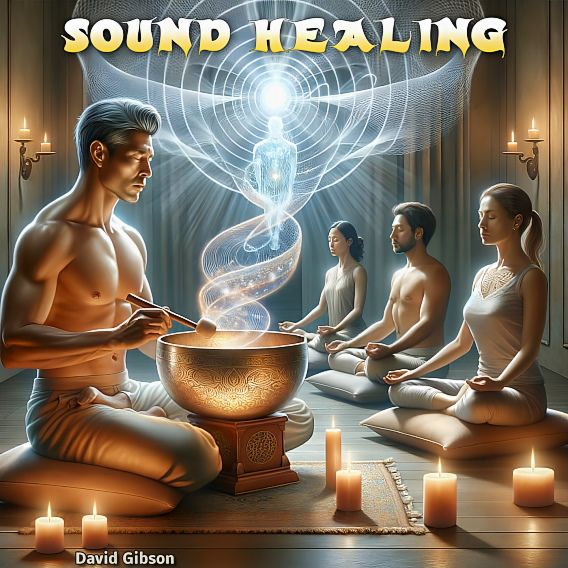

Sound Healing with David Gibson
Frequency Keys: Exploring Resonance from the Body to the Soul
The Sound Healing Center and Its Programs
The episode begins with a promotional overview of the Sound Healing Center and its related organizations, including the Globe Institute, Sound Healing Store, Sound Therapy Center, Sound Healing Research Foundation, Medical Sound Association, and Sound Education Association. The introduction describes certificate programs in Sound Healing and audio recording, a physical and online educational presence, hundreds of instruments and sound technologies, research materials, therapeutic resources, and vibroacoustic equipment. It also highlights dementia-related protocols, treatment plans, educational curricula for children, and several websites through which listeners can learn more. David Gibson then introduces upcoming sound baths, open houses, certificate programs, online classes, and recording courses. The institutional material establishes the broader context for the episode: sound is presented not only as music but as a tool for education, relaxation, research, therapy, and personal exploration.
Where Frequencies Come From
David Gibson frames frequencies as “keys” capable of opening different physical, mental, emotional, and spiritual doors. He begins with the broad distinction that high frequencies tend to activate the mind while low frequencies tend to calm the body, then describes several ways people derive or identify frequencies. These include numerology, scientifically measured vibration, mathematical formulas, and intuitive methods such as muscle testing or pendulum work. He discusses Solfeggio frequencies, planetary frequencies, the Schumann resonance, tuning forks, tone generators, and the use of numbers such as 111 and 432. Gibson repeatedly distinguishes between methods that have clear physical measurements and those based on symbolism, numerology, intuition, or spiritual interpretation. His central point is that frequencies come from many different systems, and listeners should understand where a claimed frequency came from before assuming it has a particular meaning or effect.
Learning Frequencies Through the Body
A substantial section of the program becomes an experiential tour through audible frequencies. Gibson plays or describes frequencies beginning around 40 hertz and progressing through 45, 100, 111, 136.102, 200, 250, 300, several Solfeggio frequencies, 432, 528, 639, 741, 852, 1,000, 3,000, 5,000, 10,000, and 15,000 hertz. He encourages listeners to sing along where possible and notice where each tone resonates in the body. Along the way, he recounts claims and anecdotes involving bone density, cat purrs, hummingbirds, migraines, sacred sites, chakras, the Great Pyramid, water patterns, babies’ cries, the Sun, DNA, intuition, and speech intelligibility. Gibson emphasizes that some of these associations are scientific, some symbolic, some anecdotal, and some intuitive. His practical goal is for listeners to stop thinking of frequency only as an abstract number and begin recognizing how different ranges feel physically.
The Problem With Healing-Frequency Lists
Gibson then turns to one of the episode’s most skeptical themes: the lack of agreement among lists that claim particular frequencies for organs, illnesses, vitamins, minerals, or therapeutic effects. He discusses frequency work attributed to Peter Guy Manners, Rife-related frequency lists, GreatDreams.com, Electro-Herbalism.com, and other collections of proposed therapeutic frequencies. Although Gibson believes frequency can be useful, he repeatedly questions how specific numbers were derived, whether the methods involved scientific study, intuition, muscle testing, or only a small number of subjects, and why different sources often disagree dramatically. He argues that organs such as the heart contain many different kinds of vibration, including mechanical, cellular, atomic, electromagnetic, photon, and what he calls quantum or emotional frequencies. Because every person and every biological level may vary, he says a single universal number for an organ or condition may be an oversimplification.
Research, Measurement, and the Need for Better Evidence
The episode develops this skepticism into a broader discussion of research design. Gibson argues that identifying the “best” frequency for a condition is extraordinarily difficult because researchers would have to compare enormous numbers of possible sound, electromagnetic, light, and other frequencies. He discusses claims associated with Anthony Holland, cancer frequencies, 528 hertz, pollution research, and various frequency devices while cautioning that showing one frequency has an effect does not prove it is uniquely or optimally suited to that target. Gibson proposes that pure frequencies may often seem beneficial simply because they provide stable, consistent vibration rather than chaos or irregularity. He says stronger evidence would come from testing devices or techniques across hundreds or thousands of people and measuring the percentage helped for a specific condition. Ultimately, he envisions individualized measurement capable of identifying a person’s own frequencies rather than relying entirely on generalized charts.
Intuition, Personal Resonance, and the Frequency of Source
The final section moves from research back into experiential and spiritual territory. Gibson guides listeners through an exercise in which they focus on an uncomfortable area of the body, intuitively search for a tone associated with its healthier state, and then silently “send” that frequency to the area through breath and visualization. He describes personal frequencies associated with heart rate, brainwaves, respiration, metabolism, the soul, love, the universe, and ultimately Source. Gibson says peace and stillness make intuitive perception easier and compares the process to a shaman listening for the song of a plant. He closes by asking whether Source, if understood as containing all frequencies, might nevertheless possess a fundamental “home note,” while also recognizing the interplay of order and chaos throughout the universe. His final message is that individual frequencies are only one layer of a larger matrix that also includes relationships and flows among bodies, emotions, souls, planets, and the universe as a whole.
SEO Keywords / Key Phrases
sound healing frequencies, Solfeggio frequencies, 432 Hz resonance, frequency therapy, vibroacoustic therapy, healing sound technology, chakra frequencies, Rife frequencies, sound meditation, frequency research
Sound Healing
Study the effects of sound on the body, psyche & spirit LIVE with the Founder and Director of Globe Sound Healing Institute. Using the Voice for Sound Healing, Inner Sound Awareness & Transformation of matter and consciousness, and to connect to Spirit.
The radio shows on this site will explore the full range of techniques and technologies used in the field of Sound Healing. Although the field is commonly called Sound Healing, it is also about maintaining health, raising consciousness and connecting to spirit. The show is a sound combination of discussion and experience including the following topics: Toning, Chanting and Overtone Singing - Root Frequency Entrainment - Sound to Improve Learning -Disabilities - Using Sound to Connect to Spirit - Tuning Fork Treatments - Voice Analysis Technologies - Chakra Balancing - Sound to Induce Desired States of Being - Tibetan/Crystal Bowl Massage - Electronic Nerve Stimulation - Water Sound Infusion Systems - Sound Visualization systems - Infratonics Holographic Sound - Scalar wave EESystem Drumming and Rhythm - HydroAcoustic Therapy - Neurophone Bio-Tuning - Sound Surgery - Cymatics Frequency based therapeutic devices - VibroAcoustic Sound Chairs and Tables
Frequency Keys: Exploring Resonance from the Body to the Soul
Speaker Identification
Speaker 1 – Announcer / Prerecorded Promotional Voice
Basis: The opening segment describes the Sound Healing Center, Globe Institute, David Gibson, associated organizations, products, research resources, and contact information in promotional third-person language. The transcript does not identify the announcer by name.
Speaker 2 – David Gibson, Host
Basis: Immediately after the promotional introduction, the speaker says, “Hi there. I’m David Gibson,” and continues as the sole teaching voice for the remainder of the episode.
.......................
Speaker 1 – Announcer / Prerecorded Promotional Voice: At the Sound Healing Center, we have four main things going on: the Institute, the Sound Healing Store, the Sound Therapy Center, and the Sound Healing Research Foundation.
At the Globe Institute, we offer two Sound Healing Certificates and one Audio Recording Certificate. All of them are offered online as well as in person here in Sausalito, outside of San Francisco. We’re the only state-approved college in the entire United States that offers Sound Healing.
David has created the number-one-selling books in the fields of audio recording and Sound Healing. In recording, there’s The Art of Mixing and The Art of Producing, and in Sound Healing, The Complete Guide to Sound Healing. He’s also written a book on sound and loving relationships, creating harmony in loving relationships, including many Sound Healing techniques. It’s all about being whole on your own, with your heart open.
The Sound Healing Store has over 400 Sound Healing instruments and technologies. We also have a physical store where you can experience everything. In the store, we’ve got over 100 CDs and downloads, all of David’s books, and a full range of instruments, including crystal bowls, Tibetan bowls, didgeridoos, gongs, drums, rattles, tuning forks, and a full range of melodic instruments.
We also have a wide range of consciousness-raising technologies, including sound chambers, sacred geometries and pendants, color and light therapies, brainwave-assessment software, and voice-analysis software.
We have a contract with the largest dementia company in Northern California, and we’ve created eight different protocols that have been implemented there for the last two years. According to our experience, it has transformed the place dramatically. Check it out at SoundForDementia.com.
We’ve also got a full range of vibroacoustic tools. We make Sound Lounges, Sound Tables, Sound Vests, Sound Pillows, Sound Dolphins, and bass straps. These are used for a wide range of physical and emotional issues, as well as for relaxation.
At the Sound Healing Research Foundation, you can find over 1,000 clinical and student papers categorized for easy searching. You’ll also find the Medical Sound Association, with over 1,000 doctors and sound therapists meeting bimonthly to create treatment plans for a wide range of issues.
These 30-page treatment plans are an excellent resource if you’re working on a specific issue for yourself or a client. Check out MedicalSoundAssociation.com, where you can also join and attend our bimonthly meetings.
At the Sound Therapy Center, we have a list of over 40 issues and all the things that we offer for each issue. These include music and frequency CDs or downloads, treatment plans from the Medical Sound Association, and treatments we offer in person and online through the Sound Therapy Center for each specific issue.
Finally, we have the Sound Education Association. We received a grant for $100,000 to bring our curriculum into two Montessori schools. With over 100 teachers and administrators, we’ve created over 2,500 exercises for children from three months up to 18 years old, all based on books on brain development.
We’re now expanding the curriculum and creating schools around the world. Check out SoundEducationAssociation.com, where you can also join for free.
You can find everything at SoundHealingCenter.com. You can also email us at david@SoundHealingCenter.com or call 415-777-2486.
Now enjoy the podcast.
Speaker 2 – David Gibson, Host: Hi there. I’m David Gibson. Let me tell you about some things going on here at the Institute.
We’ve got a sound bath coming up. Let me show it to you here. It’s a week from this coming Friday, September 4th. Let me show my screen again. It’s at the Institute here in Sausalito. It’s a Sound of Love workshop or sound bath. I’ll be playing a full range of instruments throughout the whole time, and people get blissed out.
If you’re in the area, you can sign up. Just go to SoundHealingCenter.com/events, and you’ll see everything.
We also have another open house on October 4th, from 1:00 to 5:00 p.m. It’s all about how sound works at every level of reality. Everybody also gets to go on the Sound Table. We do a lot of meditations and get blissed out. It’s about getting blissed out around here.
We have our certificate program starting September 9th, in person in Sausalito and partly online. It’s all about how the whole universe works. Then we get everybody to a place of peace and stillness over and over and over. That becomes the norm for you, along with being blissed out.
We’re also a vocational school. We teach many skills on exactly how to do this as a practice.
We also have the full program online starting this Tuesday, September 1st. It works really well online. We have individual classes as well.
We have a recording program coming up, starting September 15th: recording, mixing, and producing, totally online. We also have our voice-analysis and brainwave programs for sale as well.
Okay, that’s what’s going on here at the Institute.
Today’s show is all about frequencies.
I think of frequencies as keys that open up doors. They can often open up a door to a healthy cell or organ, or even a healthy soul. But they can also open up doors to frequencies that are not so good, like cancer, and we can turn the volume up and, as I describe it, explode them.
The most basic aspect of frequency is that high frequencies activate the mind and low frequencies calm the body.
If you’ve got a Sound Table or a Sound Lounge, that’s the best because you get the physical low vibrations on the body and it gets calmed out, while the mind can still be awake with the high frequencies. We can go both ways.
For sleep, we’d want to use low frequencies in the headphones as well. But for sports or being awake—mind awake, body calm—it’s the best.
So that’s the most basic difference between frequencies: high and low frequencies.
Now, frequencies come from several places. Let me go ahead and show you a little graphic here in case you’re on video.
First of all, we have frequencies from tuning forks. We also have frequencies from tone generators. That’s where we can get a pure frequency. We’re mostly talking about pure frequencies, which means one frequency.
You can also get the n-Track Tuner, which will not only play frequencies, it will measure frequencies and notes. The Online Tone Generator doesn’t measure them, but it will actually play them at OnlineToneGenerator.com.
Now, frequencies come from four main places.
The first place is numerology. Frequencies are commonly derived from letters. There’s a whole system where they take letters and convert them to numbers, and then the number sequence repeats. I think it may use 10 or 12 values; I forget exactly. There’s a very specific system you can look up. It takes letters and changes them into numbers.
Then there are the Solfeggio frequencies. This is how they were actually created about 30 years ago. They aren’t ancient frequencies.
Joseph Puleo took a unique numerology system—not the one I just described—and took a whole paragraph or passages from the Bible and changed the letters into numbers. He got six main numbers, and then those were converted into frequencies. A lot of people are using those now.
So that’s one method: changing letters into actual numbers.
We also have whole sets of tuning forks for the archangels. Those are created by changing the letters in the archangels’ names into numbers based on a numerology system.
Then there are just cool numbers. There’s 111, which is a triple number. Any triple number is cool. Or 1111, any quadruple number. We commonly use those, or even just 432. We often use interesting or significant numbers as frequencies.
Then there are scientific frequencies. These are measurable. There’s a physics formula for measuring a space, which we’ve gone over before, and there’s a very specific physics formula for measuring materials that is based a lot on square roots.
We can actually measure physical matter with physics and find its frequency. That’s very scientific.
There’s even the Schumann resonance, which is measured in six places around the planet every day. That’s a frequency triggered by lightning in the atmosphere that we’re all tuned to. That’s a very scientific frequency.
Even the elements have their own frequencies. A lot of things in science are defined precisely by what vibrational rate they’re at, especially when you get into chemistry and all the way down to the quantum level.
So we often have scientific frequencies that we use.
Then there are frequencies based on formulas. The main formula that’s used for the planets is to take the number of seconds it takes for a planet to go around the Sun—which is millions and millions of seconds—and then put one over that number. That gives you a really small number.
Then you double it, which is octavizing. You double it and double it and keep doubling it. Whenever you double something, you get the same note in another octave.
For the Earth, they did one over however many millions of seconds it takes to go around the Sun and then doubled it until they got 136.102 hertz.
It kind of bugs me. How come they didn’t take half of 136.102, or double it, or multiply it by four or eight? Why did they stop there? It’s kind of an unusual formula, one over the number of seconds.
The technical frequency of the Earth, physically, would be based on three main things: size, thickness, and density. We don’t actually know the exact density of the Earth at the core, but we know that, based on that formula, it would be a really low frequency.
Nevertheless, this formula of one over the number of seconds it takes to go around the Sun is commonly used for planetary gongs and planetary tuning forks. It seems a little weird to me, but a lot of people are into it.
I’m not throwing the baby out with the bathwater.
Then there are frequencies based on intuition—not only intuition, but muscle testing or actually using a pendulum. That can be cool.
I’ve got this psychic. He says energy gets stuck in the teeth and then goes to the meridians and causes all types of problems.
I said, “Well, what’s the frequency for that?”
He said, “There are four frequencies.”
One of them was 852, and one was 963—some Solfeggio frequencies.
It was so funny. I told him, “852 is a Solfeggio frequency.”
He said, “What’s that?”
I told him the whole story. A lot of people think they’re ancient, but they’re really not ancient. They were discovered by Joseph Puleo by doing numerology on the Bible.
He said, “Let me check in.”
Then he goes, “Whoa. 852 created the universe.”
So maybe it’s a little more ancient than we thought.
In fact, I just had this other guy who’s totally intuitive, a total intuitive genius. He said that 528, even though it’s now been shown that it doesn’t have anything specifically proven to do with love, is actually a very good frequency for healing.
Who knows anything for sure?
Again, I don’t throw any frequencies out with the bathwater. Intuition could be totally cool.
Ideally, what would be really cool would be to get a room full of intuitive psychics and ask them to tell us the frequency of all the different organs and issues. Then go into the lab and actually test those frequencies. That might make the research journey much simpler. Maybe they’re right.
You never know. You never know.
So those are all the different places that frequencies come from.
Now, the trick with frequencies is to get to know them in your body and know their names.
We know frequencies intuitively. We are frequency beings. Every cell is a frequency. Every emotion is a frequency. Every thought is a frequency. Everything is frequency. Every organ—it's all frequency.
We’re enveloped in this world of frequency. Our whole being knows it really well, but we don’t know the frequencies by name.
So let’s play with some of the frequencies and get to know them by name.
Let’s see. Okay. I had this pulled up, but I don’t see it now. Let’s see if we can find it again here.
Nope.
Okay, I’ve got to pull it up again. Okay. I’m in there. I’ve got frequencies. Oops. Okay. Frequencies. Here we go.
The lowest frequency we can hear is about 20 hertz. Zoom only goes down to around 40 or 50 hertz, but we can make some of these frequencies out loud.
Everybody do a kitty-cat purr. That’s around 20 or 25 hertz, which is around the lowest frequency we can hear.
Generally, the lowest frequency I can make out loud is about 50 hertz.
Oh, wow.
Most women only go down to about 100 or 150 hertz. Guys can generally go down to around 100 and sometimes 70 or 80.
So let’s play with different frequencies across our hearing range.
Here is 40 hertz. You probably won’t hear this on your computer. You’ll need headphones. But I’ll play it very briefly. I think of this as the root-chakra range. It’s like the low bass of music as well.
Here’s 45 hertz, which, according to two clinical studies I’m referring to, has been shown to regenerate bones. It actually makes bones more dense.
It also happens to be around the main frequency of a kitty-cat purr. So if you ever get a broken bone, you can get some kitty treats.
Have you ever seen a cat with a cast? No. They’ve got really dense bones because, as I like to joke, they purr themselves into more density.
That’s really interesting.
Also, that frequency is right around the frequency of a hummingbird, which I’m looking at one right now, by the way. That’s really funny. There’s one right in front of me.
So the frequency of a hummingbird and a kitty cat are almost the exact same frequency. They say hummingbirds vary more, whereas cats are mostly around the same frequency.
Those are really low frequencies. That’s like the main deep bass.
Then we’ve got 100 hertz, which I think of as the second chakra.
To get to know these frequencies, it’s nice to tone them out loud. You’re welcome to sing along and see if you can match it. Also notice how hard it is to sing and where it resonates in your body.
That’s 100 hertz.
Here’s 111 hertz. According to Bob Beck, 111 hertz is really good for cell rejuvenation, although I would bet that different cells are a little different.
It’s also a frequency found in 70 sacred sites. I’ve also found it really good for migraines.
I had a woman in class years ago who said that before she took the class, she had a really bad migraine. She heard a voice that said, “Tone this.”
She looked at her digital clock, and it was 1:11. She did a search, found a web page, played 111 hertz, toned it, and said her migraine went away.
I even have a song for headaches on one of my CDs that’s really good. I forget the name of the CD. We actually created it for Massachusetts General.
So 111 is a triple number, and it’s really auspicious.
After she got rid of her migraine, she signed up for the class immediately and then did her final paper on 111. She said 111 has been used since the beginning of time. It’s a very auspicious frequency besides being present in multiple sacred sites as well. Often, just the wind blowing through and hitting the rocks creates it.
So that’s 111. Here it is again. Go ahead and sing along.
Then we have 136.102 hertz. As I said, that’s the frequency based on the formula where they put one over the number of seconds it takes for the Earth to go around the Sun and then octave it up.
See how this one feels.
If you have an Earth gong, this is what it’s tuned to, or an Earth tuning fork as well.
Sing along.
Then we have 200 hertz, which is right around the third chakra for me, at least.
See how this one feels. Go ahead and sing it and see where it resonates in your body. That’s where I actually go to when I’m resonating up.
Then there’s 250 hertz, which is around the average frequency of the voice, especially in the main frequency range that women speak in. For women, this frequency is often really easy to tone.
Sing along with this one: 250.
It’s also a frequency that mathematically is a resonance of the King’s Chamber in the Great Pyramid.
Then we get to 300 hertz, which I think of as around the heart chakra—maybe a little higher than where I normally go.
See how this feels.
As you might have heard in a previous show, I actually believe everybody has a different frequency for their heart. It varies. Everybody’s a little different.
Then we enter the range of the Solfeggio frequencies.
Again, these were discovered by Joseph Puleo. Then what happened is somebody said, “Oh, let’s actually add the Solfeggio syllables to these frequencies from 30 years ago.”
So they took the syllables associated with Father Guido—do, re, mi, fa, sol, la, ti, do—which are connected with musical notes, and added them to the frequencies.
Everybody got confused and thought, “Oh, these are ancient frequencies. They’re from Gregorian-chant times.”
Father Guido was actually around 1000 A.D., but he didn’t use these particular frequencies. He was using the syllables that were later added to them.
Even the titles or descriptions associated with the frequencies are not ancient either.
But the numbers are very auspicious mathematically. If you break them down, they all resolve to 3, 6, or 9.
For example, if we add the digits of 396, 3 plus 9 is 12, plus 6 is 18, and then 1 plus 8 equals 9.
All of the Solfeggio frequencies break down numerologically to 3, 6, or 9. That’s really interesting.
There are many other very cool mathematical things about them as well, so they could be really important.
The main thing people do with them is actually tune music to a particular frequency, because all of the frequencies together sound really annoying—or at least very activating.
Here’s 396 hertz, the Solfeggio frequency associated with liberating guilt and fear.
Go ahead and sing along with this one.
Then there’s 417 hertz, which is associated with undoing situations and facilitating change. Again, that’s the Solfeggio frequency 417. Sing along.
Then there’s 432, which is not a Solfeggio frequency.
There are a lot of auspicious things associated with 432. It creates, according to material I’ve seen, a beautiful mandala pattern in water droplets when you play it to water.
It’s also said to be what they tuned to in ancient Egypt. It’s around the average frequency of a baby’s cry when the baby comes out of the womb. It relates to the radius of the Sun, which is often cited in connection with the number 432,000.
It also appears as a frequency at many sacred sites and as a number in distances, latitudes, and longitudes associated with sacred sites. They also say it’s connected to the heart meridian.
Most importantly, it’s the time I was born: 4:32 a.m.
Okay, so check this out. Here’s 432.
Sing along.
Then there’s 528 hertz, again a Solfeggio frequency. Leonard Horowitz says it unravels DNA and opens the heart. He now admits there’s zero science behind that, but it’s still really, really cool.
Notice we’re getting up around the top of your vocal range now.
Here’s another Solfeggio frequency: 639 hertz. See if you can sing this one.
And 741, which is associated with awakening intuition.
Here’s 852. See if you can sing this high. That’s the frequency the intuitive I mentioned earlier claimed created the universe.
Here’s 1,000 hertz. I can still sing that.
Three thousand hertz is actually a really important frequency. Even though we can’t sing that high, it’s present in the harmonics of our voice. Our vocal harmonics can go up to 20,000 hertz when we speak.
Three thousand hertz is also in the attack of each consonant when we speak. If you can’t hear the attack of a consonant—like K, B, T, or G—then they can start sounding similar and you can’t understand speech.
So it’s a critical frequency range for understanding speech. If you can’t hear it, you may need a hearing aid.
Here’s 3,000 hertz.
And here’s 5,000. This is right around the frequency range of the treble control on your stereo.
There’s 10,000, which I think of as the crown-chakra range for me.
Then, about the highest most people can hear is 15,000. See if you can hear this.
Cool.
It’s really good to get to know your frequencies.
Again, you can go to OnlineToneGenerator.com or get the n-Track Tuner. It will play the frequencies. Also, if you make a frequency, it can tell you what frequency it is.
If you have a crystal bowl or anything else that makes sound, it can tell you what frequency it is.
Again, it’s nice to get to know the names of the frequencies. High frequencies are activating. Low frequencies are more calming.
Now, there are a lot of other frequencies that people have come up with for all different types of things.
First of all, let’s look at the frequencies for the different organs.
There are these frequencies from Peter Guy Manners, who was a doctor in Germany before World War II. He left and then came back after the war and got these frequencies from doctors who had done really horrible research by putting microphones into people—but, according to this account, also got useful research from it.
He took these frequencies, worked with them, moved to London, got a device, and helped refine them.
The center frequency is the actual main frequency.
I’ve got frequencies here for conditions ranging from hemorrhages to heartburn, Hodgkin’s disease, pinched nerves, and indigestion, all the way down to sprains, rheumatism, and vertigo.
There’s a center frequency and then two other frequencies that are derived based on a Chinese tuning system, but the core frequency is the center column.
These are frequencies that we’ve actually created CDs from. We’ve got a full range of CDs that have these frequencies in them.
Again, you don’t just listen to them. You actually play them on your body.
We’ve got sets for arthritis, asthma, brain, chronic fatigue, the circulatory system, depression, digestion, endocrine glands, happy bones, muscles, nerves, tendons, ligaments, and the respiratory system.
You can play them on the body with headphones, or we’ve got a little subwoofer you can use and play on the body with much more bass. You can use the Sound Vest that we sell, especially the Sound Dolphin, and you can also use the Sound Lounge and Sound Table.
These are especially good, in my experience, for pain. It’s really worth checking out all these different frequency CDs.
Those are based on this research from the Germans.
But there are also other sites that show a full range of frequencies. There are tons of sites if you go on the internet.
Here’s one that is GreatDreams.com. It’s got frequencies for blood, adrenals, kidneys, liver, all the different organs, and the chakras. It’s got frequencies for mineral nutrients.
We actually hand out a whole list of frequencies for every vitamin and every mineral there is. The claim behind these lists is that if you play those frequencies, they can help create or support that vitamin and mineral in your system. It’s very cool as a concept.
Then we’ve got tons of frequencies here for just about everything you could imagine.
The problem with these frequencies is that no one is really giving you exactly how they found them.
Some people do, but it’s pretty rare.
How did they do the research? Did they test one person? Did they do muscle testing? Did they derive it intuitively? Did they do a scientific study? Did they test it with a thousand people?
How do we really know what’s going on here?
And here’s the biggest problem: no one agrees with anybody on the frequency of anything.
It’s kind of a big mess.
Before we get into that, though, I want to show you one more document or website here.
This is a cool site called Electro-Herbalism.com. If you click on the frequency section, it’s got something like 20 lists of frequencies that people have come up with, including the Rife frequencies.
Royal Rife, back in the 1950s, had or developed what was described as a very good microscope and then identified frequencies for many diseases.
Those were electromagnetic frequencies, though. They were not actual sound frequencies. They were modulation frequencies.
For example, he might take a carrier frequency around three million hertz and, if he was using a 20-hertz modulation, sweep 10 hertz above three million and 10 hertz below. It went sweeping up and down above and below that carrier frequency.
Then people started using the 20 hertz as a sound frequency. But it wasn’t originally a sound frequency. It was electromagnetic, and it was a modulation going up and down.
So it doesn’t necessarily translate into sound very well.
But it’s very cool. I know people who have worked with Rife machines who say they’ve had miraculous results and have used them in relation to different cancers and other conditions. So they’re a very interesting set.
There are all these other sets that are worth checking out. In fact, it looks like they’ve added more since the last time I looked at this.
Oh, yeah. Oh, my God. There are like 25 different sets.
Again, that’s Electro-Herbalism.com.
But here’s the big problem with frequencies.
The basic idea is very cool: find the frequency of a part of the body or a cell, play it to it, and help make it healthy. There is scientific research and there are some clinical studies that people cite in support of aspects of this idea.
But the problem is that no one agrees with anybody on any frequency.
If you look at all these different sets, nobody has come up with the same frequency for everything. Often they’re not even close.
We’ve got proposed frequencies for different organs that go from 20 hertz all the way up to 40,000. It’s all over the place. It’s wacky.
So here’s why I think that happens: everybody is different.
Everybody’s cells are a little bit different in frequency. Everybody’s organs are a bit different in frequency.
What we need is a chart that shows the range of frequencies for every type of cell—all 210 types of cells—and every organ.
That would be really good.
Then you could sweep between those frequencies and likely hit the resonant frequency of health for that part of the body.
Ultimately, we should be able to measure it scientifically.
There’s Raman spectroscopy that will measure frequencies in vitro, out of the body. There’s also a type of light microscopy that, according to the material I’m referring to, can measure aspects of it in the body.
That would be very cool because then we could find the exact frequency for you.
But here’s the other problem that makes it kind of wild and wonky when you look at all the different frequencies.
Take the heart. There’s a mathematical formula related to the size of the heart, the spaces in the heart, and the materials of the heart. There are fluids in the heart. There are cellular frequencies. There are atomic frequencies. There are light or photon frequencies. There are electromagnetic frequencies that MRI looks at. And there are what I would call quantum frequencies, like love for the heart.
So the heart has tons of frequencies in it.
People often aren’t defining which level they’re looking at. That’s why there are so many different frequencies proposed for any part of the body, not to mention that some of them may simply be wrong based on the way they were derived.
Ultimately, what we need to find is this array of frequencies—all the different frequencies that make up any organ.
I would bet that the frequencies within any organ are related through very specific musical intervals, which is very cool. They might be related mathematically in the same way from person to person.
That means you could find one frequency of the cells in the heart and then extrapolate all the other frequencies of the heart.
We’ll see when we actually start doing the research.
But imagine that you now have all the frequencies of the heart and you play them all to the heart. In the model I’m describing, you could resonate every part of the heart toward its healthy state.
Then we want to get into the whole aspect of musical flows within the heart, or musical flows within the circulatory system in which the heart exists.
There are the emotional-body frequencies and flows, the mental body, and then we haven’t even dived into the whole spiritual realm of soul and Source.
It’s very complex, the way it all ties together when you look at frequencies.
That’s where we’re headed: to actually find, scientifically, a very specific frequency by using measurement technology and to be able to see exactly what yours is. Then we can play it to that area.
Now I want to say something before we continue about research around frequencies.
It’s really difficult to research whether a frequency works or to find what frequency is best for something, because that means you have to play 20,000 frequencies. If you go into decimal points, we’re talking about an effectively infinite range of possible values.
And this is just sound.
What about electromagnetic frequencies?
It took Anthony Holland, as I recall it, almost 15 years to track down 15 frequencies for 15 types of cancer that he reported would destroy them about 80 percent of the time in the lab.
There are so many frequencies that it’s difficult to figure out which one is doing anything.
That’s why I’m really skeptical when someone says, “Oh, here’s the frequency for something.”
What’s happening is that people go, “Okay, I’m going to play this frequency. Let’s play 528 hertz on this disease or part of the body.”
Then they say, “Look, it’s effective. It’s actually giving us good results.”
But that doesn’t mean 528 hertz is the frequency for that cell or organ or whatever at all, because you haven’t tested all the rest. Maybe other frequencies are way better.
Here’s the deal.
Pure frequencies have one really major thing going for them: they are not chaos.
They are stable, consistent vibration, which is generally good for the body.
Stable and consistent is normally way better than chaos because we want to overcome chaos, which I associate with fear, anger, anxiety, stress, pain, and irregular vibration in the body.
That’s where any cell starts to get frazzled because of chaos.
You play a stable, consistent frequency to it, and that can be good.
So 528 is a stable, consistent frequency. It may generally be good. Any pure frequency may have that stabilizing quality.
But until you test all of them, there’s no way to know that one particular frequency is the best.
That’s why when people say there are six clinical studies on 528, I’m still skeptical. I saw a study where they said 528 actually cleans up pollution in the ocean.
Well, did you test all the other possibilities across the 20,000-hertz audible range? Did you test electromagnetic frequencies, light frequencies, and scalar effects too?
Oh, my God. No.
How do you know that’s really the one?
So if you see research that says a particular frequency does something, I’m really skeptical—very skeptical—because it’s so difficult to actually pin down millions of possibilities and know which one is the best.
Not to mention, there are so many different levels within any part of the body.
A cell has many different levels. You’ve got the whole cell. You’ve got the mitochondria. You’ve got all the parts of the cell. You’ve got the atomic level. You’ve got the quantum level.
Oh, my God. There are so many different frequencies in or associated with anything.
So it’s really very tricky.
Now, that doesn’t mean a lot of these frequencies are not good.
If you see a list of frequencies for a part of the body—which we have in our course reader and in my book—you can check them out and maybe they’ll work. They might. Who knows?
Someone may have found something that’s really good and really useful.
What we really need is, if someone says there’s a frequency device, ideally you should have 500 or 1,000 people and ask, “What percentage of people did this help for this specific issue?”
That’s what really shows it.
Now there’s another way to do it, which I highly recommend since, as you can tell from this whole presentation, I don’t think we can automatically trust any one frequency list.
That is to find it yourself intuitively.
You could actually go up and down in your head and find the frequency of your adrenals. Intuitively get on it, like a little fairy that goes there, or maybe it’s just a knowing.
To get to this level of intuition, what I’ve learned is that peace is the whole deal.
The more you’re at peace, the more intuition opens up.
There are ways we can do it where we play a full range of frequencies that entrain your brain into oneness, because when you’re one with the universe and in unity consciousness, then the whole world of vibration in the universe opens up and becomes known.
It’s exactly like the shaman who’s looking for the song of a plant.
The shaman doesn’t go, “Oh, let’s get on ChatGPT and find the frequency. Tell me the frequency of this plant. Come on. And then we’ll actually sing its song. Tell me the song of the plant.”
Of course not.
They become very still and very tuned in to the field, and they hear the song of the plant.
What I’ve learned is that we can all do this.
With practice, even over just a few months, you can get really good at it.
I know this from what I’ve seen with hundreds of students. At the beginning, they’re like, “I don’t trust my intuition. I don’t even have intuition.”
By the end of the class, they’re saying things like, “Dave, I can hear my liver’s disease frequency,” or, “I can hear my mom’s cancer.”
So that’s really cool.
Just practice finding the frequency of something.
Let’s try this.
It’s a little advanced, but we can go for it. You can do it.
Tune into something in your body that’s bothering you—a little pain or an issue somewhere in your body.
Go up and down in your head. You could do it out loud as well.
Find the frequency of what’s right, before it was wrong.
You can find the frequency of what’s wrong and then try to break it up, but we’re going to find what’s right.
Let me demonstrate first.
I’m going to put on my original sound so you’ll definitely hear me.
I’ve got chronic pain in my neck from when I broke out a windshield with my face in high school.
I’m going to go up and down and find the frequency that feels like what my neck needs, or what was right before it was injured.
Okay.
Actually, it’s interesting. Around here seems to make it worse, whereas here seems to be better for it.
Okay.
So do that.
Go up and down and find the frequency of that part of the body where you have a problem.
I’ll be here when you’re done.
Okay.
Now. Got it?
Okay.
What we’re going to do is actually send that frequency to it silently.
I’m going to demonstrate. I’m going to breathe in, and on the out-breath I’m going to breathe that frequency I just found into my neck. I’m going to send it to it with my head and visualize it going into my neck.
Okay, check it out.
Breathe in, and I’m going to breathe out. Here it is—silently, so you don’t hear anything.
In and out.
Here we go again. And out.
That’s really cool.
Try that.
Breathe in and out. Send that frequency that you found to that part of the body.
Very cool.
I’ve found this so effective. The breathing itself is really good for you as well. But when you find that frequency, I’ve had so many people say they got rid of pain and very specific issues doing just this.
It can be shockingly effective in my experience, and you don’t need any chart at all.
The more you practice it, the better you’re going to get at it.
Oh, Miss Panda Bear [unclear comment] too. Here’s the frequency of Miss Bear.
Okay.
Now we get to some really important frequencies.
The most important frequency of all is yours.
That includes the frequency of your heart rate, which you have to average out because it goes up and down, and your brainwave rate, which you don’t have to average when you’re at peace. It’s even the frequency of your breath when you’re at peace.
That’s what we’ve been finding for 15 years.
You can find it at YourHomeNote.com. We can do it over Zoom.
Now we’re actually creating an app with an EKG, EEG, and respiration monitor that will find it automatically. It should be ready within a week or so.
Oh, my God. That’s really cool.
Imagine listening to music tuned precisely with the sound frequency, the rhythm, and the different brainwave states tuned precisely to you.
There is no better frequency than yours.
That’s really cool.
Well, maybe there is a better frequency than the one associated with your physical body, which is what we’ve been talking about.
What about your soul frequency?
I had a psychic who said you can see it in the eyes.
I said, “How?”
She said, “You can shine a light in the eyes, and the reflection, if you put it into a prism, will split into the color frequencies of your soul.”
I said, “Well, it would be nice to find that one day.”
She said mine is D-sharp, which is really interesting because my body frequency, or tempo, is actually associated with B-flat—my metabolism.
Those are really cool.
But then we get to the really large frequencies.
What’s the frequency of love for you?
Bring love into your heart, go up and down, and find the frequency of that love in your heart.
We’ve done this many times.
Let’s do it silently because I believe everybody is different.
But what is the frequency of universal love in our universe?
I’ve had people say it’s actually D. They’ll tell me what frequency it is.
But what is the frequency of our universe—our whole universe?
Some people say our whole universe is a frequency and there are many other universes at different frequencies.
I don’t have a clue what that might be, but that would be a really important frequency.
Then we get to the most important frequency of all, and that’s Source.
Now, it’s interesting. We’ve had many shows on this.
I think of Source as all frequencies.
I never thought about this until this moment: if Source is all frequencies, does it have a fundamental or home note—the key of all of them? Is there a core frequency or note?
That’s really interesting.
What if all of Source—which is all—had a home note?
Technically, it would seem like it should. When we have an array of ordered frequencies, they generally have a fundamental.
Although, if something is 100 percent random, which a lot of things are—I mean, there’s a lot of chaos in the universe—then it wouldn’t necessarily have a home note.
The ocean doesn’t really have a home note because it’s like white noise. It’s highly random.
But even in the ocean there are very specific frequencies, especially when a wave crashes over. In fact, it goes from low to high.
So even in the universe, even though there can be a lot of chaos, there’s also a lot of order.
There’s a lot of order.
Whenever there’s order, there’s often a fundamental home note, just like the home note of the key of a song.
Hmm.
That’s an interesting one to ponder.
But remember, frequencies are only part of the whole matrix.
The whole matrix includes a bunch of frequencies that make up something like the heart we talked about, or a bunch of frequencies that make up the whole of Source that we have heard.
Then there are all the relationships among all the frequencies: my heart to my liver, the relationship of my soul frequency to my cat, one rock to another, one crystal to another, one planet to another, one soul to another.
Then there’s musical flow: the flow of the galaxies, the flow of blood through the body, the flow of electricity through the nervous system, and the flow of Source into us.
Although they say we are Source, so maybe it isn’t even a flow. We are that flow, or we are being in the flow in the moment.
There are all these different levels, from a single frequency, to many frequencies, to relationships, and then to flow.
Frequencies are only one part of the whole that we’re a part of.
Ultimately, one day, I believe we’ll know all of this. We’ll be able to heal every disease and be at one with everybody all the time on the whole planet—everybody.
And hold that frequency for the rest of the night, the weeks ahead, the months ahead, the years ahead, and the lifetimes ahead.
Thanks for listening, and take care.
Bye, Panda.