
Signs of Life, August 27, 2026


Signs of Life - Personal Experiences - hosted by Dr. Betty Kovacs, Janet Mayer and Kimberly Saavedra
Cracking the Code of Connection: Signs, Synchronicities, and Love Beyond Loss
Everyone Has A Story To Share.
We Invite You To Share YOURS!Many Of Us Have Personal Experiences That Defy Mainstream Thinking. Join Us As We Explore The Types Of Experiences That People Have, What They Mean, And How We Can Integrate Them Into Our Daily Lives.
Summary
Technology, Timing, and a Mother’s Continuing Bond
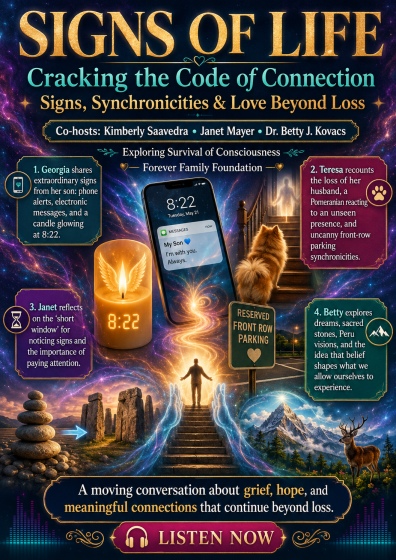
The episode opens by inviting listeners to share direct personal experiences that they interpret as evidence of continuing connection with deceased loved ones. Caller Georgia describes the death of her son and says she has experienced many signs from him over the years. Her most striking story involves repeated device notifications telling her she was a few minutes away from what the phone identified as her son’s home, even though his old phone service and accounts were no longer active. She says the notifications appeared on multiple devices and recurred on the 22nd of successive months, which she connected with the date of his death. Georgia also describes an LED candle that appeared to illuminate while switched off and that seemed to activate around a time she associated with August 22. The co-hosts respond by emphasizing attentiveness and by framing Georgia’s experiences as meaningful to her without suggesting that grief itself disappears.
A Pomeranian, a Stairway, and a Shared Experience
Caller Teresa recounts losing her husband of 37 years to COVID and bringing his ashes home after the cremation process. The morning after the urn returned to the house, her daughter’s Pomeranian behaved in a way that Teresa and her daughter found extraordinary. The dog stood at the bottom of the staircase, barking, bouncing, and staring toward a landing while refusing to respond to either woman. Teresa explains that the dog had shared a playful daily routine with her husband before his death, including stealing his socks while he dressed. When Teresa’s daughter watched the dog and quietly suggested “Dad,” Teresa says they both understood the moment in the same way. She later explains that having her daughter witness the event kept her from dismissing it and opened her to asking for and noticing additional signs.
Parking Spots, Synchronicity, and Hope Within Grief
Teresa continues with a pattern of repeatedly finding unusually convenient front-row parking spaces while running errands. She initially laughed about the pattern and began telling family members about it. Later she watched a movie in which a deceased brother appeared to a living character and referred to being responsible for years of favorable parking spots, creating a synchronicity that stunned her because it mirrored her own recent experiences. Teresa stresses that these experiences do not remove the sadness of losing her husband. Instead, she says they provide hope and a sense that the relationship is not entirely gone, even though it is no longer physical. The co-hosts use her story to discuss how personal meaning can emerge through patterns that another observer might interpret differently.
Paying Attention Without Living in Constant Vigilance
Janet expands on a phrase she calls a “short window” for noticing experiences associated with loved ones. She does not mean people should spend every moment searching for signs, but rather that ordinary life can make subtle moments easy to miss. According to Janet, a person may be reading, meditating, watching television, or going about routine tasks when something suddenly captures attention. She encourages listeners to pause and notice what the experience means to them while also continuing to live their normal lives. Janet later describes several household objects that appeared to move unexpectedly while she was recovering from a foot and leg injury, including a massage ball, a water-bottle lid, and a massage gun. She interpreted the cluster of events as a practical reminder to hydrate, care for her body, and follow through with physical therapy.
Dreams, Belief, and the Limits People Accept
Betty shares a dream involving tiny pebbles that are first dismissed and then transformed, through an artist’s attention, into enormous sacred standing stones. She uses the dream to describe what she sees as a tension between a culturally conditioned tendency to dismiss unusual experiences and a more receptive, imaginative way of perceiving them. She later recounts a profound vision in Peru in which she experiences herself approaching a sacred mountain, only to realize that she does not need to enter it because, in the vision, she already embodies the mountain and its wisdom. A loving voice then tells her that saying she cannot create a world has itself created a world in which she cannot create. Betty interprets the experience as a lesson about how beliefs can shape the boundaries of what people allow themselves to experience. She connects that idea with a vision her husband had after their son’s death in which their son’s voice said that even the horizon was not the limit.
Recording Experiences and Remaining Open to Meaning
Near the end, Janet recalls falling forward on a staircase years earlier and suddenly finding herself seated safely back on the top step, an event she personally interpreted as intervention from spirit. She recommends that listeners write down and date meaningful experiences because patterns may become easier to recognize over time. Betty adds a story from a friend who believed she and her son had inexplicably avoided being struck by a truck that ran a stop sign. Throughout the episode, the co-hosts repeatedly emphasize that one person’s experience may not convince another person and that listeners should not assume everyone will interpret unusual events identically. They describe storytelling itself as valuable because hearing how others process grief, coincidence, synchronicity, and spiritual experience can broaden the range of possibilities people are willing to consider. The program closes with a prayer for all beings to be fulfilled, awakened, liberated, free, and at peace, followed by thanks to Georgia and Teresa for sharing their experiences.
Signs of Life
Signs of Life Radio Show is a unique radio show dedicated to the exploration of Life After Death!
Call In or just listen to top Scientists, Mediums, and Researchers discuss their personal work in the field and answer your most perplexing questions.
Topics will include: Mediumship, Near Death Experiences, Death Bed Visions, Reincarnation, Apparitions and Poltergeists, After Death Communication, ESP and Telepathy, Survival of Consciousness, and the list is endless!
Programming Schedule for Signs of Life, a Forever Family Foundation production
- First Thursday of each month: The Gathering with Bob Ginsberg, Tom & Melissa Gould, and Marta Kane
- Second Thursday of each month: Medium Insights with Roman Karpishka interviewing a FFF Certified Medium
- Third Thursday of each month: Mediums & Messages with Joe Perreta with a Psychic-Medium (giving readings)
- Fourth Thursday of each month: Personal Experiences with Dr. Betty Kovacs, Janet Mayer and Kimberly Saavedra
- Fifth Thursday of each month: Signs of Life with Bob Ginsberg and guest (when there is 5 weeks to the month)
Signs of Life Radio Show is a unique radio show dedicated to the exploration of Life After Death! Call In or just listen to top Scientists, Mediums, and Researchers discuss their personal work in the field and answer your most perplexing questions. Topics will include: Mediumship, Near Death Experiences, Death Bed Visions, Reincarnation, Apparitions and Poltergeists, After Death Communication, ESP and Telepathy, Survival of Consciousness, and the list is endless!
Speaker Identification
Speaker 1 – Prerecorded Announcer / Theme Voice. The opening program identification, theme lyric, show description, call-in information, and co-host introduction are presented as prerecorded introductory material.
Speaker 2 – Kimberly Saavedra, Co-host. The introductory voice identifies herself as Kimberly Saavedra and names Janet Mayer and Dr. Betty J. Kovacs as the other co-hosts. Later references to “Kim” and requests for Kim to repeat the phone numbers support this identification.
Speaker 3 – Janet Mayer, Co-host. Janet is identified in the introduction as a Forever Family Foundation Certified Medium and an author. Later speakers directly address Janet by name when discussing her repeated advice to “pay attention,” her meditation about a “short window,” her experiences with moving objects, and her fall on the stairs.
Speaker 4 – Dr. Betty J. Kovacs, Co-host. Betty is identified in the introduction. Her identity is reinforced when another co-host explicitly addresses “Betty” after her dream account. The longer philosophical discussions about Western assumptions, the sacred-stones dream, the Peru vision, and her husband and son are attributed to her based on those internal references.
Speaker 5 – Georgia, Caller from Tacoma, Washington. She is introduced by name and location and describes signs she attributes to her deceased son.
Speaker 6 – Teresa, Caller. She is introduced by name and describes experiences following the death of her husband, including her daughter’s Pomeranian, recurring parking experiences, and a movie-related synchronicity.
Some very short co-host interjections in the raw transcription cannot be independently distinguished by voice from text alone. Where those brief remarks were not necessary to preserve substantive meaning, they were incorporated into the surrounding clearly identified exchange rather than assigned by guesswork.
Speaker 1 – Prerecorded Announcer / Theme Voice:
Welcome to Signs of Life: Exploring Survival of Consciousness, brought to you by Forever Family Foundation on the web at foreverfamilyfoundation.org.
“I call your name, the echo is haunting, the echo is always the same. I call your name, the echo is haunting, and the echo can never be changed. So I call your name.”
Hello and welcome to Signs of Life Radio. This episode is about personal experiences and exploring the afterlife. Many people have personal experiences that challenge mainstream beliefs. Please join us as we explore the types of experiences people have, what they mean, and how we can integrate them into our daily lives.
Although mediums provide a valuable connection to the deceased, this show centers on your direct experiences, which do not involve a medium. We invite you to call into the show to share your personal story or experience. We are happy that so many people are having meaningful, life-changing spiritual experiences and are sharing them with others.
For those who have written books or offer any kind of service, we celebrate you in our hearts. However, due to the guidelines of the show, we cannot promote anyone’s work, books, or services on the show.
The call-in numbers are 1-888-627-6008 within North America and 1-323-744-4831 from outside North America.
The co-hosts are Janet Mayer, Forever Family Foundation Certified Medium and author of Spirits They Are Present; Dr. Betty J. Kovacs, author of The Miracle of Death, There Is Nothing But Life, and Merchants of Light: The Consciousness That Is Changing the World; and Kimberly Saavedra, Director of the Kamlak Center.
Speaker 2 – Kimberly Saavedra:
Hello, Betty, and hello, Janet. It’s nice to be back together with you.
Speaker 3 – Janet Mayer:
Hello.
Speaker 4 – Dr. Betty J. Kovacs:
How are you?
Speaker 2 – Kimberly Saavedra:
We already have a caller, so let’s jump right in. Welcome, Georgia, from Tacoma, Washington. We’re happy to hear from you.
Speaker 5 – Georgia:
Hi. How are you guys doing? Thank you for answering my call.
I lost my son nine years ago, and I know he “cracked the code” on the other side because I have thousands of signs from him. I want to tell you about one that really resonates with the idea that young people leave this earth with so much knowledge about electronics and technology. I sometimes think it makes it easier for them to reach out.
My son passed away on August 22, 2017. Since then, all of his accounts have been stopped. I still have his phone, but it’s just the phone; it doesn’t have a contract on it anymore.
Last year, on August 22, I was leaving the grocery store to come home when I got a notification on my phone saying, “You’re five minutes away from Panago’s home.” Panago is his name. I was startled. I thought, “Oh my gosh, what does that mean?” Then the same notification appeared on my Apple Watch and my iPad.
When I got home, I looked through everything to see whether my address was somehow listed as Panago’s address, and it wasn’t. I just said, “Okay, thank you, honey. I got the message. Thank you so much.”
The next month, on the 22nd, I was leaving work and - boom - the same thing happened. Then the next month, in October, it happened again as I was leaving work. You don’t know how happy it made me every time it happened.
That October night, I had a sense of his thoughts, almost as if he were letting me know something was wrong and he couldn’t do this anymore. The next morning, I found out there had been an iPhone update. I thought, “Okay, I understand.”
He has sent me his voice and his face in different ways, but that particular experience filled me with so much joy. You should have seen me. I was practically dancing in the streets because it felt like he was going so far out of his way to make me happy.
Speaker 2 – Kimberly Saavedra:
That’s quite a story. My goodness. And there is something especially interesting about the technology aspect.
Speaker 3 – Janet Mayer:
What really struck me is that a device might normally say, “You’re five minutes from home,” but yours was saying his home. To you, it felt like he was finding a way to say, “Hi, Mom. I’m still around.”
I also love that you were paying attention. I say that constantly on the show: when people pay attention, they begin to notice more, feel more, and understand more. You sensed that something was changing with the way the notification was occurring, and then the software update happened. It was as if you had a warning that this particular method might change.
Speaker 4 – Dr. Betty J. Kovacs:
His persistence is remarkable too.
Speaker 5 – Georgia:
A couple of years ago, I got an LED candle. I never really turned it on. I placed it near his memorial area. One night I saw that the candle was lit, but when I looked at the switch, it was in the off position.
Then it started happening every night, and I noticed it was coming on at about 8:22. I was trying to calculate what it could mean, thinking too deeply about it, and then it hit me: 8:22 - August 22. That’s when he passed. I felt that he was trying to let me know.
The candle still comes on. Because of the time changes, it isn’t exactly 8:22 all year round, but it continues to happen. When I take pictures of the flame, I sometimes see what looks to me like angel wings behind it.
We’re not religious; we’re spiritual, and my son was spiritual too. I just think people who cross over are doing incredible things to get in touch with us.
Speaker 4 – Dr. Betty J. Kovacs:
I think we have to regain that deep, intimate, sacred connection to what you call the other side, and your son is certainly doing his part in your experience.
Speaker 3 – Janet Mayer:
And it matters that you notice. For you, these experiences are not only comforting; they also feel validating. You recognize them as his way of letting you know he is still around.
Speaker 5 – Georgia:
That’s what I tell other grieving mothers. The thing I want them to understand is that our loved ones can feel right there with us, and we can talk to them. In my experience, they show up in many different ways.
The hurt never goes away. I cried my eyes out on the 22nd of this month because it was the anniversary of his passing. Paying attention to signs and being grateful for them doesn’t mean you aren’t still hurting. You can hurt and still appreciate what you experience as their efforts to reach you.
Speaker 4 – Dr. Betty J. Kovacs:
That’s a good way to put it. Grief can feel very different when it is not only the emptiness of loss and the fear that you will never meet again. You still miss the person because they are part of who you are, but experiences like yours can change how someone understands that absence.
Speaker 2 – Kimberly Saavedra:
Thank you for sharing that beautiful story, Georgia. I’m sure it is touching many hearts right now.
Speaker 5 – Georgia:
Thank you so much. You were the first place I went after I lost him. You gave me things to read and helped me begin looking at all of this. Thank you.
Speaker 2 – Kimberly Saavedra:
Thank you for saying that, Georgia. Take care.
Speaker 3 – Janet Mayer:
I loved when she said her son “cracked the code.” That was such a beautiful way to put it. In her experience, he figured out how to connect with her, and she was listening.
I also loved the idea that she sensed a warning that there was a problem with that particular method before the phone update. If one way changes, she is now open to whatever way the next experience may come through. That keeps the relationship evolving for her rather than limiting it to one kind of sign.
Speaker 2 – Kimberly Saavedra:
We have another caller. Welcome, Teresa. Thanks for calling in with a story.
Speaker 6 – Teresa:
Thank you. I have a story I want to share.
Five years ago, I lost my husband of 37 years to COVID. April 11 marked five years. Before he passed, he had told everybody that when his time came, he wanted to be cremated, so my two daughters and I honored that.
The whole situation was unexpected, and it took a while to get the urn, receive his ashes, and bring him back to the house. Before he passed, my youngest daughter had moved back in with us, and she had been there about ten months. She brought a little Pomeranian with her.
Every morning, when we got ready for work, the dog would come into our room with toys, roll balls around our feet, and jump around wanting to play. When my husband sat down to put on his socks, the dog would grab one off his foot before he could put his shoe on and run away with it. My husband would have to chase him down and get the sock back. That happened practically every morning.
The night I finally brought my husband’s ashes home, I placed the urn downstairs near the television, and my daughter and I went to sleep. The next morning, the dog came out of my daughter’s bedroom and into my room. This was maybe three weeks after my husband had died.
I was getting ready in the bathroom when I heard the dog barking somewhere far away. At first I didn’t pay much attention, but he kept barking. I thought, “Where is he?” I knew he wasn’t in my daughter’s room because she was trying to sleep.
I walked out to the top of the stairs and saw him at the very bottom. Our staircase went up about five steps, reached a landing, turned 90 degrees, and continued upward. I was at the top looking down. The dog was at the bottom, bouncing, barking, and staring toward that landing.
I called his name, but he would not look at me. I called my daughter out and said, “Come here. Look at your dog.” She stood beside me at the top of the stairs. The dog kept barking, playing, bouncing, and looking at that landing. He never paid any attention to us.
We couldn’t see anything on the landing. This went on for several minutes. My daughter finally looked at me and said, “Dad?” I said, “Yeah.” Then, all of a sudden, the dog stopped.
Speaker 2 – Kimberly Saavedra:
What a beautiful story.
Speaker 3 – Janet Mayer:
The dog’s reaction clearly meant something powerful to both you and your daughter. In your interpretation, he was engaging with your husband, and the fact that the dog would not break his focus made the moment especially striking.
Speaker 6 – Teresa:
It was amazing. I’ve had many signs since then, but at the time I didn’t know what to think. If I had been standing there by myself, I might have talked myself out of it. But my daughter was standing right beside me and seeing the same thing.
That experience sent me into looking for other things, questioning more, looking for my husband, and asking for signs. I’ve had many things happen since then. Before he passed, I didn’t even know whether any of this was possible.
Speaker 3 – Janet Mayer:
It is strange how that works. If you don’t think something is possible and then you have an experience you interpret that way, suddenly your sense of what is possible changes. From there, you can become more open to additional experiences.
You might simply say, “I feel your energy. I know you’re here with me. Thank you.” You are acknowledging that, for you, the relationship continues in a different form. It doesn’t remove grief, but it can help someone move forward.
Speaker 4 – Dr. Betty J. Kovacs:
And it is important that the dog opened you to possibilities you had not considered. We are often told that we can only see what we believe we can see. A person can be conditioned to dismiss something immediately as coincidence or imagination.
When another person shares the experience with you, it can be harder to talk yourself out of what happened. I understand that very much. I had experiences where I was grateful my husband was experiencing things too. He had not previously been interested in this kind of subject, so when he also had experiences, it helped me remain open instead of falling into disbelief.
Speaker 2 – Kimberly Saavedra:
And how meaningful for your daughter too. She was there with you and can carry that shared memory.
Speaker 6 – Teresa:
Oh, yes. And there have been a lot of experiences over these five years - not every day or every week, but enough that I started noticing patterns.
For example, while I was running errands around town, I started getting these incredibly convenient front-row parking spots. Over and over, a spot would be open right up front, often next to the accessible spaces. I started laughing about it and telling my mother, my daughter, and other people. It just kept happening.
I would get out of the car flabbergasted and say, “I can walk. I don’t need this, but this is wonderful. Thank you.”
A couple of summers ago, I had been outside cutting the grass. I came in, showered, sat down, and decided to watch a movie. I was tired and wasn’t sure I would find anything I wanted to watch. A movie preview came up on one of the streaming services. I thought it might make me too sad, but I decided to give it a chance.
In the movie, a man’s brother had died when they were teenagers. The deceased brother came back in the story to counsel the living brother about his marriage. During one of their encounters, the deceased brother looked at him and said, in effect, “How do you think all these years you’ve been getting those front-row parking spots?”
I almost rolled off my couch. It connected so directly with what had been happening to me.
It doesn’t take away the sadness or the missing, but it gives me hope. That piece of hope is what I need - the sense that the connection is still real and that he is present in some way. We’re just not used to that connection not being physical. That’s the hard adjustment.
Speaker 2 – Kimberly Saavedra:
Thank you, Teresa. Hearing what other people have been through matters to a lot of listeners, and we’re grateful you called in.
Speaker 6 – Teresa:
Thank you. It helps me too to hear what other people have experienced.
Speaker 2 – Kimberly Saavedra:
Take care, and thanks again.
Speaker 3 – Janet Mayer:
The stories we heard from Georgia and Teresa are beautiful. I was thinking about this during meditation today: sometimes we have what I would call a short window in which we notice a connection with a loved one. They may be trying to share something meaningful, and staying open, aware, and mindful can help us notice it.
That doesn’t change grief, but for some people it helps. The experiences are received through love, and paying attention can make a difference.
Speaker 4 – Dr. Betty J. Kovacs:
That reminds me of a dream I had. I may have told it on the show before, but it relates directly to paying attention and to what we allow ourselves to see.
In the dream I was in Budapest, out in the country. I had something like a sieve or shallow container that I was gently shaking, and there were tiny pebbles in it. A detached hand came in, knocked the pebbles away, and said, “These don’t belong in the city.”
I immediately understood that as the Western mind saying, “These are just little pebbles. We don’t need those things,” and dismissing them.
Then the scene changed. I was still out in the country, but an artist appeared and placed the little pebbles in a circle. Suddenly everyone became focused and meditative, and we began walking around them. Then we realized they were not little pebbles at all. They were enormous sacred standing stones of antiquity.
The relationship with them felt powerful because we could feel their sacredness and presence. That is why I tell the dream. The Western mind in the dream dismissed them as nothing, while the artist - the person willing to look, see, and pay attention - placed them where they could be experienced differently.
Suddenly, through his ability to see and create that sacred space, all of us were able to feel what had been there all along. We were in a deep, meditative, communicative state with what I understood as the other side.
The dream showed me that I still had a part of myself that could dismiss things even when I wanted to believe. Maybe I was afraid of being fooled, or maybe I was afraid that what I hoped was true would turn out not to be true. I had to learn to let that “artist” side of myself remain present instead of automatically dismissing what I experienced.
Speaker 2 – Kimberly Saavedra:
That is a beautiful dream, Betty. I imagine waking from something like that gives you a great deal to think about emotionally and spiritually.
Speaker 4 – Dr. Betty J. Kovacs:
It did. And Janet, I have a question. You used the words “short window.” Could you elaborate on what you meant?
Speaker 3 – Janet Mayer:
When I say “short window,” I mean that I feel our loved ones may be around us often, but we are busy living our lives. We’re working, handling responsibilities, and doing everything else life requires.
Then there may be a moment when you suddenly feel present with someone you love or sense something coming through. That’s when I think it helps to focus and pay attention. Otherwise, you might not notice it at all, or you might catch only part of it.
I don’t mean that they are going to sit and talk with you on the phone for half an hour. I’m talking about a moment of awareness. You might be meditating, reading, watching television, or simply going along with your day when something slips into your awareness. I stop and ask myself, “What am I receiving? What am I getting?”
Sometimes the experience is very obvious to the person: an electronic event, a light, a candle, an unusual parking spot, or a dog barking at something. Teresa could have ignored the dog and missed that particular moment. That doesn’t mean another experience would never happen. It only means that paying attention can allow you to notice the experience when it occurs.
I also don’t want anyone to think they must remain constantly focused on this. We have lives to live. If you miss something, another experience may come in a different way or even the same way. My point is simply to be aware and mindful.
Sometimes I suddenly feel a familiar energy and think, “I just felt so-and-so come through.” I may feel happy, or feel that I need to pay attention, or interpret it as a warning. That is what I mean when I say Georgia’s phrase “cracked the code” made sense to me. It’s as though, in our interpretation, the loved one finds a way to get our attention that we will understand.
Speaker 4 – Dr. Betty J. Kovacs:
I understand now. That ties into something I was reading in a book referred to in the transcript as Afterlife Encounters by Diane Archangel. It discussed different states in which a person might experience what they interpret as contact or penetration from the other side. We might be busy, distracted, daydreaming, awake, asleep - but there can be a moment when something is present, and if we are not attentive we may miss it. I appreciate the clarification.
Speaker 2 – Kimberly Saavedra:
Janet, what came through in your meditation before the show?
Speaker 3 – Janet Mayer:
It was essentially that idea of the short window and connecting through love. When we pay attention, we can personally understand and validate what an experience means to us.
What I receive does not mean the person next to me is receiving the same thing. They may understand something differently, yet both of us can be having a beautiful and meaningful experience.
I think we have to remember that because people sometimes judge an experience they did not have. Someone may tell you, “That’s nice,” while you are thinking, “No, you don’t understand what this meant to me.” Over the years, I’ve learned to let that go. They don’t have to understand my experience. I received it; I know what it meant to me.
Grief is also different from person to person. Your experience may be similar to someone else’s, but your connection is still your own. Be okay with that. Another person can suggest alternative explanations, but they were not inside your experience.
Betty, when you told your dream, I thought, “That was beautiful. I wish I had a dream like that.” Then I realized that by sharing the story, you allow the rest of us to receive a piece of it too. That is one of the great things about this show: we share experiences, and hearing one another can strengthen us.
I’d like to share another story. A couple of months ago, I told you about a massage ball we had on the floor in the living room. One morning it had somehow moved around the corner into the kitchen. I assumed my husband had moved it, but when he got home and I asked him, he said he thought I had moved it. Neither of us had.
I tried rolling the ball from the living room into the kitchen to see whether it could have traveled there naturally, but because of the turns it would have had to make, I couldn’t reproduce what had happened.
I had injured my foot and leg while on vacation, so I wondered whether the massage ball might somehow relate to that.
Then, a couple of weeks ago, my husband and I were sitting in the living room watching television when we heard a loud noise from the kitchen. I got up and found the lid from my aluminum water bottle at the doorway. It appeared to have traveled several feet from the counter to the floor.
I looked at my husband and said, “How would that happen?” I started thinking that if I was going to interpret these events as messages, maybe one was telling me to drink more water and the massage ball was reminding me to care for my injured foot.
Then last week I was in my office by myself when I heard another loud crash. In the living room we have a massage gun stored upright near the coffee table. It had fallen, but not simply straight down; it was farther out toward the middle of the floor than I expected it to be.
I sat down and thought about the pattern: the massage ball for my foot, the water bottle reminding me to drink more, and the massage gun for my leg. I had been in a boot and had not been very active that month. I began interpreting these incidents as a reminder that I needed to take care of myself physically. Soon after, I started physical therapy.
For me, it felt as though somebody on the other side was watching out for me. What made it especially interesting was that the objects I noticed all related in some way to my physical care. I took it as another reminder to pay attention.
Speaker 4 – Dr. Betty J. Kovacs:
That is interesting because your interpretation was connected to very practical things you could do to help yourself. It was not only abstract; it was about hydration, your foot, your leg, and caring for your body.
I often say I’m from the “Show Me State” - you have to show me. In my life, the experiences I remember tend to be dramatic enough that I cannot easily ignore them.
Keeping with the theme that we may experience what we believe we can experience, I once had a profound vision while I was in Peru during a meditative ritual.
I experienced myself at Machu Picchu, looking down from above at my dead body. Four spirits were moving very quickly toward a sacred mountain nearby. In the vision, I understood the mountain as a great mother figure and a sacred place connected with ancient wisdom. I was excited because I believed I was being taken there to receive the secrets of sages from the past.
I did not care that my body in the vision was dead. I interpreted that as symbolic of some aspect of myself dying while another part entered a sacred realm. But when we reached the mountain, the four spirits stopped. There was no entry.
Then, all at once, I knew: I am the mountain. I am the sages. I know these secrets. We all do. I felt I was speaking not only for myself but for all of us: we are everything.
Suddenly I was in a forest and a deer appeared. I understood the deer as a sacred animal for me. Then I realized that the vision was also about creation: we are part of all of this, and we are creators of our lives.
Sitting in the forest, I said aloud, “But I can’t create a world.” A voice answered with great love, “You just did create a world in which you cannot create.”
That felt profound to me. If I say I cannot create a world, I have already created a worldview in which creation is impossible. It made me think about how strongly our beliefs shape the reality we permit ourselves to experience.
I often speak critically about Western culture because, in my view, we have denied an entire dimension of experience by insisting that material reality is all there is. If I create a world in which I cannot experience the people I love on the other side, then I have created that limitation for myself. I believe that kind of worldview has hurt us deeply.
Speaker 3 – Janet Mayer:
That’s beautiful, Betty. I also think we are more capable than we often assume. Sometimes surrendering the need to know exactly how something works can make room for understanding.
Speaker 4 – Dr. Betty J. Kovacs:
Yes. I think we are much more involved in shaping what we experience than we realize, and we have to allow ourselves to experience it.
Speaker 2 – Kimberly Saavedra:
It’s like the saying, “Whether you think you can or you think you can’t, you’re right.” I’m borrowing that from somebody.
Speaker 4 – Dr. Betty J. Kovacs:
Exactly, Kim.
I’ve told this story before too. After our son died, my husband, Ishwan, had a vision involving our son, Pichdi. In the vision, he was sitting on a mountain looking out over the ocean, and the sky seemed to join the ocean so that everything looked infinite.
He heard our son’s voice say, “Dad, even that is not the limit.”
For us, the meaning was that there are no limits except the ones we believe in. He was looking at that enormous horizon and still receiving the message that even the horizon was not the limit.
In those days, I still believed strongly in limits. I could think of a dozen different limitations in two minutes. I don’t do that in the same way now. I’ve gradually come to believe that many of the boundaries we accept are learned.
Speaker 3 – Janet Mayer:
We were raised with limits. Many of us were taught very definite ideas about what can and cannot happen. At this point, the three of us are much more open to experience, and when something happens that challenges an old assumption, we’re willing to say, “Okay, bring on more.”
Speaker 4 – Dr. Betty J. Kovacs:
When I was young, I used to listen to stories in the Ozark Mountains, where my mother’s brother lived. He was something of a hermit, and he was married to a woman who was part Cherokee. We had little oil lamps, and at night she would tell stories.
She could make us imagine all the magical things that might exist in the world. She could take us there through story. Those were wonderful times.
Speaker 2 – Kimberly Saavedra:
For anyone who wants to call in before we finish: from inside North America, 1-888-627-6008; from outside North America, 1-323-744-4831. We have only a few minutes left, so if anyone wants to share a quick story, we’d love to hear from you.
Speaker 4 – Dr. Betty J. Kovacs:
Janet, you have so many good ones. What about the story where you were on the steps?
Speaker 3 – Janet Mayer:
The one where I fell and felt as though I was caught?
It was many years ago, when my son was still very small. I was at the top of a staircase and turned to take the first step down. I tripped and started falling forward.
The next thing I knew, I was sitting back on the top step. My experience was that someone in spirit had grabbed me and pulled me back. I will never forget it because I remember exactly where I was and how shocked I felt.
I believe I had already fallen two or three steps forward, and I could not grab the banister. I was going face-first. Then, suddenly, I was sitting at the top. I don’t remember how I got there. It happened so quickly.
It is one of those experiences that can be difficult to explain to somebody else. A person might look at you and say, “Maybe you did something yourself,” but I had no idea how I ended up seated at the top step, looking down in shock.
I had many experiences in that home, but I don’t think they were limited to one house. I’ve had experiences in every place I’ve lived.
That is why I remind people that your experience does not have to look like mine. It can still be meaningful to you. Hold on to it. I always recommend writing these experiences down and dating them. Each time something happens, add it. Over time you may begin to see patterns - what you were going through, what happened around the same time, and what repeated.
Speaker 4 – Dr. Betty J. Kovacs:
Hearing other people’s stories can also make it easier for us to consider possibilities we might otherwise dismiss.
A friend told me something last year that she called one of the most significant things that had ever happened to her, even though she did not know how to explain it. She was driving with her son when she looked to her right and saw a large truck running a stop sign and coming directly toward them.
She said she knew, in that instant, that they were both going to die. Then the next second, she looked to her left and the truck had already crossed the street and was on the other side of them. She could not explain how they had avoided the collision.
Speaker 3 – Janet Mayer:
It’s amazing to hear stories like that because they challenge our ordinary expectations about what should happen. That is one reason I love when people call in. Every person brings another experience to consider.
Speaker 2 – Kimberly Saavedra:
And that is why we do the show.
Speaker 4 – Dr. Betty J. Kovacs:
It’s about time for that special prayer, Janet.
Speaker 3 – Janet Mayer:
Yes. I’ll read it.
May all beings everywhere, with whom we are inseparably interconnected, be fulfilled, awakened, liberated, and free. May there be peace in this world and throughout the entire universe. And may we all together complete the spiritual journey. Amen.
Speaker 2 – Kimberly Saavedra:
Amen to that.
Speaker 4 – Dr. Betty J. Kovacs:
Amen indeed. Thank you, Janet. I love that one.
Speaker 2 – Kimberly Saavedra:
Good night, everyone. Hopefully we’ll see you and hear you next month. Thank you for joining us, and thank you to Teresa and Georgia for having the courage to join us tonight and give their stories to all of us.
Speaker 3 – Janet Mayer:
Yes. Thank you, and good night.