
Shadow Politics, June 7, 2026
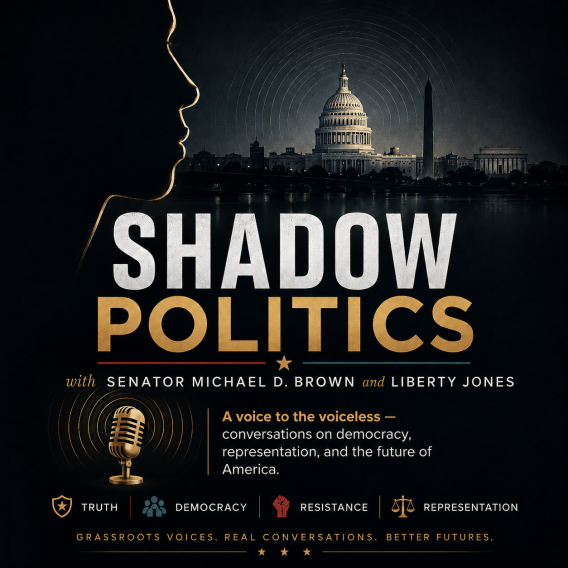

Shadow Politics with Senator Michael D. Brown
Remembering Barney Frank: Shadow Politics Replays a Conversation on Democracy, DC Statehood, Reform, and Public Service
Michael D. Brown Opens with a Tribute to Barney Frank
In this episode of Shadow Politics, Former Shadow Senator Michael D. Brown opens by explaining that the program will not take live calls because it is replaying a special interview with Congressman Barney Frank. Brown says Frank had recently passed away and describes him as an important Democratic stalwart whose public service spanned decades. He frames the replay as a tribute to Frank’s life, career, intellect, humor, and long support for democratic representation, including DC statehood.
Revisiting the 2022 Interview
The replayed interview comes from a 2022 edition of Shadow Politics, hosted by Michael D. Brown with then co-host Marília Duffles. Brown introduces Barney Frank as a legendary former member of the U.S. House of Representatives who served from 1981 to 2013, chaired the House Financial Services Committee, and was a leading co-sponsor of the Dodd-Frank Act. Brown also notes Frank’s status as one of the most prominent openly gay politicians in the United States and thanks him for his early support of DC voting rights and statehood.
DC Statehood and Representation
Brown begins the interview by recalling a previous backstage encounter with Barney Frank, Tom Harkin, and Bill Clinton in Iowa, where Frank and Harkin jokingly debated who supported DC statehood first. Frank discusses his long support for giving the District of Columbia representation and notes the irony that states with smaller populations than DC can help block the District’s path to full rights. Brown connects that issue to the filibuster and the difficulty of advancing statehood legislation in the Senate.
The Economy, Inflation, and the Midterms
The conversation then turns to the economy and the 2022 midterm elections. Brown asks whether Democrats were doomed because of inflation and economic frustration. Frank says Democrats were in trouble politically, but argues that inflation was a worldwide issue tied to energy, the war in Ukraine, and global economic pressures rather than simply the fault of President Biden or Democrats. He also notes that despite inflation, the economy had strong areas, including low unemployment and wage growth among lower-income workers.
Dodd-Frank and Financial Reform
Marília Duffles asks whether the Dodd-Frank Act actually made the financial system safer or simply created more regulatory complexity. Frank defends the law, saying it worked well and helped prevent a financial crisis during the severe disruption of the pandemic. He explains that the law was broad because it combined what could have been many separate bills into one package, largely because of Senate filibuster realities. He also says major financial leaders had since acknowledged that the law was functioning effectively and did not require major changes.
LGBTQ Rights, Race, and Social Progress
Brown asks whether LGBTQ rights were under greater attack in the country. Frank replies that gay people have always faced attacks, but argues that conditions for LGBTQ Americans had improved dramatically over the decades, especially regarding marriage equality and general social acceptance. He says transgender rights remained more contested, but expresses optimism because younger generations are far more supportive. Frank also contrasts progress on LGBTQ issues with what he sees as more troubling regression on race, especially after the weakening of the Voting Rights Act.
Democratic Politics, Young Voters, and Biden
The interview also covers President Biden’s standing with voters, especially young people. Frank says Biden could do more on student loan debt and marijuana policy, both of which he believes matter to younger voters. However, he also argues that Biden and congressional Democrats accomplished a great deal despite having only 50 Democratic senators. Frank says frustration often comes from voters expecting more than the political reality allows, especially when senators such as Joe Manchin limit what can pass.
Ukraine, Putin, and Global Democracy
Marília raises the war in Ukraine and asks whether the United States could do more to help. Frank praises Biden’s handling of the crisis, especially his ability to build and maintain a broad coalition of European and allied nations against Russia. He compares Putin’s aggression to earlier authoritarian expansion and says Biden’s coalition-building has been a strong example of foreign policy leadership. Brown then asks whether Russia, China, India, North Korea, and other authoritarian or illiberal forces could form a dangerous bloc, and Frank says the democratic response today is stronger than the weak response to Hitler in the 1930s.
Reparations, Harvard, and Institutional Responsibility
Brown asks about Harvard and other universities committing money or institutional efforts toward reparations or recognition of slavery’s legacy. Frank says universities such as Harvard and Georgetown are acknowledging that they directly benefited from slavery and related exploitation, making those efforts a form of deferred payment or responsibility for services and labor that helped build those institutions. On national reparations, he says the policy is more complicated, but he supports strong efforts to address the economic damage caused by slavery, racism, and later discrimination.
Political Polarization and the Loss of Collegiality
The interview closes with reflections on Congress, political polarization, and public service. Marília asks about the decline of substance, civility, and intelligence in politics. Frank says collegiality has collapsed and that more extreme elements have gained influence, partly because reasonable voters often withdraw from the process while extremists show up in primaries. He argues that voters must punish destructive behavior if they want it to end. Frank also reflects on missing the people of Congress, especially talented staff and colleagues, while enjoying the reduced stress of retirement.
Closing Tribute
The replay ends with Brown thanking Barney Frank and dedicating a closing song to him, describing Frank as someone he admired during and after his time in Congress. The current episode’s tribute framing gives the interview added weight: it presents Frank not only as a policymaker, but as a sharp, funny, principled public servant who spoke clearly about democracy, equality, reform, representation, and the responsibilities of political life.
Shadow Politics
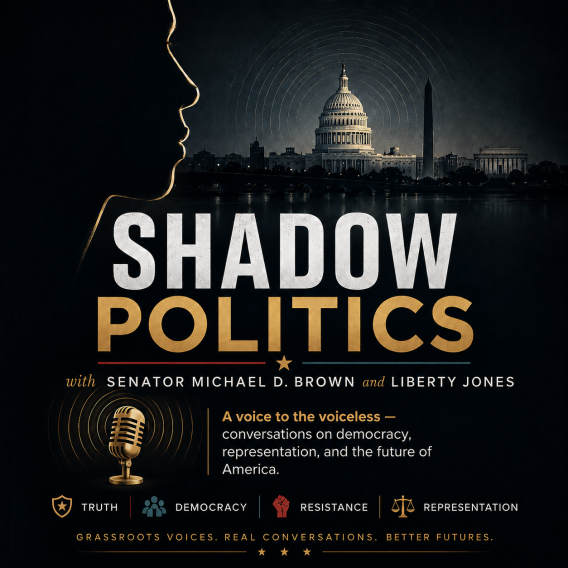

Shadow Politics is a grass roots talk show giving a voice to the voiceless. For more than 200 years the people of the Nation's Capital have ironically been excluded from the national political conversation. With no voting member of either house of Congress, Washingtonians have lacked the representation they need to be equal and to have their voices heard. Shadow Politics will provide a platform for them, as well as the millions of others nationwide who feel politically disenfranchised and disconnected, to be included in a national dialog.
We need to start a new conversation in America, one that is more inclusive and diverse and one that will lead our great nation forward to meet the challenges of the 21st century. At Shadow Politics, we hope to get this conversation started by bringing Americans together to talk about issues important to them. We look forward to having you be part of the discussion so call in and join the conversation. America is calling and we're listening… Shadow Politics is about America hearing what you have to say. It's your chance to talk to an elected official who has spent more than 30 years in Washington politics. We believe that if we start a dialog and others add their voices, we will create a chorus. Even if those other politicians in Washington don't hear you — Senator Brown will. He's on a mission to listen to what America has to say and use it to start a productive dialog to make our democracy stronger and more inclusive. If we are all part of the solution, we can solve any problem.
Democracy is a chorus and it starts with you. Shadow politics. Let the midnight speak.
For the overlook, the unheard, the strong and the weak. Senator Michael D.
Brown holding open the door. Liberty Jones saying we were silent no more. From the district streets
to the nation's soul. Every broken out voice makes the country whole. Shadow politics. Turn the dark
into sound when America listens. Justice comes around. Good evening and welcome to Shadow
politics. An hour long grassroots soft show that is on a mission to make America think again.
On your host, Michael D. Brown, United States Senator Emeritus and along with my amazing co-host
Liberty Jones, we're interviewing the people that are making it happen. Not always in front of the
camera but always ahead of the curve. We're not going to tell you how to feel and who to vote for.
We're just putting the information out there because what goes on in the shadow is really what makes
the world go round. So come listen and learn because a vote is a terrible thing to waste and now more
than ever we need everyone listening, learning and engaged. If we're going to make America sane again,
got a question you can usually call in but not tonight because we're going to rerun a show for
you that's very special. Congressman Barney Frank who was a Democratic Starward from
one of the 50 years passed away two weeks ago and we've had guests the last couple of weeks so we
haven't been able to rerun this but I wanted to rerun an in-year interview that I did in 2022 with
him. He was an amazing man. I hope you enjoy this interview and we miss him sincerely.
This goes out to you Congressman and we'll be back next week with another guest. Thanks so much.
Hello and welcome to Shadow Politics, an hour long grassroots talk show which will attempt to
shine a light on the issues that you care about. I'm your host United States Senator Michael G Brown
coming to you live from the District of Columbia America's last colony. I'm joined by my co-host
Marilia Duffels and together we hope our show will start a dialogue with America about the issues
that are important to you and affect the lives of all of us. So if you want to be part of the
conversation you can call in at 888-627-6008. We have a really wonderful guest tonight. Marilia,
it's great to hear you. We're looking forward to a lively discussion and our tonight's guest is
legendary Congressman Representative Barney Frank who served as a member of the US House
for an amazing 16 times from 1981 to 2013. He was a Democrat and served as chairman of the
House Financial Services Committee and was leading co-sponsor of the 2010
Monumental legislation that died referred to as the Dodd-Frank Act. He's a resident in Newton
Massachusetts and was considered the most prominent gay politician in the United States when he's
coming to Congress. He was born in Bayon, New Jersey. I want to give a shout out to
Bayon, New Jersey because I was born in North New Jersey not far away. So Congressman,
welcome to the show and thanks so much for being with us. Well thank you, neighbor.
I don't know if you remember this, probably not but in 2016 I was lucky enough to stay back
to be backstage at the Iowa caucuses at a rally with you and Tom Harkin and Bill Clinton. And
during that brief encounter which was a lot of fun for me, you and Tom Harkin got into a little
a friendly argument about who supported DC statehood first. But you were one of the first
members of Congress to do that. I got to vote for ratification
of the amendment that we had to give votes back in the 70s, I'm not sure it's right,
but if you know the people opposed to a woman's right to choose, decided that DC would be too
supportive of that right and mobilized against it. Yeah it was a big problem for us and that
was an amendment that when finally passed in Congress didn't make it to ratification just
for that very, very reason. But we thank you for always being supportive of that legislation.
And we're working hard at it now. We have a piece of a statehood bill that's passed.
The House of Representatives sits in the Senate doomed unfortunately due to the filibuster.
But we have an ironically, Michael, you know, due to the votes of states that have smaller
populations than the district. Yes absolutely. And that's the irony isn't it Congressman,
that we are doomed by states that smaller populations in the district. But let me ask you
first and foremost since you serve so long on the financial services committee.
Back in the 1980s, a guy named James Carbell coined a phrase for Bill Clinton. It's the
economy stupid. We all remember that. Are we doomed to lose the midterm elections because of the economy?
Congressman, what do you think? Well, we're in trouble, but I do think
unfortunately some Supreme Court's partisanship has recently played a role in so that the Republicans
didn't get an edge in the Gary Manry crisis and the House. I believe in the Senate that's
that's still very much an open question. There was some good Senate candidates there. I think Donald
Trump's typically arrogant, clumsy intervention in Georgia is very good news for roughly a one-act.
So I don't concede the Senate. But what your question is essentially right. We are getting
heard by the economy. Well, tonight isn't fair. The economic problems now are not the Democrats
fall to go Biden fall. The question of inflation. The Republicans are arguing, well, that's just an
American problem. But in fact inflation is a worldwide problem. Inflation in Europe is about
the same as inflation in America, higher by one measurement, lower by another, but very close.
The energy crisis, the war in Ukraine, all those things contribute. It does appear now that the
federal reserve should have gotten a little tired of interest rates. But by the way,
when the federal reserve board was not raising interest rates back last year,
that was a decision made by Trump appointees. Donald Trump had a majority of his appointees
controlling the federal reserve. So those who believe the problem was, and I think that's an
argument here, that the federal reserve probably should have built a little quicker, are criticizing
buying large Donald Trump appointees. Now, it's not, it doesn't make them bad people. I was glad
Mr. Powell was reappointed. So at the end of your question, short answer, given too long here,
yeah, we're going to be hurt by the economy, even though that's not a good relevant factor.
The other thing to say though, is that even with the little bump that we got in this past quarter,
the economy is performing very well. You know, the problem is when you're in government,
if nine things are going well and two are going badly, you're going to hear about the two.
So yes, we have higher inflation than is helping, but we also have a much stronger
economy and less unemployment than anybody expected at this point.
But voters, isn't it true that that since most of us are not in the stock market and most of us
don't have big 401ks and most of the indicators for most voters in America are gas prices and food
prices. Are they not if we can't get gas prices and food prices down?
He actually looked at inflation. One of the major contributors was the price of cars. So if you
weren't funded by an additional car and you were used, you weren't here as bad.
It is also the case that wages are going up especially for the people who have been
most unfairly treated in America, people in the lower wage groups, they're not going up as high
as inflation, but they are going up considerably and that's a trend we should be encouraging.
But really, don't let me monopolize the conversation which I will do because this man is one of my
heroes. Go ahead. Absolutely. Lovely to have you here, Congressman, and I've always followed your
career because I myself worked in politics a little bit different than yours, but I worked in the
Reagan administration in Bush 1. But it was insofar as Dodd-Frank and I know you
and the legislation and eventually the law was meant to address the failures in the financial
system and prevent future crises like the one that it was meant to address in 2008.
But time and time again, when it fixes needed by Congress, the pendulum often swings
quite widely. And it was controversial, received a lot of criticism as overreaching.
It was like, what, you know this yourself, 898 pages long and it was about 22,000 pages of
rulemaking and there were about 140 attempts to appeal or amend it. So my question is with all that
in mind, has it made a difference? Are our banks, our financial system safer, less risky today?
And as a result of the regulations, are they still thriving or have we just generated more
business for financial or regulatory lawyers? Well, I think there's a pretty strong consensus
that it's worked very well. The financial services committee on which I served had a hearing,
which is very ably led by Congresswoman Maxine Ward, who's doing a great job. And I've been hearing
one of my former college congressman Ed Perlmutter from Colorado. They had all the heads of the six
biggest banks, Morgan Stanley, JP Morgan, Chase Bank of America, etc., Goldman Sachs. And he asked
them what they thought of how Dodd-Frank has worked. And they all said basically it's worked
very well and we have no major changes. And you're right, there have been all these efforts to
amend it. But the key is that none of them went through. The Republicans were much more
focused on trying to do something about Obamacare, although by now that's become too popular. But
it was clear in the beginning, the American public was supportive of what we were doing.
I have a couple of specifics first. Yes, it's 800 pages or so. That's by the way, because it's
really 10 separate bills. If you go back to the era of Franklin Roosevelt, they passed legislation
equal in scope to what we did. The difference was they did it in separate bills. There was a
bill for the bank. There was a bill for the security exchange commission, etc. And there's a very
simple reason that Senator Brown will learn when, as I hope he gets to the Senate, we in the House
took the same path. And we had eight or nine separate bills because it covered consumer
protection, mortgage loans, derivatives, a whole range of things. And my colleague, Senator Dodd,
who was a great legislator, I said, well, we're going to send you these eight bills. He said,
oh, my God, don't do that. Because of something we have now learned is a terribly destructive thing.
The filibuster, he said, you know, I got to get 60 votes in this Senate on every bill we fed.
I don't think I can survive having to get eight separate 60s. You got to move on one bill. So,
in fact, if you look at how we dealt with them in the House, we ate wheat,
voted on them, considered them as separate bills. And then we consulted them. The last point,
yes, it has worked very well. The first place the economy has been very strong.
The problem now remembers that there is the economy is too strong, according to many people,
and that's where we have inflation pressure. But secondly, if someone had said,
years ago, look, you're going to have this terrible pandemic that's going to really wreck the economy.
I think everyone would have expected under the old rules that there would have been a financial
crisis. And sometimes in politics, the most important things you've done is the thing you've
prevented from happening. And I'm very proud of the fact that we've gone through this terrible
economic upheaval with no financial crisis whatsoever. And I think that's because we've put the rules
in place. Interesting. Let me ask you, given what you just said about putting the bills together,
we've just gone through a period here where in front of the Senate was the consideration
of two voting rights bill. The John Lewis Voting Rights Act and another bill that would have
extended voting rights, you think it would make sense for us to take the DC statehood bill,
which is a separate bill that stands before the Senate, maybe in reconvene and put those three
voting rights bills together might have a better chance of passage if we were able to figure out
a way to put them all together in one new expanded voting rights package. Think there's any viability
in that? In the first place, I have to say, I don't serve the Senate and that's a very specific
decision. Obviously, all three of those are very important. But it needs to come out as a
provider side of judgment in the specific context. As I said, 12 years ago, I planned to do all
these bills separately. We voted on them separately in committee. But then because of the Senate,
Senator Dodd said, no, that's not going to work. I can't get that true. So the first answer is that
depends on the specific to the Senate. The second answer though is that unfortunately,
in the modern Republican party, well, it's not very modern, but it's the current one,
I don't think there's any support for much of that at all. That is, they're also negative
that my initial view is that you wouldn't pick up any votes by adding DC statehood. In fact,
you might considerably move one or two of the Republicans because they like having
the advantage they have both in the Electoral College and in the Senate by these small,
very conservative states that have significant overweight, thanks to the Constitution.
They're going to defend that and having the District of Columbia enjoy some of those rights.
Fighting them. Let me change gears for just a second. LGBTQ rights seem to be under attack
across America. Is that something different? I mean, are we seeing
do gay people in America need to be more worried about what's going on now?
It's my recollection that gay people have always been under attack in America. So do we see
these recent moves like to sing in Florida with DeSantis? It's my opinion that every gay person
or everybody that supports gay people in America should go out and buy a Disney sweatshirt somewhere
and wear it. But what do you think I've been to gay people that have more to be worried about
now than they had 10 years ago? No, but it's understandable. Here's the issue. When you're
engaged in a social movement, you start with a very low degree of success and you fight for success
two dynamics that work first of all, you may be getting successful. By the way,
being a gay or lesbian or bisexual person in America, and even a transgender person
although running in the more resistant is much better for you than it was before. This year
will mark the 35th anniversary of my announcing that I was gay. I was the first member of Congress
to make that announcement voluntarily. And back then, there were a whole lot of respect.
So let's look at some of the gains that are not at issue. Same sex marriage. 20 years ago, you
had Republicans acting as if that was going to be the end of family life. Same sex marriage is now
a fact in America. It's not being contested anywhere. All of the negative predictions turned out to
have been wrong. In much of the country, gay men, lesbians, bisexual people are protected.
So the legal status for most LGBT people is pretty improved and not seriously under assault.
There is a problem with transgender people and their rights are still being contested.
That's still a new issue. But once again, if you're looking to degree of progress,
we're way ahead of where we were. And the other thing is that
I'm optimistic for this reason. If you poll people on this subject and you talk to them,
what you find is this, the younger people are, the more fully supportive they are
of full rights for anybody regardless of if it's a gender or sexual orientation.
So this is a problem that I think will continue to receive. Sometimes you have an issue where
younger people are on one side, but as they get older, they switch sides. But what we see here is
generational. Younger people began years ago being less prejudiced and they continue to be less prejudiced.
The big factor here now is that reality control bigotry.
Inky LGBT sentiments flourished frankly when we were hidden and they were reinforced by the
fact that nobody knew who we were. So this is about us perpetuating. But as people have gotten to know
the reality, that's gotten much better. And in fact, I have to say, and I'm disappointed by this,
we have been making more progress in the last couple of decades and LGBT issues in on race.
And I've always felt race was the more serious problem. So that was symbolized by that one
week in 2013 when the Supreme Court made two major decisions. One, they allowed
same-sex marriage everywhere, which is a great advance of personal liberty. But secondly,
in a terrible decision, they basically gutted the Voting Rights Act.
And that's been the basis for a lot of the problems since. So I would say we're continuing
to make progress, LGBT issues. But I am disappointed that there's been more slippage
sadly on race. Well, you know, I think a lot of that has to do with what you just said,
Congressman, you know, we all have, you know, the reality of the situation. We all work with gay
people that we respect. We all have gay friends and neighbors that we cherish. And we all have
gay members of our families that we love. So I think it is the reality, whereas we're still able,
race is still able something that that's unfortunately able to define us.
You're right, Michael.
You just made the point. Every gay person I know has a lot of straight relatives,
but not that many black people have a lot of white relatives.
I was just reading a book. As I said, I think racism has been much worse in homophobia. And at
every score, African-Americans, blacks have had a much worse time. There's only one advantage
gay people had over African-Americans. No black teenager ever had to worry about the reaction
of coming out to his parents. Yeah, absolutely.
I just got one anecdote. Yeah, please. Please. I was reading about when they were debating in
Parliament, England about lifting the ban on gay people. And Margaret Thatcher was a terrible
anti-gay bigot. And there was an effort to repeal the law that said if you had consenting
sex between adults, you could go to jail. And there was a man who was pushing hard to that in the
House of Lords. And finally, he got the bill through the House of Lords on another issue we
cared about to protect C-turtles. But after they passed the bill to protect C-turtles,
they defeated the bill to protect gay people. And some would say to him, well, how do you account
for the difference between the vote and favor of C-turtles and the vote to not discriminate against
C-turtles, but the vote to discriminate against gay people? He said, well, there aren't that many
C-turtles serving in the House of Representatives for the House of Lords.
Well, let me go on record as a former Maryland Tariffan that I'm also protecting. I'm also
protecting C-turtles and gay people. Marie, go ahead. Absolutely. Just to get off specific issues,
if I may, in Congressman in 2004 and 2007, I'm sure you know what I'm going to say,
you are rightfully voted by Hill staffers as the brainiest, funniest, and most eloquent member of
Congress, which you deserve that well deserved. But I have to say, and I'm sure you'll agree with
me that if Congressman Mike Siner had not passed away, you would have had some serious competition.
But you are. But the point, the more on the series note, the point I want to make is that
this no longer happens. I don't think we have these votes anymore. I don't think we have these
the sort of lightness of being, if you will, in terms of that. And more importantly, a focus
on intelligence. Back then, you featured, and Mike Siner featured on C-SPAN, and it was big,
and people tuned in both to the radio and television C-SPAN. And they asked substantive
questions because they were well-informed and they were interested, and they were respectful.
Also, there is one very poignant episode, I think it was one of those morning shows where
Mike Siner was discussing debt and the deficit and the balance budget. Those aren't simple topics.
And yet there were fewer outlets back then. There were certainly no Google, no social media for
people to go running and get a quick education on. But yet, today, we don't have that. It seems to me
that people, the citizenry is not educated. And it seems to me, and this is a question that
when Dodd-Frank was passed, perhaps, there was a more educated citizenry. And you don't see good
thought pieces by members of Congress, like the kind that you wrote in the Financial Times,
or much less, lunch with the FT, which you featured. And I used to write for the Financial Times, so I'm
very focused on this. So what do you think can be done? I mean, I do think that the education
has gone downhill and people don't have the substance nor the interest. Do you agree? And
what do you think can be done? Oh, I absolutely agree. By the way, let me join in your
lamenting the early debt that Mike Siner is right back. Yeah, actually, and I lived across the street
from each other when we were in the kitchen. I know you did. On Southeast, on East
Street, Southeast, we were parked from Eastern Market. Yeah, so I remember waving to you one time
from Mike's front door. In fact, one day, Mike, one day, saw somebody leaving my house, he'd broken
any case, and he didn't catch Mike with a wonderful, wonderful guy. And I made the Washington Post.
Oh, I do miss him. But as far as the voting, one of the major reasons you don't see those polls
these days is the total collapse of collegiality. Back in those days, Democrats and Republicans could
put aside partisan and Republican would vote for Democrats, a good order, a Democrat would vote
for Republicans as a hard worker. Things have hardened now. And I don't know what would happen.
On the other hand, if it came to a contest, who said the funniest things, I'm not confident I
would beat Marjorie Taylor Greene. Yeah, but I think that you'd have to put the parameters
within reality around that. You said the other one, though, is they used to have a category of
best-stress demand and best-stress women. So now I guess Madison, the court one would be a candidate
for both of them. Yeah, well, let me ask you, there's been a Boston Globe study. If we could talk about
the Democratic Party again for a minute, because you've been in the Democratic Party so long.
There's a recent Boston Globe poll that shows that the approval of the president is 46%
in Massachusetts and a place where he beat Donald Trump by more than 33 points. This is especially
weak, is approval rating is especially weak among young people. What does the Democratic
Party need to do to get young people back in the polls? What do you think? Are we making mistakes
there? Do we need to do more on college loans and things like that in order to
shore up our support among young people? Well, there are two things that I think Joe Biden should
do. One is substantial reduction in student loan debt for people graduated according to your income.
Your phase it out. So at some point, people don't get it. There are incomes are too high.
And he also disappointed that he still was stuck in the old anti-Marijuana. Well,
you know, marijuana to me is about like same-sex marriage. It's something a lot of people wanted to
do, but other people thought if it happened, it would have all these terrible social negative
impacts. And then in a couple of cases, we started doing it. And by now, people are aware that no,
they don't have those negative impacts. And they're going forward. And I don't know why the president
holds back on that. But generally, I think it's not a lot we can do for this reason. People forget
and they don't have a historical perspective. This goes back to the question who asked me
about the media and public opinion. Remember, there were 50 Democratic senators. That's
no majority. And in fact, if you judge by historical standards, what Biden and the Democrats have
done has been very impenseless given that we've never had total part of unity. There was the
infrastructure bill. There was $1.9 trillion. We've built there some other things that have happened.
The problem is that, and this goes back to the media situation, you don't get, I think, explanations
of what's happening. And people say, well, I voted the Democrats and I didn't get what I wanted.
Well, I feel that way too. But I didn't vote for Senator Manchin. I'm sending a mention.
I wish he would vote differently. But on the other hand, we got it with Donald. If he wasn't there,
we wouldn't even have had the Supreme Court justice. Now, because he would almost certainly
be replaced by a Republican. So I think what you have is young people
won the president or act on marijuana and on student loans. But too, we have to try to explain
to people that the reality is what it is. And there's one last point I would make. Yeah,
46% approve Joe Biden. Well, you mentioned his margin over Trump. The number of people who
approves Donald Trump is of course much lower. And I believe that if Biden ran against Trump again,
this time, which could happen, the margin would be similar.
Do you see any challengers on the horizon to the president in 2024? He is the presumptive nominee.
Do you think that? I remember 1980 Congressman, the brief fight that
take Henry had against my boss, who was Jimmy Carter. And it didn't last very long. I think we
defeated Kennedy on the first vote at the convention. But do you see a contentious convention ahead for the
No, probably because of the example you gave. And I was part of that. And
I think the lifetime from 1980 and I was a Kennedy supporter and I acknowledged that was not a great
idea. And I think we can give me credit. Those kinds of, I mean, I don't know, you've been
in politics because you have people sometimes they all primary. It's great. I love having a
primary and I will tell you based on my own experience. Anytime you hear someone talk about how
wonderful this type of primary, you're talking about something you've never had one. And the,
you know, if President Biden decided to run again, and his health is good, people talk about how
Ronald Reagan, sadly, was mentally, fairly gone by the last year of the chairman, which now
cleared the Iran-Kintra issue. He was not with it. The Biden on the other hand, they showed none of
that. You know, one of the great people talking about Harry Truman, the old Biden's performance
with regard to the Russian attack on Ukraine is one of the best examples of foreign policy
leadership in American president to never show and people who follow this understand that. But
if he decides to run again, no, I do not think there will be opposition again based on how that
backed by 1980 even on the people who wanted to see the change. If he decides not to run,
that's possible. Then it's wide open.
Merlea, do you have a question?
Yeah. What more, as a woman who is on the sidelines watching this atrocity, this tragedy,
this barbaric scene unfold in the Ukraine with all those people suffering at the hands of that
madman psychopath. I just wish and hope that something else can be done in terms of helping the
Ukrainians, in terms of helping the military. So do you think that is there anything more that
Biden can do at this point other than provide the amount of military warfare that he's provided?
I'm always pushing for him to do more. But I don't know. I'm not a foreign policy expert.
No, this is a good example. I share your views. This is a good example of the constraints on
the president when you judge us. One of the things that Bill Biden has done that has really been
extremely impressive is bring this European and Japanese. He's got a very effective coalition
of the leading economic power to the world against Russia. I mean, Germany, which had been laggard,
is now fully involved. So here's Biden's dilemma. There are things he might want to do individually.
But if he does them, he may lose support in the European countries. And one of the things we know
about sanctions, people say sanctions don't work. But I was there when one type of sanctions did work.
You'll remember this. Nelson Mandela, one of my proudest moments was standing
in the sanctuary hall in the Capitol and listening to Nelson Mandela thank the members of Congress
because we overgrown Ronald Reagan's veto, the mandate sanctions against the racist regime
of South Africa. And Mandela said that was a major factor in my being here today in front of you.
So and that was because we had a worldwide sanctions network. If only America would do
things. Yes, we could maybe do something a little harsher, but we wouldn't have the support
of other countries. So what Biden has done is to get a broad coalition. And in the interest of
that broad coalition, he's not done everything he could have done right away. And doing more and
more and the most recent requests for sending stuff. And you know, I was glad that they called it the
one lease program. This is an idea. I mean, Putin is Hitler. People talk about people
doing too quickly. But his he is following the Hitler approach of going after Austria,
the Sudeten German, the generous and terribly racist approach. But I do think Biden
is doing everything it is possible to do while still holding together that coalition and to
the extent that there may be a little less that we're actually doing by America alone.
That's more than compensated for by the importance of having so many other countries joining.
Interesting. Let me ask you, do you think there's any chance, you know, it scares me, Congressman,
I think about this all the time that somehow it seems like 1939 to me, when you look at people
like Modi in India, who's also kind of a fundamentalist nut and Kim in North Korea.
And the guy invented the whale. Is there you think there's any chance that Putin will put together
a coalition that somehow like ours in 1930s? It's a good question, Michael. I share your
disappointment with some of these people. You know, since you mentioned Modi,
I've been as many of us have been very strongly against what would appear to be anti-Muslim
prejudice in America. But you know where there is now rampant anti-Muslim persecution in India.
And I'm disappointed that some of the Muslim countries are not standing up
to defend. I mean Muslims have been the victims in China and Xinjiang and in Myanmar, but especially
in India, there are virtual pogroms there. But it is disappointing to see so many of these
non-Western countries doing this. The optimistic vote though is that they do not have the strength.
I mean, Hitler has his main ally Japan, so that there is not that the countries we have seen
hopefully signing with Russia don't have that. So, for yeah, however, with China, which is of
course a major power and acting with the a morality that characterizes them. So yeah, there is that
potential of Russia and China together. But the big difference between now and 1939 is the
leadership that is being shown by the elected leaders in the democratic nation. And I know it's
common to say all things have gotten from which Russia etc. But I think if you look at the response
of the democracies, America, France, Britain, etc. to Putin, and you compare that to the laughter
of spine and moral commitment to Hitler, things have gotten better than that in that 80 year period.
Let me switch gears a little more time. Your alma mater recently announced that they're getting
about $100 million towards reparations and recognition of, I don't know, recognition of their role in
slavery, but recognition of America's role in slavery. We've also seen Georgetown,
University and UVA do similar things. What do you think about this? We've had many people on the
show to talk about reparations. And let me first tell you my feeling. My feeling is that
we have looked at reparations as compensation for the ROM that was done to African Americans
during slavery. But I think when Harvard and some of these places, educational institutions
step up to the plate, it's more of a recognition of the contribution that African Americans have
made to America. It's a recognition that they own a piece of the pie because they worked
to make it what it is today. What do you think?
Well, I believe that what the universities are doing is also acknowledging that they have
been very direct beneficiaries of the slave labor. I mean, that, you know, there's a continuity there
in Harvard and Georgetown art today, what they are in part because of what they were. And it is very
clear. They need slave labor and exploitation of slavery, the money that they got at Georgetown.
Those have contributed. And so I think those are really sort of deferred payments,
or services rendered, the specific institutions, and are very much in favor of them. As far as
reparations, there's a policy. I do not see how it would work if people are talking or should
work, but we talk about money to individuals. I do believe that we have this enormous debt
that we owe to people who were victimized. And I always believe that the beginning
sin of America was racism. And I believe that we should be following policies that
reimburse people in effect or compensate people for the damage done to them.
But I also believe it should be merged with economics. So part of the problem is that
the mistreatment of racism is one of the reasons you've had the economic disparity.
So I am in favor of institutions that benefited from slavery, because I said, reimbosing the
descendants as far as the national issues in terms. Yeah, I think there should be policy with one
of the big problems we have is the assault on affirmative action. That's coming. That is a
terrible thing. One thing I'm very proud of, by the way, you mentioned the financial reform bill
under the leadership of Maxine Waters, who's an extraordinarily talented member of Congress.
People don't recognize, you know, you talk about people talk about how big the bill is.
We put in the whole section requiring all the financial regulators, which are eight or nine,
to build up their anti-racism part and to have inclusion and diversity sectors. And we
press the financial institutions to do more. So I am very much in favor of an active effort
to have policies that seek to overcome the negative effects of racism that was not just slavery and
look at. Obviously, if you're talking about making up for bad practices,
in endless slavery, it continued and got even worse in any ways during the reconstruction period.
Marilla, do you have a question? Yeah, if I may get back to Congress in terms of the climate,
it's just any more self-gain is the compass in politics and political gains or the driving force
in what wins any sort of sorted behavior goes. It's not substance. It's not an educated or
interested legislator. It's not democracy as a result. And it seems, you know, from the Matt
Gates of the world to everybody else there, even Kevin McCarthy lying and then being found out
by the tape that he was lying. And that's just one example. But it's immoral approaches and
behavior that make and take the headlines. So how do we get back to the good old days with the
elbow days of the world working with Darksun and Jack Kemp with the Democrats? What do you think?
We're back to the voters. You know, a part of the problem is when we talk about the motives
of politicians, you have to begin with a fundamental fact, if you don't want decisions to be influenced
by politics, don't ask 500 politicians to make them. I mean, that's just kind of inevitable. And
it's not been though it's gotten worse. And it's gotten worse. And some of the things you mentioned,
the media, the problem has been that the most extreme elements in American politics
have gained influence. And you know, part of the problem is, I believe, it's the fact that
it's a natural reaction when people are angry with what's happening. Some of them withdraw from it.
So what happens is that the more reasonable people are put off by the antics and they say,
okay, I'm not going to get involved. The key to the particular is look at the difference in the
number of people who vote in elections and in primaries. And the problem is that we have a very
unrepresentative sample of people voting in primaries. Now, it's mostly that vote. We do have
voters in pressure now, these cities in parts of the country. But there are people who could vote,
and the answer is to try and get
non-extremists, frankly, to vote in primaries. That's the biggest, I try to give an example of that.
Liz Cheney, I think is making a mistake. She's running for renomination as a Republican on Wyoming.
I wrote a comment in the post that said, no, she should run as an independent. So Democrats
can vote for her in November. So it's the fact that reasonable people don't vote primaries,
plus the intensity of the social media and that the people who listen to social media
people shut off social media as I do, but then they don't vote in primaries. So that, I don't think
there was a solution other than the voters. Now, one thing is, and obviously I mentioned this in
other cases, the question will be this, will the Republicans be punished for some of this,
because yes, there have been problems with some Democrats, but it's been pretty one-sided.
It's the Republicans who have been engaged in this, who wouldn't vote to certify the election,
who support J.D. Vance, is this guy who wrote a book and he's running for Senator Ohio. He's
supposed to be a light guy, a lot so graduate. He was campaigning with Matt Gaetz and Marjorie
Kelly Green. So it's in the hand of the voters. If the voters start to punish this kind of behavior,
it'll end, but if they were wanted it won't. Well, you know, I'm sorry, go ahead.
Oh, just say also, I think that the the sordid nature of politics anymore also keeps out
potentially really good people from running for office. So that goes hand in hand with what
you're saying about the voters. I just said, no. And let me just add to what you said,
Congressmen have had primaries. In the District of Columbia, the primary is the only election
that counts because you were so solidly Democrat. If you win the Democratic primary,
you go out on election day and give people cookies. No Democrat has ever won the Democratic
primary and then lost the general election. But yet in D.C., we don't even understand that.
You know, there's still very low voter turnout in our primaries as important they are.
Michael, run out of time here, Congressmen, a couple of quick questions. One, do you miss
Congress? And two, are you doing anything fun in your retirement? Well, yeah, two, I do miss
Congress. I don't miss stressing. I don't miss having to make tough decisions. But I do miss the
people. And you're right. Good people were being discouraged. But I was lucky enough to be there
when good people wanted to show you. And not only were my colleagues,
interesting people, one of the great bargains the American people have gotten, and I hope this,
you don't lose it, is the willingness of so many talented young people and people in general
who were bright and dedicated to work in the Congress for a lot less money and a lot more
spread than yet in the private sector. So I miss working with all of those people.
As far as what I'm doing, I'm trying to do some writing and they weren't on a book. And
but I, as I said to my husband the other day, it is very nice not to have to get up when I don't
want to get up and be free of stress. And the, I guess I said the single biggest advantage
of not being in Congress is that I haven't marched in a parade in 12 years.
I can, I can understand that we just had our little, a man's a patient day parade, which goes
three blocks is a pain in the ass that takes hours to line up. Yeah. So I certainly,
yeah, you know, Michael, people say, I get caught politics and say, Oh, I love campaigning.
My answer is, well, if the love campaigning so much, how come you don't do it if you don't have an
opponent? Yeah, exactly. Well, they do do it in the sense that they still try to raise money,
whether they have a, but I have a bucket list that is things that I want to get done. But I don't
want to be crude. I have another list kind of lines with bucket and there's a lot of things I don't
have to. Well, that's great. I hope you're getting to spend time with your family. And let me,
since we're on the subject, just give a shout out to your sister and Lois, who was a great,
you know, force in the Democratic Party. And what's at one time, the national political
leader for the Democrats.
He was one of the pioneers for women to be in real political positions. And I'm very grateful.
Like I mentioned, I was at her house in Maryland for the Seder and my husband, my
brother found the hearing aid I lost. So I'm very grateful.
Well, well, finally, you found a use for brother-in-law's. I haven't, I get to find a
use for mine. But, you know, yes, she really was a force and very well respected, you know.
That's one thing you know in politics of congressmen, if you can't find people saying bad things about
you, it really says something. It really says something because there's so few people that
rise to that level. Well, if you have a field that you don't have enough people being critical,
I'm better. I could learn to have a field of mine.
All right. Well, thanks for that. I was spoken like a true big brother. But anyway, let me
just thank you so much for being on our show. We've run out of time here, unfortunately.
We hope that when you finish writing that book, that you'll come back and be our guest again.
Oh, absolutely.
Absolutely. Absolutely. That would be wonderful. When do you think it will be out?
I'm hoping early next year. Okay. Right. That's around the corner.
Yeah. Can't wait to read it because I'm sure you have so much interest.
I have to do it in my work to get it in, then before it comes out. But I'll honor it.
All right. Sure you are. Well, great. Well, we hope to speak again.
All right. Well, thank you guys. I enjoyed it.
Thank you. It was wonderful. It really was. Thank you, Congressman.
And we always dedicated song at the end of the show. So here's a song from a former hippie
to a man that I admired so much while he was in Congress. And I still admire.
Here's one from a classic from Bob Dylan by the birds called my back pages. We'll see you next week.
Come with your questions. Come with your history. Come with your hope. America is calling.
This time we listen. Shadow politics make the blue notes rise. Put the unheard city right before
the nations are. Send it to Michael D Brown. Liberty Jones by his side. Turning conversation
to a rising tide. From statehood dreams to the truth we defend. From the stranger at the door
to the voice of a friend. Shadow politics. Let the whole room sing. Representation is where freedom
begins. Leave one light on the window tonight. Leave one chair open. Leave one question bright.
The shadows are empty. They're waiting to be heard Sunday night. We give the people the world.


