
The Power of Synergy, July 27, 2026


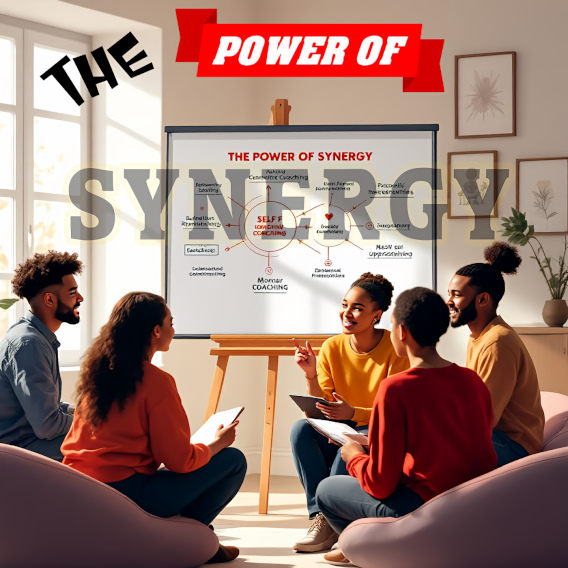
The Power Of Synergy with Gabrielle Cardona
Synchronizing for a Stronger Marriage: Communication, Compatibility, and Giving More Than You Take
Marriage as a Practice of Synergy
Gabrielle Cardona presents marriage as an active process of synchronization in which two people coordinate their thoughts, feelings, actions, and practical responsibilities. Using exponential numbers as a metaphor, she argues that partners who genuinely connect can create an impact much greater than the sum of their separate efforts. She describes her own 32-year marriage as an example of two distinct personalities continuing to function with emotional and mental quality. Her central premise is that lasting partnership depends on learning how to empower rather than diminish one another.
Communication, Knowledge, and Compatibility
The host distinguishes knowing information from truly knowing a person and makes communication the backbone of relationship success. She uses Myers-Briggs personality types to explain why some differences can be useful while certain similarities support compatibility. In her account, she and her husband perform well together because they have different dispositions but share two personality letters and a compatible way of making and executing decisions. Partners can strengthen a marriage by identifying their talents, limitations, preferred tasks, and low-function areas instead of expecting identical abilities.
Accountability and the Quality of Energy
Cardona outlines three principles of synergy: there is no neutral energy, there is no emotional inertia, and power carries responsibility. She argues that indifference affects relationships negatively and that people are always moving toward, away from, or with one another. Her definition of accountability requires partners to consider what they contribute, not merely whether they can avoid consequences. A marriage-oriented value system, in her view, asks each person to give more than they take and to become a higher-quality presence for the other.
Re-Centering, Intimacy, and Emotional Honesty
The discussion turns to mood, self-regulation, and sexual connection. Cardona advises partners to identify when they are in a low-quality emotional state, communicate honestly, and take constructive time to re-center rather than deliver toxicity to the relationship. She opposes using sex as a weapon and describes intimacy as a form of connection that must adapt as health, location, pregnancy, accidents, age, and other circumstances change. She also emphasizes that a person should step back when unable to participate in intimacy with emotional quality and return after regaining internal alignment.
The TIPS Framework for Resolving Conflict
Cardona introduces TIPS—Topic, Issue, Problem, and Solution—as a structure for understanding relationship impasses. She identifies four possible barriers behind a problem: ignorance, indifference, impotence, and incompetence. From there, she proposes three broad paths: re-center emotionally, address an unrelated personal trigger, or recognize that the requested task falls within a low-function personality area. Partners can then negotiate encouragement, support, facilitation, motivation, reward, and recovery time so that difficult responsibilities are handled honestly and sustainably.
Prioritizing Connection in Marriage and Family Life
The host argues that prioritizing the marriage can benefit children by giving them an example of healthy communication and restored emotional quality. She recounts leaving the house with her husband to talk through tension, her daughter’s insistence on phone-free time together, and her husband’s need to think aloud before inviting others into a conversation. A coffee-shop stranger’s disbelief that the couple could still laugh, kiss, and enjoy one another after 25 years becomes the episode’s concluding illustration. Cardona’s final message is that durable marriage depends on understanding personality, protecting connection, communicating needs, and using personal power positively.
SEO Keywords / Key Phrases
marriage communication, relationship compatibility, emotional synchronization, healthy marriage strategies, personality types in relationships, conflict resolution framework, intimacy and connection, emotional self-regulation, giving more than taking, family relationship priorities
The Power of Synergy

"Is relationship coaching right for me?"
Unlike conventional counseling, relationship coaching is about insightful education and listening more than talking.
Connection, communication, and accountability are the 3 elements to a successful relationship. All 3 are vital and perpetual. Relationships are about knowing yourself and understanding others so that what you share is healthy and beneficial--to you both.
Some questions to ask yourself:
- Are you truly ready for healthy change?
- Can you handle homework?
- How honest are you with yourself?
- How much support do you provide to others?
- Are you qualified for a relationship?
Only YOU know the answers!
Do you know what the things people say mean? How do you interpret their actions? Try taking a look at their personality! There are 16 different personalities, and one statement from one person can mean something completely different when coming from someone else.
Learn about what's behind behavior. Information from "experts" can confuse people. It is inaccurate. If you attend an MBTI seminar, you'll walk away knowing AND understanding what people do, how they do it, and why they do it. You'll also understand yourself.
"Relationship Coaching"
What's the formula to success? How can you reach your goals? Want some practical advice on how to get what you want out of life, without making it painful or complicated?
The Relationship Coaching program provides information, tools, resources, and support to set you up for success in every area of your life. Define your goals, know where you are, and create the path in life that YOU want to take. Check it out and take the Workbook that comes with it home with you for free!
Synchronizing for a Stronger Marriage: Communication, Compatibility, and Giving More Than You Take
Speaker Identification
Speaker 1 – Prerecorded Theme Vocalist / Announcer
This voice performs the opening and closing theme lyrics and introduces the program and network. The individual’s name is not stated in the transcript.
Speaker 2 – Host, Gabrielle Cardona
The speaker identifies herself by name near the beginning of the program and describes herself as a relationship expert and relationship coach. No guest or caller is heard in the provided transcript.
Speaker 1 – Prerecorded Theme Vocalist / Announcer:
We are more than what we see.
Every voice, every story holds the key.
Together we rise in synergy.
Different faces, different pain,
Different stories, same refrain.
Trying to find a place to stand,
Trying to feel a guiding hand.
What you say and what you mean,
Life somewhere in between.
Every action has a cause,
Every heart behind the walls.
[Unclear opening lyric.]
We can see it.
There’s a pattern in the soul.
Every piece can make us whole.
The power of synergy,
Understanding you and me.
Every difference, every truth
Leads us back to something.
It’s the power we can be
When we see what’s under.
Welcome to The Power of Synergy on BBS Radio.
Speaker 2 – Host, Gabrielle Cardona:
I’m Gabrielle Cardona, a relationship expert—yes, a relationship coach. What’s a coach? Some people think I’m like a counselor or a psychologist because I teach people how to be healthy mentally and emotionally. But, you know what? A mental-health professional may label you with some kind of illness and perhaps offer you medication. As a coach, I teach people how to score in the game of life. I give them equipment and strategy, and I stand on the sideline giving them the encouragement and support they need to succeed—to score, make progress, and experience personal growth.
I’ve been doing that for more than 20 years. I started as a life coach, but people told me that was too general and too broad. They said I needed a niche, a specialty, or an area of expertise that people could identify as something I was particularly good at. I was told that about 15 years into my career, and I thought, “I don’t really know. I teach people how to do everything from time and money management to weight loss, relationships, and career changes.”
I asked myself what consistent theme or topic clients brought to me. Their questions could range from, “What’s wrong with my 12-year-old granddaughter?” to, “If my life is perfect on paper, why am I not happy yet?” I took an inventory of the themes and topics consistently interwoven through people’s personal issues. You know what it was? Relationships—the people in their lives.
It was not just the activities in their personal, professional, or public lives. People were always a consistent element and an inevitable factor they had to consider if they wanted to be successful. Success on paper is one thing, but if people want to be happy and fulfilled, they need to make good, quality connections with others.
I thought, “That’s it. Relationships will be my specialty.” Then I broke it down further. What is the fundamental backbone of success in relationships? Communication. A lot of people simply do not know how to connect with the people in their lives. When they have problems and frustrations, how often is it because they cannot quite synchronize?
It could be a coworker, a boss, a client, a mother, a child, or the person they are married to. They may have intense feelings for the people they love—or the people they feel stuck with. They may like someone but still be unable to make the relationship work. How can they synchronize?
What is synchronicity? It means they synergize; they come together. I like to use numbers as an example because I’m an INTP. If you do not know about Myers-Briggs personality-type profiling, you can search for INTP, and it will tell you a lot about who I am. I’m kind of like a computer. I like information. You can never give me too much information because I want everything to make sense.
When I teach people about synchronicity, I explain that when people truly come together, they empower one another. Math is simple for me to understand, so I ask people to quantify their value on a scale from one to ten, based on the quality of their thoughts, feelings, actions, and performance. Sometimes we may be a four, sometimes an eight, and sometimes a ten. How can we raise the quality of not only our thoughts and feelings, but also our performance?
Synergy means that the other people in our lives also bring the value and quality of their thoughts, feelings, actions, and performance. Let’s say I’m a four today and my husband is a seven. Four and seven are not merely eleven. They are not even just twenty-eight. Four to the seventh power is 16,384, and seven to the fourth power is 2,401. That is much more than eleven or twenty-eight.
How can we come together with the people in our lives and create that significant an impact on the world—not only in the situations we are in, but also on the people in those situations, even if they are not directly interacting with us? Simply by being in the same environment with someone we have synchronized and synergized with, we can have an exponential impact. We do not merely add to people or multiply their efforts.
Think about this logistically. When different people perform different activities, they add to a situation. If I were a four and my husband were a seven, and we were doing something in the kitchen, we would each add to whatever was happening—perhaps preparing a meal. I could help him by chopping food, and that would add to the meal.
If we are connecting emotionally, however, four and seven could become twenty-eight because we are giving one another power and energy in a positive way. When we fully synchronize, our thoughts, feelings, and actions sustain and maintain the connection.
I’m using my husband as an example because today I’m talking about marriage and how we can synchronize in order to synergize within marriage. I had him on the show a couple of weeks ago, and we had a great conversation about how, after 32 years of marriage, we are still emotionally and mentally high-quality when we are together.
I was told many unfortunate lies by people in my life. Unfortunately, many of them were women and feminists who told me terrible things about men and marriage: women do not need men, men are the enemy, women are the competition, and if you want to prove your value as a woman, you must make your mark on the world and get a job. I was told that being barefoot, pregnant, and in the kitchen made a woman a sellout, and that being submissive as a wife meant compromising her value.
What? That is not true. You can have a home life. You can be a domestic engineer and be submissive to your husband while still being confident and independent. When you come together with your husband, synchronize, and synergize, you can have what you want as a career woman within the capacity of matrimony.
My son is getting married in less than two weeks, and it struck me the other day how special he is to me. I have three children, but I had a very different connection with my middle son, who is getting married soon, than I had with the other two. He was not necessarily my favorite—some people would say my daughter was my favorite because I liked her so much—but he was still my boy. I began thinking about all the things I taught him about marriage while he was growing up.
I’m not taking any breaks today, ladies and gentlemen. I’m going to talk about marriage and everything, logistically and constitutionally, that can help make marriage successful. If you have a question or comment to contribute to this stream of consciousness, please call 888-627-6008. I’ll remind you of that number a few times throughout the show.
Let’s get down to the fundamental question: What is the purpose of marriage? I have a book titled Till Death Do Us Part: Is Marriage Practical? People see how I am with my husband and do not understand how, after 32 years, we can still act like boyfriend and girlfriend. Yes, there are things you have to do, but there are also important secrets to getting those things done.
When I talk about synchronizing in order to synergize, the first thing is to know the person you are with. I love that Spanish distinguishes between knowing a person—conocer a la persona—and knowing information—saber la información. Knowing information is not the same as knowing people.
I was born in 1976 and came of age as a young woman in the 1980s. Through the media, I received a lot of incorrect information not only about marriage, but also about men: men are stupid and selfish; all they want is sex; women can do everything men can do, probably better; women do not need men; marriage is entrapment; and being a wife and mother—barefoot, pregnant, and in the kitchen—makes a woman a sellout because she must choose between family and career.
I’m so glad my husband came from a family of 15 children and was number eight. Let’s just say he knew how to cook, clean, and change diapers by the time he was eight years old. Through his example, I learned that many of the things I had been told were lies.
Here is what I came to believe: Men can be very interested in commitment; just do not make them crazy. They can be amazing in the kitchen if you give them space and appreciate their effort. They are often willing to give you what you want if you are specific about what it is.
I had a career while I was married and raising my children. I had a job, but my marriage came first, and my children were also a high priority. I needed to keep everything in balance. When I went to work, I checked in with my husband and said, “This is what I’m doing for work today. What’s the family situation? What would you like to have finished by the end of the day? How much of what the children need can you provide? How much can I provide? How much is negotiable?”
Yes, you can actually talk to the person you love more than anything. They may listen and appreciate that you had the conversation with them and for them. When your mind, heart, and body synchronize with the other person, you have a tremendous opportunity to accomplish many things in life.
I’ve also been told that opposites attract, while birds of a feather flock together. So how do you know who is right for you in marriage? A large part of the reason my husband and I have synchronized so well is that we have different dispositions, but two letters of our personality types are the same.
Marriage is about living with someone all day, every day. It includes mundane activities and daily lifestyle responsibilities that are domestic, practical, personal, and connected to companionship. You have to be with that person. If you are synchronized, it is because each person understands what the other is doing, why they are doing it, and how they are doing it.
You need to know that there will be some things you agree about and other things you disagree about. That does not have to be an impediment. You can take advantage of your differences. Stumbling blocks can become stepping-stones, and weapons can become tools.
If you are wondering whether you are looking for the wrong person or what kind of person would be good to sign a lifelong document with, call 888-627-6008.
When I talk about similarities in functionality, I refer to the four letters in a personality type. The first concerns social inclination. The second concerns general focus. The third concerns how we make decisions. The fourth concerns how we carry out those decisions. There are 16 possible personality types.
A person’s disposition is based on certain letter combinations. If the second letter is S, the disposition connects with the last letter, producing either SP or SJ. If the second letter is N, it connects with the third letter, producing either NF or NT.
For more information, I have a book called Embrace Your True Nature and Improve Your Functionality. It is available on my website, life-synergy-coaching.com, and there is also an audiobook for people who prefer listening to reading.
Having different dispositions in a marriage, courtship, or companionship can be good because the two people will naturally want to do different things. Many different responsibilities must be handled: money management, time management, household arrangements, and raising children. Who should do which task? Identify your differences, and let each person do what they love and what they are especially good at.
Things are more likely to be accomplished when people know what they are good at and what they are bad at. It is acceptable to be bad at some things because, if the partners are different enough, the other person will probably be good at those things. Talk it out, discover the differences, and understand them.
At the same time, I believe two personality letters should be the same. My husband is an ESTP, and I am an INTP. The fact that we are both thinking perceivers means we often approach life in a similar way. The first two letters are different, however, so our attention is often directed toward different things. We have a similar modus operandi in the way we execute decisions, but we apply it in different areas of life.
As a sensory perceiver, my husband is like a muscle. He gets things done and can multitask. As an intuitive thinker, I’m more concerned with the source and plan behind what we are doing. I want to plan and organize before he begins, and I try to prevent every possible failure. Then, when I tell him, “Okay, baby, go ahead and do this, that, and the other thing,” he can execute it very well because, as a sensory perceiver, he prioritizes performance.
As an intuitive thinker, I want to ensure we are not doing something foolish or doing it in a foolish way. But I often do not want to perform the task myself because, as an intuitive thinker and an introvert, I tend to want to be alone.
Find out what your nature is. Know what you work well with and, just as importantly, what you do not work well with. When you consider “till death do us part,” you are considering forever. Is that reasonable? It can be, if you are different enough to get things done but similar enough to do them for the same reason or in a compatible way.
Then you can identify the tasks you will let the other person handle while communicating clearly about your own strengths, abilities, limitations, and faults. Again, that comes back to communication. The station number is 888-627-6008 if you have questions.
Now let’s talk about some of the practical differences between men and women. Yes, they can be different—“men are from Mars, women are from Venus.” My oldest son, who once called me “a shrink in denial,” told me a joke about a computer’s gender when he was about 13.
A Spanish teacher explained that Spanish nouns are grammatically masculine or feminine. Instead of one word for “the,” Spanish uses el or la. For example, la puerta means “the door,” while el desayuno means “breakfast.” One student asked whether a computer should be called el computador or la computadora.
The teacher asked whether the computer was more like a man or a woman. One man said, “Never mind. I withdraw the question. I don’t want to answer that; it will open Pandora’s box.” The teacher replied, “We’re all adults. We’ll divide into groups of men and women. Talk it out and decide whether this beautiful machine on my desk is more like a man or a woman.”
The men immediately took out pen and paper, whispered, and laughed. The teacher asked what they were writing. They said they were making a list and had decided the computer must be feminine.
Their first reason was that only the computer’s creator understands its logic. Second, computers speak a language only they understand. Third, they store every mistake you make in long-term memory for later retrieval. Fourth, half your paycheck goes toward their accessories.
The teacher looked at the women and said, “Save me. I’m drowning here. Those were good. Please tell me what you came up with.” The women said, “No, this thing is a man. We have four reasons, and we didn’t even have to write them down.”
First, a computer will not do anything for you until it is turned on. Second, you can give it information all day long, but it will never think for itself. Third, it claims to be able to solve every problem in the world, but in real life, when push comes to shove, it is often the problem. Fourth, and most importantly, if you had waited six months, you could have had a better one.
Ladies and gentlemen, let’s be honest. Men and women sometimes love to hate each other, but we all have strengths, talents, gifts, and abilities. Our attitude helps determine our success. Notice that all eight reasons in the joke depended on judgment, interpretation, and the way an idea was presented. Every strength can be viewed as a weakness, and every potential benefit can become a detriment, depending on how you view the person and that person’s capacity to affect your life.
I teach three principles about synergy. First, there is no neutral energy. You are either positive or negative. Some people try to use “I don’t care” as a get-out-of-jail-free card, but indifference is negative energy. In my view, if you are not helping another person become a better-quality soul through your interaction, you are making that person worse. Ask yourself whether your attitude and energy are positive or negative.
Second, there is no inertia. You are never standing still mentally or emotionally around other people. You are moving toward them, moving away from them, or moving with them. Moving with them is synchronization.
Third, power comes with responsibility. You are accountable for the decisions you make—not only for what you do, but also for how and why you do it. You are accountable to the other person.
Beginning in the 1970s and 1980s, an independent attitude became common, not only among women but among people generally: “I don’t need you. I don’t want you. I don’t care about you. I take care of myself first.” Fine. Congratulations; you take care of yourself. But when you finish taking care of yourself, what is your motive and intention toward other people? Do you feel accountable?
Responsibility means paying the consequences for your actions. Accountability, as I use the term, means you owe something to the people you are with. You have to give more than you take. If you take more than you give, you hurt other people.
People in the modern world sometimes believe they have a right to say, do, or be almost anything they want. I disagree. You have to be a high-quality soul if you want to be in a relationship, especially a permanent, lifelong arrangement such as marriage.
Now let’s discuss some practical secrets about marriage that are almost the opposite of what I was told. First, get into a good mood when you are with someone and when you talk to them. You need to be a high-quality emotional person. Almost anything can be said in a positive or negative way.
When you are in a bad mood, your toxicity affects other people. Think about the numerical examples—13,000, 16,000, 2,000, even 11 or 28. If you have a negative impact on someone, it affects how that person performs.
You may need to say, “I’m in a very low-quality state. I’m at a low number, and I’m carrying bad energy in my state of mind and condition of heart. I need to take care of myself.” But you must know how to care for yourself in a way that actually improves the quality of your being—your mind, heart, body, soul, and energy.
Be honest with your partner. You can say, “You are not going to like what I give you, what I do for you, or how we are together if I stay in this toxic state. If you allow me to do something healthy for myself and move out of this toxicity, I promise the return on your investment—the personal sacrifice you make by giving me that time—will be worthwhile for both of us.”
That way, even when you are not physically together, you remain in sync. This is where communication matters. If each person understands that the other knows what is happening, there is less need to worry. That understanding can eliminate much of the anxiety people experience when they imagine everything that could go wrong. You do not have to focus on what might go wrong when you know how to return yourself to a high-quality state.
Being centered means that the mental, emotional, and physical parts of you are in alignment.
The second thing I tell people is that you cannot use sex as a weapon. In my opinion, the sexual revolution made sex cheap, sleazy, selfish, and potentially harmful. Human sexuality is not only about reproduction; for us, sex is also about connection.
If anyone has a question or comment and wants to have a dialogue with me about sex, I’ll be discussing it for about five minutes. The number is 888-627-6008.
I was a virgin when I got married. People ask whether I regret never having sex with anyone else. No, I do not. For me, sex is a profound and intense experience that I wanted to share only with someone who truly loved me and made a permanent commitment to me—till death do us part.
People ask, “What if you had not been in sync?” Here is the first secret: During the 32 years my husband and I have been together, there were probably about five years in total when we were not sexually in sync. He had been in an accident. I was pregnant, having children, and breastfeeding. My seizures were completely out of order. I was also very different when I lived in Washington than when I lived in Arizona.
If we had been deciding whether to marry around February of [year unclear; source transcript says 2004], and I had based the decision entirely on our sex life at that particular time, I would have run quickly in the opposite direction.
On our honeymoon, however, we knew we were good together. When we moved into an apartment, the landlord told us to close the windows when we were having sex because, apparently, the whole building could hear me.
Sexual synchronicity can be important, but both partners will change. The question is whether you can work with each other, make sacrifices, adapt, learn, and try new things.
One important thing I tell people is that I stretch for an hour a day. I’m 50, but depending on the day of the week and the day of the month, I feel as though I look and act somewhere between 25 and 30. Stretching helps me feel good and sleep well, and it allows me to continue doing things for my husband that I did on our honeymoon. That is vitally important to me.
Most importantly, I do not believe in withholding sex when you know the person you are with needs release and gratification. Sexual activity can involve dopamine, oxytocin, serotonin, and endorphins. Do not force a spouse to seek solitary release merely because you are angry or upset and want to deny what you consider a genuine biological need.
However, if something is happening inside you and you cannot be emotionally high-quality while being sexual with your partner, take a step back and get re-centered. Say, “I can’t do this in a good-quality way for you right now. Give me time to take care of myself and get past whatever is making me negative. When I return to a positive state, we can be together.”
One of my favorite principles in life is: Do not go to bed angry. Do you know how to take care of yourself mentally and emotionally so that, when you close your eyes at night, you can say, “I am a high-quality soul”? Even if your physical, quantitative value has fallen to a two or three, can you restore your emotional and mental quality to a seven or eight?
When I was growing up and studying ballet, it was difficult to stay balanced on my toes, especially because my body was changing during puberty. My instructor would sometimes say, “Get out of the group. You are throwing everyone off because you are not performing the steps or moving your body correctly. Go get re-centered.”
It was not about strength, ability, focus, or energy. It was about genuine internal alignment. Once I learned to bring myself internally into a straight line, my body reflected that alignment in my physical performance.
If you can tell the person you are with, “I need to return myself to a high-quality state so I do not go to bed angry,” a healthy partner may say, “I appreciate your honesty. I respect your willingness to do this. I trust your intentions and motives. When you do something you need to do for yourself, I know you are ultimately doing it with our relationship in mind.”
That is what marriage means to me. When two people become one flesh and commit until death, each person will always be affected by what the other does, says, feels, and thinks.
You cannot escape that effect. You need to tell the other person, “You have a choice. You can accept me in my present state, or you can give me time to become a better-quality partner for you.” The improved quality of the later experience can become the reward for the temporary sacrifice of time.
People are often willing to make sacrifices and contribute to your personal progress if you explain what you need them to do with you or for you, especially when that effort will help you become a better-quality partner. If someone is unwilling even to consider that kind of support, that person may not be marriage material.
We may be in denial about certain things, but when it comes to signing up for forever and living all day, every day with someone, you need a person whose beliefs and values are conducive to marriage. One of those values is giving more than you take.
Do you believe there is more joy in giving than receiving? Some people do not. That may be because they have never truly given in an unselfish way, or because what they offered was not well received by the people around them.
If you are surrounded by people who reject, judge, or shame you when you give sincere and unselfish gifts of time, energy, skill, or ability, you may need healthier and more generous people in your life. When you sign up for forever with someone, that person needs to be high-quality.
In relationships generally, you have to understand how to communicate. For marriage, I use the acronym TIPS: Topic, Issue, Problem, Solution.
First, identify the topic. The topic is the situation or element involved when you reach an impasse and cannot synchronize or synergize in a healthy way.
Next, identify the issue. The issue is why that specific variable or element has frustrated you and caused you to approach the activity negatively. The situation may have triggered something inside you.
Then identify the problem. I describe four possible “I’s”: ignorance, indifference, impotence, or incompetence. One of these may be preventing resolution.
Ignorance means you do not understand what the problem is. Indifference means you do not care or have turned off your personal interest in the situation. Incompetence means you do not have the knowledge or skill to do the work. Impotence means that, even if you understand and care, something inside you has taken away your personal power to employ the skills you possess.
Once you identify the topic, issue, and problem, you can look for a solution. I usually see three broad possibilities. First, you may need to get re-centered and return to a high-quality state. Second, the situation may have triggered an internal issue that has little or nothing to do with the present person or activity, and you need to address that separately. Third, the task may simply fall within one of your low-function areas.
That possibility can be a relief. Often, I ask clients: Are you off-center? Is there a profound issue? Or is this simply not consistent with your personality? It may be unpleasant, but it does not have to be exaggerated into something more negative than it is.
You can tell your partner, “If you need me to do this, I’m going to need help because I’m not naturally good at it.” If the activity is counterintuitive and opposite to the fundamental fiber of your being, there are forms of assistance another person can provide: encouragement, support, and facilitation.
You need motivation—a reason to begin. You also need some form of reward or gratification beyond the motivation itself, something that shows the task was accomplished and produced a practical result. Finally, you may need recovery time. When you perform a low-function activity, you need time afterward to restore yourself to a high-quality state.
In marriage, you can tell your partner, “We have options. I need to become genuinely invested in this activity. I need to believe it is the right thing to do, that it is valuable, and that it is worth my time and energy. I need to know that completing it will create a tangible, practical benefit for the world around me.”
That belief can give you a sense of the joy of giving, but the task may still drain you. You may need to do certain things afterward to recover from the effort.
Most people will accept your limitations if they understand the symbiotic dynamic. If you are exceptionally poor at one activity, you may be exceptionally good at its opposite. In personality-type terms, the inferior function is the polar opposite of the dominant function.
For me as an INTP, extroverted feeling is my inferior function, while introverted thinking is my dominant function. My husband knows that when I have to be socially interactive, nurturing, and responsive to emotional needs that I do not experience as logically or analytically purposeful, I am simply being called to love for the sake of love. I cap out at about two hours.
He knows that while I am doing that, he may need to do NT-type things with me or for me, or I may need breaks. When I am done, I may want Martinelli’s sparkling apple cider and York Peppermint Patties because I feel as though the life has been sucked out of me. I do not have to perform that kind of activity very often, but when I do, I try to do it in a high-quality way.
For an ESTP, the inferior function is introverted intuition. My husband has difficulty thinking alone and hypothetically about long-term possibilities and speculative situations. Even discussing that can make him feel overwhelmed.
When he has to use his inferior function, I know he caps out at about five minutes. If I need an hour and a half of that kind of mental activity from him—90 minutes—I can divide it into 18 five-minute intervals throughout the day. I can ask, “Honey, can you do this mental activity for me?” I do not ask him to do it for longer than five minutes at a time, and afterward I do something sensory with or for him so he can breathe.
When the people in your life understand you, they may be willing to negotiate what works for you and for them. Is it worth it? Yes, because of the return on investment when you synchronize.
Let’s return to the example of seven and four. What happens if someone improves by only one point? Four to the seventh power is 16,384, while five to the seventh power is 78,125. That improvement of one creates a difference of more than 60,000.
Seven to the fourth power is 2,401, while seven to the fifth power is 16,807. Logistically, tangibly, practically, and pragmatically, a small improvement can mean that when you return to the relationship, what you give will have either a larger quantity or a higher quality.
You can tell the people in your life, “I want to give more than I take, and I want to be worth the sacrifice or investment.”
When you are with your marriage partner, you may also be raising children. Children require a great deal of time and energy, but I believe the marriage partnership comes first. If the two partners are one flesh, they can tell their children, “Mommy and Daddy will both be better when we talk about what is happening and work through it in a healthy way.”
That gives children an example of synchronization and synergy. It may take time. When my husband and I needed to talk, we sometimes left the house. Our children knew we might get unhealthy fast food or go to a coffee shop and talk for a while. When we returned, the quality of the home was better because we were both in a good mood, laughing, and the tension had lifted.
Children may seem to need a lot because they need attention repeatedly, but if you teach them that quality is more important than quantity, they do not need an excess of things or material possessions. When you spend good time with them, synchronize with them, and understand them, they can see that the work you have done with their other parent has beneficial results not only for you as a couple, but also for them.
They can learn that time is more important than money and connection is more important than possessions. They want to know that you want to be with them.
My daughter and I used to go to breakfast once a week without the men—no brothers and no dad. When she was about 12, she turned to me with daggers in her eyes and said, “If you ever pull out your cell phone while you are with me in public, I will divorce you.”
I said, “Honey, my phone is on silent, and I left it in my purse under my chair. May I ask where this is coming from?”
She said, “Look at that family over there. There is a father, a mother, a son, and a daughter, and they are all eating with phones in their hands. They are not even looking at one another. I’m scared you are going to do that to me. Let’s promise never to hold our electronic devices when we are together.”
Time is important. I might say, “I have work to do on my phone.” She would answer, “That’s fine, Mom. When we’re done being together, you can do whatever work you need to do.”
I might say, “If I do not work, I do not make money, and we will not have money to buy things.” She would answer, “That’s okay. Let’s go for a walk and talk.”
What an idea. Do we know how to talk with each other?
I tell my children that sometimes their father needs to “verbally vomit” or speak in a stream of consciousness, and they should not interrupt him. My husband is an ESTP. Sometimes he does not know what is happening in his mind until he hears himself say it.
During a conversation, I may ask, “Honey, do I get to participate?” He may say, “No, not yet. I don’t know what I’m thinking, and I’ll know when I hear myself say it. I’ll have an ‘aha’ moment, and then I’ll invite you into the conversation.”
I need to be present while he gets it all out because being around me is different from being around his brother, and being at work is different from being at home.
When you truly know and understand a person, and you are willing to accommodate the small, idiosyncratic things that matter to that person’s personality, you receive benefits and rewards.
After my husband and I had been married for 25 years, we were in a coffee shop and noticed a woman looking at us. She asked, “May I ask you a question?”
I said, “Yes. I see you here all the time. What’s the question?”
She asked, “Are you two having an affair?”
I replied, “Yes, we are. How did you know?”
My husband looked at me as though to ask what I was doing, and I gestured for him to let me continue.
I asked again, “How did you know?”
She said, “I see you here together often. You have fun, touch each other, kiss, and laugh. But you are wearing wedding rings that do not match, so I know you are both married. You must be doing something devious because there is no way you could have this much fun if you were actually married to each other.”
I said, “No, we are married to each other. We have been married for 25 years.”
She said, “What? Are you serious? Well, you obviously do not have children.”
I said, “Yes, we do. We have three children, and they are all adults.”
She asked, “How are you still acting as though you are on your honeymoon?”
I said, “Because we prioritize each other. Our children know that when Mommy and Daddy are both in a good mood, enjoying each other, being intimate, and giving to each other, it will be good for the entire family.”
She said, “That’s amazing.”
Ladies and gentlemen, marriage can be a wonderful thing if you know what to do and, even more importantly, what not to do.
My website is life-synergy-coaching.com. I have Till Death Do Us Part: Is Marriage Practical?, my life-coaching workbook about how to score in the game of life, and a book referred to here as Embrace Your Nature and Maximize Your Functionality.
Know your true nature so that when you come together with other people, the interaction can be high-quality. Synchronize. Synergize. Use your power to affect people in a good way. Be proactive in the choices you make, and remember that personal power can be used positively or negatively—but positive power is stronger.
Thank you so much for listening to The Power of Synergy on BBS Radio. The station number is 888-627-6008 if you ever want to call and ask a question about relationships. The show will return to its regular format next week.
Thank you for listening. Tell your friends and family about us, because we are not going anywhere anytime soon. Relationships are an industry and a topic that will never be boring. We’ll see you next week here on BBS.
Speaker 1 – Prerecorded Theme Vocalist / Announcer:
Same words, different meaning,
Same moment, different seeing.
You think it’s them; they think it’s you,
But there’s a deeper point of view.
You said it straight; they took it wrong.
Now you’re wondering what went on.
Same sentence, different weight;
Now you’re standing in debate.
You call it honest; they feel hit.
You move fast; they need to sit.
You think silence means they do not care;
They think space means [unclear lyric].
It’s not the words; it’s how they land.
It’s not the fight; it’s what they can
Explain in ways you recognize,
Because you’re not seeing through their eyes.
That’s the power, the power of synergy:
Understanding what you do not see.
Same words, but a different code;
Different minds on a different road.
That’s the power when it finally clicks.
It’s not about wrong; it’s not about fixed.
It’s about reading what’s on—
[Closing lyric cuts off in the source transcript.]