
LEO Round Table, May 28, 2026

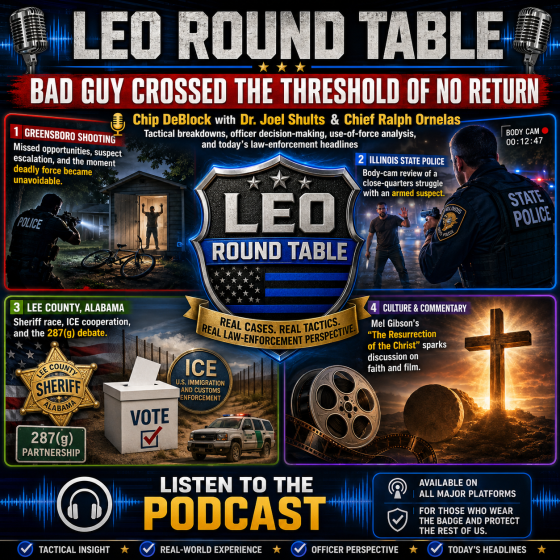

LEO Round Table with Chip DeBlock
S11E104, Bad Guy Crossed The Threshold Of No Return When He Charged At An Officer!
Mel Gibson finishes filming the 'Resurrection of the Christ.' Bad guy crossed the threshold of no return when he charged at an officer. Sheriff ousted by opponent for refusing to work with ICE. Man fatally shot during struggle with officers on video.
Bad Guy Crossed the Threshold of No Return: Police Shootings, Mel Gibson’s Resurrection Film, ICE Cooperation, and Tactical Lessons
Mel Gibson’s Resurrection Film and the Bible Discussion
This episode of LEO Round Table opens with host Chip DeBlock welcoming panelists Dr. Joel Shults and Chief Ralph Ornelas before previewing a set of law-enforcement and public-safety stories. The first discussion departs from typical police topics to cover an article about Mel Gibson finishing filming The Resurrection of the Christ, a sequel to The Passion of the Christ. Chip reflects on the emotional impact of The Passion of the Christ and why the resurrection story is central to Christianity. Dr. Shults says he hopes the movie drives people back to Scripture rather than treating artistic films as Scripture itself, while Ralph shares a personal memory of meeting Mel Gibson and comments on Gibson’s faith, imperfections, and support for Robert Downey Jr.
Greensboro Shooting and the Threshold of No Return
The first major tactical case focuses on a Greensboro police shooting from August 2025 involving a trespass suspect who refused commands, moved toward a shed, obtained a weapon, dropped it, mounted a bicycle, then picked up a pipe wrench and advanced toward the officer. Chip describes the encounter as beginning with a misdemeanor trespass call but escalating when the suspect ignored orders and armed himself. The panel notes that the officer was justified in the shooting, but they also examine several tactical moments that might have changed the outcome. These include the officer’s attempt to conduct a weapons pat-down, the suspect’s movement toward the shed, the officer’s use of radio while the suspect advanced, and a possible missed opportunity to take the suspect down while he was straddling the bicycle.
Tactical Lessons on Control, Timing, and Force Options
Ralph and Joel use the Greensboro incident to discuss training points for officers. Ralph emphasizes coordination with a partner, going hands-on before allowing a suspect to reach a dangerous area, and considering impact weapons such as an expandable baton or PR-24 as alternatives that may prevent a situation from escalating to deadly force. Joel says the officer may have been delaying contact while waiting for backup and notes that public scrutiny, body cameras, and uncertainty can make officers hesitate to make early physical arrests. The panel agrees that officers must know whether they are having a conversation, conducting an investigation, intervening in criminal activity, or making an arrest, because that objective shapes the level of action required.
Alabama Sheriff Race and ICE Cooperation
The next story turns to Lee County, Alabama, where longtime Sheriff Jay Jones lost a Republican primary to former deputy Cameron “Cam” Hunt. Chip explains that the race centered heavily on immigration enforcement and whether the sheriff’s office should participate in the federal 287(g) program, which allows trained local law-enforcement officers to perform certain immigration-enforcement duties under ICE supervision. Joel says the incumbent’s position may have been more nuanced if his office already cooperated with ICE without a formal agreement, but he also observes that national politics, especially support for Donald Trump, is increasingly shaping local races. Ralph draws on his experience with the Los Angeles County Sheriff’s Department and argues that cooperation with ICE can be handled cleanly when agencies do their jobs without politicizing the process.
Sheriffs, Local Accountability, and National Political Tensions
The Alabama story leads the panel into a broader discussion of sheriffs, local elections, political polarization, and the role of national figures in local government. Chip praises aspects of Trump’s approach to personnel, saying he respects decisions based on beliefs and actions rather than party labels, and cites Robert F. Kennedy Jr. as an example. Ralph comments on Kennedy’s personal transformation and public-health focus, while Joel says he remains concerned about divisiveness but strongly supports the democratic electoral process and the office of sheriff. Ralph adds that some jurisdictions have taken steps to weaken sheriff independence, including a Los Angeles County charter change that allows the board of supervisors to remove a sheriff under certain circumstances.
Illinois State Police Shooting and the Importance of Seeing the Hands
The final major segment reviews Illinois State Police video from a fatal Woodlawn shooting involving Hollin Carpenter during a domestic-violence-related response. Chip describes how troopers approached Carpenter, asked whether he had weapons, and began struggling with him after he failed to cooperate. Body-camera and surveillance footage showed Carpenter with a gun, and the gun reportedly went off during the struggle before both troopers fired. Ralph credits the troopers for quickly identifying the gun, trying to contain it, creating distance, and using coordinated deadly force during a close-quarter engagement. Joel stresses the familiar law-enforcement principle that officers must see and control the hands, while Chip criticizes the suspect’s family narrative portraying Carpenter as a “good kid” despite his adult age, electronic monitoring status, and alleged armed resistance.
LEO Round Table


LEO Round Table is a nationally syndicated law enforcement satellite radio talk show discussing today's news and issues from a law enforcement perspective. They also have components on TV, Podcasts, and Social Media. Their panelists are among a Who's Who of law enforcement professionals and attorneys from around the country.
https://leoroundtable.com/how-to-become-a-panelist/
Speaker Identification
Speaker 1 – Chip DeBlock / Host
The host identifies himself at the beginning. The transcript renders his name as “Chip de Block” and “Chip the Block,” but the user-confirmed spelling for LEO Round Table summaries is Chip DeBlock.
Speaker 2 – Dr. Joel Shults / Panelist
The transcript renders the name as “Joel Schulls” and “Joel Schultz.” He is identified as a retired police chief from Colorado. I used Dr. Joel Shults as the likely corrected spelling, but it should be verified if exact publication accuracy is required.
Speaker 3 – Chief Ralph Ornelas / Panelist
The transcript renders the name as “Ralph Ornellis,” “Ralph Rinalis,” and “Ralph Reneaus.” He is identified as a retired chief from California and former Los Angeles Sheriff’s Department commander. I used Chief Ralph Ornelas as the likely corrected spelling, but it should be verified.
Speaker 4 – Prerecorded Galls Advertisement Voice
This speaker appears during the first sponsor break and promotes Galls.
Speaker 5 – Prerecorded Compliant Technologies Advertisement Voice / Host-Read Ad Segment
This segment promotes Compliant Technologies and the glove. It may be host-read or prerecorded, but it functions as a sponsor segment.
Speaker 6 – Prerecorded GunLearn Advertisement Voice / Host-Read Ad Segment
This segment promotes GunLearn.com. It may be host-read or prerecorded, but it functions as a sponsor segment.
Speaker 7 – Body Camera / Police Video Audio
This speaker label is used for the body-camera and police-video audio played during the Greensboro and Illinois State Police shooting segments.
Speaker 1 – Chip DeBlock / Host:
Welcome to LEO Round Table at LEORoundTable.com. My name is Chip DeBlock, and I’m your host. We’re a group of law-enforcement professionals who talk about today’s news and issues, but we do it from a law-enforcement perspective.
Let me introduce the crew, guys. If you don’t mind watching the video portion of our show, he’s back: Dr. Joel Shults, retired police chief from Colorado. We’ve also got retired Chief Ralph Ornelas from California, where he still resides. He is a former Los Angeles Sheriff’s Department commander as well. Thanks, guys, for being on the show.
I want to give a shout-out to our sponsors. Our title sponsor is Galls at Galls.com. Don’t forget that discount code. You get 15% off if you type in RADIO15 the next time you go to Galls.com and make a purchase.
Also, CompliantTechnologies.com is our satellite sponsor. We have GunLearn.com, MyMedicare.live, and TwoBells.com. We’ve built our new online store at LEORoundTable.com.
We also have a lot of outlets getting our stuff out there. Brian Burns with the Tampa Free Press, thanks for carrying our content. Also, Reed Detrick at FormerLawman.com, and our very own Travis Yates with LawOfficer.com. Thanks to all those guys for helping make this happen.
If you want to watch the show, if it’s a podcast platform, we’re on it, especially Spotify and Apple iTunes. We’re also on Rumble, YouTube, Facebook, Twitter/X, Truth Social, you name it. We’re on it as well.
The best way to track the show and watch us is to go to our website, LEORoundTable.com. At the top menu bar, you’ll see links telling you where we’re at: the live show, delayed shows, and radio stations, what they are, where they’re at, what the call signs are, the hours, the days. All that stuff is explained on the website.
We’re on 147 stations. We’re nationally syndicated across the country right now, and we just got off Westwood One satellite radio. We’re trying to make the transition to satellite radio with SiriusXM. I think it’s going to be a good fit for us. We’ll keep you posted on that.
Now, what in the world are we going to be talking about today? Let’s see the topics. I think we might be able to get through all the topics today.
The first one, I feel like we need to cover. The most important story in human history: Mel Gibson finishes filming The Resurrection of the Christ, reveals photo and release dates. Of course, we’re all familiar with The Passion of the Christ. I didn’t realize that was back in 2004. That’s how long it’s been—over 20 years. I did not know that he was making it. He covered the death of Christ, and now he’s covering the resurrection of Christ. We’re going to give a little bit of insight into that. We’re not going to spend a lot of time on it, but I feel the need to cover it.
We’ve also got a revolt in Alabama as a pro-Trump challenger ousts a sheriff who refused to work with ICE. I’m curious what you guys think about that in Lee County, Alabama.
Moving along, we’ve also got a Greensboro police officer justified in a deadly August 2025 shooting. We have a video with that.
Then Illinois State Police released a video from a trooper’s fatal shooting of a guy named Hollin Carpenter.
We’ve got an ICE agent facing assault charges in Minneapolis, and it’s raising questions about federal and local law-enforcement coordination.
Then we’ve got no charges for Gastonia police officers who shot and killed an armed guy at a convenience store.
So those are the stories. That’s the lineup.
This first one involving Mel Gibson is from WorldNetDaily, WND.com: Most important story in human history: Mel Gibson finishes filming The Resurrection of the Christ.
The subtitle says, “Who gets back up three days later after he gets murdered in public? And who gets back up under his own power? Buddha didn’t do that.” That was the catch title.
Mel Gibson wrapped up filming The Resurrection of the Christ, which I was not aware of. It is a sequel to The Passion of the Christ. I’ve got to be honest with you guys: I didn’t know. This is 22 years later. He’s directing it, and we know how great The Passion of the Christ was.
Look, The Passion of the Christ was so good I could only watch it one time. I don’t know how you guys feel, but it was so dramatic. I know it’s true, but to watch that, it was just too accurate, brutal, and brought it home. It was very difficult to watch. It’s not one of those movies you’re going to go see again and again. It’s like going to the Holocaust Museum in D.C. You go through it once. It’s going to take three hours, and it’s like, “Okay, I’ve done that. I don’t know that I can handle that again.”
So this is a sequel. He said it happened just as he envisioned it. He said, “I’m deeply grateful to my incredibly talented cast and crew for pouring their hearts into this production. Together, we created something powerful.”
I suspect that it is. He said it’s a mission he’s carried for over 20 years, to tell what he believes is the most important story in human history. I know what he means by that. The death would be nothing if we didn’t have the resurrection, right? That’s the whole point of it.
He said reuniting with many of his original collaborators from The Passion of the Christ allowed him to bring the story to the screen exactly as he envisioned it. He got tremendous support from longtime partners Adam Ferguson and the team at Lionsgate.
Lastly, if anyone’s interested about the guy playing Jesus, they’re using a Finnish actor. Now, one of our guys—it was funny because we’re doing this live show, and I’ve got our Finnish guy who just piped in, Lawrence Finnish. He was making me think, “Well, crap, I’ve got a Finnish guy.” I don’t know if he’s Finnish or not. I’m just saying his name sounds Finnish.
This Finnish actor, Jaakko Ohtonen, is playing Jesus now. He took over the lead spot from Jim Caviezel, who did the original Passion role, due to scheduling conflicts. They’re talking about de-aging technology being the reason for the swap because you don’t really think about it, but it’s been over 20 years, 22 years. We all age differently, I guess, right, Ralph and Chief Joel? If you’re 22 years older, and maybe didn’t age as well as some other people, or even if you did, 22 years is 22 years. When Christ died and rose from the dead, I think he was about 33 years old, if I remember correctly.
So all that said, I don’t know if any of you guys caught this. If you want to say anything on it, we don’t have to, but I was pretty impressed to see that it’s hitting theaters. Chief Shults?
Speaker 2 – Dr. Joel Shults / Panelist:
One of the things that I hope this movie does—and I didn’t see The Passion of the Christ because I deliberately avoided it for the reasons that you don’t watch it again—is two things.
One, I hope people can ignore the looney-tunes stuff that Mel Gibson has done that kind of reduces his credibility as an evangelical Christian. He’s not an evangelical; he’s a Christian within the Catholic sect.
The other thing is, I hope it drives people to this book. Only 20% of Christians across the planet have read the Bible all the way through.
Speaker 1 – Chip DeBlock / Host:
Amen. Maybe bring up the big boy.
Speaker 2 – Dr. Joel Shults / Panelist:
For evangelical Christians, it goes up to maybe—
Speaker 1 – Chip DeBlock / Host:
I brought up the big boy.
Speaker 2 – Dr. Joel Shults / Panelist:
Yeah, that’s strong enough to be used as a weapon physically as well as spiritually.
Maybe 60% of regular church attenders have read the Bible through, and only about a third of actively attending church members read their Bible either daily or weekly. The amount of biblical illiteracy among proclaiming Christians is absolutely scandalous in a country where there’s absolutely no excuse for that.
So I hope this drives people to seek the truth on their own. We have The Passion, we had The Ten Commandments back in the day, we have The Chosen, and we have this movie coming out. Those are artistic representations of what is presented in Scripture. They are not Scripture. They represent capital-T truth, but they may not be projecting all the things that one would discover if they were reading the accounts right out of Scripture.
I hope we see a resurgence of interest in genuine Scripture study.
Speaker 3 – Chief Ralph Ornelas / Panelist:
Great points. I really respect the passion of Mel Gibson doing this again 22 years later. I’m looking forward to seeing it when it comes out in 2027.
I saw The Passion of the Christ four times. It just resonated with the way he did it.
I’ll tell you this on a personal note. One of my reserves owns a very famous cigar lounge in Beverly Hills. I’m not going to say it on the air here, but I was a guest there, and I met Mel Gibson in 2009. I did comment, and I’ve got to tell you something: as much as he’s had engagement with the L.A. County Sheriff’s Department a few times with some issues, he truly was a gentleman. He was a very, very down-to-earth man to talk to, very briefly.
I’ve got to give him credit for what he stands for. You look at what he did for Robert Downey Jr.
Speaker 1 – Chip DeBlock / Host:
I heard that story.
Speaker 3 – Chief Ralph Ornelas / Panelist:
He went through alcoholism and addiction himself. If it wasn’t for Mel Gibson mentoring Robert Downey Jr., Robert Downey Jr. owed it all to Mel Gibson on stage after winning an award.
I like the fact that we have imperfect people who accomplish these things. Look no further than our president of the United States. You’re absolutely right. There have been things in Mel Gibson’s past that kind of make you cringe a little bit, but I love it.
Speaker 1 – Chip DeBlock / Host:
It’s funny. I have a neighbor who stops me all the time and asks me questions about the Bible because I’ve read the Bible for many decades, and I’m pretty knowledgeable about it. I’ve done Bible studies myself on Revelation and the Book of Daniel, which are a little complicated.
I believe in having a study Bible. I recommended one to my neighbor the other day. He asked me, and I said, “Get a Bible.” Then I said, “No, no, no. Get a study Bible, not just any study Bible.”
I like John MacArthur. The study notes are sometimes larger and more involved than the Scripture you’re reading, just to be able to dummy it down for you. But a good study Bible, like the John MacArthur Study Bible, is worth its weight in gold. It is fascinating stuff. Thank you for mentioning that because I do read it.
Speaker 3 – Chief Ralph Ornelas / Panelist:
I’m going to buy that. Thank you for the recommendation.
Speaker 1 – Chip DeBlock / Host:
I can’t give it a high enough recommendation. The New King James Version is the one I like. Chief Shults will come with that.
Speaker 2 – Dr. Joel Shults / Panelist:
Google my name on YouTube, and you will find a series of my sermons and Bible teachings. I don’t stand up to MacArthur, but it might be of interest.
Speaker 1 – Chip DeBlock / Host:
All right. I love it. Great conversation.
Stick with us. We’ve got our first commercial break. We’ve got some good stuff coming up. Guys, we’ll be right back.
Speaker 4 – Prerecorded Galls Advertisement Voice:
My family only cares about one thing: that I come home safe.
At Galls, every order begins with a promise made with purpose, stitched for support, packed with pride, answered by dedicated hands, delivering the standard you have sworn to uphold.
We serve more than the mission. We serve the person. Each piece is engineered to help get our first responders through the shift and back home safe.
Speaker 1 – Chip DeBlock / Host:
Welcome back to LEO Round Table at LEORoundTable.com, the law-enforcement talk show. My name is Chip DeBlock, and I’m your host. We’re joined by Dr. Joel Shults, retired police chief, and also Chief Ralph Ornelas in California. Thank you, gentlemen.
We left off talking about Mel Gibson’s new film coming out, the sequel to The Passion of the Christ, called The Resurrection of the Christ. Watch out for that. It’s been 22 years since he had The Passion of the Christ. I’m curious what our users think about that, especially after you see it.
I wonder how many people go to movie theaters anymore to watch movies. Typically, I don’t, to be honest with you. If I do, I’m not one of these guys who likes to throw a lot of money around, and I don’t have a lot of money to throw around. But if I go to that experience, I’m willing to pay a little extra money to get a little bit more secluded area. Maybe they’ve got food and dinner and stuff. I don’t want to use the word “riffraff,” but I don’t want somebody next to me on their phone and talking loud. I don’t want to have to get into a confrontation with someone because I’m going to have to say something.
The last guy with my agency who said something ended up having to shoot the guy, went to jail, had to fight it, and got cleared years later after he depleted his retirement funds. So, yeah, I’m trying to avoid being that guy.
This next one is at Rumble.com. Greensboro police officer was justified in a deadly August 2025 shooting, and that’s at Rumble.com, our favorite law-enforcement video channel, This Is Butter.
We’re in Greensboro, North Carolina. They released this body-worn camera footage related to a fatal shooting that happened last year.
Speaker 7 – Body Camera / Police Video Audio:
Let’s not do this. Don’t touch him, man.
I’m not cuffing you. I just need to make sure you don’t have a weapon.
Get out of here, bro.
I just need to make sure you ain’t got no weapon.
I don’t have a weapon.
That’s a good thing.
No, we’re not going to do that.
Show me your hands.
Lay on the ground.
I will shoot you, bro.
I will shoot you. I will shoot you right now, bro.
You’ve got a weapon. Brandishing a weapon.
Get out. Get out. Get out.
Stop moving.
Get on the ground.
Come here.
I’ll shoot you.
One at gunpoint. One at gunpoint.
Stop moving.
Put your weapon down.
All units, all the way over now. Let’s go.
Speaker 1 – Chip DeBlock / Host:
According to the Greensboro Police Department, at 4:06 p.m. on August 5, a Greensboro cop was flagged down by a resident about a trespasser call. The resident directs the officer toward this guy, later identified as 48-year-old bad guy Syed Azeem, who was suspected of trespassing on nearby property. So we’re talking about misdemeanor trespass here.
The officer starts talking to this bad guy, and he is technically still a bad guy, even though he’s trespassing. He refuses to comply with repeated commands of the police officer. Then our bad guy gets a weapon and moves toward the officer, and the officer ends up shooting him. Our bad guy dies at the scene.
Remember, we’ve always got Travis Yates talking about being aware of people’s actions and pre-attack indicators. If you start watching the body-camera video, around the three-minute-and-15-second mark, the officer is interacting with the trespassing suspect, who is not letting the officer—what the article doesn’t say, but what’s really going down is the officer is trying to do a weapons pat-down on him.
There’s a lot of opportunity for us as cops with the power of articulation and proper belief systems to be able to have the right to do just a weapons pat-down on somebody.
About 17 seconds later, the suspect walks away from the officer, and now he’s walking toward the shed against the orders of the officer. Now the officer draws down on him.
At the four-minute mark, the suspect exits the shed, which the officer let him get into, but now he’s got a weapon. It looks like a saw blade, and he’s advancing toward the officer. What does the officer do? He’s hopping on his police radio. It just drives me crazy. He’s got this guy walking at him with a weapon, and he’s got to go out on the radio.
At 4:20, the suspect throws the weapon on the ground and then hops on a bicycle. I think Ralph and I talked about this, and maybe there was a missed opportunity. I’ll let you guys cover that.
At one point, he throws the weapon down. No visible weapons appear to be in his possession, and he has both hands and lifts up a bike and gets on the bike. The officer gets closer. He doesn’t charge the guy, but he gets closer. All of a sudden, our bad guy ditches the bike, bends down near where he ditched the saw, picks up a pipe wrench, and advances toward the officer. The officer fires four shots.
The suspect falls down and then runs behind the house after the last shots are fired. The officer does not pursue him. He walks around both sides of the house, sees the bad guy, walks back on the original side of the house, and ends up handcuffing him. The suspect ends up dying.
So that’s the way it goes down. Chief Ornelas, I know that you’re a little familiar with this. I want you to take this one first, if you don’t mind, because I know you and I talked about this too, looking for opportunities.
Speaker 3 – Chief Ralph Ornelas / Panelist:
I want to hear from Joel also, but I think last week I mentioned this to you.
Number one, they know the suspect already. I would have hoped on the radio before they get there, the two officers would speak about how they’re going to address Syed Azeem. Number two, they engage each other verbally. He tells him to come over here. You’re right, Chip. He also has a right to pat him down for weapons. So he should use the powers that he has, go hands-on to pat him down, and also coordinate this approach with his partner. You notice the partner—I don’t know where he’s at.
But let me go back a little bit. You have a misdemeanor, not committed in the presence of the officers. Now, in California, when you have that—and again, I could be wrong here in Greensboro, because they may have different laws—you have a certain amount of power and authority to make the apprehension of a suspect.
So now here he is, and you think he’s going to cooperate. Then the guy says no and starts walking away. The other part is this: he pulls his taser out. Understanding, from researching in the article you provided, Chip, that they can’t use that taser unless there’s an imminent threat. That is an Achilles’ heel for this officer, which protracts it.
He keeps moving forward, and now he’s telling him that he’s pointing the taser, “I’m going to arrest you.” Now you don’t give up your trump card. Continue somehow coordinating with your partner. Go hands-on before he walks to that gate and gets to that shed.
I’ve got to tell you, tactically, and thank God the shooting is justified, this should be another shooting that has to be trained at the academy. Use it as a platform to use tactics.
Let Joel say some more because I don’t want to take all the time.
Speaker 2 – Dr. Joel Shults / Panelist:
No, that’s fine, Ralph. I was just catching up on a little sleep. No, I was—
Speaker 1 – Chip DeBlock / Host:
When I called on you, I had—
Speaker 2 – Dr. Joel Shults / Panelist:
I had my mic muted, and I was just getting over a coughing fit from choking on my coffee.
Speaker 1 – Chip DeBlock / Host:
I guess we’ll talk about this when we get back. Yeah, Ralph did it again. He took up all the time. Here we go. Commercial break.
Speaker 5 – Prerecorded Compliant Technologies Advertisement Voice / Host-Read Ad Segment:
All right, guys. It’s time to talk about Compliant Technologies at CompliantTechnologies.com, and they are committed to providing non-lethal solutions to help officers gain the upper hand safely and rapidly in a humane, low-liability manner, utilizing what they call their CD3. That stands for conductive distraction and de-escalation device technology.
Their flagship product, we all know by now, is called the glove. It’s not only helped officers tens of thousands of times, but they’ve actually had over 250,000 deployments. And guess what? No injuries and no deaths. It’s an amazing stat.
It has actually helped them achieve non-lethal status in an arena that predominantly can only offer less-lethal results. When it comes to weapons retention, transitioning to a sidearm or a conductive energy weapon, the glove by CompliantTechnologies.com has virtually eliminated weapons confusion.
Stay ahead of the game with Compliant Technologies and the revolutionary CD3. The hundreds of agencies have already turned to it nationwide. Friends, take it from me: when it comes to safety, this is one of those common-sense hands-on solutions that has ever come along. Go to CompliantTechnologies.com today. Say that Chip sent you.
Speaker 1 – Chip DeBlock / Host:
Welcome back to LEO Round Table at LEORoundTable.com, the law-enforcement talk show. My name is Chip DeBlock, and I’m your host. We are joined by Chief Joel Shults from Colorado and Chief Ralph Ornelas from California. I’m sorry about that.
We left off talking about a Greensboro police officer being justified in a deadly shooting that happened in August of 2025, so six months ago or so. I know that Chief Ralph had just gotten done, and he handed the conch over to Chief Shults just in time for me to say, “We have a commercial break.” So, Chief Shults, the floor is yours.
Speaker 2 – Dr. Joel Shults / Panelist:
Colorado is becoming more like California every day, so I don’t begrudge your misapplication there.
No, Ralph covered most of the really good points. I’m hoping this officer was delaying the hands-on contact for another officer to arrive, because if I understand the video right, he didn’t have backup until the guy was already shot.
One of the questions that I had was, what if there had been two officers? How would that have played out differently? Would they have coordinated? Would they have been a little bit more aggressive?
The taser coming out—when you’ve got a guy with that kind of jacket, that taser wouldn’t have accomplished anything. I think the officer realized that pretty quickly and re-holstered.
There is a relatively low threshold for detaining somebody and putting somebody in handcuffs. Chip and I had disagreed about the best point to say, “Yes, you’re under arrest,” to bring in the statutory obligation for that person to comply and to justify your actions in completing that apprehension. Ideally, of course, with 20/20 hindsight, this guy would have been cuffed up really early in that encounter.
Although I appreciate that he came in with a conversational, congenial tone, trying to deal with what was only a misdemeanor, that still gives you the opportunity for arrest. When it comes to cuffing somebody up, you don’t have to be right; you just have to be reasonable. You can un-arrest somebody if your facts develop differently.
I’m glad this officer survived the encounter. I think we’re kind of afraid because of the public opinion of policing right now, body cameras, and just our questioning of ourselves. Can I take this guy down without any help? Can I, as a solo officer, go ahead, step in, make a physical custodial arrest, and accomplish the handcuffing and searching without backup and without using too much force?
One of the studies or commentaries that came out of Lewinski’s work with Force Science is that a lot of officer and suspect injuries could be avoided if the officer had acted more aggressively at the beginning of the contact.
So, yeah, this is a spooky situation with relatively happy endings. I’m glad for that.
Speaker 3 – Chief Ralph Ornelas / Panelist:
You bring up some great points, Joel. This is where impact weapons come in, either an expandable baton or the PR-24. I look through my career, and the side-handle baton, when I used it, prevented escalation to deadly force. I broke elbows and knees with that side-handle baton, and guess what? I didn’t have to shoot somebody.
Especially in an encounter like this, I really believe it didn’t have to get to that level if he would have—I may have been incorrect here, but my impression was that there was a partner on scene with him and they didn’t coordinate that right.
If he didn’t, then maybe he should have delayed with more conversation. When the partner gets there, they both go hands-on with this guy. One goes high, one goes low, especially if they don’t have impact weapons. I never would have let the guy get to the shed.
Speaker 1 – Chip DeBlock / Host:
Nope. I agree.
After that happened, when I was watching the video, I saw a moment of opportunity when the guy dropped the weapon and mounted the bike. In my mind, I was saying, “That cop, if he sprints and just nails the guy—he could have done a dropkick or tackled him—and while the guy is on the bike, the bike and he would have all gone down.”
The guy didn’t have a visible weapon anymore at that point. That was the time, right or wrong, to get there. He had about six seconds, I counted, to be able to sprint. The guy wouldn’t have been able to get off the bike and do anything about it. I think that was a missed opportunity.
I know it’s easy in 20/20 hindsight to watch the video, but when I saw the video, not knowing what was going to happen, I immediately thought, “Oh, crap. This guy is vulnerable straddling a bicycle in a standing position. He can’t ride away, and he’s not going to be able to dismount before the cop hits him.” So, hello.
Speaker 2 – Dr. Joel Shults / Panelist:
I know this is a grotesque observation, but those of us who have been around the death rattle, the death groan, that death moan that this suspect made while he was being handcuffed—we all knew he was not going to survive.
Speaker 1 – Chip DeBlock / Host:
He’s toast.
Speaker 2 – Dr. Joel Shults / Panelist:
That’s a very distinctive sound that hopefully most people have never heard.
Speaker 3 – Chief Ralph Ornelas / Panelist:
I said that last week to Chip, Joel, exactly. He’s yelling, “Turn over and get handcuffed,” and the guy’s already dead.
The other thing is, “I’ll shoot you. I’ll shoot you,” he’s yelling. I’ve got to be honest with you, man. You’re putting yourself in a corner because now you’ve given up your leverage. I just never used that.
Speaker 2 – Dr. Joel Shults / Panelist:
I think it is important for an officer to know—and I know there are so many variables, and I wasn’t there—but you’ve got to know at least some parameters. Am I having a conversation? Am I doing an investigation? Am I doing an intervention? Am I doing an arrest? What really is my objective here?
If our objective is, “I’m going to do this and make sure that this person doesn’t get hurt,” that’s a nice thing to have on your list, but it can’t be the first thing if you’re intervening in criminal activity.
Speaker 1 – Chip DeBlock / Host:
Yeah, I agree.
Well, guys, we have an Alabama story to go to. Good coverage on this one. This is from RVMNews.com, Red Voice Media: Revolt in Alabama as pro-Trump challenger ousts sheriff who refused to work with ICE.
Lee County, Alabama will have a new sheriff for the first time in nearly three decades after longtime incumbent Sheriff Jay Jones lost his Republican primary reelection bid to former deputy sheriff Cameron “Cam” Hunt, who has a cool name, by the way, as reported by Trending Politics News.
Hunt, the winner, defeated Jones, the current sheriff, with about 51% of the vote in the primary on Tuesday, ending incumbent Sheriff Jones’ 30-year tenure as sheriff. That’s substantial. It’s a thin margin, 51% of the vote, but this guy had been sheriff for the past 30 years.
Sheriff Jones had served as Lee County sheriff since 1998 and was seeking another term after seven terms in office. I don’t know how old this guy was. That’s a lot of time in office.
The race centered heavily on immigration enforcement and whether the Lee County Sheriff’s Office should participate in the federal 287(g) program, which is that optional agreement that allows trained law-enforcement officers to carry out certain immigration-enforcement duties under the supervision of ICE.
The newly elected sheriff, Hunt, criticized Jones during the campaign for not placing Lee County in the 287(g) program. He argued that Lee County was one of 31 sheriff’s offices in Alabama that did not participate. He said the county would be safer if local deputies had a formal relationship with ICE under that program.
The issue gained some attention after a deputy-involved shooting back in April of 2026 involving a person Hunt described as allegedly being undocumented. Sheriff Hunt renewed the criticism after that incident and pledged that if he got elected, which he did, he would make sure Lee County joined the 287(g) program.
Jones, the one who got beat, defended his office’s record throughout the campaign and said the criticism was misleading. Maybe you guys can add some clarification. He argued that not having a formal 287(g) agreement alone did not stop them from having a relationship with ICE. He said the Lee County Sheriff’s Office cooperated effectively with ICE, and he came up with some reasons why they didn’t do that.
There you go, gentlemen. Whoever wants to take this one first.
Speaker 2 – Dr. Joel Shults / Panelist:
I think it probably was misleading if the incumbent’s claim was that he was doing a lot of other stuff to cooperate with ICE, just not this particular program.
What’s interesting to me about this is the Trumpification of local politics and how somebody sitting in Washington, D.C. is going to be determinative of what happens in Lee County. I’m not sure how that’s going to play out for the next couple of years.
Speaker 1 – Chip DeBlock / Host:
Well, another commercial snuck up on us. It’s commercial break time, guys. Stick with us. We’ll be right back.
Speaker 6 – Prerecorded GunLearn Advertisement Voice / Host-Read Ad Segment:
All right, guys. It’s time to talk about GunLearn at GunLearn.com, and there’s some new stuff going on with GunLearn.
If you’re not familiar with them, they were the first and only company to offer a step-by-step program that takes you from your present knowledge level to becoming a safe, accurate, and competent certified firearm specialist.
Now the certification—that’s what’s changed. It’s now with college credits. Even if you got it five years ago, GunLearn.com has partnered with SmarterDegree and their university partners in order to make that certified firearm specialist credential have college credits that come with it.
They’ve been doing this since 1996. They’ve been teaching everything that LEOs, law-enforcement officers, need to know about firearms and ammunition to all badges of law enforcement. You can start today with online training, or you can sign up to attend a live seminar. If you’re a chief or a sheriff, you can actually host a seminar for absolutely no cost. It’s an amazing opportunity.
Go to GunLearn.com and hook up with the founder, Dan O’Kelly. If you haven’t been there before, you’ll be glad that you did. Again, that is GunLearn.com.
Speaker 1 – Chip DeBlock / Host:
Welcome back to LEO Round Table at LEORoundTable.com, the law-enforcement talk show. My name is Chip DeBlock, and I’m your host. We’re joined by Chief Ralph Ornelas all the way from California, and that’s right, we’ve also got Dr. Joel Shults, retired police chief in Colorado. Thank you, gentlemen.
I can’t even remember where we were. I know we were talking about the revolt in Alabama, the sheriff who got replaced by the new guy, Cameron “Cam” Hunt. The 30-year sheriff, Jay Jones, lost the election in Lee County, Alabama.
Speaker 3 – Chief Ralph Ornelas / Panelist:
I think Joel covered it, but I look at sheriff’s departments, and I was part of the L.A. County Sheriff’s Department. When I was a captain at Men’s Central Jail, we cooperated with ICE in turning over illegals and criminals and stuff like that. We did it very peacefully and not a problem.
Now it’s gotten to a point where Joel mentioned something, where President Trump has impacted local governments and stuff. If everybody just did their job without putting some politics into it, we would handle these very cleanly without having all the uproar and negativity, these organizations coming against law enforcement and protesting outside L.A. County Sheriff’s Jail or wherever around the country.
I think it’s unfortunate. It really is.
Speaker 1 – Chip DeBlock / Host:
Yeah, I agree.
One thing I do like—and look, by and large, most cops are conservative—one thing I have to say that I like about Trump is, if you look at his administration and how many former Democrats and people like that are in there, look no further than Kennedy and what he’s done. I like the fact that it seems like Trump doesn’t make judgments based on the political party you’re affiliated with. It’s based on your belief system, on your actions, and what you actually do.
I’ve always appreciated the fact that Kennedy was not going to win an election as president, and he never would have had the chance to do what he wanted to do. By hooking up with Trump, look at him. The guy’s living the dream, and he’s making such huge changes that he’ll be known for decades for.
Speaker 3 – Chief Ralph Ornelas / Panelist:
It’s a dream for him. It’s also a nightmare for him too, because internally his family and friends of his wife, who is an actress, are taking a lot of shots, uppercuts, and right crosses. I’ve got to give him credit. It shows his resiliency and strength.
What goes back to what you said, Chip, is he believes what he believes in.
Speaker 1 – Chip DeBlock / Host:
Have you seen that guy doing pushups or pullups?
Speaker 3 – Chief Ralph Ornelas / Panelist:
He does pullups too, and he always wears jeans. He got into a tub of ice water. Oh my gosh. The guy is tough.
Look at his history with alcoholism, and maybe some drugs that he was involved in. Look what he and his wife have done personally to elevate his life in the health realm. It’s unbelievable.
Speaker 1 – Chip DeBlock / Host:
When you talk about abusing drugs and stuff, why do you look at Chief Shults and ask him like he has some knowledge of that?
Speaker 3 – Chief Ralph Ornelas / Panelist:
No, his knowledge of just being a student.
Speaker 1 – Chip DeBlock / Host:
Oh, he does have doctor in front of his name. That little D.R. that he always reminds us about when we’re not on air.
Speaker 2 – Dr. Joel Shults / Panelist:
That’s true, but it doesn’t come with a prescription pad, so don’t come knocking.
I’m sorry for the divisiveness in our country right now. Even though it might not be great that people at the local level—like we have two Democrats running in the primary for Colorado governor, and both of their total campaigns are, “I’m going to fight Trump, I’m going to fight Trump.” They’re two of the wimpiest people you ever saw.
All that having been said, I love the democratic electoral process, and I love the office of sheriff. I hope that never goes away. That is a bastion of freedom and accountability. I love reading about sheriffs because I think they’re so important.
Speaker 3 – Chief Ralph Ornelas / Panelist:
You bring up a great point, Joel. They passed an amendment in L.A. County in 2022 that can change the charter against the sheriff. If the board of supervisors believes that there’s something the sheriff did, or a policy violation, they can remove him.
Speaker 2 – Dr. Joel Shults / Panelist:
Not good.
Speaker 3 – Chief Ralph Ornelas / Panelist:
Look at Washington State and what they went through.
Speaker 1 – Chip DeBlock / Host:
Guys, we’ve got Rumble.com, This Is Butter, our favorite law-enforcement video channel: Illinois State Police released video from a trooper’s fatal shooting of a guy named Hollin Carpenter.
Speaker 7 – Body Camera / Police Video Audio:
So what happened right now?
Okay, do you have any weapons on you? Do you mind lifting up your shirt?
Come on.
Stop. Leave me alone.
Stop reaching.
He’s got a gun. He’s got a gun.
Stop. Stop. Stop.
Shots fired. Shots fired.
65th and Vernon.
Speaker 1 – Chip DeBlock / Host:
Now we’re in Woodlawn, Illinois, and we’re talking about Illinois State Police. They released video footage showing the moments before we have two state troopers shoot and kill a guy last month in the Woodlawn neighborhood.
State police said troopers were responding to a domestic violence call. It’s 10:40 at night on April 15. They said the incident started on Interstate 57. Troopers chased a vehicle involved into the city’s Woodlawn neighborhood. When they got there, they found an armed guy at the scene.
The guy is later identified as 24-year-old Hollin Carpenter. He was killed in a struggle with police. The body-camera video shows the police approach this guy on the sidewalk, and a male state trooper asks him, “So what happened right now?” He goes, “Me and my girl were arguing, but that’s it.”
The trooper goes, “Okay, do you have any weapons on you?” Carpenter gives an answer that is unclear. The officer then asks him to lift up his shirt before the two guys begin struggling.
The view is obstructed a little bit on the body camera at this point, but we can hear the bad guy saying, “Hey, what are you doing? Stop. Leave me alone.” The trooper can then be heard telling him, “Stop reaching.” Then he verbalizes, which is very important, especially when he has partners, that the guy has a gun.
Now we have surveillance video as well from a nearby house. It shows our bad guy, Carpenter, holding a gun as the officer is struggling in an attempt to restrain him. The bad guy’s gun goes off at least once.
Remember, it’s like 10:30 at night. It’s dark. When you’re watching the surveillance video, there’s no sound. You can see the flash of the gun. That surprised me because I thought, “Man, did that bad guy’s gun go off?” You’re looking at the cop, who has basically got this dude in a bear hug. Behind the cop is the street that the cop car is parked on. They’re on a sidewalk, up against a fence or property line.
So, yeah, he bear-hugged the guy, and he couldn’t necessarily see what the bad guy had in his hand. Carpenter is running out. Both officers—the other officer comes and gets involved in the fight too—are seen shooting the bad guy multiple times.
Now the father of the bad guy, Stan, said he wants a full investigation into his son’s death. He says, “He took his last breath in the cold street and died alone. I want to see body cameras. I want to see the evidence.” Stan Carpenter said his son was a father to a son who is almost two years old. Then, of course, the sob story starts. “I’m just hurt right now. My family’s hurt behind this. He was a good kid. He worked for Amazon.” So you know he’s good. “He made some mistakes in his life.” You think? “And he was doing good, man.”
John Carpenter’s mother said he was the oldest of five children. Carpenter was on electronic monitoring on an aggravated assault charge at the time. “He’s a good kid.” It’s amazing the ignorance of these parents. They always take up for the kid who would have shot and killed two cops.
Guys, we’ve got a little over a minute. We can go a little overtime on this, but whoever wants to take it first.
Speaker 2 – Dr. Joel Shults / Panelist:
I just want to say how thankful I am for Illinois’ very restrictive gun laws. I don’t know why this didn’t prevent this whole thing from happening.
Speaker 3 – Chief Ralph Ornelas / Panelist:
I’ll just say this. I’ve got to give both troopers credit. The male trooper yelling “gun,” putting his hand, trying to contain it, and when the gun went off—I liked the tactics. The female backed up. The male shot the guy right in the right shoulder, where the gun was, and pulled back and shot again. Then the female shot him on the other side when he turned his body around.
It was a close-quarter engagement. They did a good job. I’ve got to be honest. I thought they did a very good job.
Then the father of the suspect—I don’t like when people use the term “kid.” He’s a grown man. Obviously, he’s been involved in stuff. Don’t use that term.
Speaker 2 – Dr. Joel Shults / Panelist:
It could have ended much differently. I’m glad it didn’t. Hands, hands, hands—you’ve got to see the hands.
Speaker 1 – Chip DeBlock / Host:
Yeah, this thing got hinky, and now we know why the guy had a gun. He didn’t want to get patted down or anything by our cops.
Gentlemen, thank you so much for being on the show today. Chief Ralph Ornelas and Chief Joel Shults, you guys killed it today. I also want to thank our audience and our listening audience as well.
I want to mention the Wounded Blue at TheWoundedBlue.org. Lieutenant Randy Sutton’s 501(c)(3) is helping cops around the world who are suffering from PTSD and other issues. If you guys are looking for organizations to support, please check them out at TheWoundedBlue.org.
I also want to mention our sponsors, guys. Please support our sponsors. They go to great lengths to bring this good-quality content to you. We have Galls.com, and don’t forget that discount code RADIO15 when you go to Galls.com. CompliantTechnologies.com, GunLearn.com, MyMedicare.live, and TwoBells.com.
We’ll look for you guys tomorrow, a special show back live Thursday at 12 noon Eastern.