
LEO Round Table, May 15, 2026

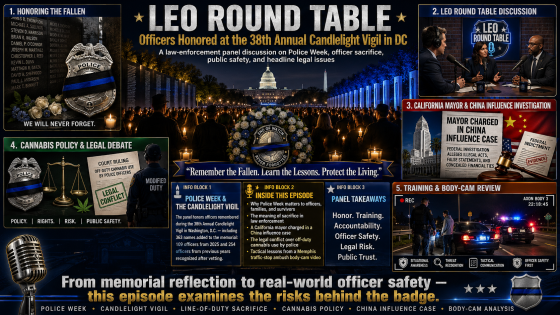

LEO Round Table with Chip DeBlock
S11E095, Officers Honored At The 38th Annual Candlelight Vigil In D.C.
Officers honored at the 38th Annual Candlelight Vigil in D.C. Mayor charged with acting as an illegal agent for Communist China. Lawyer for cops fired because of cannabis use says they can return back to duty. Officer shot during traffic stop in shocking turn of events.
Police Week, Officer Safety, and the Risks Behind the Badge
Honoring Fallen Officers During Police Week
Chip DeBlock opens the episode by introducing the LEO Round Table panel and outlining the show’s main topics, beginning with Police Week and the 38th annual Candlelight Vigil in Washington, D.C. The discussion centers on the National Law Enforcement Officers Memorial Fund and the addition of 363 names to the memorial, including officers who died in the most recent year and others whose line-of-duty deaths were confirmed after a vetting process. Chip emphasizes that he believes every officer, active or retired, should experience Police Week in person at least once because of its solemn meaning and professional camaraderie.
The Personal Weight of Line-of-Duty Deaths
Attorney Von Kliem and Dr. Travis Yates speak about the emotional impact of officers being killed at work. Von stresses that many officers personally know colleagues who have been murdered in the line of duty, and that the loss affects coworkers and families alike. Travis adds his own experience serving on an honor guard and watching survivor families arrive at memorial ceremonies. He also discusses how his wife’s father, an Oklahoma Highway Patrol lieutenant, was killed in the line of duty, making the sacrifice a continuing part of family life rather than a single annual remembrance.
A California Mayor Accused of Acting for China
The panel then discusses a story about Arcadia Mayor Eileen Wang being charged with acting as an illegal agent for the Chinese Communist Party. Chip presents the allegation that Wang worked with Chinese officials and a media outlet to promote pro-Beijing messaging inside the United States. Travis and Von broaden the discussion to concerns about foreign influence, propaganda, political access, and long-term relationship-building by foreign governments. Their comments are strongly critical of alleged Chinese influence efforts, but the discussion is framed around the legal and national-security implications of the reported charges.
Cannabis Use, Police Work, and Legal Conflict
A major portion of the episode focuses on New Jersey police officers who were fired after testing positive for cannabis and later won court rulings saying they should be reinstated. The panel discusses the conflict between state marijuana legalization and continuing federal restrictions on controlled substances and firearm possession. Von explains that, from a policy and liability standpoint, the issue is complicated because THC may remain in the body and because there is not a simple test that clearly measures impairment for every individual. Travis agrees and argues that officers carrying firearms face a higher standard because of the public-safety risks involved.
Officer Safety Lessons From a Memphis Shooting
The final major topic involves Memphis Police Department body-cam footage showing an officer shot in the face during a traffic stop. Chip summarizes the incident, explaining that the officer stopped the suspect over a VIN issue, patted him down, and then the suspect produced a firearm and shot him. Travis critiques the officer’s apparent tactical posture, saying the officer appeared too relaxed despite signs of a potential felony investigation. He also notes the importance of watching a suspect’s body position during a pat-down, especially when the suspect presses his waistline into a vehicle. Von adds that the speed of violent assaults can be faster than the brain’s ability to process and react.
Training, Risk, and Professional Awareness
The episode closes by returning to themes of officer safety, professional standards, and training. The panelists do not simply discuss the incidents as news items; they use them as examples of policy questions, legal exposure, tactical decision-making, and the realities of law enforcement risk. The memorial discussion underscores the sacrifices officers and families make, while the cannabis and traffic-stop segments emphasize the need for clear policy, realistic training, and awareness of how quickly danger can develop.
LEO Round Table


LEO Round Table is a nationally syndicated law enforcement satellite radio talk show discussing today's news and issues from a law enforcement perspective. They also have components on TV, Podcasts, and Social Media. Their panelists are among a Who's Who of law enforcement professionals and attorneys from around the country.
https://leoroundtable.com/how-to-become-a-panelist/
Speaker 1: Welcome to LEO Round Table at leoroundtable.com, the law enforcement talk show. My name is Chip DeBlock, and I’m your host. We’re a group of law enforcement professionals who talk about today’s news and issues, but we do it from a law enforcement perspective.
Let me introduce the crew. Guys, if you don’t mind waving for the video portion of our show, we have attorney Von Kliem, all the way from Force Science. Thanks for being back on the show, Von. We’ve missed you. We also have Dr. Travis Yates, retired police major from the Tulsa Police Department. Thank you, gentlemen.
We’ve also got our sponsors: Galls.com. Don’t forget that discount code RADIO15 to get 15% off your next purchase. We have Compliant Technologies, our satellite sponsor. They, of course, have The Glove, my favorite product. We have GunLearn.com, MyMedicare.live, and SafeGreatRecruiting.com, our streaming sponsor. Thanks to SafeGrade. We’re streaming to about a million people right now during the live show. We also have TowBellas.com, and the new online store at leoroundtable.com. Please check that out. You can buy shirts, hats, mugs like the one behind me, and all kinds of stuff.
We also want to give a shout-out to all the people helping make the show possible. We’ve got our own Travis Yates with LawOfficer.com, Brian Burns from the Tampa Free Press, and Ray Dietrich with FormerLawman.com.
People keep telling me, “Man, tell people how they can watch your show.” We are on 47 radio stations around the country, but we’re also on podcast outlets. If there’s a podcast outlet, we’re going to be on it, especially Spotify and Apple Podcasts. We’re on social media, Rumble, YouTube, Facebook, X, Truth Social, and we’ve got a lot of stuff out there. Go to leoroundtable.com, and in the top menu bar, you’ll see a place where we tell you where we’re at. If it’s a radio station, we’ll tell you the station, channel, day of the week, and time.
To whet your appetite for what we’re going to be talking about today, we’ve got a couple of main topics. They tend to be a little bit deeper. The first one is from the National Law Enforcement Officers Memorial Fund. We’re talking about the memorial, Police Week, which is going on right now, and the 38th annual Candlelight Vigil. We’re talking about 363 names being added, and we’re going to explain why not all of those officers were killed in the line of duty during the past 12 months.
Then we have a California Democratic mayor charged with acting as an illegal agent for communist China. She has admitted to it. It’s a wild story. Then we have cops fired over cannabis use who remain sidelined despite a court ruling to put them back to work. I expect Von to be all over that. We’ve also got Memphis police body-cam footage of a suspect shooting an officer during a traffic stop. It was brutal. The officer got shot in the face. Then we have no charges for Gastonia police officers who shot and killed an armed guy at a convenience store. We also have a security guard off duty who saw a kid with what turned out to be a BB gun, thought he was getting ready to do an armed robbery, and took him out. That guy is getting ready to go to prison. Then we have another Roanoke Police Department video of a viable arrest. If we have time, New Mexico City is paying $6.5 million for a fatal shooting of a guy during a mental health call.
Gentlemen, if you want to take anything out of order, just let me know. We’ll start off with the first main topic. This is from the National Law Enforcement Officers Memorial Fund, and the acronym is NLEOMF.org, if anybody wants to check it out.
Officers from across the country are being honored during the 38th annual Candlelight Vigil on May 13 in Washington, D.C. Let me stop there and say that I think every cop, whether active or retired, really needs to go to D.C. and experience Police Week at least once in their lifetime. Nothing I can say will put you there. I cannot give you a verbal word picture that will do justice to the camaraderie. It is the safest place in America to be, with upwards of 25,000 to 40,000 cops there. Everybody is armed. You’ve got your badges hanging out. You don’t have to pay for subways. It is safe. The camaraderie is incredible. You have to put up with the NYPD and the Miami cops, but besides that, it’s pretty cool. They have this whole thing going on with each other. I highly recommend it.
The names of officers killed in the line of duty are engraved on the walls of the National Law Enforcement Officers Memorial during April, and then they are dedicated in May at the annual Candlelight Vigil. In this case, it’s the 38th annual Candlelight Vigil at night. They’ve got a blue laser. They read every name at the National Mall, Judiciary Square, and that’s going on at 8 p.m. this evening.
The Roll Call of Heroes features the names of official line-of-duty heroes who made the ultimate sacrifice. It includes 109 federal, state, tribal, and local law enforcement officers who died in the line of duty during 2025. In addition to that, 254 additional names of officers who died in previous years are also being inscribed this year and recognized. The reason is that they research and make sure people qualify. There’s a vetting process to get in. It’s not unusual for them to add names from prior years, maybe tribal police, another jurisdiction, or maybe there was a question about whether they were certified. These have all been vetted.
Police Week, in my recollection, is normally May 12 through May 15. May 15 is normally the day of the ceremony where, hopefully, the president of the United States comes and addresses the surviving families and everybody there. There will now be 24,775 officers’ names engraved on the memorial, representing all 50 states, the District of Columbia, all U.S. territories, federal law enforcement, campus police, and military police as well.
Von, you want to start us off on this one?
Speaker 2: Yeah. I think what a lot of people forget when you show up there is that you have to take a moment to look around and realize you’re looking at thousands of people who go to work, and like a lot of emergency first responders and their families, the people you work with are often murdered at work. People you work with are killed at work, and that’s kind of lost on people.
We need to talk about how many people go to work and have worked with people who have been murdered. If that happened one time in another workplace, it would be life-changing. I was just looking, and I wanted to take a moment to think and remember. For me, I had friends like all these cops: Tony Patterson, Joey Bolander, Jeff Howey, Jeff Atherley, Officer Gojan, Officer Harwood. These are guys you work with every day, and then they’re murdered at work. It’s not a small thing. It’s not a small sacrifice, not just for the officers and their families, but for all of us who had to work with them.
When you go to Police Week, that’s not lost on you. You see hundreds of people there who didn’t just work with them. That’s their family member who was killed at work. It’s great that the country is doing that, taking the time to stop, reflect, and remind people that there is sacrifice involved with this work.
Speaker 3: Yeah, it is real, Chip. I served on the honor guard at my agency for a decade and went to that memorial many times during this week. I’ll never forget the very first time I went. Bill Clinton was president, and he was there. I was in the front, second or third row. When you go, you’ve got seating in front, and most people are behind, but I found myself in the second or third row with a family that was there.
The family wasn’t actually there yet. The seats were empty because what they do is the survivors come in on these big, long buses. I was doing officer training back then, and I thought I was this officer-safety and risk-management guy. But when you watch hundreds of women, children, mothers, and fathers get off that bus after losing their loved one in the previous 12 months and walk into those chairs, it is life-changing.
I thought I knew what sacrifice was about. I was at a scene with Dick Hobson, and his name is on the wall. That was my first experience with it, with about two years on my department. But until you see the look and expressions on their faces coming off that bus for the first time to walk up to that ceremony, it’s pretty incredible.
I also live it every day. My wife’s father, Lieutenant Pat Grimes with the Oklahoma Highway Patrol, was killed in the line of duty in 1978, and she was four years old. She grew up with that in the background, and in a sense, every day we experience it in some way, whether it’s something with her family or Father’s Day or whatever it is.
It’s not just a one-year time for those men and women. Von is correct. We have men and women who are raising their hands and going to work every day, and the vast majority of them know someone they worked with or around who has been murdered. That’s just the truth. I’m glad we’re honoring this once a year. The media may talk about it for half a day on the 15th or whatever, but if this happened in any other workplace, it would be news all the time. Now officers get murdered and you don’t even hear about it. We hear about it because of the media we follow, but most people never hear about it.
Speaker 2: Yeah. You hear, “Well, cops signed up for it.” There are a couple of things that always strike me, and this is a great time to think about it. We have this counter-police narrative that if cops had just been nicer, slowed down, or de-escalated, then they wouldn’t have been killed or hurt. It’s always shifting the culpability to the police officer.
You go and look at the stories behind these officers and how many of them were shot before they could see it coming. All they did was come up and give the greeting of the day, and they were shot and killed. A couple of the names I mentioned did nothing more than ask a guy to step out of a car, and he shot them both in the head because he had been smoking weed. They were just going to tell the guy, “Hey, you can’t smoke weed out in the parking lot.” You don’t see it coming. You don’t predict it. The families who watch their officers go out the door tonight, some of them don’t realize that. They think they’re safe from it. But in moments like this, none of them can deny it.
Speaker 1: I’m looking at my shadow box right now. I’ve got 10 pictures of 10 people I worked with. The first one was when I was in the police academy. Actually, I guess I had already graduated and was in holdover training when I went to my first police funeral. So I’ve got 10 that I worked with, and I’ve got another guy I trained in the academy who went over to the DEA and ended up getting killed in the line of duty. So yes, it’s close to home.
Hey guys, it’s time for our first commercial break. Stick with us. We’ll be right back.
Speaker 4: My family only cares about one thing: that I come home safe. At Galls, every order begins with a promise made with purpose, stitched for support, packed with pride, answered by dedicated hands, delivering the standard you have sworn to uphold. We serve more than the mission. We serve the person. Each piece is engineered to help get our first responders through the shift and back home safe.
Speaker 1: Welcome back to LEO Round Table at leoroundtable.com, the law enforcement talk show. My name is Chip DeBlock, and I’m your host. We’re joined by attorney Von Kliem from Force Science and Dr. Travis Yates, retired police major from Tulsa. We’ve been talking about Police Week, the Candlelight Vigil going on this evening, and how many names are being added to the wall.
I see that we’re also live on StreamYard, Facebook, YouTube, LinkedIn, and over on Rumble, where we’ve got Bill and MBS and Chilling and all these guys making comments about the loss of life in the line of duty. Thanks for the support, guys. Any closing comments on this one before we move on to the next one?
Speaker 2: I just want to say Police Week isn’t just about solemnity. The remembrance is important, and I think they started out that way, but it has become a celebration of the profession. It’s remembering the good. It’s remembering that there are people still making that sacrifice. You’re going to see a lot of celebrations. You’re going to see some competitions. Pipes and drums. They are impressive.
Speaker 1: I thought you said drunk.
Speaker 2: No, no. The pipes and drums. They are impressive.
Speaker 1: Yeah. And the competition they have in the halls. Seriously, they go from bar to bar late at night and take over the bar with their pipes and drums. It’s actually inspiring. It’s a lot of fun.
Speaker 2: No, I agree.
Speaker 1: Very good, guys. If you’re ready, let’s go on to our next one. This is the second main one from RVM News, RedVoiceMedia.com. We’ve got a California Democratic mayor charged with acting as an illegal agent for communist China. I’m not making that up, guys. I’m really talking to our subscribers, viewers, and listeners. I’m not going to say this could only happen in California, because it could really happen anywhere. But what stuck out to me is that she has already admitted to this. I guess the other argument is that the case is so strong she didn’t really have much of a choice.
Federal prosecutors have charged Arcadia Mayor Eileen Wang with secretly serving as an illegal agent for the Chinese Communist Party. It describes a stunning development that exposes just how far Beijing is willing to reach into American politics. She is 58 years old, a California mayor, and she agreed to plead guilty. The Department of Justice announced it, describing a disturbing pattern of deception and loyalty while sitting in elected office in Los Angeles County.
Wang allegedly collaborated with Chinese communist officials to push a pro-Beijing propaganda campaign inside the United States. She concealed connections to the People’s Republic of China while using her American political position to legitimize a campaign of influence molded by Beijing’s interests. Federal prosecutors say her actions violated laws meant to protect the nation from covert foreign influence. If convicted, she faces up to 10 years in federal prison.
Court filings revealed a two-year relationship between Mayor Wang and a guy named Mike Sun. He was recently imprisoned for acting as a Chinese agent. The pair ran a supposedly independent Chinese American media outlet known as U.S. News Center. It posed as a harmless local news site, but allegedly posted stories dictated directly from Beijing. It was a propaganda machine. This kind of covert journalism fits neatly within the Chinese Communist Party’s propaganda playbook.
Dr. Travis Yates, why don’t you take it from here?
Speaker 3: Well, I’ll let Von cover the honeypot situation that we see through politics. It’s amazing to me for a couple of reasons. First, you’re not going to hear this story much in the mainstream media. Second, it should be a bombshell story. Third, do we think it’s limited to Arcadia, California?
We’ve got stories of alleged affairs with congressmen and Chinese spies. We have a congresswoman right now who says her first priority is Somalia, not America. There’s a documentary coming out, and I want to pitch it. It’s not out yet, but it’s called Minnesota Mao. It’s being done by Alpha News. If you know anything about Alpha News, they don’t do anything that’s not legitimate. When you do documentaries, you have to be legitimate or you suffer the consequences of that. That is something people should pay attention to: Governor Tim Walz’s ties to China. It’s not just some nefarious schoolteacher traveling over there with students a couple of times. You need to watch this documentary when it comes out.
He’s easy to pick on, but I think we ought to consider where else this is happening. I’m not sure we’re looking hard enough for it, because it is obviously an issue. It has always been an issue.
Speaker 2: Yeah. I think people also forget that, if you’re paying attention, you’re seeing this propaganda machine and these narratives being driven, whether it’s democratic socialists in America or our own politicians driving narratives that would have been subversive, anti-American, almost treasonous even 30 years ago. Now it’s mainstream. The Overton window is getting expanded so that things that used to be anti-American are now just political speech.
When we catch a Chinese spy or somebody working on behalf of the Chinese Communist Party, we don’t have to look for deep spy efforts. You can look at our own mainstream media for the anti-American narratives swirling around right now. The other thing that shouldn’t be lost on anybody is that these efforts are going on all the time everywhere.
You talk about honeypots. They are not built on Jason Bourne-level espionage right now. They are about relationships: long-term relationships with employers, corporations, and politicians. It’s about access. China is playing the long game, but it’s not just China. This is not even the tip of the iceberg of what we’re having to deal with in America right now.
Speaker 1: I don’t know what could have gone wrong, Chief. We’ve been giving priority to Chinese foreign exchange students to our Ivy League colleges for decades. Could that ever have gone wrong for us? We’re seeing this coming.
Guys, we’ve got some cops fired over cannabis use, but I can see my clock flashing. We’ve got 10 seconds. Let’s take a commercial break and cover cannabis when we get back. We’ll be right back.
Speaker 1: It’s time to talk about Compliant Technologies at complianttechnologies.com. They are committed to providing non-lethal solutions and helping officers gain the upper hand safely and rapidly in a humane, low-optic manner, utilizing what they call CD3, which stands for Conductive Distraction and De-escalation Device technology.
Their flagship product, which we all know by now, is called The Glove. It has not only helped officers tens of thousands of times, but they have actually had over 250,000 deployments, and guess what? No injuries, no deaths. That’s an amazing statistic. They’ve actually achieved non-lethal status in an arena that predominantly can only offer less-lethal results.
When it comes to weapons retention, transition to a sidearm, or conductive energy weapon, The Glove from Compliant Technologies virtually eliminates weapons confusion. Stay ahead of the game with Compliant Technologies and the revolutionary CD3 that hundreds of agencies have already turned to nationwide. Friends, take it from me: when it comes to safety, this is one of the most common-sense, hands-on solutions to ever come along. Go to complianttechnologies.com today.
Welcome back to LEO Round Table at leoroundtable.com, the law enforcement talk show. My name is Chip DeBlock, and I’m your host. We’re joined by Dr. Travis Yates, retired police major from the Tulsa Police Department, and attorney Von Kliem from Force Science Institute and former police officer as well.
I kind of whet the appetite on the next story. This update story comes from NewJerseyMonitor.com. Cops fired over cannabis use remain sidelined despite a court ruling to put them back to work, according to a lawyer.
The players involved here make a difference, so I’m going to go a little slower. We’re talking about New Jersey. A state appellate court earlier this month sided with two Jersey City cops and said they should not have been fired for off-duty cannabis use. Not on duty — off duty. But it’s unknown what the next steps are in this fight over New Jersey’s marijuana legalization law.
We’ve got a couple of mayors involved and an agency that is refusing to put the guys back to work. A spokesperson for Mayor James Solomon, the current mayor and a Democrat, said the city is reviewing the policies of Solomon’s predecessor, Mayor Steve Fulop, who argued that federal law prevents armed police officers from using cannabis at any time, on or off duty. But the officers’ lawyer, Michael Rubas, said the city has refused to return them to their old jobs despite several rulings that they should be reinstated.
The attorney says, “I’m very disturbed by the way Mayor Solomon’s administration has been handling things. We thought they were going to come in and do the right thing, but they’re not. They’re doubling down and they’re lying about it, which is even worse.” He is accusing the mayor’s office of lying.
Mayor Solomon’s spokesman, Nathaniel Styer, indicated that the mayor’s view on police officers using cannabis while off duty is a little different from his predecessor, Mayor Fulop. This dates back to 2022. A few months after New Jersey’s legal recreational cannabis market opened, the attorney general’s office told police departments that the state’s marijuana legalization law does not allow them to discipline officers for using cannabis off duty. But Mayor Fulop argued that federal law prohibits anyone who uses a controlled substance from possessing a firearm, period.
In September 2022, two Jersey City police officers, Norhan Mansour and Omar Polanco, tested positive for cannabis. They claimed they bought it in the legal market. The city suspended and then fired them. Administrative law judges and the state Civil Service Commission sided with the officers and ordered the city to reinstate them. The officers were placed on modified duty back in 2024, but they were never returned to their previous positions. The city appealed both rulings, and on May 1, a state appellate panel ruled in the officers’ favor again.
A separate decision involving a third police officer was upheld because that officer did not go through the licensed process to obtain the marijuana that was in his system. Attorney Rubas said Mansour and Polanco are each owed hundreds of thousands of dollars in back pay, and they have not had their firearm ID cards or weapons returned to them. That would be a problem if you’re a cop. The officers still have to get their police licenses reissued by the Police Training Commission. The attorney says that if the city cooperated, the officers could be reinstated to their typical posts within a week.
Von, why don’t you start us off? This is an interesting story because even when I was with the union, we had urine tests and controlled substances showing up in cops’ bloodstream. And then, of course, there is this whole marijuana issue when you legalize it, but then you’ve got the federal statute. What are your thoughts?
Speaker 2: Yeah. This was a big issue when I was at Lexipol writing as a policy attorney. I had to do a deep dive on this particular issue. Here are the challenges. If it’s legal in the state, it’s still illegal federally. From a statutory standpoint, it’s still illegal for an unlawful user of a controlled substance, or an addict, to possess a firearm. It’s not just an addict, but an unlawful user. It’s still a controlled substance.
If you hand a gun to an officer who you know is an unlawful user of a controlled substance, you’re violating federal law at that point. That’s the risk. That’s the initial tension point. That’s not even the biggest tension point, because it still needs to be fleshed out in the circuits.
I think the Fifth Circuit had a case where they said prohibiting an unlawful user does not necessarily comport with the Second Amendment unless you could show that the individual is dangerous, or historically unlawful users or addicts were barred from possessing firearms. The Fifth Circuit said that as applied in that case, it was unconstitutional. But that’s just one circuit, so it’s going to have to continue to be fleshed out through the other circuits.
The bigger issue for me, as I was doing the research, is THC itself and the intoxicating effects of THC. There isn’t really a useful test to determine whether somebody is still physiologically or psychologically influenced by the effects of THC, or for how long, because it is so individualized. You can have THC in your system for a long time, but that does not mean the intoxicating effects are there as well. The problem is that there is not a test, not even necessarily a blood test, to determine that at this level of THC, this individual is experiencing this level of intoxication. That is not just physiological. It is also psychological and decision-making issues.
The challenge for police is this: you went out this weekend and smoked weed legally in your state. What psychological and physiological state are you in on Monday or Tuesday? How many days do we need to give you off for the THC effects to dissipate for you individually? They have demonstrated that it is different per individual.
If you’re the legal advisor for an agency, what happens after a shooting? We test you for alcohol to see if you’re under the influence of alcohol or other drugs. We ask how much sleep you had. We start diving into whether you went to war or have PTSD issues. We look for any possible influence on your decision-making so we can hold that against the agency, which should have known and should have taken steps to mitigate the effects of prior trauma, lack of sleep, and other issues. Now we have a state that says you can go smoke weed. That should concern everybody because there are not answers to those questions, at least as I looked at them five years ago. Unless the testing has become super advanced and I can give you a test on Monday to determine psychological and physiological impairment after smoking weed over the weekend, I’m not aware of one.
Travis, I don’t know if you’ve looked at those issues.
Speaker 3: No, I think you’re exactly right. I don’t think any of that has been corrected. The other issue is what THC level you are getting. They may tell you how much is in it if you buy it legally, but we’re seeing exorbitant THC levels now that you never used to see. That is causing significant psychological and psychosis issues.
I’ll just end with this. Somebody in law enforcement may think they have a right or may think they want to make this argument and get some court decision, but it’s still a federal crime. You may not agree with that. There are plenty of crimes I don’t agree with, but I still follow them to the best of my ability. It’s a federal crime. I don’t care what your state is doing. If you want to go out and enjoy a substance on your days off, that is a federal crime to do so. I don’t think you should expect anything less than what is going on right here in New Jersey.
Speaker 1: There’s a risk involved. Let me ask you guys: wearing an agency hat, if you’re the head of the agency, a chief, sheriff, or whatever, would you have fired the guys?
Speaker 3: First off, you have to have a policy that is very clear and understood. If you have a policy that is very clear and understood and it’s violated, I don’t know if I would fire them. I might treat it differently. It’s hard to know without knowing the details. We don’t usually treat alcoholism with termination. We usually treat it with rehab or something like that. But firing would certainly be on the table in my mind.
I also understand the problem of how you put these guys back to work after what Von explained. You’re in a pickle, for lack of a better word, if you’re wearing that agency hat.
Speaker 2: What do you do with them? They don’t want modified duty. We talked a little bit about whether you give them 30 days. If these guys want to smoke weed, it’s not illegal in the state, but it’s still a federal law issue. I guess they want to assume the risk as an agency that the feds aren’t going to enforce personal-use marijuana.
When I was in law school, there was a guy, one of the most brilliant people I’ve ever had the pleasure of meeting. He smoked a lot of weed during law school, and he was telling me about it. He was a good guy. Nobody should think that because someone smokes weed, I think they’re a bad guy. Lots of bad guys smoke weed; lots of great people smoke weed. Fine.
This guy said he knew when he had to stop because THC levels don’t dissipate very quickly. You can have it in your system, then it starts to dissipate, then you smoke another joint and it goes up again. It doesn’t dissipate at the same rate it comes up. He said when he could no longer string his guitar, he knew he had to stop smoking weed for a while. So this is a guy walking around in life in a constant state of intoxication to the point where he had to monitor his own physiological symptoms. Now make that a cop.
Speaker 1: Don’t give us the name, though. It’s time for our third commercial break. We’ll be right back.
It’s time to talk about GunLearn at GunLearn.com. There is some new stuff going on with GunLearn in case people haven’t been paying attention. GunLearn is the first and only company that offers a step-by-step program that takes you from your present knowledge level to becoming a safe, accurate, competent, certified firearm specialist.
If you’ve got that certification, even if you got it five years ago, there’s a game changer now. They partnered with Smarter Degree, and with Smarter Degree’s university partners, that specialist certification is now worth college credits. That is a big deal. They’ve been doing this since 1996. They have been teaching everything that LEOs, law enforcement officers, need to know about firearms and ammunition to all facets of law enforcement.
You can start today with online training, or you can sign up to attend a live seminar. If you have your own agency, you can host a seminar at no cost. It’s an amazing opportunity. Go to GunLearn.com to get more information.
Welcome back to LEO Round Table at leoroundtable.com, the law enforcement talk show. My name is Chip DeBlock, and I’m your host. We’re joined by Dr. Travis Yates, former police major with Tulsa Police Department, and attorney Von Kliem with Force Science and former officer as well. We’ve been talking about a couple of guys who got jammed up for smoking marijuana off duty. It is still against federal law. They were ordered after being fired to be reinstated, but the department has them on modified duty. Both panelists, Travis and Von, have added some good input.
Von, did you want to give closing words before we move on?
Speaker 2: Yeah. What we do know is THC at some level will affect things like reaction time, ability to multitask or divide attention, perception, working memory, and paranoia, like we talked about. The testing for that and the ability to predict what that’s going to be for an individual is so uncertain.
The remaining question is: what level of uncertainty is acceptable for an armed professional entrusted with public safety? That is the question an executive leader has to decide. Frankly, I don’t even think it’s a close call. We have so hyper-politicized this that we’ve made it almost like it’s a right to smoke weed. By all means, if you’re in a state where that’s legal and you want to do it, don’t smoke the weed if you’re an officer. That does not necessarily mean you need to be a police officer carrying a gun in the community if you do.
Speaker 3: Consider this, Chip: the half-life of THC is anywhere between one day and 15 days depending on usage. You’re not going to be able to get away with just saying, “It’s just marijuana” or “It’s legal in the state.” You have an illegal substance in your body when you’re back to work. You can say all day long it doesn’t affect you, but get in a critical incident and see what happens to you on the stand or in depositions. It’s a ridiculous argument for someone to try to say they want to do this.
Speaker 1: I have a question, mostly directed to Von, because I see similar correlations with PTSD. We have a lot of officers who have PTSD from the department, or maybe from prior military, and they bring some baggage with them. Even at the union my last six years, we had an officer who had a breakdown in the middle of the department. They caught him lying on an application, and now he’s having all these issues. What do you do with somebody who can’t get past that?
In this particular situation, if you have a court ordering you to reinstate someone and put them back to full duty in their former capacity, carrying a gun and doing police duties, and you put them there, and later there’s an issue involving liability because their marijuana use contributed to a poor decision involving loss of life, does that court bear any responsibility or assume any liability? Or is that all hanging over you and your agency?
Speaker 2: That’s the challenge. It’s not going to be the court that has that liability. A legal order is a legal order. The agency head is the one who has to determine it. To make it simple, if that same court said, “You need to put that officer back on the street with his gun despite the fact that he’s drunk every day when he comes to work,” no agency leader is going to do that. They don’t care what the court says.
The question being presented right now is whether these guys are under the influence of THC. At what point? There is just not a reliable scientific method for determining that. The executive leader has to make that tough choice. In this case, their attorneys are spot on. They’re saying, “We’re going to put them back. We’re going to pay them. We’re going to minimize the employment consequences, but we’re not giving them a gun until the feds speak up on this.”
Speaker 1: Even if they’re not under the effects of THC, what Travis was talking about — those conditions, psychosis and stuff — those can be from long-term effects of using marijuana, correct, Travis? You don’t necessarily have to be high at that moment to have aftereffects from using marijuana.
Speaker 3: Right. There are so many unknowns. THC affects people differently depending on body composition, fat content, how it dissolves in the body, or how much you use it. Chronic usage can affect people a lot differently than occasional use. Ultimately, what Von said is spot on. We don’t know enough about it. We’re being told things by the media, activists, or your next-door neighbor’s opinion, but we don’t really have enough science behind it. Until we have that, I think it’s ridiculous to say we should be able to do this.
Speaker 1: This is something we could do a whole show on. It’s a controversial point. I know a lot of people watching the show feel all over the place on this, so I’m glad we covered it. The people questioning the agency head for not putting the guys back to work may understand a little bit better now why that hasn’t gone down there.
Speaker 2: What’s the rule for pilots? Can your airline pilot smoke weed? That’s one of the things we start to look at. I don’t remember where we came down on it, but maybe these airlines are letting pilots smoke weed. I know and hope no. Is there a certain period of time that they have to have stopped smoking weed and have THC completely cleared out of the system before they get behind the controls? Why would that be different?
Speaker 1: We’ve got three minutes left, and I’ve got one more that I have to get in, and it’s got a video component. This one is from Rumble.com, our favorite law enforcement video channel. This is about Memphis Police Department releasing body-cam footage of a suspect shooting an officer during a traffic stop.
Speaker 5: I was just going to stop like that.
Speaker 6: Was it?
Speaker 5: I was just going to stop like that.
Speaker 1: I’m going to go through this very fast so we have time to cover it. Memphis Police body cam, February 26. It’s an officer-involved shooting. The officer is Oscar Torres Molina. He stops the suspect, Danelle Maxwell, because there is an issue with the VIN. We don’t know exactly what it is.
Investigators say the officer was questioning Maxwell and got him out of the car. The officer is kind of lax. He has what looks like a phone or tablet in his hand, and he is looking at it a lot while talking to the suspect. It looks like it is dark outside. He takes the guy back to his cruiser, seemingly to put him in the backseat. All of a sudden, the suspect produces a handgun. I couldn’t exactly tell where he produced it from. He shoots the officer in the face, and then it looked like a revolver. The suspect runs away.
The Tennessee Bureau of Investigation gets involved. The Marshals get involved. This initially happens on February 26. They don’t catch the guy until May 7, about two and a half months later. Then they find Takeitha Owens, his girlfriend. She initially told officers that the vehicle he was driving belonged to her, and they detained her. Then they found out she was harboring him, so they both ended up getting charged. He faces 50 to 60 years in prison.
Travis, start us off. We have two minutes.
Speaker 3: As you know, I’m always looking at these videos and analyzing what behavior the suspect is displaying before the attack happens. But on this one, to get ahead of the fight, you have to be following basic tactics. If you want to know the mindset of the officer and why he got in this position and couldn’t even respond, as he’s walking up on the car, he’s flipping his keys around his finger. He is so nonchalant about it.
He’s got his phone in his right hand. He starts standing in front of the car and taking pictures of the VIN because he’s obviously concerned about the VIN. The VIN has been scratched off. So we see all this stuff. We see the potential felony in the car, but he’s still treating the guy like he’s coming through a Chick-fil-A drive-thru. That’s why he had no chance.
There were some behaviors as the guy starts walking off, particularly hands in front of the body and things like that. But to get ahead when you see that, you’ve got to be in a different mindset. It was very clear there was no mindset of tactical anything when it came to this officer. It probably didn’t start on this stop. I would hope we are identifying that with our officers and trying to correct it.
Speaker 1: I want to point out before you go on that the officer patted the guy down against the car before this even went down.
Speaker 3: That’s a great point. One of the things I noticed, and every officer needs to pay attention to this, is that the suspect was against the car. If you notice, he pressed his belt line into the vehicle. That prevents the officer from being able to reach around to that centerline because it looks like he’s being cooperative. His hands are behind his back, he presses himself into the vehicle really hard, and it puts the gun between your belt line and the car so your hands can’t reach it.
Unless you’re conscious of that, you’re going to pull him off the car to make sure you’re deliberately getting that.
Speaker 2: You hate that this guy got shot, but if we’re going to actually review that, Travis is exactly right. There are a lot of things to look at and lessons to learn from this.
The speed of the assault is something I’ve been training on a lot recently. We’re seeing people with a gun in their hand turn and fire in less than a tenth of a second. It takes your brain almost a third of a second to recognize an unexpected change in the environment, which means if you’re being shot, punched, or stabbed in a tenth of a second, your brain isn’t even registering it.
Speaker 1: No chance. No chance whatsoever.
Guys, I appreciate having you both on the show. We’re kind of on overtime right now, but I do want to mention ForceScience.com. Von, if you’ve got anything coming on, and then I also want to cover what Travis has going on with Focus Certified.
Speaker 2: The Force Science Conference is coming up September 22 through 24. It is an outstanding training lineup. I’m looking forward to going to this. Get online at ForceScience.com and register for the conference. Use the early bird 26 code.
Speaker 1: Galls.com, CompliantTechnologies.com, GunLearn.com, MyMedicare.live, SafeGreatRecruiting.com, TowBellas.com. Thanks, guys. We’ll see you back tomorrow at 12 noon Eastern.


