
LEO Round Table, May 14, 2026

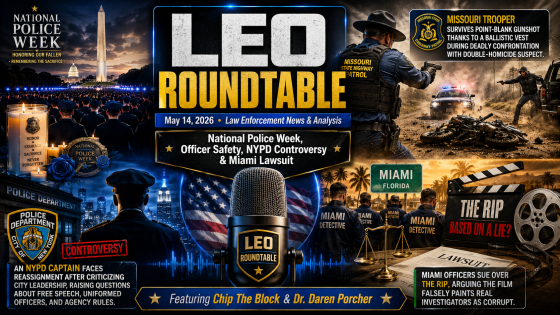

LEO Round Table with Chip DeBlock
S11E094, Trooper Shot Point Blank By Armed Suspect Saved By Ballistic Vest On Video
Panelists talk about the National Police Week schedule. NYPD Captain demoted after speaking negatively about Mayor Mamdani. Trooper shot point blank by armed suspect saved by ballistic vest on video. Miami officers sue Matt Damon and Ben Affleck over "depiction" of them in film.
LEO Round Table: Tactical Survival, Political Friction, and Hollywood Legal Battles
LEO Round Table: Behind the Badge
Tactical analysis of Police Week, ballistic saves, and Hollywood's "corrupt" portrayals.
Key Incident Reports
A Trooper survived a point-blank shootout with an Arizona double-murder suspect. Tactical takeaway: The vest worked, but the vehicle should have been used as primary cover.
Two Miami Sergeants are suing Matt Damon & Ben Affleck for $75k. Claim: The film "inspired by true events" falsely portrays them as corrupt thieves and murderers.
Captain James Wilson transferred to 911 dispatch after criticizing the "Socialist Mayor" in uniform. Debate: First Amendment vs. Paramilitary organizational directives.
Expert Perspective
“
As police officers, we're tasked to preserve democracy, but not practice it.
— Dr. Daren Porcher, Retired NYPD Lt.
- Candlelight Vigil: 45,000 cops in DC honoring the fallen.
- Unity Tour: Arrival of the multi-state cycling memorial.
- Camaraderie: "The safest place in the country" during May 15th ceremonies.
Keywords:#BackTheBlue #PoliceWeek #TacticalGear #FirstAmendment
This episode of the LEO Round Table features host Chip The Block and retired NYPD Lieutenant Dr. Daren Porcher. The discussion spans the deep traditions of National Police Week, the tactical realities of a life-saving ballistic vest in Missouri, and a unique defamation lawsuit filed by Miami officers against Hollywood A-listers.
The Legacy and Lessons of National Police Week
National Police Week serves as a critical period for law enforcement officers to honor fallen comrades and build professional networks. The speakers highlight key events such as the Candlelight Vigil at the National Mall and the Blue Mass, noting that the atmosphere in Washington D.C. during this time is one of total community embrace. However, Dr. Porcher recalls a "catastrophe" from the 1990s involving NYPD misconduct during the event, which led to intense Internal Affairs scrutiny and serves as a reminder of the high standards of conduct required even during memorial events. Beyond the ceremonies, the week is valued for "socialization," allowing officers to trade patches and build a lifetime of investigative contacts.
National Police Week: Key Observances
- 🕯️ Candlelight Vigil: A moving nighttime ceremony at the National Mall featuring the reading of fallen officers' names.
- ⛪ Blue Mass: A traditional service held to bless those serving in law enforcement.
- 🤝 The Unity Tour: The arrival of thousands of officers who cycle to D.C. to raise awareness.
- 🛡️ Memorial Etching: The practice of "scratching" names from the memorial wall onto paper as a tribute.
Political Speech and Disciplinary Action in the NYPD
The transfer of NYPD Captain James G. Wilson to a 911 call center in the Bronx sparked a debate on the limits of free speech for uniformed officers. Wilson was reassigned after a video went viral showing him criticizing the "Socialist Mayor" and Democratic leadership. While some view the punishment as a double standard, Dr. Porcher clarifies that while officers have First Amendment rights as private citizens, those rights do not supersede organizational directives when in uniform. He notes that the transfer is likely not a formal demotion in rank, but a "slap on the wrist" for speaking on behalf of the agency without authorization.
Tactical Analysis: The Missouri Trooper Shootout
A harrowing incident in Sweet Springs, Missouri, demonstrated the life-saving necessity of ballistic vests. A trooper engaged in a head-on collision with a double-murder suspect, Francis Chavez, who was fleeing on a motorcycle. In the ensuing point-blank shootout, the trooper was struck in the chest but saved by his vest, eventually neutralizing the suspect. Dr. Porcher offers a tactical critique, emphasizing that the police vehicle should always be used as a primary source of cover. He suggests that while the trooper’s actions were valiant, awaiting backup and maintaining distance is often the safer course of action to avoid "point-blank" exposure.
Tactical Debrief: Missouri Incident
EQUIPMENT PERFORMANCE
Ballistic Vest
Stopped point-blank round to the chest.
TACTICAL RECOMMENDATION
Vehicle Cover
Utilize engine block for ballistic protection.
Miami Sergeants vs. Hollywood: "The Rip" Lawsuit
Two Miami police sergeants, Jason Smith and Jonathan Santana, have filed a $75,000 defamation lawsuit against Matt Damon and Ben Affleck’s production company regarding the film *The Rip*. The officers allege that while the film is "inspired by true events"—specifically their record-breaking $21.9 million cash seizure in 2016—it falsely portrays them as corrupt, depicting characters based on them stealing money and murdering a colleague. The lawsuit claims the film’s "fictionalized" elements damaged their real-world reputations, leading to questioning by prosecutors. Dr. Porcher expresses skepticism regarding the lawsuit's success, noting the difficulty of suing over fictional works that do not use the officers' actual names.
Key Data
- 45,000: Estimated number of law enforcement officers who descend on Washington D.C. for Police Week.
- $21.9 Million: The amount of cash found behind a false wall in the 2016 Miami drug bust that inspired the movie The Rip.
- $75,000: The specific amount sought by Miami sergeants in their defamation lawsuit for emotional distress.
- 250,000+: Deployments of "The Glove" (CD3 technology) by Compliant Technologies with zero reported injuries or deaths.
To-Do / Next Steps
- Encourage Attendance: Every police officer should attempt to attend National Police Week at least once for the camaraderie and memorial experience.
- Tactical Training: Instructors should continue to emphasize the use of the police vehicle as cover during felony stops to mitigate the risks of point-blank encounters.
- Policy Adherence: Officers must remain cognizant that political speech while in uniform is generally prohibited by organizational directives, regardless of First Amendment protections for private citizens.
- Equipment Maintenance: Agencies must ensure all officers are issued and wearing ballistic vests, as they are "bullet-resistant" and critical for survival in unexpected shootouts.
Conclusion
The discussion underscores the complex intersection of law enforcement tradition, tactical survival, and the public's perception of the profession. Whether surviving a high-speed shootout in Missouri or defending their reputation against Hollywood dramatization, the modern officer faces challenges that require both tactical proficiency and a keen understanding of the legal and political landscape.
LEO Round Table


LEO Round Table is a nationally syndicated law enforcement satellite radio talk show discussing today's news and issues from a law enforcement perspective. They also have components on TV, Podcasts, and Social Media. Their panelists are among a Who's Who of law enforcement professionals and attorneys from around the country.
https://leoroundtable.com/how-to-become-a-panelist/
[00:13] Speaker 1: Welcome. Leo Roundtable at leoroundtable.com, the law enforcement talk show. My name is Chip The Block, and I'm your host. We're a group of law enforcement professionals that talk about today's news and issues, but we do it from a law enforcement perspective. And you recognize him. Yes, ladies, he is back. Dr. Daren Porcher, retired police lieutenant from NYPD. So thanks for being back on the show, Dr. Daren. Uh, appreciate it. Love having you on here. And, hey, and it's just you and me, so dude, we are... You, you're in charge, Daren. Do you wanna talk about it? You wanna skip the story? You just let me know. I'm just... Your, it's your show today. I'm just doing, I'm just working the controls for you, okay? So you tell me.
[00:49] Speaker 2: Awesome.
[00:49] Speaker 1: I'll even... Yeah. All right. All right, I love it. So-
[00:51] Speaker 2: Well-
[00:51] Speaker 1: ... hey, a shout-out to our, our sponsors. You know, our title sponsors, Gulls and Gulls.com, and don't forget that discount code. It's REDIO15 to get 15% off your next purchase at Gulls.com. We also have our satellite sponsor, complianttechnologies.com. You know, the people with the glove. We've got gunlearn.com, mymedicare.live, safeguardrecruiting.com, our streaming sponsor. Thanks to them, we're reaching about a million followers on the live show right now, streaming. And then we've got twobells.com. They built their new online store at leoroundtable.com. Uh, go to the website, upper right corner of leoroundtable.com. You can see our online store. You can buy, uh, like the mug behind me, shirts, hats, all kinds of cool gear that's got our logo on it. The prices are dirt cheap. We don't make a dime off of anything that we sell. We're just trying to get our gear out there.
[01:31] Speaker 1: And also a shout-out to all the people that are carrying our show and helping us, uh, get on, like, platforms like MSN and stuff. We got Brian Burns with Tampa Free Press at tampafe.com, Ray Detrick, formerlawman.com, Travis Yates with lawofficer.com. So thanks to all those entities, and if you guys are looking to see how to watch our show, uh, we are on... If you... If it's on podcast, we're there. We're on Spotify, Apple iTunes, the full gamut. And we also are on, uh, s- radio. We've got 47 radio stations that we're on across the country. We're nationally syndicated. We're on social media, Rumble, YouTube, Facebook, Twitter, uh, Truth Social. If you wanna find out where we're at, radio stations, dates, times, how to get ahold of the show, leoroundtable.com, our website. All the information's at the top, uh, in the top header menu. Uh, whew, that's a lot of information. So, if you guys are ready, let's go ahead and talk about...
[02:15] Speaker 1: Or just kinda give you guys a peek at what we're gonna be talking about. We're starting off with National Police Week. The schedule is going on right now. Normally, it starts on the 12th, and they started... You know, they started early this, uh, this year, uh, Dr. Daren. So we've also got, uh, NYPD, your neck of the woods. A captain ends up being demoted. He criticized the mayor and the dems in general. We're gonna be talking about that. We've got a ballistic vest that saves a Missouri trooper shot, uh, by an Arizona double murder suspect. But th- the trooper didn't get shot before he took the guy off, on the bike. It was like a head-on collision. It was crazy. Uh, we got a chase involving a U-Haul truck that caught on camera, and it ends with a crash, and the truck flips over, and then they have to kick in the windshield to get the bad guy out. It's pretty cool. Uh, Miami cops sue. They're suing over Matt Damon and Ben Affleck. Now, yeah. Now I caught people's attention.
[03:11] Speaker 1: I'm gonna read, I'm gonna read that back. Miami cops sue over Matt Damon and Ben Affleck, two huge actors. The true events film, they claim it falsely paints them as corrupt. So, this new film that just came out, it's called The Rip, and, uh, these guys, apparently they took a story that these two Miami cops were involved with, and, uh, they're saying it's true events. But they, but they changed the plot a little bit, Daren, and they made the cops kinda corrupt. (laughs) And the, and the cops, the real cops, they're not liking that.
[03:40] Speaker 2: I saw the movie, yeah.
[03:40] Speaker 1: Yeah, yeah. Uh, they're not liking it, you know. So they're suing, you know. So, uh, then we got a, uh, machete-wielding man injures a K9. Uh, Dr. Daren and I were talking about this before the show went live. Uh, we're gonna... We're... If we have time, we're gonna talk about that. But the bad guy ended up being shot by Oxnard police inside of a restaurant where this went down. And then lastly, New Mexico City is paying six and a half million in the fatal shooting of a man during a mental health call, and when they put that in the titles, they're kind of, like, insinuating that we should do something different because it's a mental health call, and why in the world would we kill someone, you know? But I always say, "Don't call the police unless you want a police response." You know? So, uh, um, now, policeweek.org is the source for the first story, and, and, and, and Dr. Daren, I don't know if you've ever be- I've been to, I've been to Police Week quite a bit. I...
[04:29] Speaker 1: In fact, one, one t- I went about 10 years in a row, and, um, Tent City, all that stuff. And so, uh, ha- have you ever been to Police Week? Just curious.
[04:38] Speaker 2: Aha, yeah. I've been there. And, uh-
[04:40] Speaker 1: Oh, you have?
[04:41] Speaker 2: I, I, I... Yeah, and I, I'm not going back again, and I'll give you a story.
[04:44] Speaker 1: Why not? No.
[04:44] Speaker 2: Just, right, uh, just, you know, the header on this, you know. Um, I wanna salute friend to the show, Randy Sutton. Um, he's the president of Wounded Blue, and he actually, uh, has a tent set up at, um, Police Week, and they do phenomenal things for us as police officers that have been wounded. And we just really wanna sal- salute Randy Sutton for the courage and the endeavors that he produces on behalf of law enforcement. But just (laughs) we go back to, uh, police suite. Years ago, back in the '90s, uh, then we had, uh, William Bratton was the NYPD Police Commissioner. And this is, uh, you know, the, the, uh, in, in all transparency, you know, this is a public story. There was a series of NYPD cops that went down to, uh, Police Week. Uh, this was back in the '90s. And they would, you know, they would strip naked. They got drunk. They were sliding down banisters.
[05:37] Speaker 2: I mean, it-
[05:38] Speaker 1: Oh, yeah.
[05:38] Speaker 2: ... it was... Yeah, it was a catastrophe, to say the least. And so this stuff became universalized with video, pictures.
[05:45] Speaker 1: Ugh.
[05:46] Speaker 2: And from that point forward, they brought us all into Internal Affairs. And of course, I had all of my clothes on, and I wasn't intoxicated. But-
[05:53] Speaker 1: Of course.
[05:54] Speaker 2: ... from that point forward, I just said, "Look, I'm not going anymore," because they put us through hell. Just people-
[05:59] Speaker 1: Yeah.
[05:59] Speaker 2: ... of the common police officers, uh, from the NYPD that went down to pay homage to, um, our police officers the now fallen. And so I haven't (laughs) been back since that incident happened-
[06:11] Speaker 1: So-
[06:11] Speaker 2: ... in the '90s.
[06:11] Speaker 1: So I gotta ask you. When you said getting naked and everything, is that where you originally met Randy Sutton?
[06:17] Speaker 2: No, we were in a hotel room with no clothes on. We didn't slide down past the ceiling.
[06:21] Speaker 1: (laughs) Oh. Oh, oh.
[06:21] Speaker 2: But yeah, you know, on, on a serious note, you know, it's funny because Randy and I, I wanna say, uh, we wo- Fox News sent us to Tucson, Arizona, um, to, you know, to provide commentary on the Nancy Guthrie, uh, disappearance.
[06:34] Speaker 1: I remember, yeah.
[06:35] Speaker 2: And we were actually staying in the same hotel inn. But different rooms, but we were-
[06:39] Speaker 1: Different room.
[06:39] Speaker 2: ... staying at the same hotel inn. Randy's a great guy.
[06:42] Speaker 1: Oh, I agree. Well, you know, I, I love, uh, I love Police Week. You know, I really think that every cop should go at least once. It, it, and, you know, one of the most moving things is the candlelight vigil.
[06:50] Speaker 2: Great time. No, you're a phenomenal time.
[06:51] Speaker 1: Yeah. Well, you, you've got 25 to 40, you know, 40,000, 45,000 cops descending on Washington DC during that. You know, it's always May 15th is usually the ceremony where they have the president talks, addresses the surviving families and stuff. It's very touching, moving. You've got the candlelight vigil. Um, I've got the list of events here right now. You've got the annual w- well, it started earl- I mean, you know, the annual Blue Mass, uh, was back on May the 5th, you know. Um, that was a week ago, uh, today. And then we got, they had a 5K on Saturday, National Police, uh, K-9 Memorial Service, that was on Monday, May the 11th. So they already, you know, they got a jump start. Usually, I associate it with the 12th or the 15th, but it looks like they've got more stuff going on now. And the 15th, of course, being their ceremony, where nothing happens after the ceremony where the president talks.
[07:36] Speaker 1: You've got the Tent City Takeover Kickoff Party that happened on Monday, May the 11th, and that's where I used to be in Tent City, and they moved it to a less desirable place, and that's why I ended up stopped going. I couldn't make the trips pay for themselves anymore. You got the Honor Guard Reception, you got the Police Unity Tour arriving, that's, like, on Tuesday. Um, you've got the 38th Annual Candlelight Vigil on Wednesday, May 13th. That's special. I hope people get the ch- get to attend that in the National Mall. Um, and you've got other events, um, Honor Guard Pipe Band. You know, there's so many cops down there that descend on DC. It's, like, the safest place to be in the country. It's just amazing. And everybody has their badges hanging out. You're, they, they, you don't have to pay, um, the fees for the subways or anything. They, they, everything's free if you have that badge hanging, and they, it's just, the city embraces you. It's just, it's just a heck of a time now.
[08:24] Speaker 1: If we could just keep the Miami cops and the New York cops away from each other during Police Week, there wouldn't be as much, uh, memorialized stuff in pictures and videos, you know. We'd be better. (laughs) I mean, I, I remember stories when I was going, we had, like, N- NYPD guys stealing Miami police cars or Miami, Miami guys stealing NYPD car, and then they're going by the fire stations and stealing fire trucks and dude, it was freaking, it was just chaotic. It was just crazy.
[08:49] Speaker 2: Yeah, it was. Yeah, yeah.
[08:50] Speaker 1: Yeah.
[08:50] Speaker 2: And, you know, th- there's a couple of things, you know, from a symbolic perspective, you know, you get the chance to see fallen members of your department, and you're able to, when you go to Police Memorial, you know, you see their names etched in stone, and that's just a really, uh, resonating thing for you as a police officer-
[09:07] Speaker 1: Oh, yeah.
[09:07] Speaker 2: ... knowing that you worked side by side with officers that are actually on that wall. So, what we traditionally do is we take a sheet of paper, we place, place it on, against the wall, right? And we scratch and we're able to gain-
[09:18] Speaker 1: Etch it. Yeah.
[09:19] Speaker 2: ... the image, etch it and gain that image of the officers, and I was a cop during 9/11, um, in the NYPD. And so, you know, there was several of my, uh, my counterparts, friends that have lost their lives, um, and they're all up on that, um, in that Police Memorial, as well as, uh, and a, and a semblance of other officers that have fallen in the line of duty. In the NYPD, we've lost more police officers than any other police department in the country. Not to say that we're a better or worse department, but it just, uh, it, it, it's a testament to what we do for the m- the minimal amount of money we're paid. You put your life on the line for the sake of democracy in the city that you're out there to protect, and that memorial actually is something that pays homage to us in backing the blue.
[10:09] Speaker 1: Yeah, you know, that, uh, Judiciary Square and that, um, you know, the memorial, the candlelight vigil is, is probably the most touching out of, out of everything for me. Just when they read those names, you got the blue laser, it's nighttime, everyone, you got candles. It's just, it's just moving. You know, some really special stuff. So I'm glad you, uh, you kind of brought me back, you know. It, and I hope that we've got the curiosity-
[10:30] Speaker 2: And also, the socialization. Not to cut you off, Trump, uh, Chip, but the socialization is huge.
[10:35] Speaker 1: You call me, you call me Trump?
[10:36] Speaker 2: I called you Trump.
[10:37] Speaker 1: You called me Trump?
[10:37] Speaker 2: You know why? Because you're the boss. This is your show.
[10:40] Speaker 1: (laughs) Oh.
[10:40] Speaker 2: Okay?
[10:41] Speaker 1: Damn.
[10:42] Speaker 2: La, la, la, la, la, la. No, this is your show.
[10:43] Speaker 1: (laughs)
[10:44] Speaker 2: You, you know, it's funny, um, that my, my wife actually knows Trump, and they met while he, while he was doing The Apprentice, and they've just known one another over the course of years.
[10:53] Speaker 1: Yeah.
[10:53] Speaker 2: But going back to, to this, the socialization is huge.
[10:56] Speaker 1: It is.
[10:56] Speaker 2: We trade patches with members of other departments, and you keep running communication, uh, to the point whereas there's been many instances whereas to this day, I've still reached back, and I'm talking about over 30 years ago, I still have contacts that I reach out to quite frequently as it relates to information that I can extract that assists me as an expert in testifying in these trials moving forward.
[11:19] Speaker 1: Yeah, I, I've, I've got so many guys I've met over a 10-year period at, at Police Week that I still stay in touch with. You're, you're absolutely right, and, uh, you know, it's a lot of, a lot of good memories, so if you... Look, if you're, if you're listening to the show and you've never been to Police Week, I hope that we've wha- what Dr. Daren and I both said, I hope that it, it at least gets you to start maybe curious and start checking out, going with some other guys and stuff. And when he, when he talks about the camaraderie, I'm telling you, there is not a, there's not an Irish bar you can walk into where people aren't wanting to buy you a beer or, or food. I mean, it's, it's just, it's just an am- um, I'm telling you, an amazing experience you'll never forget. But if you're a cop, you should go at least once. Commercial break, guys, coming up. We'll be right back.
[11:57] Speaker 3: (instrumental music plays) My family only cares about one thing, that I come home safe.
[12:04] Speaker 4: At Gull's, every order begins with a promise. Made with purpose. Stitched for support.... backed with pride, answered by dedicated hands, delivering the standard you have sworn to uphold. We serve more than the mission. We serve the person. Each piece is engineered to help get our first responders through the shift and back home safe.
[12:57] Speaker 1: Welcome back to LEAR Roundtable at learroundtable.com, the law enforcement talk show. My name is Chip Devlock, and I'm your host. We're joined by Dr. Darren Porcher, retired NYPD Police Lieutenant. We've been talking about Police Week, trying to get you guys excited about going if you've never been before and kinda going over the schedule with you as well. Um, I know that we're live right now on StreamYard, which means that we can see commentary on LinkedIn, on YouTube, and also on Facebook, so thanks for watching and over... popping over the Rumble here. We've got a bunch of the guys over there as well. So MVS in Northwest Colorado, where apparently it's 57 degrees today, and Bill BC in Pensacola, where it's 74, and all these guys, thanks for watching the show. We appreciate it. Chili's over there, all those guys, so thanks, guys, for watching. Um, Dr. Darren, uh, before... just before we came back to radio, you had asked me if I liked lasers and, um...
[13:46] Speaker 1: and, and I, I, I'd say, I like, I like, like, red dots and stuff, sightings better than lasers. A- and so where I'm going with that is that, um, you can get... I know people that carry... that have carried lasers that get so reliant on lasers. Let's just say that the battery... 'cause, you know, it's, it's... it runs on battery. If, if, if the laser doesn't work, they feel like, "Oh my gosh, how am I gonna be able to shoot the bad..." you know? So I, I, I always try not to get too reliant on something. Like, when I... if, if... when I was running outside, um, before I blew my knee, um, I didn't always... I didn't like to wear headphones because, you know, if a bad song comes on then you have a crappy run, you know? You just want that good, good song. So there's some outside influences that can affect you. So I, I do like the red dots and stuff, but if they have a high profile, if I'm carrying... like, an everyday carry, like, I'm carrying a Micro now and I like...
[14:35] Speaker 1: it's, it's the, uh, new SIG 365. Great gun. I got rid of my Taurus Slim and, uh, it's smaller profile, but if I had a... if I had, like, a red dot on that, now I'm not gonna be able to, number one, keep it in that, in that sticky holster that I, that I like, and I... it's gonna have a bigger profile to where I'm not gonna be able to hide it, like, when I... I wear shorts a lot and stuff like that, so. But I, I, I like the sights better than the laser, but I do like the lasers. But my lasers are on my, my bigger guns.
[15:03] Speaker 2: Y- you know, one of the misconceptions that people have with the lasers or the red dot is, is breathing and trigger pull. So you can have your, your, your sight placement spot-on, but if you're breathing and trigger pull are off, it's a moot point. You're not gonna hit the target that you intend on, uh, striking.
[15:20] Speaker 1: No, you're right. I, I like, um... You know, the guns I have now, it, it, it's nice that now you don't have to have a Glock to have a Glock trigger, right? So my Taurus Slim had a Glock trigger. Um, my new .365 SIG has got, essentially, a Glock trigger. My old SIG, my 290 that was like a, a subcompact, that had a horrible trigger. So it didn't have the soft, the soft... the, uh, the quick reset like the Glock, and you had to fully depress the trigger before the, uh, the, the gun engaged, and then you had to fully release it, and it was, it was, it was horrible range shooting gun and I had to get rid of it, because this... my shooting was horrible.
[15:53] Speaker 1: So, uh, so I do like the-
[15:54] Speaker 2: I carry a GLOCK 19 every day.
[15:56] Speaker 1: Oh, you do? Okay.
[15:58] Speaker 2: Even when I go to-
[15:58] Speaker 1: That's a bigger gun.
[15:58] Speaker 2: ... the supermarket. But, uh, I'm good with it. Look at where I live. (laughs) I mean, look at where I live.
[16:02] Speaker 1: Yeah, yeah, yeah.
[16:03] Speaker 2: What city I'm in.
[16:04] Speaker 1: But, but, you know what? But I'm wearing shorts and stuff everywhere. You know, I mean, here in Florida, you know, I'm wearing shorts.
[16:09] Speaker 2: If I'm wearing shorts, I still got my GLOCK 19, man.
[16:11] Speaker 1: All right. Well, that's a bigger... that's a big gun to be packing for, uh, for a quick, for a shoot, man.
[16:15] Speaker 2: If I'm going to the cleaners, if I'm going to the supermarket. Jeese. Only place I don't bring it is when I go to the gym 'cause I don't want to worry about somebody breaking into my locker and taking my weapon.
[16:25] Speaker 1: I got you. I got you. I'm with you. Well, look, if you're... if you're ready, we've, uh, got an update story here at, uh, NYPD. So, uh, rvmnews.com, which stands for Red Voice Media, NYPD captain demoted for criticizing Socialist Mayor Mamdani-
[16:41] Speaker 2: Yes. (laughs)
[16:41] Speaker 1: ... and the Dems in general. So, uh, this article says that the Newark Police Department captain who called out radical City Hall politics, he's now being made an example of, and New Yorkers on the right are taking notice. So this guy's name is, uh, Captain James G. Wilson.
[16:58] Speaker 2: Wilson.
[16:58] Speaker 1: Caught on video deriding Socialist Mayor, uh, Ziran Mamdani and, and he called him an embarrassment. The footage, it went viral and, uh... So the political left, uh... Well, it, it... they're... he's getting scorn from the political left and from NYPD brass actually, and they quickly transferred him, uh, Captain Wilson, to a-
[17:17] Speaker 2: To the 911 call center.
[17:19] Speaker 1: Yeah. Is that what it is, in the Bronx?
[17:21] Speaker 2: Yeah, he's in the 911 call center. That's where... yeah, I mean, where the calls come in and are dispatched, but that's where he is right now.
[17:27] Speaker 1: Yeah, it's... he's... that's where all hot dispatchers are, right? Good for him. So, uh-
[17:31] Speaker 2: Uh, no, not there. Maybe where you are. (laughs)
[17:34] Speaker 1: (laughs) I'm joking.
[17:35] Speaker 2: Not here. Not here.
[17:36] Speaker 1: So, uh, i- the article goes on to say that too many conservatives, uh, um... Well, I guess too many conservatives, his punishment is, uh... you know, it's a double standard because if he would have been talking, you know, trash about Trump, he would have been a hero, and because he was talking about the Socialist mayor, you know, they're coming down on him and stuff. We have a councilwoman, Joan Arriola, you might know her, in Queens, that was, uh... that was kind of agreeing, saying that, um, you know, they're treating him differently, because if he would've been trashing Trump everything would have been okay. So what are your... what are your... what are your thoughts on this? And it sounds like a lot of the troops are sticking up for him, uh, but, uh, I don't know that there's much point to it.
[18:09] Speaker 1: But, but also, when you work for an agency and you start talking publicly, and this thing went viral, you start talking publicly about your boss and stuff, I mean, you know, you, you, you know, you wear different hats, and just because you have the freedom of free speech doesn't mean you have total freedom, you know, when you're working for a police agency and you're disparaging the agency or its leader, so... um, or, or the mayor. What are your thoughts on this, Dr. Darren?
[18:33] Speaker 2: Well, Trump, well, I say Trump. I keep thinking of-
[18:36] Speaker 1: Ah, there you go.
[18:37] Speaker 2: ... he was Trump because you're the, you're the man, Chip.
[18:39] Speaker 1: (laughs)
[18:39] Speaker 2: No, I'm actually thinking about a, a story that I'm going to have to do as it relates to Trump going over to China. And let's pray for our president, and hopefully, hopefully this is a successful trip, as it relates to his engagement with Xi Jinping. Because, uh, that, that when we look to the Strait of Hormuz, uh, we need to establish a level of dominance there. And hopefully China will connect with us and we can get this done the way it should be, but that's another story for another day. But just going back to what happened with Captain Wilson, um, Chip, you touched on it on, in the initial piece, in that we have First Amendment rights. However, your First Amendment rights do not transfer to your organizational, um, directives.
[19:22] Speaker 2: When I say that, meaning this, if a labor union, um, presents a, uh, a demonstration in front of a location and they say the mayor sucks, uh, the policies coming from city hall are inept, those individuals that are protesting as, um, private citizens are, are covered under the First Amendment. Um, so free speech is protected in that particular case. Free speech is not, um, unlimited, because of course, we have some parameters to it, such as you can't yell fire or you can't present a level of harm, grave harm to other individuals with your free speech. Now, when we move on the side of private industry or an organization, then you have specific directives that fall within the purview of that private organization, such as the NYPD. And we all know as cops, uh, political speech while you're in uniform are not something that is, um, uh, it, it's not recommended and, and abs...
[20:24] Speaker 2: It's actually prohibited when you're in uniform and you're taking a pos- a poli- a political position because you're now speaking on the part...
[20:31] Speaker 1: Hold that thought. Commercial break. Be right back, guys. All right, guys, time to talk about Compliant Technologies at complianttechnologies.com. And they are committed to providing non-lethal solutions that help officers gain the upper hand safely and rapidly in a humane, low optics manner, utilizing what they call their CD3, which stands for conductive distraction and de-escalation device technology. Now, their flagship product, we all know by now it's called the Glove. It's not only helped officers tens of thousands of times, but they've actually had over 250,000 deployments. And guess what? No injuries, no deaths. It's an amazing statistic. It's actually moved them into the realm of non-lethal in an arena that predominantly can only offer less lethal results. And when it comes to weapons retention, transitioning to a sidearm or a conducted energy weapon, the Glove at complianttechnologies.com, they virtually eliminated weapons confusion.
[21:18] Speaker 1: So stay ahead of the game with Compliant Technologies and the revolutionary CD3 that hundreds of agencies have already tuned to nationwide. And friends, take it from me, when it comes to safety, this is one of the most common sense hands-on solutions. Go to complianttechnologies.com today. Welcome back. Leo Roundtable at leoroundtable.com. The Law Enforcement Talk Show. My name is Chip The Block and I'm your host. We're joined by Dr. Darren Porcher, former NYPD lieutenant. So thanks for being on the show, Lieutenant or Doctor. Um, I get it mixed up sometimes. I know you change the titles just to mes- just, just to mess with me, so, um. Hey, uh, we've got a story with a video component. Is there anything with the last story that you want to... with the NYPD, uh, story that you want to get back out there?
[21:56] Speaker 1: The, uh, the, uh, captain that was, uh, in the re-
[22:00] Speaker 2: With Captain Wilson?
[22:00] Speaker 1: Yes.
[22:00] Speaker 2: All right. The, the short version is he has not been demoted. He's been removed from being the executive officer of the Nine-Four precinct in Brooklyn to the, the, the 911 call center. Believe it or not, the 911 call center is not a bad gig. Uh-
[22:14] Speaker 1: Seriously.
[22:15] Speaker 2: So, so... Right. It's not a demotion, uh, so he's not being demoted from captain to lieutenant. He's still in the rank of captain, and he's probably gonna take a slap on the wrist for making political statements while he's in uniform. Because whenever you make statements while you're in uniform as a police officer-
[22:30] Speaker 1: Speaking for the agency.
[22:31] Speaker 2: ... it amplifies as you're speaking for the agency, and that's basically as far as it's gonna go. So I see it as going nothing further than a warning, admonish, and he'll move forward and continue to do great things in the NYPD.
[22:44] Speaker 1: You know, it needs, it needs to... For people watching the show, it, it needs to be that way. We are, you know, we're paramilitary for a reason. Look, if I'm a... You can, you can... It's hard to command... And look, you know, your, your mayor is in charge of your, you know, commissioner, your police chief. Um, you've, you've gotta be able to have respect from rank and file, or at least, at least, at least publicly. Um, so if this, if this police leader, if this captain really felt comfortable saying what he said, he should just take it and be proud. Take it like a, uh, a badge of honor, the write-up or whatever he's gonna get, because there's, there needs to be consequences for what you do. So I hope it was worth it for him. Now, where I'm at, when we put a lieut-, I think we have, um, captains in charge of our, um, co- of our, um...
[23:23] Speaker 2: Public affairs.
[23:24] Speaker 1: Dispatch. Um-
[23:25] Speaker 2: Okay.
[23:25] Speaker 1: And... But it, it, it's... You know, you're, you're... Whenever you have to supervise a bunch of, um, civilians, and especially a lot of those, and I'm gonna get myself in trouble, but when a lot of those are like females, there, there is, there's a lot of drama. So I, I wouldn't necessarily, uh, I wouldn't wish to be the supervisor over the, uh, dis- over, you know, 911 call center and stuff, because I know that there's inherent problems that go in there. Just like being in charge of, like, the domestic violence, uh, unit, where you have a lot of civilians and you have a lot of females, and there, there are just inherent issues. I mean, I've seen it, you know, so, uh, but, uh, anyhow, I hope that he, I hope that he braves that storm at the 911 call center and stuff, you know, well.
[24:05] Speaker 1: (laughs)
[24:06] Speaker 2: Hey, Chip, just remember one thing. As police officers, we're tasked to preserve democracy, but not practice it.
[24:12] Speaker 1: No, I love it. I love it. All right, that's a good point. All right, uh, moving along, we've got a story with a video component that we're going to cover next at rumble.com, our favorite law enforcement video channel, called This is Butter. We have A Ballistic Vest Saves Missouri Trooper Shot by Arizona Double Murder Suspect.
[24:28] Speaker 3: Coming straight at me on 115.
[24:35] Speaker 5: 10-50.
[24:42] Speaker 3: ... ahead of me. 27-64, this is information here. You're headed straight towards the A48. All right. All I can see is the red and blue... 87, I'm doing 45, 50. I can't see, uh, the motorcycle anymore. It's just a... Well, at 848 you have it, let me know, direction of travel and what happened.
[25:08] Speaker 1: So, I like the fact, Daren, that they didn't put "bulletproof vest" because there's no such thing as a bulletproof vest.
[25:14] Speaker 2: Exactly. They're bullet-resistant.
[25:14] Speaker 1: I see that, just like when we see "assault weapons," I mean, there's no such thing as an assault weapon. But anyhow, Sweet Springs, uh, is where we're at in Missouri. There's a new video that shows how a ballistic vest saved a Missouri State Highway Patrol trooper who was shot point-blank by an Arizona guy that was wanted for a double homicide. So, detectives say that this 23-year-old, um, bad guy, Francis Chavez, he killed his own parents and Taylor, and this happened last year. And the body cam from the Missouri State Patrol, uh, trooper, it captures this deadly encounter in the moments the trooper realized that his vest had saved his life. So, in the body camera, uh, that's released, you see the trooper and Chavez. I'm gonna, I'm gonna have to go with my own recollection of this, because I think my version's gonna be a little bit more dramatic and better. So, these guys are on a dirt road and they're headed at each other, you know, head-on.
[26:04] Speaker 1: You've got the, you've got the, uh, trooper in his cruiser and you got the bad guy on a freaking motorcycle with no helmet, and they're, like, going at it. They're, like, coming right at each other. And so, they're on a dirt road and there's, like, a field on both sides of the dirt roadway. And so, yeah, there's, like, dust kicking up, they're, like, hauling butt. So, the, the, uh, double murder suspect veers off the roadway, um, so when you're looking at, you know, the, uh, the dash cam on the trooper you get to see the guy's veering off to the left, his right. And so, the trooper veers off to the left, and then he clips the freaking motorcycle. They're going a decent speed. Cycle starts flipping and stuff, bad guy goes flying off of it. Remember, he doesn't have a helmet on. And so now, the trooper, um, gets out of his, uh, cruiser. And you can see, um, through the, uh, through the side window, it's a little bit dislodged, the camera angle, but you see the bad guy gets up.
[26:54] Speaker 1: He goes up to the motorcycle and he's trying to, like, pick it up off the ground, 'cause he wants to get out of dodge, right? 'Cause, you know, he's wanted for double homicide. And our, our trooper runs up on him and, when they say point-blank, it was pretty much point-blank, and runs up on the bad guy. Bad guy produces a gun. Well, trooper didn't have his gun out, so now he's trying to unholster his gun and, and, anyhow, uh, there was a shootout. And the trooper at some point gets hit, but it gives in his ballistic vest. He shoots the bad guy, who goes down. Bad guy continues to engage the trooper, another string of tr- fire from the trooper, and ends up taking care of the, uh, the bad guy. And I'm just trying to look here. It says that, um, uh, Chavez, when he hit the ground, returned fire, trooper fires a second time, Chavez died at the scene, Chavez being the bad guy. And, uh, all this happens very...
[27:40] Speaker 1: It's only a two-minute-long video, so all this happened pretty, uh, pretty quickly. And, uh, you know, that's one for the good guys, and, uh, and saved by the vest. Dr. Daren Porcher?
[27:50] Speaker 2: You know, uh, these stories, I hear them time and time again. And, you know, Chip, not Trump, but Chip, uh, I, I, one thing I, uh, thing, one thing I wanna say is, you know, I, this was a very valiant, um, endeavor partaken by the trooper, but I just think that a lot of times we have these, and this is just unfortunate, and this is just the nature of policing as it relates to being a state trooper. Oftentimes, they are performing solo patrol. Now in a lot of the other, the s- smaller departments, the officer's attached with s- um, solo patrol. I just think, whenever you're, um, engaging a suspect with the attempt on taking them into custody, the best course of action is to, um, garner additional officers to help you. Um, and one of the things that I look to is the felony car stop, um, policy, or procedure.
[28:43] Speaker 2: Now granted, we have no national policy in policing, but the felony car stop, um, procedure is something that's a great way for you to engage someone that you're conducting a felony stop of. Now, granted, is this person on a motorcycle? Yes. Did the motorcycle go, uh, did, did the bi- motorcycle tip over? Yes. Did the person try to get up and move away on it? Yes. But that police vehicle is a great source of cover. And oftentimes, we, we, our adrenaline flows and I, I... We've all been in these situations when we're chasing people. We want to get the bad guy and everything, a lo- oftentimes tactically, things will go out, uh, go out the window. Fortunately, the trooper was, um, was able to neutralize the suspect, but, you know, uh, he took a round to the chest with the, with this bullet-resistant vest. And it just goes back to, a lot of times it's best, i- i- the best course of action is to await the additional officers to assist you and backup.
[29:43] Speaker 2: If a person gets away, I mean, it's unfortunate, but you want to be safe about this. Fortunately, Chavez was the person that came out and gained the short end of the stick. But-
[29:53] Speaker 1: (laughs)
[29:53] Speaker 2: ... tactically, always use... I, I, I'm a person... I, I was a police academy instructor, so I taught police recruits this for years on end. That police vehicle is a great source of cover, and use that to your advantage.
[30:07] Speaker 1: Yeah. So, do you think it's fairly safe to say this Chavez guy won't ever do this again?
[30:11] Speaker 2: Well, I mean, it's... (laughs)
[30:13] Speaker 1: See, it, it is...
[30:13] Speaker 2: Yeah.
[30:14] Speaker 1: (laughs)
[30:14] Speaker 2: We, we clearly see that, that he lost his life. And, you know, another thing is unfortunate, and, and Chip, I, I, I can't tell you how many times you, I'm sure you've heard this. "Why didn't they shoot him in the leg? Why didn't they shoot him in the arm?" (laughs) you know, people just don't understand the concept of what we as police officers do. And the goal is to...... shoot at center mass, but it's to neutralize the threat. We don't go out there to kill people, but at the same token, we wanna go home. And so, the reason why we aim for center mass is because it's the largest component of the body, so it makes it easier to hit. That's why we don't shoot, but that's why we don't aim for the arm or the leg, because you have a greater propensity to miss, and that will not necessarily neutralize the threat. You wanna terminate the threat, not terminate the person. But sometimes the person loses their life, as, as happened in this situation.
[31:06] Speaker 2: But this was a legit shooting, because when we speak under, um, the 1989 Supreme Court decision, titled Graham versus Connor, it introduces... Officers have the ability to use objectively reasonable force. And, it, it, it's through the eyes of that officer at the scene, not hindsight being 20/20 as a c-, as a person that's a Monday morning quarterback that can judge what happened. This officer did everything right. I just would have preferred that he use that vehicle for cover and garnered additional s-, um, a- additional a- assets. But fortunately, he was able to escape this with his life.
[31:47] Speaker 1: Well, I mean, I, I know why he didn't use it for cover. He was trying to get the bad guy before. He didn't know the bad guy was armed, but he was a double homicide suspect. But if he wouldn't have, if he would've used the car as cover, he had no right to shoot the, uh, bad guy at that point. And the bad guy would've hopped on the bike and would've driven away, and then you would've had another chase. So I know, I know he's trying to get to the bad guy. He ran around the car, and he's just trying to get to the bad guy before he lifted the bike up and hopped on and took off again, you know? So he was trying to end, end the chase. But I, I, I kind of wish he would've been expecting to have the bad guy produce. As soon as the bad guy dropped his hands to produce a weapon, I wish that he would've drawn, or at least had his gun out. Because he, it, it acted, he acted like he just totally was unexpected when the bad guy produced the gun.
[32:28] Speaker 1: And now we're, like, as close as, uh, as you are to my, as me and my monitor is like, you know. I mean, you're so close that the bad guy is not gonna miss, and he didn't, you know. He hit the guy in the vest, you know, but it's like, it's just one of those things, you know?
[32:39] Speaker 2: Yeah, but Ch- Chuck, I, I say, I say Chip, you gotta remember-
[32:43] Speaker 1: Call me Trump. Call me Trump.
[32:44] Speaker 2: See, i- because I see you as in a position of superiority. What we think-
[32:48] Speaker 1: Well, hold that thought. Thirteen seconds, I'm gonna start your favorite song, and we'll pick this up after commercial break. Stick with us, guys. We'll be right back. All right, guys. Time to talk about GunLearn at GunLearn.com. Hey, there's some new stuff going on with GunLearn, so pay attention, you know. And they are the first and only company that offer a step-by-step program that takes you from your present knowledge level to become a safe, accurate, and competent certified firearms specialist. Now, that certified firearms specialist, if you have that, even if you got it five years ago, now it's worth college credits. Why? Because GunLearn.com, they have hooked up with a, with SmarterDegree and SmarterDegree's university partners that have turned that certification into college credits. Amazing opportunity. And of course, GunLearn.com, they've been doing this since 1996.
[33:28] Speaker 1: They've been teaching everything that LEOs, which is law enforcement officers, need to know about both firearms and ammunition, to all factions of law enforcement. You can actually start today with online training, or you can sign up to attend a live seminar. And you can even get free training for yourself and all the people at your agency by hosting a seminar for absolutely no cost. Go to GunLearn.com to get more information. Hook up with the founder, Dan O'Kelly. Again, that is GunLearn.com. You'll be glad that you did. Welcome back. LEO Roundtable at LEORoundtable.com, the law enforcement talk show. My name is Chip The Block. I'm your host. We are talking with Dr. Darren Porcher, and we just talked about a video, uh, or a, a, a police story that had a video component, and it was about a, uh, about a, uh, a trooper taking out a bad guy on a motorcycle.
[34:09] Speaker 1: Which I, I gotta admit, I kinda, I kinda like, um, 'cause he, he wasn't scared to hit the, uh, to hit the guy on the bike, you know, with, with the cruiser. And even though the cop got shot at point-blank range, the, uh, the ballistic vest, you know, saved his life. And I'm glad they acknowledged that. And if your agencies are still out there and you're not putting your guys in uniform and ballistic vests, you should be. You know, just like they should be having long guns, too. Um, any final words on this one before we go to Miami, Darren?
[34:35] Speaker 2: Nah, let's take it to Miami. Let's go to the celebrity. Let, let, let's get the celebrity take on this, right?
[34:40] Speaker 1: You sure you're ready for this one? All right. So, we've been talking about Miami cops a little bit, 'cause we were talking about Police Week and the rivalry between Miami and NYPD.
[34:49] Speaker 2: The great state of Florida.
[34:49] Speaker 1: Yeah. Yeah, so, so FoxNews.com and, uh, and Darren's no stranger to Fox. Uh, that's the news source. Miami cops, they're suing... This is a, this is a little embarrassing because I'm in Florida and I gotta apologize for my Miami, you know, counterparts here. They're suing over Matt Damon and Ben Affleck. Tru Event- Tru Events Film, uh, it claims, they claim it falsely paints them as corrupt. Now, I, I, I admit you're in a bit of a pickle here, but, but listen to what goes down and we'll find out what you guys think, and what Dr. Darren thinks. We have two Miami, and they're sergeants, Miami police sergeants. And behind a historic $22 million drug bu- bust, they've filed a federal lawsuit over the 2026 movie. So this is, like, current day, and the movie's called The Rip. R-I-P, as in Paul. Um, saying that Matt Damon and Ben Affleck, these two huge actors, uh, they falsely portrayed these sergeants, Miami sergeants, as corrupt cops based on their real case. Um, it, it gets better.
[35:48] Speaker 1: The lawsuit names Artists, with a plural, with a, with an S on it, Equity, which is a production company that, well, ended up being put together and funded by these two stars, and, as well as Falco Pictures, uh, which is also involved in the production. Now Netflix, which distributed the movie, um, they are not listed in the lawsuit. So the movie Rip was advertised as, quote, "Inspired by true events," unquote.So that's apparently what created some of the issue, including how the Miami-Dade Narcotics Unit found $21.9 million hidden behind a false wall in orange buckets. And according to the lawsuit, the core plot about their criminal misconduct is fabricated, it's not true. So in real life, the investigators, uh, remember we have two sergeants here in White- or, uh, Miami, uh, sergeants. They made a seizure at the home of a gardening supply center and, uh, or the, the home of a gardening supply center store owner suspected of taking part in marijuana trafficking.
[36:41] Speaker 1: And this is back in, like, 2016, and it was the largest cash seizure in the history of the Miami-Dade Police Department, which has now become the Miami-Dade Sheriff's Office. And so that's what happened. In the movie, members of the cr- narcotic unit, they face suspicion for allegedly stealing some of the money under false pretenses and for their own benefit. Now, this is all in the movie, this is not like what happened in real life. It also depicts a fictional, made-up DEA agent implicated in the murder of a Miami Police lieutenant, who himself was killed by Affleck's character later without due process. So they've, they've taken the liberty of throwing some extra goodies in the movie. They kinda keep it entertaining, I guess.
[37:16] Speaker 1: While the film had a, a, a fictionalized, uh, twist, the lawsuit contends that it, it included enough real-world, you know, nonfiction facts to damage the reputations of Jason Smith and Jonathan Santana, who are the two sergeants, including locations, send these details about the false wall, cash being found in the orange buckets, and a loaded TEC-9 firearm that was stashed, uh, with the cash. So they're saying that because of all the, they had enough real stuff in there where people could figure out, "Ah, well, we're talking about Jason Smith and, and Jonathan Santana, so they must be corrupt too." It gets a little bit better. Uh, Smith was the sergeant supervising the real investigation. Santana was the lead detective and has since been promoted to sergeant. Their names are not used in the movie, but the lawsuit alleges that they were the basis for the characters of Da- of Damon and Affleck, their playing in the movie.
[38:00] Speaker 1: And according to the lawsuit, after the trailer came out for the movie, a county prosecutor contacted one of them saying, "Hey," uh, asking, "Are any of these allegations of theft, have they ever been made in connection with the case?" and he wanted his office to... He said, "Look, my office is gonna be looking into this," like, thinking that these guys (laughs) are actually corrupt, uh, based off the trailer. They allege they've also faced questions about how many buckets they kept, whether they, uh, stole the money to pay for home improvements. And, I, I, and, uh, here's one saying, uh, pros- a county prosecutor said, "I can't believe you killed another cop." That sounds a little bit far-fetched to me, uh, but that's what they're saying. On top of that, the film allegedly credited a department member who had absolutely no connection with the investigation. Uh, they used him for consulting, and they paid him.
[38:42] Speaker 1: So Smith and Santana, they're seeking only $75,000 for defamation and emotional distress. The lawsuit also accuses Hollywood. They're saying they negatively portray cops, and that they've got a habit of doing all that stuff. Now, Dan- uh, Matt Damon and Ben Affleck, himself, they praise cops publicly. Uh, I, I know Matt Damon does. Um, and, uh, and, and, and says Affleck does too, which I'm sure. So prior to the lawsuit, both these Miami cops had asked for a public retraction and a correction and either a prominent disclaimer attached to the film or an end to its distribution. The producers countered that, "Hey, this is fiction. It's, like, made up and stuff," and now we've got lawyers invol- involved, and everybody has until today to figure out what they're gonna do, or else the lawsuit's gonna, gonna go forward. So, Dr. Darren, make sense of this for us.
[39:29] Speaker 2: I wish I was a cop in Florida. I would've taken the $10 million, and Chip and I, we would've established a palace in the Middle East, right? (laughs)
[39:36] Speaker 1: (laughs) Oh, no. You know better.
[39:38] Speaker 2: We would've killed them. We would, we, we would've killed this. There were no more podcasts, and we would've split it 50/50. No, on a serious side, on a serious note, I blame the prosecutor for this, because the prosecutor should not have reached out to the officers. I could've, I could've-
[39:53] Speaker 1: Mm-hmm.
[39:53] Speaker 2: ... understood the prosecutor maybe reaching out to the production company that, that produced this movie, because it's inspired by true events. And by the prosecutor conferring with the, the production company that erected this movie, it would've stopped there. But for the prosecutor to reach out to the officers, I just thought was totally, totally, totally out of bounds. And, you know, I, I borderline see this as prosecutorial misconduct, because you should know better. I mean, how many times do we see a movie on the big screen, and then we say, "Okay, well, we're sure that these cops did this"? You go to the source, which was who produced this movie first, and then if you get information that is, uh, something that's a salient piece to move forward with, then I can understand it. But I just think the prosecutor jumped the gun on this. Hats off to our heroes that were the cops, um, down in Miami.
[40:49] Speaker 2: I think they do a phenomenal job, um, and it, it's just one of those things whereas, uh, the prosecutor was out of bounds. And it, it's unfortunate that it's coming to this point whereas the officers have to raise a civil suit because of this. But as you mentioned earlier, Matt Damon, um, I, I, you know, I've s- I've met Matt Damon several times in the past. Standup guy, super, super back-to-blue guy.
[41:15] Speaker 1: Smart. Smart guy.
[41:15] Speaker 2: And, yeah. You know, and just, uh, I, I, I can't say, I can't say enough about him. Now, his partner-
[41:22] Speaker 1: Yeah.
[41:22] Speaker 2: I don't know his partner, but, you know, at the same token, I could just speak to, you know, having interactions with Matt Damon in the past, and I just thought that he was a really, really nice guy. And he was a total-
[41:31] Speaker 1: And his mother was, uh, a teacher, and, uh, a schoolteacher, from what I remember. And that dude, that dude, I... If you ever get in a debate, don't get in a debate with Matt Damon. (laughs) He's, he's a sh- he's a super sharp guy. I've heard him, and he's, he's just amazing. But, you know, I... So I know we got a little less than two minutes. I'm not a, I'm not a, a sue-happy guy, even though I, I've had to file a whistleblower lawsuit in defamation of character stuff. I do that reluctantly. I, I don't like to sue. I gotta say that because the amount's only $75,000 that they sued for, it kind of puts the cops in a better light. If they were suing for multimillion, I'd think, "Ah, these are Miami cops just trying to get ahead of the game and trying to take advantage of someone making a movie and stuff." Um, so it's only $75,000, so that adds some credibility, uh, to them. But I, I still, I would...
[42:16] Speaker 1: Look-This movie, it- i- (sigh) this movie opened up a- an opportunity for these cops to write a book, or to have some revenue-generating opportunity from a book or a script or whatever, you know, because of, if they were really used for the basis of this movie, that's a huge opportunity, and then you can get your own story out there and talk about how, you know, the story was, uh, you know, it- it was fiction. It wasn't- it wasn't true, even though it had some non-fiction true components, you know. So, I, uh, I hate the lawsuits, but it's only 75 grand, so I'm, you know, I don't- I don't think these guys are- are bad guy, you know, these Miami cops. I think they're probably good guys. Maybe they just got some bad advice on how to- on how to purs- pursue this. Or maybe I'm wrong. Maybe they- maybe they should go this route, you know? Maybe they don't wanna write a book or whatever, so.
[43:01] Speaker 2: Well, these are challenging suits, uh, whenever you're suing, uh, a movie production company, especially on something that is based on true events. The one thing is, you know, they never, uh, reveal their identities in the movies, their actual identities, meaning the officers, the- the actors, you know, um, in the movie never re- revealed the actual identities of the police officers. And I- I saw The Rip. I actually saw it last year.
[43:26] Speaker 1: Oh, you did?
[43:27] Speaker 2: It's not a new movie. Yeah. This is not-
[43:28] Speaker 1: Okay.
[43:28] Speaker 2: ... this is nothing new. This has been out for a while. And in my wildest dreams, I never imagined this to be, um, a- a- a- an actual, uh, something that actually happened.
[43:38] Speaker 1: (laughs)
[43:38] Speaker 2: But the short version of it is, you know, hey, look, this is what happens. But it's gonna be a- it's- it's- it's a tall order for the officers suing the, uh, the production company on this because it's based on, um, real events, not in entirety as being a documentary.
[43:57] Speaker 1: Right. Right, right. It's- they're not saying it's a work of- it's a non-fiction, uh, true- true- the entire thing is not a true story. Hey, Dr. Daren, thank you so much for being on the show. You've nailed the day, and, uh, I- I do wanna mention The Window Blew at thewindowblew.org, Lieutenant Raines 50- Lieutenant Raine Sutton's 51C3-
[44:12] Speaker 2: The great Randy Sutton.
[44:12] Speaker 1: ... helping- helping cops out. A shout-out to our sponsors, gollus.com, complianttechnologies.com. We have, uh, gunlearn.com, mymedicare.live, safeguardrecruiting.com, and 2belles.com. Don't forget your Gollus gift card code. It is Radio15. Type it in. We'll see you tomorrow, 12:00 noon Eastern. (instrumental music plays)


