
LEO Round Table, June 30, 2026


LEO Round Table with Chip DeBlock
S11E127, Gunman Gives Up After Drone Footage Shows His Surrender On Video!
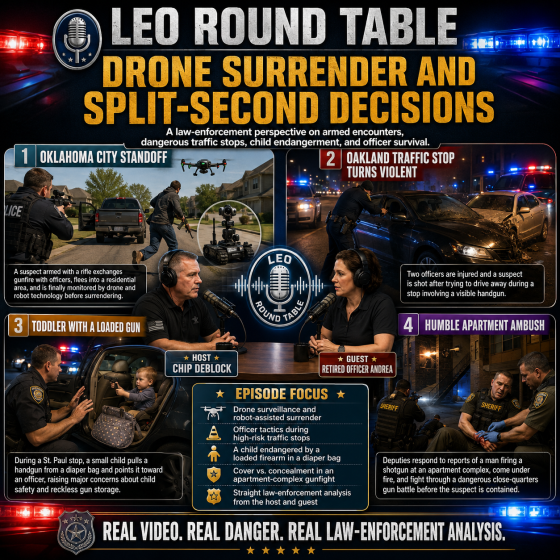
Gunman gives up after drone footage shows his surrender on video. Suspect injured while trying to flee from traffic stop with officer. Toddler pulls loaded gun from diaper bag during traffic stop. Deputy shot during intense gunfight with suspect.
Drone Surrender, Traffic-Stop Tactics, and the Hidden Risks Officers Face
Drone Footage Changes the Tactical Picture
The episode opens with host Chip DeBlock welcoming retired Tampa Police Department officer Andrea Casao for a law-enforcement discussion centered on body-cam and dash-cam incidents. The first major story examines an Oklahoma City armed-disturbance call in which a suspect identified in the transcript as Charles Ray Henry Jr. ran from a truck with a rifle, moved toward a residence, and later surrendered after officers used a drone and robot to monitor and contain him. The discussion focuses on how modern technology can help officers avoid unnecessary exposure during dangerous armed encounters.
Radio Use Under Pressure Becomes a Tactical Question
Chip and Andrea analyze the Oklahoma City video from an officer-safety perspective, especially the officer’s apparent decision to use the radio while also trying to maintain a rifle-ready position. Chip argues that, in many fast-moving armed confrontations, getting on the radio can distract from the immediate need to protect oneself and address the threat. Andrea adds that body-worn camera footage does not always match what the officer actually sees and suggests that officer psychology today may be shaped by fear of second-guessing and prosecution.
Oakland Traffic Stop Raises Officer-Safety Concerns
The next incident involves an Oakland traffic stop where police said the driver had a stolen firearm, resisted detention, attempted to flee, and pinned an officer between vehicles before being shot. Chip questions how the officer recognized the gun as stolen before confirmation, while Andrea focuses on the tactical choices made at the vehicle. She emphasizes slowing down, maintaining visual control of the suspect’s hands, avoiding reaching into vehicles, and waiting for additional officers when possible.
A Toddler With a Gun Turns a Seat-Belt Stop Into a Crisis
The episode then shifts to a St. Paul traffic stop where a toddler reportedly pulled a loaded handgun from a diaper bag and pointed it toward an officer. The transcript says the driver had no license, active warrants, and three children under age three in the vehicle. Andrea strongly criticizes placing a firearm anywhere near a diaper bag or young children, describing the child’s act of pointing the gun as possibly learned behavior and stressing how quickly the event could have become tragic.
Child Safety and Pretext Stops Become Part of the Debate
Chip uses the St. Paul incident to argue that routine traffic stops and pretext stops can reveal serious hidden dangers, including warrants, unsafe child restraints, and unsecured firearms. Andrea expands the concern to child welfare, noting that the children were apparently not properly secured and had access to the diaper bag. Both speakers express relief that the children and officers were not harmed, while questioning whether child protective services would take meaningful action.
Humble Apartment Shooting Highlights Cover, Concealment, and Crossfire
The final major video discussion concerns a Humble, Texas apartment-complex gunfight in which deputies responding to reports of a man firing a shotgun were shot and injured. Chip explains the reported use of SWAT, technology, and CS gas before the suspect surrendered, while Andrea critiques the officers’ positioning, possible crossfire, and lack of cover or concealment after one deputy was hit in the wrist. The episode closes with a practical explanation of the difference between cover and concealment and a reminder that officers often must make urgent tactical decisions under dangerous and uncertain conditions.
LEO Round Table

LEO Round Table is a nationally syndicated law enforcement satellite radio talk show discussing today's news and issues from a law enforcement perspective. They also have components on TV, Podcasts, and Social Media. Their panelists are among a Who's Who of law enforcement professionals and attorneys from around the country.
https://leoroundtable.com/how-to-become-a-panelist/
Speaker Identification
Speaker 1 - Chip DeBlock, Host. The speaker identifies himself by name at the opening and repeatedly refers to his role as host of the law-enforcement talk show.
Speaker 2 - Andrea Casao, Retired Police Officer. The host introduces Andrea as a retired Tampa Police Department officer and describes their prior work connection. The spelling “Casao” is the most likely rendering from the transcript, but it is listed for verification.
Speaker 3 - Video Narrator / Prerecorded Incident Voiceover. This voice provides structured narration over the Oklahoma City police video, describing the suspect, drone footage, tactical unit response, and surrender.
Speaker 4 - Body-Cam / Scene Audio. This label is used for short quoted commands and emergency audio captured in the video clips, including officer commands and injured-officer statements.
Speaker 5 - Sponsor Voice / Prerecorded Commercial Voice. This label is used for sponsor messages that appear to be prerecorded or read as distinct promotional segments.
Speaker 1 - Chip DeBlock, Host: Welcome to Leo Roundtable at leoroundtable.com. My name is Chip DeBlock, and I am your host. We are a group of law-enforcement professionals who talk about today’s news and issues, but we do it from a law-enforcement perspective.
Let me introduce Andrea Casao, retired police officer with the Tampa Police Department. Andrea and I actually used to work together. She worked for a couple of decades in Tampa. When I used to teach, she was in my class at the academy, and she blew all the records away in the physical fitness portion. That was pretty good. That was a long time ago, huh?
Speaker 2 - Andrea Casao, Retired Police Officer: That was a long time ago. It does not seem like it was that long ago, but it was a long time ago.
Speaker 1 - Chip DeBlock, Host: Yeah. Great memories. Thanks for being on the show. We appreciate it, Andrea.
Speaker 2 - Andrea Casao, Retired Police Officer: Thanks for grabbing me.
Speaker 1 - Chip DeBlock, Host: Normally, during the school year, she works at school. God bless her. She is doing God’s work putting up with all those kids during the school year, but we get to borrow her occasionally when school is out.
A shout-out to our sponsors. Our title sponsor is Galls at galls.com. Do not forget that 15% discount code. It is Radio15, and you can use it at any time. We have Comply Technologies, our satellite sponsor GunLearn.com, My Medicare.live, and Two Belles.com. They built a new online store at leoroundtable.com. Check it out. You can buy the mug behind me. We do not charge anything extra for the stuff. We have hats, shirts, pants, and even some dry-fit and tribal items, I believe, Andrea. If you guys are interested, check it out. We are just trying to get our gear out there, and that is why it is so dirt cheap. I actually pay the same prices that you guys pay when I order stuff.
A shout-out to Brian Burns with the Tampa Free Press, Reed Deidrich with Former Lawman, and Travis Yates with lawofficer.com. Thanks for helping us stream the show. We are also on every podcast platform known to man, including Spotify and Apple iTunes, two of the biggest. We are on social media, Rumble, Facebook, YouTube, X, formerly Twitter, and Truth Social. We are on all those outlets and a lot more. The best way to find everything is to go to leoroundtable.com. Our website’s top menu bar has all the outlets we are on, all the 47 radio stations, the call signs, and the dates and times of the broadcasts. All that stuff is there, so check it out.
Now let’s whet the appetite and talk about the topics for the show. We have a lot of body cams. We have body-cam video showing a shootout between a suspect and Oklahoma City police officers. We have two officers injured and a suspect shot when he tries to flee from a traffic stop. We have a toddler, and I was always hoping you would be on the show when we covered this one, Andrea. A toddler pulls a loaded gun from a diaper bag during a St. Paul traffic stop. Crazy, right? Of course, St. Paul and Minneapolis are right there next to each other.
Then we have body-cam footage showing the moment a deputy was shot during a gunfight at the Humble apartment complex. We have SCOTUS, the Supreme Court of the United States, declining to hear a qualified-immunity case, allowing Michigan officers to be sued over a use-of-force situation. Davenport police dash-cam video shows two squad cars colliding with each other. We also have a chase involving a U-Haul that is caught on camera. It ends in a crash, the driver in handcuffs, a pretty fancy PIT maneuver, and some cool music as well.
Are you ready to get started, Andrea?
Speaker 2 - Andrea Casao, Retired Police Officer: I am ready.
Speaker 1 - Chip DeBlock, Host: All right. If you want to take anything out of order, let me know. Let’s start off with the first story with the video component. At rumble.com, and all these videos are from our favorite channel, This Is Butter, we have a body-cam shootout between a suspect and Oklahoma City police officers.
Speaker 3 - Video Narrator / Prerecorded Incident Voiceover: Henry exited the truck armed with a rifle and ran toward a nearby residence. While running toward the residence, Henry pointed the rifle at officers, prompting one officer to discharge his rifle at him.
Speaker 4 - Body-Cam / Scene Audio: Shots fired. Shots fired. When you come around the corner, his truck is in the road. He just dipped into a house.
Speaker 3 - Video Narrator / Prerecorded Incident Voiceover: The suspect was not hit by the officer’s gunfire. Henry fled into a neighbor’s backyard, where he eventually positioned himself behind a shed. He was still armed with the rifle and appeared prepared to fire at anyone who approached. All the nearby homes were evacuated for safety. Several attempts were made to get Henry to surrender, but he refused. The Oklahoma City Police Department tactical unit responded to assist. Officers utilized drone technology to safely monitor the suspect’s actions for several hours until he eventually surrendered.
Speaker 1 - Chip DeBlock, Host: Oklahoma City, Oklahoma. We have newly released body-cam video showing the moments that led up to a shooting between the suspect and Oklahoma City police officers back in April.
The police department says officers were called on April 9 to an armed disturbance. First flag: at least the cops going in knew that it was an armed situation. The worst part is not knowing that it is armed and then finding out after the fact, when maybe it is too late. After officers got to the scene, they said the suspect fired at a responding officer, who ended up returning fire.
The suspect fled, but he was later located. There was a police perimeter and evacuations of nearby homes while officers secured the area. Officers were later able to take the suspect, identified as 36-year-old Charles Ray Henry Jr., into custody after he surrendered to police. At the time the article was written, the Cleveland County Jail was holding this guy on a $5 million bond, which is actually pretty high considering what we usually have to deal with. Everybody thinks bad guys are in jail for a lot of money. Not normally. Usually, they purge the jail, do they not?
At the five-second mark, we get slow motion on the video of the suspect running from the vehicle to the residence. He has a rifle in his possession. Then we have the real-time video starting at 16 seconds. I kind of wish they would have done it in the other order, Andrea, because when you watch things in real time, it is so weird. When you are the officer, as Andrea knows, and I am preaching to the choir, when things happen in real time, you miss things. You just are not going to get everything right.
When they show things in slow motion first, you kind of get almost everything. I like full motion first, because you are going to miss a lot of stuff. Then they do the slow motion, and you say, “Oh, crap. I did not notice this. I did not see that.” They kind of did it in reverse order.
The officer fires his duty rifle at the suspect. We have at least two officers with rifles, and the officer fires at the suspect twice. If you notice on the video, the cop is on the police radio because they simply cannot help themselves. He is on the radio when he needs to be taking a shot with a rifle, and it interferes with his ability to protect himself and shoot the bad guy.
At the 43-second point, we have a drone up in the air. It is recording video of the bad guy, who is armed in the backyard of the residence. At 1:09, he ditches the rifle and surrenders to the police robot, which is kind of cool. I also noticed all the police green lasers on the bad guy at the time of the arrest.
Andrea, you have it from here.
Speaker 2 - Andrea Casao, Retired Police Officer: Real quick, I think what is cool is that you start to look at the technology in law enforcement that maybe we did not have access to as much. It is really neat what you can use these tools for. The drone footage is amazing. I actually think that is awesome. It probably protected a few officers, with the robot being able to go in.
If you notice, he saw that robot, and it was kind of like, “I am just going to go ahead and leave this gun right here, and I am going to come on out.” The one thing I will say about the officer is that it is really cool to have the body-worn camera, but it is still on your chest. It does not give the same vantage point as what the officer is seeing with his eyes. There is more that you are missing.
It goes to show that he could almost use that fence more. If he bladed himself, he was so close to that fence that if he had taken a little step back and gotten a better vantage point, maybe he could have gotten a better shot off. It looked like he almost surprised himself with that first shot. Because they showed it slowed down, we saw what was going on. When you are sitting there watching somebody point that firearm at you, there is that split second to react. He is quick to try to take the shot, but then he gets on the radio.
You hear it real quick. He is on that radio, and all of a sudden you lose your vantage point. You can no longer see him. If he had taken a little bit of a step back, relaxed a little bit, and not worried about the radio, it sounded like there was a second officer there. If they need to get on the radio, let them get on the radio. If he is taking charge of that scene, let him take charge. This is one of those things that happens so fast that, unless you are there, it is really hard to judge the whole situation. Amazing with the drone and the robot, though. Very cool.
They evacuated the houses close by. When you look at the grand scheme of things, they did a good job. The only thing I would say is, “Take your time. Back off. Let the other officer get on the radio.” Those things happen so fast in the moment.
Speaker 1 - Chip DeBlock, Host: I was thinking when I watched it, before we had the robot, we just would have sent Andrea in.
Speaker 2 - Andrea Casao, Retired Police Officer: There is a lot of truth to that.
Speaker 1 - Chip DeBlock, Host: The radio, I do not know what it is with the new cops. I do not know why they feel so compelled. It is different if you have a bad guy in a sniper situation and he is taking out cops as they arrive. You might say, “Do not arrive from the south. Come from the north,” or “We are trying to contain the guy, so the unit down on the south side needs to block the streets,” or whatever.
But when you are engaging a bad guy, and you are not going hands-on but guns-on, and you may have a shooting situation, and you have to release the firearm with one hand, especially if you have a long gun, just to get on the radio and let them know what you are doing, tactically, in most situations, that is an unsound move. In this case, the bad guy rolls out with the rifle, and our cop is not ready because he is on the radio.
Speaker 2 - Andrea Casao, Retired Police Officer: I think if somebody breaks down the psychology involved, it is going to be kind of a subconscious thing. It is one of those things of knowing that people are not behind you. So many times, they are second-guessing these things. When you are reacting as a police officer now, the psychology is different. Officers are thinking about so much more.
We have been talking about this progression of law enforcement for years, from the time maybe when you got hired versus when I was there, and all the changes in law enforcement. The psychology is totally different for officers on the street today than it was for us. We used to do stuff and be able to articulate it. Now you look at officers getting prosecuted. Their lives are being taken away when all they are doing is trying to protect themselves and the public. They are doing their job.
I am not saying that applies to every situation, but they are having to think about all these things. It is almost like, “If I get on the radio, I have my people behind me. I am letting them know.”
Speaker 1 - Chip DeBlock, Host: Like your peeps.
Speaker 2 - Andrea Casao, Retired Police Officer: Yeah. I would have to think it is a psychology thing. It is an insecurity thing. It used to be that training would just take over. You would do it, react, calm down, and slow it back down. I remember every time we would go and shoot, it was, “Slow it back down. Breathe.” We are missing that step.
Speaker 1 - Chip DeBlock, Host: We need to bring people like us to be supervisors, Andrea, so we can kind of chill it out for the cops. No? You are not interested? All right. It is time for our first commercial break. Stick with us. We will be right back.
Speaker 5 - Sponsor Voice / Prerecorded Commercial Voice: My family only cares about one thing: that I come home safe. At Galls, every order begins with a promise made with purpose, stitched for support, backed with pride, answered by dedicated hands, and delivering the standard you have sworn to uphold. We serve more than the mission. We serve the person. Each piece is engineered to help get our first responders through the shift and back home safe.
Speaker 1 - Chip DeBlock, Host: Welcome back to Leo Roundtable at leoroundtable.com, the law-enforcement talk show. My name is Chip DeBlock, and I am your host. We are joined by Officer Andrea Casao, formerly of Tampa Police Department. We have been having a good day talking about a video with a use of force.
Andrea, if you are ready, let’s move on to the next one. Before we do, we have people telling us how they are rolling on the Fourth of July. George is going to be doing fireworks. MBS is in Colorado, and he says they canceled all the fireworks because he is in northwest Colorado. I guess they are worried about fires and stuff. It is sad that they had to cancel the fireworks.
Speaker 2 - Andrea Casao, Retired Police Officer: You should do a little special, Chip. Have some fireworks. Do something for them.
Speaker 1 - Chip DeBlock, Host: So you are volunteering to be on the show on the Fourth of July. Is that what I am understanding, Andrea? Your family can watch it live.
Speaker 2 - Andrea Casao, Retired Police Officer: Be careful. Be careful.
Speaker 1 - Chip DeBlock, Host: Sharon Cottell just posted that she is in the mountains for the week, easier on the dog, small-town parade, and a car show. Okay. I love it. That is kind of cool.
Speaker 2 - Andrea Casao, Retired Police Officer: That is very cool. Car shows are fun, and I love the small-town parades.
Speaker 1 - Chip DeBlock, Host: I wish I still had that show car that I sold a year and a half ago. I had a lot of great memories, but it is all good.
We are moving along, guys. We have another story with a video component from rumble.com, This Is Butter again: two officers injured and a suspect shot when he tries to flee from a traffic stop.
Speaker 4 - Body-Cam / Scene Audio: Step out of the vehicle. Step out of the vehicle. Do not reach. Do not reach. Do not turn on the vehicle. Sir, stop. Hold it. Get your hands up. Give me a favor. Just keep your hands up. Step out of the vehicle. Do not reach.
Speaker 1 - Chip DeBlock, Host: We are jumping over to Oakland, California. Oakland. If it were not for places like Oakland, we would not even have a show. Oakland has a civilian committee that reviews police use of force, and they openly advertise for convicted felons to join this civilian oversight panel that is in charge of cops. They solicited convicted felons.
Then, of course, you have that drama where the dispatcher’s daughter was involved with half the department, and there was all kinds of stuff going on. Oakland is so woke. I am not necessarily talking about the cops, but the people there. It is like the only place I think might be as bad or worse would be Portland. I am throwing that out there. I am saying worse than even San Francisco and L.A. It is bad. I am giving people an insight into what we are getting into here.
We are in Oakland, California. Oakland police shot a person who they say was armed, and two officers were injured during an early-morning traffic stop in Oakland’s Little Saigon neighborhood. So they apparently have a Little Saigon.
James Beere said the driver, Caleb Grant, had a stolen gun. The incident started when two patrol officers conducted a traffic stop. The driver, who of course is in that bad-guy age range that is always 18 to 21, right, Andrea, is from Sacramento. Now they are throwing Sacramento under the bus. He was from Sacramento and the sole occupant of the car, and he had a stolen handgun.
During the stop, the officers saw that the driver had a gun, and one of the officers believed it was stolen. When officers attempted to detain the bad guy, the driver resisted arrest and tried to drive off. He ended up crashing. During the process, an officer was in the doorway. The door was ajar, and the officer was trying to get this guy out. Then he put the car in gear and drove, and the officer tried to stop him.
The officer got pinned, and in the video it looked pretty bad because the guy crashed. The officer was pinned between the car and the parked vehicle that the guy rammed into. The officer who was pinned fired his gun at the driver and struck him once. More officers arrived at the scene, and the two officers and the suspect were taken to a nearby hospital. They were all listed in stable condition. That is the way that ended.
Going back to my notes, the officer observed what he suspected was a stolen firearm. They do not really say more. It sounds like creative writing to me. I am not that against it, but you know what I am saying. Today, if somebody has marijuana and they can have a medical marijuana card, you cannot always use that as a purpose to stop somebody. Different states have rules about whether it is burned marijuana, raw marijuana, or what you are smelling.
Just because someone has a gun, especially after the U.S. Supreme Court, do not automatically assume they do not have a license to carry unless you know they are a prohibited person or something. This officer says, “I thought it was a stolen gun.” I would like to see how that was justified in the report.
The officer opens the driver’s door. They try to grab the firearm at gunpoint. So he has his gun out and is trying to grab the gun. Then the suspect drives away. The officer does not have use of both hands because he has a gun in one hand. The officer gets pinned and fires a shot at the 2:08 point. Then they jump to body-cam and do a freeze frame on the video, which is kind of cool because it helps us. Andrea just talked about that in the last one. Andrea Casao, the floor is yours.
Speaker 2 - Andrea Casao, Retired Police Officer: This is one of those again: slow it down. You do not have to rush. The officer was developing rapport. I do not love how the first officer walks up. For some reason, a lot of times officers will be like, “Hey,” trying to calm them down and be friendly, but he is right up at the window. He is literally faced right at him. Use the car. Use that barrier.
He does have that rapport, so keep him talking. Officers on the passenger side should keep their eyes and keep the visual. Keep your gun on him and allow the other officers to come to the scene. Get more officers there. Slow it down. Do not reach into the vehicle. How many times do we say, “Do not reach into the vehicle?” He got pinned. He reached across this guy. Do not do it.
We have said it so many times, officer-safety-wise. I think there are officer-safety things here that we would definitely critique. Thank God the officers left alive, because that is one of those. Thank God nobody got killed in this one. It is scary. These things happen. Slow it down. Wait for other officers to arrive. You are better in numbers. The more you do that, the less articulation is needed because you just slow it back down and document everything that happened.
It did end up being stolen, but at the same time, you probably find that out after the fact. Then it is, “I am going to make sure I put that I thought that gun was stolen.” God love them; somebody taught them how to articulate, but that wording is probably going to go in the wrong spot. They will be asking, “How did you know what a stolen gun looks like?” Just slow it back down.
Speaker 1 - Chip DeBlock, Host: Yeah. We need to clone that cop and put him on every squad in America, because he can tell when guns are stolen. I am wondering what he can do with cars. Driving down the road, “Hey, that car is stolen, dude.” We used to have officers who could tell you if one was stolen just by driving by. “That is stolen.” Commercial break. We will be right back.
Speaker 1 - Chip DeBlock, Host: All right, guys. It is time to talk about our sponsor, Comply Technologies, at complytechnologies.com. They are committed to providing non-lethal solutions that help officers gain the upper hand safely and rapidly in a humane, low-optics manner, utilizing what they call their CD3, which stands for conductive distraction and de-escalation technology.
Their flagship product is called The Glove. It has not only helped officers tens of thousands of times, but they have actually had over 250,000 deployments and, guess what, no injuries and no deaths. It is an amazing statistic. They have achieved non-lethal status in an arena that predominantly can only offer less-lethal results.
When it comes to weapons retention and transition to a sidearm or a conductive-energy weapon, The Glove at complytechnologies.com has virtually eliminated weapons confusion. Stay ahead of the game with Comply Technologies and the revolutionary CD3, which hundreds of agencies have already turned to nationwide. Friends, take it from me: when it comes to safety, this is one of the most hands-on common-sense approaches that has ever come along. Go to complytechnologies.com today and tell them that Chip sent you.
Welcome back to Leo Roundtable at leoroundtable.com, the law-enforcement talk show. My name is Chip DeBlock, and I am your host. We are joined by former officer Andrea Casao, retired from the Tampa Police Department. Thanks for being back on the show.
We have been talking about stories with video components and uses of force, and Andrea has been tearing it up. Anything you want to add on the last story and the last use of force, Andrea?
Speaker 2 - Andrea Casao, Retired Police Officer: When you see an officer get pinned like that, I do not know about you, but the further I get away from law enforcement, and the less I can do about it, that really starts to hit me even more. Thank God they are okay. That is all I can say with that one.
Speaker 1 - Chip DeBlock, Host: For the people just tuning in, we are talking about a car that was pulled over. The bad guy had a gun. There was one thing, Andrea, I was trying to figure out. Maybe you picked up on it. The cop dealing with the bad guy had another cop on the other side of the car, which I would like to say is pretty much standard protocol, but who knows what they are doing today.
It looked like the cop on the other side of the car, who was looking in the car and could see all over the car, did not give me the impression that he saw anything until after he walked back over to the driver’s side with the officer who was initially talking with the driver. Then he says something about there being a gun. Do you think he did not see it until he got back on the driver’s side, or that he knew it and kept his mouth shut?
Speaker 2 - Andrea Casao, Retired Police Officer: That was initially what I wondered. I had to watch it again. No, he got on the radio, and I feel like that is when he called it. He let them know on the radio. He never said anything, from what I could tell, to the other officer on scene.
To me, you keep that position on the passenger side. They did a great thing. The officer who had the rapport asked him to roll down the windows. Great. He had a great vantage point when he was looking at that back seat. He had full visual, from what we could see, of the interior of that car. I believe he saw it when he was near that back quarter panel of the car, because he walked back to the rear of the car, taking his eyes off the interior and off the bad guy’s hands.
Then he gets on the radio. Apparently, whatever their codes are, he let them know that they had a visible stolen gun. So now, again, you have the psychology of it. The officer who has this rapport is hearing that, but the other officer never verbalized it directly to him from what I could tell. You could see he kind of covered the camera, and I am guessing his mic was right there. Maybe that is how the officer let the other officer know when he got on the radio. Unless he motioned to him, which we do not know, that seems like the only way he notified the other officer. But he was taking his eyes off the interior of the vehicle.
If you want to ask for more units, again, stay right there. Keep that vantage point of the entire interior of the vehicle and the bad guy’s hands, and wait for other officers to come.
Speaker 1 - Chip DeBlock, Host: Tactically, why do you need more officers? You have two officers with guns. If I see the gun, I draw down and say, “Signal zero.” I let you know that the guy is signal zero. He is not going to know what signal zero is, but you will. If he goes for the gun, I can shoot him through the glass from the passenger side of the vehicle. My partner, I assume, is going to get his gun out, too. I do not think you need them, but you might as well get them coming.
Speaker 2 - Andrea Casao, Retired Police Officer: In today’s day and age, you might as well get them coming, especially in Oakland. You are probably better in numbers because if that starts to go bad, you might as well have them coming. You do not necessarily need them, though. The whole thing is, if you are going to get on the radio and say that, do not take your eyes off the interior of the car.
Speaker 1 - Chip DeBlock, Host: Yeah. Do not take your eyes off the gun.
Speaker 2 - Andrea Casao, Retired Police Officer: Do you need them? No. Just get him out of the car and deal with the gun afterward. You do not have to reach in to get that gun. Get the guy out of the car and get him away from the firearm. Could they have handled it? Absolutely. But if you want to get on the radio and tell everybody else who is not there that you see the firearm, what about the officer who is there? I think that guy afterward might say, “Thanks a lot. What about me standing right next to this guy, literally having a conversation with him?”
Speaker 1 - Chip DeBlock, Host: All right. Speaking of traffic stops and wild things, lawofficer.com has a story: toddler pulls loaded gun from a diaper bag during a St. Paul traffic stop. This is crazy. I am glad Andrea is on the show. I cannot wait to hear her on this. We have not talked about this before the show, so there is really no prep time here for us. I just cannot wait to hear what she says.
St. Paul, Minnesota, which is right next to Minneapolis, is where all the crap happens that negatively affects our entire country. St. Paul is right next door. A routine seat-belt stop in St. Paul became anything but routine when a toddler reached into a diaper bag on the floorboard and pulled out a loaded handgun. What did the toddler do with the gun? The toddler pointed it at an officer standing at the vehicle.
The incident happened May 11. Kenneth Ray Terry was stopped for a seat-belt violation. Terry told the St. Paul police officer that he did not have a driver’s license. Not good. The officer discovered that Terry had active warrants for his arrest. Even worse, he had three kids in the car, all under the age of three, and they were in the back seat.
An officer on scene observed that one of the children was crying and not properly seat-belted. A second child grew concerned about mucus dripping from a sibling’s nose and climbed toward the Mickey Mouse diaper bag on the floorboard to grab a tissue for the sibling. The child reached in the bag and turned toward the officer holding a Taurus handgun, according to the reports.
The officer had the child put the gun down on the car seat and then recovered it. The firearm did not have a round in the chamber, but it had six rounds in the magazine. When officers asked the child where the gun came from, the child pointed toward the diaper bag. Then the father, who was driving, who had active warrants and was not wearing a seat belt, said that he obtained the handgun for protection because he had been receiving death threats. He told officers he placed the gun near the diaper bag because he had been pulled over. So he put it in the diaper bag in the back seat next to three kids.
Terry does not have a permit to carry a firearm. That could mean something, depending on the state. There are ways to secure guns in plain view. In Florida, maybe things are different. It does not say that he was a prohibited person, so I do not know whether he had a license or not, or whether that was a big deal or not. Andrea can give us her opinion on that, but the father ended up being arrested. Andrea Casao?
Speaker 2 - Andrea Casao, Retired Police Officer: Under three years of age. All of the children were under three years of age. First of all, the fact that you put a firearm in a diaper bag at all, at any time, I just do not know. Diaper bag and firearm do not make sense together.
Think of a three-year-old or younger picking up a firearm and pointing it at a police officer. Some of these are learned behaviors. I am not even going to make it about the police officer. Why is a child seeing anybody point a gun or know how to point a gun at anybody? As far as I am concerned, that is a learned behavior. That is something they have seen. Obviously, the officer handled it well. There is no malintent there.
Speaker 1 - Chip DeBlock, Host: You think they were Cuban? You said they had seen it before.
Speaker 2 - Andrea Casao, Retired Police Officer: I hope not. Why are you trying to give me a hard time about my people?
Speaker 1 - Chip DeBlock, Host: I am hoping your mother is watching this. Maybe not today.
Speaker 2 - Andrea Casao, Retired Police Officer: My mom will be laughing. She would. For some reason, she just has a huge laugh.
Anyway, it blows my mind. The fact that they would even know what to do with that gun and point it at somebody is very scary. It is one thing to pick it up and be handling it, but to have it pointed at somebody, thank God the babies are okay. Anytime you think of a child handling a firearm, we have all seen it. Kids get hold of guns. How many times does it happen, or almost happen?
This father does not need to be responsible for those children, at least not with habits like that. He may be a great person otherwise and maybe a great dad, but his habits need to change in order for him to be responsible for three children under three while putting a firearm in a diaper bag.
Speaker 1 - Chip DeBlock, Host: Let’s be honest. This could have gone down a little differently, too. It could have been a lot worse.
Speaker 2 - Andrea Casao, Retired Police Officer: It could have been so many things.
Speaker 1 - Chip DeBlock, Host: You have a cop, though. I could not imagine there being a cop shooting a three-year-old with a gun pointed at him, but I know they are out there. Honestly, a strike to the face would be the first shot. The kid would not have been able to retain the gun or hold it. I do not know what they charged the dad with. He had warrants. Assuming there was maybe nothing illegal about him having a gun in the car, he would have been charged for putting the gun in proximity to the kids and giving them access to that firearm. He definitely would have been taking the ride for that one.
Speaker 2 - Andrea Casao, Retired Police Officer: Child protective services should get involved. It does not say anything, but they should get involved. Unfortunately, with the way a lot of DCF goes right now, are they going to actually do anything about it? I do not know.
Speaker 1 - Chip DeBlock, Host: True. Well, guys, thanks for sticking with us. We have another commercial break, and we will be back in just a second. Stick with us.
It is time to talk about GunLearn at gunlearn.com. There have been changes with GunLearn, so pay attention because this is pretty substantial. GunLearn.com, for starters, is the first and only company to offer a step-by-step program that takes you from your present knowledge level to becoming a safe, accurate, and competent certified firearm specialist.
Here is the deal. That certified firearm specialist degree that I talked about, even if you got it five years ago, is now worth college credits. The reason is that GunLearn.com has partnered with a group called Smarter Degree and their university partners, and they have attached college credits to that certified firearm specialist degree. It is a huge opportunity.
They provide citations from federal law and ATF rulings, and they have been doing this since 1996. They have been teaching everything that LEOs, which means law-enforcement officers, need to know about firearms and ammunition to all facets of law enforcement. You can start today with online training, sign up to attend a live seminar, or go to the website, gunlearn.com, to get more information.
Welcome back to Leo Roundtable at leoroundtable.com, the law-enforcement talk show. My name is Chip DeBlock, and I am your host. We are joined by retired officer Andrea Casao of the Tampa Police Department, and she is tearing it up today.
Andrea, we were talking about the toddler. There were three of them in the back seat of the car when the dude got pulled over. He was not wearing a seat belt. This is why these pretext stops work, and you do not want to take them away like what they are doing in California, because you never know what you are going to get. Granted, we ended up having a toddler getting hold of a gun and pointing it at the cop, but Dad had a warrant for arrest, and he was not wearing a seat belt. You never know what you are going to get on these things.
Any final words on the toddler-with-a-gun stop?
Speaker 2 - Andrea Casao, Retired Police Officer: Thank God the kids are okay. Thank God the officers are okay. Hopefully that guy learns from the situation. Imagine if he is ever in the care of his children again.
Speaker 1 - Chip DeBlock, Host: Could you imagine what Mama did when she found out about this?
Speaker 2 - Andrea Casao, Retired Police Officer: I do not know, because obviously it is not the first time. You have a toddler trying to take care of another toddler in the car, so my guess is that she is probably not very involved. Again, I am making a snap judgment, but if the kids are not well secured in the car and child seats, if they are getting out of their seats and going into a diaper bag, how do they even have access to anything like that in the car?
When my kids were in car seats, they were not going to be reaching into any bag, because I did not want them taking everything out of the bag. They should be secured properly in the car, and clearly that did not happen. There are so many things you could pick apart.
Speaker 1 - Chip DeBlock, Host: We have Spook Dog saying, “Oakland, the armpit of the world,” so he is familiar with Oakland.
Speaker 2 - Andrea Casao, Retired Police Officer: He probably knows why they called more officers there.
Speaker 1 - Chip DeBlock, Host: Over on Rumble, we have a lot of interaction going on with MBS and Bill B.C. and all these guys. Of course, MBS is the guy in Colorado where they are not going to have any fireworks this year because I guess they are worried about the drought and starting a fire. That would be even worse. Bill B.C. is challenging and poking fun at you, and he is also saying, “Girly man coffee for Chip.” They are slamming me because I am trying to be honest.
Speaker 2 - Andrea Casao, Retired Police Officer: I need to start monitoring Rumble. I need to get on there. I have to get more screens up.
Speaker 1 - Chip DeBlock, Host: Or just a different tab. You can open up a spare tab and bounce back and forth. That is what I do there. Rumble is a good platform. They are still antiquated, but they are certainly better than YouTube, which is why we predominantly left YouTube. We have a little presence on YouTube, but not much, only the live shows.
If you are ready, Andrea, we have another story with a video component at the Humble apartment complex. What a name, huh? Rumble.com, This Is Butter channel: body-cam footage shows the moment a deputy was shot during a gunfight at the Humble apartment complex.
Speaker 4 - Body-Cam / Scene Audio: Shots fired. My wrist. My wrist. Start the bleed. Stop the bleed. Police.
Speaker 1 - Chip DeBlock, Host: We are in a place called Humble, Texas. I have never heard of it. I did not even know they had a Humble. I have never even heard of a humble Texan. Have you? I mean, you know, they beat their chests and say, “I am a humble Texan,” but I think my daughter is there now, so I am not going to say.
Speaker 2 - Andrea Casao, Retired Police Officer: I see.
Speaker 1 - Chip DeBlock, Host: Tell her that we talked about her on today’s show. We are in Humble, Texas. Newly released body-cam footage from the Harris County Precinct 4 Constable’s Office shows a deputy was shot and wounded during a gunfight with an armed suspect at a Humble-area apartment complex.
I get the idea that Humble is a small town. I am just going to go out on a limb, Andrea, and guess it must be right outside or not too far from Houston, because I think the medical facility they went to is in Houston. I am going to guess that. At the constable’s office, they call them deputies. The deputy was shot and wounded during a gunfight with an armed suspect at a Humble-area apartment complex.
The video captures an exchange of gunfire that left two deputies injured. Authorities say they were ambushed while responding to reports of a man firing a shotgun. Keep in mind, guys, that long guns are dangerous. A shotgun is not going to have the reach-out-and-touch effect that a rifle will. It is usually closer quarters, and you have a spread for the pellets. You are not going to take a guy out 100 yards away with a shotgun, but I still would not want somebody shooting at me with a shotgun. That is assuming he is not shooting slugs, too, and that he has double-aught buckshot, birdshot, or whatever.
According to Precinct 4, multiple callers reported a guy walking through the apartment complex with a shotgun and firing it. When deputies arrived and located the suspect, he opened fire on them and struck two deputies. I have to assume the call went out with this information, and it sounds like it did. They knew they were going to a call like that. They said he opened fire and struck two deputies. It does not say whether they were two different shots or the same shot. It is very possible one shot caught two deputies because of birdshot, buckshot, or whatever it was.
Following the shooting, the suspect barricaded himself inside an apartment, and a lengthy standoff began. SWAT showed up. They breached the residence, and the report says they used technology to locate the suspect and deployed CS gas before he surrendered. It does not say what the technology was. CS gas is different from OC pepper spray. CS gas is a dispersion agent, so your eyes are open, you can talk, you can communicate, and you can see where you are going. With pepper spray, you cannot. That is why you normally do not use pepper spray in situations like that, because people cannot go anywhere when they cannot see.
Authorities identified the suspect as Edgar Villegas, 38 years old. One of the newly released videos shows several deputies positioned outside the apartment building near a stairwell with weapons drawn and flashlights on. Then two gunshots ring out, followed by a deputy shouting, “Shots fired,” and then there is a barrage of additional gunfire.
The second video is from the perspective of one of the injured deputies, Dante Zepeda. It captures the moments leading up to the shooting. In that footage, they can be seen standing in the apartment breezeway, trying to figure out where the suspect is located. Is he at the window? Is he in there? At that time, a second volley of shots rings out.
I will let Andrea talk about cover versus concealment. After the first shots are fired, Zepeda, one of the injured officers, appears to fall forward. He gets back to his feet and retreats. You can see drops of blood all over the pavement as he moves from the line of fire. The deputy then turns back in the direction where the shots came from, draws his weapon, and appears to return fire before seeking cover. He apparently got shot in the wrist. We finally have another deputy applying pressure and a bandage to render aid and get that thing to stop bleeding.
Andrea, the floor is yours. Two minutes.
Speaker 2 - Andrea Casao, Retired Police Officer: Humble, Texas, is north of Houston, so that is correct. You are right.
Real quick, this one looked like a lot of crossfire. I am looking at them in this stairwell, and I could not quite tell where the window was, but it actually looked like one of the officers who was pointing the firearm had another officer right in front of him. I did not love it. No cover, no concealment. They were kind of out in the open.
Once the officer who got hit in the wrist was wide out in the open, take that firearm out of his hand. He is obviously reacting from getting shot, and his wrist is clearly bleeding. He is holding the firearm. Please take the firearm out of his hand when the hand has now been shot and he does not have proper control over it. Take the firearm and get it secured. Then they need to go conceal themselves from there. Clearly the bad guy has a gun and he is shooting.
Again, those officers are wide out in the open. From the beginning, I did not love the cover, and I did not love the concealment. You cannot quite tell where the window is, so I will be careful with being too critical, but after he was shot, there was no concealment on those officers at all. They were right there and possibly in the line of fire, where they could get hit again.
It sounded like the bad guy got hit. Clearly somebody got that shot off. I think that is one of those things where you have to remember to use that stairwell. That is some great concealment. Make sure you use those things when you have them, and watch the crossfire.
Speaker 1 - Chip DeBlock, Host: Guys listening to the show, if you are not from our world, you may not know the difference between concealment and cover. With cover, you get both concealment and cover. Concealment does nothing to stop a bullet. You can hide behind a plastic trash can or a curtain, and it will hide where you are, but it will not protect you from a bullet. That is where cover comes in. An engine block, or the stairwell Andrea is talking about, concrete walls, driver’s doors, and things like that can provide some cover, but a lot of rounds will go right through them like butter. It is better than nothing, but there is a lot of ammunition out there that will make Swiss cheese out of that.
There is certainly a difference between cover and concealment. Sometimes you just take what you can get, but ideally you want to have cover, which offers concealment as well.
Final words, Andrea?
Speaker 2 - Andrea Casao, Retired Police Officer: Thank you for having me. I hope everybody has a wonderful Fourth.
Speaker 1 - Chip DeBlock, Host: Andrea Casao, thank you. Guys, thank you so much for watching the show. Thanks also to galls.com, complytechnologies.com, gunlearn.com, My Medicare.live, and Two Belles. We will see you guys back on Monday at 12 noon Eastern for the live show. Hopefully, we will get Andrea back sometime soon.