LEO Round Table, July 10, 2026


LEO Round Table with Chip DeBlock
S11E135, FBI Investigates The 11 Missing Or Dead Defense Scientists (S11E135)
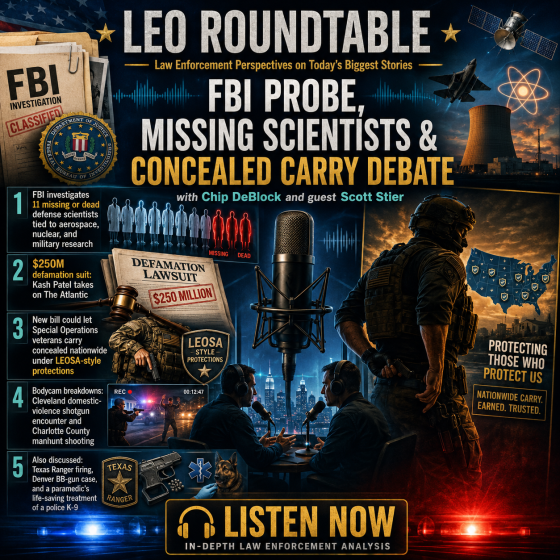
Kash Patel files $250M defamation lawsuit against the Atlantic. FBI investigates the 11 missing or dead defense scientists. Elite warriors may soon be able to carry concealed weapons in all 50 states. Armed man shot during domestic violence call. Suspect fatally shot after pointing gun at officers.
Missing Defense Scientists, Nationwide Carry Rights, and Officer-Survival Tactics
Summary
A Defamation Fight Over Anonymous Sources
Chip DeBlock opens by reviewing an article about FBI Director Kash Patel’s reported $250 million defamation lawsuit against The Atlantic and writer Sarah Fitzpatrick. Chip and Scott Stier question the reliability of anonymous sourcing, discuss how protected sources can be privately validated in court, and argue that publishers should be accountable when allegations are false, exaggerated, or insufficiently vetted.
Eleven Scientists and a Troubling Pattern
The central discussion concerns an announced federal review of 11 missing or deceased scientists connected to aerospace, nuclear, military, planetary-defense, and fusion research. Chip describes several cases from the article, while Scott considers whether espionage, coercion, kidnapping, or foreign interference could be plausible explanations. Both emphasize that the clustering of cases warrants a serious investigation rather than an assumption that every case is an unrelated coincidence.
Police Contacts, Bias, and Limited Information
Responding to a viewer’s question, Chip and Scott distinguish professional threat awareness from prejudice. Scott recounts a police contact involving his son at a private skate facility, explaining that the encounter ended once the officer learned the relevant facts. They argue that officers often enter uncertain situations with limited information and that ordinary questioning should not automatically be interpreted as harassment.
A Proposed Carry Law for Special Operators
The hosts examine the proposed Special Operations Forces Concealed Carry Act, which the episode describes as extending nationwide concealed-carry privileges similar to LEOSA protections to qualifying active-duty and honorably discharged special-operations personnel. Scott supports the proposal, citing extensive firearms training, threat identification, judgment under stress, and the potential value of trained former operators being present during an active-shooter attack.
Cleveland Shooting and the Duty to Use Cover
The first body-camera analysis involves Cleveland officers responding to a domestic-violence call involving an armed man who reportedly wanted officers to shoot him. Chip focuses on the officer who made a difficult pistol shot and criticizes officers who remained exposed or failed to have a long gun immediately ready. Scott stresses role assignment, weapon readiness, use of cover, spacing, and positioning officers so that one attacker cannot easily engage everyone at once.
Charlotte County Manhunt and Small-Unit Tactics
The final segment reviews the fatal shooting of an armed suspect after a Charlotte County manhunt. Chip recounts the reported homicide, the suspect’s exchange of gunfire with deputies, his return from the woods, and the final confrontation. Scott critiques officers bunching behind a shield or a single piece of cover, warning about crossfire and accidental shootings, and calls for more law-enforcement training in flanking, maneuver, spacing, and small-unit tactics.
LEO Round Table


LEO Round Table is a nationally syndicated law enforcement satellite radio talk show discussing today's news and issues from a law enforcement perspective. They also have components on TV, Podcasts, and Social Media. Their panelists are among a Who's Who of law enforcement professionals and attorneys from around the country.
https://leoroundtable.com/how-to-become-a-panelist/
Speaker Identification
Speaker 1 - Chip DeBlock: Identified by the opening self-introduction as the host of LEO Roundtable.
Speaker 2 - Scott Stier: Introduced by the host as a retired Green Beret and former Delta Force operator associated with Aero Precision. The exact spelling of his surname should be confirmed from the program records.
Speaker 3 - Prerecorded Sponsor Voice: A separate commercial voice heard during the Galls advertisement.
Speaker 4 - Body-Camera Audio: Officers and other voices heard in the embedded police video clips. Individual identities cannot be reliably assigned from the transcript alone.
Speaker 1 - Chip DeBlock
Welcome to Leo Roundtable. At LEORoundtable. com, my name is Chip DeBlock and I'm your host and work group of law enforcement professionals that talk about today's news and issues, but we do it from a law enforcement perspective. I’m going to introduce Scott Stier, a retired Green Beret and former Delta Force operator. He was with Delta Force and is now with Aero Precision. So that's a pretty impressive resume and I’ve pulled some stories that should make Scott very happy today. So I can't wait to cover those. So thanks for being on the show, Scott.
A shout-out to our sponsors. You know, we have our title sponsor, Galls. com. And don't forget, they've given us that discount code, which I'm getting ready to give to you. It's easy to remember, but don't forget it because you've always got 15% off with Galls with it. It's Radio 15. So remember, Radio 15, next time you go to the Galls. com, we have Compliant-Technologies. com or satellite sponsor, GunLearn. com, MyMedicare. live and tobellas. com, and Tobellas. com. They are both available through our new online store at LEORoundtable. com. I shout out to Brian Burns for the free press at TampaFP. com, Ray Dietrich, FormerLEO. com and Travis H with LawOfficer. com. Thanks for helping make the show happen. And don't forget, we have relaunched Leo Affairs at Leo Affairs. The. ch extension is not because the first two letters are the first two letters are my first name, but because it's hosted in the Switzerland, that's why we have this dot CH extension, which is for your protection and your privacy.
So I just went through all the sponsors and stuff. Let’s whet the appetite for what in the world we're going to be talking about today. And so we've got a couple of main topics. The first one FBI Director Kash Patel files a $250 million defamation lawsuit against the Atlantic. Yeah, a woke publication is putting out some crap. We've also got vanishing act FBI launches a massive probe in the 11 missing or dead defense scientists. That's alarming. We're going to find out what's behind that. I dropped the third main story because it was too close to something we'd already covered Scott just FYI for that. Our third article though, this should interest Scott. Elite Warriors could soon carry concealed weapons across the United States, all 50 States and territories. How can that happen? We're going to explain to you. There's going to be there. Hopefully, there will be some changes to the LEOSA, the Law Enforcement Officers Safety Act of 2004. We've got Cleveland Police officer shoots an armed man during a domestic violence call. And then we got body-camera footage showing deputies fatally shooting a suspect after Charlotte County manhunt. Then we're going to jump back.
We got a badge gun PTSD, Texas Supreme Court backs the DPS Department of Public Safety, firing a Texas Ranger after a school standoff after a school standoff. But it brings an interesting case, something similar to what I have when I was at the union in my last six years with the, with a police department. I'm curious what people think about it. If you think that they should have fired this guy or not, it's a, it's a, it's a conversation. We got a 58 year old who was armed with a BB gun with a BB rifle actually fatally shot by Denver police officer. And then lastly, right thing to do with a K-9, a paramedic. And I believe this is in Kansas. He said, well, it says that he will not be punished for treating a dying police dog. That's an incredible story. And yeah, that's in Kansas. So if we have time to get to that, we will. So if you guys are ready, let's go ahead and by guys, I mean, Scott, let's go and get started.
So the livery daily. com and the TampaFP. com, the free press. I didn't say the Atlantic. So this was in the Epoch Times FBI director, Kash Patel on Monday, about a $250 million defamation lawsuit against the Atlantic and its staff, writer Sarah Fitzpatrick over an article that was alleging false claims, according to Patel. I mean, in all honesty, I don't believe they're true, but, you know, I tell you the media, it's almost like cash is taking something out of Donald Trump's playbook is forced, you know, still in the media, even though Trump's lawsuit, he has, he has drug them through the mud, but he has been successful too. In a lawsuit filed in the U. S. Court of Appeals for the District of the Columbia Circuit, Patel, the FBI director, stated that the magazine and Fitzpatrick, the writer published the article with actual malice, despite being expressly warned hours before the publication that the central allegations were categorically false. Also, despite having abundant publicly available information that contradicted those allegations and despite obvious and fatal defects in their own sourcing.
I know that I hate it when they use a number of anonymous sources, you know, the Atlantic article by Fitzpatrick cited anonymous sources claiming Patel he drank in excess. His colleagues were concerned at one point. They said that Fitzpatrick wrote that multiple current officials and former officials had stayed close to him, meaning Patel, because they were concerned about the alleged drinking. They also claimed that President Trump was seeking to replace him, Patel, following the ouster from former Attorney General Pam Bondi. The lawsuit stated that the defendants’ “conscious decision to ignore the detailed specific and substantive refutations in the pre-publication letter and their refusal to give a reasonable amount of time for the FBI and director Patel to respond is among the strongest possible evidence of actual malice.” According to the lawsuit, his lawyer said that the Atlantic has a documented long-running editorial, animus against the FBI director, and stated that the defendants cannot evade responsibility for their malicious lies by hiding behind sham sources. And we don't even know what the sources are, right? The Epoch Times reached out to The Atlantic for comment.
They got no response. And it says that in April 17th post on X, Fitzpatrick, this is the writer, Fitzpatrick said that she spoke with two dozen people who were familiar with Patel's conduct before publishing the story, but she doesn't say or give a hint who they were. She also said that in response to 19 detailed questions, Patel allegedly responded, “All false, I’ll see you in court. Bring your checkbook.”. The magazine later changed the title because they initially called it Kash Patel's erratic behavior, could cost him his job. This occurred after Pam Bondi left office. And then they changed it to the FBI director is MIA. But I mean, personally, I'm seeing absolutely no evidence of that. And it seems like he's just absolutely freaking killing it. Scott, what do you, what do you, I mean, I hate because, you know, you've only got so much control over so much and you can file a lawsuit and stuff, but, you know, one story is like this, get out there, especially if they're not true, the damage has been done, right?
Speaker 2 - Scott Stier
Yeah, I mean, there's a lot going on here. I mean, the media obviously is biased. There is no doubt about it. Okay. So you have that. Yeah, absolutely. And there's they have been proven to, um, to say false statements that's been proven. So you have all that going on. So I get the, you know, it's a very weird thing when you say you have, um, informants and, um, you're not going to mention their names. It's almost like I could just make up whatever I say and say, no, I have 12 people, you know, Oh, that in some way we say, Oh, when you have 12 sources that are saying the same thing, it must be correct. But I could just pull that number out of my, you know what and just say it because there needs to be some checks and balances here. So, and I get it sources. I mean, in many cases need to be protected or else they're not going to come forward. But at the same time, there's got to be some way of validating that. And because I'm with you, I don't, I think this is all crap. Um, you know, any time someone has an opportunity or the media, the mainstream, it has an opportunity to smear someone in this administration, cash, tell Donald Trump, anybody, whatever, they're going to take that.
They've already proven that's their M. O.. So, you know, um, I don't believe it. And so what if he did go out and drink a little much when, you know, uh, they, who cares? That's being human. Um, obviously he didn't do anything crazy or radical, whatever. I mean, let's just back up here, stop acting like childish kids here, trying to pick and poke and try to every little thing he has a drink, probably whatever. I mean, come on, you know, so I think I don't believe it. I think it's something that's been thrown out of context. And I hope they, I hope, cause that's the only thing we have, I say we like the, anybody has these lawsuits that they can threaten them. There's no, you know, what else do you have? So you have to go after them with lawsuits because you have to hurt and hurt them where it hurts most, which is in their pocket.
Speaker 1 - Chip DeBlock
So here's an example of what, and there is a system, there is a way, cause this happens in place where, you know, all the time where we have, where we actually, we have confidential sources, we have to protect their identities, but they want to make sure we're not, you know, fabricating stuff. But so look what happens. We're already hoping that, you know, we're already making excuses for, well, what happens? I mean, what, so what if we had an extra drink here or there? You brought the hockey, the hockey thing. And so we don't even know if he even drinks. I mean, but we're already, and I'm not, I'm not faulting you, Scott, because in my brain, I'm thinking the same thing too, even if it's true, what's it? But you know, he may not even drink a drop of liquor in his life like Trump. Maybe he's never even had a drink, but we're already, we're already like, even a part of that's true, which is the one mindset to be because they're accomplishing what they're doing damage, you know, well, I think he was he's on video drinking a beer or chugging a beer or something. Okay, maybe, okay. Yeah, when they're all in there, like, ah, everybody, you know, they're partying.
I remember, I remember, I just don't remember the beer thing, but I remember being in the locker room and I had, look, I thought that was a great, a great thing. So let me kind of tell you what happens in the, in the police world, when you do cases and you have undercover informants and stuff, you know, what you do is you don't parade him in court in an open courtroom, although I had one judge that did that and he burned my informant because he insisted that he come out and I can't remember exactly how all that ended, but I had a, I had a, in my opinion, he was a corrupt judge and he was doing, you know, stuff like that. So, that said, you have a meeting with the judge in the chambers that's private and the other side doesn't necessarily get invited because, you know, if you've got, let's just say that there's somebody in the office supplying information about Kash Patel, you know, you bring a legitimate source and they appear before the judges satisfy that query, okay, without, you know, revealing who that guy is, if his identity is protected, but I know that you and I both feel the same way.
If there is some truth to this allegation, then they should not, I mean, if there's truth to it, they shouldn't be liable if they exaggerated or there's untruth and they should be held liable for what is untruthful or maybe wasn't vetted or sourced, but they need to cough it up. If they, if they don't want to produce the sources, then guess what? There's repercussions for that. So, I hope they hold their feet to the fire.
Speaker 2 - Scott Stier
I do too.
Speaker 1 - Chip DeBlock
All right. So we're going to have, we got a commercial break coming up. So I think we've got just enough time in order to whet the appetite for the next story, Vanishing Act, FBI launches massive probe into 11 missing or dead defense scientist, which is kind of scary. We're going to cover that next stick with us guys and be right back.
Speaker 3 - Prerecorded Sponsor Voice
My family only cares about one thing: that I come home safe and galls every order begins with a promise made with purpose. Built for support. Backed with pride. Assembled by dedicated hands. Delivering the standard. You have sworn to uphold. We serve more than the mission. We serve the person. Each piece is engineered to help get our first responders through the shift and back home safe.
Speaker 1 - Chip DeBlock
Welcome back. LEORoundtable. com, the law enforcement talk show. My name is Chip DeBlock, and I’m your host. We’re joined by We've got a special forces operative, former Green Beret, Delta Force, operator Scott Stier. Thanks for being back on the show, Scott. I love having you on. We're ready to talk about the missing scientist. I see here we've got a lot of people on Todd Irving and Betty Dunn and a bunch of guys Sergeant George and all these people that are either on Facebook and we're streaming to like I think about five Facebook pages right now. We're on YouTube as well and then pop it over to rumble. We've got Bill B. C. We've got MVS and the whole crew over there too. So thanks for watching the show, guys. We appreciate it. They want to know what the Leo Affairs website is. The new Leo Affairs, it's Leo that's Elioaffairs. ch. That is what the website is. And that is for my old website that let you talk about law enforcement issues anonymously without the fear of repercussion from your agency. I had over 500 law enforcement agencies in 18 countries and over 400 volunteer moderators when I sold it 12 years ago.
The new company I'll nicely say defied some guarantees that were made to me when I sold it. One of the guarantees was that it would not be taken down. So it's down so I'm resurrecting it. And it's already taken off at least locally here in this Florida area. And we're just trying to start growing it and expanding it again. So yeah, leealfairs. ch. So let's go. We left off. Let's go to our second main topic. Tampa Free Press at TampaFP. com. We have a vanishing act. FBI launches a massive probe in that 18. I'm sorry, 11. It’s probably 18 by now Scott, but 11 missing or dead defense scientists. So I'm going to go through this article quickly. There may be some new information in there. I suspect that there is because even I learned a thing or two federal investigators have launched what they are calling a holistic review into the mysterious deaths and disappearances of 11 scientists that are linked to high-level aerospace nuclear military research. So think about that. These guys are connected to aerospace nuclear and military research. And they're all they're like missing or dead. This is like scary. We've got 11 of them that we know of.
The probe confirmed by the White House and the FBI. It aims to determine if there is a pattern among the cases, which span from California all the way to Massachusetts. They include some of the nation's top experts in planetary defense and nuclear fusion. So think about that for a minute. And don't even think we just found out that SpaceX is, you know, our space program was heavily involved and has been and continues to be with what's going on with Iran right now too. Now the White House press secretary, Karoline Leavitt, she announced that the administration is coordinating with the FBI and the Department of Energy to identify any potential commonalities and FBI director, Kash Patel. So apparently he's not MIA Scott because he's here being quoted in the article. She said the agency is now centralizing evidence from various local jurisdictions to look for connections involving classified access or foreign interference. The investigation is put a spotlight on LA County, Los Angeles County because they had four prominent researchers with ties to Caltech and NASA's Jet Propulsion Laboratory among the 11 cases. So they're missing four. They give some other names and some other people.
I'm just reading the bios of some of these like Monica Reza, aerospace engineer and Aerojet Rocketdyne and just she vanished on June 22nd, 2025 hiking in the in a national forest. And despite seeing her friend just moments before she disappeared, no trace has been found. Carl Grillemore, astrophysicist, known for his work in dark matter. I mean, dude, this is just like Another expert on comets and asteroids died on July 30th the cause of death has not been released. It goes on and on. Your thoughts, Scott?
Speaker 2 - Scott Stier
Scary. I just, you know, I try not to look, you know, like, OK, and I'm trying not to think of it in like a conspiratorial type of manner. But that's just odd to me. I mean, and let's just face it. Like if a foreign agent wants, which they all want information on what we're doing, that's just we're all playing that game. If they can't get the information, like this person is not willing to be corrupted, he's not going to play ball. Maybe there's threats that he's going to go because I mean, usually they someone's going to they're going to get to them. They're going to try to, you know, befriend you somewhere in your daily life. You know, they're going to do their research and then sometimes they convert, they take the money and they sell secrets. And then a lot of times they don't. So if they don't, what are their options? OK, well, the only other option is to kidnap somebody and take them and then force or torture them and get information. Now, the death thing that's a little bit odd there unless it's like, OK, they're not trying to necessarily get information or maybe they did it didn't work. So they eliminated them. It's just it's just it makes you wonder.
It makes you wonder because you never know. I mean, it's definitely possible. I mean, it's plausible and there's that many and that short amount of time in the same industry. I mean, come on. I mean, when you start narrowing it down, I mean, what are the odds? I mean, what's the magic number? I mean, we're having this conversation and there's already 11.
Speaker 1 - Chip DeBlock
I know. Why do we not have this conversation when they were like four?
Speaker 2 - Scott Stier
Or I agree. I agree. I agree totally. So it's about time. I'm glad they're doing it. It's something we definitely need to investigate. I mean, that's just that's to me. It's just common sense. I mean, I mean, just at least we need to be diligent to at least eliminate. Oh, no, this is just the craziest, you know, coincidence ever. OK, well, at least there was an investigation. But yes, something needs to be done. And I'm just I’m like you two. I'm surprised it's taken this long.
Speaker 1 - Chip DeBlock
So if they don't come back with a link or something, then I'm going to be even more suspicious, right? I mean, you know, there's no way there is no there is. I'm telling you there is no way there's no plausible explanation that is benign. And in the look of the circumstances to look at the look at the guy. He was in New Mexico, the Air Force guy. He left home without a wallet, without his phone, and he had a pistol. And his wife of, I mean, I don't know, 30 some years, whatever knows him better than probably himself is like, this is odd. This is not what he does. And he goes missing like that in itself. I mean, that's like a major red flag. And so you have to wonder, like, what does he know? What was he doing? Who was he talking to? Why did he carry a gun? Why didn't he bring anything on a hike? Nobody does that.
Speaker 2 - Scott Stier
Yeah, I know.
Speaker 1 - Chip DeBlock
And we're not conspiracy theorists, guys, but we're just saying, I mean, you just do you just say the obvious?
Speaker 2 - Scott Stier
Yeah, do it. Yeah, you just, you know, if you have just basic intelligence, you just the flags have to start going off.
Speaker 1 - Chip DeBlock
You just can't and don't believe everything that people tell you. Don't believe everything you see. Don't, they certainly don't believe everything in the government tells you guys, it's time for a second commercial break. Stick with us. We'll be right back.
All right, guys, just tell them to talk about Compliant Technologies at Compliant-Technologies. com. And they are committed to providing nonlethal solutions to help officers gain the upper hand safely and rapidly. And what they call a humane, low-risk manner utilizing their CD3. And that stands for conductive distraction and de-escalation device technology. Now their flagship product we all know by now is called the glove. It's not only helped officers tens of thousands of times, but they've actually had over 250,000 deployments. And guess what? No injuries, no deaths. It's an amazing scat. They've actually achieved nonlethal status in an arena that predominantly can only offer less-lethal results when it comes to weapons retention, transition to a sidearm or a conductive energy weapon. The glove and Compliant-Technologies. com, they have virtually eliminated weapons confusion. So stay ahead of the game with Compliant Technologies and the revolutionary CD3, the hundreds of agencies have already turned to nationwide and friends take it from me when it comes to safety. This is one of the most common sense hands on solutions that's ever come along.
So go to Compliant-Technologies. com today. Tell them Chip sent you again, Compliant-Technologies. com.
Welcome back. LEO Roundtable at LEO Roundtable. com. The long force. McTalk show. My name is Chip DeBlock and I'm your host for joined by former Green Beret and Delta Force operative Scott Stier. Scott was, we had a question and we're going to go back to the we're on radio right now, but we're going back to the show that we left off that. And just a second, but we had Quentin Kerry, a streamer from Facebook that asked basically a question why cops harass citizens, even though they're just like, you know, they put your shoes on the same way, your pants on the same way we do. And the short answer is they don't, you know, the vast majority of cops don't don't do that. But absent the information, I don't know who you are, what you're doing in your spare time or what you're doing to make cops want to pull you over and stuff, you know, but the odds are that the issue is something that you are doing odds are, you know, and you're asking a question like that. It's not a problem around the country. And cops, you know, real, although we, you know, just like I know, special-forces operators, you know, you never confuse confidence with arrogance. Would that be an accurate statement?
I think that you could appreciate that, Scott, right? I mean, you know, a lot of a lot of people confuse the two. And Scott was talking about prejudice and bias. And so I read a very interesting article because people talk about prejudice stuff. But the article explained the difference between prejudice and bias. And there's there's certainly a difference. And bias is not necessarily a bad thing. In fact, it's something in our line of work in Scotts line of work, you know, special forces and in law enforcement. If you don't have bias, you're you're dead. You have to have bias. So bias is an educated awareness of things going on. Like someone I talk about, a white dude being in a predominantly Black area that's high-crime, high-traffic or a dope hole and stuff. Yeah, you got a bias on that. That's not a prejudice. That's a bias or you have a guy that's walking down the street and his hands are swinging, but one hand is staying closer to the body than the other hand. And you're thinking that guy may have a concealed gun, you know, a concealed weapon or firearm, you know, those are biases, which are healthy and good.
So I mean, everything can be, you know, taken too far and made a bad thing, but I'm just pointing those things out. Scott was telling a story when we were coming back to break, he was finishing up about his son being stopped by a cop and some was at a property with a skate park inside. The cop just wasn't aware of all the information. As soon as your son explained it, and he was aware of it kind of changed everything, right?
Speaker 2 - Scott Stier
Yeah. Yeah. He, so he said, yeah, we're in here, we're going skating. And so the cop was like, oh, I didn't know because it says private property and it's not open to the public. And so he looked in there and he saw, you know, some kids in there and were skating and using the facility. And he goes, okay, he goes, well, you know, he just wanted to make sure he wasn't doing anything illegal because that area, he said, look, he goes, I don't care. You kids, as long as you guys aren't, you know, getting in trouble, this is fine. But don't be here after dark. There's a lot of drug activity and crime. So, and then my son was like, oh, no, we're just here during the day. We don't, we don't come at night. So that's all I did. And he turned around and they left. It's like it's the cop did his job. He wasn't there to harass. He was there to ask questions. And once he found out that there was no criminal activity involved, he was not focused on the no-trespassing sign. He's like, that's not, that's not what he was looking for. And so he let him go. So, I mean, and that happens a lot, you know, we're all guilty of it.
But I would just say have some, have some empathy for the, you know, for the cop, they have a hard job. A lot of times they have to go into situations. They have very little information on it. They don't know what, you know, so that's what I would say.
Speaker 1 - Chip DeBlock
I love it. I mean, I love when I, when I go to the airport and they search me or whatever, you know, if they're saying, I mean, if I have a belt buckle, like, have a dog tag on whatever, you know, I forget to take it off, you know, I love it when they do it. Cause I have nothing to worry about, right? I'm not doing anything illegal and stuff, you know, so I love it. And I love it when these guys are not lazy and they do their jobs. They do what we're paying them to do and they're looking out for our best interests. So I have a little bit different, a difference of opinion than what our streamer did. So hopefully that answers your question. Now, let's get to this next topic. I can't wait to talk about, if you are, if you're former Special Forces, and I believe that's pretty much what it's covering, but there are some special-operations classifications that I, that I was a little surprised, I'll be honest with you Scott. I, hopefully you can explain that to me. Tampa Free Press at TampaFP. com. My buddy Brian Burns runs that over there. Elite warriors could soon carry concealed weapons across all 50 states. And I will throw in there also us territories as well. It's, it's huge.
It's not, it's not the contiguous states. I mean, like Alaska's in there and Hawaii, it is great representative Pat Harrigan of North Carolina of all places, introduce a new bill on Thursday. That would allow active duty and honorably dischargeddd special operations forces to carry concealed firearms throughout the U. S. and those other places I told you about including the territories. The proposal is titled the special operations forces concealed carry act. I’m going to say it again slower in case anybody wants to do research on it, special operations forces concealed carry act. And they're granting elite military members the same federal concealed carry privileges currently held by retired law enforcement officers. We call it the law enforcement, so the Law Enforcement Officers Safety Act or LEOSA and it was formerly known as H. R. 218. Uh, but that just means that it was a, you know, like a house bill at one point before it was passed legislation targets, qualified special operators, Navy SEALs, Green Beret, like Scott, Army Rangers, um, whose training the marksmanship standards often exceed those required a law enforcement federal law.
I'd already trust retired cops to carry concealed nationwide, according to the hair again, that makes sense, but it makes no sense that a retired seal, Green Beret, someone who's been a career mastering firearms under the most demanding conditions in the world has no equivalent recognition under federal law I agree, it passed the bill would amend the LEOSA, the Law Enforcement Officers Safety Act of 2004. If passed, it would amend that act to include them. The existing law allows qualified active retired leos law enforcement officers to carry concealed weapons across state lines, regardless of local or state bans. And that includes like, even they have a magazine ban in like California, where you can't, you can't have a magazine that holds more than 10 rounds, right? Uh, but you technically, you could, according to LEOSA, the state cannot restrict me of California. But I only carry 10 round magazine when I go because I don't want to push the buttons, you know, Harrigan’s bill would expand the framework to include specific military roles.
And this is where my question comes in, Scott, because special forces in my head, but they say Special Forces communications sergeants and Navy special warfare operators. So I am in my head, I'm thinking that these are guys with freaking radios or something, or they're up in an E-2 Hawkeye or whatever, or Marine scout snipers, Air Force pararescue, or a pararescue jumpers that they're including them as well. The bill specifies that this authority would be permanent, which I love, for those who maintain an honorable discharge status and who remain eligible under federal law to possess a firearm. In other words, they're not a convicted felon or something like that. Notably, the legislation removes the requirement for an annual firearms re-qualification, citing the high-level expertise already required for these military roles. So I have to qualify annually for LEOSA, but I'm assuming it makes it sound like you guys are not going to have to qualify annually, which is, wow, that's pretty cool. The move comes as concealed carry numbers continue the climb, listen to this stat, as of mid 2024. This is just, this is like mid 2024, this is like almost two years ago, the U.
S. concealed carry association reported that back two years ago, 22.9 million permit holders nationwide. That's about 23 million. Under the proposed timeline, the secretary of defense and the secretary of veterans affairs would have 180 days to implement a program for issuing the necessary identification cards if the bill becomes law, so that Scott, you could get a card that your LEOSA card and stuff. So this is a good idea. This is exciting stuff.
Speaker 2 - Scott Stier
It is exciting stuff. And I was telling you earlier, I remember being in the team room and we're all talking about this because I think it was like one of us went down, we got our concealed carry permit in North Carolina, which I'm not surprised at North Carolina. The representative is the one who proposed the bill because that is the home of Fort Bragg, special operations. So I'm not surprised at that. I think it's a great idea. I mean, I really can't see any downside to this. I mean, the level of training, I mean, I trained law enforcement for years. And the actual marksmanship side of things and the identifying threats and being able to do that quickly under stress, there's no comparison. And it's just because that's what we were selected and trained to do and that's what we trained a lot. So I think it makes sense because we look at it. You have all these special-operations personnel out there, active-duty and retired sprinkled all over America, who are very competent in their skills.
And now they're kind of sprinkled everywhere, you know, they’re at the mall, they're at or wherever they're, you know, still, because I mean, they're still, I guess, within there's other places that you're not still allowed to carry on assuming, but wherever they are allowed to carry, but they're sprinkled everywhere at the grocery store, at the coffee shop, whatever. And that's a good thing, because, you know, if an active shooter does happen and presents itself, you know, I'd like to have somebody like myself there to quickly eliminate the threat. So I love it. So I hope it
Speaker 1 - Chip DeBlock
goes through. So all you guys, former military, you're watching the show, you have some special forces. And I think it applies to retirees, but I'm hoping that I mean, I, you know, I know you can have a career in the military, but I'm assuming that they're going for the guys that did their, you know, that they did their four years or maybe they signed over some extra time. But I mean, to me, that you're good to go four years, you know, the level of training is so high. And then of course, having, you know, special forces, being a special forces for like 20 years or so, I don't know what the stats are on that. But I would think that would probably be a little bit more typical to do with age and abilities and all that stuff. So I may not, I'm so excited about that. Guys, we're coming up on our third commercial break. And we've got a story with a video component coming up. So we're going to be covering that. So stick with us. It's going to be fun. We'll be right back. All right, guys, it's time to talk about GunLearn at GunLearn. com. And hey, there have been some changes with GunLearn.
So if you haven't heard lately, you may want to pay attention, you know, and GunLearn for starters, they're the first and they're the only company that offers a step by step program that takes you from your present knowledge level to becoming a safe, accurate and competent, Certified Firearms Specialist. Now, this certification we're talking about, even if you got it five years ago, now it's worth college credits. That is because GunLearn. com, they partnered with SmarterDegree in their university partners in order to pull that off. So again, that certified firearms specialist degree, now it's worth college credits. And they've been doing this since 1996. They've been teaching everything that Leo's, which is law-enforcement officers need to know about firearms and ammunition to all factions of law enforcement. Now you can actually start today with online training, or you can sign up to attend a live seminar. And you can even get free training for yourself and all the personnel at your agency by hosting seminar for absolutely no costs. Go to the GunLearn. com to get more information GunLearn. com. Welcome
back. LEO Roundtable at LEO Roundtable. com. My name is Chip DeBlock. And I'm your host for joined by former Green Beret and Delta Force operative Scott Stier talking about some interesting things. Actually, we just got on talking about a proposed bill that would allow special people with special forces operators like Scott Green Beret, they didn't even mention Delta, which I was kind of surprised. But I know Delta puts people together from different units. And there's a lot of cross training and stuff. But it would allow them to essentially carry under LEOSA Law Enforcement Officers Safety Act, the Law Enforcement Officers Safety Act of 2004, which pretty much lets active and retired officers in good standing carry anywhere in the United States, including territories, which is kind of cool. And so it would let our special forces partners, you know, do that as well, which I think is a fantastic idea.
But of course, every time this comes up, there are people that say, you know, it's the “me too” argument, you know, me to you know, throw me in there, let me do it, you know, so I don't necessarily feel the same way personally about civilians, I have no problem with constitutional carry. I just have some concerns. I you know what you just I really the responsible thing is to have some level of training, you can already get state permits in a lot of places without getting any training. But and I understand their Second Amendment, you know, guarantees, I don't want to trample on that. But that's just my personal preference. I don't want to get taken out by some dude with a gun that doesn't know what he's freaking doing. And I know that Scott knows Scott, if he sees a situation, he's automatically going to be thinking. So, just because we know automatically just because we have a dude with a gun does not mean he's a bad guy. You know, we realize that so that leave everything else, Scott, you know, you got you get pretty animated Scott when you move your hands like that. I can't even I almost hear like the wind going back and forth there.
So yeah, you know, but the training and that's the thing
Speaker 2 - Scott Stier
that I think civilians don't quite understand is like, what's going to help make a decision is that you're not overwhelmed by stress, which means like the situation that is at hand, it's not going to affect or cloud your judgment. So when you operate in that stressful environment all the time, and you know, like coming up like there's someone shooting and you know, we're not freaking out. And it's like, okay, we address it. And so we calmly make decisions. So we're able to do that. So yeah, we might not be let's say as good as a shot is like a professional shooter. That's a grandmaster level shooter in the IPSC or something like that. True. But you know, we're also had that stress inoculation as well that helps us make decisions. So it all it's all there, you know, and yeah, so I think it's a great idea. So we'll see where it goes.
Speaker 1 - Chip DeBlock
All right, cool. Can't wait. So we have a story with a video component at rumble. com. This is PoliceActivity channel Cleveland Police officer shoots an armed man doing a domestic violence call.
Speaker 4 - Body-Camera Audio
Let me see your hand. Oh, [Unclear body-camera audio.] They’ve got the gun. Grab the gun. Get over to cover. Drop the gun! Drop the gun! Shots fired. Drop the gun! Drop the gun! Drop the gun! Drop the gun! Drop the gun! Put it down!
Speaker 1 - Chip DeBlock
Did you want to take something out of it, or, Scott? You okay doing the Cleveland one or the DV call?
Speaker 2 - Scott Stier
Yeah, that's fine.
Speaker 1 - Chip DeBlock
Cleveland, Ohio. So according to the Cleveland Police, an officer shot a man while responding to a domestic-violence situation around 1:30 in the morning, which is when they usually happen. And so the officers, they later learned that the subject involved, 33-year-old Charles Motley Jr. was in a car outside the home. So we're kind of armed with all the information, but the cops didn't know that when they were there. The caller told the officers that the guy had a firearm, he was threatening suicide by cop. According to the incident report, when the officers get there, Motley, the subject, exits the vehicle and he's brandishing a shotgun. In the body-camera footage, officers gave multiple commands to drop the weapon. Instead, he raises the weapon at the officers. One officer fired, striking Motley in the head. I'm going to cover that in my show notes in a second. He was reported in stable condition. He gets shot in the head. And I believe this was a pistol shot. The firearm was recovered at the scene. Motley's currently in jail being held on a $50,000 bond. Now let's jump to my show notes real quick here. We got a couple of body-cameras.
So the first one, and I recommend watching it from the beginning as the officers are dealing with this armed guy. He's inside the parked vehicle. DV, domestic violence call. And so he gets out of the car though. And it's kind of hard to tell what kind of a weapon he's got. They circle it, but it ended up being a shotgun. So at the 42-second mark, our officer running by another officer that's standing out in the middle of the street and the officer runs past another officer standing in the street, and I’m thinking: take cover. Take cover, dude. Because this guy's in the car getting out with a freaking shotgun. Our guy with a pistol has some cover and he does a one-shot headshot with a pistol. It looked like it was a decent distance. Not to mention the fact we have another cop that's got a long gun. Didn't take the shot. So, and the guy, the dude goes down. And I never saw, well, we'll get to the guy not doing the cover. They do a slow motion of this. And then we go to the body-camera number two and that's our guy with the long gun. And he, I'll let Scott talk about him. And he's pointed the bad guy and then he chambers a round. And then the pistol shot goes off.
And then the third body-camera, we have our cop that's standing out. No cover. And the dude runs by him and he still, he starts backing away, he starts back in creating distance, but he doesn't go, there's cover to the right. There's cover to the left. The dude, I mean, it drives me freaking crazy. Scott Stier.
Speaker 2 - Scott Stier
Yeah. So when I saw him charge the weapon, I was like, Oh my God, right there. Just, but at least he finally figured it out. I'm not giving him a pass on that. Cause I mean, when you come out of that vehicle, you better be ready to shoot at a moment’s notice. You better be able to employ that weapon. I look at it like this too. If someone, if a law enforcement officer, if he's the one with the long gun, okay, just like, listen, I'm going to draw a parallel here. If we're doing an assault, you know, we have a support by fire, you know, that's all our heavy machine guns, you know, crew-served weapons. They have a, they go into position. They have a role. They're not going to go in and clear the building. They're not going to do it because they have a long gun, right? But they're going to set up to where they can have suppressive fire and stuff like that. They have a duty. If I'm a cop and I get out and I have a long gun and everybody else has a pistol, I should be thinking, I need to go support this the best way I can with this advantage, which is a long gun. That is a huge advantage. And he just kind of stayed there.
It's like the minute you see where the threat is, the first thing I'm thinking is where do I need to go to support this? You know, and then I don't want to be like this with everybody else because I've talked about this many other times on the show. And cops have this tendency and there's another video as well that it illustrates this, but they stay together. It's like this comfort thing. I almost think like it's like get over there because one person cannot easily shoot two people positioned far apart. You know, like flanking somebody. That's why you do it. But if you're all together, all I got to do is just start shooting and there's a chance as I can hit as many as I want. So, you know, just, I think maybe that law enforcement officer, he needs to go back and get some retraining. Maybe he was overwhelmed by the situation. But yeah, it was.
Speaker 1 - Chip DeBlock
Let me throw this other one in. We’ve got two and a half minutes, but let me, let me cruise through this. This is the other one you're talking about. The rumble. com. This is another body-camera video: Body-camera footage shows deputies, fatal shooting suspect after a Charlotte County manhunt. He's armed. He's armed. Put the gun down now. Put it down. Shots fired suspect down. So, Charlotte County, Florida. Body-camera shows the moment a suspected gunman was killed by Charlotte County deputies and a North Port police officer after deadly shooting. So, we have Charlotte County Sheriff Bill Prummell, said the alleged shooter. Matthew Ryan Cross walked up to Charles VanDevere. His, I guess, I think it's a neighbor's front door. He shot the man in the head on March the 30th and then the sheriff said that altercation started a few days prior after Cross allegedly stole a gun from VanDevere’s home. So, according to the sheriff's office, Cross got a ride to the store and Cross is our suspect. Approximately 1245 p. m. He then walks in the woods and is dropped off. Deputies were in the area investigating the man with a gun call and they did not know it was Cross at 1 20 in the afternoon.
This guy emerges from behind a tree and shoots at deputies. One deputy discharges a service weapon and then Cross and now we saw a picture of him falling going down, but I guess he gets up off camera, runs into the woods and now deputies hear another shot, but they're all huddling together around the cars and stuff on the road. There's a line of trees and stuff. This dude comes out with the gun pointed up to his head at 3 12 p. m. And they light, the officers open fire. He's walking towards them, with the gun to his head and they received numerous mental health calls over the years involving this guy, Scott Stier.
Speaker 2 - Scott Stier
Yeah, so the one that I'll talk about. So when he was coming out of the tree, the tree line, I can, at least they were like you had a team over here. You had a team over here. Within the teams, one element was flanking. and one was the main element, as we would call it. That was okay in my, in my mind because they had cover where there was no cover. Well, I'm talking about before when he ran off. The cops are approaching. You have one cop with a, with a shield and his pistol and then everybody else behind him. Like, and I think it's actually a term like the stack or something like that. It's like, come on, dude. Like spread out. Like that, you're assuming that shield is going to, you know, what if he shoots the guy in the knee and now all of a sudden everybody falls down. It's, it's chaos. Maybe they start shooting. One guy backs off and you have guns behind each other, which you never want to do. You never want to shoot from directly behind somebody who's in close proximity. That's the way to shoot your buddy in the back of the head in that chaos. So spread out. It just, it just, it just, it irritates me. I mean, I want to see that because it's not hard to figure out.
It's like, if they don't, you know, like I said before, law enforcement, they typically do not train in small unit tactics. So they're, they're not thinking spread out, flank and maneuver and stuff like that. Now they are when they go hands-on, you know, like if you go into a parking lot and they're approaching a subject, you know, and it's, whatever, they'll, they'll get to the side of them. They do it all the time. Cops are really good at that. But as soon as somebody has a gun, they always get behind one piece of cover, creating a false sense of security.
Speaker 1 - Chip DeBlock
Great show, Scott, Stier, thank you again. Good luck with that. Getting on the LEOSA guys, please support our sponsors also. They go to the great links that bring the show to you. We've got our title sponsor, goals at Galls. com. Don't forget that discount code radio 15. Compliant-Technologies. com gunner. com, MyMedicare. live, two bells at. com. We'll see you guys back tomorrow live 12 noon Eastern.