
The Laughing Heart, July 19, 2026

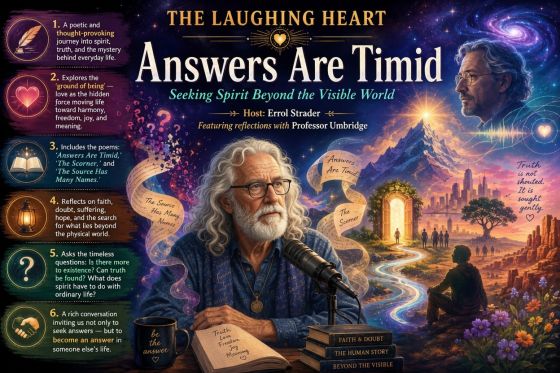

The Laughing Heart with Errol Strider
Answers Are Timid: Seeking Spirit Beyond the Visible World
Summary
An Absurd Question Opens a Serious Inquiry
Errol Strader begins with an uncomfortable but deliberately absurd story from 1970s San Francisco, asking listeners how they would respond to a vulnerable man lying on the pavement. The anecdote establishes the program's blend of humor, moral uncertainty, and philosophical investigation. From there, Errol asks what is most urgent and essential to share in a time marked by social division, authoritarian pressures, nuclear danger, and widespread anxiety. He proposes that beneath those conflicts may be a deeper "ground of being" whose nature is love. The opening frames love not merely as emotion, but as a force urging existence toward harmony, freedom, joy, and continuing expression.
The Limits of the Mind and the Possibility of Change
Professor Umbridge argues that the rational mind can provide only a map of ultimate reality, not the direct experience itself. Most people, the guest suggests, are absorbed in the machinery of ordinary life and rarely pause to ask whether anything dependable lies beyond mortal existence. Suffering can make the idea of continuation undesirable, yet changing historical conditions demonstrate that even dire circumstances do not remain fixed forever. The contrast between Nazi-era Germany and modern Germany, along with Europe's movement from centuries of rivalry toward union, is offered as evidence that human conditions can evolve. This reflection creates space for hope without denying present suffering.
Answers That Must Be Approached Gently
The poem "Answers Are Timid" portrays truth as something subtle, patient, elusive, and resistant to force. Answers must mature, be sifted from confusion, and be approached by a mind prepared to receive them. The poem warns against squeezing answers into expectations or treating facts as final truth, suggesting instead that facts are only the clothing answers wear. Courage, loyalty, patience, love, labor, and obedience are presented as the qualities that allow deeper understanding to emerge. The concluding invitation - "Be an answer" - shifts the search from abstract discovery toward becoming a source of meaning in another person's life.
Why Spirit Is Neglected in Everyday Life
Errol recalls a lifelong refusal to accept that there are no answers and explains that his search repeatedly led him toward spiritual reality. He defines the spiritual as the underlying dimension from which existence emerges, then explores questions about God, the soul, mortality, and what may lie beyond the physical universe. Modern life, however, prioritizes what can be measured, controlled, purchased, predicted, or immediately used. Questions about dinner, money, work, health, travel, relationships, and entertainment routinely push spirit to the margins. Errol uses humor to imagine a culture in which philosophy, forgiveness, and psychological inquiry receive the same public attention as consumer products and breaking news.
The Scorner and the Readiness to Seek
In "The Scorner," abstract claims about reality, divine harmony, eternity, and cosmic trust are repeatedly challenged by a skeptical voice concerned with suffering, physical needs, sensual experience, and bodily death. The poem does not erase skepticism; it dramatizes the tension between transcendent possibility and the demand for tangible proof. Errol then recounts a story from The Urantia Book in which Yeshua identifies four conditions absent in a man he does not approach: dissatisfaction with oneself, willingness to seek help, hunger for truth, and an open mind capable of receiving spiritual light. These conditions become a self-assessment for listeners considering whether they are ready to explore spiritual reality. Pride, fixed assumptions, and lack of inward openness are presented as barriers to that exploration.
Many Names, One Loving Source
The closing poem, "The Source Has Many Names," gathers titles from different religious, philosophical, and cultural traditions while asserting that the underlying divine nature remains loving and kind. God, Allah, Brahman, Yahweh, Jehovah, the Tao, the Source, the Force, Father, Mother, Creator, and other names are treated as varied attempts to describe one transcendent reality. Errol closes by acknowledging that mystery cannot be fully solved and that final answers may always remain elusive. Nevertheless, a person can embody compassion, creativity, insight, and hope for others. The episode ends with an invitation to live richly, remain open to discovery, and become an answer in someone else's life.
The Laughing Heart

Be kind - Support this WONDERFUL show
- and laugh a lot -
$5.99/mo or $9.99/mo
Click HERE
SUBSCRIBE TO TALK SHOW
The Laughing Heart--a podcast
Humor, story, and spoken word for insight, inspiration, and connection
Hosted by Errol Strider, poet, performer, and non-prophet.
Speaker Identification
Speaker 1 - Errol Strider, Host
The speaker identifies himself as Errol Strider at the beginning and end of the episode and presents the introduction, personal stories, philosophical commentary, poems, promotional information, and closing remarks.
Speaker 2 - Professor Umbridge, Guest or Character Voice
The host introduces a special guest as Professor Umbridge, who responds directly to Errol and offers an extended reflection. The transcript does not establish whether this is an independently appearing guest, a recurring fictional character, or a voice performed by the host.
Speaker 1 - Errol Strider, Host:
Hello, partner. This is Errol Strider coming to you from Los Gatos, California. Welcome to The Laughing Heart, where we explore what is most essential and, hopefully, what is really absurd.
Speaking of the absurd, I want to begin with a story. I was living in San Francisco in the early 1970s, and one day, while walking outside my flat, I came upon an older Black man lying on the concrete. I was going to pick him up, but I noticed that his penis was sticking out of his pants. My question was: Do I pick him up as he is, or do I put his penis back in his pants first? We will return to that later. As you think about it, see whether you can determine what I did - or what you would do.
Every time I do one of these podcasts, I ask myself: What is most urgent? What is most essential? What is the best that I have and could share?
It seems that, in these times, we are challenged and often consumed by distressing forces within our civilization - this tiny society living on a tiny planet in a tiny solar system. Divisiveness, the pull between democracy and authoritarianism, the possibility of nuclear Armageddon, and other compelling obstacles stand in the way of peace and joy in the human context.
Yet, in the background of all this, from my experience and point of view, is what the theologian Paul Tillich called the "ground of being": that which undergirds reality, that which over-controls it. Its nature is what we call love - love as the continual embrace of all existence while simultaneously impregnating that existence with the urge toward harmony, freedom, joy, and eternal expression.
Hmm. Those sound like big words to me. Let us see whether we can unpack them tonight with a special guest. This is Professor Umbridge. Welcome, Professor.
Speaker 2 - Professor Umbridge, Guest or Character Voice:
Ah, Errol. It is so delightful to be here. You are often exploring these incomprehensible possibilities, which means, inevitably, that you cannot use your mind to get there. The best your mind can do is provide a map. Just as a regular map does not reveal the actual experience you will have when you arrive - wherever "there" is - the same is true when ascertaining what is most real.
Very few people are actually asking that question, understandably. They are caught up in the mechanisms and machinations of mortal existence. However, some stop long enough to ask: Is this all there is? Is there something else? Even more importantly, is there something I can depend upon that would validate my existence and assure me of its ongoingness?
Of course, if you are experiencing suffering, you may not want to continue, because your idea of continuing would simply mean more suffering. But, as a Zen Buddhist once said to me, "Everything that comes around goes around." As dire as circumstances may be now, a time may come when they will not be so dire.
Consider Nazi Germany and where Germany is now; things do evolve. Consider also the hostilities and the vying for power among European countries in the 16th, 17th, and 18th centuries, and then consider that there is now a European Union. Had you been alive then, who would have thought it possible?
Speaker 1 - Errol Strider, Host:
Answers Are Timid
Answers are timid, my friend.
They are born when the snow starts to melt
and blossom when sweat beads fall.
They cannot be churned out like butter,
but must age like cheese.
In the desert, they lie under rocks.
On the mountains, they are high on the crest.
They are mixed in with confusion,
one thousand times their mass.
One must pan them like gold,
sift them like flour,
or just listen.
Answers are timid, my friend.
They are so close you can touch them from here,
but you have to know where to reach
before that answer will ever appear.
They hide themselves in corners,
on shelves covered with dust,
and they are in front of your eyes for years.
They will take you sailing on a bright, windy day,
then make you wait in a lull.
Just when you think the wind has died,
you are in a typhoon,
and you must trust your timid answer,
who is at the helm.
They will coast on the surface for a while,
until you think you see every one of them.
Then they will dive to the depths
of the unfathomable unknown
and will not even come up for air.
They cling to their mother, Truth,
who will not easily give them away.
She expects a good dowry
of love, labor, and obedience.
Answers are timid, my friend,
and they are slippery when wet.
You cannot hold on to them.
The more you squeeze and squish,
the farther they go.
You must skip along with them
on the rocks of the river of truth,
from conclusion to conclusion.
They are reluctant to appear
to the uncontrolled mind,
but joyfully bounce to a brain that is ripe.
Do not make the mistake
of looking for them in new facts.
Facts are just their clothes.
Undress the old facts you know.
Answers are timid, but not modest.
Answers are timid, my friend.
They are bashful and shy.
They only come out for familiar friends,
not the lazy, the proud, or the sly.
Watch it, my friend.
They will change size and shape on you in a flash,
so be careful.
Do not box them into your expectations.
They are liable to break the box
or disappear inside.
They go to those who will trust them,
who take a chance on their worth,
to those who hold them gently
and will not squeeze them dry.
The subtle ones are the hardest to catch
because they are bigger, more mature.
They can sidestep half-hearted attempts.
Answers are timid, my friend,
but bold when confronted by those
with enough courage to seek them out
in the caverns of adversity.
Answers are good friends
because they are always leading you to new friends.
Once they know you are loyal and patient,
one answer waited a million years before he was found.
He lived in an atom.
Another lived as a human
and is around although the human is dead.
People have talked of the human for years.
They need to discover his answer instead.
Answers are timid.
So be timid, my friend.
Be an answer.
Well, there you have it: "Answers Are Timid." The music was written by my son, Lev Strider, for which I am grateful. In fact, the piece became a video for which the music served as the soundtrack. You can see it on our YouTube channel, Strider Innertainment, or, even better, go to our website, TheLaughingHeart.org.
That piece has a wonderful history. When I was living in San Francisco and managing an apartment building - which is another story - I made a list of images and ideas. One of them jumped out at me from the page: "Answers are timid." So I wrote the poem.
My wife and I began performing it while touring. She played the answer, running around and hiding from me, living out all the images in the poem. We did that for years.
One day, we were about to perform it, and I was introducing the piece. My little three-year-old had somehow gotten into the donation box. When I said, "Now we are going to talk about answers," he lifted up a $20 bill.
Some people might, in fact, think that is the answer. I have often thought so myself on numerous occasions. For many of us, money is an answer, but a temporary one at best.
I remember living in St. Louis, Missouri, in the 1960s. I had a roommate, and I once asked him, "What is the answer?" His response was, "There are no answers."
That was not good enough for me, because something within me said that there are answers. I have spent the majority of my life looking for, and often finding, answers. They frequently point toward a deeper reality than the one we are accustomed to engaging - that which I have come to know as spiritual.
Here, I define "spiritual" as the undergirding of all existence, with everything emerging from this fundamental reality. There comes a point in our lives when we must consider the dimension of human experience that comes under the heading of spirit.
This can run the gamut from asking, "Is there a God?" to "Do I have a soul?" to "Is there anything beyond the physical universe, and what is its relevance to my life?"
The question may occur to us when we are four or five years old, as it did with both of my children, or in the middle of life, when we awaken to the fact that much of the future we had planned is already behind us. Certainly, when we first awaken to our mortality, these questions begin to surface.
A midlife crisis can come at any age. It is usually frightening, confusing, and fraught with the imponderable. In our modern secular society, despite our pretensions toward spirit - carved on our money and given lip service by politicians - we give it very little serious thought.
Most of us have focused our lives on what is accessible and immediate: what can be felt, seen, grasped, thought about, and predicted. Spirit must take a back seat to such formidable and apparently more significant questions as: What's for dinner? How much does that cost? When will we be there? What did the doctor say? Where should we spend our vacation? What's wrong with you? How many times have I told you? What is our net profit? Did I get a promotion? Who won the game? Or, would you take your clothes off?
Many of us stay away from the whole issue of spirit because it is not tangible and therefore seems to exist beyond the possibility of knowing. It is certainly outside our control. Since so much of our lives is spent trying to control things, people, and circumstances, it is no wonder that we stay away from spirit - the mystery. It is definitely something we cannot control, though that has not deterred religionists throughout the ages from trying.
I keep expecting to hear on the nightly news: "A man in Milwaukee has just broken through into superconscious mind. He is now able to see his life from a position of complete forgiveness."
When I walk through a shopping mall, I hope to see stores with signs that say, "Special: This week's latest philosophy, half off," or a sign in the psychology store that says, "12 p.m.: Heated discussion on the effect of psychological and genetic factors and the economics of 2040. Children and seniors free."
Obviously, my hopes and expectations are futile.
We often dismiss the possibility of spirit as either the opiate of the people or the stuff of airheads, with nothing to do with the real world. We tend to confine our definition of the real world to what is measurable and full of conflict: politics, divorce, market shares, custody cases, national defense, AIDS, poverty, parties, and the 85 different brands of cereal we are trying to sell.
What does spirit have to do with all of that?
Many of us accept some nominal belief in God, go to church regularly, and have some vague sense of a possible afterlife. Yet we grasp at the earnest hope of spirit only in the middle of crises and then wonder why God does not answer our prayers.
Some people contemplate the nature of spirit deeply and profoundly but are hard-pressed to understand how spirit affects human experience as it expresses itself in the marketplace, at home, at school, at work, or especially amid poverty, oppression, war, disease, death, and disappointment.
Others believe they understand spirit intimately and exactly. They may even go so far as to foist their fixed viewpoints on others, assured that they are doing so to save our eternal lives.
Many people see the images they grew up with as inadequate for meeting the problems of modern life and thus irrelevant to the needs and concerns of an adult. They take God no more seriously than Santa Claus. As a result, they abandon the possibility of knowing and experiencing spirit.
At the risk of sounding dualistic, spirit may be the most critical aspect of our existence, even though the way society is structured discourages us from engaging it. I would like to pause here and reinforce what we have been discussing. This is a poem called "The Scorner."
The Scorner
A fragment of reality
has happened into the cosmos.
It emerged from the Infinite,
the Absolute Potential.
"Abstractions," says the Scorner.
"What does that mean to me?
They are useless fragments,
lost in theology's clutch.
They are not reality.
What do they have to do
with food, shelter, or clothing?
Can I take them home with me?
Will they feed me and console me?"
A fragment of pure essence,
of dynamic energy,
power, force, creativeness,
universal flexibility.
The Scorner replies,
"What does that have to do with me?
This talk of powers, numbers, and force?
That science is laboratory.
I know only of suffering and love,
time, space, and decay.
I cannot relate to this mystic stuff
or to science's progeny."
A fragment of divine harmony,
perfect balance in eternity's hands,
a foreshadowing of the beautiful stuff
that comes from divinity.
"What does that drivel mean to me?"
the Scorner replies.
"Counterbalance and form?
I do not care much for artistic stuff.
I find it all a bore.
I like a sensual experience
that I can manipulate and grasp,
or I can fornicate and fabricate,
because none of this art will last."
A fragment of purity,
loving, merciful, and just,
denying itself completely
to turn us on to cosmic trust.
"Now I have heard everything.
To think I could trust something
that cannot even be seen.
Nothing cares for me that much.
I am tired of all these sophistries
trying to convince me to believe
that there is something beyond myself
watching over me."
A fragment of the enduring,
patient, forbearing, and true,
who knows how to wait,
trying to eternalize you.
"Now you have reached the end of credibility,"
expresses the doubter,
"expecting me to believe
that I could live eternally.
This is my body,
and that is all I have got.
You cannot convince me
that it is not going to rot.
You are wasting your time with me, you know.
I am a die-hard atheist.
You can believe all of this stuff;
as for me, I am going to resist."
A fragment of reality,
both abstract and volitional,
who smiles and yearns for the scorners
who have it all figured out.
Here is a little test you can ask yourself. There is a story in The Urantia Book about a moment when Yeshua was walking through a marketplace in Rome, I believe. You get the sense that he stopped and spoke to anyone he had the opportunity to engage, drawing them into the question of their eternal soul.
As he passed one man without stopping to speak, the young person walking with him asked, "Master, why didn't you engage with this man by the road?"
Yeshua's answer offered what I see as four ways of qualifying the, shall I say, spiritual customer. He said the man was not dissatisfied with himself. He was not willing to ask for help. He was not hungry for the truth. The eyes of his mind were not open to receive light for his soul.
That is a useful way to see whether you are primed and ready to consider a spiritual reality. Are you dissatisfied with yourself? We may be dissatisfied with our circumstances, but are we dissatisfied with ourselves? Are you hungry for the truth? In other words, are you searching for the essence of reality that is considered truth? Are you willing to ask for help, or is your pride keeping you from reaching out when you truly need assistance? Finally, are the eyes of your mind open to receive light for the soul?
I have often seen this when encountering people. There is simply no place in their minds for exploring, or even considering, the possibility of engaging with spirit.
If you are one of those who do not need to be persuaded that something is there - call it what you will - let us consider some of the varieties and possibilities of what we call it. Let us explore that with this piece, called "The Source Has Many Names."
The Source Has Many Names
It does not matter what you call him,
what you think of as his name.
Though his titles are all different,
his nature is just the same.
Some call him the Light,
and others Father,
the Infinite One,
or the Eternal Son.
He is known as God to some;
to others, he is a chum.
Some think of him as the Source;
to others, he is the Force.
He is called Allah by a Muslim;
a Hindu calls him Brahman.
Others call him Yahweh;
to a few, he is Jehovah.
Often the Father of Lights,
or named the God of Might;
sometimes she is the Mother,
or the Transcendental Mother,
the Infinite Upholder,
the Divine Controller.
To many, he is Creator
or Primal Animator;
the All-Powerful One
or the gleaming Sun,
who inhabits eternity
or oversees infinity.
In China, he is the Tao;
to the I, he is the Thou.
He is Spirit to the Indian,
hope to almost everyone.
It does not matter what you call him;
he is Creator of body and mind.
Though he is called most everything,
he is like a father and mother combined.
Though he has so many names,
his nature is loving and kind.
I hope this journey has been useful, or at least provocative. There was not as much humor as I would normally like to put into it. It is hard to create humor when I am alone, as I am in this podcast.
In any case, we are situated on a planet that is itself a mystery, along with the mystery of everything else in the universe. Thank you for joining me as I continue to probe that mystery, knowing I will never be able to find the answer because, as I said earlier, answers are timid. But we can be an answer in somebody's life.
There is hope in that, whether you believe in a transcendental other or not.
This is Errol Strider. You can reach me with comments or questions at thelaughingheart.org@gmail.com, or go to our website to see the plethora - I do not get to use that word very often - of offerings that I have created with my spouse, Rochelle. We have done many interesting and creative things over the last 50 years. Yes, it will be 50 years on August 1st.
You can also visit our YouTube channel, if you are more of a YouTube person, at Strider Innertainment. That is I-N-N-E-R-T-A-I-N-M-E-N-T.
Until we talk next time, may this period of your life be rich with opportunity, creativity, joy, discovery, and insight. We will be with you again very soon. Thank you for joining me. Be good to yourself.