
The Laughing Heart, August 2, 2026
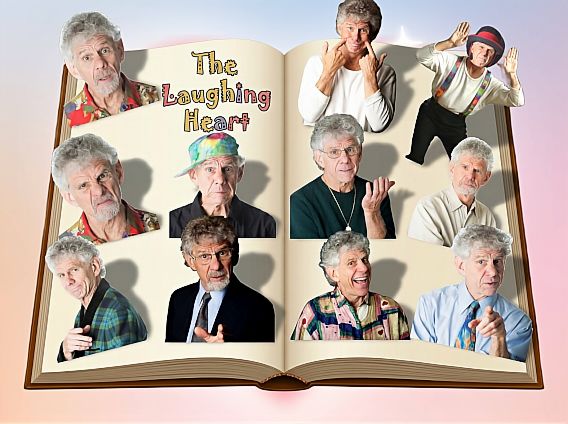

The Laughing Heart with Errol Strider
Never Too Late to Be in the Now
Errol Strider, through Barney and a lively cast of inner characters, explores appreciation, awareness, humor, fear, faith, free will, and the present moment, blending poetic observation with playful dialogue and reflective spiritual insight.
Barney Steps In and Opens Errol’s Mind
In this episode of The Laughing Heart, Barney steps in as the “kind-of host guy” because Errol Strider is not initially available, creating a playful frame in which the audience enters the crowded landscape of Errol’s mind. Barney jokes about Errol’s mental busyness, his worries about money and comparison, and his habit of revisiting the past. The corrected transcript notes that the episode preserves the opening character monologue, Errol’s deli poem, the character conversation, and the closing reflection on fear, faith, free will, and the present moment in sequence.
Diamond People in the Delicatessen
Barney then introduces a poetic piece Errol wrote in a San Francisco delicatessen in the 1970s. The poem transforms an ordinary deli into a living field of human connection, where customers, workers, food orders, tables, voices, and glances become part of a sparkling system of exchange. People are described as gems, diamonds, emeralds, rubies, and amethysts, each one beautiful and distinct. Through matzo ball soup, corned beef, knishes, tea, coffee, and conversation, Errol’s poem sees everyday human interaction as a kind of social chemistry, where thoughts couple, awareness expands, and “finding truth” becomes the sport.
Consciousness Practitioners and Shared Awareness
After the poem, Professor Ambridge appears and joins Barney in reflecting on people as “little exquisite bubbles with consciousness.” Their conversation turns toward awareness as something everyone has, but also something people must practice. Barney calls himself a “practicing consciousness practitioner,” and the Professor agrees that awareness depends on what people are practicing being conscious of. Rabbi Greenberg then enters the conversation and adds that some people avoid awareness because they are afraid of being found or exposed. Together, the characters turn awareness into a humorous but meaningful invitation to become more present and awake.
Father O’Malley, Errol’s Inner World, and the Communion Story
Father O’Malley joins the gathering and jokes about being one of the voices who has tried to help Errol through anxiety, depression, and his “crazy times.” The characters tease the confusion of living inside Errol’s head while also praising his cleverness, especially the line, “It is never too late to be in the now.” Father O’Malley then tells a story about Errol and Rochelle being invited to serve communion at a cathedral. When told to say “The blood of Christ,” Errol cannot do it because of his different theological position, leading to a funny and revealing moment that captures the show’s blend of spiritual curiosity, discomfort, honesty, and humor.
Everything Comes Out of the Now
The conversation settles into a deeper reflection on the present moment. Professor Ambridge explains that the now is where a person is when they are not going backward into the past or forward into the future. Barney realizes that the now is the only place where anything can emerge, and Rabbi Greenberg adds that the now is always available, requiring no permission, tickets, or special achievement. The characters make the present moment feel both philosophical and accessible, turning mindfulness into something comic, practical, and immediate.
Fear, Faith, and the Search for Stability
Errol finally appears and shifts the episode into a direct reflection on fear. He suggests that people keep using fear because, at some level, they believe it will protect them, even though fear eventually betrays that promise. Professor Ambridge defines faith as “the active use of one’s will to act as if there were nothing to fear,” while Rabbi Greenberg humorously expands that into a triple “act as if” practice. Father O’Malley clarifies that faith does not necessarily make life safe, but it can make a person feel stable and secure even while uncertainty remains.
Free Will, Choice, and the Creative Closing
Errol closes by acknowledging the pain, uproar, and uncertainty of life, then offers a creative reflection on freedom, faith, doubt, loyalty, service, pleasure, pain, truth, and falsehood. The closing piece argues that choice matters because love, devotion, faith, and truth only become meaningful when alternatives are possible. The episode ends with Barney, Professor Ambridge, Rabbi Greenberg, Father O’Malley, and Errol thanking one another, inviting listeners to visit TheLaughingHeart.org and Strider Entertainment on YouTube, and encouraging everyone to be good to themselves.
The Laughing Heart
Be kind - Support this WONDERFUL show
- and laugh a lot -
$5.99/mo or $9.99/mo
Click HERE
SUBSCRIBE TO TALK SHOW
The Laughing Heart--a podcast
Humor, story, and spoken word for insight, inspiration, and connection
Hosted by Errol Strider, poet, performer, and non-prophet.
SPEAKER IDENTIFICATION
Speaker 1 - Barney
Speaker 2 - Professor Ambridge
Speaker 3 - Rabbi Greenberg
Speaker 4 - Father O'Malley
Speaker 5 - Errol Strider
Speaker 1 - Barney:
Welcome to The Laughing Heart. This is Barney from the neighborhood. Errol has asked me to step in for him tonight because he was not available, but he wanted to extend his welcome. Anyway, I guess I am the kind-of host guy.
This also is not a bad opportunity to talk about Errol. I have the unusual opportunity to live inside of his mind, and it is crowded in there. There is always something going on. He is very busy on the mental side of him. He gets upset when things are too expensive, or when he cannot have something that looks like somebody else is having and that he thinks he would like.
And what else? Oh, the past. He is constantly going back into the past and bemoaning it because it did not go the way he would have liked to remember it. These are just some of the things Errol does. Do not tell him I said this about him, because he might feel a little embarrassed.
One thing he did ask me to do, since I have you with me on this show, is to play this piece. Errol and I, to a certain extent too, have become more and more appreciative of people. Like diamonds, everybody is a little jewel when you start to look at it that way.
Anyway, Errol wrote this piece. He was sitting in a delicatessen back in San Francisco in the 1970s. He was looking around, and he saw these people. He wrote this poem from his impressions at the deli. Here you go.
Speaker 1 - Barney:
"How much for one of those? And those? A knish? Fifty-five cents. What is it?"
Raincoat, gray scarf. She is old, on her way home. A little treat on the way. An emerald.
White cake with mocha frosting. "I'll take it. What else, please?"
Two sit in one corner, earnest over tea and coffee. Earnest bundles. People grouped, sipping one another. Each sends a wilted statement; it hovers and then, as a feather, sifts into a receptive zipper.
Tight bundles coil, come undone, and share points of common ground. Synapse, breaking up, recoupling with new reciprocal thoughts. Red sweater, pink skirt, ruby, corned beef on rye, and long white pants standing at the cash register. Eighteen tables, seven people, and laughter from one end.
Lipside, cabbage, borscht soup, and delight. Then the pairing starts some more. Wonderful exchanges. A new thought for me. Thank you. "What's in that one? With cream and chocolate." Sensation.
A diamond walks in on crutches. Refined four legs, laughing. In and out together as ideas recirculate throughout the room. Each is affected by a new entry. The world changes. So many tastes.
Wonderful little children inside each person, playing each like an atom's nucleus, condensed, waiting to explode with goodness. And the gentle sounds of searching together, in, out, and stranded momentarily, waiting to come home again to couple. Another mate, and the dance continues. A new person, synapse, an added dimension, and the system spirals onward.
"Matzo ball soup, please, and a Coke." A Coke, ninety-three cents, please, and seven cents change.
For a coat, a white new brown waits near the entryway for a mate sent for two coffees. And they couple across brisket-stained wood with mayonnaise. Slim and green, tall, regal, an emerald who reads Kurt Vonnegut and liverwurst, but so cool. She did not couple, but oh, what a kid behind.
Chopped liver with split pea and jeans, jeans, jeans everywhere for those who know no costume. Hot, steamy coffee rises as couples congregate. Beautiful coupling goes on. Full systems: one and one are two, and their children two squared.
The long counter of decisions: this or that? What are those? My tastes change tonight after fog lifts. Step up, receive, pass out of line.
In one corner, multiple figures in a dark shading of business creeping into otherwise social surroundings. One man coffees over figures. New people, coat and boots, add one. No, two. Oh, how infinite.
A smile surrounds, expressions sincere, and a warm Friday beard. A Napoleon, maraschino people to go, please. One black collar nudges forty gray hairs, but he is alone with seedless rye, looking over his shoulder for news served on trays with ketchup.
Two bagels and a knapsack, please. Red lights bump onward as diamond people continue to glisten.
And now, an aerial shot. Little two-legged gems in their first exploration of the universe, their universe, their home with mostly unseen rooms. Awareness expands, though slowly. People-gems finding their minds, their beings tied to earth by gnawing cravings of mutable stomachs and bell-bottom sex. All searching to find out about the me within.
Hot corned beef, extra lean, kosher salami, attempted interest in a life explanation asked for with dill pickle on the side. Two more, very distinct: a sweater, leather jacket, and the flow continues as fingers point. "That one, please. No, no, that one." Many fingers pointing, many places. That one, this one. Voices point every which way in their preferences, and then all hands back in pockets.
But here comes a known. Jerome has left. Pretty Girl fingers her hair, amethyst. Thank you, Pretty Girl, for being as pretty as everyone else, but special. Fingers in hair, yours, mine, together.
And the worker-servers exclaim like a chorus: "Order, please. What do you have? Please, order." You have so much to couple with.
Two women sit not far off, one young and one not so, serving one another. I catch phrases of real worth. They explore, stirring up old blockages, which evaporate as coffee grows cold. Refill. Refill. Refill me, please.
Serve me hot and steamy, steamy hot joy, diamonds so concentrated, and electrons escape from one person to another. They run around each other's circuits, back and forth, and that coupling goes on. Oh, joy!
Hair lifted to outside of coat where it belongs. Swept-back hair that wants only fingers running through it. Jerome scrutinizes, opens wallet slowly, and before you know it, hot tea is sitting next to me.
First movement is drawing to a close as my own coupling approaches. A big tray with a little cup of tea. Big frame for a morsel. All now in one electronic recoupling. Interchange. People being beautiful. They spin, shuffle together, part, bump, turn. Heads connect, word here, word there. They spin, synapse, coil, glisten.
Treasures, all gems. Sensation of colliding. Eighteen tables sharing, bumping people, emeralds, interchange orbits, spinning, and then resolution. Jerome says to me, "Finding truth is the sport." And so it is, as eighteen treasure chests nod in agreement.
Speaker 1 - Barney:
This system works beautifully, don't you think? I love that image: people like little gems and diamonds right there in the middle of the matzo ball soup. Whoever thought of such things like that? I never thought that, but there you have it - these little people.
Just a minute here. We have Professor Ambridge. I am so glad you came here tonight, Professor. I did not expect to see you.
Speaker 2 - Professor Ambridge:
And I am delighted to see you too, Barney. When I heard that Errol could not make this evening's program, I thought, well, I would come and see if maybe I could offer something. Quite frankly, it is nice to do the show without Errol. Do not misunderstand me. I think he is quite a jolly good, great boy, but sometimes we do need a break.
Yes, I have become seeing people that way too. They are just little exquisite bubbles with consciousness.
Speaker 1 - Barney:
Yes, that is a good way to talk about them. Bubbles with consciousness.
Speaker 2 - Professor Ambridge:
And, of course, what they do with the consciousness varies considerably. But it is what they are being conscious of, or I should say practicing being conscious of.
Speaker 1 - Barney:
Yes, for some people it is a practice. But someday, if they practice long enough, they will become conscious. I think of myself as a practicing consciousness practitioner.
Speaker 2 - Professor Ambridge:
Yes, that is what we call ourselves: the consciousness practitioners. I practice every day trying to be conscious, to be aware.
Speaker 1 - Barney:
You know what is funny, Professor? I think what you are trying to say is that everybody is aware of something. You look around, and that guy is aware, and everybody is aware of something. Since everybody is aware, I figure we share the awareness.
Speaker 2 - Professor Ambridge:
Oh, jolly good. Sharing the awareness. Oh, that is so good.
Speaker 3 - Rabbi Greenberg:
Well, come here. Let's just pour. Everyone is showing up tonight. Good to have me here.
Speaker 1 - Barney:
Hi, I am glad to see you, Professor, Barney. This is good. You are talking about awareness.
Speaker 3 - Rabbi Greenberg:
Awareness is a thing that you think you would just like to go to. Do not take a bus. Just stick out your thumb and get to awareness, because being aware is like the best thing.
Many people think being unaware is better, because they are scared. If they are aware, then they will not be able to hide themselves behind the little part of them that is scared of being found.
Speaker 1 - Barney:
That is so profound. I can hardly - just a minute. We have Father O'Malley here.
Speaker 4 - Father O'Malley:
Good evening to you, boys. It is like we are having a little reunion, all of us who have worked with Errol and tried to help him through his crazy times.
He has been working through anxiety and depression. I think he feels obligated to have gone through that, to somehow validate his need to have suffered to achieve the joy and the light that he is meant to go toward. Forgive me there. I dropped my accent for just a few seconds, but I am back now. That was still me without my fake Irish accent.
No, I learned it when I was coming up as a boy. I was born in Yugoslavia, and they used to teach me fake Irish accents. I took it for a year, then I took the fake Italian accent. You see, I get them all mixed up. Now I do not know who I am.
Speaker 1 - Barney:
It is all right, Father O'Malley. We all have that problem inside Errol's head. It can get very confusing.
Speaker 2 - Professor Ambridge:
One advantage to living inside Errol's head is you can pick his brains.
Speaker 4 - Father O'Malley:
Oh, yes, he has a bunch of brains, and he has synapses going off every which way. But he actually does have some ideas once in a while, and he says it is quite all right to come in and poke around and pick one if I like it. I do like it.
Speaker 2 - Professor Ambridge:
One thing I found out about being in Errol's mind is that he is very clever, which is why I like to pick his brains. Of course, being clever is no substitute for character growth, and he will catch up when he can on that part. But in the meantime, I love his cleverness.
Here is a good example. It says, "It is never too late to be in the now."
Speaker 1 - Barney:
Professor, that is really funny. Did he make that up, or did you make it up?
Speaker 2 - Professor Ambridge:
No, no. He made it up.
Speaker 1 - Barney:
I think that is terrific: never too late to be in the now. Tell me about the now again.
Speaker 2 - Professor Ambridge:
When you are not going backward and you are not going forward, that is the now. Most of us are either going backward or forward all the time. Once in a while we go sideways. But do we ever stop and just be right there in the now?
The now, people do not realize, is that everything comes out of the now. If you are in the then or the there, you are going to miss out.
Speaker 1 - Barney:
I never thought of it that way, Professor, that you are going to miss out if we do not start in the now. The now is the only time. Well, of course, it is not really time, is it, if it is the now? Well, it is the only time that anything can emerge.
Rabbi, what do you think?
Speaker 3 - Rabbi Greenberg:
Everything comes out of the now. The now is like the holding place for everything. That is right. It is waiting to come in. It is just waiting for more now-ness.
Of course, there is lots of now-ness to go on, because now is never not there. It is always now. So there is plenty of opportunity to jump into the now any time you feel like it. You do not have to wait for permission. You do not need tickets. You do not have to win the lotto. You can go into the now any time you want.
Speaker 4 - Father O'Malley:
Father O'Malley here. I will try to keep my accent straight this time. There is a little story about Errol that he does not tell very often. I would like to share it with you because I think it was very funny.
Errol and Rochelle used to go around the country doing their thing. Sometimes we would be there with them, but mostly it was just them doing their thing for groups and churches. In this case, they were going to be performing at the Loyola Cathedral, the one near the lake and named after Loyola. Oh, he was Mr. Loyola, or the saint. I never had a good memory for that sort of thing.
Errol and Rochelle were invited to serve communion in the Mass. For those of you who do not know, it is a little wafer and a little bit of wine that sort of symbolizes Christ dying for people, and you are drinking blood. I was never so fond of that, but there is more to that story than you think.
What happened was Errol and Rochelle were asked to serve communion there. I was over on the side, and I saw what was going on. The priest, Father Jackson, said, "Errol, just say when they come up to you, 'The blood of Christ.'"
Errol was taken aback because he did not really think that was what it was all about, and so he did not know what to do. What he said was, "I cannot do that." And the father said, "Oh, why not?" And Errol said, "I have a different theological position around that issue."
I know, quite something to come up with in that moment. It was a showstopper, because the priest, who had been putting on his vestments, stopped there for a minute and went, "Oh. Oh, well, then do not say anything."
So if you can imagine Errol there, serving communion to all those people and not saying anything. Of course, later, when they found out that not only were Errol and Rochelle not Christians, they were Jewish, that gave them a setback.
Speaker 1 - Barney:
What a great story. I may have heard that from Errol. I do not know, but it is a great story.
Speaking of Errol, I know he would like us to share something else, things he has written, because he is very fond of the things he has written and is always happy to share them with people. So here we go. Here is another piece of Errol's.
Speaker 5 - Errol Strider:
Hi, guys.
Speaker 1 - Barney:
Errol, I thought you could not make it tonight.
Speaker 5 - Errol Strider:
Well, I had to share something. Hi.
Speaker 2 - Professor Ambridge:
Oh, hello, Errol.
Speaker 5 - Errol Strider:
Hi. It is good to see you. I am so glad you missed me, because I missed you. But I have to share something. I was thinking about fear. Plenty of that to think about. Probably nothing new to anyone else, but it struck me that we use fear, besides having it, of course, because at some level we believe it is going to protect us.
I know, I know. That is probably obvious to you, but for me it came in with some new insight. Otherwise, why would we continue to use it? Talk about deluded and unreal, as if fear could protect me.
I understand fear is going to serve me well if it kicks me into doing something. What I am realizing is that I have to overcome, I almost want to say addiction, but certainly the dependency on something absolutely guaranteed to betray me, and that can never offer me what it says it can, which is protection.
Any fear that is longer than just the time for the system to kick in and get you out of there, or get you to stand up for your rights, is useless. When it moves to worry, it is even more useless. Yet at some level I feel we must believe we deserve it. At the very least, as I said before, we think it will protect us.
Guess what? It will not. So where does that leave us? Professor, you are here. What is your view of that?
Speaker 2 - Professor Ambridge:
It leaves us bereft. Yes, rather bereft. There is a space there, a scary space, because it looks empty. That is because it has not been filled up with something actual. Faith, old boy.
Speaker 5 - Errol Strider:
Well, not just like faith, but actually faith.
Speaker 2 - Professor Ambridge:
Faith is the active use of one's will to act as if there were nothing to fear. There you have it. That is faith.
Speaker 1 - Barney:
Can I bump in here for just a little bit and help clarify something? Professor, maybe you can come up here, but what you are trying to say is that faith - would you say it again?
Speaker 2 - Professor Ambridge:
Faith is your use of your will to act as if there were nothing to fear.
Speaker 1 - Barney:
Act as if there were nothing to fear. That sounds pretty hard.
Speaker 3 - Rabbi Greenberg:
If I could say something, it is not as hard as it looks. You just have to act as if you can act as if you act as if you are not afraid. It is a triple "act as if" thing. But if you get one, they will give you the other two for free. So it is not so bad, not so expensive.
Speaker 5 - Errol Strider:
That is good. Thank you. Thank you all. All right, funny, but let's get back to the issue here. How do we release fear and allow the faith that you are talking about to come into the situation and redirect it, take it over, move it to a better place, a more healthy, rewarding, safe - there you go, safe place.
So you are telling me that faith can actually make it safe?
Speaker 4 - Father O'Malley:
If I might enter that for you, Errol, Father O'Malley again: not exactly make it safe. It makes it feel stable. Yes, that is it. You are stabilized. There is little chance of you falling over into nothingness.
People do not think about it, but it seems like that sometimes. But you are stable. You can be sure. You can be secure. You never know how it is going to turn out, so there is always going to be an element of uncertainty. You will feel secure, but you will still be uncertain. There is the game of life, my boy.
Speaker 5 - Errol Strider:
That is good. How do I get to feel secure?
Speaker 4 - Father O'Malley:
It goes back to what we were talking about before, Errol. It is faith. Faith is something you can ask for. If you are willing to be humble and just ask away and ask, you will find, my boy. That is what happens, but you have to be humble enough to recognize that you need to ask.
And then, lo and behold, you just very well might find an answer. As a matter of fact, you may find an answer in ways that you never would have thought of or expected.
Speaker 5 - Errol Strider:
Oh, man. That is a lot to take in. Let me mull on that. You out there, I hope that has some meaning for you and that you can do something with it.
It is challenging. We live in a world where we are constantly, at the very least, perplexed. If not, we are in a whole lot of internal and external uproar. We live in a very uproarious consciousness, and not necessarily in the best way. There is a lot of pain in all that uproar, the roaring-up-ness of our time here on this planet.
We have certainly covered a lot of ground today: fear, faith, and now. Lots to think about. But what I would like to leave you with is this, what some would call a right-brain piece. I would call it a more creative way of approaching some of these issues. So settle in, put your left brain to rest, and take this experience in.
[Brief contemplative musical or spoken interlude.]
Though they seem unfair, we must be free to choose, to have faith or to have doubt, knowing less than what is believed. That is what faith is about.
Here I must be present to help us realize we need not embrace the error or even compromise. We must be free to choose that which is ideal. The good is always relative, so when chosen, it is more real.
We must be free to choose to be loyal. When assaulted, desertion must be possible for devotion to be exalted. We must be free to choose to serve ourselves or others. If there were not a choice, we could not really love our brother.
We must be free to choose to have pain or pleasure, so the precious times of joy are even greater treasures. We must be free to choose the ways of truth or falsehood. We need not embrace the error, but we are free to know we could.
Well, there you have it: another episode of The Laughing Heart podcast. I want to thank my good friends for being here.
Speaker 1 - Barney:
Oh, happy to be here.
Speaker 2 - Professor Ambridge:
Of course, any time, my friend Errol.
Speaker 3 - Rabbi Greenberg:
Yeah, we like to be here. It is a good thing.
Speaker 4 - Father O'Malley:
It is a good thing to do, Errol. Since you talked to me last, I would like to leave people with the possibility of finding out more about The Laughing Heart. Go to TheLaughingHeart.org, and you will find out all about it.
Speaker 1 - Barney:
Oh, yeah, it is very good. And the other thing you can do is go to Strider Entertainment on YouTube.
Speaker 5 - Errol Strider:
Thank you, fellas. It is good to get those recommendations. Hopefully, you will join us next time. Again, this is Errol Strider of The Laughing Heart, and you all be good to yourselves. Thanks for watching.


