
LaGrave Live, June 7, 2026

LaGrave Live
LIVE Morning Worship Service 06-07-2026
The Way of Wisdom: The Way of Wisdom: Wisdom & Creation
About The Service:
We will continue our summer sermon series. Our sermon series is called The Way of Wisdom. We will look at the parts of the Bible that are considered Wisdom Literature. These are Bible books and Bible passages that address the practicalities of living in God's world. Pastor Jonker will continue the series with a sermon on Proverbs 3: 1-20.
Order of Worship:
https://lagrave.org/wp-content/uploads/2026-6-7-AM-Order-of-Worship.pdf
About the Church:
We are a traditional CRC church in the middle of Downtown Grand Rapids, MI, worshipping at 8:40am, 11:00am, and 6:00pm. (10:00am and 6:00pm during the summer months)
We'd love to hear from you:
Connection: https://www.lagrave.org/contact
Let us pray for you:
Prayer: https://www.lagrave.org/prayerrequest/
Giving: https://www.elexiogiving.com/App/Giving/lagr107178
The June special offering is for Pine Rest Patient Assistance Fund: Part of Pine Rest Foundation Fund offering financial assistance for individuals, families and children who need care.
Listen on the go:
Amazon Music: https://bit.ly/LGPodAmazonMusic
Apple Podcast: https://apple.co/3tuOdwQ
Google Podcast: https://bit.ly/LGPodGoogle
Soundcloud: / lagravecrc https://soundcloud.com/lagravecrc
Spotify: https://spoti.fi/3yXDFaT
Follow us!
Facebook: / lagravecrc https://www.facebook.com/lagravecrc
Instagram: / lagravecrc https://www.instagram.com/lagravecrc
Website: https://www.lagrave.org
#LaGrave #LaGraveCRC
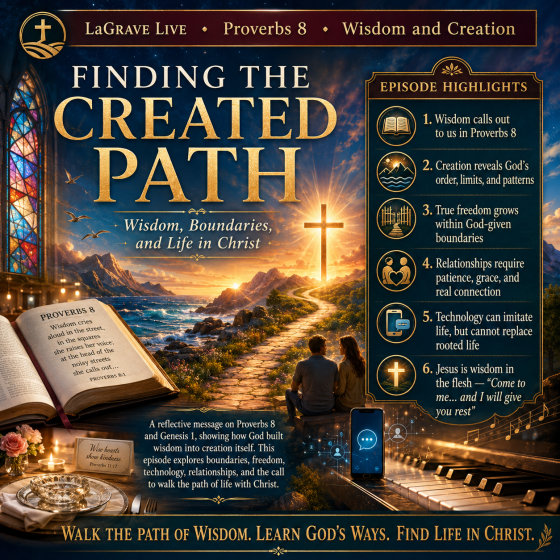
Finding the Created Path: Wisdom, Boundaries, and Life in Christ
Opening Worship and Congregational Prayer
The service begins with music, congregational singing, and prayer. Much of the opening musical portion is difficult to recover from the automated transcript, but the clearer prayer section asks God to care for Blake and Tim in military service, bless Matt Bonzo’s teaching ministry and travel in southern Africa, and support Thomas and Dana in their mission work in India. The prayer also lifts up people struggling financially, the denomination’s upcoming Synod meeting, government leaders, global conflicts, disease, and the church’s calling to be faithful kingdom agents.
A Children’s Lesson About Wisdom and Kindness
During the children’s message, the speaker tells a story about Queen Wilhelmina visiting Frisian farmers in Iowa. At a formal dinner, the farmers mistakenly drink from finger bowls because they do not understand the custom, and the other guests quietly laugh. Queen Wilhelmina wisely chooses to drink from her own finger bowl too, leading the rest of the guests to follow her example and saving the farmers from embarrassment. The lesson presents wisdom as kindness, social awareness, humility, and the ability to preserve another person’s dignity.
Wisdom Speaks Through Proverbs 8
The Scripture reading comes from Proverbs 8, where wisdom is personified as a voice calling out to people and inviting them to find life. The speaker explains that wisdom is not merely an abstract idea or a human invention. In the passage, wisdom is described as present with God from the beginning, before the mountains, seas, horizons, and foundations of the earth were set in place. This establishes the sermon’s central theme: wisdom is woven into creation itself.
Creation, Boundaries, and the Path of Flourishing
The sermon connects Proverbs 8 to Genesis 1, emphasizing that God created the world with order, boundaries, patterns, and limits. These boundaries are not presented as restrictions meant to harm people, but as the structure through which life flourishes. The speaker explains that just as people recognize physical limits such as food, exercise, and sleep, they must also learn the created patterns that guide relationships, work, speech, emotions, family life, and moral decision-making.
Technology, Friction, and Real Relationships
The sermon then applies the theme of wisdom to modern technology and relationships. Technology is described as useful when it serves God’s paths, but dangerous when it promises a frictionless life that avoids real human connection. The speaker uses examples such as texting instead of phone calls, AI-screened communication, and simulated life through screens to show how removing relational friction can also remove depth, growth, and love. Real relationships require boundaries, conflict, adjustment, and the patient work of learning another person.
Jesus as Wisdom in the Flesh
The sermon concludes by identifying Jesus as the embodiment of wisdom. The speaker connects Proverbs 8 and Ben Sirach’s appeal to wisdom with Jesus’ invitation in the New Testament: “Come to me, all you who labor and are heavy laden, and I will give you rest.” Rather than leaving people to discover wisdom alone, God sends Jesus, who walks with them, fills them with the Holy Spirit, and guides them along the path of life. The closing prayer asks God to open the congregation’s eyes and hearts so they may discern his ways and live a flourishing life.
LaGrave Live

If you’re looking for a warm church that commits to an intensely pertinent Gospel in the Reformed tradition of the Christian faith, we invite you to worship with us. Our 1,800 members come from across West Michigan and gather weekly in our sanctuary for relevant Biblical preaching, beautiful music, and inspiring worship. We expand our worship through intentional outreach in our community and world, attentive care for our members, and plenty of spiritual enrichment and social opportunities for everyone.
We focus on a living Savior who provides genuine solutions to the deep needs of a hurting world. We are committed to need-meeting ministry in His name, and we are committed to being real people who enjoy real life and who cry real tears. Because we are a fairly large and diverse group in terms of age, occupation, marital status, lifestyle, and physical ability; our members create many accessible opportunities for community service, Bible study, and small social groups.
We worship God, the Almighty Creator of heaven and earth, and we enjoy expressing our vision of His holiness through traditional music and formal liturgy.
Music plays an integral part of our weekly worship gatherings. Congregational singing—of both traditional hymns and newer ones—is typically supported by our pipe organ. Vocal choirs, handbell choirs, small ensembles, instrumentalists, and vocal soloists provide additional music offerings.
Led by the Holy Spirit, we seek to worship and serve God in all of life, transforming His world and being transformed to reflect the character of Christ.
Founded by 36 Dutch immigrants on February 24, 1887, LaGrave Avenue Christian Reformed Church has always been deeply committed to both this local community and worldwide missions. God has seen fit to guide and bless these commitments with sustained growth, spiritual gifting, and a continual stream of new work for our members.
Speaker Identification
Speaker 1 – Worship Leader / Minister: Identified from the pastoral prayer, congregational transitions, Scripture reading, sermon, closing prayer, and benediction. The transcript does not clearly state the speaker’s name.
Speaker 2 – Children’s Message Leader: Identified from the direct address to the children, the invitation for children to come forward, and the children’s sermon about Queen Wilhelmina and the Frisian farmers. This may be the same person as Speaker 1, but the transcript does not make that certain.
Speaker 3 – Congregation / Choir / Musicians: Identified from hymns, sung responses, repeated “Amen” responses, and musical interludes. Individual singers are not identified.
Speaker 3 – Congregation / Musicians:
[Opening guitar music and extended vocalizing.]
[The opening section includes prolonged nonverbal singing and repeated “oh” syllables. These repeated vocal sounds have been condensed for readability.]
Speaker 3 – Congregation / Musicians:
[Musical interlude continues.]
[Several lines in this section are severely garbled in the automated transcript and cannot be confidently reconstructed from the text alone. They appear to be either music, background audio, or unrecoverable transcription noise.]
Speaker 3 – Congregation / Musicians:
[Congregational song.]
Be all praise.
Most mighty, your working.
Most wondrous, your ways.
Your glory and might are beyond us to tell,
and yet in the heart of the humble you dwell.
Lord of all wisdom, I give you my mind.
Reveal truth that surpasses our knowledge to find.
What eye has not seen and what ear has not heard
is taught by your Spirit and shines from your Word.
[Additional sung lines are partially garbled in the source transcript and could not be fully reconstructed with confidence.]
Speaker 1 – Worship Leader / Minister:
Lord, we pray that you will also be with Blake and Tim, serving in the military. Constantly watch over them, we pray.
Lord, we pray for fruitful teaching ministry and safe travel for Matt Bonzo in southern Africa.
We commit to you Thomas and Dana for their mission work in India. The children they work with have experienced a lot of darkness. Through Thomas and Dana and their workers, shine the light of your love and grace upon these kids, we pray.
We also pray, Lord, for those who struggle financially, those within our church as well as others around us, especially right here in the downtown area. Grant your provision to meet their needs, Lord, and use us as channels of your blessing.
We pray for our denomination’s annual Synod meeting, which begins this coming Thursday, and for safety for all those traveling for that. We pray for the moving of your Spirit at Synod, binding all delegates and attendees in love and grace. We pray for listening ears and hearts, and that you will guide the deliberations toward wise plans and decisions.
We pray for our nation, Lord, as we enter another election season. We pray that you will work through this process to bring people of true wisdom, skill, and integrity to office. Meanwhile, we pray that you will be with all our current government leaders, on local, state, and national levels, to work for what is just and right and beneficial for all.
Lord, we commit to you our troubled world. We are continually disturbed by the senseless killing of people in ongoing conflicts in Sudan, Gaza, Israel, Lebanon, Iran, and the Persian Gulf, and by the Ebola epidemic in Africa. Lord, we pray for resolution of these conflicts and for cooperation in dealing with diseases and other calamities.
Help our nation be influential for peace, justice, and human flourishing. Come quickly, Lord Jesus, to bring the fullness of your kingdom. Meanwhile, make us your faithful kingdom agents in this world.
In Christ’s name we pray. Amen.
Speaker 3 – Congregation / Musicians:
[Congregational hymn.]
Lord, my God, when I in awesome wonder
consider all the works your hands have made.
[Additional hymn lines are partially garbled in the source transcript. The congregation continues singing.]
When doubts disturb my troubled breast
and all is dark as night to me,
here, as on solid rock, I rest:
that so it seems good to thee.
Be this my joy, that evermore
thou rulest all things at thy will.
Thy sovereign will, O God,
is holy, wise, and good.
Amen. Amen.
Speaker 2 – Children’s Message Leader:
All right, children, it’s time for the children’s message. Come on down. I see you poised.
All right. Hello, hello, hello, hello, hello. Oh, there you are. You were so confused, submerged beneath all these adults, but here you are coming up. It is so good to see all of you. Come on down, everyone.
We are talking about Queen Wilhelmina. You have a peppermint named after her. Have you ever had a Wilhelmina peppermint? You should go home and ask your parents for a Wilhelmina peppermint. They will hook you up. Maybe.
Queen Wilhelmina was the queen of the Netherlands. Some of the people she visited lived in Iowa, and they were Frisian farmers. So Friesland is a province in the Netherlands, part of the Netherlands, and these were Frisian farmers. She was going to go visit them and say hi.
They had a very special meal. Now, you can imagine, when a queen comes for dinner, do you think that dinner was like McDonald’s, or was it fancy?
Oh, it was super fancy. Super fancy. Like a table with a cloth, a tablecloth. And napkins were not made of paper. They were made of cloth, definitely made of cloth. And you did not just have one fork beside your plate. You had three forks beside your plate.
I know. Some of you are like, “Three forks? Why do you need three forks?” That is what they do at fancy meals.
They had candles, and it was just beautiful. It was just beautiful.
Now, maybe you have been to a meal like that. Have you been to a meal like that, something fancy like that? Some of you, maybe?
The Frisian farmers had never been to a meal like that, so they were not sure what to do. One of the things on the table was a little bowl about this big with water in it. That was called a finger bowl. You know how, when you eat something, your fingers get sticky? You could stick your fingers in that bowl and wash them, and they would not be sticky anymore, which is kind of nice.
The Frisian farmers had never seen a finger bowl. So guess what they did with the water? They saw this bowl of water, picked it up, and drank it.
The fancy people around the table looked at the Frisian farmers and said, “Look at those guys. They do not even know what a finger bowl is.”
They did not say it out loud. The Frisian farmers did not realize they made a mistake, but Queen Wilhelmina could see that the fancy people were laughing at the Frisian farmers. Then Queen Wilhelmina did something very wise. She did not want that meal to be bad, so she did not want the Frisian farmers to be embarrassed. She did not like that people were laughing.
Guess what she did? She picked up her own finger bowl and drank it. When all the fancy people saw that she did that, guess what they did? They picked up their finger bowls and drank them too.
She saved the party. That was a kind thing to do, right? It was also very wise.
Congregation, what is our prayer for these children?
Speaker 3 – Congregation:
The Lord be with you as you grow.
Speaker 2 – Children’s Message Leader:
All right. Go in peace.
Speaker 1 – Worship Leader / Minister:
Before we open God’s Word, we are going to sing our hymn of preparation, which is also a prayer of preparation, and it is found in your bulletin. We will sing this song every week.
Before we sing it, Larry wants me to tell you that you are doing it wrong. Larry wrote the music for this, as you know, and he wants to draw your attention to the very end of the song. See the word “and,” “hearts”? That word “and” is not one step down from the last note. It is two steps down from the last note. Consider yourself warned.
Let us prepare our hearts by singing this song.
Speaker 3 – Congregation / Musicians:
[Hymn of preparation.]
Speaker 1 – Worship Leader / Minister:
Our Bible reading this morning is from the book of Proverbs, Proverbs 8. Proverbs is, of course, the quintessential wisdom book of the Old Testament.
I will read verses 1 through 6, and then verses 22 through 36.
Before I read it, you will notice that in this passage, what you will hear is that wisdom will be talking to you. Wisdom is personified. Wisdom is not just a set of principles or ideas. In this passage, it is like wisdom has become a person. It is a poetic device, and this person is calling out to you. Wisdom is saying, “Follow me. Learn my ways, and you will find life.”
As you listen to that, as you listen to wisdom’s personal appeal, when you get to verses 22 through 31, I want you to notice that when wisdom is making this appeal, wisdom clearly has a Bible passage in mind. You will hear another Scripture passage that I think most of you know behind it.
All right, let us read it together.
Does not wisdom call out?
Does not understanding raise her voice?
At the highest point along the way,
where the paths meet,
she takes her stand.
Beside the gate leading into the city,
at the entrance,
she cries aloud:
“To you, O people, I call out.
I raise my voice to all mankind.
You who are simple, gain prudence;
you who are foolish, set your hearts on it.
Listen, for I have trustworthy things to say.
I open my lips to speak what is right.”
Now let us jump down to verse 22. Here is where I want you to listen for another Bible passage.
“The Lord brought me forth as the first of his works,
before his deeds of old.
I was formed long ages ago,
at the very beginning,
when the world came to be.
When there were no watery depths,
I was given birth;
when there were no springs overflowing with water;
before the mountains were settled in place,
before the hills,
I was given birth;
before he made the world or its fields
or any of the dust of the earth.
I was there when he set the heavens in place,
when he marked out the horizon on the face of the deep,
when he established the clouds above
and fixed securely the fountains of the deep,
when he gave the sea its boundary
so the waters would not overstep his command,
and when he marked out the foundations of the earth.
Then I was constantly at his side.
I was filled with delight day after day,
rejoicing always in his presence,
rejoicing in his whole world
and delighting in mankind.
Now then, my children, listen to me;
blessed are those who keep my ways.
Listen to my instruction and be wise;
do not disregard it.
Blessed are those who listen to me,
watching daily at my doors,
waiting at my doorway.
For those who find me find life
and receive favor from the Lord.
But those who fail to find me harm themselves;
all who hate me love death.”
This is the Word of the Lord.
Speaker 3 – Congregation:
Thanks be to God.
Speaker 1 – Worship Leader / Minister:
So I think that was a pretty easy question, if you know a little bit of Bible. What Bible story did you hear behind verses 22 through 31?
Genesis 1, right? It is the creation story.
When wisdom describes who she is, she is following the pattern of the creation story. At the beginning of her description, she talks about how she was there before the world was formed, when there were no watery depths and the mountains were not in place. That is like the beginning of Genesis 1, when the earth is formless and void.
Then, starting at verse 27, it says that she was there when God started to create order, when he drew the horizon line, put the foundations in place, put a boundary for the sea, and raised up the mountains. He created structure and order. That was the next part of creation.
At the end, she says, “I was delighting the whole time. I was delighting in all that he had made.” That reflects the end of the creation story, where God looks at everything he sees and says, “It is very good.”
So Proverbs 8, wisdom is making her appeal, and she is attaching it to the creation story. That is done on purpose. Wisdom is communicating to us, the Holy Spirit is communicating to us through this poetic device, that wisdom is built into the fabric of creation.
Wisdom is not a human creation. Wisdom is not a social contract. Wisdom is not something fashioned by cultures. Wisdom is something that is built by God from the very beginning into the way the world is laid out.
Wisdom is the boundaries and the limits of God’s creation. If you notice, when wisdom describes what God did in creation, the emphasis is on boundaries and limits. “I drew the horizon line. I told the sea where to go, and I would not let it go further.”
Wisdom is describing how, in the physical world, God created all these boundaries and structures. The implication is that just as there is a boundary for the physical world, so there are boundaries for all the other parts of our lives too. There are limits and boundaries. There are paths and patterns that have been built in at creation, and wisdom is learning to find them.
There are boundaries for our relationships, for our speech, for our emotional life, for the way we do our work, and for the way we conduct our families. All of these patterns have been laid at the foundation of creation, and wisdom is finding these paths and finding these patterns.
That is what we are going to be doing all summer, finding these paths and finding these patterns.
Now, for some parts of life, it is relatively easy for us to accept these paths and patterns that God has created. For example, for our physical life, we all know that there are limits to our physical life. We cannot eat candy all the time. Sometimes we have to eat our vegetables. We cannot sit on the couch all day long, day after day. We have to get out and get some exercise. We cannot stay up all night, partying or doing whatever else. We have to get some sleep.
Those are basic physical boundaries, and we all recognize them. We do not always observe them. We do not always eat our vegetables. But even when we do not eat our vegetables, we know that we should. We know the boundary is there, the limit, the path, the pattern.
So in the physical realm, we accept those things. Where it gets tricky is in the realm of our wants, our desires, our passions, and our goals. There we have a harder time.
In one of his poems, Robert Frost said these famous words: “Something there is that does not love a wall, that wants it down.” That is us.
In The Abolition of Man, C. S. Lewis elaborated on that when he said this about wisdom and how human beings have approached it through the years. He said, “For the wise men of old, the cardinal problem had been how to conform the soul to reality, and the solution had been knowledge, self-discipline, and virtue.”
So the traditional way of doing things is that you look out there, you find the patterns, and then you conform your soul to that. You conform your life to what is out there.
But then Lewis says that for modern people, the problem has become how to subdue reality to the wishes that are in your heart.
Do you see the pattern there? It used to be, “I look for the patterns and the paths out there, and I try to conform my life to it.” That is wisdom. But now, increasingly, it is, “What are the limits out there? If there are limits out there, how do I push aside those limits so I can fulfill what is in my heart?”
So in our world, it is not just wisdom crying out in the street, trying to show you a path and a way. There are other voices crying out in the street. Wisdom is crying out, “Learn these creational patterns, and you will live.” But there are other voices saying, “Follow me, and I will knock down all the barriers, and I will give you your heart’s desire.”
One of the strongest voices offering that to us these days is technology. Technology is not a bad thing in and of itself. But as it increases in power, I think you will all agree that what it offers many of us is this: “You have the power to bend reality absolutely and to shape this world into the shape that you want. I will take away all the friction. I will take away all the problems and make a clear path for you.”
Let us look at just one way where that is true: relationships.
As we continue looking at Proverbs all summer, we will find that a lot of these proverbs are about relationships, about how we relate to one another. That is really important.
When you think about it, when we relate to one another, what are we doing? We are looking for creational patterns. It is like wisdom in miniature.
If I am encountering you and you are encountering me, say we are starting a job together and are going to be colleagues, I am going to spend a lot of time paying attention to how God made you. What patterns did he put in you? How do you react to conflict? What are your emotional responses? What are your passions? What things set you off? What are you good at? What are you not good at?
I am going to be paying a ton of attention to that and trying to conform my life to that. Hopefully, you will be doing the same to me. If we both do that, we will have a fruitful relationship. We will walk the path of wisdom together.
That can be hard work. If you do that in marriage or in work, you are going to bump into each other once in a while. There is going to be conflict. But when you have those conflicts, what you are learning is that you are learning the boundaries. If you adjust, eventually the friction will ease, and you will find your way forward.
That is the path of wisdom, and the friction is important. The friction is how you learn each other. You cannot have love, you cannot have real relationship, without some of this bumping into each other and friction. It is part of the process.
Technology promises something very different. It says, “I will give you a frictionless experience. I will take away all the people who are a pain. I will make it so you do not have to deal with them very much.”
Here is one little example. I am going to talk to all of you here under 25. Sorry. I know this is not true of all of you, but broadly speaking, for your generation, this is true. Maybe you know this. A lot of people in Gen Z, people under 25, hate calling a live person on the phone and talking to them. This is a thing. Not everyone, but by and large this is more true.
Why is that? Because you have grown up in a generation where you do not have to. You can text. You can email. There are all kinds of ways that you can communicate without a phone call.
A phone call has more friction. It is not even face to face, but it has more friction, because you have the politeness of opening the phone call, then you have to negotiate whatever happens in the phone call, the mood of the person, however they are, and then you have to negotiate the ending of a phone call, which can be a very tricky thing.
So, all that friction. But you could just send a text, man.
When you make that choice, and I text too, do not get me wrong, but when you consistently make that choice, while you lose the friction, you are also losing the connection. You give up the conflict, but you are also giving up the relationship. You are not choosing the path of wisdom.
This is what technology does, and this is only increasing. Nowadays, and maybe some of you here have your voicemail set up this way, you can call a person and there is an AI voice that will administer your call and screen you. You can have AI screen your calls. You can have it all go to voicemail. You can have AI look at your voicemail and summarize what the request was, and then you can have AI send an email or a text in response. You do not have to deal with a person at all.
Technology promises to take all the messiness out of human interaction.
I heard a philosopher this week named Joe Vukov, a Christian philosopher, who spoke of the exchanges between a real and rooted life and a simulated life. A really easy picture of that is a real and rooted life, like actually being with people, talking with them in a room, or actually going out in nature and experiencing it, versus being on your phone and watching other people’s relationships. Rooted life, simulated life.
Now, technology does not do this all the time. I am not anti-technology. We have to have some technology in our lives. If you seek out the path of wisdom and the patterns of wisdom, if you find God’s paths and patterns, and then use technology to help you down those paths, that is okay. But increasingly, that is not what is happening in our world.
Analogous to this, and another way to think of it and why it is destructive, and why the path of wisdom is better, is to think about the way you think about freedom.
A lot of people in our world today, when they think about freedom, think about freedom as freedom from boundaries: no rules, no boundaries, you can do whatever you want, create yourself, whatever. That is not Christian freedom. That is not biblical freedom.
Christian freedom, biblical freedom, is bounded freedom. It is like learning to play the piano.
You could learn to play the piano by saying, “I am going to play the piano in complete freedom. I am not going to let anyone tell me what to do. I am going to make whatever noise I want to make on this piano.” You could play that way. It would not be very pleasant for other people, and it would not be that enjoyable for you.
But what if you embrace the friction of learning to play the piano? What if you learn the limitations and the powers of this instrument, this specific instrument and the sounds it can make? You learn the scales, the chords, the arpeggios. You learn key signatures. You learn to do this amazing thing. You so discipline yourself to the realities of this instrument that you can get to a point where you can take these abstract markings on a page and have them just come out as music. You do not have to think about it. You have so internalized the limitations and the ways of this instrument that you can just play it.
That is a different kind of freedom, and I think you will agree that it is a much better kind of freedom for you and for the world.
That is wisdom in miniature. What wisdom is offering to us essentially is, “I want to help you sight-read life. I want to help you go out into the world and just have a deep sense of God’s patterns and God’s paths, so that you can naturally walk in ways of flourishing.”
Now, this sounds really hard, and it is really hard, and it takes a lifetime to do it, and none of us does it perfectly. What I need to tell you, and this is so important, is that you do not do it alone.
God is so interested that you answer wisdom’s call that when we fail to answer wisdom’s call, God sent Wisdom to help us.
There are lots of Old Testament passages that sound a little bit like this one, where wisdom is calling out to us and making an appeal, saying, “Follow my ways.” One of those passages is in an apocryphal book named Ben Sirach, which probably most of you have never heard of. There is this really interesting passage, which is an appeal from wisdom. Listen to this passage and see if it reminds you of something else, another passage in the New Testament.
Here is Ben Sirach, hundreds of years before Jesus:
“Turn unto me, you who are untaught. Why do you say you are lacking in these things, and why are your souls so thirsty? I say to you, find wisdom. Put your necks under its yoke and bear its burden. If you are intent, you can find wisdom. See with your eyes that I have labored for it, and I have found for my soul much rest.”
Do you hear the echo?
Because in the New Testament, something very similar to that was said by Jesus Christ. Only Jesus did not talk about wisdom. He talked about himself:
“Come unto me, all you who labor and are heavy laden, and I will give you rest. Take my yoke upon you and learn from me, for I am gentle and lowly in heart, and you will find rest for your souls.”
Jesus, in so saying, names himself as the embodiment of wisdom. Jesus is wisdom in the flesh. It confirms what Paul says later: in him are all the treasures of wisdom and knowledge. “Jesus Christ, the wisdom of God,” is something Paul says repeatedly.
Jesus sees us struggling to find the paths, struggling to find the patterns, and so he comes and walks alongside us. More than that, he puts his life in us. He puts his Holy Spirit in us. Jesus created these patterns. Jesus knows these ways. He puts his Spirit in us so that, as we look for these patterns, Jesus is working with us to find our way in this world, and he will make sure that we get home.
Jesus is wisdom in the flesh. Not a system to learn out there, but a person who is in front of us, behind us, and by his Spirit in us.
So this morning, when I read Proverbs 8, it was not just a poetic device reaching out to you and saying, “Hey, find wisdom.” It was Jesus saying, “I want to show you the path. Take my hand.”
If I were you, I would take him up on his offer.
Amen.
Lord, you know how much we want to find the path of life. Every day we get up in the morning, and we are trying to figure it out. Forgive us when we try to do this on our own without listening to all the things you have taught us, without looking for your paths as you have revealed them in Scripture, and without listening to the voice of your Holy Spirit in our hearts.
Lord, this morning fill us again with your Spirit. Open our eyes and our hearts so that we may discern your ways and live a flourishing life in your world.
In Christ’s name we pray it. Amen.
Speaker 3 – Congregation / Musicians:
Amen.
[Closing music.]
Speaker 1 – Worship Leader / Minister:
As you go from this place and look for the paths of the Lord, know that you go with his presence and his blessing.
The grace of our Lord Jesus Christ, the love of God, and the fellowship of the Holy Spirit be and abide with you all.
Speaker 3 – Congregation:
Amen.


