
LaGrave Live, July 19, 2026

LaGrave Live
LIVE Morning Worship Service 07-19-2026
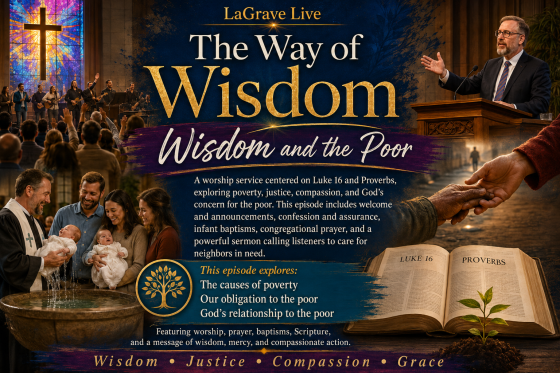
The Way of Wisdom: Wisdom and the Poor
About The Service:
Rev. Peter Jonker will preach on Proverbs 13: 23.
Order of Worship:
https://lagrave.org/wp-content/uploads/2026-7-19-AM-Order-of-Worship.pdf
About the Church:
We are a traditional CRC church in the middle of Downtown Grand Rapids, MI, worshipping at 8:40am, 11:00am, and 6:00pm. (10:00am and 6:00pm during the summer months)
We'd love to hear from you:
Connection: https://www.lagrave.org/contact
Let us pray for you:
Prayer: https://www.lagrave.org/prayerrequest/
Giving: https://www.elexiogiving.com/App/Giving/lagr107178
The July special offering is for Westminster Food Pantry. The downtown food pantry provides an emergency supply of food and personal care items to people in need while also promoting self-sufficiency through referrals and education.
Listen on the go:
Amazon Music: https://bit.ly/LGPodAmazonMusic
Apple Podcast: https://apple.co/3tuOdwQ
Google Podcast: https://bit.ly/LGPodGoogle
Soundcloud: / lagravecrc https://soundcloud.com/lagravecrc
Spotify: https://spoti.fi/3yXDFaT
Follow us!
Facebook: / lagravecrc https://www.facebook.com/lagravecrc
Instagram: / lagravecrc https://www.instagram.com/lagravecrc
Website: https://www.lagrave.org
#LaGrave #LaGraveCRC
When Poverty Has No Walls: Wisdom, Justice, and the Grace That Saves
Summary
Worship, Welcome, and Confession
The service opens with congregational singing, a greeting of grace and peace, and announcements about fellowship gatherings, a missionary presentation, and upcoming church events. The worship leader introduces the continuing Way of Wisdom sermon series and identifies care for the poor as the morning's focus. A reading of Jesus' parable of the rich man and Lazarus confronts the congregation with the consequences of ignoring suffering at one's gate. The congregation then confesses its failures to feed the hungry, welcome strangers, clothe those in need, and visit the incarcerated. The assurance from Psalm 130 emphasizes forgiveness, unfailing love, and full redemption.
Baptism into a Covenant Family
The baptismal portion welcomes Noah Thomas Leichert and Henry Roger Baumann into what the pastor describes as God's ancient covenant family. Beginning with Abraham and continuing through Pentecost, the pastor explains baptism as a sign of grace, belonging, and God's promises to believers and their children. Membership in this family gives the children a shared character, inherited stories of God's faithfulness, and the assurance of God's attentive care. It also brings obligations because the family participates in building God's kingdom and proclaiming Jesus Christ. The parents and congregation are asked to promise prayer, instruction, nurture, and faithful example as the children grow.
Prayer for the Vulnerable
Following the baptisms, the service turns toward confidential prayer requests and a pastoral prayer for people facing illness, grief, treatment, hospice care, and recovery. The prayer also remembers neighbors threatened by heat, poor air quality, and material need, asking that they receive shelter, health, companionship, and practical assistance. Families grieving recent deaths and supported missionaries in Haiti are commended to God's care. The newly baptized children, their parents, and their prayer partners are included in a petition for wisdom and strength. The congregation is challenged to recognize its blessings and use them to bless people around them.
The Many Causes of Poverty
The sermon begins by rejecting a one-dimensional explanation of poverty. Proverbs sometimes connects poverty with poor choices, laziness, procrastination, and the failure to work diligently, preserving an important place for personal responsibility. The preacher then emphasizes that Proverbs also identifies injustice, prejudice, social exclusion, and the absence of protective resources as causes that can trap people in poverty. The seventh-year agricultural law is presented as a God-given foothold for the poor that unjust landowners could remove. Low-income housing resistance and the contrast between wealth as a fortified city and poverty as ruin illustrate how people with resources possess protections that the poor often lack.
Becoming a Fortified Wall
The second major sermon point concerns the obligations of people who have resources. Proverbs calls believers not only to avoid exploiting the poor but also to notice them, listen to their cries, defend their rights, and give generously. The preacher uses his own habit of avoiding eye contact with panhandlers to explore how a seemingly practical act of avoidance can train the heart to ignore vulnerable neighbors elsewhere. The sermon connects Proverbs with the agricultural laws of Exodus and Leviticus, including the seventh-year rest and the practice of leaving part of a harvest available for those in need. The congregation is urged to become the protective wall that poverty has denied to others and to allow care for the poor to take root deeply in the heart.
Grace Revealed in Human Poverty
The final sermon movement argues that care for the poor reflects God's own character because God hears, defends, identifies with, and stands beside those in need. Jesus is presented as one who entered material poverty, centered good news for the poor in his ministry, and taught that service to the least is service to him. The preacher then turns from material poverty to the spiritual poverty experienced when families break down, illness becomes incurable, sin is exposed, or human ability reaches its limit. In those moments, people discover that achievements, money, and impressive resumes cannot supply the grace they need. The message concludes that the same divine compassion directed toward the materially poor is also the compassion through which Jesus saves, calling successful people to recognize their own dependence on grace and extend that grace to their neighbors.
LaGrave Live

If you’re looking for a warm church that commits to an intensely pertinent Gospel in the Reformed tradition of the Christian faith, we invite you to worship with us. Our 1,800 members come from across West Michigan and gather weekly in our sanctuary for relevant Biblical preaching, beautiful music, and inspiring worship. We expand our worship through intentional outreach in our community and world, attentive care for our members, and plenty of spiritual enrichment and social opportunities for everyone.
We focus on a living Savior who provides genuine solutions to the deep needs of a hurting world. We are committed to need-meeting ministry in His name, and we are committed to being real people who enjoy real life and who cry real tears. Because we are a fairly large and diverse group in terms of age, occupation, marital status, lifestyle, and physical ability; our members create many accessible opportunities for community service, Bible study, and small social groups.
We worship God, the Almighty Creator of heaven and earth, and we enjoy expressing our vision of His holiness through traditional music and formal liturgy.
Music plays an integral part of our weekly worship gatherings. Congregational singing—of both traditional hymns and newer ones—is typically supported by our pipe organ. Vocal choirs, handbell choirs, small ensembles, instrumentalists, and vocal soloists provide additional music offerings.
Led by the Holy Spirit, we seek to worship and serve God in all of life, transforming His world and being transformed to reflect the character of Christ.
Founded by 36 Dutch immigrants on February 24, 1887, LaGrave Avenue Christian Reformed Church has always been deeply committed to both this local community and worldwide missions. God has seen fit to guide and bless these commitments with sustained growth, spiritual gifting, and a continual stream of new work for our members.
Speaker Identification
Speaker 1 - Worship Leader / Liturgist
Basis: This speaker delivers the opening greeting, church announcements, call to confession, assurance of pardon, prayer-request instructions, and congregational prayer. The transcript does not provide the speaker's name.
Speaker 2 - Pastor / Baptism Officiant / Preacher
Basis: This speaker explains the covenant meaning of baptism, administers the baptisms, addresses the children and congregation, reads the sermon texts, delivers the sermon, offers the closing prayer, and gives the benediction. The transcript does not provide the speaker's name.
Speaker 3 - Congregation / Choir
Basis: This label is used for congregational prayers, responses, hymns, and sung material. Some responses and song lyrics were not captured clearly enough to transcribe word for word.
Speaker 4 - Parents of the Baptized Children
Basis: Kevin and Shannon, and Alex and Megan, are addressed as the parents making baptismal promises. Their spoken responses are not clearly captured in the source transcript.
[Opening Music and Congregational Singing]
Speaker 3 - Congregation / Choir:
Come, ye sinners, poor and needy,
Weak and wounded, sick and sore;
Jesus ready stands to save you,
Full of pity, love, and power.
I will arise and go to Jesus;
He will embrace me in his arms.
In the arms of my dear Savior,
Oh, there are ten thousand charms.
[The remainder of the opening music is too garbled in the automated transcript to reconstruct reliably.]
Speaker 1 - Worship Leader / Liturgist:
Friends, Jesus Christ, the one who honored others above himself and shared with the Lord's people who were in need is with us this morning and he greets us with these words. May grace, mercy, and peace be unto you from God our Father, the Lord Jesus Christ, and through the empowering work of the Holy Spirit. Amen. You may be seated.
Good morning and welcome to LaGrave Avenue Christian Reformed Church. We are delighted to see a packed sanctuary this morning with so many faces. We extend a special welcome to those of you who may be visiting this morning for the baptisms. We are delighted that you are here and we look forward to the celebration together. As always, welcome to those of you who may be online worshiping via livestream, and welcome to all of you here in the sanctuary.
Following this morning's service, as always, we will hold a time of coffee and conversation in the multipurpose room, which is just through the narthex down the hallway and to your right. District coffees will also continue this morning, so for those of you who may be living in District 9, your coffee and conversation will be held in the parlor this morning. That is through the narthex down the hallway and to your left.
Also following this morning's service at approximately 11:15 a.m., we will be having a missionary presentation downstairs in the fellowship hall. We would love to see as many of you there as possible so that you might hear for the first time or hear more about this hard and incredibly important ministry of ours.
As many of you have probably noticed, summer is slowly but surely coming to a close, but there are still a number of fellowship events to mark on your calendars. First is the courtyard barbecue for CREW and college/career students taking place on Wednesday the 29th. Second is the third annual LaGrave golf outing taking place on August 1. And the third is the women's [event name unclear] event on August 6 at Deep Roots Farm. If you're interested in any more information on any of these events, please refer to the upcoming-events section of your bulletins or you can always reach out to Cindy Busker.
This morning we continue our summer sermon series entitled The Way of Wisdom. This morning we will be thinking especially about caring for the poor.
Would you hear this call to confession from Luke chapter 16? There was a rich man who was dressed in purple and fine linen and lived in luxury every day. At his gate was laid a beggar named Lazarus, covered with sores and longing to eat what fell from the rich man's table. Even the dogs came and licked his sores. The time came when the beggar died and the angels carried him to Abraham's side. The rich man also died and was buried.
In Hades, where he was in torment, he looked up and saw Abraham far away with Lazarus by his side. So he called to him, "Father Abraham, have pity on me and send Lazarus to dip the tip of his finger in water and to cool my tongue because I am in agony in this fire." But Abraham replied, "Son, remember that in your lifetime you received your good things and while Lazarus received bad things, but now he is comforted here and you are in agony. And besides all this between us and you a great chasm has been set in place so that those who want to go from here to you cannot, nor can anyone cross over from there to us."
He answered, "Then I beg you, Father, send Lazarus to my family for I have five brothers. Let him warn them so that they will not also come to this place of torment."
Abraham replied, "They have Moses and the prophets, let them listen to them." "No, Father Abraham," he said, "but if someone from the dead goes to them, then they will repent." He said to him, "If they do not listen to Moses and the prophets they will not be convinced even if someone rises from the dead." Would you join me now in our prayer of confession?
Speaker 3 - Congregation / Choir:
Jesus, friend of sinners, your words to your disciples were plain: whatever we did for the least of our brothers and sisters, we did for you. But have we fed the hungry, invited the stranger, clothed those whose garments were threadbare, or visited the incarcerated? In your mercy, Lord, forgive us. Amen.
Speaker 1 - Worship Leader / Liturgist:
Friends, we belong to a God who commanded us to be devoted to one another in love. Now that we have together confessed our lack thereof, would you hear these words of assurance from Psalm 130? If you, Lord, kept a record of sins, Lord, who could stand? But with you there is forgiveness, so that we can with reverence serve you. Israel, put your hope in the Lord, for with the Lord is unfailing love and with him is full redemption. He himself will redeem Israel from all their sins. Thanks be to God. Amen.
Speaker 2 - Pastor / Baptism Officiant / Preacher:
Congregation, today we are privileged to witness the sacrament of baptism: God's grace flowing into the lives of Noah Thomas Leichert and Henry Roger Baumann. They will become part of this family today and it is a beautiful and a very old family. This family has been going on at least since the time of Abraham. God came to Abraham and said, "Abraham, through you I am going to start a family. It will be a family of grace. It will be undergirded with my promises." God said to Abraham, "I'm going to be God to you and to your descendants after you. I will establish an everlasting covenant between me and you and to your descendants after you to be God to you for generations to come." This covenant, this promise, was not just for Abraham; it was for his children and the sign of passing on to the children was the sign of circumcision. It was a sign that these people were special to God and had a special role given to them in this world.
At Pentecost, after the death and resurrection of Jesus and the coming of the Holy Spirit, the promise to Abraham extended from just the Jewish people to the whole human race. Because of what Jesus did, Peter stood in front of people from all different parts of the world and he said, "Repent and be baptized, every single one of you," and he said that the promises represented in the water of baptism were for us and for our children after us.
So now by the sign of baptism instead of circumcision we become part of this family. We are joined together in the covenant family of God. That means so many things. I would like to just name three things that this means this morning.
It means that when we become part of this family, we inherit a character. Every family has a character, right? So if you were part of the Smith family you say, "We are the Smith family. We do things a certain way. Let me tell you stories. This is who your grandfather was. This is who your grandmother was. This is how they did things." You inherit stories and a way of being in the world. It's the same thing with this family. We hear the stories of God's covenant faithfulness throughout the ages, especially the story of Jesus Christ and his death and resurrection, and we understand what it means to be part of this family. There's an ethos in this family that we follow.
Bearing God's name also means that you get special attention from God. Noah and Henry will get the Lord's attention. When parents go to a youth soccer game they watch the whole game. They cheer for all the kids, but they especially have their eye on their child. So it shall be for these two.
Finally, having this name brings obligations. There is a family business that we are baptized into. There is a way. There is a project. Noah and Henry now become part of this project. That project is the building of the kingdom of God and the proclamation of the glory of the name of Jesus Christ, our Lord. All these wonderful things are happening to these children today even though they are way too young to even understand, but someday they will understand through your help and through the work of the Holy Spirit.
Kevin and Shannon, and Alex and Megan, you've heard God's promises. I'd like to ask you to rise where you are right now and answer these questions about Henry and Noah. Kevin and Shannon; Alex and Megan: Do you profess your faith in Jesus Christ as your Lord and Savior and affirm the promises of God made to you and to your children in his Word? Do you promise to instruct Noah and Henry by word and example with the help of this Christian community in the truth of God's Word and in the way of salvation through Jesus Christ? Do you promise to pray for them and to teach them to pray and do you promise to nurture them within the body of believers as citizens of Christ's kingdom?
Kevin and Shannon, what is your answer?
Speaker 4 - Parents of the Baptized Children:
[Response not clearly captured in the source transcript.]
Speaker 2 - Pastor / Baptism Officiant / Preacher:
Alex and Megan, what is your answer?
Speaker 4 - Parents of the Baptized Children:
[Response not clearly captured in the source transcript.]
Speaker 2 - Pastor / Baptism Officiant / Preacher:
I invite you now to come forward to receive the sacrament.
I would also like to ask the prayer partners to come forward. Paul [surname unclear] and Dita DeKryger, who have agreed to represent you on behalf of the congregation to pray for these two children in a special way, which does not absolve the rest of you from praying for them as well.
I'd also like to ask children to come forward. This is the children's sermon time. So come on up and I'd like you to come over here and I was going to say a few words to you before we do this baptism. Come on up, kids. You get a front row seat. Have a seat. You can sit down, Ellie. I'm not going to sit down today. Come on up. All right. Guests are welcome too. Come on up. You can sit over here because otherwise I won't have room to baptize the baby and that would be too bad. Okay. Would you mind sitting over here even if that's not your regular side? You guys are just like the congregation members. You have places you'd like to sit and you don't like to move from them. Come on, everyone. The more the merrier. I see many more coming. Wow. This is so great.
All right. You see the two. Do you know which one is Henry and which one is Noah? Some of you do because they're like your cousins. Okay. This is Noah and that's Henry over there. You can see they already have families, right? Those are their families standing there. But today they got a new family and that's us. That's what we're celebrating today. It's a really big family. Look at all the people in this family. Look at how many people. It's way more than this too, right? You know who else is part of this family? King David is part of this family and Moses is part of this family. Paul and Peter are part of this family and, most importantly, Jesus, who died for us is part of this family. So let's baptize these two children into this family. All right. Let's start with Henry. Oh, wait. I never asked you guys for your promises. Did I? All right. We're going to do this.
Congregation, you also have a role in these promises as I have indicated. Do you, the people of LaGrave, promise to pray for Henry and Noah? Do you promise to surround them as they grow older? Do you promise to help nurture them in the way of the kingdom and the way of Jesus Christ?
Congregation of LaGrave, what is your answer? Do you promise?
Speaker 3 - Congregation / Choir:
[Congregational response not clearly captured in the source transcript.]
Speaker 2 - Pastor / Baptism Officiant / Preacher:
Henry Roger Baumann. I baptize you in the name of the Father, and of the Son, and of the Holy Spirit. Amen.
Noah Thomas Leichert, I baptize you in the name of the Father, and of the Son, and of the Holy Spirit. Amen.
All right, kids, Mrs. DeKryger is going to bring over the other baby. She is a prayer partner for Henry. See, this is Noah and that's Henry. They sure are little. For many of you, when you were this little, you were baptized too and Jesus has been with you ever since and that's so important and so exciting. Now I'm going to bless these babies, okay?
Henry and Noah, may the Lord bless you and keep you. May the Lord lift up his face to shine upon you and be gracious to you. May the Lord always smile upon you, walk with you, and fill you with his peace both now and forevermore. Amen. Let's sing of God's promises.
Speaker 1 - Worship Leader / Liturgist:
If you ever have something that you would like to be prayed for, there are prayer-request forms on the back of the sermon note cards. You may fill one out and drop it in the wood box outside the chapel narthex. The prayer team welcomes these requests as a privilege, and all requests are kept confidential. One update before we go to prayer this morning is that Carol Hoffman was hospitalized with a virus but has now been transferred to a rehab facility and the family is requesting no visitors at this time. Let's go to God in prayer this morning.
Almighty God and gracious Father, in the presence of your bounty, would you keep us humble and in the presence of all of our needs, make us compassionate and caring. We think especially this morning of those in immediate need in our neighboring community. The heat and poor air quality threaten the livelihood of the already needy. Bless them with cool shelter, preserved or restored health, and grant us, Lord, hearts inclined toward helping wherever and however we can. May your presence in us inspire confidence to do your work and to ensure companionship for all.
Lord, we think too this morning of those living in immediate need in our own church community. We pray for all illness and pain, thinking specifically this morning for Sandy DeKryger, Oren Gelderloos, Renee Kuiper, Dave Vander Ark, and Carol Hoffman as each of them walk the journey of recovery. In each case, Lord, grant healing through your hand of omnipotence. We lift the same prayer up for Steve Palazzolo as he remains in the hospital following inpatient chemotherapy and for Joanne [surname unclear] as she is now receiving hospice care at Raybrook Assisted Living.
Lord, in all of these requests may your grace give new hope to find victory in the very scene of bodily failure.
Lord, we lift up to you those who have recently lost life in this world. In the very scene of bodily failure, may you grant hope to Kara and Mark Steit in the death of Kara's mother, Janice; to Cal and Marge Vandermaiden; and to Ruth and Jeff Kanandyk and their family in the death of their granddaughter and niece, Kaylee Geertman. Also grant hope to Jonah and Jusko Lazar and their children, missionaries we support in Haiti, in the tragic death of Jonah's father. Grant each of these individuals hope, knowing that you, Jesus Christ, stood in the presence of ultimate bodily failure - death - and planted your flag of ultimate hope: eternal life.
Flowing from the ultimate hope of eternal life, Lord, we have been commanded to go, to go and to make disciples of all nations, baptizing them in the name of the Father, Son, and Holy Spirit. We praise you for the lives of Henry Baumann and Noah Leichert as each has been welcomed into this family of hope. Grant Alex, Megan, Dita, Kevin, Shannon, and Paul all that they stand in need of to raise these children in your Spirit. Instill in them and in us the conviction to be passionate in our caring and proclamation of the gospel for not only these children but for all of your children.
Lord, as each of us children of God head into this new week, we ask that you would keep watch over us as you always have. As you do, would you incline our hearts, our eyes, and our spirits toward recognition of your blessings unto us. You have blessed our lives and the life of this church immeasurably for which we are grateful. Would you push us now to use those blessings to bless those around us? It is in your name that we pray. Amen.
Speaker 3 - Congregation / Choir:
Praise to the Lord of the small, broken things,
Who sees the poor sparrow that cannot take wing,
Who loves the lame child and the wretch in the street,
Who comforts their sorrows and washes their feet.
Praise to the Lord of the faint and afraid,
Who girds them with courage and lends them his aid.
He pours out his Spirit on vessels so weak
That the timid can serve and the silent can speak.
Praise to the Lord of the frail and the ill,
Who heals their afflictions or carries them till
They leave this tired frame and to paradise fly,
To never be sick and never to die.
Praise him, O praise him, all you who yet live,
Who have been given so much and can so little give.
Our frail, lisping praise he will never despise;
He sees his dear children through mercy-filled eyes.
[Exact hymn wording should be verified against the service bulletin.]
Speaker 2 - Pastor / Baptism Officiant / Preacher:
Our Bible readings this morning, as we continue our wisdom series, are printed in your bulletin. I will read them in a moment, but I would like to say a few words first.
I wonder whether the service of confession struck you a little more deeply than a service of confession usually does. I hope you heard those words. When I read the parable of the rich man and Lazarus as a LaGrave member, I feel as though Jesus is looking directly at me. There was a rich man who lived in luxury, and at his gate was laid a beggar named Lazarus. I do not think of myself as a rich man, and probably you do not either. But by historical standards and worldwide standards, that is what 95 percent of us are.
Every single day when I come to work, there are multiple Lazaruses at my gate. There was a Lazarus sleeping in the north doorway this morning. That is pretty typical. So when I read this parable, I hear Jesus saying to me, "Okay, buddy, what are you going to do about this?"
That is a question we will all be thinking about together this morning. We will approach it through the book of Proverbs and its many words about wisdom and poverty. Not all of them, but many of them. Before we turn to those texts, let us sing the song printed in the bulletin as preparation.
Before I read these proverbs from your bulletin, let me read two verses from Exodus. This law from the Old Testament helps us understand the very first proverb on our list. Here is the law.
God says to the Israelites, "For six years you are to sow your fields and harvest the crops, but during the seventh year let the land lie unplowed and unused. Then the poor among you may get food from it and the wild animals may eat what is left. Do the same with your vineyards and your olive groves."
Now let us listen to these proverbs and note the connection with the first one.
An unplowed field produces food for the poor, but injustice sweeps it away.
The poor are shunned even by their neighbors, but the rich have many friends.
All hard work brings a profit, but mere talk leads only to poverty.
The wealth of the rich is their fortified city, but poverty is the ruin of the poor.
Speak up for those who cannot speak for themselves, for the rights of all who are destitute. Speak up and judge fairly; defend the rights of the poor and the needy.
Those who give to the poor will lack nothing, but those who close their eyes to them receive many curses.
The righteous care about justice for the poor. The wicked have no such concern.
Whoever shuts their ears to the cries of the poor will also cry out and not be answered.
Do not exploit the poor because they are poor, and do not crush the needy in court. For the Lord will take up their case and will exact life for life.
Do not move an ancient boundary stone or encroach on the fields of the fatherless. For their defender is strong and he will take up their case against you.
The Lord tears down the house of the proud but he sets the widow's boundary stones in place.
Whoever mocks the poor shows contempt for their Maker, and whoever gloats over disaster will not go unpunished.
Whoever oppresses the poor shows contempt for their Maker. Whoever is kind to the needy honors God.
This is the word of the Lord.
As you can see, the book of Proverbs has many, many proverbs concerning wisdom, the poor, and God's will for our lives with respect to those in need. I read twelve of them this morning; there are many more. I think these twelve are sufficient to give you a sense of how Proverbs views the poor and the way we should treat them.
This morning I am going to have three points - three themes that appear in those verses that I read. I am going to talk about them in the order of the Proverbs that I read. We are going to talk about the causes of poverty according to Proverbs, our obligations to the poor according to Proverbs, and God's relationship to the poor according to Proverbs. So: causes of poverty according to Proverbs, our obligations to the poor according to Proverbs, and God's relationship to the poor according to Proverbs.
The way I just read it, those first four sort of go with point one, causes. The next five go with our obligations and the last four address God's relationship to the poor.
First, the causes of poverty as laid out in Proverbs. What do the proverbs say causes poverty? On the one hand you have many proverbs that talk about how poverty is often the result of bad choices made by human beings. The poor are poor because they have made poor choices. That's the third proverb on our list, Proverbs 14:23. All hard work brings profit, but mere talk leads only to poverty. If you are just all talk and no work, you are going to struggle to stay solvent in this life. To avoid poverty you need to work, says that proverb.
There are other proverbs like that in the book of Proverbs, including many that reference one of the more colorful characters from Proverbs, the sluggard. I love that word, the sluggard, right? You have heard of this. It is a word that, if you know it, you probably know only from the book of Proverbs. The sluggard is a kind of lazy person who likes to procrastinate and who likes to stay in bed. So you have proverbs like Proverbs 20:4 which says, "Sluggards do not plow in season, so at harvest time they find nothing." There are proverbs which say, "Look, here is a good way to avoid poverty, be diligent, work hard."
And a person might read those proverbs and only those proverbs and say, "See, it is all about personal responsibility." Avoiding poverty is all about personal responsibility. If poor people would just be diligent, if they would learn a few skills and apply them, everything would be fine.
But that is not all that Proverbs has to say about the causes of poverty. Look at the first proverb on our list, the one set up by that law, okay?
Exodus 23 tells us this amazing law that every seven years a farmer was supposed to leave his field and vineyard unplowed, so that the poor could come in and take some of the produce to give them a foothold and help them climb out of poverty. Once every seven years. That is amazing, right? In effect, one-seventh of the farm's productive cycle was dedicated to the poor.
Now listen to the proverb. An unplowed field produces food for the poor, but injustice sweeps it away.
The suggestion is, "We all know that law is there, but in real life, a lot of people just were not obeying it." They were planting every year. They were not rotating their crops. Or perhaps they were letting their fields lie unused, but they were going in first and taking out all the produce for themselves.
This was not about the failure of responsibility of the poor. The poor were ready to go in and take what they could get. This law was intended to be a foothold for them to get a leg up, but unjust people were kicking that foothold out from under them.
Sometimes the cause of poverty is injustice. Sometimes it is prejudice. Look at the second proverb on our list.
What is interesting about this proverb, and this is true of a lot of proverbs, it does not tell you to do anything. It just makes an observation about the way life is. It makes an observation about society. The poor are shunned even by their neighbors, but the rich have many friends.
This is why it is hard to get low-income housing built, right? We all like the idea of lower-income housing. We know there is a housing crisis. We know it is hard for poor people to find affordable housing. We all like the idea of lower-income housing, but all of us, present company, me included, if we hear there is a five-story, lower-income housing block going up one block away from our house, we are concerned. We show up at the planning meeting because the poor are shunned even by their neighbors when it affects housing values.
Or consider Proverbs 10:15: The wealth of the rich is their fortified city, but poverty is the ruin of the poor. The wealth of the rich is a fortified city, but poverty ruins the poor. Their own poverty works against them.
What does that mean? The rich have a fortified city.
If something goes wrong in our lives, those of us who have resources, we have walls. If I get sick, I know all kinds of people, healthcare professionals whom I can call to give me advice. I have health insurance. I have a fortified city against that sickness. If I get into legal trouble, this congregation is crawling with lawyers. I can call them and get good advice, or they can point me to the right person. So can you.
If your child is struggling in school, say it is time for the SATs, and they are not quite getting their scores up to where they need to be. What do we do? We hire a tutor. We send them to a program so they can get their scores up a little higher, and they get a better scholarship and get into school. We have a fortified city. There is nothing wrong with these fortified walls.
The point of the proverb is that the poor have none of these walls. They have none of these walls, so when trouble comes to their city, they are swept away. The wealth of the rich is a fortified city, but poverty is the ruin of the poor.
The book of Proverbs has a very nuanced, very rich, very up-to-date account of how poverty works among us, and how it takes root in people and in culture. So that is what Proverbs says about the causes of poverty.
What does Proverbs teach us about our obligations to the poor? I think you heard that, in the book of Proverbs, God lays strong obligations and duties upon us and calls us to work for the poor.
Proverbs 10:15, which we just read, talks about how the poor have no fortified wall to protect them, in effect Proverbs is saying, "You become their fortified wall. You surround them." That call is really strong.
In some of the proverbs I read, you hear, "Do not oppress the poor. Do not take advantage of them because they are weak." So that is a minimum standard, but Proverbs goes well beyond that. It also says it is a sin to oppress them. It is also a sin not to pay attention to them. It is also a sin to ignore them. In Proverbs 28:27, 29:7, and 21:13, the wicked have no concern for the poor. They shut their ears to their cries.
Proverbs 21:13 is especially sharp. Whoever shuts their ears to the cry of the poor will also cry out and not be answered. That is strong. I think most of us here would not actively take advantage of the poor, would not knowingly oppress them. I take that for granted. You are good people.
But ignoring the poor, I personally have become very good at driving up to street corners, where someone is panhandling and completely ignoring them. Maybe you have too. I look straight ahead. I do not look at their sign. I certainly do not look them in the eye. If I am getting off the off ramp on the interstate and there are two lanes, and they both turn left, I usually take the outside one if I see a person on the inside lane.
I know, and you probably know too, that sociologically speaking I am on pretty good ground. Everyone says not to give money to panhandlers. I know I may be doing the right thing at one level, but here is my worry: in learning to ignore them at these intersections, I am teaching myself a dark art. So I ignore them in my car, which is right and proper, but that same skill that I learned there helps me to ignore them in my neighborhood or wherever else I see them. That is possible, right? It is not good because those who close their eyes to the poor receive many curses. That is what Scripture says.
When it comes to wisdom in our obligations to the poor, Proverbs is very much in line with the Old Testament law, which also lays on those strong obligations. I already talked to you about the law in Exodus 23, which essentially says one-seventh of your produce.
In addition to that, you remember Leviticus 19 in the gleaning laws, right? You could not harvest your whole field. You had to leave a rim around the outside so the poor could come and get their harvest there. Add those two together and you see strong obligations to the poor in the law of God. God wants care for the poor to live deep in our hearts.
Which brings us to the third thing that Proverbs has to teach us about wisdom and the poor. Proverbs tells us that we have a high call to care for the poor because God cares for them deeply. God hears them. God stands with them. God identifies with them. God is beside them in a special way.
Fully six of the proverbs I just read - and you can go back and check my math on that - make this point.
Fully six of the proverbs that I printed in your bulletin say some version of this: if you mess with the poor, you are messing with God, right? You heard that. If you mess with the poor, you are messing with God. The last five say so more or less explicitly.
Proverbs 22:22 says that if you oppress the poor, the Lord will take up their case and exact life for life. Proverbs 23:11 says that if you move an ancient boundary stone, so if you fudge a boundary so that you can get more land at the expense of a poor widow, God will be their defender. Proverbs 14:31 says, "Whoever oppresses the poor shows contempt for their Maker, but whoever is kind to the needy honors God."
So if you mistreat the poor neighbor, that is like mistreating God. If you love and care for your poor neighbor, that is like loving and caring for God. You can hear Jesus' parable here, right? Whoever does this for the least of these does this for me. Proverbs 14:31 anticipates what Jesus will say later. And in case we do not yet understand how much God cares for the poor and how much he stands for them and how much he hears their cries.
Finally, God does one more thing. He becomes one of the poor. He becomes a child born in a stable and laid in a manger, born to parents who are so poor that they cannot pay the usual price of dedication of a lamb. They have to offer two pigeons or doves, the sacrifice of a poor person.
As an adult, he is essentially homeless. Foxes have holes, the birds of the air have nests, but the son of man has no place to lay his head. During his ministry, he constantly places concern for the poor at the center of his mission.
In his first sermon recorded in the book of Luke, he stands up in his hometown and he says, "The Spirit of the Lord is upon me to do what?" He gives sight to the blind and preaches good news to the poor. In his most famous sermon, the Sermon on the Mount, the very first words out of his mouth in that sermon are, "Blessed are the poor in spirit for theirs is the kingdom of heaven."
In Matthew 11, when John the Baptist starts to wonder, is Jesus really the Messiah? Jesus sends a message back to him that says, "Go tell John that the blind are given sight and good news is preached to the poor."
Then to underline all this, he tells parables like the rich man and Lazarus. He tells the parable of the sheep and the goats. He says, "Do not store up treasures on earth, where moth and rust destroy."
God's concern for the poor is not a sidelight in Scripture. It is at the center of his mission and at the center of his heart.
Let's take a breath for a moment. I know that I have been hitting you pretty hard in this sermon. You might even feel guilty. If that is true, that is okay, because I will tell you what, I felt guilty all week and I felt like these texts were hitting me too, okay? You have only been dealing with it for 20 minutes. But I do not want you to leave this place feeling guilty and beat up because that is not gospel preaching, right? That is not the gospel to beat people up with guilt.
So by way of conclusion, let me say this. That profound concern for the poor, which I have tried to show you lives in God's heart and makes him stand beside the poor, is the same concern he wants to live in us. We should be deeply thankful for it because that same concern is what causes him to save us.
We may not be materially poor, but think about it. When is it that you know the truth and power of the gospel? It is when you are in your poverty. It is when you are at wit's end. It is when you know you do not have another card to play.
Your family is coming apart, your daughter will not return your phone calls, and there is nothing you can do about it. The doctor says the cancer is throughout your body and is not curable. We get caught in sin and we realize that we are actually not that nice a person. We are shallow and we are self-centered.
When things like this happen to us, we know our poverty. We know that there is nothing on our resume and nothing in our hands that can give us what we need. What we need is the grace of Jesus Christ. We cry out and God saves us through Jesus Christ. It is in our poverty. That is what Jesus is talking about of course when he says, "Blessed are the poor in spirit for theirs is the kingdom of heaven." It is when you come to that kind of realization.
When I say that, I am not spiritualizing the text. Jesus is not just talking about the spirit because the materially poor come more quickly to that realization than we do. Right? We upwardly mobile middle-class people, we think we have skills. We think we have stuff on our resume. We think we can do something to improve ourselves, to climb the ladder of success, to climb the ladder of righteousness and impress God. The poor understand that they have nothing and it is all about grace.
Years and years ago - it must have been 25 years ago - I heard the well-known preacher Fleming Rutledge give a talk at Calvin Seminary. I still remember in that talk she was complaining about modern preaching at middle-class churches. She said, "You know, I do not much like it. I do not think it is very good these days," which hit a little hard.
The reason she said it was not all that good was that it was all this can-do preaching. Five ways to improve your family. Four ways to improve your prayer life. The body language of that is this, "Here is another little skill so that you can climb the ladder of righteousness, improve yourself."
She said, "But do you know where I like the preaching? In the Black church." Because in the Black church, they know it is all about grace. The Black church preaches a God who makes a way out of no way. A God who parts the Red Sea when such a thing seems impossible. A God who raises people from the dead. A God who, while we were still sinners, died for us. That is the God we need.
So, all of you successful people - all of you poor, successful people - Jesus sees your poverty, and he gave his life to save you. We have earned nothing. Every penny in your bank account and every shiny sentence in your resume is a gift from God. You know it.
So as we look at the needs of our poor neighbors, may something of what is in the heart of the God who saved us live in our hearts too. Amen.
Lord Jesus, you know how much we need you. We need you. Oh, we need you. Every hour and every moment we need you. Thank you that in your generosity and your grace you came to our poverty and saved us. Give us wisdom, Lord, as we do the incredibly hard work of helping people. Lord, you know that it is not simple. You of all people know that it is not simple. You walked this earth for three years and, Lord, for you it was not simple. Give us wisdom as we look at our neighbors and look at our world and figure out how to love them in your name. In Jesus' name. Amen.
[Closing Congregational Song]
Speaker 3 - Congregation / Choir:
[Most closing-song lyrics are too corrupted in the automated transcript to reconstruct reliably. The clearly repeated phrase is: "We know that we can stand."]
Speaker 2 - Pastor / Baptism Officiant / Preacher:
Congregation, receive the blessing of your Lord. The grace of our Lord Jesus Christ, the love of God, and the fellowship of the Holy Spirit, be and abide with you all.