
LaGrave Live, July 12, 2026

LaGrave Live
LIVE Morning Worship Service 07-12-2026
Hearing Abel, Raising Cain
About The Service:
We welcome Rev. Scott Hoezee, Director of the Center for Excellence in Preaching at Calvin Seminary, to our pulpit, and we will celebrate the Lord's Supper together. Rev. Hoezee's sermon will be "Hearing Abel, Raising Cain" from Genesis 4:1-16.
Order of Worship:
https://lagrave.org/wp-content/uploads/2026-7-12-AM-Order-of-Worship.pdf
About the Church:
We are a traditional CRC church in the middle of Downtown Grand Rapids, MI, worshipping at 8:40am, 11:00am, and 6:00pm. (10:00am and 6:00pm during the summer months)
We'd love to hear from you:
Connection: https://www.lagrave.org/contact
Let us pray for you:
Prayer: https://www.lagrave.org/prayerrequest/
Giving: https://www.elexiogiving.com/App/Giving/lagr107178
The June special offering is for Pine Rest Patient Assistance Fund: Part of Pine Rest Foundation Fund offering financial assistance for individuals, families and children who need care.
Listen on the go:
Amazon Music: https://bit.ly/LGPodAmazonMusic
Apple Podcast: https://apple.co/3tuOdwQ
Google Podcast: https://bit.ly/LGPodGoogle
Soundcloud: / lagravecrc https://soundcloud.com/lagravecrc
Spotify: https://spoti.fi/3yXDFaT
Follow us!
Facebook: / lagravecrc https://www.facebook.com/lagravecrc
Instagram: / lagravecrc https://www.instagram.com/lagravecrc
Website: https://www.lagrave.org
#LaGrave #LaGraveCRC
The Better Word: From Cain's Restlessness to Christ's Peace
Summary
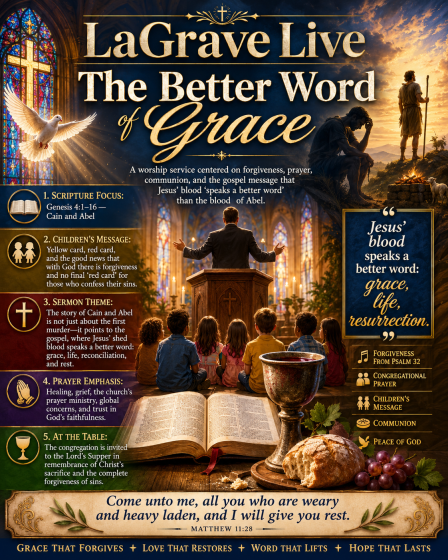
A Worship Service Grounded in Forgiveness
The service opens with confession and assurance drawn from Psalm 32, emphasizing that acknowledged sin is met by God's forgiveness. Congregational prayer then holds together personal illness, grief, birthdays, church ministries, missionary work, denominational renewal, international suffering, and the hope that God's love and faithfulness extend beyond every human need.
No Red Card with God
The children's message uses soccer's yellow and red cards to explain conviction, confession, and grace. A yellow card becomes an image for the Holy Spirit's warning when someone lies or harms another person. Unlike a referee who permanently removes a player, God does not cast repentant people out of his family; confession is met with forgiveness.
Reading Cain and Abel Beyond the Simplest Version
The sermon turns to Genesis 4 and challenges children's-Bible summaries that portray Cain as obviously evil from birth and Abel as obviously righteous. The preacher observes that the text gives little explanation for God's different responses to the offerings, making room for a more careful reading of Cain's anger, God's warning, and the tragedy that follows.
The Cry of Innocent Blood
After Cain kills Abel, Abel's blood becomes the Bible's first voice of an innocent victim crying from the ground. The sermon connects that cry with continuing violence throughout human history. Cain's punishment uproots him from the soil and makes him a restless wanderer, yet God still marks and protects him, interrupting the cycle of retaliatory death.
A Better Word Spoken by Christ
Hebrews 12 provides the sermon's central theological claim: Jesus' blood speaks a better word than Abel's blood. Abel's blood names injustice and death, while Christ's blood speaks grace, life, resurrection, and reconciliation. Jesus represents both victims and perpetrators, revealing God's insistence on life even where human beings repeatedly choose violence.
Communion as Reconciliation and Homecoming
The closing illustration from Places in the Heart imagines victims, perpetrators, the dead, the marginalized, and the guilty sharing communion and exchanging the peace of God. The service then moves directly to the Lord's Table, where bread and cup proclaim that Christ brings restless wanderers home, creates shalom, and offers forgiveness and rest to wounded hearts.
LaGrave Live

If you’re looking for a warm church that commits to an intensely pertinent Gospel in the Reformed tradition of the Christian faith, we invite you to worship with us. Our 1,800 members come from across West Michigan and gather weekly in our sanctuary for relevant Biblical preaching, beautiful music, and inspiring worship. We expand our worship through intentional outreach in our community and world, attentive care for our members, and plenty of spiritual enrichment and social opportunities for everyone.
We focus on a living Savior who provides genuine solutions to the deep needs of a hurting world. We are committed to need-meeting ministry in His name, and we are committed to being real people who enjoy real life and who cry real tears. Because we are a fairly large and diverse group in terms of age, occupation, marital status, lifestyle, and physical ability; our members create many accessible opportunities for community service, Bible study, and small social groups.
We worship God, the Almighty Creator of heaven and earth, and we enjoy expressing our vision of His holiness through traditional music and formal liturgy.
Music plays an integral part of our weekly worship gatherings. Congregational singing—of both traditional hymns and newer ones—is typically supported by our pipe organ. Vocal choirs, handbell choirs, small ensembles, instrumentalists, and vocal soloists provide additional music offerings.
Led by the Holy Spirit, we seek to worship and serve God in all of life, transforming His world and being transformed to reflect the character of Christ.
Founded by 36 Dutch immigrants on February 24, 1887, LaGrave Avenue Christian Reformed Church has always been deeply committed to both this local community and worldwide missions. God has seen fit to guide and bless these commitments with sustained growth, spiritual gifting, and a continual stream of new work for our members.
Speaker Identification
Speaker 1 - Worship Leader / Officiant: Leads the confession, assurance of pardon, congregational prayer, communion liturgy, and benediction. The transcript does not provide the speaker's name.
Speaker 2 - Children's Message Leader: Gives the soccer yellow-card and red-card illustration. This may be the same person as Speaker 1, but the transcript does not establish that with certainty.
Speaker 3 - Guest Preacher: Reads Genesis 4:1-16 and delivers the sermon on Cain, Abel, violence, grace, and the blood of Christ. The speaker says he was invited back to LaGrave, but his name is not stated.
Speaker 4 - Congregation: Gives spoken responses during prayer, Scripture, communion, and the benediction.
Speaker 5 - Choir / Musicians / Congregational Singers: Performs hymns and service music. Most lyrics are not reliably intelligible in the automated transcript.
Speaker 1 - Worship Leader: from our sin, O God, and renew our right spirit within us.
In the name of Jesus our Savior, we pray. Amen. Hear these words of assurance, words of forgiveness from Psalm 32. The psalmist says there in verse 5, that if we acknowledge our sin and do not cover up our iniquity, if we confess our transgressions to God, God forgives the guilt of our sin.
Thanks be to God that we are a forgiven people. Thank you.
[Congregational hymn or choral music - lyrics mostly unintelligible in the automated transcript.]
[Congregational hymn or choral music - lyrics unintelligible in the automated transcript.]
Speaker 1 - Worship Leader: So we go to God in a time of congregational prayer this morning.
We have one update in addition to what you find in the bulletin. And that is that we extend our sympathy to Mark and Cara Stite in the death of Cara's mother, Janice Geer, who died on July 3. Also if you ever have a prayer request that you would like prayed for by the prayer team, there are cards you can find in the pew racks.
You can fill those out, drop them in the wooden box. Just outside the chapel entrance and the prayer team loves to pray for those things and they will keep them confidential. We will be assisted in prayer this morning with words from Psalm 108, including the response that you find listed in your order of worship.
I invite you to listen for those words that I will pray and then you'll respond with me and those to those words that are in bold. Let us pray. Oh God, in this morning hour we sing and make music to you to help awaken the dawn. And we do so because you are worthy of all our praise because your glory extends over all the earth and because your love, oh God, is higher than the heavens and your faithfulness reaches to the skies.
Father your word also reminds us that we should uphold those who need your aid and horror feeling pressure from the enemy at times. Father we pray that you would be with Renee Kuiper as she continues her recovery from cancer surgery, continue to strengthen her each day.
We pray that for Orren Gelderlose as he recovers from back surgery and we pray for renewed strength and decreased pain for him. And we pray for Dave Anderarch who now enters the time of rehab after hospitalization for blood clots. Renew Dave's strength as well.
We pray that you would be with Steve Paolo Zolo, father who had chemotherapy treatments once again. You know the long journey he has been on in this battle with cancer. And we pray, Father, that you would guide all the medical staff so that he will be cured of his cancer once and for all.
We pray for Sandy DeCryger in her journey with cancer. And we pray, Father, that you would go before her as she anticipates surgery this week. We pray that would be a success and that you would grant her healing from that and eventually healing completely from cancer.
Lord our God, we lift before you as well those who are grieving this morning. We lift before you the understimate family and the death of Dorothy. Father, we thank you for her long life and all the ways she served you faithfully. But we pray now for comfort and peace for her family knowing that Dorothy is home with you.
We pray as well for all of us who knew and loved Cecil Lawson, people in the neighborhood and people here in this church. And we pray for your comfort and peace to be upon us. And we lift before you the state family and the death of Kara's mother, Father, May they too rejoice knowing that she is home with you.
And Father, we also lift before you those names who have been in our fishbowl this past year and those who are being added to the fishbowl now even as it sits in the library. And we pray that your spirit would work in powerful ways in the lives of those who do not know Jesus as Savior, those who are wandering in their faith, those who have left the Christian faith by your Spirit, O God, draw them to you.
We lift all these people before you because your love, O God, is higher than the heavens and your faithfulness reaches to the skies. Here we also have reasons this morning to celebrate your abundant goodness. We pray, Father, for Marlon Arnoise and Ray Cornell.
And we thank you for your faithfulness to them as they will turn 90 this week Friday. Continue to bless them in the future as you have in the past. We thank you, O God, for opportunities to grow in faith even in these summer months. We thank you for the Bible studies that continue to meet as well as the new women's study on Thursday nights.
And we thank you as well for the prayer ministries of this church that continue to meet your round. Father, we pray for a spirit of prayer to continue to sweep through this congregation here at La Grave. We praise you as well, O God, for the opportunity to come to the table this morning.
Use it, O God, to remind us of your sacrifice, to draw us closer to you as we are fed not only physically but spiritually and as you shower us with your grace. And we thank you as well for the freedom to come into your house, and worship you that we have in this nation.
We thank you, Father, for the opportunities to come here at La Grave, both on Sunday mornings and Sunday evenings. We praise you for so many things, including your love, O God, that is higher than the heavens and your faithfulness reaches to the skies.
God of all creation, we also lift before you these needs for intercession. We pray, Father, for people in Africa who are affected by the Ebola crisis. We pray for healing. We pray for wisdom and how to contain it. We pray for comfort for those who have lost loved ones to the disease.
We pray as well for the conflict in the Middle East and we plead for peace, lasting peace and for freedom, for Christians in all areas and especially for those Christians in Iran. Father, we also lift before you the country of Cuba and we pray for stability for that place.
But we also pray in the midst of the instability that they have now that you would use your church to shine the light of Christ during these hard times. We lift especially before you the Cuba-Christian Reformed Church and its work of distributing food to those in need.
May people see that light shining through the work they do. We lift before you, Nellie Voss, our missionary in France and we pray that her recently published books would reach hearts and lives for Jesus and that message of the gospel would spread throughout your word.
We lift before you the ministry of ReFrame and Words of Hope. Father, they would send forth your word by the various means of media that they use. And we pray, O God, for our denomination, for the Christian Reformed Church. We pray that you would revive us by your spirit to be people of prayer and people who live out the gospel in word indeed so that more people may come to faith in Christ.
We pray too for renewal of our existing congregations and for the successful planting of new ones. We lift all these things before you because your love, O God, is higher than the heavens and your faithfulness reaches to the skies. Thank you for hearing our prayer and for answering in your way and in your time, O God.
We ask these things all in the name of our Savior, Jesus Christ, who lives and reigns with you and the Holy Spirit. One God now and forevermore. Amen.
Speaker 2 - Children's Message Leader: Children, come forward for the children's message to come join me down front.
I have a few things to show you. Come on down. Good morning. Good morning. Good morning to everyone. Good morning. Good morning. Can you grab me that? Thank you. We'll get to that. Good morning. All right. A few more. Okay. There is, I think maybe one more in the balcony.
We'll see you once. There we go. We'll wait. That's okay. It's a long journey from the balcony or glad you made it. Okay. There are a lot of people around the world in the last few months who have been watching a game on TV and it is the game of soccer.
The game of soccer exactly. The world cup is happening. Lots of people are watching people play the game. Now I do not know all the rules about soccer but I do know that the referee in a soccer game has two colored cards that he can use if people do something wrong.
Sometimes he pulls, he looks at a player and he pulls out a card that is the color of yellow. Exactly. Okay. He says, that's a warning. He says, you have done something wrong. You violated the rules. You better be careful. Okay. That's a warning if he pulls out his yellow card.
Now if that player does something else wrong or they do something really wrong, they pull out this color. The color of red. They get a red card. Okay. And the red card means they are out. They're out of the game. They cannot come back in the rest of the time.
Okay. They're done. All right. The red card. Exactly. That person is out. If you get the red card, you are gone. Okay. Now it might be that if you get the red card, it may the player would want to say, oh, I am sorry. I asked for forgiveness. I did that wrong.
Will you please forgive me? The answer is no. You're still out of the game. The red card still holds. Okay. You're still out of the game. In life, we have rules we have to follow too. Sometimes we have rules at home. Sometimes we have rules at school.
God has rules for us in the Bible, right? He expects us to do. And sometimes when we violate his rules, he uses something like a yellow card, a warning for us. Okay. Sometimes he uses like a yellow card. For example, we may do something wrong. Like we say something mean to someone else.
And then later we feel bad about that. And you are like, oh, you know what? That wasn't right. I should say sorry to that person and I should say I am sorry to God. Okay. That's God's Holy Spirit. He's telling us that we did that wrong. Other times we are reading something in the Bible, like for example, if you are reading the Ten Commandments and it says that you shouldn't lie and you think, oh, you know what?
I lied to my neighbor. I should say sorry for that. And so you do. You say sorry to that to your neighbor and you can say sorry to God for that as well. That's like having a yellow card. That's like a warning. Now here's the good news. If we confess our sins to God, if we say sorry, although that's like the yellow card, God never gives us a red card.
He does not kick us out of his family or out of his kingdom. If we confess our sins and we say we are sorry, it is not like the game of soccer. He forgives us and he says your sins are forgiven. So that's the good news. Soccer is a fun game and they have the rules.
But with God, he gives us the warnings. We want to remember that. But then we say sorry if we hurt someone or we confess our sins to him and he forgives us of our sins. There's no red card with God. All right. I remember that. Congregation, what is our prayer for these children?
Glory be to you. Glory to you. Go in peace. in. That's right. Good to go. Good. If I had any, my own. Good to go. Good.
Speaker 3 - Guest Preacher: If at any point during the sermon this morning Chad pulls a yellow card.
I am going to go back and change one of your grades. Just tuck those things away. It's good to be with you this morning. Thank you for inviting me back here to La Grave and the summertime seasons. We're going to turn to the first book of the Bible into a very early chapter of that.
Genesis chapter 4. I think the bulletin says 1 through 6. It's 1 through 16. Genesis chapter 4. Please pray with me. Speak, Lord, for your servants are listening. Speak to us in your living voice through this word and we pray through Jesus the word made flesh.
Amen. Genesis 4 at the first verse. Adam made love to his wife Eve and she became pregnant and gave birth to Cain. She said, with the help of the Lord, I have brought forth a man. Later she gave birth to his brother Abel. Abel kept flocks and Cain worked the soil.
In the course of time Cain brought some of the fruits of the soil as an offering to the Lord. Abel also brought in an offering, fat portions from some of the firstborn of his flock. The Lord looked with favor on Abel and his offering, but on Cain and his offering he did not look with favor.
So Cain was very angry and his face was downcast. The Lord said to Cain, why are you angry? Why is your face downcast? If you do what is right, will you not be accepted? But if you do not do what is right, sin is crouching at your door. It desires to have you, but you must rule over it.
Now Cain said to his brother Abel, let's go out to the field. And while they are in the field, Cain attacked his brother Abel and killed him. Then the Lord said to Cain, where's your brother Abel? I do not know, replied, am I my brother's keeper? The Lord said, what have you done?
Listen, your brother's blood cries out to me from the ground. Now you are under a curse and driven from the ground which opened its mouth to receive your brother's blood from your hand. When you work the ground, it will no longer yield its crops for you.
You will be a restless wanderer on the earth. Cain said to the Lord, my punishment is more than I can bear. Today you are driving me from the land, and I'll be hidden from your presence. I will be a restless wanderer on the earth, and whoever finds me will kill me.
But the Lord said to him not so, anyone who kills Cain will suffer vengeance seven times over. Then the Lord put a mark on Cain so that no one who found him would kill him. And so Cain went out from the Lord's presence and lived in the land of Nod east of Eden.
This is the Word of the Lord.
Speaker 4 - Congregation: Thanks be to God.
Bible stories. Many of us grew up with them. In the Christian school, Bible is always taught with an emphasis on the stories themselves, especially in the elementary grades. Here at church, Bible stories are usually the bedrock foundation of Sunday school and worship centers.
We retell these stories so as to evoke in children wonder and curiosity about them. Those of us who have been or who are currently parents of young children probably have had at least one children's Bible in the house, and we maybe use that for devotions around the dinner table and the like.
And that is of course a good thing to do, introducing our little ones to the rhythms of scripture in ways that we hope will stick with them throughout their lives. But we should also hope that the day will come when they'll be able to move past the simple narrative renderings of the average children's Bible to better and deepen their understandings of these stories.
Years ago, one of the children's Bibles we had for our kids tended to reduce even somewhat complicated and longer stories to no more than a half dozen very short and simple sentences. Here's what Genesis 4 boiled down to. Adam and Eve had two sons, their names were Cain and Abel. Abel obeyed God, but Cain did not obey God. Cain was angry and killed Abel. This was wrong.
Adam and Eve were very sad. God was very sad too. Well again, maybe that will do for a young child, but eventually we should hope to make progress in deepening our appreciation for these narratives, many of which have many different layers. By the inspiration of the Holy Spirit, these stories always tell us more than what looks like on the surface.
So we have to resist the temptation to oversimplify these stories. For instance, the version of the story I just read a moment ago said, flat out, Cain did not obey God. One of the higher level children's Bibles we had at our home said that God did not like Cain from the beginning because, quote, Cain was cold and proud and self-willed.
Well you read that, you know, and then we tend to retain those characterizations even as adults. And so even as adults we all but assume that Cain came out of Eve's womb already wearing a black baby bonnet, whereas Abel was born wearing a white one. We also remember how most children's Bibles titled this the first murder.
And so we assume that Genesis 4 is in the Bible mostly to serve as an illustration of the spread of sin. Now of course there is some truth to all that, but it is far from the whole truth. As is true of so many Bible stories, so also this morning, this is not actually just a little story about something that happened once upon a time long ago and far away but has nothing to do with us.
Now ultimately and have seen from the right angle, this story may shed a startling light on that central event in the Christian scriptures, which is the sacrifice of Jesus on the cross. But before we get ahead of ourselves, let's go to the story. See if we are going to approach it in a reasonably fresh way.
It begins simply and straight forwardly enough. Adam and Eve begin a family. They have two sons. Cain, the older, grows into a farmer and the younger lad Abel becomes a shepherd. Probably 15 or 20 years are compressed just into that one verse there. But notice that aside from their eventual occupations, we are told nothing about Cain or Abel.
Each of you said to have brought some of what his work had helped him to produce. Cain brought some produce from his gardens and Abel brought some of the firstborn animals from his flocks. So far so good. Now in the past, you've no doubt heard it said that a red flag gets raised here.
When you read that whereas Abel brought some of the firstborn of his flock, Cain is said to only have brought some produce, but it is not identified as being from the first fruits of his crop. So maybe the difference is that Cain kept back for himself the best stuff, whereas Abel willingly offered up his very best.
Maybe that indicates a lukewarm, spirituality on Cain's part over against the true blue piety of Abel. And that is a possibility. But if you just let the text of Genesis 4 tell this story, there's a reason to wonder about that easy scoring of Abel's piety over against Cain's more selfish nature.
Because as you know, so far in the Bible, there has not been a single mention of the need to sacrifice at all, much less the regulations and stipulations about firstborn and first fruits. God's giving out those kinds of laws are centuries, maybe thousands of years, in the future.
Now, of course, since Genesis was written and read long after God had given all those laws, you know, governing sacrifices, it is possible that the author knew his readers would know all that first fruit, firstborn business, and would pick up on the difference between the boys' offerings.
Possibly, but again, it is not glaringly obvious in Genesis 4. If you were reading this for the first time, without an awareness of those later regulations that would govern sacrifices in Israel, you'd be startled by verses 4 and 5, and there's sudden, out of the blue pronouncement, that God liked Abel's offering, but not Cain's.
Why? We're not told. But since we do not want God as coming off as arbitrary and capricious, we try to track down the rationale for God's reaction to something that went awry with Cain's offering. But the text itself is not terribly helpful here. Indeed, we are not told how it was that Cain sensed his nonacceptance over against Abel's being favorably received.
How did he know that? I mean, did God blow the smoke of the sacrifice back into Cain's face or something? The text offers nary a clue, but Cain knew somehow and it upset him. He was angry, but also rather sad and depressed. Downcast. Why did not God like his worship?
It's not a bad question. After all, before this story is finished, Cain will become guilty of something quite horrible, so horrible as to make whatever went wrong with this sacrifice look pretty trivial by comparison. But once Cain is a murderer, God takes steps to protect him, despite Cain's banishment to the land of Nod.
But you know, if God found it possible to deal with Cain graciously after a murder, why wasn't God a bit more lenient with Cain when his only crime was keeping back the juiciest tomato for his own chopped salad instead of offering it up to God? Again, we are not told.
What is obvious or seems obvious anyway is that God likes Cain at some basic level. God's words to Cain and verses 6 and 7 are not harsh. They even demonstrate some genuine concern over Cain's well-being. God is warning Cain off from the sin that's knocking on his front door.
And whatever else may be overall wrong with Cain's attitude, it is not so bad that Cain is helpless. God suggests that with some effort, Cain can wrestle temptation to the ground and become the master over it instead of its victim. Now, did Cain ponder that at all?
Did he try to wrestle with his frustrations and anger? We do not know because the narrative does not miss a beat wasting no time in having Cain haul Abel out into a field where the deadly deed is done. Have you ever noticed that Abel never speaks in the Bible? He never says a word.
At least not until his blood cries out from the ground. The only words available are the cries of the innocent victim of violence and abuse. And it is that cry that rings deafeningly in God's ears. Cain cannot get away with this crime. God even says to him in verse 10, Don't you hear your brother's blood crying out?
Apparently Cain did not. Neither do we, most of the time. But if our loving and almighty God really does hear the blood of the innocent crying out from the soil of this earth, then the roar of noise and God's head must be maddeningly loud more days than not.
Because Cain's crime goes on and on. So does its punishment. Like a farmer who sows poison into the soil of his fields, so for Cain in dumping his brother's blood out onto the ground, now nothing will grow for him. Cain and the farmer is now literally uprooted from the ground, consigned to be a restless wanderer on the earth.
He will not be able to sink down roots anywhere anymore, but instead moves to the land of nod to nod, which is Hebrew for wonderland. But Cain seems to sense that to live east of Eden, and so cut off from God, was a kind of living death. Without God, he would face death.
He would become a candidate for murder himself. It's a little irony that you can still see today. Even murderers who seem to have so little regard for the life of others nevertheless value their own lives pretty highly. Cain who killed his brother begs God to please not let that same fate come to him.
And you would expect God to tell Cain tough, buddy. He chose death, and so now you need to take your chances in facing the specter of your own death. But no. As was the case after Adam and Eve ate the forbidden fruit, so also here, humanity keeps choosing death, and God keeps choosing life.
God knows that the cycle of violence needs to be snapped, and so rather than let Cain suffer Abel's fate, God somehow marks Cain in a way that will ensure the continuation of his life. It was bad enough that Abel's blood was screaming into the divine ears.
God could not bear it to let Cain's blood scream too. So God chooses life in the face of death. He raises Cain up. He resurrects him to a new life, albeit a restless life for now. Somehow, through it all, God seems to love Cain. Who knows why? Doesn't seem terribly lovable.
But in the mystery of grace, God is able to reach out to save Cain at the very moment when Abel's blood is still screaming. And if you are able to hold those two images in tension, then you are approaching the mystery of the gospel. Every children's Bible I've ever looked at shows some picture of Cain, striking Abel over the head with a rock or a stick.
It's terrible. But that is not the image Genesis 4 leaves you with. Instead, you see on one side a pool of Abel's blood crying and screaming into God's ears. It pains God to hear it, and so he almost has his hands cupped over his ears. And yet at the same moment on the other side, God is bending down and kissing Cain's forehead, marking him for life.
Screaming blood and kissing lips, justified punishment in gracious preservation, Cain's bloody hands and the mark of God's protection on Cain's forehead, the images collide and bewilder. Why does God keep insisting on life? Why does not the cry of Abel's blood have the last word?
Why? Because only God may have the last word, and that last word is life. You know, despite the fame of this story, the rest of the Bible makes virtually no reference to Genesis 4 at all. But the single most intriguing such reference is in Hebrews 12.
As is typical of the book of Hebrews, the author of chapter 12 says that the presence of Jesus has changed everything. We do not need to worry that in coming before God, we are coming before some dreadful dictator who should terrify us. Because now the author says in verse 24, now we come to Jesus, the mediator of a new covenant, and to the sprinkled blood that speaks a better word than the blood of Abel.
We come to Jesus, the mediator of a new covenant, and to the sprinkled blood that speaks a better word than the blood of Abel. The blood of Jesus has something to say. Apparently, the shed blood of the innocent always has something to say. Abel's blood cried out to God in screams of horror, injustice, violence, and death.
Jesus' blood cried out too, but it speaks a better word. And what is that better word? Grace, life, resurrection. God did not let anyone shed Cain's blood because the cycles of violence and death must stop. And so God insisted on life even for can. But it wasn't enough in history.
For God to keep stepping into one situation at a time, something needed to be done to save the whole creation, and that something was found through the sacrifice of God's Son. Here was the final innocent victim whose blood was shed unjustly. Jesus' blood does not scream at sings. It does not cry at crunes.
It does not darken into a pool of death but becomes a fountain of life. The blood of Abel cried out this creation's infatuation with death. The blood of Jesus speaks the better word of God's insistence with life. And the wonder of God's insistence on life for this creation is that in the end, Jesus took Abel's place, but he took cans place too.
Jesus stood in for and became a representative of every victim of sin, but of every perpetrator of sin too. While we were yet sinners, the New Testament proclaims God loved us and gave himself for us. And there's that paradoxical image again. In the background is Abel's screaming blood, in the foreground is God bending to kiss the murderers forehead.
In the background is the cross of Jesus, sorrow, and love flowing mingle down, in the foreground a tomb cracked open, and a risen Christ Jesus with a love of love, grace, and our resurrection power to forgive those who also crucified and denied him. But for now, the blood of the innocent keeps getting shed.
The cries from the blood soaked soil after mass shootings in this country, in Uvalde, in Newtown, in Pittsburgh. The blood soaked soil of Ukraine, the blood soaked soil in Sudan, the blood soaked soil in Israel and Gaza and Iran. All of it must send God reeling.
It is no wonder that the one who is blood at last spoke a better word of life, also looked at our restless, wandering human race, and said, Come unto me, all you who are weary and heavy laden, and I will give you rest. Cain set our human race to wandering, unable to sink down roots in the soil we have sullied, but Christ came to reconcile all things through his shed blood.
I have preached often enough here at LaGrave, that my closing illustration here is quite possibly one I have used here before, so if it sounds familiar, it probably is, it was probably me. But it comes from one of my all-time favorite movies, It's Robert Benton's 1984 film, Places in the Heart.
It's set in the 1930s in Texas, and the movie portrays Edna Spalding, who is suddenly widowed in the film's opening scene, when a drunk young black boy named Wiley accidentally shoots Edna's husband, who is also the town sheriff, Wiley accidentally shoots him through the chest and kills him.
The sheriff is dead. Wiley is then quickly lynched by the white townsfolk, and now Edna is left with a load of death thick enough to choke a horse and two very young children to raise. Well, eventually, Edna meets Mose, a black migrant farmer, who's really good at growing cotton, and he is hired by Edna to make enough money to save her farm from foreclosure at the hands of the local but very heartless banker.
And it works. Edna makes enough money to save her farm. But the white townsfolk are not happy that Mose is around, and so dressed up in their Ku Klux Klan robes, they come to the farm one night, beat Mose up and force him to flee. And as Edna watches Mose leave, and as the question hangs in the air, as to whether she'll be able to make enough money next year without Mose's help, as that is all going on, it looks like the movie is over.
But it is not. It was one last scene, and it is in church. It's Sunday morning. The pastor delivers a sermon on 1 Corinthians 13, and then while the choir sings they serve communion, as we will in just a moment. And this is where the film becomes surreal, but also deeply, deeply theological.
Because first, as a viewer of the movie, you notice that the church, which had been at best half full in earlier shots of the congregation, that church is now packed. But then to the startlement of us viewers, suddenly we see the bread and the wine being taken by a woman who had died in a tornado earlier in the film.
The town prostitute is there too, sitting next to the banker, who had so unfeelingly in the face of Edna's fears of foreclosure. Let me see some people where pretty sure might be members of the KKK taking the Lord's supper, and once more they pass the trays of the bread and the wine to no less than the black man Mose, who was suddenly sitting there in church with Edna and her family.
Finally, Edna takes the bread and the wine, and she passes it to her husband, who was suddenly sitting next to her again and next to him, while the black boy. The black boy who had killed the sheriff and who had been killed himself as a result. And as the sheriff and Wylie eat the bread and drink the wine, they look at each other and they say, the peace of God.
The sheriff and wily, the victim and the perpetrator, can enable, and by the better word spoken by Christ's blood, they can say to one another, the peace of God. Jesus grants us a settled place to sink down roots into his love and grace. Cain brought us to nod, Jesus brings us home, Abel's blood spoke of death and injustice.
Jesus' blood speaks the better word of life and grace. In common parlance, you know, raising Cain means creating chaos and wreaking havoc. In biblical parlance, raising Cain means creating shalom. And granting rest. Blessed are all those who can hear in Christ the better word that rescues and reconciles Abel, Cain and us all.
Amen. Please pray with me. For your gospel, O Lord, for your grace, for the proclamation of that grace to our hurting and restless hearts, and now for receiving this sacrament, which brings us to the foot of that cross again, as we see what Jesus shed blood did and does, and will always do for us.
We give you our thanks through Christ our Lord. Amen.
Speaker 1 - Worship Leader: I invite you to join us in your bulletin there.
God feeds us at his table. Please follow along as we begin with the prayer of Thanksgiving.
Speaker 1 - Worship Leader: The Lord be with you.
Speaker 4 - Congregation: And also with you.
Speaker 1 - Worship Leader: Lift up your hearts.
Speaker 4 - Congregation: We lift them up to the Lord.
Speaker 1 - Worship Leader: Let us give thanks to the Lord our God.
Speaker 4 - Congregation: It is right for us to give thanks and praise.
With joy, we praise you, gracious God, for you have created heaven and earth, made us in your image, and kept covenant with us, even when we fell into sin. We give you thanks for Jesus Christ our Lord, who by his life, death and resurrection, opened to us the way of everlasting life.
Therefore, we join our voices with all the saints and angels in the whole creation to proclaim the glory of your name. We are the three of us. Let us continue to pray. Lord, our God, send your name to us. O Lord, we are the three of us. O Lord, we are the three of us.
O Lord, we are the three of us. Let us continue to pray. Lord, our God, send your Holy Spirit so that this bread and cup may be for us, the body and blood of our Lord Jesus Christ. May we and all your saints be united with Christ and remain faithful in hope and love.
Gather your whole church, O Lord, into the glory of your kingdom. We pray this in the name of Jesus, who taught us to pray, saying, Our Father, to heaven, hallowed be thy name. Thy kingdom come, thy will be done, on earth as it is in heaven. Give us this day our daily bread, and forgive us our deaths as we forgive our deadness, and lead us not into temptation, but deliver us from evil.
For thine is the kingdom and the power and the glory forever. Amen. The Lord Jesus, on the night in which he was betrayed, was gathered with his disciples, and after the supper, he took the bread, and after he had given thanks for it, he broke it, and he gave it to them, saying, Take, eat, this is my body, which is for you, do this, in remembrance of me.
Amen.
[Communion hymn or choral music - lyrics unintelligible in the automated transcript.]
Take and eat. Remember and believe that the body of Jesus was slain and crucified for the complete remission of all your sins. In the same way after supper, Jesus took the cup and he said, this is the new covenant in my blood. Do this as often as you drink it and remembrance of me, for whenever you eat that bread and whenever you drink this cup, you proclaim the Lord's death until he comes again.
Take and drink. Remember and believe that the precious blood of our Lord and Savior Jesus Christ was shed for the complete forgiveness of all our sins. All our souls rest in them Let's alvies Him by being tiring side. Those at last have brought service to the greater by all the asking lady Nyowine, five nine Oh, oh, oh, oh, oh, oh, oh, oh, oh, oh, oh, oh, oh, oh, oh, oh, oh, oh, oh, oh, oh, oh, oh, oh, oh, oh, oh, oh, oh, oh, oh, oh, oh, oh, oh, oh, oh, oh, oh, oh, oh, oh, oh, oh, oh, oh, oh, oh, oh, oh, oh, oh, oh, oh, oh, oh, oh, oh, oh, oh, oh, oh, oh, oh, oh, oh, oh, oh, oh, oh, oh, oh, oh, oh, oh, oh, oh, oh, oh, oh, oh, oh, oh, oh, oh, oh, oh, oh, oh, oh, oh, oh, oh, oh, oh, oh, oh, oh, oh, oh, oh, oh, oh, oh, oh, oh, oh, oh, oh, oh, oh, oh, oh, oh, oh, oh, oh, oh, oh, oh, oh, oh, oh, oh, oh, oh, oh, oh, oh, oh, oh, oh, oh, oh, oh, oh, oh, oh, oh, oh, oh, oh, oh, oh, oh, oh, oh my God.
Oh, my God, just let us be alive.
Speaker 1 - Worship Leader: God go before you to guide you.
God go behind you to protect you. God go beneath you to support you. God go beside you to befriend you. Be not afraid. May the blessing of Almighty God, the Father, the Son, and the Holy Spirit, descend upon you, settle around you and make its home in you.
Be not afraid. Go in peace. And all God's people said. Amen.