Basketball Culture, July 18, 2026
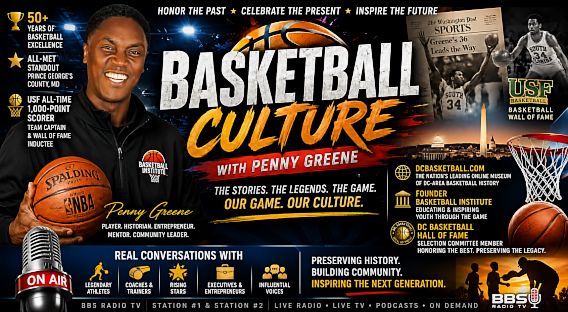

Basketball Culture with Pennington "Penny" Greene
The Game Is Not the Same: Old-School Basketball, Modern Offense, and the Lost Floor General
Penny “Penn” Greene reflects on how basketball has shifted from fundamentals, defined roles, and floor-general leadership into a faster, offense-first era shaped by three-point shooting, rule changes, and entertainment value.
From the Court to Basketball Culture
In this episode of Basketball Culture, host Penny “Penn” Greene opens with the theme “The game is not the same,” then gives listeners a personal résumé explaining why he feels qualified to discuss the evolution of basketball. He traces his journey from Southeast Washington, D.C., West Baltimore, Greenbelt, Parkdale High School, and the University of South Florida to the Hawks camp, DCBasketball.com, the D.C. Basketball Hall of Fame Committee, and the Showtime documentary Basketball County: In the Water. Penn frames basketball as more than a sport, describing it as a life blueprint, a culture, and a community that shaped his discipline, identity, and lifelong passion.
Why Old-School Players Feel the Change So Deeply
Penn explains that many old-school players, coaches, and fans feel heartbroken watching today’s game because the basketball they loved was built on strategy, physicality, teamwork, fundamentals, discipline, and roles. He makes clear that his criticism is not aimed at today’s players personally, but at the modern style of play, the entertainment emphasis, and the way the game has changed over decades. For those who grew up playing, coaching, and passing the game on, the transformation can feel personal because the sport they devoted themselves to now feels like a different version of basketball.
The 1970s: Fundamentals With Personality
Looking back to the 1970s, Penn celebrates an era when fundamentals and personality lived side by side. He discusses Oscar Robertson’s balance, angles, footwork, strength, and head fakes, then moves into the flair of ABA and NBA stars such as Pete Maravich, Walt Frazier, Dr. J, George Gervin, Calvin Murphy, Archie Clark, and Earl “The Pearl” Monroe. He recalls meeting Earl Monroe as a young man while working at the University of Maryland and describes how that moment helped sell him fully on basketball. For Penn, the greats of that era had style and swag, but their creativity was rooted in skill, intelligence, and command of the game.
Skill, Deception, and the Myth of Pure Athleticism
Penn challenges the idea that past players could not compete with today’s athletes. He argues that basketball is a game of deception, timing, intelligence, and craft, not simply size, speed, or jumping ability. To make that point, he references modern stars whose dominance comes through skill rather than pure explosiveness, including Shai Gilgeous-Alexander, Nikola Jokić, Jalen Brunson, and Luka Dončić. His message is that players who truly know how to play can succeed across eras because basketball IQ, patience, footwork, passing, and shot-making remain timeless.
Basketball Institute and the Game as a Life Classroom
The episode includes a promotional segment for the Basketball Institute, which presents basketball as a classroom for discipline, teamwork, confidence, leadership, respect, and opportunity. The segment explains that the organization connects young people with former players, coaches, and mentors who understand the life lessons the game can teach. It also emphasizes preserving basketball history so young players can see themselves as part of something larger than the present moment. Through mentorship, educational resources, community engagement, and positive role models, the Basketball Institute is described as a pathway toward leadership, hope, and a better future.
Defined Roles, Team Balance, and the Missing Point Guard
Penn contrasts today’s expectation that all five players do everything with the older model where every position had a distinct responsibility. The point guard controlled tempo and acted as the coach on the floor; the shooting guard was the reliable scorer; the swing forward did a little bit of everything; the power forward brought toughness, rebounding, and enforcement; and the center posted up, protected the rim, and controlled the paint. Penn argues that those five pieces once fit together like an engine, while today’s positionless style can lack structure and leadership. He uses a San Antonio Spurs example to explain how a true floor general would manage the clock, slow the game down, and protect a large lead.
Three-Point Basketball, Rule Changes, and Entertainment Value
Penn identifies the rise of the three-point shot as one of the biggest changes in the modern game, saying it created more points, opened the lane, and reshaped basketball from checkers into chess. He also critiques switching every screen, poor boxing out, moving screens, Eurosteps, step-backs, flopping, landing-space fouls, carrying, offensive players creating contact, and players over-dribbling. He says many of these changes favor offense and were driven by money, television, marketing, sponsorships, highlights, and the need to sell entertainment. Still, Penn ends with balance: the old school should not be hated, today’s players should not be disrespected, and everyone should recognize that change is constant.
“Old-School Point Guards” and the Champion in You
The episode closes with Penn introducing and playing his song “Old-School Point Guards,” a tribute to pass-first leaders, floor generals, and players who measured success by winning rather than fame. The lyrics celebrate point guards who controlled tempo, made teammates better, talked on defense, took responsibility, sacrificed, and understood that passing is an art and leadership is a skill. After the song, Penn says the biggest thing missing from today’s game is leadership on the floor, especially the point guard as an extension of the coach. He closes by dedicating the show to “the champion in you” and reminding listeners that basketball culture is where the game lives.
Basketball Culture


Basketball Culture with Penny Greene is a bi-weekly television, radio, and podcast program dedicated to celebrating every level of the game.
From neighborhood playgrounds and recreation centers to AAU basketball, high school, college, the NBA, and the WNBA, the show brings together the players, coaches, executives, officials, and visionaries who have shaped basketball's past, present, and future.
Each episode features exclusive interviews, inspiring personal stories, basketball history, player development, recruiting, leadership, and insightful conversations about the issues impacting today's game.
Basketball extends far beyond the court. It influences fashion, music, business, education, politics, and communities around the world. Basketball Culture explores how the sport continues to unite people while inspiring generations of athletes and fans.
Whether you're a lifelong basketball enthusiast or discovering the game for the first time, Basketball Culture with Penny Greene delivers authentic conversations with the people who have lived the game and continue to shape its future.
This is more than basketball. This is Basketball Culture.
Executive Producers:
Pennington Greene • Jeremy Harris • Christian Swann
Speaker Identification
Speaker 1 - Announcer/Intro/Outro
Speaker 2 - Penny "Penn" Greene, Host
Speaker 3 - Basketball Institute Promotional Segment
Speaker 4 - Musical Segment / Song Performance
Speaker 1 - Announcer/Intro
What's up, my global basketball community? It's Penny "Penn" Greene, one of America's premier basketball aficionados. From Baltimore's back alleys and the rec centers of PG County to the bright lights of Madison Square Garden, this game gave me a blueprint for life. So fasten your seatbelt and take this ride with me through the players, the legends, the history, and the future.
This is Basketball Culture with Penny "Penn" Greene. It's more than just a game. It's a culture. You're killing them, Slim. You're killing them. Basketball Culture: the champion in you.
Speaker 2 - Penny "Penn" Greene, Host
Hello, my global basketball community. It's your boy, Penny Greene, and I'm pleased to be with you. We've got an exciting show today. The show is: "The game is not the same." All you old-school guys know what I'm talking about.
Before we jump into the show, I want to give you my resume real quick. If you ever watch ESPN or any of the top sports shows, they always put a little caption telling you a little bit about the guy doing the talking. So, just so you know I'm qualified to do this, I'm going to give you a quick resume.
First of all, I grew up in Washington, D.C., Southeast. Then my mother moved us to West Baltimore, The Village. If you grew up in that area, you know they build nothing but soldiers in those neighborhoods. Later, I landed in the suburbs of Washington, D.C. My mother saw the writing on the wall and got me out of that environment. It was a great thing. It was a breath of fresh air.
As a young man, my mother saw my passion for the game of basketball and got me into camps. Those camps included Tom Young, Chuck Daly, Dr. Tom Davis, Lefty's camp, and I was under the tutelage of Will Jones. All these guys touched my life as I was becoming a ball player and learning the skill sets. As I look back, I was very blessed to learn the game of basketball from those gentlemen.
When I landed in the suburbs of Washington, Greenbelt, Maryland, I hooked up with a bunch of guys and started playing with them on a regular basis. As a ninth grader, I saw them go up against mighty St. Anthony's and John Thompson, on an 18-game win streak and number one in the country. Believe it or not, they pulled off the upset. They had a kid named Mickey Corbin out of the Greenbelt Youth Center. I used to play with them on a regular basis, so that gave me a lot of confidence and made me feel good about myself. The guys I was playing with regularly had just upset the number one team in the nation.
From there, I was fortunate to play for Parkdale High School. My coach was a stickler on fundamentals. You had to see the ball and the man. It was about passing. It was about understanding basketball and the intelligence that goes with basketball.
I was fortunate. He actually gave me the green light - or I should say I took the green light - because once you start shooting and making it, there's no reason to stop. I did my thing. I averaged 25 and 7, was the second-leading scorer in the area, shot 48 percent from the field, and 80 percent from the free-throw line. I saw box-and-ones and triangle-and-twos, so I had a really successful high school career. I was on the cover of The Washington Post sports section, which high-school players almost never get to do. It was a wonderful experience.
Then I started getting recruited by Hall of Fame coach John Thompson, and I ended up with Bill Gibson, ACC Coach of the Year in 1972. My game was at that level, where I had some of the best coaches in America looking at me as a player.
I showed up at the University of South Florida with Bill Gibson. Bill had all the personality. He was a super guy. Unfortunately, he passed away my freshman year. My sophomore year, we went 19 and 8, and that record was the best winning percentage in the school's history for 50 years. We played an excellent schedule, one of the most powerful schedules in the country, and we did our thing. I developed as a player.
My senior year, I played with four freshmen. We went to the Sun Belt Conference Championship and shocked everyone. Unfortunately, we finished one game short of the NCAA's, the Big Dance. After that, I ended up in the Hawks camp in 1979 with Hubie Brown. Anybody who knows Hubie knows Hubie was a no-nonsense New York/Brooklyn guy. He would cuss you out at the drop of a dime. He was a little nutty, to be honest with you, but I liked him. I played against the best players in the world, and that tells you a little bit about my basketball background and why I think I'm qualified.
From there, I fell in love with the game as far as my passion goes. I created DCBasketball.com, a comprehensive, Wikipedia-type virtual online museum about the history of Washington basketball. I'm proud of that. I also ended up on the D.C. Basketball Hall of Fame Committee. We have an event once a year at Bethesda Country Club, which is very prestigious. That was a great experience.
I was also fortunate to appear in the Kevin Durant documentary Basketball County: In the Water on Showtime. I had four appearances and a couple of voiceovers. That built up my off-the-court basketball experience.
Lastly, for a guy who just turned 70, I still go to the gym and play 21. You guys know 21 is like jailhouse basketball. No fouls are called. It's very physical. Young people don't like to see old people do things to them, and I definitely do things. At 70 years old, I'm 190 pounds. In college, I was 185. That's discipline, and I'm not on any of those weight-loss products. That comes from discipline.
I say all that to say I've put in over 10,000 hours studying the game and playing the game. That qualifies me to talk about the game. You with me? Here we go.
The game is not the same.
A lot of the guys I came up with call me and say, "I can't even watch the game." I learned that a lot of old-school guys are heartbroken because basketball was such a big part of their lives. They grew up playing it, coaching it, passing it on to the next generation. They loved the strategy, the physicality, the teamwork, the fundamentals, the discipline - basketball over the decades.
When they watch today's game, they feel the sport they fell in love with has changed so tremendously that it becomes difficult and painful to watch. Some guys might even say it has been butchered. That's extreme, but I get it. Their pain is real. They take the changes in the game personally.
The issue is not the players. The issue is the style of play, the emphasis on entertainment, and the way the game has changed over the decades.
When we go back in retrospect, to the 1970s, that's when I started getting involved in the game. There were guys like Oscar Robertson. He was going to beat you with basics: fundamentals, angles, balance, footwork, timing. He was strong. He would back you down, use head fakes. That's what coaches were looking for back in the day.
Then the ABA came along, and it had flamboyant guys with style. Coaches started letting players show a little more personality on the floor. Players played with more style and swag as we went into the early 1970s.
Guys like Pete Maravich had the floppy socks and was throwing behind-the-back passes from 94 feet away, hitting you right in your hands. Walt Frazier was wearing big brims, driving Rolls-Royces, and appearing on fashion-magazine covers. Dr. J was flying through the air with his afro fluttering as he dunked on you. George Gervin, the Iceman, was tiptoeing around the court, throwing finger rolls from the free-throw line without even sweating. Calvin Murphy, at 5'9", could shoot the lights out.
Everybody talks about Steph Curry and his dynamic shooting ability - best shooter of all time. But Calvin Murphy shot 95.8 percent from the free-throw line. I'm going to double-check, and you all can check me, but I don't think Curry ever shot 95.8 percent. I could be wrong, but those are the kinds of guys I grew up watching.
Archie Clark had the crossover before Tim Hardaway, before Isaiah Thomas, before Pearl Washington. Archie Clark was doing it in the 1970s and breaking ankles.
Lastly, my guy was Earl "The Pearl" Monroe. They called him Black Jesus. Earl had the spin dribble. He would put you in the spin cycle. He had the herky-jerky, the head fakes, barely jumped off the floor, and could give you 35 with his eyes closed. In college, he averaged 41.
I was fortunate enough to meet Earl. I was working at the University of Maryland selling Coca-Colas. The Washington Bullets were transitioning from Baltimore to Washington. I showed up at the locker room and knocked on the door. Gus Johnson said, "What can I do for you, kid?" I said, "I want to speak to Earl Monroe, sir." He said, "Hold on. Magic, come here. Young boy wants to talk to you."
All of a sudden, Earl comes out. "How can I help you?" I said, "Mr. Monroe, I just want to say hello. I aspire to be like you one day." He gave me some conversation and showed me some love, then went back into the locker room. Later I saw him walking out, very majestic. I saw two young ladies sitting on the wall. He grabbed one lady on one elbow and the other on the other elbow. I wasn't sold on basketball before that, but I was sold after seeing him walk off into the sunset with the two most beautiful women I had ever seen in my life.
That was the evolution of personalities coming through in the game of basketball.
Let's also understand that every generation thinks its generation of basketball is the best. Young guys call me up and heckle me. They tell me the skills and athleticism are so tremendous today that guys from the past couldn't play with today's players. Bob Cousy couldn't play. Bill Russell couldn't play. They go down the list of old-school guys who, according to them, couldn't play with today's guys.
I say this: when it comes to basketball, if you're fat, I've seen fat boys kill. If you're skinny, I've seen skinny boys kill. I've seen guys you knew were going right and you couldn't do anything about it. I've seen guys you knew were going left and you couldn't do anything about it. If you can play the game, you can play the game. I don't care what your size is or what you look like. If you can play, you can play.
Basketball is a game of deception. If a guy can jump and he's very athletic, you give him a head fake. Boom, he's gone. You lay it in. Athleticism is nice, but it is not going to dictate all your wins and losses.
To make my point, look at four of the top NBA MVP-level players. Shai Gilgeous-Alexander has a mid-range game, bumping you in slow motion. That's old school. The Joker in Denver can barely dunk at seven feet, but he's slinging that thing behind his head like he came straight out of the YMCA. Killer. Straight killer. He looks to pass first before scoring as a big man. Then you've got Brunson, who had 45 in the finals and plays with that tippy-toe jumper going left. Then you've got Luka, who is slow as a sloth but still very effective. It's ironic: we talk about athleticism, but the top players in today's game are skilled.
Speaker 3 - Basketball Institute Promotional Segment
The Basketball Institute was founded on a simple but powerful belief: the game of basketball can open doors to a much wider world. For many young people, the court is more than a place to compete. It is a classroom where discipline, teamwork, confidence, and leadership are learned. It is a place where young men and women begin to see possibilities for their future, both on and off the court.
Through the Basketball Institute, we connect youth with a powerful network of former players, coaches, and mentors who have lived the game and understand the life lessons it teaches. These mentors help guide young people toward opportunities in education, athletics, careers, and personal development.
Today, we are at a critical moment. To continue our programs and expand opportunities for the next generation, we need your support. Your financial contribution is more than a donation. It is an investment in young people who are striving for a better life.
Your support helps us provide mentorship programs, educational resources, community engagement, and positive experiences that keep youth focused on their goals. In many of our cities, young people face powerful negative influences every day. But we believe there is always another path - a path built on encouragement, opportunity, and positive role models.
Basketball Institute works to create that path. We provide an environment where youth can grow, learn, and develop a mindset built on confidence, respect, and determination.
We also believe it is important to preserve the history of the game. By introducing young players to the stories of the athletes, coaches, and community leaders who came before them, we help them understand they are part of something bigger. When young people see themselves reflected in those stories, they gain the strength and inspiration to build their own future.
An investment in youth is one of the most important investments anyone can make. Your support helps us continue this work and expand our impact. Please consider making a contribution today, volunteering your time, or becoming part of the Basketball Institute community. Together, we can ensure that basketball continues to be more than just a game, but a pathway to opportunity, leadership, and hope. Thank you for your support.
Speaker 2 - Penny "Penn" Greene, Host
Today, they expect players to do everything. They expect them to shoot threes, post up, interchange on defense, check the best player, and handle mismatches. But when I came up, everybody had a role.
The point guard was the leader on the floor. He controlled the tempo. He could speed the game up for fast breaks or slow the game down. Everything he did was connected to the coach, and he did it because he was trying to win. Strategy depended on the game and what the other team had.
I recently watched the San Antonio Spurs. They had a 29-point lead at halftime. Then they came down and shot 12 three-pointers in a row, with only two or three seconds off the clock. If I'm running the point, I'm snatching one of those guys by the jersey and saying, "Look, we're trying to win. Let's take 10 or 15 seconds off the clock. Let's make sure we get a high-percentage shot. Let's work the clock. The clock is on our side."
That's what point guards did when I was coming up. They controlled things and kept things organized.
Your shooting guard, in most cases, was your best shooter - the guy who could fill it up. He would shoot 80 or 90 percent from the line, 45 to 50 percent from the field, and come off picks for catch-and-shoot opportunities. That was his role.
The three man, the swing forward, would do a little bit of everything. He would handle the ball a little bit, shoot, and work the boards. He was normally the most versatile player.
Your number four guy was going to be physical. He would get the offensive boards. He was usually a tough guy, more of an enforcer, and watched everybody's back in case things got out of control.
Lastly was your center. The center would post up in the low post, take high-percentage shots, and block shots when they came to the bucket. If anybody just moseyed through the lane unnecessarily, he might shoot an elbow. Don't come in here. This is not for you.
Those five pieces fit together to make a team. It's like pieces of an engine. You've got the pistons and spark plugs. Put all that together and you've got an engine that moves a car. Those are big differences. When you have five guys trying to do everything, there is no way all five guys are going to do everything well.
If you shot a 25-footer when I was coming up and you missed it, coach would put you on the bench. Have a seat, son. Now the game has evolved. We've got two different styles. Some older guys might have adjusted to the new style, but change is constant, so we're trying to live with it.
Then you get the rise of the three-point play. The three-point play changed the whole game. We went from checkers to chess. The three-point play creates more points and more entertainment value. The irony is that a guy who shoots 33 percent from three versus 50 percent from two is still creating comparable efficiency. So yes, the three-point shot is a major change.
It opened up the lane, where guys like Tony Parker could lead the league in points in the paint because the lane was wide open. I can't imagine having that much room to go to the lane. When I used to go to the lane, I had to go to the bucket like I was Bruce Lee - knees, elbows, kicking folks, bowling folks. Now the lane is like the sea parted and you just go to the basket. It's unbelievable.
On defense, a guy can dribble from the top of the key all the way to the basket. In the old days, you went and helped, then got back to your man. No one dribbled 15 times to get to the basket. It just didn't happen.
In the old days, you didn't switch every pick. Now they switch every pick, and now you've got a mismatch - once again, an advantage for the offense. No one boxes out. In the old days, you found your man, boxed him out, then pursued the ball. Those are defensive deficiencies that assist the offense.
The three-point play was huge. Then we went into that physical era, with the Knicks and the Chicago Bulls beating up Michael Jordan. The Detroit Pistons were beating up Mike. They were barely scoring 100 points a game, so the NBA had to start making changes: no more hand-checking, open the game up, sell tickets. Less than 100 points was like watching sumo wrestlers. That's not attractive basketball. They needed to change the landscape of the game.
Switching on defense is another issue. If I'm paying a guy $30 million a year, I'm not letting him switch every single time. Sometimes you switch. Sometimes you go through the pick. Sometimes you go over the pick. But switching every pick is lazy basketball as far as I'm concerned. Now Steph Curry has a seven-footer checking him. Come on. Guys who have basketball intellect and basketball IQ see these things, and it turns them off.
Then there are moving screens. Today, your guy can screen the defender, and if it's not a good screen, he drops to the other side of the guy and screens him again. Moving screens create mismatches. I can't imagine playing with moving screens. That would have been like heaven on earth.
Now we come to the offensive end of the game. You have the Eurostep. It's jazzy. It's sporty. But to old-school eyes, that was a travel. Once again, older guys look at it and say the rules have been bent a little too much. I'm uncomfortable watching a guy take three steps to the bucket.
Then you have the step-back. James Harden steps back and to the side to get space to shoot. Once again, that was a travel back in the day. A lot of older guys are uncomfortable watching the game and its changes because those moves were not allowable decades ago. But once again, entertainment value.
Then there's the flopping. Acting like somebody hit you, over-exaggerating, falling on the floor, being dramatic - then they do instant replay and you see the guy didn't get touched. To me, that destroys the integrity of the game.
Another amazing rule is the landing-space rule. A guy goes up to take a shot, and if the defender gets too close, they say you're in his landing space and call a flagrant foul. Are you kidding me? The object of defense is to make the offensive player uncomfortable. Now you can go up and take a shot knowing the guy can get nowhere close to you. Once again, it's difficult for older generations to digest.
Dribbling has changed too. You can carry the ball in ways that used to be called carrying. I'm trying to break this down so you can see the challenges that some older generations have watching basketball today.
The one that really gets me is the charge. A guy can dribble and run right into the defensive player, knock him back, and then shoot. That used to be a charge. I can't imagine having Giannis or LeBron James at 6'8", 260 pounds running up my chest. I'm trying to get away. He runs over me. I can't breathe. I'm having difficulty breathing. Big man just ran over me, and the referee says, "Foul on number 12." Huh? Foul on me?
These are the changes: charging calls, carrying the ball, switching on defense, flopping, shooting rules, offensive players leaning into defenders, and players dribbling the air out of the ball. My man Brunson - I give him all due respect - can dribble the air out of the ball. He might drop it on the floor 15 or 20 times before he shoots. I grew up with Adrian Dantley. He would dribble five times and the whole Detroit Pistons team would lose their mind.
Those are things that take away from the game, but it is what it is. The only thing constant in life is change.
Let's think about why we change. In this country, it's normally money. Money, money, money. Cheese, chips, dollars - call it what you want. Everybody knows the love of money. Capitalism. Basketball evolved because of money, television, marketing, and entertainment value. Team owners need to sell tickets, television packages, sponsorships, merchandising, corporate skyboxes. High-scoring games produce highlights. Highlights attract viewers. Viewers attract advertising. It gets back to the money.
Offense has become king, and many rules and interpretations have been adjusted to encourage scoring. Many old-school fans no longer watch because they believe the game has been changed too much. To them, it feels like the basketball they loved has been replaced with a different version of the sport.
We should not hate the old school, and we should not disrespect today's players. We should understand that change is the only thing constant in life. As the old saying goes: don't hate the player, hate the game.
We have to understand how the game has changed. We must either embrace the change or just relax. We must talk about whether basketball has gained or lost, and perhaps it has done a little bit of both. The game has changed, but the culture is still with us. Love it or hate it, the game is just not the same.
We'll never stop loving this game. I just want people to really think about it. We're about to play a song that fits this whole storyline. This one is for the floor generals, the leaders, the pass-first guards, the ones who knew how to win.
Speaker 4 - Musical Segment: "Old-School Point Guards"
Where have the old-school point guards gone?
Before the highlights and the social-media fame,
Before everybody wanted 30 points a game,
There was a point guard running the floor,
Making everybody better, always wanting more.
He knew every player's strength,
Every weakness too.
He knew exactly what each teammate could do.
He controlled the tempo, never rushed the play,
Made sure the ball found the right hands every day.
He wasn't chasing stats.
He wasn't chasing shine.
His mission was the team crossing that finish line.
A perfect assist was worth just as much,
Because winning championships was the ultimate touch.
Where have the old-school point guards gone?
The leaders that held the whole team strong.
Where have the floor generals gone?
The ones who made everybody feel like they belong.
Where have the old-school point guards gone?
The game moved on, but their legacy lives on.
Where have the floor generals gone?
They knew how to win. They knew how to win.
He was the coach on the floor every night,
Calling out the sets and keeping everybody right.
Talking on defense, diving for loose balls,
Taking responsibility whenever his team would fall.
Accountable to the coach.
Accountable to the squad.
Never pointing fingers when the journey got hard.
Measured success by victories, not fame,
Because the name on the front meant more than the name.
But don't get it twisted. He could score when needed.
When the offense broke down, he competed.
He could get a bucket when the pressure got real,
But making others better was his greatest skill.
Where have the old-school point guards gone?
The leaders that held the whole team strong.
Where have the floor generals gone?
The ones who made everybody feel like they belong.
From the playgrounds of D.C. to Baltimore streets,
New York blacktops where the legends would meet,
Philadelphia tough and Chicago pride,
Real point guards gave the game its guide.
They played with heart.
They played with IQ.
Made the simple pass when others wouldn't do.
Leadership, toughness, sacrifice, and trust,
Understanding team success was always a must.
Now everybody wants highlights and fame.
Everybody wants glory and their name in the game.
But somewhere along the road we lost that art,
The point guard who played with his head and his heart.
Passing is an art.
Leadership is a skill.
Winning is the ultimate statistic.
And the old-school point guards,
They knew how to win.
Yeah, they knew how to win.
Where have the old-school point guards gone?
The leaders that held the whole team strong.
Where have the floor generals gone?
The blueprint lives on even though they're gone.
Where have the old-school point guards gone?
We still tell their stories when the lights come on.
Where have the floor generals gone?
They knew how to win. They knew how to win.
So here's to the floor generals,
The leaders,
The pass-first guards,
The extensions of the coach,
The ones who understood that leadership matters,
That passing is an art,
And that winning is the ultimate statistic.
Speaker 2 - Penny "Penn" Greene, Host
Excuse me while I put on my North Face bubble jacket, because this narrative is colder than Minnesota.
It's your boy, Penny Greene. I'm back at you. I hope you enjoyed my song, "Old-School Point Guard." I'm part of the point-guard fraternity. I take it real personal.
I was sitting at home watching San Antonio blow a 29-point lead, and I realized there was no leadership on the floor. We called my guy up, he went into the laboratory, and he came out with that song, "Old-School Point Guard." I hope you enjoyed it. It had real meaning to me because, as we discussed tonight, the game has changed.
If I were to review the whole evening's narrative, the biggest component missing on the floor is leadership. Leadership is the point guard. When everybody is doing all five functions, who takes the role and initiative to be the leader, the coach on the floor? That song was appropriate for the show, and it puts a bow on the show's narrative.
I thought it was hot. I hope you enjoyed it. I enjoyed it. I got a lot of good reviews on that piece. I dropped it on reels on Facebook, and people seem to be loving it. I needed to share that with everyone. Once again, I thought it was appropriate for the show as we look at the changes that have taken place in the game.
Change is constant. This is your boy, Penny Greene, signing off.
Let me just say this: for all you guys who have addictions, I'm addicted to winning. This is a tribute to the late, great P.D. Greene. I tell it to the hot. I tell it to the cold. I tell it to the young. I tell it to the old. I don't want no lying. I don't want no crying. And most of all, no signifying.
Remember, this show is dedicated to the champion in you.
This is your main man, Penny Greene, signing off. Visit BallCoacher.com or call 770-374-4750. Keep on balling.
Speaker 1 - Announcer/Outro
Basketball Culture, where the game lives and the champion lives in you.