All Learning Reimagined, May 29, 2026

All Learning Reimagined with Teresa Songbird
Reimagining Money, Value, Abundance, and Energetic Exchange — Part 2
Reimagining Wealth Beyond Money
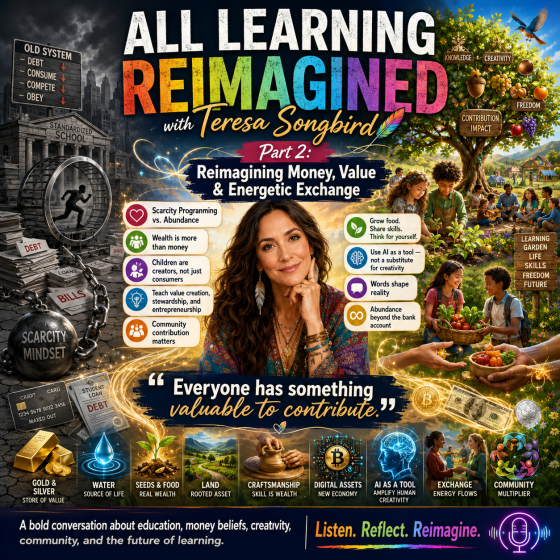
In this episode of All Learning Reimagined, Teresa Songbird continues part two of her discussion on reimagining money, value, and energetic exchange. She explains that the previous episode explored the history of exchange, fiat currency, the energetics of words, maritime jurisdiction, and whether wealth is only money. In this follow-up, she expands the conversation into scarcity programming, abundance, social conditioning, family belief systems, and the way background and culture shape a person’s relationship with money. Teresa emphasizes that wealth is not limited to a bank account and can include health, deep relationships, time, rest, choice, creativity, and meaningful connection.
Scarcity Programming and the Lie of Productivity-Based Worth
Teresa examines inherited beliefs such as “money does not grow on trees,” “rich people are greedy,” and the idea that people must struggle in order to be abundant. She pushes back against the belief that a person’s worth equals their productivity, calling it one of the major lies affecting humanity today. In her view, everyone has something to contribute, whether through listening, storytelling, building, singing, writing, mentoring, or caring for others. She contrasts job-based value with energetic exchange and argues that people can contribute to society in many ways that are not limited to paid employment.
Children, Education, and the Collapse of Old Work Models
The episode connects money programming directly to the schooling system. Teresa says that many children today are already pushing back against outdated systems and asking why they must follow old patterns that no longer match the future. She argues that traditional schooling is not adequately preparing children for jobs that may not exist by the time they graduate, or for the skills they will actually need. Instead of training children to comply, compete, and become employees, she calls for schools to cultivate confidence, groundedness, communication, creativity, problem-solving, discernment, entrepreneurship, and the ability to think beyond existing boxes.
Value Creation, Stewardship, and Community Contribution
Teresa proposes that education should teach children how to create value, contribute to community, and become stewards of the world around them. She shares an example from a school where children helped restore plant life along a creek after a flood and became responsible for watering, caring for, and even singing to their own trees. She also asks why schools are not doing more with bartering, food growing, cooking, cleaning, chores, and practical life skills. In her view, contribution to the school community and broader community can help children learn responsibility, reciprocity, stewardship, and real-world value beyond grades or money.
Currency, Technology, AI, and Tangible Assets
The episode also explores possible futures of exchange, including digital currency, decentralized systems, local community currencies, skill exchanges, resource-backed systems, reputation-value economies, and contribution-based networks. Teresa acknowledges discussions around XRP, XLM, gold-backed currencies, Basel III and Basel IV-compliant banks, and shifting central banks, while also grounding the issue in everyday reality: people still need groceries, money, or barter to meet practical needs. She warns about digital IDs, surveillance, dependence on centralized systems, and children becoming too reliant on AI. For Teresa, technology can be a useful tool, but children must not lose their own creativity, writing ability, and independent thinking.
Language, Abundance, and a New Vision for Energetic Exchange
Teresa closes by emphasizing that language shapes reality, especially the words children sing, repeat, and absorb into the subconscious. She argues that words carry emotional frequency and should be part of what schools teach, because they shape relationships with prosperity, identity, and possibility. She rejects the idea that society must be divided into haves and have-nots and says she sees a world where everyone has enough resources and food, where people give freely, follow their highest excitement, and contribute through work they love. The episode ends with Teresa’s call to explore, experience, express, and live learning, followed by the show’s closing song about wonder, questions, courage, creation, and remembering.
All Learning Reimagined

Please help support this show!
Support this show by subscribing
$5.99/mo or $9.99/mo or more
Click HERE
All Learning Reimagined: Where passion meets possibility, one story at a time.
All Learning Reimagined is a global podcast exploring the many ways we learn, grow, create, and contribute throughout life. A gathering place for people who know that the future is something we learn, create, and steward together.
While education is often where the conversation begins, this podcast reaches far beyond classrooms and curriculum. Together, we explore learning as a living process that unfolds through relationships, community, nature, creativity, curiosity, experience, and the pursuit of what brings us alive. Through inspiring conversations with parents, educators, authors, visionaries, community leaders, and everyday people, we share stories that expand what learning can be and how it shapes our families, communities, and world.
Drawing from diverse perspectives, indigenous wisdom, practical experience, emerging ideas, and timeless principles, each episode offers insights that nurture self-direction, discernment, contribution, and a deeper connection to what matters most.
Whether you are a parent, educator, learner, creator, community builder, or simply curious about what is possible, All Learning Reimagined invites you to explore meaningful questions, fresh perspectives, and inspiring stories from around the world. Because learning is a living journey to nurture.
Cultivating self-trust. Nurturing wisdom. Inspiring contribution. Strengthening community.
Speaker Identification
Speaker 1 – Prerecorded Song / Intro Voice
This appears to be the show’s opening theme song introducing All Learning Reimagined and Teresa Songbird.
Speaker 2 – Teresa Songbird / Host
The host identifies herself as Teresa and is named in the show song as Teresa Songbird. She presents the full episode topic and closing remarks.
Speaker 3 – Prerecorded Song / Outro Voice
This appears to be the show’s closing theme song and outro messaging for All Learning Reimagined.
Speaker 1 – Prerecorded Song / Intro Voice:
There is another way to learn.
Questions open doorways,
Where wonder leads us home,
Where every heart remembers
The wisdom it has known.
All Learning Reimagined,
Where passion meets possibility,
With Teresa Songbird.
Come explore what learning can be,
For parents, teachers, seekers, and dreamers.
Learning comes alive.
Speaker 2 – Teresa Songbird:
G’day, g’day, g’day. Welcome to All Learning Reimagined. I’m your host, Teresa, bringing you a little ray of sunshine as, together, we are reimagining the future of education, one inspired story at a time.
Welcome back, everybody. To all my beautiful regular listeners, thank you so much for all of the shout-outs that I get and the emails that you are sending me through BBSRadio.com. I really appreciate it. If you are new to the channel, welcome, welcome.
Today’s topic is actually a part two. Last week, I spoke about reimagining money, value, and energetic exchange. It is a bit of a different topic, I know, than what I would normally talk about, but it really did stick in my mind. I was talking about life experience, as well as the history of exchange and fiat currency and where it came from, the energetics of words, and the fact that we have maritime jurisdiction involved in there. I was also asking the question: is wealth only money? Many of us already know that it is not. There are so many things we can be wealthy in that have nothing to do with money.
Today, I am going to expand on the conversation from last week, and I am going to start with programming, really: scarcity programming versus abundance. I guess you could say that the programming is more like social conditioning, or even belief systems. This fits into it.
I do not know about you, but it really depends on where you are in the world, the family that you are born into, the mindset and heart-set that they have, the resources that you have, and the background that you come from. It really does shape a lot of what we see and believe.
For example, possible inherited beliefs could be something like, “Money does not grow on trees.” I am sure you have heard that one before. Or that rich people are greedy. I actually know some people who do not want to be rich because they feel like being rich is bad. It is almost like they would feel guilty, and they think that people who have money are morally bankrupt, which is certainly not true.
There are so many beautiful people in the world who do have resources, who are generous and open. Many of them work hard for that money—not all of them, but many of them—and they do incredible things to help communities, families, and the environment. This belief that rich people are greedy is certainly not true. On the flip side, of course, yes, there are some who are, but I do think that a lot of movies and social media really do perpetuate that belief system.
Then there are also beliefs that you have to struggle and that you have to work in order to have abundance. There is the belief that your worth equals your productivity. That is one of the number one lies for humanity today: that you have to be productive to be worth anything.
Everyone is worth something. Everyone has something to share and give. Money has nothing to do with it, because you also have energetic exchange. You can have someone who tells a story, or someone who will just sit and listen. You do not need to do anything. They might be good at building with their hands, or singing a song, or writing a story. There are many ways that people can contribute in society without having to go out and actually get a job, which is one of these other perpetual belief systems that we have been programmed in this society to believe we have to do.
It never used to be this way. When you look at all of the ancient cultures, the structure has changed so much over the years. I have struggled with the belief that security only comes through external systems, that you need to have some sort of income coming in in order to be able to pay the bills, because that is what we have been programmed to believe in Western society.
But I can see and feel, and I am seeing evidence of, a huge shift toward different ways of exchange, and toward men and women starting to sit back and look at what it means to be abundant in your life. Money is definitely not everything. If you have deep relationships, intimacy in your relationships, caring relationships with your family, and if you have good health, then that is definitely wealth. There are so many different ways that we can be rich.
My personal definition of being rich is being able to have the time to rest and the time to follow my highest excitement. I do not have to do anything. I have choices. That is being rich to me. I do not need a lot of money hoarded in a bank. I do not need a lot of resources. I just need good connections and friends and the time to be able to do and follow what I love to do. I do not want to have to wait until I retire to then have the freedom to do what I love to do.
As an educator, I have actually noticed that, definitely over the last 10 to 15 years, a lot of the children coming through the schooling system today are pushing back on this system. “Why do we have to do this? Why do I have to do that?” They are also shifting and shaping the careers that are happening today. Yes, technology and AI do have a part in that, but a lot of the children are saying, “I do not see why I have to not have a lifestyle.” I am really loving the fact that they are bringing forth this energy and this change in belief system, because the children I am seeing today, many of them, are teaching us and leading the way, absolutely, when it comes to breaking down scarcity programs and abundance programs.
Let us face it: the writing is on the wall for education. If it does not shift, traditional education is so outdated. It is not preparing children for the skill sets they need when they leave school. Neither are universities. Yes, this is my opinion, but there is enough evidence out there to see that our little prep children today, our little children who are five years old—who quite frankly, in my opinion, should be at home playing with their families, not in a daycare center—and that is not me having a go at people who put their children in daycare centers, because many of you do not have a choice. We have to work, work, work.
What are we doing? We are circling around because we are chasing money. This rat race does not make sense to me, and I do not know if this is resonating with you, but we have young children today who are just starting school, and we are supposedly preparing them for jobs that do not even exist yet. Or we are preparing them for jobs that will no longer exist by the time they graduate. What is going on here?
We really do need to consider the skill sets and the richness of children being invested in, or us investing in the children themselves. They are the ones we need to be supporting and growing. They are growing their own skills, their own confidence, their own groundedness. If they know who they are and they know what they are, then they are able to cope with change. They can communicate with others. All of these things bring about abundance.
If they have creativity, if they can problem-solve, if they understand that there is a solution to every problem, and if they can really genuinely think for themselves and discern, then that is going to bring them a wealth of abundance. They are not going to be in victim mindset or scarcity mindset. They are not going to be open to all of the programs out there that say, “You must do this. You must do that,” because they will be able to think for themselves. They will be able to think outside the box, because for them, there is no box.
They are creators. They are creator beings, which, in my opinion, is also hugely part of being abundant. Being a creator being.
You look at nature. You take one piece of fruit, and inside that fruit are many, many seeds that you can grow from, unless it is genetically modified. Natural nature, organic nature, has abundance everywhere. Inside every child, inside every adult, is everything you will ever need. We are like that seed. We are like a little acorn or seed. Everything we need as we grow and learn is inside us. We do not actually need all of these external programs telling us where we need to go and what we need to do.
Yes, we do need community. We need to work with a community, and there need to be shared belief systems and shared agreements. But being able to know how to do that, know what resonates with yourself, and be able to contribute to community is really essential.
The number of children and adults that I am seeing who have anxiety, really doubt themselves, and do not know who they are is quite alarming. Yet we are at a tipping point. We are at a tipping point because abundance, we know, is creativity, adaptability, trust in your own capabilities, meaningful contribution, collaboration, and resourcefulness. All those things I just mentioned are things that I am seeing grow in small communities that are popping up everywhere globally. I network with people in many different countries, and there is a huge shift toward asking, “Why are we just working, working, working for a piece of paper that is a promissory note, compared to an energetic exchange? What value am I contributing?”
I love this. This is so good. I really urge you, if this is making you stop and think, to consider your situation and your circumstances. Bring this up at the dinner table and ask the question: what value are you contributing? Not just money to pay bills. What other value are we contributing to family, to our beautiful planet, to our pets, to the animals around us, the environment, and the community?
There is an exchange. There is reciprocity and aligned contribution, and it is the way it has always been. Of course, our elders, our beautiful elders, as they are coming up and sharing their wisdom, are stewards. They hold space. It is really the business of consciousness when you think about it. They value creation. They may not have the strength to go out and do the physical things they could do when they were younger, although many of them can. But they have that mutual benefit. There is an integrity in an exchange because they are sharing their wisdom, their guidance, and their counsel for those who can go and do other things for them.
It is a symbiosis. It really is a flow. Throughout history, healthy exchange often emerged through trust, contribution, and relationships. Relationships are everything. Relationship to self, relationship to the unified field around you, nature, and of course relationships with others who you are living with.
Healthy exchange is not accumulation and hoarding something like Scrooge McDuck. That is hoarding energy, because money is energy. You give and you receive. Learning to receive is that balance of masculine and feminine energy.
Something I have personally struggled with in this lifetime is how to receive. I am a giver. I give, give, give because I love it. Giving gifts is my love language. I love to write things for people. I get a lot of pleasure doing things for people, coaching and mentoring, and seeing them grow and succeed. Oh my gosh, it just makes me so excited when I can see and do things for others. I have struggled for the longest time to accept from others, to receive.
I am learning it now. I am getting there, but it has taken me many, many years to wrap my head around the fact that I was completely out of balance. My masculine and feminine energy was out of balance because I needed to be a breadwinner. I had to go out and earn. So as a mother, there was a lot of guilt around having to go and have a job. A lot of guilt.
What are we doing when we consider how many people are headed to burnout or are already at burnout stage, many of them, purely chasing a piece of paper, a promissory note, which today, when we talk about economics, is not worth a lot? It is definitely not worth as much as it used to be.
Yes, digital currency is coming in. Yes, you have your XRP and your XLM and all of those things being discussed, and the idea that we are going back to a gold-backed currency, that everything is collapsing, and that Basel III and Basel IV-compliant banks are changing and shifting. Central banks are shifting globally. I can see evidence of that. Yes, I can acknowledge that.
But we are still living in this reality right here, right now, and the reality is that if I want to put groceries in my fridge, I either need to go and buy them, or I need to go and barter, which I do. But I cannot barter everything. There are times when I have to have money in order to make up for the shortfall.
What I would really love for us to be able to do in schools is come back to children and the conditioning that we have around money. What are children currently being taught about money? From the perspective where I am standing, and hopefully you are seeing a different perspective from me, I am seeing a lot of children working in shops who do not know how to give change. They are doing Afterpay. They are actually spending money they do not even have. Money does not seem to mean anything, and they are getting themselves into huge debt.
In schools, however, we are teaching them the same thing that we have learned for decades. Very little of the content is new or innovative or encouraging children to become entrepreneurs. We are essentially training them to become employees. I do not know if that is the way it is meant to be. I do not believe that that is the way it is going to go in the future.
Those who cannot think for themselves, be creative, or problem-solve are going to be at the mercy of the system and whoever is in control of the system. I do not know about you, but this is definitely something I do not want children to have to experience. I would love for them to be able to get out there and create. We are absolutely creative beings.
In schools, children are currently being taught compliance for rewards. Follow authority. Do as you are told. Sit down. Shut up. Do not question. Follow authority. Yes, I acknowledge that this is not all schools. There are amazing schools out there that do break these bonds and break these barriers. Forest schools, for example. I know that Alpha schools are really taking off all over the world, the two-hour schools where children are doing life skills and only spend two hours a day doing the basic numeracy and literacy skills. Yes, there are fantastic places to go, but it is not everywhere yet. So I am talking very generically.
I am seeing that a lot of children are being taught scarcity. They are competing against each other. Debt is being normalized. We are not supposed to be in debt. What is this? This is crazy. Consumerism is just rife. It is embedded in the belief systems of our Western school societies. And status through possessions: what status have you got? This is something that I can see.
I know that teachers do not mean to push these beliefs. They do not know any better because this is what they have been programmed to believe, and it is perpetuating. But at some stage, we need to ask ourselves: what should we teach instead? What needs to shift? What other possibilities are there?
Value creation. How can we get children to create and add value to life, society, and community, even if it is in their school community? Some schools do this really well.
Stewardship. Can children be stewards? I remember many years ago I was working in a school that had a natural creek alongside the school. After a huge flood, a lot of the plants were damaged, and we went and planted a lot of greenery and plants along the water’s edge. The children became stewards of their little tree. It was their responsibility to go and water it, to care for it, talk to it, sing to it, and nurture it.
It was so beautiful. This was a primary school. It was not a secondary school. It was amazing because they were given the practical skills of how to care for a plant. They were given lots of practical skills when it came to gardening and being outside, nutrients, and understanding that you cannot just put a plant anywhere. It needs to have the right conditions in order to grow and thrive.
Entrepreneurship is something else that I know is hit and miss. Some teachers do this really well, but as a system, I am not seeing this done very well, in my opinion, particularly in high schools. There are so many opportunities for our talented teenagers to be able to get out there and set up entrepreneurial businesses without having to rely on going to university for another three, four, five, or seven years to get a piece of paper before they can start earning money.
What is this? This is crazy. No wonder there are so many YouTubers out there and children on Instagram, or whatever social media is popular today. I do not really follow it. They are out there, and they are making money because they are creating, and they are doing it outside the system. Some of them are shocked when they actually learn how much tax they then have to pay. Honestly, this is just getting crazy.
Why are schools not bartering? Why are children not growing food and cooking their own lunches? Why are they not doing the chores around the school and doing the cleaning? Why are we employing cleaners? Should the children be cleaning and learning the life skills of being able to clean themselves? They can empty their own bins. They can vacuum the floor. They can clean the windows. There are things that children can do. They are more than capable, rather than coming in and expecting other people to do it for them. What message are we actually sending here?
Community contribution, and community also being the school, is really worthwhile to step back and look at. I know there will be a lot of teachers saying, “Oh, I would not be allowed to. The parents would not like it. There are rules in the system.” Well, we are the system. At some stage, someone needs to take a stand and say, “How can we? Let us think outside the box. What can we do to get around this? Can we get permission?” There has to be a way. There always has to be a way that we can do this.
I know that for the homeschoolers sitting back there, you are all over this. I am not telling you anything you do not already know.
I know that discernment through advertising is done fairly well in schools. We do teach children about how manipulative advertising can be and about propaganda, and that is really important because money and where their funds go are really manipulated. Children, in my opinion, are heavily targeted by advertising today, particularly online in the gaming system, with the ads that come up when children are gaming online. Twenty years ago, we would never have said “gaming online,” but today it seems to be normalized because that is exactly what they do. That is how many children socialize today.
The emotional relationships and where we are spending our energy matter. Where your attention goes, energy flows. Energy is money, and energy is an energetic exchange.
Why are we not teaching children that they are electrical beings and how to ground themselves, and about all of the energetic bodies that they have? They are not just a physical body. Yet this is something that is not even discussed in any of the fields or groups I have anything to do with. There does appear to be a movement where it is becoming more socially acceptable, but it is not mainstream yet.
I would really love to see us teach children and allow them to grow and nurture all aspects of themselves, where they truly know who they are and what they are capable of doing, without us having to constantly tell them and impose our belief systems on them.
Let me think. What else? I guess the other one, and this is something I talk about all the time on my show, so regular listeners will know this, is that we want children to be creating instead of only consuming. Do we really want children to just be consumers, or do we want them to become creators and creative beings? This is essential.
This is my number one concern when it comes to AI. We are getting a lot of children today, and I am seeing it as well, who are so reliant on technology now. They are becoming dependent on it. They are losing their own creativity and their ability to write and create themselves without having the technology there.
There is a fine line between using technology as a tool, as a creator being, to enhance what you choose to do—which is a fantastic thing you can do—compared to it doing the thinking for you. There is definitely a big shift in that space.
I mentioned things like possible futures of currency. We have digital currency, which is convenient. It has speed and global access. Concerns around that will definitely be privacy and dependence on centralized systems. Digital currency that is decentralized and cannot be controlled from a central place, like a central bank, is something that is definitely being explored globally today.
Then, of course, you have the surveillance possibilities, and we really do need to think about this. Digital IDs and surveillance: while many people are saying, “That is so convenient. This is fantastic,” have you not seen many of the dystopian movies that are out there today? It can go either way. It can swing either way. It is a matter of being able to still stay sovereign and in control of what you are doing.
Tangible assets are something we do not really talk about in schools: gold and silver, land, water, seeds, being able to grow food and crops, proper seeds, not GMO seeds, and craftsmanship. These are tangible assets. Having skills and being able to build things, create things, grow food, and have quality water—these are assets, tangible assets. These are things that people historically valued because they hold practical utility beyond the symbolic. Yet I do not see us having this in mainstream schools. It is not really something that is discussed.
I feel that we probably have hybrid futures. We may have local community currencies, skill exchanges, decentralized digital systems, and resource-backed systems. It might not just be gold and silver. It could be resource-backed. We will have reputation-value economies. Not just, “Oh, look how many likes they have. They have this many followers, so they must be good,” because we know and have proven that bots are out there bumping up certain influencers. Because they know psychologically how humans behave, they are treating us like sheep, quite frankly, where we just follow the herd. Then, of course, contribution-based networks.
These are all things that I see in our future when it comes to wealth and energy exchange.
Of course, I would really love to see the fact that we are looking at the way language shapes our reality and the current words that we are using. There are so many words that we use every day that are programming ourselves to believe that we are broke and that we will never have any money. We do not even realize we are saying it. Many children are singing these words in songs over and over. They think they are just singing a popular song. What they are doing is programming their subconscious.
It is very important for us to consider the emotional frequency that words evoke in people and how language shapes our relationship with prosperity. This is something that I believe needs to be on the school curriculum, not just about money, but about anything, because words have power. The old saying, “Sticks and stones may break my bones, but words will never hurt me,” is the biggest lie I have ever heard in my life. It is crazy. Absolutely crazy.
We definitely want to look for abundance beyond the bank account, because that is a great distortion of our modern society: the idea that money and abundance are the same thing. They are not.
I really, really would love for everyone to have an abundant life. All of us. Some people say, “Oh, it is not possible. You need to have the haves and the have-nots.” I absolutely disagree with that. Absolutely. I see a world where everyone has more than enough resources and food to survive, so there does not need to be crime. Everyone will give freely, and everyone can follow their highest excitement. They will go and do some work, but they are doing what they love to do so they can contribute.
That is the world that I see for our energetic exchange.
I am going to leave it there. Thank you, everybody, for joining me on All Learning Reimagined. Until next week: explore, experience, express. Go out and live learning.
Speaker 3 – Prerecorded Song / Outro Voice:
Carry the wonder with you.
Carry the questions home.
Every seed of understanding
Has a life of its own.
All Learning Reimagined,
Where learning comes alive.
With heart, with hope, with courage,
We help the future rise.
With Teresa Songbird.
Until next time,
Keep exploring,
Keep creating,
Keep remembering.