
All Learning Reimagined, July 31, 2026

All Learning Reimagined with Teresa Songbird
Episode 9 of series on Embodied Intelligence
Future Learner
The Future Learner: Cultivating Human Intelligence in a Changing World
Summary
Learning for an Emerging World
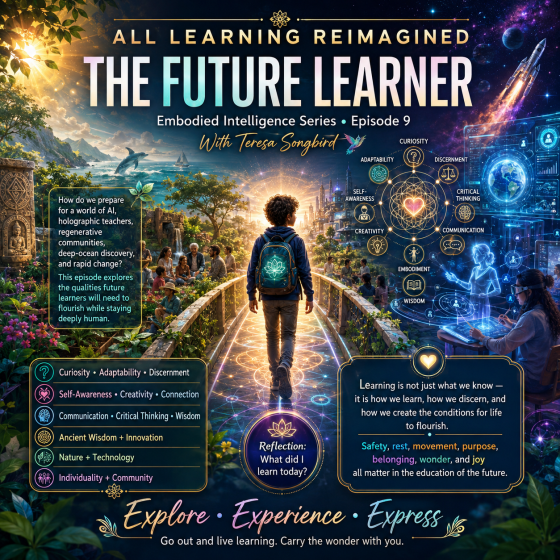
In the final installment of the nine-part Embodied Intelligence series, Teresa asks what kind of learner - and what kind of human - an increasingly technological and uncertain future will require. She imagines today's children navigating artificial intelligence, virtual reality, regenerative communities, ocean exploration, and possible travel beyond Earth. Rather than centering the episode on technology itself, she brings the discussion back to human development. She argues that learning belongs to people of every age and should remain rooted in wonder, reflection, and curiosity. The central question is not only what future learners will know, but how they will learn and who they will become.
Timeless Capacities for Rapid Change
Teresa identifies curiosity, adaptability, discernment, self-awareness, creativity, connection, and communication as essential qualities for the future learner. She describes communication as broader than speech, including writing, singing, body language, and other forms of perception. Reviewing the full series, she connects these qualities to awareness, safety, connection, memory, presence, expansion, identity, and wisdom. She emphasizes that attention is a superpower and that growth depends on feeling safe enough to expand rather than contract. Ancient wisdom, in her view, remains relevant and should not be discarded simply because it is old.
From Information Access to Discernment
The episode contrasts today's information-rich world with an educational model developed when information was scarce, knowledge was centralized, conformity was rewarded, and careers were predictable. Teresa argues that the modern challenge is no longer access but discernment: deciding what is useful, relevant, truthful, or manipulative. She warns that repetition across social and conventional media does not automatically make a message true and encourages listeners to pause before making decisions. Her approach includes consulting bodily responses, seeking additional information, cross-referencing sources, and going beyond a simple search-engine result. She criticizes educational environments that discourage questioning and calls for richer discussions in which learners can safely examine authority and competing claims.
Becoming More Deeply Human
Although technology can process information quickly and support many activities, Teresa maintains that human intelligence still includes wisdom, ethics, relationships, imagination, compassion, creativity, and embodied experience. She presents attention and energy as precious resources that can be directed toward nurturing people, communities, and living systems. The future learner, she suggests, will need a blend of intellectual, embodied, emotional, relational, ecological, and creative intelligences. Nature provides a model because rivers, trees, and ecosystems continually adapt to changing conditions. In this view, responsiveness, flexibility, and the ability to evolve are not merely job skills; they are expressions of being alive.
Conditions Where Learners Flourish
Teresa compares a learner to a seed that needs the right conditions in order to grow. She asks listeners to identify the environments in which they thrive, contract, feel stressed, or become fully alive. Connection, nourishment, rest, movement, purpose, challenge, contribution, belonging, curiosity, wonder, and joy are among the conditions she highlights. She also stresses self-knowledge, communication, and boundaries because different learners respond differently to pressure, time, space, and structure. Creating conditions in which life can flourish becomes, in her formulation, a central part of learning itself.
Bridging Ancient Wisdom and Innovation
The episode closes by envisioning future learners as bridge builders who can connect science with wisdom, technology with humanity, innovation with nature, information with discernment, individuality with community, and local life with global exploration. Teresa emphasizes that learning happens far beyond school - in kitchens, farms, travel, conversation, mistakes, nature, service, community, and everyday life. She offers a daily micro-practice centered on asking, "What did I learn today?" rather than focusing only on achievement and completion. She also leads an embodied affirmation about remaining open to growth, wisdom, possibility, and evolution. The series concludes with an invitation to live learning, carry wonder forward, and become more deeply human while navigating change.
All Learning Reimagined

Please help support this show!
Support this show by subscribing
$5.99/mo or $9.99/mo or more
Click HERE
All Learning Reimagined: Where passion meets possibility, one story at a time.
All Learning Reimagined is a global podcast exploring the many ways we learn, grow, create, and contribute throughout life. A gathering place for people who know that the future is something we learn, create, and steward together.
While education is often where the conversation begins, this podcast reaches far beyond classrooms and curriculum. Together, we explore learning as a living process that unfolds through relationships, community, nature, creativity, curiosity, experience, and the pursuit of what brings us alive. Through inspiring conversations with parents, educators, authors, visionaries, community leaders, and everyday people, we share stories that expand what learning can be and how it shapes our families, communities, and world.
Drawing from diverse perspectives, indigenous wisdom, practical experience, emerging ideas, and timeless principles, each episode offers insights that nurture self-direction, discernment, contribution, and a deeper connection to what matters most.
Whether you are a parent, educator, learner, creator, community builder, or simply curious about what is possible, All Learning Reimagined invites you to explore meaningful questions, fresh perspectives, and inspiring stories from around the world. Because learning is a living journey to nurture.
Cultivating self-trust. Nurturing wisdom. Inspiring contribution. Strengthening community.
Speaker Identification
Speaker 1 - Prerecorded Theme Voice
Basis: This voice delivers the program's opening and closing theme language rather than the main discussion.
Speaker 2 - Host, Teresa Songbird
Basis: The speaker introduces herself as Teresa, identifies the program, delivers the full episode discussion, and is named as Teresa Songbird in the closing theme.
Speaker 1 - Prerecorded Theme Voice:
There is another way to learn. Questions open doorways, where wonder leads us home, where every heart remembers the wisdom it has known. All Learning Reimagined, where passion meets possibility, with Teresa Songbird. Come explore what learning can be for parents, teachers, seekers, and dreamers. Learning comes alive.
Speaker 2 - Host, Teresa Songbird:
Good day, good day, and welcome to All Learning Reimagined. I'm your host, Teresa, bringing you a little ray of sunshine. That's where, together, we're imagining the future of education one inspired story at a time. And guess what, everybody? We've made it to the final show of our Embodied Intelligence series. This is number nine.
So, welcome back. I really love this one. This one's actually my favorite because we're talking about the future learner today and really wrapping a big bow around it. We're pulling it all together and considering where we are now, but also where we are headed.
For any of our new listeners out there, welcome. We really encourage you to take this information, apply it, and reflect on your own circumstances and your own life. Learning is not just for children in schools; it's for all of us, constantly. It's wonderful for us never to lose our wonder and sense of curiosity.
All right, so the future learner. Goodness gracious me. I mean, how do we learn in this emerging world? When you think about it, there are just so many things shifting very, very quickly. I know other people are feeling it because we're talking about it quite a lot, but it has made me stop and wonder. I do wonder a lot.
How do we remain valuable in a future where there is so much technology, change, and uncertainty? What kind of learner does our future need? For that matter, what kind of human does our future need? There seems to be a lot of conversation around humanity, who we are, and how things are taking shape.
This is what I want to explore today. I don't want to focus on quantum technology, AI, or even galactic exploration. There are many conversations out there at the moment. I really want us to come back to the question: Who are we? What sorts of skills, mindsets, and heartsets are we going to need and choose moving forward?
I feel this particularly when I look at the little babies and very small children of today - those born today or within the last couple of years - and think, wow, what sort of world will they be navigating as learners? One day, they are going to be walking alongside artificial intelligence. Not that it is even all artificial, because some of it is biological. The whole technological-intelligence conversation is worth having, and, very interestingly, it seems to trigger a lot of people.
When I am centered and can tap into my own body and how it is communicating, I find it much easier not to be manipulated by other people's thoughts. I can ask, "Okay, what do I feel?" rather than simply reacting to the energetic weather out there.
These children may grow food in regenerative communities. There is a huge resurgence of people returning to community living and moving out of cities. Yes, it is not happening everywhere, but there is a massive movement in this direction: returning to natural ways, rebuilding connections, and seeking those connections.
At the same time, many of these children may have holographic teachers. Virtual reality is already here. It seems to be everywhere I look, and many children are really leaning into this technology.
I know we are going to explore our oceans more deeply. Much of the ocean has not yet been explored, and there is so much there. There is a whole world to explore. I can imagine that the future learner's view of the ocean, including what is beneath it and what lives within it, is going to shift and change.
Personally, I would say they may travel beyond Earth - definitely beyond Earth. I think that is going to happen for today's young children within their lifetimes. It feels as though so much technology is brimming beneath the surface, sitting there and waiting to emerge publicly. Of course, there will also be many discoveries in the next few years that we cannot yet imagine.
The technology may change, and the landscape may change. I have been looking at and feeling into all of this change and then asking, "Well, that's all well and good, Teresa, but what qualities are going to help this young child flourish? What qualities are going to help us adults flourish in all of these changing times?"
There are many shifts and a great deal of evolution taking place. Jobs are changing, and information is becoming increasingly accessible. However, in my opinion, certain qualities are more valuable than ever.
I wrote down a list: curiosity; adaptability, including the ability to adapt to situations; discernment; self-awareness, which is probably one of the most important; creativity, because creativity is creation; connection to oneself, the unified field, nature, the world around us, and other people; and communication.
When I say communication, I don't just mean opening your mouth and going, "Blah, blah, blah." I mean communicating in many different ways. We have people now who say they are communicating telepathically. We communicate through body language, through what we write, and through what we sing. There are so many different ways of communicating today.
I feel that all of these qualities are going to be valuable for the future learner. It is not just what they learn; it is how they learn. They will need to tap into their perceptions and their own intelligences, because those intelligences are expanding.
It makes me wonder how we prepare for a world that is ever-changing. When we reflect on what is currently happening in schools, much of it is still very traditional and unable to keep up with the shifts and changes happening so quickly.
When I look back over this Embodied Intelligence series, I can see where we have been leading. We focused on and explored awareness: the idea that we are more than a physical body and can also consider our multidimensional selves.
We explored safety and the fact that learning requires safety. How do we gain that sense of safety in such an uncertain world? That was episode two. In episode three, we looked at connection and how everything is connected. None of us is isolated; we are all strung together.
We looked at memory: how the body remembers life, and how memories may be held through the fascia, the nervous system, and every part of the body. The body is not a collection of completely separate parts. Everything works together. We need to stop looking only at separate systems, while still being willing to examine them and focus on the body because it is communicating with us.
We explored presence and how our attention shapes our experience. I am going to do another show purely on attention because it is so important. Many people, children in particular, are being heavily distracted at the moment. Attention is a superpower.
Then we explored expansion. Growth occurs when capacity increases, but how do we allow the body to communicate and know that it is safe to expand rather than contract and turn inward? This is where anxiety can fit into the picture, especially when we are seeing what I would call an epidemic of anxiety. Growth can happen naturally when we feel safe enough to expand.
We also looked at identity and why knowing ourselves matters. Last week, we explored wisdom and the idea that life is always teaching. I am very passionate about ancient wisdom. We do not need to throw the baby out with the bathwater. We need to return to and tap into ancient wisdom because it is still relevant today. Just because something is old does not mean it is no longer viable.
In my opinion, much of what we are doing and learning today is way off course from where we need to be. Ancient wisdom is important because, as we look at integration today, we need to bring these forms of wisdom together.
What I am observing is that our educational systems were designed for a different era, and that era is over. It is long gone. That was an era when information was scarce, knowledge was highly centralized, conformity was rewarded, and predictable careers were common. You basically entered a career and remained in it for your entire working life.
That era is gone. So why are we still teaching this way, and why is our education system still set up to cater to an era that no longer exists? It is not merely on its way out the door; it is already gone.
Today, information is everywhere. It is not scarce. In fact, there is too much information. How do you know what is useful? You can experience analysis paralysis because there is so much information available. It is overwhelming. The challenge is no longer simply gaining access to information; the challenge is discerning which information is relevant, whether it is true, and whether it may be propaganda.
Don't even get me started on propaganda. It is everywhere. There is so much rubbish out there and so many people trying to convince you that their way is the only way. There is so much righteousness. It drives me bonkers to feel that many of us have lost our ability to discern for ourselves.
I have struggled with this myself. What I have learned is to give myself space to feel into something and say, "I just need to sit with this." Then I see what other information comes through. I might say, "I'm going to put a pin in that. I need more information before I can make a decision," rather than allowing myself to be pushed and pushed and pushed into deciding immediately.
Just because I have seen something three, four, or five times does not make it true. In the world of social media and large media companies, you might see the same message across several forms of media, but there is one company that owns all of the media. Repetition still does not make the message true. So how do we discern today?
That is one reason I brought together the Embodied Intelligence series. Our bodies can help us cut through the noise. The mind can be tricked, but the body speaks a different language from the brain. It is part of our discernment and our process of making meaning.
We also need to ask how we apply all of this information. Sometimes it is tricky to say, "Okay, what do I do with this?" That comes back to wisdom: having the wisdom to know that sometimes less is more, and sometimes knowing everything is not enough. What are you going to do with the information?
I have had conversations with countless people who say, "Oh, I already know that." Great. What are you doing with the information? That is fantastic, but how are you applying it in your life?
The future learner is going to navigate - and is already navigating - different capacities. These include the capacity to pay attention and to discern information wisely. Future learners will also need to think critically. Thinking critically uses the whole body. In my view, it includes the neurons in the heart and the neurons in the stomach. Gut feelings are part of critical thinking. It is not only an intellectual process; there are many forms of intelligence.
Future learners need to work creatively alongside technology. They need to know themselves deeply, build meaningful relationships, care for living systems, reconnect with nature, and communicate strongly with the natural world. They also need to adapt to change without losing themselves.
Who wants to go along with the crowd, do whatever they are told, and live life by default without stopping to think and question, "Hang on a minute. Just because we are doing this, is this the best way for me?"
You do not have to follow the crowd. Yet this is what we have often been trained to do in our education systems: sit down, shut up, follow authority, do not think, and accept the information being presented. Quite frankly, it smacks of indoctrination, and I believe it has for a very long time.
Where is the curiosity? Where are the rich discussions in which it is safe to question, ask deeper questions, and cross-reference information? I mean cross-reference it deeply. Simply Googling something is not research. Google is a search engine. It is a way to search for something, not a complete method of research. Research means going back again and going deeper.
That is challenging today because algorithms are presenting people with information selected by whoever is behind those algorithms. Some information can become buried, lost, changed, or adapted. I believe history has literally been rewritten as we speak, and I have seen what I consider evidence of this during the last few years.
That is a whole other conversation, but the future learner is going to have to navigate all of it. They will need these skills. If we, as adults, guides, and mentors who truly care for children, want to be role models, we have to learn how to do this too.
I want to delete the word "need." We are in the process; we intend to do this too. That means we have to continue learning throughout life because learning is part of being alive. That is a really important point.
All the qualities I have mentioned are timeless human capacities. None becomes obsolete because AI has come to the table. They remain important capabilities and part of the conversation. This makes me wonder: What does it mean for humankind to become more deeply human?
Yes, technology is becoming faster and more capable of processing information. Yes, it can be valuable in many areas. However, human intelligence still includes wisdom, discernment, ethics, relationships, imagination - probably one of the most important capacities - compassion, creativity, and embodied experience.
My all-time favorite is tending living systems: tending to them as you tend a garden, nurturing them, and deciding what you are going to feed them with your attention and energy. Attention and energy are two of your most precious resources. They are your superpowers.
These capacities involve lived human experience. As we have discussed on many other shows, there are many forms of intelligence. We have intellectual intelligence, which is where our schooling and education systems have predominantly focused. We have embodied intelligence, which is what this entire series has been about.
We also have emotional intelligence, which is fairly common in today's conversations. Most people will talk about emotional intelligence and how important it is. Then we have relational intelligence, ecological intelligence, and creative intelligence. There are so many forms.
The future learner will not be able to focus on only one. There has to be a blend. Developing across all these different intelligences will be part of the process. I look around at nature, and those of you who know me know that I love the natural way. Nature teaches us so much.
Nature does not stop learning. A river adapts to an obstacle. Trees respond to the seasons; they shift, change, and bend. You can shape them in different ways, but they will always adapt. They are changing and learning. An ecosystem continually adjusts. Life itself is responsive, and we are alive.
We are in that process, and the future learner will be responsive, flexible, and adaptive. Learning works in the same way that nature works.
Throughout this series, we have explored the body, the nervous system, memory, presence, identity, and wisdom. None of those can flourish without the right conditions. When I talk about tending a living system, I think of a seed requiring soil, sunlight, and water. A human learner also requires supportive conditions.
That is one of the questions I encourage everyone to ponder: What conditions do you thrive in? Under what conditions do you contract, become stressed, or feel that the environment does not suit you? What conditions help you thrive?
How do we create those conditions for our beautiful future learners, including the children being born today? What can we create for them so they can flourish?
I would argue for connection and nourishment. Rest is certainly important in today's world. Where is rest? Rest has become a luxury. People who are rich and abundant in this world have time to rest.
Movement, purpose, challenge, and contribution can all help people flourish. I flourish when I know I am contributing to others. Contribution is one of my core values. I come alive under those conditions.
If you put me in a situation where I am not contributing and I cannot see the point, I am not doing it. I just will not do it. I will not comply. That is one of the core actions I feel I am living right now.
It comes back to knowing yourself. Where are your boundaries? You do not have to go along with something if it does not suit the conditions you need. That also means being able to communicate those conditions, speak up, courageously establish your boundaries, say what you need, and observe not only yourself but other people as well.
Read body language. A sense of belonging is very important. The future learner will need conditions that foster curiosity, wonder, and joy.
Some people might say, "Oh, they are just words." I do not believe they are just words. I believe there are frequencies within these words and that these are very powerful words. They create a huge ripple effect, not only when we say and speak them - because speaking, as we know, is sound and vibration at a creational level - but when we live them and embody them. That has a massive ripple effect everywhere we go.
The future learner will have to understand how to tend to these conditions, and every learner is slightly different. Learners will have to know themselves. Some people say, "I work really well under pressure. I come alive under pressure." They truly like that. Other people do not. They need time and space. They need space to create and may need spaced learning.
What do you need? That is my question.
There is a lot to think about. I am probably all over the place here. I am just talking and talking and talking. In my opinion, however, learning is about creating conditions. A huge part of learning is creating conditions in which life flourishes, because learning is life. We are living the learning.
Interestingly, as technology becomes more sophisticated, people are simultaneously rediscovering old ways. They are returning to nature, gardens, local communities, growing food, walking barefoot, and watching the seasons.
These beautiful forms of ancient wisdom are coming back. The future learner will be invited to remember what was and what still is, while also embracing and blending it with the innovation arriving through new technologies.
Future learners will probably be bridge builders, bringing science and wisdom together, technology and humanity together, innovation and nature together, and information and discernment together. They will bring together individuality and self-knowledge with community and connection; body and mind; the local and the global; Earth and exploration.
I could go on and on and on. There are so many things flowing out of me right now. It is going a little crazy. But I do know that learning is moving beyond school.
Learning happens in kitchens. It happens on farms, in conversations, while traveling, through mistakes, through nature, through community, through service, and through life itself. Learning happens everywhere. School may be one place where learning occurs, but it is not the only place.
In my opinion, the future may not require us to abandon ancient wisdom. It will require us to integrate it. That is what the future learner will be focusing on.
For those of you who are new, every week when I discuss a topic on this show, I write an article and add micro-practices or small activities. It is all available for free. You can access it by going to bbsradio.com/alllearningreimagined. There you can find the archived shows and articles. There is almost a year and a half of weekly material, with plenty to explore.
For this week's micro-practice, I wanted to focus on learning from life. The activity is to reflect at the end of the day and ask, "What did I learn today?"
We do not often stop and focus on that. "What did I achieve?" and "What did I complete?" are more often the questions people ask. I am not asking, "What did I achieve today?" or "What did I complete today?" I am asking, "What did I learn today?" Life itself becomes the teacher.
There is another embodied practice I would love to share. Place your hand on your heart, take three slow, deep breaths, and reflect on the journey through this entire series. Then speak these words aloud:
I am a learner.
Life is teaching me.
I am open to growth.
I am open to wisdom.
I am open to possibility.
I trust my capacity to learn and evolve.
When you speak those words aloud, just notice - notice what arises. Notice how your body feels. You are speaking this into existence, and your body will communicate with you as well.
I also have reflection questions and a weekly integration. The universal-law connection for this week is evolution, because life evolves, nature evolves, and community evolves. Our future learner is part of that evolutionary process.
It is fantastic. It is very exciting. The future learner will know how to tend to life: themselves, their relationships, their communities, nature, wisdom, and curiosity. Aliveness will be very important to the future learner, as will understanding what it takes to become more deeply human.
I feel I am probably going to leave it there today. Thank you so much for joining me on All Learning Reimagined and for joining me at the end of this nine-episode series on embodied intelligence. It has been a good journey, and I have learned a lot while bringing together notes and doing the research needed to present this to you.
It is such an honor. Thank you so much, everybody. Until next week: Explore. Experience. Express. Go out and live learning.
Speaker 1 - Prerecorded Theme Voice:
Carry the wonder with you. Carry the questions home. Every seed of understanding has a life of its own. All Learning Reimagined, where learning comes alive with heart, with hope, with courage. We help the future rise, with Teresa Songbird. Until next time, keep exploring, keep creating, keep remembering.