
All Learning Reimagined, July 24, 2026

All Learning Reimagined with Teresa Songbird
Episode 8 of series on Embodied Intelligence
Wisdom Across Time
When Knowledge Becomes Wisdom: Learning Through Nature, the Body, and Life
Summary
Wisdom Must Be Lived
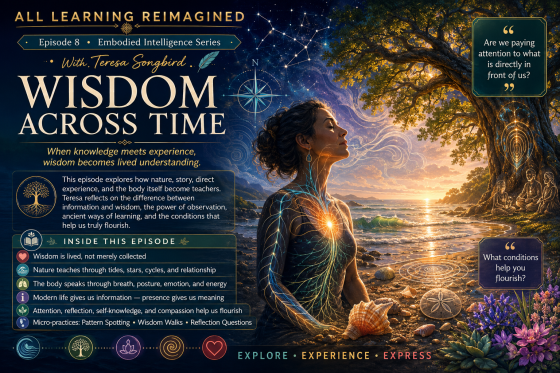
Teresa explores the distinction between information and wisdom, arguing that information can be gathered quickly while wisdom develops through lived experience. She describes learning as a process of discovering one's own understanding rather than merely adopting the thoughts and beliefs of others. Facts about the ocean, courage, or relationships cannot fully replace the lessons gained by standing beside the sea, acting courageously, or participating in a relationship. In her view, knowledge becomes wisdom when it meets observation, experience, reflection, and discernment. This distinction forms the central thread connecting the episode to the broader Embodied Intelligence series.
Nature as a Timeless Teacher
Drawing on childhood memories of fishing with her grandparent, Teresa explains how close observation of tides, currents, weather, animals, and changing shorelines can produce practical wisdom. Her grandparent's fishing knowledge came from sustained attention rather than a textbook, and one of Teresa's brothers later embodied that learning. The ocean taught lessons about patience, timing, humility, relationship, and the limits of control. Teresa extends this idea to ancient sailors who navigated by stars, winds, currents, birds, and cloud formations. These examples show how pattern recognition and direct engagement with nature allowed wisdom to move across generations.
Information, Technology, and Presence
Teresa contrasts society's unprecedented access to information with what she sees as growing disconnection from the self, other people, and the natural world. She recalls seeing a family in a restaurant where every adult and child was absorbed in a separate screen, with no eye contact, shared stories, laughter, or mutual presence. The scene leads her to ask whether humanity is becoming better informed without becoming more attentive to what is directly in front of us. She does not reject technology or innovation, but questions the assumption that newer is always better. She encourages listeners to preserve storytelling, observation, relationships, and experience rather than becoming passive consumers of information.
The Body as a Source of Intelligence
The episode returns to the body as a teacher, building on earlier discussions of electrical activity, fascia, the nervous system, memory, and bodily communication. Teresa says the series has changed her own practices and strengthened her ability to sense whether a choice feels right, wrong, or simply premature. She observes that fear changes breathing, joy changes posture, grief changes energy, and belonging changes how a person feels. The body, in her view, continually communicates through these signals, even when the conscious mind is not listening. She also emphasizes that sunlight, fresh air, movement, nourishment, touch, community, beauty, stillness, and purpose are meaningful conditions for bodily flourishing.
Attention, Identity, and Flourishing
Teresa shares several principles she keeps on a note near her desk: pay attention, observe nature, know yourself, listen deeply, honor relationships, learn from experience, live in harmony, and do no harm. She describes attention as a spotlight that helps shape a person's experienced reality and therefore deserves careful direction. She also identifies safety, rest, support, hydration, breath, movement, curiosity, repetition, presence, expansion, and patience as conditions that help her learn and flourish. A major part of this process is identity: understanding who one is beneath professional, social, educational, or medical labels. Teresa explains that optimism and playfulness became part of her default state through repeated conscious choice, illustrating her belief that self-awareness can help a person act as a creator rather than only a consumer.
Bringing Timeless Wisdom Into Modern Learning
Teresa argues that education should involve not only acquiring knowledge but also learning when and how to apply it in everyday life. Academic achievement alone, she says, does not necessarily produce a full or abundant life without experience, relationships, reflection, compassion, and discernment. She points to recurring wisdom themes across cultures, including interconnectedness, cycles, consequences, balance, self-knowledge, and natural law. Books and films such as the Ringing Cedars of Russia series, The Lion King, Moana, The Alchemist, and Jonathan Livingston Seagull are offered as sources that invite reflection on these themes. She closes with micro-practices involving pattern spotting and wisdom walks, asking listeners to notice what life is showing them and what conditions help them flourish.
All Learning Reimagined

Please help support this show!
Support this show by subscribing
$5.99/mo or $9.99/mo or more
Click HERE
All Learning Reimagined: Where passion meets possibility, one story at a time.
All Learning Reimagined is a global podcast exploring the many ways we learn, grow, create, and contribute throughout life. A gathering place for people who know that the future is something we learn, create, and steward together.
While education is often where the conversation begins, this podcast reaches far beyond classrooms and curriculum. Together, we explore learning as a living process that unfolds through relationships, community, nature, creativity, curiosity, experience, and the pursuit of what brings us alive. Through inspiring conversations with parents, educators, authors, visionaries, community leaders, and everyday people, we share stories that expand what learning can be and how it shapes our families, communities, and world.
Drawing from diverse perspectives, indigenous wisdom, practical experience, emerging ideas, and timeless principles, each episode offers insights that nurture self-direction, discernment, contribution, and a deeper connection to what matters most.
Whether you are a parent, educator, learner, creator, community builder, or simply curious about what is possible, All Learning Reimagined invites you to explore meaningful questions, fresh perspectives, and inspiring stories from around the world. Because learning is a living journey to nurture.
Cultivating self-trust. Nurturing wisdom. Inspiring contribution. Strengthening community.
Speaker Identification
Speaker 1 - Prerecorded Theme Voice
The opening lines appear to be a prerecorded musical or spoken theme introducing the program and Teresa Songbird.
Speaker 2 - Host, Teresa
The speaker explicitly introduces herself as Teresa. The opening theme identifies her as Teresa Songbird, and she remains the sole conversational speaker throughout the episode.
Speaker 1 - Prerecorded Theme Voice:
There is another way to learn,
where questions open doorways,
where wonder leads us home,
where every heart remembers the wisdom it has known.
All learning reimagined,
where passion meets possibility.
With Teresa Songbird,
come explore what learning can be.
For parents, teachers, seekers, and dreamers,
learning comes alive.
Speaker 2 - Host, Teresa:
G'day, and welcome to All Learning Reimagined. I'm your host, Teresa, bringing you a little ray of sunshine as, together, we're reimagining the future of education one inspired story at a time.
Can you believe it, everybody? We are up to Episode Eight of our Embodied Intelligence series. We only have today and next week to go. It's been amazing. Thank you for joining us on this journey. It's been fantastic, and I'm really loving the feedback I'm getting from our listeners. It makes my heart sing to hear that the micro-practices are really helping you and that there are shifts in perspective around how you look at your body and how we can embody intelligence when we are learning.
Welcome to any new listeners. You can go back to any of the previous shows, and you can also read any of my articles. I create a new article every week with activities that you can access for free. Take them, use them, embed them, and share them. That's what they are there for.
If you're interested in accessing those resources, you can go to BBSRadio.com/AllLearningReimagined. You'll be able to find everything you need there, which will be wonderful.
Let's get into it. Today's topic is wisdom across time. I felt that I was tying ancient wisdom into each show, but there is so much content there that it seemed to need space of its own. Wisdom is not actually something we invent. It is something we recognize, and wisdom has always been here across time.
Anyone who knows me knows that I love nature because nature teaches. Everyone knows I love stories because stories teach, and experiences teach. Of course, all of this leads to the most important thing, which is life. Feeling alive, experiencing aliveness, and living life all teach us. That is what learning is meant to be about.
Learning is not necessarily meant to be indoctrination or the adoption of other people's thoughts and beliefs. It is about discovering your own understanding. Doing that through observation, particularly through nature, experiences, and direct life experience, is certainly where it's at. This has happened across generations, cultures, and traditions. People have been paying attention to those lessons for a very long time, for eons.
Throughout this series, we have spoken about the body being electrical and interconnected. We have discussed fascia and the nervous system, the body as a form of remembering, how it holds memory, and how it communicates. Today, we are going to put a big bow around it and tie much of it together. When does knowledge become information, and when does knowledge become wisdom?
Information and wisdom are two completely different things, in my opinion. Information can be read. Information is everywhere. Personally, I feel there is information overload, particularly with AI today. Everywhere you go, you can find information at the drop of a hat. You can click your fingers, and there it is. That does not mean you have accessed wisdom.
From my perspective, wisdom must be lived. Anyone can give you information. You can pick up information all over the place, but wisdom is lived. I feel this is a really important connection to learning because a learner can memorize facts.
Let's take the sea or the ocean as an example. Learners can memorize facts about the ocean, yet you cannot fully explain the experience of standing beside it. That teaches you something completely different. A learner can read about courage, but until you step up, live courage, and have that experience, you learn something different. A learner can study relationships, yet being in a relationship is very different because it teaches you something that study alone cannot.
Wisdom often emerges when knowledge and experience meet. Of course, this is just my perspective, but I have put a lot of thought into it. I have spent a lot of time under my beautiful tree, feeling the energy come up and bubble out of me. It is fantastic. I know my body holds wisdom if I actually bother to listen.
Never before in history have we had access to so much information. Yet, from what I am seeing and observing, and from conversations I am having with people, many people feel increasingly disconnected from themselves, from each other, and certainly from the natural world. I am not criticizing because I am one of them. It is simply something I am noticing, and other people are beginning to notice it too.
I walked into a restaurant the other day and saw a beautiful family sitting together. There were young children, and the parents were there. Every single person was looking at a screen. The children had iPads, and the adults had their mobile phones or other devices out. Information was flowing and communication was happening, but it was not happening with each other.
There was no eye contact, no presence, no shared stories, no sharing of food, and no laughter. It was almost as though they had been pulled down into those screens, which held all their attention. It made me feel a little sad that this is where we are today, rather than feeling that connection with one another.
That invites an interesting question: as humanity gains more information, are we becoming equally skilled at noticing what is happening directly in front of us? It feels to me as though we are not necessarily exploring all the possibilities because we are distracted.
That reminded me of when I was a child. I have told many of these stories, particularly in my very first episode, which was well over a year ago. I loved being on the beach with my family. I also used to go fishing with one of my grandparents, and she knew exactly where to cast the line.
She understood the tides, the currents, the weather, and the habits of the fish. She also understood that my incessant talking as a young child was scaring the fish away. She understood all those things, and that wisdom did not come from a textbook. Mobile phones had not even been invented back then. The internet had not been invented either.
Her wisdom came from observation. It came from paying attention, spending time with the ocean, and learning through experience. That knowledge became wisdom, and of course she passed it on.
I have three brothers, and one of them certainly took that wisdom on. He is an amazing fisherman and is deeply connected to wildlife. It is incredible. As for me and fishing, no, I am not very good. I do not have the patience to sit still for that long. I did not necessarily embody that particular lesson, but he certainly did.
The ocean teaches patience, timing, and humility. You cannot control the tide. You certainly cannot command the weather, and you cannot force the fish to bite. Perhaps there is someone out there who can, but from my perspective, I was not able to do that. The ocean invited a relationship rather than control, and that really felt like wisdom.
It often made me ask questions such as: Why are we here? How do we live well? How do we navigate change? Like the tides, every time the water went out, the sand was different. There was different coral, different shells, and different debris on the beach to explore. It was always fantastic and gave me a sense of peace.
Then, of course, you think about ancient wisdom, navigation, and the stars. Sailors navigated vast oceans without a GPS saying, "In 500 meters, turn left now." That certainly did not happen. They observed the stars, currents, wind patterns, bird migrations, and cloud formations.
All of this involved observation, pattern recognition, relationship, and wisdom. Pattern recognition is one of my favorite things. I love recognizing patterns.
There are also stories of wisdom carriers. People sometimes assume wisdom is found only in books. It is not. Wisdom was told and passed along through stories, myths, songs, oral traditions, parables, and legends. Stories often survive because they contain patterns that remain relevant today, and those patterns carry wisdom.
This makes me ponder, and perhaps you are curious about it too: What knowledge actually survives across generations? With the generations we have now, what knowledge will move into the future from person to person without necessarily using technology? Why do similar ideas appear in different cultures, including cultures that may never have met in ancient times? How did that ancient wisdom get there, and what does it offer modern learners today?
There are many people looking backward to help navigate how we move forward. Of course, the wisdom is that there is no past and present. Time is an illusion, and we need to be in the present moment. The now moment is what creates everything. It is amazing. There is so much to sit with and ponder.
What happens when we combine observation, experience, and curiosity? As you know, I love questions. I love to sit and ponder them. I often do not have the answers, but that does not matter because I have put the question into the field. Then my brain, the wonderful tool that it is, will seek the answer.
It is amazing how answers to my questions come to me. They are manifesting faster now. Sometimes I receive the answers almost instantly or within an hour. It used to take a day or even weeks, but the answers come when I ask the questions, particularly when I speak them aloud. Speaking, as we know, is vibrational, and that operates at a creational level.
I want to return to what we currently believe in modern society, which often assumes that newer is better. In my opinion, newer is not always better. There is new technology, new information, and new discoveries, yet so many new discoveries are rediscoveries of something old.
Many advances have improved our lives. I completely understand that, and I am not criticizing innovation. I am simply wondering whether, in the pursuit of innovation, we sometimes overlook timeless wisdom. It has always been there. It is not merely old wisdom; it continues to prove useful.
This assumption that newer is better seems especially common in Western society and Western communities. Perhaps it is because our brains like novelty. I do not really know. I am not quite sure what causes it, but I do know that certain societies and communities on our beautiful planet, our beautiful realm, seem to have found a better balance because they have not forgotten ancient wisdom.
Consider the wisdom of observation. Before there were laboratories, people observed. They watched the seasons, animals, weather, stars, rivers, relationships, and growth. Over generations, those observations became stories, teachings, and traditions. At their heart was the simple practice of paying attention, noticing patterns, and learning from experience.
When I think again about the family in the restaurant, completely absorbed in their devices, I wonder what the future will hold if we all become like that. Where are the storytelling and the paying attention, rather than simply being fed information and becoming consumers of it? How do we make room to live and experience life as well?
A couple of episodes in this Embodied Intelligence series have been about the body as a teacher. That has been amazing. Investigating, researching, and preparing what I am going to discuss each week has shifted me personally. Designing this series has made me stop and reflect.
The body as a teacher has led me to change some of my micro-practices. It has deepened my understanding of going within and strengthened my discernment because I am now much more in tune with my own body. My body will tell me whether something is a yes and is on the right path for me, whether the answer is no, or whether it is simply not time yet.
Fear changes breathing. Joy changes posture. Grief changes energy. This is all alchemy happening within us. A sense of belonging can change the way you feel. The body is always teaching us, and emotions are an integral part of that.
What I discovered was that I was not listening. My body was always communicating with me, but I was not listening. I am now, but I was not always.
When I think about the family sitting in the restaurant and scrolling on their phones, I wonder whether they are aware of their own body language and signals. Is the energetic weather overwhelming their senses? By energetic weather, I mean everything else in the world that is not themselves.
The body also asks for certain conditions. The body craves sunlight, fresh air, and movement. It does not have to be movement in a gym with a "no pain, no gain" mentality. It can simply be movement. The body also needs nourishment, touch, community, beauty, stillness, and purpose.
Those are not luxuries. In my opinion, they are inputs into your body, just as a plant requires certain conditions to grow and thrive. So do we. The body often communicates what it needs for us to thrive because, news flash, the body is us. It is an aspect of our whole multidimensional self. We are living in this physical reality, and our body is part of it.
Using ancient wisdom as a lens, it is not ancient merely because it is old. It is ancient because it is simple, timeless, practical, and still useful. I wrote down some examples that really landed with me. I have them on a sticky note in front of my desk. Every now and then, I look up at it, and it reminds me to settle back in.
The first thing I wrote was: pay attention. I did not realize how often my mind drifted or became distracted until I learned to bring it back. What am I placing my attention on? That spotlight is literally creating my reality, so it is very important.
I am quite selective about what I observe, who I speak with, and what I allow into my field because I do not want my attention pulled in someone else's direction by someone else's agenda.
The other things I wrote down were: observe nature, know yourself, listen deeply, honor relationships, and learn from experience. Listening deeply was a particularly good one. Learning from experience is my everyday life. It is just another Tuesday, quite frankly.
I also wrote: live in harmony with life. Harmony, peace, and balance matter. Do no harm. Natural law is also important.
These themes appear across many different cultures. Everything is connected. Life moves in cycles. Actions have consequences. Balance matters. Relationships matter. Most importantly of all, in my opinion, self-knowledge matters. You need to know yourself. It is one of the most important things we can possibly do.
I like to connect these ideas with natural law and universal principles. What wisdom continues to appear no matter where we look? When a pattern keeps reappearing, there is definitely something in it for us.
This matters for learning. Some people say education is about information. I do not feel it is only about information. It also needs to be about wisdom. Knowledge tells us something, but wisdom helps us know when and how to apply it. Is that not what learning is meant to be about: living what we learn in everyday life? Otherwise, what is the point?
You can know many facts. I have seen many children become straight-A students who know all the facts, yet their life experience does not match their academic achievement. Getting a good grade does not necessarily translate into having a fantastic, full, abundant life.
Experience, reflection, discernment, relationships, and observation remain key parts of awareness. They help us recognize the conditions we need in order to flourish. What conditions do you need to flourish?
For me, I need to slow down. I need presence and reflection. That is something I have grown into over time. I also need a condition of safety. My nervous system needs to feel safe and settled in order for me to connect. If I am in fight-or-flight mode, I really struggle with that.
Sometimes the body wants you to stay with what you already know and remain in your comfort zone. It is doing its job. It is protecting you. Sometimes I have to communicate with myself and say, "It is okay to expand. It is okay to learn. We are safe." I have that connection and communication with my body.
Other conditions that help me flourish include allowing my body to move freely, hydration, breath, and nature. Memory also needs to be part of this. What conditions help us create new experiences? Safety, repetition, and curiosity all play a role.
Something else I have already mentioned is presence. I do not mean presents under a tree or a gift for someone else. I mean presence. When you pay attention and are fully there, you are in the now moment. It is almost like being in the rhythm of life and in a flow state. Being present certainly helps me flourish.
Does it help you flourish? I do not know. I have not met you, so I do not know what helps you. This is simply what speaks to me.
Expansion helps me flourish. I constantly want to learn and grow into new things. Being able to expand and evolve is fascinating. I love it. I feel life would be very boring without it.
In order for me to expand and grow, however, I need rest because I need spaced learning. I also need support. I cannot do it alone. Something I am still learning is patience because I want everything to have happened yesterday. I do not know about you, but that is certainly me. Oh, dear.
Another important condition is identity. This is a big one because we have to know ourselves. What defines your identity? It is not your job. It is not what you do. That is not who you are as your authentic self.
When you strip away the labels, who are you as a being? That question is worth a whole show of its own because there are so many labels. People say, "I am this," or, "I am that." Medical labels can also shape a person's identity, and we need discernment around those labels.
Self-observation helps you understand who you are and what is important to you. What are your values? What do you stand for? When you strip away the labels, who are you underneath? What is your default personality, mood, or energetic state?
I can speak only for myself. I cannot speak for anybody else, but my default state is often joy. Even if I feel sad, or something happens and my emotions peak very quickly, I return to my default state of optimism, playfulness, and seeing the bright side of things.
I used to say, "I am just wired this way," but I have realized that is not actually the case. I choose this. I have been choosing this emotional state for so long that it has become part of who I am. I consciously chose it.
We have much more power than we may feel we have. To exercise that power, you need to be present, in tune with yourself, and aware of whether you are acting as a creator or a consumer. What are you creating, as opposed to simply consuming what is being, for lack of a better word, programmed into you?
I do not mean "programmed" in a nasty way. It is simply part of how we are shaped. In some cases, we are programmed or indoctrinated by society, our families, and education systems. That is just how it is. I am not judging it as good or bad. It is simply how it is.
When we know ourselves, we can choose what we want to believe. That is where wisdom comes in. What conditions help us learn from life? Attention is definitely one of them. I feel humility and compassion are also very important.
Humility and compassion are qualities I have seen starting to slip away in some children. I see a sense of entitlement sneaking in, particularly among children who spend a lot of time with technology. It does not seem similar to what I experienced at that age, so I am genuinely curious about how that will unfold.
We need to integrate and embody what we have learned in our lives. There is so much here that we can bridge into our understanding of identity.
I also want to mention a couple of books and films that have helped me because they contain a great deal of ancient wisdom. One is the Ringing Cedars of Russia series. I have mentioned it before, but if you have never heard of the Anastasia books or the Ringing Cedars of Russia, I highly recommend checking them out.
There are many free YouTube clips that unpack the books because the books themselves are quite expensive these days. I do not understand why. Well, I do have an idea of why that might be. The ancient wisdom in these books is amazing. They invite reflection on our relationship with nature, community, learning, family, and what it means to live in harmony with life. There is so much wisdom in them.
Then there are films. Some children's films are among the best. The Lion King contains wisdom about identity, responsibility, and belonging. Moana contains wisdom about following your calling, having courage, relating to the ocean, and knowing who you are.
There are also books such as The Alchemist, which explores trust, purpose, and following your path, and Jonathan Livingston Seagull, an old but classic work about growth, learning, and possibility. There is so much material we can explore when looking for ancient wisdom.
The micro-practice I created this week is about pattern spotting. I will also include an additional micro-practice in this week's article about wisdom walks and the question, "What is life showing me today?" Check it out when it becomes available. I have also put together weekly integration and reflection questions.
Wisdom is available to anyone willing to observe, reflect, and learn from life itself. Life is always teaching us. The question is: are we paying attention?
For me, life flourishes when the conditions support life, so I am reflecting on the question: What conditions help me flourish?
That is all I have for you today. My love to you all. Thank you for joining me on All Learning Reimagined.
This week: explore, experience, express. Go out and live learning. Keep exploring. Keep creating. Keep remembering.