
All Learning Reimagined, July 17, 2026

All Learning Reimagined with Teresa Songbird
Episode 7 of series on Embodied Intelligence
Know Thyself (Identity)
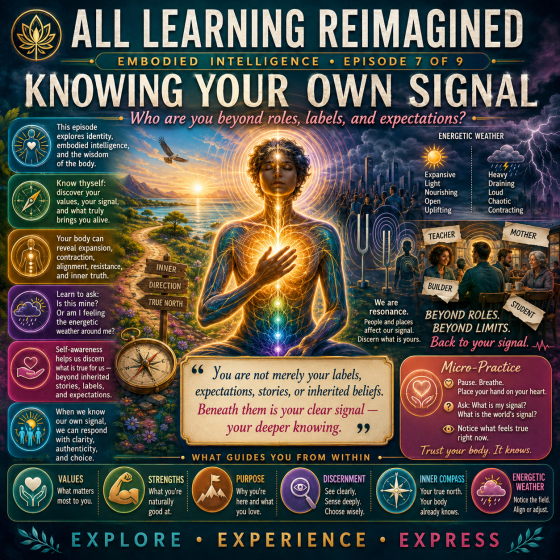
Knowing Your Own Signal: Identity, Discernment, and the Wisdom of the Body
Summary
Beyond Roles and Labels
Teresa Songbird explores identity as something deeper than a profession, relationship, qualification, achievement, or social label. She asks listeners to consider who they would be if familiar roles changed or disappeared, especially during a period when technology and life circumstances may rapidly reshape careers. The episode presents knowing oneself as a foundational form of learning and invites reflection on personal preferences, natural strengths, sources of aliveness, and activities that drain energy.
Values as an Inner Compass
The discussion turns to values, which Teresa describes as lenses through which people make decisions and interpret their lives. She identifies connection, contribution, expansion, learning, and exploration as central values in her own life while acknowledging the importance of contributing without sacrificing personal well-being. The episode contrasts self-knowledge with an endless self-improvement cycle that can reinforce the belief that a person is never enough.
How the Body Communicates Alignment
Teresa connects identity with embodied intelligence by describing physical sensations of expansion, contraction, excitement, resistance, heaviness, and relief. She suggests that the body may register a person, room, opportunity, or major life change before the conscious mind can explain what is happening. Integration may also continue in the body after a job, relationship, home, or other circumstance has changed intellectually or practically.
Identity as an Unfolding Process
The episode emphasizes that identity is not fixed. Childhood, adolescence, adulthood, careers, retirement, relationships, beliefs, and interests can all shift over time. Teresa describes inherited labels and subconscious stories, including the effect that repeated “dumb blonde” jokes had on her early self-image, to illustrate how outside messages can become internal beliefs. She encourages listeners to question whether old stories remain true or aligned with who they choose to be today.
Discernment and Energetic Weather
Teresa introduces “energetic weather” as a way of describing the emotional atmosphere of people and environments. From her perspective, people may sometimes absorb or respond to feelings that did not originate within them. Knowing one’s own emotional and bodily signal therefore becomes essential for distinguishing personal feelings from surrounding influences. She also compares people to tuning forks whose emotional regulation, joy, heaviness, or tension can affect those around them.
A Micro-Practice for Knowing Your Signal
The closing practice asks listeners to pause when a strong emotion arises, breathe, place a hand on the heart, and ask whether the feeling began within them or may have been picked up from the surrounding environment. Teresa encourages listeners to identify their own signal, compare it with the “world’s signal,” and notice what feels genuinely true in the present moment. She concludes that authentic living begins beneath labels, expectations, and inherited beliefs, where a person’s deeper essence and inner knowing can be recognized.
All Learning Reimagined

Please help support this show!
Support this show by subscribing
$5.99/mo or $9.99/mo or more
Click HERE
All Learning Reimagined: Where passion meets possibility, one story at a time.
All Learning Reimagined is a global podcast exploring the many ways we learn, grow, create, and contribute throughout life. A gathering place for people who know that the future is something we learn, create, and steward together.
While education is often where the conversation begins, this podcast reaches far beyond classrooms and curriculum. Together, we explore learning as a living process that unfolds through relationships, community, nature, creativity, curiosity, experience, and the pursuit of what brings us alive. Through inspiring conversations with parents, educators, authors, visionaries, community leaders, and everyday people, we share stories that expand what learning can be and how it shapes our families, communities, and world.
Drawing from diverse perspectives, indigenous wisdom, practical experience, emerging ideas, and timeless principles, each episode offers insights that nurture self-direction, discernment, contribution, and a deeper connection to what matters most.
Whether you are a parent, educator, learner, creator, community builder, or simply curious about what is possible, All Learning Reimagined invites you to explore meaningful questions, fresh perspectives, and inspiring stories from around the world. Because learning is a living journey to nurture.
Cultivating self-trust. Nurturing wisdom. Inspiring contribution. Strengthening community.
Speaker Identification
Speaker 1 - Prerecorded Theme Vocal / Announcer
This speaker performs or recites the opening and closing program theme. The transcript does not identify the vocalist by name.
Speaker 2 - Host, Teresa Songbird
The host identifies herself as Teresa in the introduction and is named as Teresa Songbird in the program theme. She delivers the entire episode discussion.
Speaker 1 - Prerecorded Theme Vocal / Announcer:
There is another way to learn,
Where questions open doorways,
Where wonder leads us home,
Where every heart remembers
The wisdom it has known.
All Learning Reimagined,
Where passion meets possibility.
With Teresa Songbird,
Come explore what learning can be
For parents, teachers, seekers, and dreamers.
Learning comes alive.
Speaker 2 - Host, Teresa Songbird:
Good day, and welcome to All Learning Reimagined. I’m your host, Teresa, bringing you a little ray of sunshine as, together, we reimagine the future of education one inspired story at a time.
Welcome back, everybody. Thank you for your feedback on last week’s show. It was lovely to hear that the micro-practice on expansion has been helpful for so many people. It warms my heart to know that people are connecting with the work.
Today we are on Episode 7 of 9 in our Embodied Intelligence series. If you are a new listener or have not heard the earlier episodes, welcome. You can go back to bbsradio.com/all-learning-reimagined to find the other episodes and the accompanying articles, including the activities and micro-practices shared each week. There are hundreds of resources there for you to explore and share.
This week I am focusing on something a little different. Last week, we looked at expansion and how the body responds when we feel safe enough to expand into something new rather than contract. This week, we are adding another layer by exploring identity and what it means to know ourselves.
In my opinion, this is where everything begins. You have to live with yourself for the rest of your life, so it is important to know yourself.
Speaking from direct experience, it is easy to become distracted by life, disconnect from yourself, and lose awareness of different aspects of who you are. Children may remain more naturally connected, but as we grow older, work different jobs, move through careers, run businesses, and manage all the other demands of life, we need to intentionally make space to return to ourselves and reconnect.
What if knowing ourselves is one of the most important forms of learning? That was the question I was pondering for this week’s episode.
I like to begin with stories because stories help us learn and remember. Here is a simple, everyday example.
Imagine meeting a new group of people at a cafe and asking, “Who are you?”
Someone might answer, “I’m a teacher,” “I’m a mother,” “I’m a builder,” “I’m retired,” or “I’m a student.” They may tell you their name, job, role, qualifications, or achievements because, particularly in Western societies, that is what we have been trained to say. We often think these things are our identity and that they define who we are.
Yet what happens if those roles change tomorrow? That is a significant possibility as artificial intelligence expands and affects many careers.
Who are you when you are no longer in that role? Are you still who you were? Are we still who we are?
I am inviting all of us to reflect beyond what we do and ask who we are as beings. How do you show up in the world? How do you operate? What are your preferences? What are your connections?
There are many questions to ponder: Who am I when nobody is watching? What feels naturally true for me? What brings me alive?
I have witnessed that some people come alive under pressure, while others completely crumble. Some come alive outdoors. Others light up when talking about a favorite computer game, writing, drawing, or creating art.
There is a visible aliveness when someone is doing what connects with them.
Every one of us is different. We each have a different flavor and what I would describe as a different energetic signature. What brings you alive?
Then there is the opposite question: What drains you? What drains your energy?
If you ask me to cook or iron, I am sorry, but those are simply not things I enjoy. One of my closest friends, however, is an amazing cook. Everything she touches is delectable. She loves cooking, and that love seems to pour into the food. I love eating it, but cooking is not for me.
Everyone has something that drains their energy, and everyone has something that makes them come alive. Recognizing those things is part of knowing who you are beyond the identity and labels you have been given.
Recently, I have also asked myself: What have I learned about myself through life? What do I know about myself? Do I even know myself, especially when I am constantly changing?
What if self-knowledge is more valuable than self-improvement?
Self-improvement can sometimes become rooted in the belief that “I am not enough.” It can lead to constant judgment and endless seeking. I feel we are programmed into that pattern at school: receive feedback, improve, and then improve again.
To some degree, that process is useful when developing a skill, but is that all there is? Do we have to treat ourselves, as living beings, in the same way?
Many people grow up learning what to think, what to achieve, how to fit in, and what success is supposed to look like. These ideas are programmed into us. You only have to turn on social media or television, your “vision box,” and it will tell you what success and identity are supposed to be.
Far less time is spent developing an understanding of our values.
What are your values? If I asked you to name your top three values, could you do it?
You can probably identify some of mine. Connection is one. I love connecting with people, connecting with myself, and connecting with nature.
Contribution is another. I love contributing, making a difference, and having an impact. That makes my heart sing.
Expansion, learning, and exploration are also central values for me. I value growth.
Those are three of my leading values. I have many others, but those are the ones I would share today. They operate almost like the lens through which I see everything.
If something is not going to help people, I generally do not do it. I ask, “How can I contribute? What can I do to help others?” However, I am also learning not to do that at the expense of myself. That has been a very hard lesson to learn.
What about our strengths, gifts, preferences, and purpose? What is our purpose for being here? I did not say our purpose for doing here. I said our purpose for being here.
Very little time is spent exploring identity and who we truly are. We are often told what to think, what to achieve, and how to fit in.
“Know thyself.”
We often learn about the world before we learn about ourselves. When you think about it, that seems backward.
How does this connect with our Embodied Intelligence series? Where does the body fit?
I have noticed that some choices create expansion while others create contraction. The body speaks to us as this happens.
Developing a relationship with yourself is important because it helps you discern and make choices. Are you going to take that job? Are you not going to take it? Will you enter that relationship? Will you not?
When everything feels chaotic, you can sit still until the noise settles and you can feel the communication.
Some people energize you. Others leave you exhausted. Do I want exhausting people in my life? Do I choose to remain around them? Why would I do that if we are not an energetic match or on the same frequency?
Some opportunities feel completely aligned. The body gives a full-bodied yes. Others feel heavy, like an obligation or a “should,” “would,” or “could.” Those words can carry the weight of expectation.
Your body may know that something is not aligned with your true essence.
Often, the body notices something before the mind can explain it. You can walk into a room and register something in your body before your mind catches up with what is happening or with the energy of the room.
The body also takes time to integrate change.
Something may have ended mentally and intellectually, but the body may need more time to process it. Someone may have experienced burnout, left a job, ended a relationship, moved house, or undergone another major life change. The mind can understand that the event has happened, but the body still needs time to adjust and integrate it.
A tightening in the stomach, a lifting in the chest, excitement, resistance, or heaviness can all be forms of information. The body is constantly offering us information. This is part of knowing ourselves.
Are we listening?
I did not listen for years. I listen now, and the expansion that can occur when you are in tune, aligned, and coherent is amazing.
When your gut feeling, your heart or passion, and your mind come into coherence, beautiful things happen.
Many of us are out of alignment because we are living through the “shoulds,” “woulds,” and “coulds,” following programming loops and belief systems embedded within us. Some of those beliefs may be outdated. They may have served you when they were installed, but you are not the same man, woman, child, or being now.
Your identity is not fixed.
This is a liberating idea to introduce because some people believe they must remain inside a single identity. Teachers can be particularly known for saying, “I’m a teacher. I’m a teacher. I’m a teacher.” Very few leave the system because that is how they see themselves, and many genuinely love the role.
Yet you can teach without having teaching as your job. You can teach through everyday life. You can still be a teacher without needing the professional label.
Many people seem to believe identity is fixed, but life shows us otherwise.
A child becomes a teenager, and identity shifts. A teenager becomes an adult, and identity shifts again. People retire. Careers change. Relationships change. Someone may become married or divorced. Beliefs evolve. Interests expand.
Sometimes identity is not something we discover all at once. It unfolds throughout life.
This is relevant at every age because what if we are not everything we think we are?
Most of us assume that every thought we think is ours and every feeling we feel belongs to us. Speaking from my direct experience, I do not believe that is always the case.
I can sometimes pick up on the thoughts or feelings of other people. People who describe themselves as empaths may feel that they pick up experiences from those around them. They may need to sit with a feeling and ask, “Is this mine? Is this emotion mine, or is it someone else’s?”
Self-awareness and discernment are essential life skills.
I am raising this because I feel discernment is one of the most important skills for navigating the changing and challenging times many people are experiencing.
At the same time, this can be a beautiful and expansive period for people who choose not to consume every challenge around them. They choose to create instead. They choose to become creative beings.
Part of discernment is asking, “Is this really mine? Am I responding to something that is simply around me?”
You can walk into a room feeling perfectly fine and suddenly feel anxious, heavy, frustrated, or emotional. Nothing obvious has happened, but something has shifted. Sometimes you may be picking up what I call the emotional or energetic weather of the environment.
I want to give a big shout-out to a woman named Catherine Marcel, although I am not certain how to pronounce her surname. She has a YouTube channel, and I recommend looking up her work if you want to explore this subject more deeply.
She introduced me to the concept of “energetic weather,” which has now become part of my daily language. I am grateful to her for describing it, and I am sharing the idea with you.
Energetic weather is not physical weather such as rain, hail, sunshine, or rainbows. It refers to the emotional or energetic atmosphere around us.
Some days feel calm. Some feel stormy. Some environments feel uplifting, while others feel heavy.
The awareness comes through asking: Is this my energetic weather? Is this mine? Am I picking up something around me, as though it were weather, or is the feeling coming from within me?
Where is the sensation coming from?
The body is like an antenna.
Throughout this series, we have discussed how the body is electrical, relational, communicative, and capable of carrying remembrance. We have explored fascia, the nervous system, and other aspects of embodied intelligence.
Today, I also want us to consider that knowing yourself includes understanding how you perceive.
How does your body perceive? How do you receive information? How do you interpret it? How do you choose to respond rather than react?
We are like antennas constantly gathering information.
My recurring question has been, “How do I discern what is mine, what belongs to me, and what does not?”
To do that, I need to know my own identity, signal, and home base.
Without that knowledge, it is easy to become like a wave on the ocean being thrown against rocks. You can be swept whichever way the collective consciousness, society, or surrounding environment is moving because you do not know yourself well enough to say, “This is not for me,” or, “Yes, this is for me. I want to join this experience.”
“Know thyself” means learning to recognize who you are.
That recognition is often connected with subconscious beliefs that have been programmed into us. It is important to ask, “Who am I without all the stories I inherited?”
I am not necessarily rejecting those stories. I am questioning them. Do I choose to continue living inside them?
I will give you an example. I have naturally blonde hair. When I was young, it was so light that it was almost white, like snow. People loved telling me “dumb blonde” jokes.
After hearing those jokes repeatedly, part of me began to think, “Maybe I am stupid.” That story entered my subconscious.
Eventually, I had to strip that belief from my identity and decide, “That is not a story I choose.”
How many other labels are attached to race, gender, financial situation, background, or other aspects of life? People may be labeling you right now according to who they think you are. Are you buying into that story?
I chose not to, but it took me years to reach the realization that I needed to know who I was, understand my boundaries, and decide what I would and would not accept.
This is very important to teach children.
I have found that the body can reveal identity patterns.
Think of the statement, “I am confident.” How does your body respond when you say or think those words?
Some people expand. Others contract and think, “No, I am not confident,” particularly when they are experiencing anxiety. Some feel tension or resistance. Others may feel neutral.
What do you feel?
Now try saying, “I am learning to trust myself.”
That can feel very different from saying, “I am confident.”
The body often reveals where old identities are still being held. You can explore this by speaking to yourself, sitting quietly, breathing, creating space, and noticing the sensations in your body and what those sensations mean for you.
It does not have to involve bells and whistles. The signals are often subtle. As your communication with yourself becomes stronger, your discernment can also grow stronger.
Someone can show me a story on the internet or tell me something, and my internal “BS meter” often reacts immediately. Years ago, I would have needed to sit with it for a long time. Now, I have a much stronger connection because I have worked with it. I know many of my patterns and signals.
Sometimes I still notice a sensation and think, “I am not quite sure what that is.” Even then, I can often sense whether it feels expansive and positive for me or contractive and not aligned with me.
In my opinion, this is an extremely valuable skill because awareness has to occur before change can occur.
That is what learning is about: changing, growing, expanding, and encountering something new.
Many people try to change themselves before developing awareness. You cannot change what you are not aware of.
That is why feedback can be so valuable. If someone identifies a blind spot for you, that can be a gift.
It is powerful to surround yourself with people who have enough integrity to tell you the truth rather than only tell you what you want to hear because they are afraid of hurting your feelings. When people speak honestly and constructively, you have an opportunity to grow and expand.
Take a careful look at the people around you. There is truth in the idea that we are influenced by those we spend time with.
Our bodies can also be compared to tuning forks.
If someone around you is joyous, playful, calm, and emotionally regulated, that person may help raise the emotional tone of those nearby. That is one reason some people feel good to be around.
Other people may leave you feeling drained. They may not even realize they are affecting others in that way.
Then there are people who seem to raise the frequency of a room.
We are not meant to be alone. We are meant to co-create this reality.
When more than one person is shining their light and sharing passion, laughter, joy, or whatever brings them genuine excitement, beautiful things can happen in the field around them.
It does not have to be anything flashy. It could be fishing, gardening, reciting poetry, having a cup of tea, or listening to someone because you love to care and comfort others.
When several people bring that kind of presence into a room, the effect can radiate outward.
Knowing yourself means recognizing what is right for you, following your own breadcrumbs, and identifying what is not aligned with you.
Ask yourself: What do I believe about myself? Where did that belief come from? Is it still true for me? It may have been true years ago, but is it true now? Can I let it go?
Does this belief align with who I choose to be today—not who society or social media says I should be, but who I choose to be?
Energetic weather is one part of this conversation, but awareness of yourself is central.
Ancient traditions have long encouraged people to “know thyself” through self-inquiry, reflection, and observation. None of this is new. These ideas have existed for millennia.
Modern science explores personality, emotional intelligence, self-awareness, neuroplasticity, and identity formation. The language may be different, but from my perspective, the invitation is similar: become familiar with yourself. Know yourself.
This matters deeply for learning and education.
Imagine if learners understood how they learn best, what energizes them, what their strengths are, when they need a break, how they recharge, how they respond under pressure, and what actually matters to them.
These are essential life questions. Why are they not at the forefront of education and learning?
Adults could benefit from this reflection as well. I know I have.
Learning becomes far more meaningful when it includes learning about yourself rather than only studying a subject or memorizing content.
I want to pause there because this idea needs space. I have shared a great deal, and presence is part of the process.
Identity can become stuck in the past through a label you were given or an old version of who you were. It can also become attached to a future identity you are striving to become.
Yet there is only now.
Who do you choose to be right now?
For those who are new, you can probably tell I am passionate about this topic. I have activities and weekly reflections in this week’s article that will allow you to explore it more deeply.
Please access them, share them, and have this conversation with someone else. Go to a coffee shop, sit with someone, and ask these questions.
This is why I make this podcast. It is my pleasure, my fun, and my joy. First, I like to talk. Second, I love sharing what I am personally learning.
My identity is shifting and growing, and I am actively choosing to create the reality I want to see. I do not want to consume doom and gloom. I choose to become part of the solution and help create the path we are seeking because we are pathfinders and explorers.
Here is this week’s micro-practice.
Several times throughout the week, beginning today, pause when a strong emotion arises. This might happen while you are driving in traffic, walking through a shopping center, attending a family dinner, or entering another emotionally charged environment.
Pause and ask: “Is this mine? Did it begin with me, or did I pick it up from someone else? What feels true for me right now?”
Breathe and center yourself. Place your hand on your heart and ask, “What is my signal? What is the world’s signal? What is the energetic weather? Is this someone else’s feeling rather than mine?”
Learn to discern between those signals.
Listening to your inner compass is an important skill, and the body is an essential part of knowing yourself.
This week’s article includes reflection questions and a weekly integration practice. This subject also connects, in my view, with universal law, including the law of correspondence and the law of vibration.
Let me center my heart as I close.
Knowing yourself means recognizing that you are not merely your labels, expectations, stories, or inherited beliefs. It involves gently removing those layers until you can sense what remains underneath: your true essence, which was always within you.
That is your clear signal and your deeper knowing. It is not who you were told to be. It is who you are.
Connecting with that part of yourself is a tremendous adventure. Learning about yourself can be joyful and fascinating. From there, you can begin living more authentically and making choices that reflect who you truly are.
I will leave the conversation there. It is an extraordinary topic, and I could explore it for days. I hope I have given you something meaningful to ponder.
Much love to all of you, and thank you for joining me on All Learning Reimagined.
Until next week: explore, experience, express. Go out and live learning.
Speaker 1 - Prerecorded Theme Vocal / Announcer:
All Learning Reimagined,
Where learning comes alive.
With heart, with hope, with courage,
We help the future rise.
With Teresa Songbird,
Until next time,
Keep exploring,
Keep creating,
Keep remembering.