
All Learning Reimagined, August 28, 2026

All Learning Reimagined with Teresa Songbird
Episode 3 of series on The Art of Paying Attention
Nature Trains Attention
What Becomes Visible When We Slow Down: Relearning Attention Through Nature
Summary
Nature as a Teacher of Attention
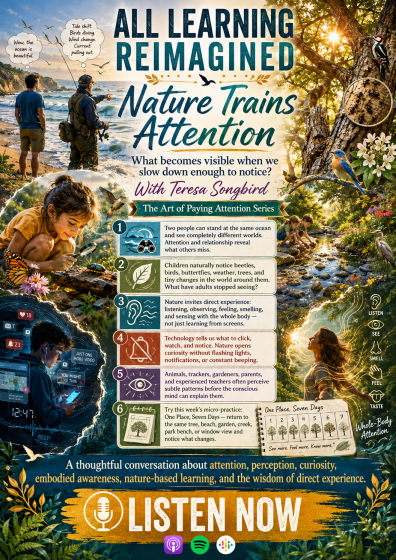
Teresa centers the episode on a simple question: what might nature teach people about attention that a fast-paced, distraction-heavy world causes them to forget? She illustrates the idea with two people looking at the same ocean, one simply seeing the view and an experienced fisherman noticing wind direction, birds, tides, surface disturbances, cloud formations, water color, and signs of feeding fish. Her point is that the difference is not intelligence but relationship developed through years of attention. She extends the example to travel, familiar places in Australia, and the things people pass every day without truly seeing. The episode repeatedly asks listeners to distinguish between merely looking and actually observing. Nature, in Teresa's framing, becomes a training ground for recovering a more deliberate and relational form of attention.
From Looking to Noticing
A major part of the episode examines how repeated attention changes perception. Teresa suggests spending ten minutes with the same tree every day and noticing details that were previously filtered out: sunlight on a branch, ants on bark, new leaves, flowers, fruit, visiting birds, or changes in scent after rain. She emphasizes that the tree has not become more interesting; rather, the observer's capacity to perceive has changed. She describes using similar exercises with children, some of whom initially report boredom because they are accustomed to rapid stimulation and instant gratification. With time, she says, many learn to slow down, observe, and become more engaged with what is already present. She contrasts nature's invitation to "look again" with a culture that often responds to fading interest by immediately offering something new.
Whole-Body Perception and Deep Listening
Teresa broadens attention beyond eyesight and describes listening, bodily sensation, movement, balance, temperature, internal feelings, and other forms of perception as part of how people experience the world. She invites children to close their eyes and separate sounds by distance, noticing birds, wind in different leaves, traffic, breathing, and quieter sounds beneath the loudest one. In her view, attention functions almost like a superpower because it brings previously unnoticed information into conscious awareness. She also describes bodily experiences such as feeling a breeze change direction, sensing warmth on the face, noticing the ground underfoot, feeling a temperature shift in shade, and observing changes in her breathing near water. From there, she asks whether intuition may sometimes involve information being perceived before the conscious mind knows how it arrived. These ideas are presented as Teresa's reflections and questions about perception rather than as settled scientific conclusions.
Technology, Education, and Direct Experience
Teresa criticizes the degree to which modern life directs attention through screens, maps, algorithms, notifications, appliances, and highly structured learning environments. She says these tools can be useful, but argues that they can also reduce opportunities for curiosity and direct observation when they tell people what to click, where to turn, what to watch, or what to notice. She contrasts that with a forest, rock pool, bird, beetle, or stream, none of which comes with a predetermined learning objective. Her educational preference is strongly in favor of direct, lived experience, including apprenticeships, excursions, camps, and time outdoors, rather than relying primarily on presented information or theory. She also urges people to observe a bird, plant, or weather condition before immediately consulting an app for an answer. Throughout this section, she frames nature as a place where the whole body can participate in learning rather than receiving information only through a screen or book.
Relationship, Animals, and the Edges of Knowing
The episode repeatedly returns to Teresa's belief that relationship deepens perception. She compares the fisherman's relationship with the ocean, the gardener's relationship with the garden, the tracker's relationship with the land, and a parent's relationship with a child, arguing that sustained attention trains people to notice increasingly subtle patterns. She also points to animals as examples of creatures that perceive aspects of the environment differently from humans, including sounds, movements, wavelengths, scents, or other cues people may miss. This leads her to tell children that the reality available to human perception is not necessarily the entirety of reality and to invite discussion about intuition, the supernatural, and capacities that may not yet be understood. She gives an example of a parent who, she says, knew a child had died in a car accident before police arrived, using the story to ask where careful observation ends and a deeper kind of knowing begins. Teresa treats these questions as openings for curiosity and exploration, especially when working with children and teenagers.
One Place, Seven Days
Teresa closes with a practical exercise she calls One Place, Seven Days. The idea is to return to the same place - a tree, garden, beach, creek, park bench, balcony, or view from a window - for about ten minutes each day, ideally for seven days. Participants avoid photographing or immediately identifying things with an app and instead use what Teresa calls their own "inner technology": looking, listening, feeling, smelling, noticing movement, and noticing stillness. Each day they compare what has changed in the sounds, smells, weather, wind, and other details, then record or draw what they noticed. By the final day, the central question becomes, "What can I perceive now that I could not perceive on day one?" Teresa ends by returning to the episode's central message: nature itself may not become more interesting when people pay attention; people become more interested because their capacity to notice has expanded.
All Learning Reimagined

Please help support this show!
Support this show by subscribing
$5.99/mo or $9.99/mo or more
Click HERE
All Learning Reimagined: Where passion meets possibility, one story at a time.
All Learning Reimagined is a global podcast exploring the many ways we learn, grow, create, and contribute throughout life. A gathering place for people who know that the future is something we learn, create, and steward together.
While education is often where the conversation begins, this podcast reaches far beyond classrooms and curriculum. Together, we explore learning as a living process that unfolds through relationships, community, nature, creativity, curiosity, experience, and the pursuit of what brings us alive. Through inspiring conversations with parents, educators, authors, visionaries, community leaders, and everyday people, we share stories that expand what learning can be and how it shapes our families, communities, and world.
Drawing from diverse perspectives, indigenous wisdom, practical experience, emerging ideas, and timeless principles, each episode offers insights that nurture self-direction, discernment, contribution, and a deeper connection to what matters most.
Whether you are a parent, educator, learner, creator, community builder, or simply curious about what is possible, All Learning Reimagined invites you to explore meaningful questions, fresh perspectives, and inspiring stories from around the world. Because learning is a living journey to nurture.
Cultivating self-trust. Nurturing wisdom. Inspiring contribution. Strengthening community.
Speaker Identification
Speaker 1 - Prerecorded Theme / Announcer Voice. The opening and closing lines are lyrical, branded program material rather than part of the host's continuous spoken monologue. The closing theme also names Teresa Songbird.
Speaker 2 - Teresa Songbird, Host. The host introduces herself as Teresa near the beginning, and the closing theme identifies her as Teresa Songbird. The episode itself is a solo-host discussion; examples involving fishermen, children, parents, trackers, gardeners, animals, and other people are stories or illustrations within Teresa's monologue, not separate speakers.
Speaker 1 - Prerecorded Theme / Announcer Voice:
There is another way to learn.
Questions open doorways,
where wonder leads us home,
where every heart remembers the wisdom it has known.
All Learning Reimagined,
where passion meets possibility.
With Teresa Songbird,
come explore what learning can be.
For parents, teachers, seekers, and dreamers,
learning comes alive.
Speaker 2 - Teresa Songbird:
G'day, and welcome to All Learning Reimagined. I'm your host, Teresa, bringing you a little ray of sunshine as, together, we're reimagining the future of education, one inspired story at a time.
Welcome back, everybody. It's so lovely to be with you again. We're in the middle of our Art of Paying Attention series. We've had two episodes, and we've got two to go. It's so exciting.
First of all, we unpacked the economy of distraction, where we really explored, "Where is my attention even going?" Last week, we looked at "Attention Creates Reality": what becomes possible when you consciously direct your attention? And quantum definitely comes into that.
Today, what I'd love to explore with you - please come on the journey with me - is that nature trains attention. So it's more: what becomes visible when I slow down enough to notice? Nature is everywhere, and it doesn't have neon signs and flashing lights. It doesn't have to try to get your attention. It's not demanding it; it's certainly inviting your attention.
And so the central question for me today is: what might nature teach us about attention that the fast-paced world really causes us to forget through the weapons of mass distraction? That's pretty much all I can say about that, really. What can I know simply by paying attention?
The story I'm going to start with today is about two people at one ocean. Let's imagine they're standing beside the same stretch of ocean. One person sees the water, the waves, and the beautiful view, breathes in that beautiful salty air and the ions, and is completely in the moment. An experienced fisherman standing beside that person may see something completely different.
One person is standing there seeing the ocean, the water, and the waves, but the fisherman beside them notices something different because of the relationship he has with the ocean. He might notice the direction of the wind, where the birds are gathering, the movement of the tide, subtle disturbances on the surface, the cloud formations, the color of the water, and signs that fish might be feeding below.
It's the same ocean. Two people are looking at the same ocean, but they're having completely different experiences. The difference has nothing to do with intelligence. It's that the fisherman has developed a relationship through attention. Years of observing have revealed patterns that were always there and might once have been invisible to him as well. Now he can see them because he has that attention. Attention reveals the detail, and that relationship reveals the meaning.
It's a very simple story, I know, but it does make me stop, ponder, and wonder. I travel to many different countries, and when I go somewhere that feels foreign to me, I look around with wonder because I haven't seen it before with these eyes. Yet when I'm in Australia and I go to certain areas that I've been seeing for years, I have a relationship with them. I know the animals; I know the signs and what they mean. It feels very different because my attention is different as well. I'm not necessarily looking at it for the very first time.
That invites the questions to ponder for this week: What surrounds me, and what surrounds you, every day that we no longer see? You've been driving past it, walking past it. It might even be in your home, your own garden, your own backyard, if you're blessed enough to have one, or your local area. You simply filter it out now. You don't even notice it anymore.
When was the last time I really observed something rather than just looked at it? What did I notice naturally as a child that I rarely notice anymore? Children are fantastic at observing things in nature. They're always pointing out that grasshopper or that butterfly, or saying, "Look at those birds." They're crouching down to see a pretty beetle and wanting to know what it is.
Questions like these, and comparing our attention with children's attention, help us understand the lens we're using. If you're a teacher, a mentor, a grandparent, or a parent, and you're homeschooling children or you're in a classroom, what you pay attention to will be different from what the children are paying attention to and seeing. It's really important to consider the lens that everybody is seeing things through.
Another question would be: What might my environment be communicating that I haven't learnt to perceive? And what can I know through direct experience rather than being told?
That's one of my bugbears, I guess - something that really annoys me about today's education system. Children are told a lot. They're presented with information without having the direct experience, and in my opinion, direct experience is the true learning. That's what we need to get back to. That's where I feel we've moved far too far away.
Think about apprenticeships, learning on the job, and having direct experience at a much younger age, rather than completing 12 or 13 years of schooling, then going to a college or university or somewhere else, and then still doing more theory before getting out into the world to start having direct experience. It just seems like madness to me. It doesn't feel natural. That's a whole other show.
The thing is, we're often being told what deserves attention. Social media tells us. The media tells us. Books tell us. People tell us. That's why I wanted to bring nature deliberately into this conversation, because without nature - without the air we breathe and the beautiful water we drink - we wouldn't even be here.
Sometimes I feel like many people in the world are taking it for granted. Going outside, putting your feet on the grass, filling up a birdbath, and speaking to the trees and the birds around you takes seconds. It's not even a lot of time in your day, but it gives you a moment to notice and give attention. What does the sky look like today? How do I feel? Is there fog? Can I tell what's going on with the weather? Well, that's a whole other conversation as well, some days.
Modern life frequently directs our attention for us. Screens highlight what to click. Maps tell us where to turn. Algorithms are constantly suggesting what we're watching next. We don't even really have a say over what pops up on our feeds. Learning environments, more often than not, tell children what to look at, when to look, and sometimes even what to see or what they're expected to notice.
I don't know about you, but to me that smacks of indoctrination. When did we decide it was okay to tell everybody exactly what to notice? Where's the curiosity? Where's the stepping back and allowing?
None of these things is inherently problematic. It's not that they aren't useful; these tools are useful. But something shifts when we enter nature. There's no learning objective attached to a rock pool. No notification tells us that a bird has landed nearby. There's no beeping. Even your washing machine beeps at you today. It's almost like Pavlov's dog - everything beeps at you.
It's really annoying, actually. I've started noticing it. I think, "This is where my attention is going. Why do all these appliances in my home and around me constantly beep at me?" The frequency of it is really jarring. Yet I don't feel any of that when I'm in nature.
A forest doesn't tell a child which insect is important. Nature offers an enormous field of information and then leaves room for curiosity to choose a direction. It might be, "I can hear running water. Let me go and explore that." Or, "I've noticed a beetle. Where does it live? Why is it that color? What does it eat? What about camouflage? Where is it going?"
Suddenly, that beetle might lead to the soil. The soil might lead to the roots. The roots of the trees might lead to the birds, and the birds to the nests. No one designs the lesson. This is why excursions and camps can be so rich. When children get out of school and have direct, lived experience, what they're noticing and attending to expands so much.
The learning is really rich compared with looking at a picture in a book - or, in a few years' time, perhaps a hologram. Think about virtual reality today. It's like, yes, children can have direct experience through something holographic, but really? Can we just go out into nature and see it for ourselves, where we can feel it, smell it, and hear the sounds? It's not just visual stimulation, so it's not all in the head. The whole body pays attention.
I want to shift now to another lens: sometimes looking is not the same as noticing. We look at thousands of things every day. I'm actually looking at lots of things right now while I'm recording this for you, but that's definitely not the same as noticing.
Let's say you go for a morning walk every day. You might walk past the same tree every morning, and initially you probably thought, "Oh, there's a tree near the gate." But if you spend ten minutes with that tree every day, eventually you're going to see more. One branch might catch the morning sun first. Ants might travel along a section of the bark. There might be new leaves, flowers, or fruit. Different birds might visit. After the rain comes, sometimes the scent of the tree might change.
The tree didn't become more interesting. Our capacity to perceive it changed.
This is a really lovely experiment to do with children. Sitting there is great because it slows everything down. Excuse me. When I've done this with children before, some of them have said, "I'm bored. Why are we doing this?" Their brains are so used to instant gratification and stimulation, with something always being presented with bells and whistles, that sitting and noticing doesn't come naturally anymore because they're used to consuming information. They've disconnected from that part of themselves.
Over time, though, it's amazing how it opens a window for a child. They actually learn to slow down, observe, and notice. It's so beautiful to observe. If you're working with children of any age, teenagers as well, [one short phrase is unclear in the source transcript; see Items Requiring Verification]. It's amazing how their opinions shift.
You can see the children who are more connected to their heart center because they don't even question it; they're so excited to be outside. But there's always one or two who seem to be so addicted to the distractions that this feels unnatural for them. It could possibly be that these are children who grew up with an iPad in their hand and don't know any better.
Going outside can actually shift your capacity to perceive. It's fascinating as a counterpoint, in my opinion, to the culture of novelty. We're often offered something new whenever interest begins to fade, but nature is constantly showing us other possibilities: look again, look again, look again. There's just so much there.
I have so many birds in my backyard, and every day there are different types of birds. Watching their interactions and listening to their chatter is fascinating. I just observe how free they are. None of them are worried. None of them are looking at the clock. None of them are worried about where their next meal is coming from. They just trust that nature will provide, and it does. It's amazing.
That fits into deep listening as well. When you're hearing the birds and separating the sounds, that's a different type of perception and attention. Close your eyes and ask: Which bird do you think is closest? Which is farthest away? Can you hear the wind moving through different kinds of leaves? Can you hear the traffic in the distance? Can you hear your own breathing? What lies underneath the loudest sound?
All of these questions open possibilities. One of the best questions I love to ask children, and I ask myself as well, is: How much of this was happening before I chose to listen? Was it always there?
Of course, the children go, "Whoa, it was always there. That's amazing." It's almost like those superhero stories where somebody has super hearing or super eyesight. The children feel as though they've suddenly got super hearing because they can tune into it. It's like a superpower, and the superpower is their attention. Their attention brought it into conscious awareness. This is a really great conversation to have.
Then I always move into the embodied perspective, because our whole body attends. Attention is not just eyesight. It's not just the five senses that have been, really, shoved down our throats, when I think about it, my whole lifetime. There are so many other senses beyond those five, and being in tune with them helps the way you move through life. It expands my awareness and my knowing.
We perceive temperature, balance, movement, position, and even internal sensations. It's like, "I've got butterflies in my stomach," or, "I've got a twitch in my arm," or goosebumps. There are countless subtle changes within and around the body that are speaking to us.
When I walk outside, I can tell through my body if the breeze is changing direction. I didn't see it; my eyes couldn't see it. I can notice it through the leaves, the wind, or the trees, but I can also feel it. I can feel the warmth on the side of my face. I can feel the ground beneath my feet. I can tell if the temperature is dropping as I enter the shade of a tree out of the sun.
My breathing changes when I'm near water. That was an interesting observation. I had an aha moment one day: my breathing actually changed when I went near water. Sometimes there might also be a sudden impulse to turn because I sense that there's something behind me, so I turn around.
All of these things are perception, and your body is part of perception. We don't only pay attention with our minds; we attend with our whole being. Nature gives us the opportunity to play with all these perceptual systems and participate with them. It's just wonderful.
Nature certainly has a lot of wisdom, I feel. When I really reflect on it, for much of human existence, paying attention to the natural environment wasn't a mindfulness practice; it was actually part of living. It was part of everyday life. People observed the seasons, the stars, the weather, animal behavior, water, wind, plants, tides, and fire.
Place-based Indigenous knowledge traditions around the world were sophisticated observations, and still are today. They were developed through generations of relationship with particular environments.
Today, it seems like, "Oh, I need to check the weather. Let me get my phone." Don't you want to put your head outside the window, actually step outside, and let that tell you what you need to know? No. Everyone's conditioned today to go and check technology.
Technology can tell us tomorrow's temperature, which is debatable because, quite often, it's wrong anyway. It can navigate us across the city. I used to look at physical maps and remember in my mind where I needed to travel, but today everyone's got GPS, so your brain doesn't even remember it; you're just driving.
We can identify a plant in seconds with technology, and that's fantastic. But what about the capacity to read the world for ourselves? Instead of immediately asking an app, "What bird is that?" and looking it up, listen first and observe it. Where is it sitting? What's the bird doing? How is it moving? What does its call sound like? Allow that curiosity before going and obtaining the answer. Pay attention.
There is so much we can learn from animals. Anyone who owns a cat definitely knows that animals perceive worlds we don't. Horses do. Dogs do. Animals perceive so much that humans don't. A dog will raise its head because it detects something we haven't noticed. A horse might orient toward a sound or movement outside our awareness. Birds respond to environmental cues. Fish do as well. Humans can completely miss them.
There are so many different species that perceive aspects of reality differently from us. Some hear frequencies outside our hearing range or see wavelengths we cannot see. Gosh, I wish I could do that. Some detect magnetic fields or experience scent in ways that are dramatically different from ours. That's quite humbling.
The reality available to human perception is not the entire reality. That's amazing. I think that's a fantastic statement to write on a board or bring into a conversation with children or teenagers: "The reality available to your perception is not the entirety of reality."
Whoa. Then they're like, "Whoa." The brainstorming and the heart-storming that can come from that, and the richness of the discussion, just expand - particularly when you say, "And now we're going to go into nature to see if we can explore." Their senses come online because they're paying attention. They're looking, searching, and seeking. It's just amazing.
That question naturally leads us beyond the known. What else might we perceive? Of course, the supernatural comes into this conversation. The children are like, "Oh!" They want to have all these abilities. And it's like, well, what if you could? What if it's possible and we just haven't learnt yet?
Ask them. An experienced tracker will see signs most people walk past, just as a musician will hear distinctions others don't. A gardener will notice subtle changes in a plant, while another person might completely walk past the plant and not even notice. A parent might notice something slightly different in their child before they can explain exactly what it is.
I know that as an educator, a leader, and a mother - someone who's had decades of lived experience and education - I just have to walk into a classroom and I can tell straight away the mood of the room. I can tell if something is off before consciously identifying the cues. I can read the play. I'm very good at it. I can tune in because my perceptions have been honed to do this, just as an experienced tracker's perceptions are honed for what to see and sense when looking for things in nature.
The explanation for me, then, is quite straightforward: years of attention have trained us to recognise extraordinarily subtle patterns before our conscious minds can articulate what we perceived.
So my next question - I've got lots of questions today; so many came out when I was sitting and writing this - is: What if attention can cultivate capacities of perception that we've barely begun exploring? Could some of these experiences we call intuition actually involve information being perceived before the conscious mind knows how it arrived?
There are so many examples of something like that happening. I know someone who unfortunately lost a child in a car accident, and they knew before the police came and knocked on their door. They knew. They already knew. They didn't have a vision; it was just that knowing that their child was gone.
It opens up a whole world of different questions about the senses and our capacity to observe, sense, discern, and know. This happens all the time; it's not just in learning environments. Where does careful observation end and knowing begin? Because knowing is a whole other, deeper level.
And then, to me, that fits into relationship. It's because of relationship. I feel that relationships really run the world. It's just relationship, relationship, relationship. It's the most important thing, in my opinion.
What I have observed is that relationships deepen perception. The fisherman I was talking about on the beach at the beginning perceives more because he has a relationship with the ocean. The gardener perceives more because they have a relationship with the garden. It's the same with the tracker's relationship with the land and the parent's relationship with their child.
It's almost as though paying attention builds a relationship. That relationship shifts perception, and that gives us deeper attention. It all fits together. Nothing is in isolation. That's what seems so crazy today: we're learning in isolation. We need to have all of our senses involved, and nature is certainly something that can help us with this.
My micro-practice this week is called One Place, Seven Days. It's a bit of an experiment, but it's really great. I've done this several times with different groups of children of all ages - multi-age groups, actually. The practice is to take them to one place and return there every single day.
Seven days is good. If you can't do seven days, just do two or three, but one is not enough; you need to go back. It could be a tree, a garden, a beach, a creek, a park bench, a balcony, or even just the view from a window. It's a great activity to do first thing in the morning on a school camp.
You spend ten minutes there. Some people say, "Oh, ten minutes is too long." Actually, ten minutes flies. You don't photograph anything, and no one uses an app to immediately identify what they're seeing. They're just sitting with their senses.
We're teaching the children that their senses are the technology. They're using their own inner technology: looking, listening, feeling, smelling, noticing movement in their body, and noticing their stillness. They're observing what has changed since yesterday. When they repeat the practice and go back, they ask: What changed since yesterday? What did you observe? What sounds were different? What smells were different? What about the wind, the weather - all of it?
By day seven, we can ask, "What can I perceive now that I could not perceive on day one?" It is amazing. You can get them to write, speak it aloud, or draw afterward. Writing is really good because they can track what they noticed and have direct evidence of that lived experience - what they observed, how things shifted and changed, and how their perception came online. Their abilities come online. It is a fantastic experiment to do.
I've got other practices that I will share, but I'll put this one in this week's article. If you're interested, you can go to bbsradio.com, forward slash "all learning reimagined," and access the article and all of the archives there as well. Take it, use it, adapt it, share it. It would be fantastic to be able to do that.
Unfortunately, I've run out of time. I could talk for days on this topic, but I'll be back next week with the final episode in our Art of Paying Attention series. It will be fantastic.
So my question to you is: What can you simply know by paying attention? When you do pay attention, the world - the natural world, nature - doesn't become more interesting. It's that we become more interested in it.
Thanks, everybody, for joining me on All Learning Reimagined. Until next week: explore, experience, express. Go out and live learning.
Speaker 1 - Prerecorded Theme / Announcer Voice:
Carry the wonder with you.
Carry the questions home.
Every seed of understanding has a life of its own.
All Learning Reimagined,
where learning comes alive.
With heart, with hope, with courage,
we help the future rise.
With Teresa Songbird, until next time,
keep exploring, keep creating, keep remembering.