
All Learning Reimagined, August 21, 2026

All Learning Reimagined with Teresa Songbird
Episode 2 of series on The Economy of Distraction
Attention Creates Reality
What Are You Teaching Yourself to Notice? How Attention Shapes Learning and Life
Summary
Attention as a Filter
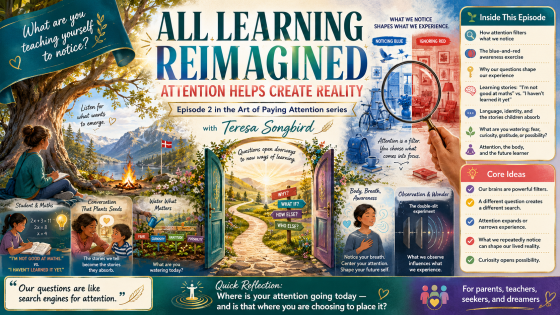
Teresa introduces the second episode in her Art of Paying Attention series by asking what people are teaching themselves to notice. She presents the idea that attention helps shape lived reality by determining what enters awareness and what gets filtered out. A simple exercise asks listeners to look for blue objects and then notice how many red objects they remember seeing. Her point is that the red objects were present all along, but a focus on blue made them less likely to enter conscious awareness. She applies this filtering idea to learning, relationships, personal challenges, and everyday experience. Throughout the episode, she invites listeners to treat the idea as something to explore rather than as a belief she is imposing on them.
Questions Change What We Look For
A central theme is that the questions people repeatedly ask can guide their attention. Teresa contrasts asking "What's wrong?" with asking "What's possible here?" and argues that each question encourages the mind to search for a different kind of evidence. She extends this to difficult experiences, acknowledging that pain, injustice, health problems, and relationship issues may require immediate attention. Her concern is becoming stuck in a repeated story that keeps attention fixed on the same experience. In learning, she gives the example of a student who repeatedly says, "I'm not good at maths," and then notices every mistake as confirmation. She proposes language such as "What haven't I learnt yet?" as a way to direct attention toward possibility and further learning.
Different Lenses, Different Experiences
Teresa recounts traveling through Scandinavia and Russia and spending time near Oslo in what she describes as Viking country. After returning to Australia, she and her traveling companion told their family very different versions of the same experience. The difference was striking enough that she remembers wondering whether they had even experienced the same reality. She now interprets that memory through the idea of selective attention: previous experiences, expectations, beliefs, and emotional states can influence what people notice and what they filter out. She connects that idea to bias in education, noting that students and adults can read the same material or live through the same event and assign very different meanings to it. This leads her to emphasize the importance of noticing the lens through which a person is interpreting experience.
Language, the Body, and What We Water
The episode moves from external perception to the way attention may affect internal experience. Teresa suggests noticing the breath, jaw, shoulders, belly, or chest, then shifting attention toward a person, animal, place, or experience that feels beautiful, peaceful, or nourishing. She says that changing the focus of attention can be mirrored in the body's internal state. She also describes changing the language she uses about health, preferring to think in terms of balance rather than defining herself through sickness or healing. Using the metaphor of two garden beds, she asks which one will grow if only one is watered. She applies the metaphor to thoughts, skills, relationships, fear, curiosity, gratitude, and identity, arguing that what receives sustained attention tends to become more prominent in lived experience.
The Words Adults Give Children
Teresa emphasizes that adults help shape the stories children tell about themselves. She recalls a grade-three music lesson in which a music teacher and classroom teacher discussed her singing voice while she was standing nearby. Teresa cannot remember their exact words, but she remembers the feeling they created: she came away thinking that she could sing and that she liked music. She says that one comment influenced how she saw herself and helped her embrace singing and music throughout her life. From that memory, she urges parents, grandparents, teachers, teacher aides, neighbors, and others around children to be mindful of what they say. Her broader argument is that words can direct a child's attention toward a particular identity, ability, or limitation and can therefore have a lasting effect on learning.
Curiosity, Science, and the Future Learner
Near the end, Teresa brings up the double-slit experiment as a topic she finds fascinating while clearly stating that she is not an expert in the science. She uses it to open questions about observation, measurement, consciousness, and whether attention influences what people experience. She also recalls another experiment involving biological samples but repeatedly says that she cannot remember the details and needs to find the source again. These examples lead into a broader call for curiosity, imagination, questioning, and discernment rather than accepting ideas simply because they come from someone labeled an expert. Teresa criticizes forms of schooling that tell children what to think instead of helping them learn how to choose, question, and participate in creating their learning. She closes by asking listeners to notice where their attention is being captured and whether that is where they consciously choose to place it.
All Learning Reimagined

Please help support this show!
Support this show by subscribing
$5.99/mo or $9.99/mo or more
Click HERE
All Learning Reimagined: Where passion meets possibility, one story at a time.
All Learning Reimagined is a global podcast exploring the many ways we learn, grow, create, and contribute throughout life. A gathering place for people who know that the future is something we learn, create, and steward together.
While education is often where the conversation begins, this podcast reaches far beyond classrooms and curriculum. Together, we explore learning as a living process that unfolds through relationships, community, nature, creativity, curiosity, experience, and the pursuit of what brings us alive. Through inspiring conversations with parents, educators, authors, visionaries, community leaders, and everyday people, we share stories that expand what learning can be and how it shapes our families, communities, and world.
Drawing from diverse perspectives, indigenous wisdom, practical experience, emerging ideas, and timeless principles, each episode offers insights that nurture self-direction, discernment, contribution, and a deeper connection to what matters most.
Whether you are a parent, educator, learner, creator, community builder, or simply curious about what is possible, All Learning Reimagined invites you to explore meaningful questions, fresh perspectives, and inspiring stories from around the world. Because learning is a living journey to nurture.
Cultivating self-trust. Nurturing wisdom. Inspiring contribution. Strengthening community.
Speaker Identification
Speaker 1 - Prerecorded Theme / Announcer Voice
The opening and closing lyrical passages are structurally distinct from the host's spoken monologue and function as the program's theme or prerecorded show identification. The individual voice is not named in the transcript, so no personal identity is assigned.
Speaker 2 - Teresa Songbird, Host
The host introduces herself as Teresa near the beginning, and the closing theme identifies the program as being with Teresa Songbird. She delivers the main episode monologue.
Speaker 1 - Prerecorded Theme / Announcer Voice:
There is another way to learn.
Questions open doorways,
where wonder leads us home,
where every heart remembers the wisdom it has known.
All Learning Reimagined,
where passion meets possibility.
With Teresa Songbird,
come explore what learning can be.
For parents, teachers, seekers, and dreamers,
learning comes alive.
Speaker 2 - Teresa Songbird, Host:
Welcome to All Learning Reimagined. I'm your host, Teresa, bringing you a little ray of sunshine as together we're reimagining the future of education, one inspired story at a time.
Welcome back, everybody. I hope you've had a spectacular week. It's been a spectacular month for me, crammed into a week. So much has happened, and it's really going to tie itself in beautifully to our topic today, which is episode two of our Art of Paying Attention series.
I really love this concept because, while I have been sitting, I go out to my beautiful favorite tree and sit and feel into what wants to emerge right now. What do I feel like the collective wants to talk about?
The topic for today is actually: attention helps to create reality. Big call, I know. For some people, that's a paradigm shift, but I'm seeing so much evidence and living this experience right now, and I really want to share some of it today because I feel like it's quite profound and pertinent to learning.
Whether it's children in a learning environment or just learning for life, it could be an apprentice. It could be someone who's learning more about how to be healthy because they're going through a health challenge. So they're shifting. It's like: where is your attention right now? Because it does have a huge impact on the lived experience and the reality that you are living and experiencing right now.
That was really the question that I asked myself: what am I teaching myself to notice? Because it helped me focus on awareness. Where is my attention actually going?
So, no opening story today. I usually love to start with a story because our brains love to be able to make connections through stories. Today I want to do something that's like a very short activity, just to help make a point before I move into questions to ponder.
Nothing that I am sharing with you today is telling you what to believe. I'm not imposing any belief systems on you. I just want to help the curiosity part of your brain activate so that you can walk away and go, "Hmm, does this resonate with me?" I also want to give you some things to sit with yourself, because it's a big call. If attention does, in fact, help to create our reality around us, then this is a very important topic right now.
So what I would love to invite you to do is just look around wherever you are. Even if you're driving in a car, just shift your awareness, and I want you to find anything that is blue. The color blue. Just notice everything that is blue. It can be any shade of blue: light blue, sky blue, dark blue, royal blue. It doesn't really matter. Just blue. It could be a book cover, a cushion, someone's shirt, a picture.
Then what I would like you to do is look around again a second time. How many red things did you see?
Now, most people really struggle with this because the red objects were there all along. Because you were focusing and looking for blue, your brain actually filtered out the awareness of what was red. The red didn't suddenly appear or disappear. Your attention changed what entered into your awareness.
This is a really important point to make because we don't experience everything that's actually available to us all at once. Our brains are really a tool, but they're also a filter. We select and notice some things, and we overlook other things.
This is huge when it comes to learning and when it comes to life, because if I am repeatedly asking, "What's wrong? What's wrong?" then I'm going to be filtering out everything that's right, and I'm going to be focusing on and getting more evidence of problems. It does shape my reality.
If I'm constantly asking, "What's possible here? What's possible here?" instead of looking at something as an obstacle or a challenge, then I begin looking for possibilities.
If I'm expecting someone to annoy me, if I'm expecting something negative to happen in my life, and I'm talking that language as well, then I will notice the evidence that supports my story. It turns up. It shows up.
This is why people say, "You're such a Pollyanna. Something's always positive." It's like, well, I'm expecting it, and I see it everywhere I go. Then that's the reality that I'm living because I'm making that choice of where to put my attention.
So the world hasn't changed whatsoever. I'm still living in the same world as the person standing next to me. Well, that could be debatable, actually. But my lens has changed. It's what I'm choosing, what I'm habitually looking for.
So my question to you is: in your reality right now, in your week right now, what is it that you're constantly looking for? What stories are receiving the most attention in your life right now? And what might be present in your life that you're simply not even noticing? You're walking past it. It's being filtered out.
Another question to ponder is: does the way you're directing your attention expand your experience, or is it narrowing your experience?
Sometimes attention absolutely needs to go to something that's uncomfortable. If you are in pain, particularly medical pain, or you're going through something where there was an injustice and you're battling something, or even a relationship problem, these things may need attention, immediate attention. I'm not denying that. That's certainly something where "this too shall pass" applies. It's a phase where all of your attention may need to go to that thing.
But the question for me personally is: I don't want to get stuck there. Sometimes you can continually relive things that have happened, and that's where the victim-mindset loop can begin, because you're constantly replaying that loop of where your attention went with whatever event happened in your life.
The same thing can happen when it comes to learning. For learners, if it's a not-so-good experience with, "I'm not good at maths. Oh my gosh, I didn't do very well in that," whatever it may be, then that's a story that the learner can continually tell themselves. It just perpetuates where they're putting their attention.
These sorts of things have a huge impact on the experience, the lived experience, that you have in your life, which ultimately helps shape the reality. The story that we're commonly living is seen through the lens of our reality. Everybody is looking at something from their own perception, and two people can experience exactly the same event and walk away with completely different stories about what happened.
I've had so much evidence of this in my life. An example is from years ago when I was traveling around Scandinavia and Russia. It was fantastic. We had stopped in a forest not far outside Oslo, in Viking country, and it was just fantastic. We were learning all about the history and really feeling into it.
The group of people we were with had a bonfire that night, and we were telling stories. It was such an amazing experience. I adored it.
But when we came back home to Australia, the person I was traveling with and I were talking to our family about this event. Both of us had completely different stories to tell, to the point where we looked at each other and it was like, "Were we even in the same place?" Because I didn't see that. I didn't experience that. They had an experience that I hadn't experienced. It was actually very interesting.
That was the first time I can remember consciously thinking: is it possible that we lived in two different realities? Were we even on the same timeline?
What's come to my attention now is that they were filtering and seeing what they chose to see, and I was doing the exact same thing. Our attention was selective. Our previous experiences, expectations, beliefs, and emotional state all matter because they help your brain choose what to filter out and what to focus on, which in turn affects the reality that we are living.
Our system is constantly filtering, and this is actually quite helpful. Otherwise, it would be completely overwhelming. We cannot consciously process every sound, every sensation, every movement, every piece of information that's surrounding us. There are hundreds of thousands of pieces of information right now, down to the taste of the last piece of food you ate on your tongue, the feel of the chair underneath your legs, or the breeze kissing your cheek when you're walking outside. There are constantly different sensations.
The system is filtering, and it's helping us do that. But it also means there may be things occurring that we're not perceiving because they're being filtered out.
I really feel like this makes it worthwhile to have a conversation around bias, because quite often you can read a piece of text with a student and have a conversation, and they're seeing it from their own biased lens, from their own perspective. Everybody is. They're putting their own meaning on what it is that they're putting their attention on.
That's actually a fascinating conversation. That's a whole other show. But the idea of a different lens is worth bringing up because it also helps us consider the language that we're using. When we're describing what it is that we're noticing, the language can actually direct us toward what we notice next.
So instead of saying, "Why is this always happening to me?" when you go on that sort of spiral, you could switch the language and say, "What is this situation showing me?" Just by changing that question, the attention can shift direction.
Or instead of a teacher or a parent saying, "Oh, what's wrong with this child?" they could switch the lens to, "What is this child communicating to me?" Through whatever their behavior is, whatever it is that they're doing, how are they communicating? What are they trying to communicate to me? That shifts the lens. It shifts the attention just by asking that question and changing that language.
Instead of someone saying, "Why can't I do this? Oh, I can't do this," shift it to, "What haven't I learnt yet?" There needs to be something else that I'm missing, a skill or something that I haven't learnt yet. That's why you can't do this: because there's still more to learn.
This is really valuable in a learning situation because I don't know how many times over the years I've heard someone say, "Oh, you're not good at maths." Then all of a sudden they start noticing every single mistake they make in maths as confirmation that they're not good at maths. And yet mistakes are how we learn, and we all make mistakes at maths. It's just a given.
But shifting the lens, the perspective, and then the expectation can create that self-fulfilling prophecy. Their lens is looking, their attention is going to find evidence to validate what their belief is.
A lot of these beliefs are programmed into us at a very young age. So even when you are well into your 40s, 50s, 60s, 70s, 80s, and beyond, we are often running on programming that was installed in us as children: belief systems and programming from childhood. Sometimes, until you bring your attention to it, you don't even know it's there. It's almost running in the background by default.
So sometimes you might hear another learner, instead of saying, "I'm not good at maths," and noticing all the mistakes, say, "Well, I just haven't found a way that makes sense to me yet." They're inviting themselves to look for possibility. It could be the same learner, but they're using different language, and that different language helps direct the attention.
That also fits into intention. What intention do you have? Potentially very different choices follow this.
I'd love for you to experiment with this in the next week, even just today. Notice where your attention is going. Is it where you choose for that attention to be, or have you gotten into a rut of living life by default, with so much passing you by that you don't even realise anymore?
Our questions are really like search engines for attention. If you ask a different question, you may receive a completely different set of results, which, in my direct experience, begins to shape a different reality that I'm experiencing, a different lived experience.
Of course, this fits into the embodied perspective. The body also follows attention. There are lots of experiments you can do around this. For this week's article, I will add a couple of experiments that you might want to play with. You can do them with young children; you can do them at any age, actually.
I find them very interesting as well, where you can consider how attention changes our internal experience in the body, depending on where you put your attention in your body.
One of the activities could be noticing your breath, noticing your jaw. Sometimes your jaw might be loose; sometimes you might be grinding or holding tension in your jaw. Or maybe it's your shoulders. It could be tension in your shoulders, your belly, or your chest.
As soon as you bring attention to something that's beautiful and nourishing in your life, like a child, an animal, the ocean, someone you love, your favorite pet, or basically a place or something where you feel peaceful, then go back to where you're holding tension in the body. You don't even have to consider changing the state.
What happens is that the internal experience just shifts because you've started focusing your attention on something positive and peaceful, and it gets mirrored in your body. Our bodies participate in what we attend to.
And I believe that this is one of the reasons why some people - you might call them "hyper-con..." [unclear term] - are always listening to what you're communicating and what it is that you're choosing by putting your attention on, rather than someone who's saying, "I choose to be fit and healthy," even if the physical reality is not saying that at the time. Usually they bounce back and heal much faster, and align and recalibrate much faster.
I'm really hesitant to use the word "heal" these days because if I say "heal," it's actually indicating subconsciously that I'm sick and that I'm unwell. So, for me, it's more about asking: what's out of balance? What's too high or too low? It needs to be brought back into balance so that my body is simply healthy.
I'm shifting and reshaping the language that I'm using and how I speak to my body. Really, this comes back to nature's wisdom. We all know I love nature. I bring it up every show because I really feel like the natural way of being is the true way of living, rather than the superficial life that we seem to be corralled into today.
I really like to slow down, because slower is faster when you slow down and actually take the time to notice what's around you.
What are you watering? If there are two garden beds and every day you're watering one garden bed but the other one receives nothing, which one grows? These are really great analogies to have with children. Attention works very similarly.
It's got nothing to do with ignoring. It's got nothing to do with pretending that something isn't happening or being in denial. It's about where you're putting your time and your energy, including in relationships, because in my opinion relationships drive everything in our reality.
Thoughts can be watered. Skills can be watered. Our relationships can be watered. What deposits are you putting into your relationship bank account, or are you constantly making withdrawals from your relationship bank account, which depletes the relationship?
Fear can be watered. If you're constantly focusing on fear and drama and all the things that are wrong in the world, your brain is going to continually filter out everything that's good, and you're going to feel validated by what you're choosing to focus on. It's a downward spiral that can be interrupted if you choose to shift your attention and break that pattern.
Curiosity can be watered. Gratitude can be watered. Gratitude is such a powerful tool that we have at our disposal.
Wherever you are, have a look around. Look at something that's beautiful. Color is a frequency. Notice a color that's around you right now, and then you go, "Oh, I really love that color, or the depth of that color, or the shade."
If you're lucky enough to be outside or able to see nature right now, notice something that is just beautiful. It could be, "Wow, look at that flower. Look at that leaf. Look at the way that bee is humming along and having a happy little life, not worrying about anything. It's just living in the moment."
Also, the stories that we tell ourselves about who we are, our identity, can be watered as well. That's a very important point to bring up, particularly with learners.
If you are a teacher, a parent, a grandparent, a neighbor, or someone who has anything to do with young children, you are part of shaping them and the stories they tell themselves. The words you're using validate and sometimes help them shift their attention toward something within themselves.
I'm going to give you an example. I remember, back in the day, in the olden days - yes, I'm going to tell one of those stories - being at school. It was grade three, an ordinary day, and I had a music teacher. We had a music lesson in the class.
She made us all line up in a long line, and we had to stand at the piano. She played a key, and we had to sing that key. I feel, from my memory, that she was actually trying to sort us out to see who could sing for the school choir, because not long after that I was actually put in the school choir.
But I remember this music teacher turning to my classroom teacher, who was standing beside her, and they had a conversation about me in front of me. They didn't even speak to me, but I listened to what they said about the frequency of my voice when I sang.
I can't remember the exact words, but I remember how I felt. I remember thinking, "Wow, I can sing. I like music." That one comment they made actually shaped how I saw myself and helped me embrace singing and music. It had a huge ripple effect throughout my entire life. I can actually pin it back to that one comment.
Now, if you're a parent, a grandparent, a teacher, a teacher aide, whoever you happen to be, please be very mindful of the words that you say around children. They are listening. If you're saying words to children, you are helping them validate something, or you're helping them choose where they put their attention.
Negative, positive - I don't want to give a label to anything. It's just what they are going to focus on. It's a really important thing to remember because our attention participates in creation. It helps us work out where we are going to be putting our energy.
There's so much that we can unpack here. And then, I don't know if anyone's heard of the double-slit experiment. If you haven't, it's too complicated for me because I don't have the scientific language to explain it. But I would research it on whichever search engine is your preference.
I don't like to say, "Just Google it," these days because I use lots of different search engines other than Google. But I would do a quick search for the double-slit experiment. There are little YouTube clips that explain it. They're very short, they're very quick, and they're fascinating to watch, particularly with children and teenagers, and to ask them, "What do you think about this?"
Because in the experiment, basically they're looking at the quantum scale, and what we can observe depends on how the system is being measured. So it's looking at what was being observed, and as soon as there was an observer, what was being filmed and observed changed and shifted because an observer was observing it. That links into all sorts of conversations around consciousness, our thoughts, and quantum physics, and whether our thoughts create the reality that we choose based on where we're putting our attention.
Now, I'm not sure about the science behind the quantum side of this. I'm still learning. I'm fascinated by this topic, but I'm by no means any sort of expert. It really does make me stop and think about how much of what we experience is influenced by what we are observing, measuring, seeking, and paying attention to.
So check it out if you haven't heard of it before. If you have, I would encourage you to share the knowledge or share a clip with someone who doesn't know about it. Share it out there, because it's really important for us to have paradigm shifts, constantly question things, and share new knowledge as it's coming forth. So much is happening right now.
It really opened my eyes to possibilities. There are so many different experiments. I can't remember the details of one that I watched probably about six months ago. Oh gosh, I cannot even remember who it was, so I probably shouldn't even be mentioning it - but I will. It's very vague.
They had cells, like cells taken from a person in a Petri dish, and they took those cells to, I don't know, another city, maybe the other side of the country. I cannot remember the details. But when the person who had provided the original cells - skin cells or hair samples, whatever it was they had - shifted and changed their attention, and the original person did something, the cells in the Petri dish also changed according to where they put their intention.
It was a fascinating experiment. Now it's got me curious. I need to go back and find it and find the details, but it started making me wonder: what is possible? My imagination just went, "What?" I was like, "What? Say what?"
Anything is possible. Just because how things actually work in our reality hasn't been in my awareness doesn't mean I cannot choose to go and put my attention on finding out about these things.
It really comes back to this: attention helps shape our reality, and then our imagination expands the possibilities. It's about not thinking by default and not thinking what we were told to think all of the time. This is the problem with many schools today. We are indoctrinating - because that's exactly what it is - we are telling them what to think instead of opening up curiosity and teaching them how to choose and make choices, which is participating in creation, instead of children just consuming content that we're handing to them.
How can they participate in creation? The whole attention-and-reality topic is quite nuanced, actually. There is a huge part of this for me that is really humbling. I think humility is quite important because this has huge implications for the stance of our future learner.
The future learner needs to be curious enough to question what they know and discerning enough not to just believe everything blindly that they've been told, regardless of where the source is coming from. We've been trained to believe experts. Some of these people just have a name badge. They're not necessarily an expert. What makes them an expert? Lived experience is more important.
And of course, the future learner also needs to have the imagination, or be imaginative enough, to explore something they don't necessarily believe. I feel like that fits back into the whole lifelong-learner idea.
There are so many questions I'd love to explore. I could talk about this for days. It's really fascinating. But I really want to bring this back. I'm going to wrap this up with a big fat bow now.
I want to bring this back and ask you the question for yourself: notice where your attention is being captured this week, or just today, or even for the next hour. Where is your attention going? Then ask yourself also: is this where I'm choosing to place my attention?
Because our life is always inviting our attention, but this week I really feel like there's something there that's waiting to be seen that we're not noticing. I encourage you to find that.
All right, beautiful people. I look forward to seeing you next week and continuing this conversation. It's fascinating. Thank you for joining me on All Learning Reimagined. Until next week: explore, experience, express. Go out and live learning.
Speaker 1 - Prerecorded Theme / Announcer Voice:
Carry the wonder with you.
Carry the questions home.
Every seed of understanding has a life of its own.
All Learning Reimagined,
where learning comes alive.
With heart, with hope, with courage,
we help the future rise.
With Teresa Songbird,
until next time,
keep exploring,
keep creating,
keep remembering.
We help the future rise.
Keep remembering.