
All Learning Reimagined, August 14, 2026

All Learning Reimagined with Teresa Songbird
Episode 1 of series on The Economy of Distraction
The Art of Attention
Where Your Attention Goes: Learning, Distraction, and the Power to Choose
Summary
The Economy of Distraction
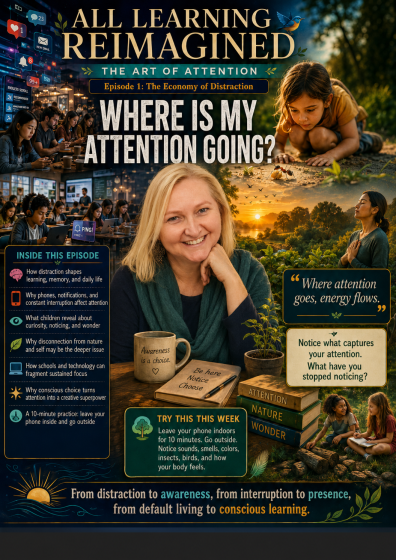
The episode opens a new four-part series about the art of paying attention, beginning with what the host calls the economy of distraction. She asks listeners to consider where their attention goes each day and whether that direction is consciously chosen. Phones, notifications, email, social media, advertising, entertainment, and the broader digital environment are presented as powerful competitors for human attention. The host does not portray technology as inherently good or bad; instead, she emphasizes the responsibility involved in deciding how it is used. Her central concern is that people can become passive consumers of whatever captures them rather than active creators of the lives they want to build.
Attention, Noticing, and the Brain
A cafe observation becomes a central illustration when the host notices a child absorbed in watching an ant carry a crumb while nearby adults remain focused on their phones. She uses the moment to distinguish looking from truly noticing and connects that distinction to learning. In her framing, the brain filters experience according to what a person repeatedly identifies as important, which means patterns of attention can shape what is noticed over time. She also warns that repeatedly seeking negative or frightening material can make those patterns increasingly dominant in one's experience. The episode therefore treats awareness as the first step toward changing where attention goes.
Children, Schools, and Interrupted Learning
Drawing on her classroom experience, the host argues that children are not becoming less intelligent but are growing up in an environment with more frequent interruptions. She contrasts her own school experience of sustained concentration with contemporary learning environments filled with devices, messages, pop-ups, and other disruptions. She says that when she works with children, she prefers to begin with books and conversation before moving into technology and research. In her view, constant interruption can make sustained attention harder and can influence memory and learning. She also questions how much choice children are given over where their attention is directed within timetable-driven education.
Reconnection Through Nature and Embodied Experience
The host says she has seen children's curiosity and attention expand when they leave the classroom, spend time in nature, build things with their hands, explore questions together, or slow the pace of an activity. This leads her to suggest that disconnection, rather than distraction alone, may be the deeper opposite of attention. She specifically names disconnection from nature and disconnection from self as factors she believes can affect learning. The episode repeatedly encourages listeners to return to bodily awareness, sensory experience, and the present moment. Nature is offered as a model of focused responsiveness because animals and natural processes appear to act according to what is needed in the moment rather than in a state of continual rushing.
Technology, Personal Agency, and Inner State
The host acknowledges that digital technology has enabled global communication, collaboration, and access to knowledge that she deeply values. At the same time, she describes her own decision to leave social media and reduce passive entertainment after realizing how many hours of attention those activities could consume. She connects deliberate attention with productivity, health choices, emotional state, spirituality, and her personal belief that protecting her energetic state or "frequency" affects how she experiences and creates her life. She describes morning practices such as grounding, gratitude, going outside, and speaking intentions aloud. Throughout this discussion, these ideas are presented as her personal observations and lived perspective rather than as universally established conclusions.
A Ten-Minute Practice in Paying Attention
The episode closes with an embodied exercise and a practical weekly experiment. Listeners are invited to notice their breathing, recall how their bodies respond to feeling rushed, and compare that response with the physical feeling of being deeply absorbed in something they love. The host encourages people to observe whether their bodies seem to expand or contract around particular experiences and to use that awareness as a prompt for reflection. Her weekly micro-practice is to leave the phone indoors, spend ten quiet minutes outside, and notice sounds, smells, colors, insects, birds, and bodily sensations. She leaves listeners with the question, "Where is my attention going?" and the idea that whatever receives sustained attention is where life quietly begins to grow.
All Learning Reimagined

Please help support this show!
Support this show by subscribing
$5.99/mo or $9.99/mo or more
Click HERE
All Learning Reimagined: Where passion meets possibility, one story at a time.
All Learning Reimagined is a global podcast exploring the many ways we learn, grow, create, and contribute throughout life. A gathering place for people who know that the future is something we learn, create, and steward together.
While education is often where the conversation begins, this podcast reaches far beyond classrooms and curriculum. Together, we explore learning as a living process that unfolds through relationships, community, nature, creativity, curiosity, experience, and the pursuit of what brings us alive. Through inspiring conversations with parents, educators, authors, visionaries, community leaders, and everyday people, we share stories that expand what learning can be and how it shapes our families, communities, and world.
Drawing from diverse perspectives, indigenous wisdom, practical experience, emerging ideas, and timeless principles, each episode offers insights that nurture self-direction, discernment, contribution, and a deeper connection to what matters most.
Whether you are a parent, educator, learner, creator, community builder, or simply curious about what is possible, All Learning Reimagined invites you to explore meaningful questions, fresh perspectives, and inspiring stories from around the world. Because learning is a living journey to nurture.
Cultivating self-trust. Nurturing wisdom. Inspiring contribution. Strengthening community.
Speaker Identification
Speaker 1 - Prerecorded Theme Vocal / Announcer
The opening and closing lyrical material is distinct from the host's spoken monologue and functions as the program's prerecorded theme or station-style framing.
Speaker 2 - Host Teresa
The speaker identifies herself at the beginning as Teresa and delivers the full episode monologue. The closing theme appears to use the name "Teresa Songbird," but the exact name form is listed below for verification because it is not independently established elsewhere in the transcript.
Speaker 1 - Prerecorded Theme Vocal / Announcer:
There is another way to learn,
Where questions open doorways,
Where wonder leads us home,
Where every heart remembers the wisdom it has known.
All Learning Reimagined,
Where passion meets possibility.
With Teresa Songbird,
Come explore what learning can be.
For parents, teachers, seekers, and dreamers,
Learning comes alive.
Speaker 2 - Host Teresa:
G'day, and welcome to All Learning Reimagined. I'm your host, Teresa, bringing you a little ray of sunshine as together we're reimagining the future of education, one inspired story at a time.
Welcome back, everybody. You'll have to excuse my voice. I've got a slight cold at the moment. I'm recalibrating, let's put it that way. I need a little bit of sunshine today. But for all my regular listeners, welcome back. And for anybody new listening today, welcome. It's so lovely to have you here.
Today I'm proud to share that we're going to start another series. This is a small series, though. The last one that we just finished, which was on embodied intelligence, was amazing. I learned so much through researching and really feeling into the information that feels like it is aligned right now with what I'm seeing and observing, and with the people that I'm talking to in our world today.
That actually sparked the question: What could our next topic be? And that is the art of paying attention. I feel like attention is something that a lot of people talk about, and yet I'd really like to dive deeper into what attention is, how we can use it to our advantage, and how we can look at it through the lens of learning, which is a little bit different.
For episode one, the first thing that I wanted to start with is what I've called "The Economy of Distraction," because in order to have attention, we need to remove distractions. I don't know about you, but since the internet was invented, since everyone seemed to embrace mobile phones, and now with the rise of technological intelligence - the AI that's here - distraction is more than ever everywhere we go.
We're all so busy, and it can be very difficult to find space today. I shouldn't say that it's very difficult, but for me, that's where I'm coming from. From my perspective, where my attention is going is a question that I'm very conscious of. I feel like many schools today have many things pulling at their attention, and there are whole economies out there built around wanting our attention.
If we give our attention away, then we become a very big consumer rather than being a creator. As anyone who listens to me regularly knows, that's something that I'm very passionate about: our children, and also ourselves, choosing what we want to create in our lives instead of living a life by default.
So my central question for today's show is: Where is my attention going, and is it taking me where I choose to go, where I want to go? I feel like this is a really good time, with all the chaos that's going on out there - and I do say "out there" - to come back within ourselves and center ourselves.
When I am centered, and I know what I will not let into my life because it's a distraction, and what I choose to spend my time and attention on, which is almost like a superpower, everything shifts for me. I often get asked, "How do you get so much done, and why are you so efficient?" I get lots of people making those comments, and it's like, I'm not efficient at all. I just choose to know what to leave out and what not to do. I'm quite particular about where I put my attention, and I do feel like this is worthwhile having a conversation about.
So my invitation to you is to reflect on your own life, wherever you happen to be in the world. We are beaming out to 48 different countries right now. Just focus on this: What in your life right now are you spending attention on? Where are your time and attention going today? Where have they been going for the last week? Is it what you're choosing to spend time on?
Or have you fallen into the pattern, which I know I have in the past, of just getting up and rinsing and repeating? You get up, do the same routine, go along to work, come home, do the same routine, and it happens again and again, day after day.
If the first thing you reach for when you wake up in the morning is your phone or a device, that's where your attention is going. Some of us get cognitive overload before we even have breakfast - if you have breakfast; many of us are fasting. But it's amazing where our attention goes if we do not take the time to stop, pause, and feel into this.
When I made the choice to write about this and create this topic for the show, I started observing. It's been a couple of weeks now because it's been on my heart for a little while, and I've been looking around and observing.
The other day I went to a restaurant - actually, it was a very busy cafe. There were lots of people talking, coffee machines were humming, phones were buzzing, and it was quite noisy. There was music playing overhead. I was sitting there with my journal, and I just wanted to write. I just wanted to be inspired.
I was looking around and observing, and outside the window I saw a child. He stopped and knelt beside the footpath, and he watched a little ant carry a crumb. It was next to a table, so it must have been a cake crumb or something. He was watching this ant carry a crumb that was twice its size. The adults sitting right next to him just continued scrolling on their phones in their own little universe, their own little world.
But that child was sitting there watching this ant and noticing this tiny little world that everyone else was hustling, bustling, and completely walking past. Nothing changed in that moment. Everything around me was the same except attention. Even me stopping what I was doing to notice the little boy - being the observer of this scenario - shifted the attention in me as well.
I really feel like sometimes the greatest difference between us is not what we are looking at; it's what we are noticing. I really wonder where this fits in with learning, because we know that our brain is like an information-seeking missile. As soon as you give it information, or you program it and tell it what is important, it will seek out and filter out what you don't want and filter in what you are choosing to give attention to. This is where bias comes in as well. Sometimes those filters then stay through our lifetime until we reprogram them and make a choice.
My personal experience, my personal lived observations in schools over many years in classrooms, is that I've noticed this changing. Children are not becoming less intelligent. I know there is a lot of chatter out there saying we are dumbing down the curriculum and children are becoming less intelligent, and I don't believe that for a minute. I know many children, and they are amazing beings.
Yes, the skill sets are not as honed as what other generations may have had, but they have also developed other skill sets that are just as valuable. So it really is perspective. What I find in my observation is that children today, even our teenagers, are becoming more interrupted.
When I was at school, back in the olden days - yes, I'm going to do one of those stories - I had sustained attention for long periods. I had to sit and concentrate, or sit and work, for long periods of time without interruptions. There were no buzzing phones with messages. There were no people constantly coming to the door with messages and disruptions. There was no technology.
A lot of children are working on devices today, and there's always an email that pops up, and then something else pops up. The distraction is there at their fingertips. When I choose to work with children today, I don't like having laptops and technology at the beginning. I like old-fashioned books and conversation before we get into the research stage so that they can have sustained time without all of the distractions.
Sustaining attention for longer periods becomes increasingly difficult when you're constantly interrupted. I really feel that this is something worth noticing. A lot of women say, "I've got baby brain because I had a baby, and now I've got brain fog." Actually, it is because you have constantly got your attention interrupted. You're being woken from sleep, and you have this beautiful child to care for.
I really feel like attention, and the constant interruptions to attention, does something to our brain, which then in turn affects our memory and also our learning. Yet when I have observed these same children and you take them to a camp, an excursion, or even just get them out of the classroom, take them outside into the garden, get into nature, build something with your hands, or explore something - do something tangible and more real that's not cerebral, that's not in your mind space - you get back into your physical body or your heart space.
If they are exploring a question together, or simply slowing the pace down, I have observed beautiful things happening. Their natural curiosity returns, and their ability to hold attention actually extends. I don't feel like this is something that can be forced. I do feel, however, that it is something that we cultivate.
So those of us who are adults who work with children - if you're a parent, a homeschooler, a grandparent, a next-door neighbour, a coach, a sporting coach, whoever you happen to be, whatever situation you have, whatever influence you have, at any age - perhaps distraction is not the opposite of attention. Perhaps disconnection is.
Even though this show is about the economy of distraction - and don't get me wrong, there are a lot of things out there right now pulling for our attention - when I dug deeper, sat back, really observed, and put my attention on this topic, I really felt that disconnection is central: disconnection from nature and disconnection from self. Yes, the distractions get in the way. That feels to me like something that is affecting our learning, and it is something I would say is the opposite of attention.
For those of you who listen to me regularly, you know I'm just sharing my opinion. I would never tell you what to think, but I do love to share what I observe because I'm curious. Are you seeing the same thing? Is there anyone out there that this is resonating with, where you're going, "Hmm, I hadn't thought about that before"?
Maybe it's something that you'll be thinking about or pondering this afternoon when you have a cup of tea and you're watching the sun go down. And if you don't have time to do that because you're so busy, busy, busy with distraction, then maybe it's time to go, "Okay, well, what am I putting my attention on? Is this my choice? If I'm not choosing this, or I don't prefer this, what can I do about it?"
Because, you know, we're not all Pollyanna here. Sometimes you actually have to take action and responsibility for the life that you've built and created and go, "Okay, what do I choose?"
My questions to ponder would be: What captures my attention every day? What captures your attention every day? Do I choose where my attention goes, or is that chosen for me?
I know in schools many children don't get a choice about where their attention goes. They're told - the teacher tells them - "Sit down. Do this activity." It doesn't matter if you feel like doing this activity, if you're not in the mind-set or heart-set, or if you don't have the energy. You're just going to do it, and you're going to do it now. We're doing it on a timetable. It doesn't matter about circadian rhythm. This is how our education economy is built.
I'm not quite sure how it got this way. I'm sure there are lots of different theories out there, but all I know is this is the reality that we're dealing with right now. So what can we do about this? What can we choose to do about this?
Because I, for one, am not going to live my life by default. I'm going to choose where I put my attention, because I know when that happens, magic happens. So many things change and shift in my life.
My other question to ponder would be: What am I repeatedly noticing? What have I stopped noticing? Have you travelled or walked the same path every day and just not noticed that gorgeous tree that is there, bursting with blossoms at the moment, with the bees humming around it? Or do you just walk past it because you don't notice it anymore?
Like that little boy at the cafe who just knelt down to watch a tiny little ant with a crumb on the ground - he was fascinated. I thought, "Wow, I used to do that when I was a child. I wouldn't even think to do that today."
If attention is energy, because where attention goes, energy flows, where is mine flowing? Hmm.
I really feel like we do live in a remarkable time. We do live in an attention economy. We're living through one of the most fascinating periods in human history, and that's my opinion. Never before have we had so many people, ideas, opportunities, and so much connection, because technology has transformed the way that we communicate, learn, and create.
Every week I'm talking, communicating, and collaborating in groups globally. I think nothing of using technology to connect with someone in South Africa, England, Canada, or New Zealand. I've got connections and friends now all over the world, and I wouldn't have been able to do that without the use of the internet. It's amazing. It allows us to access extraordinary knowledge at the touch of a button. We can stay connected across continents, and we could solve problems in ways that previous generations could scarcely imagine.
Well, I'm going to put a pin in that, because if you believe in the Tartarian Empire and all of the ancient civilizations, there's a lot of information coming through saying that there were civilizations before ours that had more advanced technology and knowledge. So I'm going to just leave that sitting in the ether, just in case that's true.
But for me, every gift invites responsibility. We have these digital platforms that we use every day, and they're designed to capture and hold our attention, which is really an economy of distraction. If you are constantly focusing on notifications, scrolling, autoplay, personalized content, and all of these things, they are incredibly effective, and they keep us engaged.
It isn't necessarily good or bad. It's just the environment that we're now living within. For children whose brains are still developing, this environment becomes particularly important because the habits they're building today may shape the way that they learn, the way that they relate, and the way that they pay attention for years to come.
So for me, the question is: How are we consciously choosing to use it? Where is my attention going? Never before have we had access to so much information, entertainment, and connection, and at the same time many of us describe feeling distracted, overwhelmed, and mentally exhausted.
I know that cognitive fatigue is just an epidemic. Phones compete for our attention. Advertising competes for our attention. The news, social media, and emails compete for our attention. I chose to walk away from social media about six years ago. It was the best thing I ever did.
When people say, "How do you get so much done?" Well, I don't sit watching Netflix for five or six hours every night. I'm creating. I'm writing. I'm connecting. I'm talking. That's where I'm choosing to put my attention, or I'm reading. I made that decision years ago because I realized that I was wasting - I was throwing away - four or five hours a day.
When you add up every time you pick up your phone, and you might only spend five or ten minutes scrolling, it adds up. When you do an audit of where your attention is going in your day, I was shocked when I did this. I thought, "No, something's got to give. What am I choosing?"
Particularly if you want to focus on health, some people say, "I'm so tired, and I've got this, and I've got all these health issues," and yet when they have a look at where their attention is going, very little is going toward being proactive about being healthy - movement and exercise, stillness and breath work, all of these different things.
This really made me see things differently. When you change the way you look at things, the things that you look at change. Whatever we repeatedly notice begins to shape our experience.
I've heard people talk about this - people who are going through their dark night of the soul and their awakening, and they're coming up for air and then starting to realize what is going on in this world. They're seeing a lot of darkness: "Oh, this is terrible, and look at this tragedy, and look at this. This is horrible."
And yes, guess what? It was always there. It's just now coming to the surface because you're starting to notice it. If you are in that stage, if that's resonating with you in your life, speaking as someone who's been through it for quite a few years, that can actually set you on a spiral where all you see is the negative. If that's what you're seeking, that's what your brain will seek out for you and find.
So it's really important to balance. Yes, it's good to know what's going on in the world, but sometimes it's also important to go, "Okay, how is this shaping me? Do I need to know all of the details, or has that been a programmed response in me?"
Because I know that if I notice kindness and beauty or possibility, I see more of it. More of it comes to me. Our world often reflects where our attention is resting. I choose not to put my attention on dark stuff, on horrible things, on drama, or on fear, because I know that it affects my energetic state, and my energetic state is very important to me.
I will not do anything that will mess with my frequency because I know that that's how I create my reality, and I know that affects everything around me. So in the morning I choose where I put my attention. I choose my state and what it is I want to experience for that day.
I ground. I go outside. I clean the birdbath. I say hello to my trees. I thank the water when I'm in the shower. I have gratitude. There are all these little things that I have embedded into my routine. I like to speak aloud that I'm going to have a day of grace and ease and peace. I actually speak the words that I'm choosing because I am setting up my day, and I'm also programming my body for where I want my attention to go.
Because attention comes before intention, and intention is really important. I'm actually going to do a very small series on intention as well because there's so much there. But before we can choose to consciously create, first we have to notice. Awareness always comes first.
That's why I thought this was a really important series. If this is resonating for you, you're going to love what's going to come up in the next three shows, because I've designed four episodes in this series. I'm very excited about it because I know, definitely through lived experience, that this has a massive impact not only on learning but on just living your life. It's amazing.
So, embodied perspective: I'd really love you to stop and pause for a moment. Now, if you're driving a car, this is probably not the most practical thing, but wherever you are right now, I would just like you to notice your breathing. Don't change anything. Simply observe.
If you have headphones on right now and you're going for a walk, you're on a treadmill, or you're exercising, that's okay. Just notice your breathing. If you're sitting still and you're having a cup of tea and you're listening, that's okay. Just notice your breathing.
Then think about the last time you felt rushed or overwhelmed. Notice what happens to your body when you think about that. Did your shoulders tighten? Did your breathing become more shallow? Did your thoughts speed up - that whole monkey mind?
Then think for a moment about a time when you felt completely absorbed in something that you loved. I have a friend who loves to paint, and I know that he just gets so caught up in the world that it's like the rest of the world fades away because he's embodied in this experience and all of his attention is on painting.
That's when you can stop time. You can literally bend time when you are on that frequency of joy and doing something that you love - your highest excitement, your passion. When you're feeling that, notice what happens to your body. What happens? Your body expands. Your chest opens. Your breathing might slow. Sometimes you tilt your head back. There are lots of things that happen to your body just by putting your attention there.
So next time you watch a sunset, you're walking in nature, or even if you're listening to music - because, oh gosh, music can change your mood just like that - or sometimes when you're talking to someone that you care about, just notice what's happening in your body. Put your attention there. What is your body doing? Your body communicates with you.
Is it expanding, which is giving you a good sign that this is a great place to put your attention? Or is it contracting? Because if it's contracting, that's the time to reflect and go, "Okay, is this right for me? Is this what I'm still choosing in my life?"
Nature does this naturally. Nature rarely wastes attention. If you watch a bird gathering twigs for a nest, a spider patiently weaving its web, or a hawk sitting quietly before it's going to fly off, nothing seems to be rushed or scattered. They're not like humans. Humans seem to be like busy little ants all over the place. Why is that? Why are we always rushing and rushing and rushing?
Even sometimes I catch myself when I'm going grocery shopping and I'm walking so quickly. It's like, "Why am I rushing? I don't know why. I just need to take a breath and calm down." Nature responds to what is needed in the moment. If we're in our headspace and we're not living in the now, in the moment, then where is our attention going? There's just so much in this.
So this week's experiment, or micro-practice, is to leave your phone inside. Sometime this week, leave your phone indoors and go outside for ten minutes. Just sit quietly and notice what you hear, what you smell, what colors appear, what insects you see, and what different birds you notice.
Then, after ten minutes, ask: How does your body feel? It's a really, really great experiment to do with children who are addicted to, or really love, their technology. It's a great activity. I highly recommend you look at it because it does have a lot to do with our learning.
I've got other activities, of course, which I'll put in our article for the week. If you're interested, you can go to bbsradio.com/alllearningreimagined. You'll be able to find this week's article and, of course, all the archived shows as well. If you're interested in any of the other series and any of the other resources that I'm creating for you for free, go and use them, adapt them, share them. That's my passion. This is my passion. This is where I choose for my attention to go.
So, to wrap it up for today and for this new series, I just want to have this question carry with you: Where is my attention going? Because wherever your attention rests, that's where your life quietly begins to grow.
The world is always speaking. The distraction is always out there. But this week, notice what captures your attention.
Thanks, everybody, for joining me on All Learning Reimagined. Until next week: explore, experience, express. Go out and live learning.
Speaker 1 - Prerecorded Theme Vocal / Announcer:
Carry the questions home.
Every seed of understanding has a life of its own.
All Learning Reimagined,
Where learning comes alive.
With heart, with hope, with courage,
We help the future rise.
With Teresa Songbird,
Until next time, keep exploring,
Keep creating,
Keep remembering.