
At The Wire, May 22, 2026


At The Wire with Scott Miller
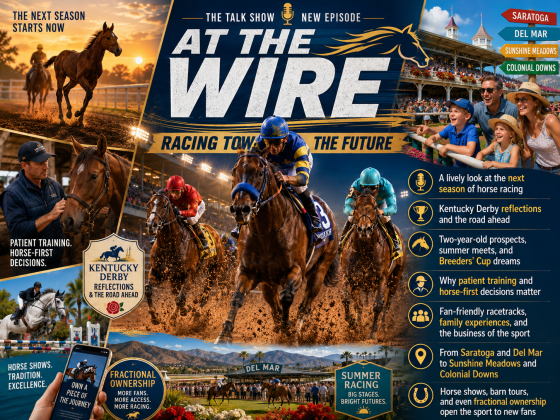
Racing Toward the Future: Two-Year-Old Prospects, Fan-Friendly Tracks, and the Horse Industry’s Next Season
A Season Turns Toward the Next Derby
The host opens by reflecting on the recently completed Kentucky Derby trail and the dispersed preparation of this year’s contenders, noting that horses trained in many different regions and weather conditions. He argues that weather, location, stall availability, and individual training decisions all affect a horse’s path through the season. With the first half of the racing year closing, his attention shifts to upcoming summer meets and the beginning of the long development cycle for future Derby prospects.
Two-Year-Old Races and Building a Horse’s Value
A central theme of the episode is the importance of summer two-year-old racing at venues such as Saratoga, Del Mar, and other major tracks. The host describes these races as the foundation for future Derby and Breeders’ Cup campaigns and says owners increasingly want horses to build a strong résumé for breeding value, not merely earn purse money. He emphasizes that a meaningful maiden win or stakes performance can establish a young horse’s value and reputation.
Praising Horse-First Training Decisions
The host highlights a female trainer whose name is unclear in the automated transcript, praising her path through the horse business and her decision to protect her Derby-winning horse by bypassing a subsequent race after assessing the horse’s condition. He argues that trainers who space races carefully and prioritize soundness will reduce injuries and allow horses to race longer. In his view, the sport is returning to an older, more patient style of preparation, with sufficient recovery time between starts.
Racetracks as Welcoming Family Destinations
The episode broadens from racing strategy to the public experience of the sport. The host praises tracks that are becoming more welcoming to families through food, children’s activities, photo opportunities, giveaways, education, and improved facilities. He cites major racetracks and equestrian destinations as examples of venues that can bring new fans into the horse world while also supporting local businesses through tourism, food, retail, and travel spending.
Learning About Horses Up Close
The host encourages listeners to attend horse shows, sales, training centers, and barns so they can see horses being groomed, shod, saddled, trained, and cared for. He discusses his plan for a new website that will teach people about horse care and transportation, drawing on his childhood experience of reading about horses before seeing the work firsthand. He also invites visitors to Sunshine Meadows, where he says families can watch harness horses train, meet horse people, and become more personally connected to the animals.
Tradition, Travel, Ownership, and the Future of the Sport
In the closing portion, the host presents horse racing and equestrian life as a family-oriented culture built around tradition, travel, and accessible participation. He references the Triple Crown, Saratoga, Colonial Downs, Tryon, major equestrian facilities, and fractional horse ownership as different ways newcomers can engage with the sport. He concludes that track renovations, fan-friendly planning, and the coming two-year-old season provide reasons for optimism as racing begins its next cycle toward the Derby.
At The Wire
Reporting on The Thoroughbred industry!
If you’re captivated by the power and grace of horses, there’s a thrilling world waiting for you—horse racing like you’ve never seen it before.
Step into the heart-pounding excitement of equestrian sports with Scott Miller, your ultimate guide to everything from the latest international racing headlines to the untold stories behind the track. Whether you're new to the sport or a lifelong fan, this program dives deep into the magic and mystery that makes horse racing one of the most exhilarating spectacles on Earth.
Discover what truly sets a champion horse apart, explore the secrets behind elite training for both standardbreds and thoroughbreds, and meet the legendary handlers and jockeys shaping the sport. Uncover the rich history, the art and science of breeding, and insider tips that could turn you into a savvy bettor.
With behind-the-scenes access and expert insight, this show brings you closer to the action than ever before. Curious? Saddle up—because this ride is just getting started.
Speaker Identification
Speaker 1 — Theme Vocalist / Prerecorded Show Opening and Closing: The sung opening and closing bookend the program and repeatedly reference “At the Wire.”
Speaker 2 — Host: A single principal speaker delivers the episode commentary, speaks directly to listeners and “horsemen,” refers to his forthcoming website, offers to show visitors around the barn, and closes the program. The host’s personal name is not stated clearly enough in the supplied transcript to identify him confidently.
Speaker 1 — Theme Vocalist / Prerecorded Opening:
Yeah, this is where it begins.
Yeah, yeah, yeah.
From the starting gate to the final stride,
feel the rush as the champions arrive.
Every heart beats [unclear lyric],
one-shot glory when it takes off.
From the dirt to the lights,
hear the crowd roar higher.
Every second burning closer to the wire.
At the wire, where the past and hearts collide.
At the wire, feel the thunder come alive.
You’re running at the wire.
Speaker 2 — Host:
Well, horsemen, it is that time of year again. We are starting to track things toward the Kentucky Derby. I have to laugh at this: the first half of the year is over for the horsemen, and now they have everything planned out.
All winter long, right up until the Derby, everything was kind of crazy. Trainers were all over the place with their horses. We had a bunch of horses, and, with no disrespect intended, I do not think we had the crop this year that we have had in some past years. Everybody was looking at it and trying to figure it out.
One of the interesting things was that the horses in the Derby came from a cross-section of the country. We had them from California, Florida, Arkansas, New York — everywhere. They were scattered all over, and they trained in different conditions and different areas.
I always talk about the weather — when it rains, how bad the weather is, and that type of thing. I am very big on that because I think it determines a lot: where these trainers go, where they stay, and whether they go back depending on the weather. That is one thing I will take into account for next year.
You have Chad Brown and a multitude of trainers. Down here, we have [unclear training-center reference]. They are full. They have a lot at Gulfstream, and of course Palm Beach Downs is down here. We are all here still, but we do not have that many stalls. We have two other stall areas, and Todd Pletcher takes most of those.
What is interesting now is that a lot of states are creating good state-bred races, good money, and good purses. They just raised the stakes money, or purse money, at Saratoga. Ellis Park has a good program. [Unclear Kentucky track/program reference] has a good program. Tampa has a good program. Gulfstream has a good program, and Saratoga is coming up.
What I like about it now is that a lot of two-year-old races are coming in. The trainers are starting to settle down and plan their track toward the Kentucky Derby and toward the Breeders’ Cup. It is really interesting to see these two-year-old races that are coming up, especially at Saratoga. That is what I like to watch when I go to Saratoga.
The classic races are up there too, probably for the aged horses and for the bigger trainers. That is really good for what you are looking at. You are seeing it in other places too. Woodbine in Canada has some great races and a lot of good two-year-olds. You have Del Mar and Santa Anita, and you have opportunities throughout the year. It is amazing where these horses are going and how they are staying longer instead of simply shipping in and leaving. They are there for a purpose.
Of course, we have Churchill now, and we have Del Mar and other tracks waiting to get all these horses in. I was pretty impressed with the way they lined these horses up this year. I was amazed at some of the trainers and where they went.
Speaking of amazing trainers, there is [female trainer’s name unclear]. She started out in the horse business, much like Chad Brown did. She began hot-walking horses, went to work with Chuck Simon, and continued working her way up to become what she is today. She had a good background and a good foundation.
One thing I find very interesting is that she is not being pressured to fall in line with all the others. What I liked about it is that she won the Kentucky Derby. I am not saying that merely because she is the first woman to do it. Trainers are not men or women, children or old people; they are trainers. That is what they do: they train horses. She came along with a system that works.
What I particularly liked was that afterward she was not going on to the Preakness because she checked her horse out and felt that the Derby had taken a lot out of the horse. She said she was going to bypass that race. I was glad to see that from her. She is very, very good about caring for the horse.
When trainers start taking care of their horses that way, you are going to see injuries go down and you are going to see horses race more. The pattern they fell into this year is a pattern trainers used back in the seventies and early eighties. Back then, you might race a horse two or three times before getting to the Derby. If you raced a horse five times and then went to the Derby, people praised you because the horse could race into form.
What they are doing now is going back to that older training schedule, with five or six weeks between races. Being a horseman, I understand the horses. You look at a major stakes race coming up on June 6 this year and think, “Where is he going to run after this?” There are a couple of good races at Saratoga toward the end of the meet, four or five weeks away. There is Monmouth Park. Then there are races at Churchill coming up. At least they have some good races and some options they can go to.
Basically, owners are now looking to add value to their horses. For a long time, it was just about how much money a horse earned and whether it could win. Now owners are looking toward breeding. They want to build a résumé for their horses, and they want that résumé to look good because it gives the horse more value when it goes through the breeding shed.
Right now, take Saratoga for a minute, or Del Mar, or [unclear track reference]. If you have a young two-year-old horse and you go to Saratoga and break the horse’s maiden in a two-year-old race, that says an awful lot. With all of those races, there is nothing quite like it. Then you look at Del Mar, which is coming up strong as well. That is where you start laying the foundation.
You are adding value to your horse, and hopefully you can get to the Derby or the Breeders’ Cup, and get to those Grade 1, Grade 2, and Grade 3 stakes. That is very important for a trainer. I see some of these trainers, and I think they are putting the importance where it belongs: getting the horse ready to go. A sore horse is not going to make that kind of statement on the track.
That is what I like to see, and that is what the industry is going back to. The industry is getting very, very good, and I just love it.
The other thing I love is the fact that people are coming to the races now. We are starting to market to people again. Look at the new Belmont facility that is going to open. I believe the grandstand is designed for about eighteen thousand people, something like that. You can start looking at what they are doing: tracks are becoming fan-friendly now.
They are making it pleasant enough for families to come out, with good food and plenty of places for people to visit. The kids can have their faces painted and do things designed for children. That is interesting to see. Over at Monmouth Park, they have a little pony where you can have your picture taken. Saratoga is very good at putting on activities, and they have a lot of giveaways. They provide some good items up there.
They are also trying to make it more educational for the people who come in: letting them know about the sport, where the horses go, how things work, and what equipment is used. That is really important to our industry, and it is starting to pay off.
Churchill kind of started the whole thing in a way and began getting bigger. Then Belmont came along and made a lot of improvements. Monmouth Park, Santa Anita, Woodbine in Canada, and others have all made efforts. That is what this is all about, because horse racing is very instrumental in the economy of a state and a city.
I will give you a good example here. We are about forty-five minutes north of Gulfstream Park. Here in Palm Beach County, we have over ten thousand horses for shows, racing, and nearly everything you can do with a horse. In fact, at a major equestrian/show event here, approximately ten thousand people came out to watch the show.
Think about what that means. Those visitors are also going to restaurants, stopping at stores, buying gasoline, and spending money locally. That is the economic impact. I have been saying for a long time that you have to start catering to the public and bringing people in.
Look at what they do at the Kentucky Horse Park. You can see horses being shod. A lot of people do not even know how to get on a horse, but they can come to the Horse Park and see how horses are cared for: how their manes and tails are prepared, how they are groomed, and how people work with the animals. The most important thing is educating people.
I am going to share this with you: beginning on the first, on my new website, which I will be announcing next week, we are going to show what horses eat, how they get their feet trimmed and cared for, and what is involved in that work. We are going to show how they get shoes. We are going to show how horses are broken and introduced to saddles, how they begin learning to carry a rider, and how they are trained.
You do not have to know a lot about horses to be interested in these things. You do not have to know anything at all. You just have to know what you want to see. You will be able to click on the website and possibly see how horses travel and ship, including on planes and in vans; how they receive shoes and other care; what they need; how they train; and how they are built up toward showing or racing.
There is much more to the sport than people realize. When I was a kid, I was always reading books. When I got old enough to go out on a farm, those books came to life. I was no longer just reading about it; I was actually seeing it. What I am going to try to do is invite everybody to tune in and watch how these things happen. It makes a big difference in how people understand the horses.
In North Carolina and South Carolina, they have a lot of good horse shows. There are equestrian facilities in Kentucky, Colorado, and Michigan with a lot of good shows going on. Many times, you can search for horses or horse shows in your area. A lot of people do not realize these opportunities are available; they just see horses in a photograph or on a show program. Going out to a horse show is a good family activity. You can make a Saturday or Sunday afternoon trip out of it.
That is what we are trying to do: build up the horse business, and bring more fans through horsemanship. We have horse sales coming up, and you can attend. It may not cost you anything to go in. You can go through the doors into a sales pavilion, get a book or catalog, and learn what horses are being sent in and what their race records are. The great thing is that it may be free to attend. Parking may be free. There is good food there, and much of the experience is accessible.
You can see the job. You can see the training. You can be up close and personal. Some horse shows do charge admission, but not very many of them. At many shows, you can walk around in the barn area and see horses getting saddled, groomed, cared for, and prepared to go into the show ring. Then you can follow them up and watch the show. That is the great thing about it.
Out here at Sunshine Meadows, if you want to come out and see the horses train, the big time of year is September through April. We have approximately 750 horses here at Sunshine during the season, and most of them are harness horses with sulkies. You can walk right out and stand next to the racetrack to watch them train. It does not cost you a thing, just a little time.
You can walk around the barn area and see the horses. A lot of the trainers, drivers, and horse caregivers will talk to you and tell you what they do and what a horse’s name is. That is what I like about trying to get people interested in horses.
We are out here near U.S. 441 in [Florida location unclear]. We have 135 acres here and approximately 250 horses. Come out and talk to the people. It is a great place to visit. In our lakes, we have alligators and deer; we have all kinds of wildlife out there. We live around it every day, and we watch people come out and visit.
Look for me. Everybody knows me, and they call me “the Governor” out here. I will talk to you, show you around the barn, introduce you to people, and let the kids look at a horse. If they are lucky, they might even get an old horseshoe to keep. We need more of those kinds of experiences.
It also goes to show how things are changing. We have a lot of great lady trainers and riders winning races. [Name unclear], up in New York, is winning all the time. It is amazing to see the people who are in the business.
When you go out and watch polo, you never can tell what kind of person you are going to see riding. A lot of movie stars and famous athletes are involved in polo. [Several names unclear] had one heck of a ride. That girl could flat-out ride. You see people like that, and I have met a lot of tremendous horse people. You see that all the time out here.
These people are normal people. [Female rider’s name unclear] is an amazing rider. Her family is involved in show jumping, and her little daughter is riding now. There are all kinds of people you see when you get out to a horse show, a horse race, or related events. You might even run into me. It is an integration of everything.
I like to talk. If it is crowded around you, just call me over and I will scatter everybody out, because I run people off. That is what it is all about: getting out there, seeing people, and meeting trainers and owners. You would be surprised at the people you see. There are people with horses all over the place, and there are some great people active in this sport.
I cannot explain the feeling I get when I see horses in all the different places. Let me tell you about Virginia: Colonial Downs is a great place to go see horses. The facility is top of the line. What I like about it is that it is close to historical sites around Richmond, Virginia. You can go to Colonial Downs one day and then tour historical sites or go on a wine tour. They have everything.
Then, when you get to Saratoga Springs, there is so much to do it is crazy. You have shopping, food, downtown, the Adirondack Mountains, and Lake George. You have everything up there, and you can incorporate racing into your vacation.
At Saratoga Lake, there is a place called [name unclear]. The people there are wonderful. You can go up there in an RV for a couple of days, a week, or a month. You are about eight miles from the racetrack and sitting right on the lake. You can fish, water-ski, and enjoy the area.
That is what we are looking at here in the horse business. If you ever get a chance, give me a call at [telephone number requires verification], and I can help you out with it. Beginning on the first, you will also be able to go to the website and get that information.
Let’s get out, go to the horses, and make it a family activity. The thing I like about the horse business is its tradition. You have the Triple Crown: the Kentucky Derby, the Preakness, and the Belmont. You have Saratoga, Del Mar, Santa Anita, Woodbine in Canada, and so many places you can go.
It is not just about horse racing. It is about the fans. Take the family. You may see the ocean. I will tell you more: Tryon, North Carolina, is one of the nicest places to go see horses. You will see a lot of people get up close and personal with the horses, owners, trainers, and riders.
There is a place called [equestrian center name unclear] that is the most amazing show facility I have ever seen in my life. We have another major facility in Ohio. You can go there and see nearly every kind of horse. They have hotels and RV parking. Many of these places are talking about RV sites and making the destination experience bigger. One center even has shops and a candy store or restaurant area. It is unbelievable. They have all kinds of things to do. When you get there, you realize it is a busy world for horses.
Some of these destinations are close to the ocean and within driving distance of places such as Daytona Beach. When you look at these locations, it is really nice to make that kind of trip.
There is also a company called MyRacehorse [company/website requires verification]. What they do is bring together owners and offer experiences tied to Belmont Day, Churchill, or whichever racetrack the horse goes to. What I like about MyRacehorse is that you can get a fractional part of ownership in a horse for about eighty dollars.
You might have a thousand people involved with you, but when you go to the track and tell them you are an owner, they do not ask how much you own. They just know you are an owner, and that is kind of nice. You can follow your horse all year long. There is no monthly maintenance on the horse; you pay the listed price for the whole ride, right through the finish. That is exciting. You may also receive access to racetracks, owners’ boxes, and other benefits.
Guys, as I said, we are starting our whole year over. The Triple Crown will soon be over, and the summer meets open up. Now trainers start pointing these two-year-olds toward the Derby. The two-year-old season is going to be the launching card, and then they begin that drive for the Derby.
A lot of the Derby horses you saw this year, and many of the older stakes horses, are going to be popping up at Saratoga. They will also be at Del Mar, Santa Anita, Churchill, and a lot of other parks.
I forgot to mention Laurel Park and racing in Maryland. In the next two years, they are building a new Pimlico Race Course [reference requires verification], and it is going to be fantastic. It is going to look like Churchill Downs or Keeneland. That is what they are doing: expanding the racetrack experience and making it friendlier for fans.
I remember back in the day, maybe fifty years ago, when you would go to the racetrack and see guys smoking cigars, drinking beer, gambling, and cussing. That was what they were doing. It is not like that anymore at the racetrack. Now you can dress up nicely, put on your racetrack clothes, and enjoy yourself. You can have a nice meal there. A lot of tracks have good gift shops, especially around major race weekends, when you can find gifts your friends might not have.
Again, I am a Derby guy. You can see it behind me. I will always have that connection with the Kentucky Derby and all the greatness of the Belmont and Saratoga.
So that is where we are. I have talked your ear off, horsemen. You are probably drinking now because it is Friday afternoon. If you wanted a reason to drink, listening to my show has given you a reason.
Guys, I really appreciate every listener I have had. If I have no listeners, that means I have no friends and nobody to talk badly about. It is Friday. The daily races are starting. Go to the horses. Go to the lake. Go to the horses. Go to the lake.
Speaker 1 — Theme Vocalist / Prerecorded Closing:
From the stories told to the races won,
every journey ends where it all begun.
Legends run, but the track remains,
echoes of glory in the reins.
Through the dust and the dreams,
through the fire and flame,
every finish line remembers your name.
At the wire, where the spirit never dies.
At the wire, see the truth in every stride.
We’ll see you at the wire.