
At The Wire, June 5, 2026

At The Wire with Scott Miller
Belmont Week, the Road Ahead, and the Business of Building a Racehorse
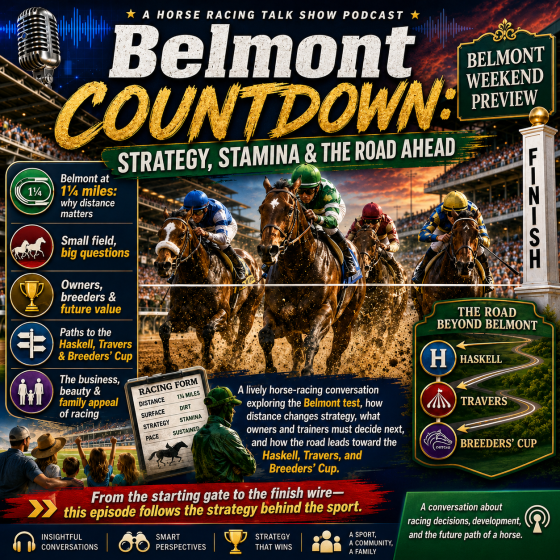
Belmont Week Takes Center Stage
The episode centers on the racing calendar surrounding Belmont, with the host emphasizing the excitement of Belmont week and the attention surrounding the race. He discusses the field size, the build-up from earlier Triple Crown events, and the challenge of getting horses prepared through the spring season. The host also notes that viewers can watch the race through Fox and through the program’s website, while framing Belmont as a major test for horses, owners, and trainers.
The Difference Between Distances
A major theme of the episode is the difference between training for a mile-and-a-quarter race and a mile-and-a-half race. The host explains that the distance change affects preparation, strategy, and how owners decide whether to continue forward with a horse. He suggests that this year’s distance makes the Belmont more manageable for some connections, while still leaving important questions about pace, stamina, and how individual horses will respond under pressure.
Owners, Breeders, and Long-Term Decisions
The host spends significant time discussing how owners and breeders think beyond a single race. He describes how some horses may be evaluated as future stallions, broodmares, or prospects for later races, and how the choice to continue racing often depends on bloodlines, money, pride, and long-term value. He also notes that owners must decide whether to aim for major races, seek easier spots, or preserve a horse’s future potential.
The Road to Bigger Racing Goals
The episode also looks ahead to the broader racing schedule after Belmont. The host refers to major races such as the Haskell, the Travers, and the Breeders’ Cup path, describing them as part of the larger strategic road for horses that continue beyond the Triple Crown season. He explains that trainers must study condition books, choose appropriate distances, and decide whether a horse should stay in the three-year-old division, face older horses, or shift to a different racing path.
Tracks, Trainers, and the Business of Racing
The host reflects on the role of trainers, jockeys, grooms, owners, and racetracks in keeping the industry moving. He emphasizes that trainers have difficult jobs because they must keep horses healthy, ready, and placed in the correct races. He also discusses modernized tracks, regional racing attractions, and the importance of making race venues appealing not just to bettors, but also to families and local communities.
Horse Racing as a Family and Community Experience
Toward the end of the episode, the host presents horse racing as more than a sport. He describes it as a family-centered experience tied to travel, local attractions, farms, beaches, parks, and community life. While some of the closing remarks are heavily garbled, the recoverable message is that racing requires planning, investment, and community connection, and that successful racing operations depend on more than simply sending a horse to the track.
At The Wire
Reporting on The Thoroughbred industry!
If you’re captivated by the power and grace of horses, there’s a thrilling world waiting for you—horse racing like you’ve never seen it before.
Step into the heart-pounding excitement of equestrian sports with Scott Miller, your ultimate guide to everything from the latest international racing headlines to the untold stories behind the track. Whether you're new to the sport or a lifelong fan, this program dives deep into the magic and mystery that makes horse racing one of the most exhilarating spectacles on Earth.
Discover what truly sets a champion horse apart, explore the secrets behind elite training for both standardbreds and thoroughbreds, and meet the legendary handlers and jockeys shaping the sport. Uncover the rich history, the art and science of breeding, and insider tips that could turn you into a savvy bettor.
With behind-the-scenes access and expert insight, this show brings you closer to the action than ever before. Curious? Saddle up—because this ride is just getting started.
Speaker Identification
Speaker 1 – Prerecorded Theme Song / Music Voice
Identified by the lyrical opening and closing segments, which appear to be musical theme material for the program.
Speaker 2 – Host
Identified as the main speaker delivering the full racing commentary, discussing Belmont, Saratoga, racing schedules, horse development, ownership decisions, trainers, tracks, and the broader horse-racing industry.
Speaker 1 – Prerecorded Theme Song / Music Voice:
Yeah, this is where it began.
From the starting gate to the final stride,
Feel the rush as the champions ride.
Every heartbeat, sederum poncah.
From the starting gate to the final stride,
Feel the rush as the champions ride.
Every heartbeat, sederum poncah.
One shot, glory.
When I take saw.
From the dirt to the lights,
Hear the crowd roar higher.
Every second burning closer to the wire.
At the wire,
Where the fastest hearts collide.
At the wire,
Feel the thunder come alive.
You’re right here
At the wire.
Speaker 2 – Host:
Well, guys, I tell you, Saratoga has inspiration today, and Belmont is tomorrow. Saratoga, thanks. Everybody is running in, and everybody is playing their part.
What is funny about it is that everybody is trying to get the nerve up through the spring and winter. It is all about the Kentucky Derby, and then the greatness of the Belmont. For the Belmont, we have small fields. We have a nine-horse field. We have some horses that everybody wanted in there, and we have Power Ship, which is a tremendous horse. Then, of course, we have Renegade. Everybody is in the rough, and we have all kinds of problems, one thing after another.
Tomorrow, the post time is 7:04 p.m. You can watch it on Fox, and you can watch it on my website, IEMT.live. We have a new website, and you can see it there. That is all good.
We were talking before about how positive it is just to get to this point. You get your horse ready, and now we have Belmont. Everybody is holding their horses and waiting for the trailer steps. Belmont is the test. I keep thinking about this one. That is a better time than the minute. Then you look at the whole model of it, and there are a lot of good races coming up.
The unique part about this is that we have a racing community that is focused on luxury racing and on really good races coming along. A lot of people are trying to get to the Breeders’ Cup. That is where everybody is focused now. It is interesting to see how everybody gets to it.
I love Sherry DeGlo. We were talking with her, and she kind of had to have that horse off. The question is whether it makes sense, because it took a lot out of that horse. That is always the issue with a good horse.
So we have a race out of the way at Belmont. We are training for a mile and a quarter, and a mile-and-a-quarter race and a mile-and-a-half race are two different things. This year, what made things easier with Belmont is that it is a mile and a quarter and not a mile and a half. Everybody pretty much stayed in the same routine.
Like I said, it is a small field. It is going to be interesting to see some of the issues. We will see what happens. He is going to come in and make a big difference in the race, which is going to be interesting. What I have taken from it is that these issues are going to play a big role in the same part of the race.
The one horse I have taken is kind of a big unknown. There is another horse in the race. He is a nice horse, and he is going to play a factor in the first mile.
With Power Ship, we do not know what is going to happen with that horse. That is how it works. That horse should be an animal. He could really get out there and make it happen, or he could do just enough and take a lot of horses out of the race.
There is another horse that should get out there and set the pace for a long time. He is really good. He came out really hard. It is going to be interesting to see what happens with him, especially in the first part of the race. It is a hard spot to get him in, and it is hard enough to pass away from him. You take your try, and it is a balance.
Training is hard because you have to point for the right places. You go to the dirt races. You have the Arkansas races and a lot of other smaller stakes. You get your horse out of the car and try to get to the Kentucky Derby. Then, hopefully, you are on to the Preakness, which most people want. After that, you have the Belmont.
What has happened this year is that we have a lot of horses that are kind of spent, or they are being looked at as future stallions, or maybe as broodmares. I think that is one of the most interesting things this year. I really spent a lot of time looking at it.
You have the Derby, and then, at the end of the season, you come up and you have the Haskell and the Travers. You have a lot of big races. You want to go in and try to make money there, because now you have major turns, and then you get to the Breeders’ Cup. We have a lot of win-and-you’re-in races coming up, and it is going to be interesting to see how this turns out.
There are a lot of big preps and big racing decisions. You can still go on with the horse and find new options. Then, of course, you are in the position where you have races that fill up, and you can get to resume building for your stallion possibilities.
There are a lot of new races. You can go get older horses, or you can stay in the three-year-old division. You can get to the Haskell and the Travers, and you can do that. It is interesting to see how some of these breeders and owners look at it.
That is what I was more interested in: the owners of these horses. You can see the two-year-old and three-year-old horses going into their time, and then you see what the owners are going to do. How many of them are breeders? How many of them are sellers? For the richer owners, it is going to be interesting to see what they do with them.
It is a whole different volume when you are running against seasoned horses. You still have to remember that he is really a three-year-old until February or March, when they come around. That makes a big difference. They still have a lot of weeks before they are fully grown up.
That is also the way I started looking at the horse-racing industry. I started looking more at the races, the race history, and which horses are going to stay with it. You look at horses when they are young three-year-olds, four-year-olds, and five-year-olds. It takes a lot of people to train them.
I know a lot of trainers. For example, George Lee is a trainer who can get a horse ready. All of a sudden, he comes around and makes up his card. Then he opens up the rest of the year. You see George right out of the training process, and he has his own way of doing it.
He is known for getting horses ready as two- and three-year-olds. If he gets something that goes on the dirt, that is great. He gets his horses ready, and then the next thing you know, you are seeing them at another angle, going into races with a lot of horses from other seasons. Even though they are young in the season, they are mostly ready to transport, and he does very well with that.
One thing I know about the racing life is that he likes to have a win in the fall. That is where he keeps his focus. He is going to get horses ready for a good search for a win, and that is where a lot of the situation comes through.
If you get a horse that breaks his maiden, and if you get a horse that runs well at the end and then comes back and runs well again, you really start to expect things from your horse. That is what a lot of buyers start to look for.
If you go back and look at some of these horses, there is a tradition. That is what they have done. It is a huge thing, and there is a lot of money out there now. You can make a lot of money running at Churchill, Saratoga, Santa Anita, Belmont, and other places. There is a lot of good money, but it is not always as good as it looks. You develop your horse in different places.
Another thing you have to start thinking about is the new grandstand part. You are going to cut down on some things. You will be able to stay in New York, for example, when the road and the barns come up. What used to be at Aqueduct will now be at Belmont. You have another first-class track, and that is another special thing to do.
I am excited about that. This is the last year that we are going to have this temporary Belmont situation, and then we are going to move back to the main Belmont Park. That is exciting, because it is so good to see the horses running there.
Some of the horses have gotten a lot higher, a little bit bigger, and stronger. That is what it is all about. Some of them did not mature at all. They had a slow go, and they will be ready for the next year. We will see what happens with them.
Chad Down has a couple of really interesting horses. There is a lot of money there. It is going to be interesting to see what this whole track means. Chad has a lot of horses in his program, and he is going to get a ton more. He is laying back and building a foundation.
You see all the big trainers. If you go back 30 or 40 years, you had trainers who built foundations. That was where you made your mark. Then they came out, and they had a good meet. You can redo that now because there is so much going on and so much opportunity.
You want to be at Churchill. You want to have a hot trainer. You want to be at the top of the card because you have to deal with the weather, the radio, the traffic, and a lot of these things. It is fair to talk about the nights and the days. You need perfect conditions to train the horse and get the horse ready.
Now that we have good places to go, there is no telling how many owners and trainers are going to use them. In this sense, it is going to be a good fit for a lot of trainers and a lot of horses. Then you come back in the fall, and it is not too cool yet. You can get ready to come back, fly home, and figure out what kind of things you are ready to do.
Tomorrow is going to be a good day. I do not care if I am going to play a ballroom. If you are doing the scene on the top, you are going to see my love tie here. It is going to be interesting to see what comes up for all of you.
The tracks are starting to modernize and make things more fun. We are doing more public policy, and in the next few years we will meet with the horsemen and sportswomen. This is the real deal. It is good. There are calls all day, and there are lessons from the track game. It is not the same timing that it used to be.
There are a lot of track attractions in these areas. You can find activities and things that you can do. The tracks tie along with local communities, and it is great to play with that situation.
That is what I always say: really know your area of horse racing. Find out what is on the horse-racing scene, what is on the horse-racing trail, and what is there for people to do. That is what is supposed to happen.
It has really been 20 years since some of these racing areas came into town, and it is good. There is so much to do instead of just coming in, going to the races, and waiting on the horse to come back. There is so much you can do.
That is what I always say: horse racing is unique. It is different than any other sport. It involves the whole family. Football, basketball, and baseball are different. With horse racing, if you go to Kentucky, you can see a three-day role in the sport and some of the best horses in the world right away. They square up, they take a ride, and they rerun it. It makes people feel rich in the experience.
We have a lot of these places in the lower part of the country. For example, in Miami, if you go down, you can go to the beach and go to the venue. The venue is right on the beach. You can go to the area, and it is only about 500 feet from the beach. That is good for the family.
You go out to the park in Colorado, which is beautiful. You can take the farm experience, and it is just beautiful. That is what the horse business is about.
I have watched this from the owners and the trainers. I would say the horse business is better. Sure, trainers have a lot of hours, so they move away. People are trying to keep the horse apart and figure out where they go. You have the jockeys in the building, too. It is very major. Personally, they all have tough jobs, but they all have real jobs.
The owners have to map out a road for the horse. Unfortunately for the owners, some of that road stops on the dirt, with the Triple Crown and the Belmont. Some of it goes to the grass. There are a lot of other strange things that you will see across the ground. That is what it is.
Then we will come up, and I am going to let you know the date when it comes. There is a qualifier that goes out straight. If you decide to go with the Australian Cross Association, there is a lot of money if you go out there. It is becoming very competitive.
We have several routes. If you run a race, you run and run, and then you get a road after a long time. Owners are always thinking about things like that. That is where it goes. There are a lot of good races, and it is a really neat lot to show.
I think it is a place that is really nice. It is 65 miles, or 100 miles a year. When they do a valid range, they do it well. The question, especially if I am training a dirt horse to a season like that, is what I have to do after a long time. That is the training question.
So I am going to ask: who are you looking at? Fair folks, we have up here. The thing that really interests me is that there are races coming up. Hellendale is coming up, and Saratoga is up there today. We have all these nice races, all these great stations, and all the major things that go with them.
Like I said, the trainers have a tough job: keeping horses healthy, ready, and able to go. They have to pick up the condition book and see whether the field is there. If it is, they have to go. You have to have time to successfully close the station and prepare.
You are going to have to have a mile, a mile and an eighth, or a mile and a quarter. You get the training program, and then you get the race. Next, you have to get your horse to sit and rate. You have to get the race, but you also have to think about the situation.
If you are going to go a mile and a quarter, or a mile and a half, you have to study for a long time. You have to get your horse ready. I saw a case a couple of weeks ago, and there was a horse that was likely going short. They were going to try to go a mile and a half. You need a three-day session, you need fair time, and you need to see whether the horse can do it.
That is why I was saying that I heard a man on the track talking about it. He was talking about the resume he had built with a horse, and he said it is often difficult to get a horse ready for the next step. If the horse has only had a try, and you would rather make a specific move, you have to decide whether the horse can possibly be in a good time and come immediately out of the raceway.
The horse could run a couple of good races. He could stand on his resume, and then the owner has to make a decision. He may want to run a brand-new race, but his bloodline may tell you something different. You have to make the decision.
There is a lot of money involved. You have money, pride, breeding value, and future value. You might have 10 resources, and if you have a horse running on a stakes-based path, following the program, you have a lot of money and a lot of pride on the line. That is a big deal.
They might go to Indiana, run for $100,000 or $200,000, and run against lighter company. That is a good way to do it. A lot of trainers are thinking that way now. The first thing is that you are going to put the horse in a place where he can compete. I think that is a good way to do it.
We have a lot of good nights, and we are going to make sure we are running out of it the right way. On the surface, you are going to find out how you finish. A lot of times, you have to think about several things: the competition, the appearance of the race, the people involved, and how the horse is developing.
You have to find grooms you can develop. You are not always going to find a lot of grooms. You have to find the right people who can go on with the horse. It is good to have real life in the barn and not have to pack up all the time.
You have to find the right market for the top horses. The long and short of it is that you have to find the right things. You do not always have to find everything. You just have to get into the right tree, get the eye, and get the horse in the right place.
The old track had its own identity. The state has the money, the radio, the mic, and the camera. You can go there and have a nice new setup. You can take the phone, and people can see it. That is what the whole thing is.
You know how conscious the market is. That is what we do. Churchill and Saratoga are how I like to do it. We are getting close to this, and we have to tell that story to the family and the community. We need to have a plan. People are coming, and we have to make a plan.
The final portion of the transcript becomes heavily garbled. The speaker appears to continue discussing planning, money, access, improvement, and getting back to the right track, but the automated transcript does not provide enough clear language to reconstruct the complete meaning responsibly.
Speaker 1 – Prerecorded Theme Song / Music Voice:
From the stories told to the races won,
Every journey ends where it all begun.
Legends run, but the track remains.
Echoes of glory in the rain.
Through the dust and the dreams,
Through the fire and flame,
Every finish line
Remembers your name.