
LaGrave Live, May 10, 2026
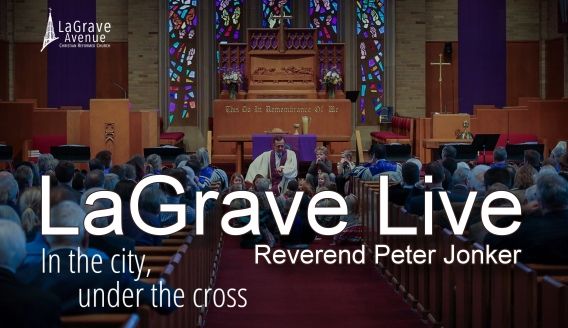

LaGrave Live
LIVE Morning Worship Service 05-10-2026
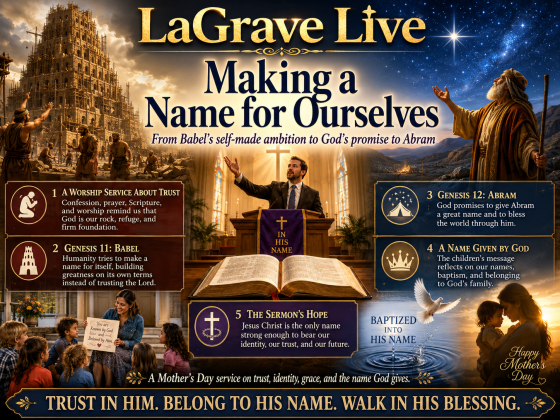
Making a Name for Ourselves
About The Service:
Rev. Kristy Manion will preach on Genesis 11 and we will celebrate baptisms at the 11:00 service.
Order of Worship:
https://lagrave.org/wp-content/uploads/2026-5-10-AM-Order-of-Worship.pdf
About the Church:
We are a traditional CRC church in the middle of Downtown Grand Rapids, MI, worshipping at 8:40am, 11:00am, and 6:00pm. (10:00am and 6:00pm during the summer months)
We'd love to hear from you:
Connection: https://www.lagrave.org/contact
Let us pray for you:
Prayer: https://www.lagrave.org/prayerrequest/
Giving: https://www.elexiogiving.com/App/Giving/lagr107178
The April special offering is for Family Promise. Family Promise partners with local congregations, individuals, families, foundations and corporations to provide emergency shelter and case management for families with children facing a housing crisis.
Listen on the go:
Amazon Music: https://bit.ly/LGPodAmazonMusic
Apple Podcast: https://apple.co/3tuOdwQ
Google Podcast: https://bit.ly/LGPodGoogle
Soundcloud: / lagravecrc https://soundcloud.com/lagravecrc
Spotify: https://spoti.fi/3yXDFaT
Follow us!
Facebook: / lagravecrc https://www.facebook.com/lagravecrc
Instagram: / lagravecrc https://www.instagram.com/lagravecrc
Website: https://www.lagrave.org
#LaGrave #LaGraveCRC
Making a Name for Ourselves: Babel, Abram, and Learning to Trust the Name God Gives
A Worship Service Centered on Trust
The Mother’s Day service begins with sung praise, a greeting in the name of the triune God, and the Easter affirmation that Christ is risen. Worship leaders welcome visitors, announce opportunities to learn about church life and study Practicing the Way, and frame the morning around trust in God rather than reliance on human achievement, skill, or ability.
Confession, Forgiveness, and God’s Name on His Children
Using Psalm 62, the congregation confesses its tendency to build on sand rather than on God as its firm foundation and receives the assurance that God is rock, salvation, and fortress. In the children’s message, Kristi Renee asks what every person receives and carries through life, leading to the answer of a name. She connects personal names and baptism by telling the children that God places his name on them and brings them into one family.
Mother’s Day Prayer and Congregational Care
The service’s prayer recognizes Mother’s Day as both a time of gratitude and a time when strained relationships and unfulfilled hopes may be especially painful. The congregation prays for people experiencing cancer, unsuccessful treatment, hospice care, and bereavement, along with missionaries and service ministries. The prayer continually returns to dependence on God’s faithful care in an uncertain world.
Babel and the Problem of Making a Name
The sermon reads Genesis 11:1–9 and asks what troubled God about the city and tower of Babel. The preacher argues that Scripture is not anti-city; rather, Babel reveals people attempting to make a name for themselves and to reduce God to a manageable local deity who will serve their ambitions. Seen against Adam and Eve, Cain, and Noah, Babel becomes another instance of God interrupting destructive human self-exaltation.
Graduation Season and Babel’s Continuing Appeal
The preacher connects Babel’s temptation to graduation season and to life beyond it, recognizing accomplishments and supportive families while warning against the pressure to establish identity through achievement, status, school, company, family legacy, or personal goals. The sermon describes two misleading versions of Babel’s message: that everything depends on individual striving, and that God exists simply to bless whatever people choose to pursue.
Abram, Jesus, and the Name God Gives
The sermon turns to Genesis 12, where God promises Abram the very gifts Babel tried to grasp: a great name, a great nation, and blessing for all peoples. This promise ultimately points to Jesus Christ, whose name alone is strong enough to bear unconditional love and loyalty. The service closes by inviting worshipers to live in humble dependence on the God who has redeemed them, summoned them by name, and sends them with his blessing and peace.
LaGrave Live
If you’re looking for a warm church that commits to an intensely pertinent Gospel in the Reformed tradition of the Christian faith, we invite you to worship with us. Our 1,800 members come from across West Michigan and gather weekly in our sanctuary for relevant Biblical preaching, beautiful music, and inspiring worship. We expand our worship through intentional outreach in our community and world, attentive care for our members, and plenty of spiritual enrichment and social opportunities for everyone.
We focus on a living Savior who provides genuine solutions to the deep needs of a hurting world. We are committed to need-meeting ministry in His name, and we are committed to being real people who enjoy real life and who cry real tears. Because we are a fairly large and diverse group in terms of age, occupation, marital status, lifestyle, and physical ability; our members create many accessible opportunities for community service, Bible study, and small social groups.
We worship God, the Almighty Creator of heaven and earth, and we enjoy expressing our vision of His holiness through traditional music and formal liturgy.
Music plays an integral part of our weekly worship gatherings. Congregational singing—of both traditional hymns and newer ones—is typically supported by our pipe organ. Vocal choirs, handbell choirs, small ensembles, instrumentalists, and vocal soloists provide additional music offerings.
Led by the Holy Spirit, we seek to worship and serve God in all of life, transforming His world and being transformed to reflect the character of Christ.
Founded by 36 Dutch immigrants on February 24, 1887, LaGrave Avenue Christian Reformed Church has always been deeply committed to both this local community and worldwide missions. God has seen fit to guide and bless these commitments with sustained growth, spiritual gifting, and a continual stream of new work for our members.
SPEAKER IDENTIFICATION
Speaker 1 – Choir / Congregational Singing: Opening and transitional sung portions are evident, but much of the lyric transcription is too garbled for publication without audio verification.
Speaker 2 – Worship Leader / Liturgist: Leads the greeting, announcements, confession, assurance of forgiveness, and creed introduction. The transcript does not state the speaker’s name.
Speaker 3 – Congregation: Identifiable responsive readings, the Apostles’ Creed, spoken responses, and sung responses.
Speaker 4 – Children’s Message Leader: Identifies herself during the children’s message as “Kristi Renee”; no surname is stated in the transcript.
Speaker 5 – Children: Brief responses during the children’s message.
Speaker 6 – Prayer Leader: Leads the congregational prayer for Mother’s Day, the grieving, the sick, and ministry partners. This may be the same person as Speaker 2, but the transcript alone does not confirm it.
Speaker 7 – Scripture Reader / Sermon Preacher: Reads Genesis 11:1–9 and delivers the sermon on Babel, Abram, and the temptation to make a name for ourselves. The transcript does not state the speaker’s name.
Speaker 8 – Benediction Leader: Gives the closing blessing; this may be the same speaker as the preacher, but it cannot be confirmed from the transcript alone.
[Speaker 1 – Choir / Congregational Singing]:
[Opening hymn or choral music. Portions of the lyrics refer to praising the risen Lord and praising his name; the automated transcription is too garbled for verbatim publication without audio verification.]
[Speaker 2 – Worship Leader / Liturgist]:
As we gather for worship this morning, let us come into God’s presence with this prayer of greeting. Heavenly Father, we pray that the grace of our Lord Jesus Christ and the love of God the Father and the fellowship of the Holy Spirit would be with us. Amen. Friends, Christ is risen.
[Speaker 3 – Congregation]:
Christ is risen indeed. Amen.
[Speaker 2 – Worship Leader / Liturgist]:
Good morning, everyone, and welcome to the LaGrave Avenue Christian Reformed Church. Happy Mother’s Day. For those of you who are visiting, perhaps because you're in town to see a loved one graduate, or for any other reason, we just want to say that we’re glad you're here worshiping with us this morning.
We have a few announcements to share. First of all, there will be a tour of the SDA building taking place during the 10 o'clock hour. This will be led by the architectural team, and if you're interested in that, knowing about that upcoming construction project, that will be a great way to be informed. Also, Rachel Thorne will be leading a book study on a book by John Mark Comer. It's called Practicing the Way. That will be in room 200. If you'd like to find other ways to get involved during the 10 o'clock hour, many of those can be found on page seven of your bulletin.
Today, we are celebrating God’s command to trust in Him completely. God shows us time and time again through His scriptures and our personal experiences that He is bigger than our achievements, our skills, or our abilities. And this should cause us to trust in Him fully.
Now, one of the ways that we practice this trust is through confession, bringing our weaknesses to God while remembering His steadfast love. Today, our call to confession is from Psalm 62:7–8. This will be read responsibly. My salvation and my honor depend on God. He is my mighty rock, my refuge.
[Speaker 3 – Congregation]:
Trust in Him at all times, you people. Pour out your hearts to Him. For God is our refuge.
[Speaker 2 – Worship Leader / Liturgist]:
Let us now join in the prayer of confession, which we will say together.
[Speaker 3 – Congregation]:
We humbly approach you, mighty God, as our refuge and ever-present help in times of trouble. You have given us your one and only Son, our Lord, from whom we have been taught to build our house on the rock and not the sand. Though we know of the immense care you have for your children, we too often build our house on the sand out of our own rebellion. Forgive us, Lord, for the sake of your Son, and help us to lean ever more on you, trusting in you as our firm foundation. In Christ's name we pray, amen.
[Speaker 2 – Worship Leader / Liturgist]:
These words of forgiveness are taken from Psalm 62:1–2. Truly, my soul finds rest in God. My salvation comes from Him. Truly, He is my rock and my salvation. He is my fortress. I will never be shaken.
[Speaker 3 – Congregation]:
Thanks be to God.
[Speaker 1 – Choir / Congregational Singing]:
[Sung worship response centered on Jesus Christ; lyrics require audio verification.]
[Speaker 2 – Worship Leader / Liturgist]:
Let us say together what we believe in the words of the Apostles’ Creed.
[Speaker 3 – Congregation]:
I believe in God the Father Almighty, Creator of heaven and earth. I believe in Jesus Christ, His only Son, our Lord, who was conceived by the Holy Spirit, born of the Virgin Mary. He suffered under Pontius Pilate, was crucified, died, and was buried. He descended into hell. The third day he rose again from the dead. He ascended to heaven. He is seated at the right hand of God the Father Almighty. From there he will come to judge the living and the dead. I believe in the Holy Spirit, the Holy Catholic Church, the communion of saints, the forgiveness of sins, the resurrection of the body, and the life everlasting. Amen. Jesus Christ.
[Speaker 4 – Children’s Message Leader]:
Children, please come up for the children’s moment. Join me up here on the step. Good morning.
[Speaker 5 – Children]:
Good morning.
[Speaker 4 – Children’s Message Leader]: I am thankful for the sun today. We have a couple more friends coming. This morning I have a way to start off our time together that I hope will make sense for you. We will see how it goes. What we can do. Here it is. What is something that everyone has and no one can buy? Something that you get right after you are born and something that stays with you for your whole life. I am going to say it one more time. Something that everyone has nobody can buy. Something that you get right after you are born and something that stays with you your whole life. What do you think?
[Speaker 5 – Child]:
The Lord.
[Speaker 4 – Children’s Message Leader]:
He does. That is a very good answer. Grant, do you have another thought? Say it again.
[Speaker 5 – Child]:
Love.
[Speaker 4 – Children’s Message Leader]: The Lord and love. Those are super, super things. You have a thought, M. Nope. Those are really good answers. They are not what I had in my head.
I asked my own family last night the same riddle and I got three different answers. One person said your body. I was like, yeah, that is pretty good. Another person said your baptism. That was getting a little warmer.
The thing I am thinking about is your name. Your name. Everybody has one. Nobody can buy one. You get it usually right after you are born. Usually it stays with you for your whole life unless sometime you decide to change it. Sometimes people do that.
I wonder if you know the story of your name. Sometimes parents pick names for kids because they like how the letters sound together. Sometimes they pick names because they like how they mean. Like what they mean or because a family member has them. That is true for me. My name is Kristi Renee. I am named after my dad's cousin that he likes a lot. Your grandma's name is Renee. That is my grandma's name too. I am Kristi Renee after a cousin and a grandma. You know what it means? A Christian born again. I did not pick that name for myself, but I am learning how to live with it. I like it. After all these years, I am getting pretty good in that space. If you don’t know the story of your name, that might be a fun question to ask your mom or your dad today in the car on the way home. Why did you choose Owen for me? Why did you choose James? Why did you choose Thea? How did you pick? You know what else? We all share a name. Most of you guys, maybe every last one of you, I am not sure. Most of you guys in this church were baptized in this church or you were baptized somewhere else maybe. When you are baptized, you know what we say? We say that God is writing His name in invisible ink across our foreheads. God’s name is on you, your whole life. Just like you are Owen for your whole life, God’s name is over you. That means we all belong to the same family together too. I wanted to talk to you about those things. You get to learn how to be God’s kid for the rest of your life. That's pretty cool. Congregation, what’s our prayer for these children?
[Speaker 3 – Congregation]:
The Lord be with you.
[Speaker 4 – Children’s Message Leader]:
Go in peace.
[Speaker 6 – Prayer Leader]:
Before we pray, we have a couple of announcements to share. First of all, our sympathy goes out to the family and friends of Ruth De Winter who passed away this Friday. Additionally, Steve Paolo received news this week that his bone marrow transplant was not as effective against the leukemia as we were hoping for. So we will be keeping both Steve and the friends and family of Ruth in our prayers this week. And now let's come before the Lord together. Heavenly Father, in your word we see time and time again that you are dependable. Although you created the world to be orderly, our sin has corrupted it in such a way that we can no longer be sure of our future, depend on our plans, or rest in our safety. Because of this, we rejoice that you have offered us life everlasting through the unchanging love Jesus demonstrated on the cross. And the eternal promise Jesus revealed through his resurrection.
This Mother’s Day, we thank you for those women in our lives who have faithfully supported and loved us. Even though we often make their task difficult, the tender care which they provide has proven to be invaluable. And in their dedication, we catch a glimpse of your love.
One way in which we practice trusting you is by bringing to you our requests and needs. So for those relationships between children and mothers which have been strained, for those who wish to be mothers but cannot, we ask they would be present and active in repairing these cases of brokenness.
We also pray for Steve Paolo, whose bone marrow transplant has not provided the healing that was hoped for. Please work through the doctors and treatment he receives to bring him back to health.
We pray for Jolene DeHer, who has also been diagnosed with [diagnosis unclear] and will begin weekly treatment to grow more red blood cells. And for all those who find themselves in the fight against cancer, including Joanne Arnois, Dan Beemer's, Marshall Hahn, Andrea Heckman, Jim Crowl, Renee Kuiper, Lloyd Tenholt, Sharon Van Houten, and Barb Voskel. We pray you would be with Sylvia Hugen, Bev Vandenbosch, and George Zans as they receive hospice services. Please guide Ray Peter and Bill Struell as they receive their own treatments.
We also pray that you would provide comfort to the friends and families who have lost loved ones, including those of Ruth De Winter, Jean Rinshaw, and John Postmus. In their moments of grief, make your love tangible and your presence known to them.
We lift up the work that fan and Rethina Veltman are doing in Ethiopia, serving as teachers at Bingham Academy. We pray for you to provide a clear path for the Academy, not only for their daughter, but for every student they are hoping to receive an education.
We also lift up the work of Mel Trotter and Degege, hoping that you will use the people working in those places to benefit those who have need. And we pray all this in your son's name. Amen.
[Speaker 1 – Choir / Congregational Singing]:
[Musical response; the automated repeated “Thank you” text does not reliably represent the sung lyric.]
[Speaker 7 – Scripture Reader / Sermon Preacher]:
Our Scripture reading for this morning comes from Genesis chapter 11, first few pages of the Bible. Page 15, if you're looking at the Pew Bible in front of you. Listen to these words. Now the whole world had one language and a common speech. As people moved eastward, they found a plain in Shinar and settled there. They said to each other, come, let us make bricks and bake them thoroughly. They used brick instead of stone and tar for mortar. Then they said, come, let us build ourselves a city with a tower that reaches to the heavens so that we may make a name for ourselves. Otherwise, we will be scattered over the face of the whole earth. But the Lord came down to see the city and the tower, the people were building. And the Lord said, if as one people speaking the same language, they have begun to do this, then nothing they plan to do will be impossible for them. Come, let us go down, confuse their language so that they will not understand each other. So the Lord scattered them from there over all the earth and they stopped building the city. That is why it is called Babel because there the Lord confused, which sounds like Babel, the language of the whole world. From there the Lord scattered them over the face of the whole earth. This is the word of the Lord.
[Speaker 3 – Congregation]:
Thanks be to God.
[Speaker 7 – Sermon Preacher]:
I had a tough time this week and I wonder if you do too when you open your Bible to Genesis chapter 11 and read the story cold, the way that we just did. It is hard to see in these nine verses just what exactly is so troubling to God about building a city in the ancient world. If this story is when you heard and learned as a child, it's a fun one to tell kids. You probably remember that God has a problem with something that happens here, but if you were pressed to answer what exactly that is, you might scratch your head a little bit. Well, you might say arrogance, ambition, pride aiming at an achievement that’s past what humans should try to do. Maybe something in that realm.
Another thing I wondered about is the city, the problem. Is God against cities? Well, no. Rural and urban communities have strengths, they have pitfalls. In the overall biblical story, God isn’t against cities. That's a good thing.
We know that God isn’t anti-city because of the story of the Bible that it begins in the garden. And many, many millennia later ahead of us, sometime out in the future, it will end in the city. The new Jerusalem coming down out of heaven from God is a bride beautifully dressed for her husband. And that’s super news if you're an engineer or a contractor or a person involved in city planning. God is not against building a city. Cities are places where God shows redemption. Pastor Rachel preached about this last Sunday night, actually, from Jeremiah 29, where the exiled Jews living in Babylon are asked to seek the well-being of the city where they're living. Babylon, the same civilization that our text today is referring to a little bit later. And Paul, Paul in the New Testament writes about his eagerness to bring the gospel to Rome the New Testament Babylon. God’s people are called to be a blessing wherever they find themselves, garden, enemy city, ultimate future. And the new heavens and the new earth that will include a city.
So what is it about this city and this part of the earliest stories of the Bible that the Lord has troubled about?
To explore those questions, we’re going to take a flyover view of the first number of chapters leading up to Genesis 11. The story of Babel is the bookend, the end of what Bible scholars call the primordial history, that very early accounts of God and his activity with people. And in those first 11 chapters, there are so many times when God comes and disrupts what people are doing. Because it's destructive, it's dangerous to the people, and it works against God’s good vision for why he made them and what he made them for.
So when Adam and Eve eat the fruit of the garden, of the tree of the knowledge of good and evil in the garden of Eden, God disrupts. He scatters Adam and Eve out of the garden to keep them from reaching out and eating the fruit from the tree of life and living forever, separated from him. But God also provides for them, right there. He provides covering for them in their nakedness. He provides a promise of a hopeful future. The story isn’t done yet.
And then Cain. Cain comes along and he kills his brother Abel, and God cannot ignore Abel's blood crying out from the ground. So God disrupts. He confronts Cain, he scatters Cain to be a wanderer on the face of the earth. But he also somehow marks Cain to protect him from harm.
By the time of Noah, people have lived into God’s blessing that they will fill the earth, but they've not only filled the earth with more people, the text says that they filled the earth with violence. God sees that the hearts of the people are filled with evil all the time. And God grieves through something like his tears. God again disrupts. Deadly washing of a flood covers all of the land. The ark becomes a mini floating Eden. And the spirit of God hovers again over the face of the water. And out of one family, Noah's family, God creates again. He creates with pairs of animals. He pledges unconditionally that he will never again destroy the whole earth through a flood.
And now after Noah is where we find ourselves today. Finally, finally, maybe God’s one people, the united descendants of Noah, will fill the earth. Maybe they’ll spread out and they’ll live the lives that God has designed them to live.
So all of that background to say, by the time we get to Babel, we are primed to look for some features of how God interacts with people. The people God loves turn to sin. God disrupts. God covers. God washes. God protects. God promises. God begins again.
But what happens in this story? Let's see. Genesis 11:8–9. So the Lord disrupts. He scatters the people from Babel over the face of the whole earth and they stop building the city. That's why the text said it was called Babel because there the Lord confused the language of the whole world. From there, the Lord scattered them over the face of the earth.
And we could be forgiven for expecting that Genesis 11, verse 10 might say something hopeful. Something about how God is recreating and carrying on his good purposes for the people. But Genesis 11 doesn’t do that. Genesis 11:10 doesn’t do that, not at least on the face of things. It just says this is the account of Shem's family line. The story and the pattern of God’s disruption and restoration seems to end. No promise for protection. Just confounded languages and scattering.
So what happens that seems to sever that relationship? What can’t God abide or allow to continue?
Well, if the basic temptation for Adam and Eve in Genesis 1 was that they wanted to become like God, that’s what they think they're going to do. Maybe the temptation in Genesis 11 is a variation on that theme. These descendants of Adam and Eve through the line of Noah want to be like God, to make a name for themselves. And at the same time, they want to make their God less. More manageable. They want a God who is more like them.
When the one human family still shares a language and they all move east to Shinar, they look around, they say to each other, this land doesn’t have any stones for building like we did back where we were. So let's perfect brickmaking. Let's make ourselves some bricks. When they do that, they see this is pretty good building material. We could do something really great here. We could make building blocks. Now let's build ourselves a city with a tower with its head in the sky. Then we’ll be something. We'll make a name for ourselves. We won't be scattered over the face of the earth.
Our passage doesn’t give a name for this kind of tower, but a lot of Bible scholars think that this tower was a ziggurat, which if you've studied your western civilization long, long, long ago, the ziggurat was a tower, a pyramid-shaped tower that was thought to be a mountain or a human-built mountain with a staircase that could go up to God. The connection point between heaven and earth. On these stairways, the local gods could come down. They could stay in a little guest room in the temple. Their needs were met by the people living around the temple. [Wording requires verification.]
So the people looking to make a name for themselves unify, band together, to make a tower for a God who is more like a superhuman, local, patron God, than the Lord of heaven and earth. The God they are ready and willing to welcome stays on their mountain. He eats their food and he drinks their water. He looks out over their city and blesses it, uses his power against their enemies, makes their nation's name great. What could go wrong?
If you know the Ten Commandments, the alarm bells are starting to go off for you. Those came later, but here they are. I am the Lord your God. God says, you shall have no other gods before me. You shall not make for yourself an idol. You shall not misuse the name of the Lord your God.
So the Creator and the ruler of all things in heaven and on earth cannot have this. A God made in the image of the humans who want to worship that God will allow them to justify almost anything. Nothing they do will be impossible. Nothing they want to do will be impossible for them, God says. So come and let us go down and confuse their language so they can’t understand each other. So God scatters from there over all the earth and they stop building.
And I wonder what you find stirring in your own mind and heart as you listen to that story and some of the challenges that humans are prone to. What names do we want to make for ourselves? What kingdoms might we want to claim?
May means graduation season. Three cheers if you're a graduate or if you're a family member who's cheering on a graduate. This season comes with so many milestone markers and important accomplishment, memory making times. And those are gold. It is so good and so important that you have time surrounded with the people who have loved you and supported you and that they can help you launch into the next chapter, whatever that is. So soak that up. Soak up the sweetness of it. Claim it for five years from now when other things are hard. Remember this.
But pay attention too. It's possible during this time or in the years ahead you’ll hear echoes of Babel. Get out there and make a name for yourself. The first thing you want to do is impossible for you. Sound familiar? If it does and you're still looking for a graduation speaker I will have cards down front. The siren song of Babel tells us everything is up to you. So you better hustle. You better get into this school or get employed at that company if you want to make your mark in this world. Don't mess up your shot. On the other hand, the siren song of Babel also says, don’t worry about it. God’s on your team. He'll bless you whatever you choose to do. Nothing matters except reaching your goals. Don't worry too much if you run over people on the way.
Unfortunately those Babel songs don’t stop calling to us after high school or college or graduate school.
As good as making a name for ourselves seems as tempting as it can be to join with others pursuing the gods that we think will bless what we’re doing. We serve a God who asks us to join him in doing what he's blessing. Being a little-g god for ourselves is exhausting. And the God of Heaven and Earth loves us too much to let us bunker there. We're called to fit into his plans for the world rather than asking him to accommodate ours. And at some point he'll confuse us and scatter us if he needs to. And we’ll have an opportunity again to learn how do we fit into your plans, God. How do we do that?
I said earlier that the story of Babel seems to just end with this scattering. And so it does. But with God, if we haven't gotten to the good part, we’re not at the end yet.
At the end of the family tree that comes after the story of Babel, we meet a man named Abram. And the first verses of Genesis chapter 12 are a key for us when we read the story of Babel. The Lord had said to Abraham, not Abraham yet, Abram, go from your country, your people, and your father's household to the land I will show you. So there's some scattering there in trust that Abram is invited to. And then God says this, I will make you a great nation and I will bless you. I will make your name great and you will be a blessing. All people on earth will be blessed through you.
Did you catch that? That God promises to give to Abraham what the people of Babel are trying to grasp? The people of Babel want a great nation and a great name. And when they try to make a name for themselves, all they get is confused. And what does God promise, Abram, that he will make Abram great, that he will give him a great name, that he will be a blessing.
Although God has divided and scattered the human family geographically and culturally after Babel, now through this particular branch of the human family, through the family of Shem, through the family of Abram, God is at work starting up his effort of restoration again.
Abram is the first in a long line of witnesses who are learning how to trust and walk before their God. Until one day, all things in heaven and on earth will reach unity in our Lord. Jesus Christ.
Only his name is sturdy enough, full enough, strong enough, eternal enough to bear the weight of our unconditional loyalty and love. Our names aren't big enough. Not even wonderful families and their last names are big enough. Not even a great school or a wonderful team or a four generation incredible family business. None of those things are enough to hold the foundation of who we are and what we’re about. Jesus is the one with that job.
Abram could hardly have imagined in his time how God would make his name great, how God would bless the families of all of the earth, how he would be woven into this patient, long-term, unglamorous sometimes fall on your face at other times project to belong in trust to the Lord. That one day God would indeed reconcile all those people he scattered under one head. Jesus.
So if you feel sometimes that you're being sucked into the lure of Babel's greatness on your own terms, we can say to ourselves, to each other, we've already got a great name. This is what the Lord says, He who created you, Jacob, he who formed you, Israel. Do not fear. I have redeemed you. I’ve summoned you by name, you are mine.
One of God’s greatest gifts to us is the worthiness of his strength and our dependence in it. We did not create ourselves. We cannot redeem ourselves. We didn’t decide to live at this time in history. We can’t so much as choose the color of our eyes. I don’t know what I’m going to have for lunch today much less what will happen in five years.
But we walk with trust and dependence in a God who is strong and a God who is worthy of our trust. Amen.
[Speaker 7 – Sermon Preacher]:
Lord, our God, you are great. And we are, oh, strangely humbled and strangely honored to be called by your name. So we pray that you will help us, Lord, in the places where we acutely feel our dependence and sometimes are tired of it. The places where we don’t see our dependence and we need you to come alongside of us and help us to keep our eyes on you. We pray for that. And we pray for your blessing this day that we will little by little learn to walk with you in trust and to sing to you because you are worthy. Amen.
[Speaker 1 – Choir / Congregational Singing]:
[Closing musical response; lyrics require audio verification.]
[Speaker 8 – Benediction Leader]:
Go out with the blessing of your Lord.
May the Lord bless you and keep you. May he make his face shine on you and be gracious to you. May the Lord lift up the light of his face upon you and give you his peace. Now and forever. Amen.
[Speaker 3 – Congregation / Sung Response]: