
LaGrave Live, June 28, 2026

LaGrave Live
LIVE Morning Worship Service 06-28-2026
The Way of Wisdom
About The Service:
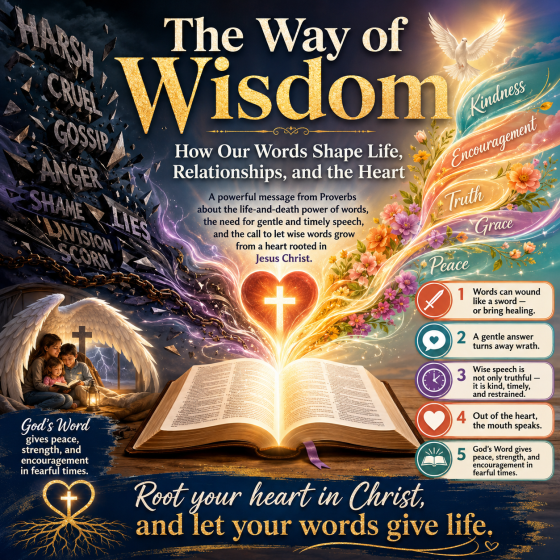
We will continue our summer sermon series called The Way of Wisdom. Pastor Jonker will preach and he will look at various Proverbs that offer us wisdom for how we speak to one another, which is a significant theme in the book.
Order of Worship:
https://lagrave.org/wp-content/uploads/2026-6-28-AM-Order-of-Worship.pdf
About the Church:
We are a traditional CRC church in the middle of Downtown Grand Rapids, MI, worshipping at 8:40am, 11:00am, and 6:00pm. (10:00am and 6:00pm during the summer months)
We'd love to hear from you:
Connection: https://www.lagrave.org/contact
Let us pray for you:
Prayer: https://www.lagrave.org/prayerrequest/
Giving: https://www.elexiogiving.com/App/Giving/lagr107178
The June special offering is for Pine Rest Patient Assistance Fund: Part of Pine Rest Foundation Fund offering financial assistance for individuals, families and children who need care.
Listen on the go:
Amazon Music: https://bit.ly/LGPodAmazonMusic
Apple Podcast: https://apple.co/3tuOdwQ
Google Podcast: https://bit.ly/LGPodGoogle
Soundcloud: / lagravecrc https://soundcloud.com/lagravecrc
Spotify: https://spoti.fi/3yXDFaT
Follow us!
Facebook: / lagravecrc https://www.facebook.com/lagravecrc
Instagram: / lagravecrc https://www.instagram.com/lagravecrc
Website: https://www.lagrave.org
#LaGrave #LaGraveCRC
Life-Giving Words and the Wisdom of the Tongue
The Weight and Wonder of Words
The service centers on the spiritual importance of words, beginning with a children's message that introduces the Bible as God's Word. The pastor explains that Scripture contains words that guide, comfort, strengthen, and reveal God's love through Jesus Christ. A story about a childhood friend in the Netherlands during wartime illustrates how a single line from Psalm 57 brought peace during danger and fear.
A Wisdom Series Turns Toward Speech
The sermon continues the summer series on wisdom literature, focusing on selected passages from Proverbs. The pastor explains that while Proverbs addresses many areas of life, one of its largest and most striking concerns is speech. The sermon organizes the selected proverbs around three themes: the power of words, the character of words, and the heart behind words.
Words Can Wound, Heal, and Create
The first major sermon theme is the power of speech. The pastor contrasts the familiar phrase “sticks and stones may break my bones” with the biblical claim that the tongue has the power of life and death. Through personal reflection and examples of both hurtful and loving words, the sermon emphasizes that speech can wound deeply, heal relationships, encourage faith, and help people flourish.
Gentleness Against the Culture of Outrage
The sermon then turns to the character of speech, especially gentleness, kindness, timing, and restraint. The pastor contrasts Proverbs' wisdom with the way social media often rewards outrage, alarm, accusation, and harshness. He argues that biblical wisdom calls people not only to speak truth but to consider the tone, tempo, and timing of how that truth is spoken.
Timely Words in Human Relationships
The pastor applies the wisdom of timely speech to friendships, marriages, families, and conflict. Using the example of a conflict-averse person and a person who wants to fix problems immediately, he explains that wise speech pays attention to the needs of the other person. The sermon emphasizes that there are times to speak and times to wait, and that words can be truthful but still unwise if spoken at the wrong time.
Speech Rooted in the Heart and in Christ
The final theme is that wise speech comes from the heart. Drawing from Proverbs and Jesus' teaching that the mouth speaks from the heart, the pastor says that anger, bitterness, fear, gentleness, patience, and love eventually reveal themselves in words. The sermon closes by calling listeners to be rooted in Jesus Christ, the Word of life, so that their speech may become life-giving, joyful, faithful, and loving.
LaGrave Live

If you’re looking for a warm church that commits to an intensely pertinent Gospel in the Reformed tradition of the Christian faith, we invite you to worship with us. Our 1,800 members come from across West Michigan and gather weekly in our sanctuary for relevant Biblical preaching, beautiful music, and inspiring worship. We expand our worship through intentional outreach in our community and world, attentive care for our members, and plenty of spiritual enrichment and social opportunities for everyone.
We focus on a living Savior who provides genuine solutions to the deep needs of a hurting world. We are committed to need-meeting ministry in His name, and we are committed to being real people who enjoy real life and who cry real tears. Because we are a fairly large and diverse group in terms of age, occupation, marital status, lifestyle, and physical ability; our members create many accessible opportunities for community service, Bible study, and small social groups.
We worship God, the Almighty Creator of heaven and earth, and we enjoy expressing our vision of His holiness through traditional music and formal liturgy.
Music plays an integral part of our weekly worship gatherings. Congregational singing—of both traditional hymns and newer ones—is typically supported by our pipe organ. Vocal choirs, handbell choirs, small ensembles, instrumentalists, and vocal soloists provide additional music offerings.
Led by the Holy Spirit, we seek to worship and serve God in all of life, transforming His world and being transformed to reflect the character of Christ.
Founded by 36 Dutch immigrants on February 24, 1887, LaGrave Avenue Christian Reformed Church has always been deeply committed to both this local community and worldwide missions. God has seen fit to guide and bless these commitments with sustained growth, spiritual gifting, and a continual stream of new work for our members.
Speaker Identification
Speaker 1 - Pastor / Sermon Speaker: Identified as the primary worship leader and preacher based on the children's message, Scripture introduction, sermon, closing prayer, and blessing.
Speaker 2 - Children: Identified from the children's message interaction, including brief responses and movement toward the front.
Speaker 3 - Congregation / Choir / Worship Leaders: Identified from sung worship portions, congregational responses, the children's blessing, and the final amen response. Individual singers or worship leaders are not named in the transcript.
Speaker 3 - Congregation / Choir / Worship Leaders: [Opening worship music and choral singing. The automated transcript contains extensive garbled lyrics in this section, including repeated fragments and unclear phrases. The recoverable substance appears to be an opening musical worship segment before the spoken children's message.]
Speaker 3 - Congregation / Choir / Worship Leaders: God be in my head and in my understanding. God be in my eyes and in my looking. God be in my mouth and in my speaking. God be in my heart and in my thinking. God be at my end and at my departing. [The choral section repeats, but much of the automated transcription is garbled.]
Speaker 1 - Pastor / Sermon Speaker: All right, children, it is time for the children's message. Come on forward. Have a seat around me. We will talk a little bit about what I am going to be talking about today in my sermon.
Hello, everybody. There you are. I knew you were here. It is so good to see you. It is starting to get warm outside, is it not? Wow. That is fun. We have a couple of balcony friends. Come on down, guys. Have a seat. No worries. I think those are the last two. Hello and welcome.
So today in my sermon, I am going to be talking about words and the things that we say. Some of the most important words, when we are Christians, are words that we listen to and look at in our lives. They are found in this book, right? The Bible. The Bible has really important words for us. In fact, we sometimes call the Bible something. Do you know the name that we use?
Speaker 2 - Children: God's Word?
Speaker 1 - Pastor / Sermon Speaker: God's Word. Have you heard that? We call it God's Word, and that means that in this book it is like God is talking to us. He is saying things to us. Sometimes in this book He tells us what He wants us to do and what He wants us not to do. Sometimes in this book He tells us how much He loves us and how Jesus died on the cross. Sometimes in this book He gives us words that give us strength and encouragement and help us when we are going through hard things.
I want to tell a story about that. It is about a friend of mine named John, or Johnny when he was little. He is gone now. He died and he is in heaven. But when he was a pretty little guy, about twelve years old, so older than you but still a kid, he lived in the Netherlands, in Holland, during a time when it was very dangerous. There was a war on, and it was a very big war. It was such a big war that planes would fly over his house sometimes and fly over the country of the Netherlands, and they would drop bombs. You never knew when planes would fly over. They could drop bombs, and a bomb could fall on your house. If it did, your house would blow up, and people would sometimes die because of these bombs that these planes would drop. It was a very scary time.
One day, John and his family were having dinner together and the air-raid sirens went off. Those are sirens that warned that the planes were coming. They knew these planes were going to come and they were going to drop bombs. You can imagine how scared they were. So he and his family went into the hallway because it was safer, and they were still really scared. Then his dad said, “You know what? I am going to pray.”
Then his dad prayed, and at the beginning of the prayer he used words from this book, from the Psalms. Psalm 57, verse 1. He said, “Lord, we shelter under Your wings until the danger is passed.” That is how he started his prayer. “Lord, we shelter under Your wings until the danger is passed.”
My friend John said that when he heard that prayer, when he heard those words, he was not as scared anymore. It was like the Holy Spirit brought him peace. He felt like whatever happened, it was going to be okay. He and his family were going to be okay. And they were.
The words of this book are so important, and I hope that you always have them as part of your life. Congregation, what is our prayer for these children?
Speaker 3 - Congregation / Choir / Worship Leaders: Go in peace.
Speaker 1 - Pastor / Sermon Speaker: Before we open God's Word and before I preach, let us sing the hymn printed in your liturgies as our prayer for illumination.
Speaker 3 - Congregation / Choir / Worship Leaders: [Congregational hymn / prayer for illumination. Several sung lines in the automated transcript are unclear and repetitive.]
Speaker 1 - Pastor / Sermon Speaker: Our Scripture reading is from your pew Bibles, but do not turn to your pew Bibles. Turn to your bulletins because the entire reading is printed out. The reading comes from various passages in Proverbs.
If you are visiting, we are in the middle of our series on wisdom, The Way of Wisdom. We will be thinking about wisdom literature this summer. One of the most important pieces of wisdom literature in Scripture is the book of Proverbs. So for the next few weeks, we will be in the book of Proverbs, including today.
In preparation for this series, what I did was read through the entire book of Proverbs. As I read, when I got to an individual proverb, I tried to categorize it, to figure out what it was talking about, and I put it in all these different categories. If it was about friendship, I put it in a friendship category. If it was about family, I put it in a family category. I put others in a money category. When I was done, there were many categories, because one of the great things about Proverbs is that it talks about all sorts of areas of life.
One of the most surprising things to me, genuinely surprising, was that the category with the most proverbs was the category about how we speak, how we use our words, and how we talk to each other. There were more proverbs about that than any other category. Obviously, the Holy Spirit is deeply concerned about the way we speak to each other.
I could not read all those proverbs here this morning because there are too many of them, so I have chosen ten. I have chosen them strategically. As I studied Proverbs, I think there are three things the Holy Spirit is communicating to us about our words. I want to teach you something about the power of our words, the character of our words, and the heart of our words. Power, character, and heart.
As I read these proverbs, the first three are about power, the next five are about character, and the last two are about heart. Let us read them together.
The words of the reckless pierce like swords, but the tongue of the wise brings healing.
The tongue has the power of life and death, and those who love it will eat its fruit.
The words of gossip are like choice morsels; they go down into the inmost parts.
A gentle answer turns away wrath, but a harsh word stirs up anger.
Anxiety weighs down the heart, but a kind word cheers it up.
A person finds joy in giving an apt reply, and how good is a timely word.
The one who has knowledge uses words with restraint, and whoever has understanding is even-tempered.
Through patience a ruler can be swayed, and a gentle tongue breaks a bone.
The heart of the righteous weighs its answers, but the mouth of the wicked gushes evil.
The hearts of the wise make their mouths prudent, and their lips promote instruction.
This is the word of the Lord.
Speaker 3 - Congregation / Choir / Worship Leaders: Praise be to God.
Speaker 1 - Pastor / Sermon Speaker: Power, character, and heart. Let us talk about power first.
There is an old popular proverb that you probably know. It says, “Sticks and stones may break my bones, but names will never hurt me.” Sticks and stones are physical things that you can strike someone with. Of course those can cause damage. But words? What can words do to you?
That proverb is not in the Bible, and for good reason, because the book of Proverbs teaches exactly the opposite. If that proverb were in Scripture, it would probably say something like, “Sticks and stones can break my bones, and words can even kill me.” That is Proverbs 18, verse 21, which we just read: “The tongue has the power of life and death, and those who love it will eat its fruit.” The words that come from our mouths have the power to bring life or to bring death.
We know this. We know how a cutting word from a friend, from a teacher, or from a parent, especially from someone to whom we are close, an authority figure to whom we have opened our hearts, can leave a lasting effect in our lives. It can make us uneasy and uncertain. It can make us limp in our souls.
Proverbs 18:8 and 12:18, the other two proverbs in the first three, both use images for how words can pierce. One says the word is like a sword. A word can go down deep into you. Gossip can go down into your inner parts. Words have the power to penetrate. It is like inception, something so deep in your heart.
We know this. Even in adulthood, I am sure all of us can think back to some cutting word that was said to us maybe thirty years ago. When we think of that moment, we can still feel the fear, the anger, the bitterness, or the hurt.
In the first ten years of my ministry, when I was still trying to figure all this out, I remember having a lighthearted conversation with two people in my congregation. They were lovely people whom I liked and trusted, and they liked and trusted me. For whatever reason, we were talking about huggers and hugging. Some people are huggers and some people are not huggers. That is just a true fact.
One of the people, who is now in heaven, looked at me and said, “Oh, Peter, I can tell right away that you are not a hugger. You have that standoffish feel.” I kept smiling and I laughed, but I thought, “That is not how I see myself. That is not who I want to be. I want to be warm and open. I do not mind a hug once in a while.” This is what was going on in my head.
I will tell you this: I have recovered from this. I want you to know that I have recovered. But for years afterward, and I think you will understand this, when I was in a situation where maybe a hug was appropriate or not appropriate, when I was trying to decide whether this person needed a hug, I found myself deeply uncertain. I found myself deeply uncertain because those words had gotten down into me. Words have power.
Not just for bad things, of course, but for good things too. Think of how it is in a loving relationship between two people who are dating, and then finally one person ventures to say, “I love you.” How powerful are those words to possibly move the relationship to another level?
Words have power, and we need powerful words like we need water and food and air. We need to hear people say to us, “I love you.” We need to hear people say to us, “How are you doing? Are you okay?” We need people to tell us, “You are not alone. You are deeply loved. Jesus died for you. You are a child of God. You are not alone in this world.” We need people to tell us, “Hey, stop doing that. You are messing up.” We need words.
If we do not have people speaking those kinds of words into our lives, we will wither and die. If we do have people speaking those words into our lives, we will be strong. We will flourish by the power of the Holy Spirit.
We should not be surprised at the power of words because, after all, how did God make this world? With a word: “Let there be light.” He spoke it into being. If the God who created this creation did so with words, and if we are made in His image, it is no surprise that our words should have enormous creative power. Words are powerful.
Proverbs starts with the power of our words. It also talks about the character of our words. How do we speak to one another? How do we talk to each other? What is the way that we use this power?
There is another saying out there that maybe you have heard. It is a little more recent. Maybe you have heard it on social media. It says, “Facts do not care about your feelings.” Have you heard that one? Facts do not care about your feelings.
There is truth in that, of course. A fact is a fact regardless of how you feel about it. It just is. But then some people take that a step further and say, “Because facts do not care about your feelings, we should just speak facts to each other. We should just tell each other the truth. Hit each other with truth bombs. Give it to them between the eyes. Just speak the truth. Do not worry about how you say it because people need to hear the truth. Facts do not care about your feelings.” A lot of online discourse and political discourse is like that.
That is not the way of Proverbs. That is not the way of biblical wisdom. The book of Proverbs is full of advice about the way that you speak. Of course Proverbs wants you to speak the truth, and there will probably be a sermon about that later. But Proverbs is also deeply concerned with how you speak the truth: the tempo of your speech, the tone of your speech, and the timing of your speech.
You heard that in some of the proverbs I read. We should not just be truthful. We should be gentle and kind. We should not just be truthful. We should be timely and apt. Let us dig down into both of those.
“A gentle answer turns away wrath, but a harsh word stirs up anger.” So, when speaking, biblical wisdom says it is better to speak a gentle word than to be harsh. Can I just observe that this is exactly the opposite of what social media discourse trains us to do?
A few years back, two researchers, William Brady from Yale and Molly Crockett from Princeton, did a study. They took over twelve million tweets, whether they are still called tweets or not, on Twitter, X, whatever. Twelve million of them. They looked at what kinds of tweets got the most interaction, what got the most likes, what got the most retweets, what got the most attention. What they found was that if a tweet expressed moral outrage, danger, fear, or moral outrage, it got more attention, more clicks, and more retweets. So if a tweet is harsh, it is rewarded.
If Proverbs 15:1 promotes a gentle answer and warns against a harsh one, what we are being trained in on social media is to go toward a harsh answer and away from gentleness. I think we see that pretty clearly in our societal discourse these days. It is not too much to say that what Proverbs is trying to teach us about our speech is the opposite of what we are being trained in by our society. Social media promotes outrage, accusation, and alarm. Proverbs values restraint, kindness, gentleness, and patience.
Proverbs wants our words to be kind and gentle. It also wants our words to be timely and apt. Proverbs 15:23 says, “A person finds joy in giving an apt reply, and how good is a timely word.” What does it mean to be timely and apt?
What Proverbs is saying there is that it not only matters that your words are kind. It matters when you speak them, how you speak them, and the tempo at which you speak them.
Imagine two people in a friendship, and one of them insists on saying what they feel as soon as they feel it. If they see something wrong or something annoys them, they have to point it out right away. They do it gently, but they cannot stop themselves.
“Bob, I think I should point out that the correct usage in that sentence is ‘whom’ rather than ‘who.’”
“Bob, that is the salad fork. Do you really want to use that fork for dinner?”
If one friend is like that in the relationship, that friendship is going to experience strain, because even though the words are gentle, they are not timely. Wise speech recognizes that there are times for us to speak and there are times for us to use restraint and keep silent.
I talk a lot about this in premarital counseling with respect to conflict. The timing of our speech in conflict is really important. This is true for marriages, but it is also true for friendships and families.
Sometimes in a relationship, one party is conflict-averse. They like to keep the peace. They like everyone to get along. If stress comes up, they do not want to show that they are angry. Let us call this person Ms. I Hate Conflict.
Maybe Ms. I Hate Conflict is going out with a guy who likes to get things done. He likes to take care of things right away. He does not want to let things linger. If there is a problem, he wants to deal with it right now. Let us call him Mr. Fix It Now.
If these two people get into a relationship together, what often happens is that if some conflict comes up, Mr. Fix It Now will come over to Ms. I Hate Conflict and look at her and say, “Is something wrong? Are you okay? Is something bothering you?” She will say, “Oh no, I am fine. There is nothing.” He can tell, so he pushes in even harder. “No, I can tell something is wrong. What is going on?” The harder he pushes in, the more she resists, and you get this sort of downward spiral. You have seen this. I know you have seen this.
Both parties need the wisdom of timely words. Interestingly, and this is typical of wisdom, both parties need different advice. Ms. I Hate Conflict needs to be challenged to say something like, “Yes, I admit it. I am annoyed. But you know what? I just need a little time. I need to process my feelings and my thoughts. I love you, and I promise we will talk about this.”
Mr. Fix It Now needs to be encouraged to say, “Look, I can tell you are a little annoyed, but I know that you just need a little time right now. I love you. It really bothers me to think that you are mad at me, but I will give you the time you need. Please promise that we will talk about this.”
Wise speech is timely and apt. It pays attention to the needs of the other.
It should not surprise us that how we speak, the character of our speech, should matter, because God has tempered His speech toward us. Have you heard this metaphor? When John Calvin talks about how God speaks to us, he says that God's speech to us is like baby talk. Have you heard this before? It is like baby talk, says John Calvin.
When a mother talks to a baby, the mother will coo to the baby and murmur to the baby, and she will adjust her speech to suit this baby's stage of life. We will see this. God does the same thing for us in this book, in His speech to us.
How could the infinite majesty of God, the Creator of the universe, possibly be contained in human nouns and adjectives and verbs? How could something as crude and simple as human speech possibly contain the living God? How could these sounds that I make with my mouth be something that would communicate the living God to you? And yet they are, because God stoops to our weakness. He accommodates to our weakness. He speaks baby talk to us. If God accommodates His speech to us, how much more should we accommodate the character of our speech to each other?
Finally, I need to spend a little time on our last point. This is the shortest of the points, but it is also the most important. Ultimately, wise speech is rooted in the heart. Proverbs 16:23 says, “The hearts of the wise make their mouths prudent, and their lips promote instruction.” That prefigures what Jesus says in Matthew 12:34: “Out of the heart the mouth speaks.” Remember that statement of Jesus? It is out of the heart that the mouth speaks.
So I can give you all kinds of advice about how to speak this morning. I already have. I can give you all kinds of advice about how you should shape your speech. But if your heart is in the wrong place, if what is in your heart is anger or bitterness or fear, eventually that is what is going to come out of your mouth.
If you really want your speech to be gentle, your heart needs to be filled with the One whose Spirit is gentleness. If you want your speech to be timely, your heart needs to be rooted in the One whose Spirit gives the gift of self-control and patience. If you really want your words to be life-giving, you need to have your heart rooted in the One who is the Word and whose word is life.
Once your life is rooted in Him and His Spirit is working in you, you need to immerse yourself in this Word. Let it fill you. Let its phrases and its cadences and its stories become the way you look at the world. It is so easy out there, because of the discourse, to let anger and bitterness and fear become the story of our heart.
Ultimately, this whole thing with our words is not a skill that we master. It is something to which we submit. We give ourselves to the Word of life. We let His Spirit fill us.
I wish for all of you life-giving words in all your relationships and in all your life, which means I wish for all of you that you will be deeply rooted in Jesus Christ, the Word. Amen.
Thank You, Lord, for the gift of speech and all its power and all its glory and all its joy. For the music of poetry, for the joy of singing hymns, for the joy of a good conversation, we know, Lord, that in all these things we are doing holy work when we do it in You.
Please, Lord, root our lives deeply in You so that our words can come out of us from a heart of joy and faith and love. In Christ's name we pray. Amen.
Speaker 3 - Congregation / Choir / Worship Leaders: [Congregational response: Amen.]
Speaker 1 - Pastor / Sermon Speaker: Before you leave this place this morning, our Lord speaks to you these words of blessing: The grace of our Lord Jesus Christ, the love of God, and the fellowship of the Holy Spirit be and abide with you all.
Speaker 3 - Congregation / Choir / Worship Leaders: [Closing response: Amen.]