
LaGrave Live, August 9, 2026

LaGrave Live
LIVE Morning Worship Service 08-09-2026
The Way of Wisdom: Wisdom for Families
About The Service:
We continue our Way of Wisdom sermon series, a series which focuses on some of the Bible's wisdom literature.
Pastor Jonker will preach on Proverbs wisdom for families as found in proverbs like 22:6.
Order of Worship:
https://lagrave.org/wp-content/upload...
About the Church:
We are a traditional CRC church in the middle of Downtown Grand Rapids, MI, worshipping at 8:40am, 11:00am, and 6:00pm. (10:00am and 6:00pm during the summer months)
We'd love to hear from you:
Connection: https://www.lagrave.org/contact
Let us pray for you:
Prayer: https://www.lagrave.org/prayerrequest/
Giving: https://www.elexiogiving.com/App/Givi...
The August special offering is for Covenant House. Covenant House Michigan (CHMI) provides shelter and hope to young people aged 18-24 who are experiencing homelessness or victims of trafficking in Grand Rapids and Detroit. Their mission is to serve all youth who come to their doors with unconditional love, absolute respect, and relentless support.
Listen on the go:
Amazon Music: https://bit.ly/LGPodAmazonMusic
Apple Podcast: https://apple.co/3tuOdwQ
Google Podcast: https://bit.ly/LGPodGoogle
Soundcloud: / lagravecrc https://soundcloud.com/lagravecrc
Spotify: https://spoti.fi/3yXDFaT
Follow us!
Facebook: / lagravecrc https://www.facebook.com/lagravecrc
Instagram: / lagravecrc https://www.instagram.com/lagravecrc
Website: https://www.lagrave.org
#LaGrave #LaGraveCRC
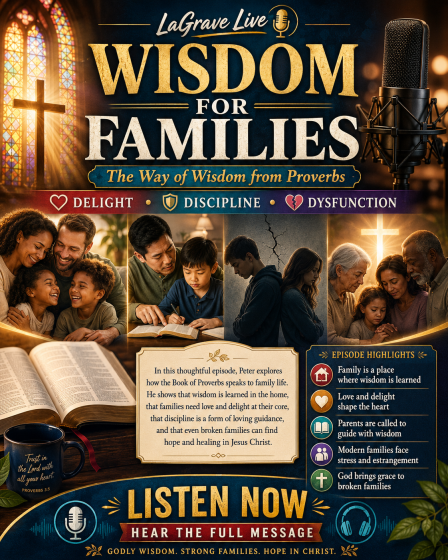
Delight, Discipline, and Dysfunction: Building Families in God’s Wisdom
Summary
Family as the Center of Proverbs
The service frames family life as one of the central settings in which biblical wisdom is learned and practiced. Peter explains that Proverbs repeatedly presents fathers and mothers instructing their children, making wisdom part of an ongoing family conversation. He argues that families shape people profoundly, whether those experiences are nurturing or deeply painful. A healthy family can become a firm foundation, while a harmful family can feel like a minefield whose effects continue through life. The sermon therefore treats family not as a narrow topic for parents with children but as a reality that affects everyone, including single people and married people without children. This broad framing leads into the need for wisdom amid the pressures facing modern families.
Modern Strain, Estrangement, and Fear of Family Formation
Peter identifies two pressures he believes are placing special strain on families today. First, he says many young people appear increasingly reluctant to marry or have children because they see the difficulty and fracture that can accompany family life. Second, he discusses family estrangement, including parents and children or siblings who stop speaking to one another. He acknowledges that separation can be appropriate in cases of abuse or severely toxic relationships and does not treat all estrangement as wrong. At the same time, he worries that relationships may sometimes be labeled toxic too quickly, producing unnecessary rupture. His conclusion is that every kind of family needs wisdom because family relationships are powerful, difficult, and deeply consequential.
Delight as the Foundation of Family Life
The first major sermon theme is delight. Peter argues that the family portrayed in Proverbs is not primarily a place of rules and rigor but a place of love, joy, and delight. He points to passages in which discipline flows from love and in which parents rejoice over wise and righteous children. This delight is presented as something that should exist at the beginning, middle, and end of family relationships. Peter emphasizes that love is not merely something beneath discipline; love and delight themselves are formative. He offers the practical idea of a five-to-one ratio, suggesting that correction should be surrounded by many more expressions of affirmation, attention, affection, and genuine interest.
Attention, Affirmation, and Everyday Connection
Peter develops the theme of delight by describing ordinary ways family members communicate love. Affirmation can be verbal, such as telling a child, sibling, or spouse that they are valued, but it can also be shown through a hug, a question, or undivided attention. He describes what psychologists call bids for attention: small attempts to connect through a smile, question, story, or gesture. In a healthy family, those bids are noticed and answered rather than ignored. His example of putting down a phone to listen carefully to a spouse illustrates how delight becomes a daily practice rather than an abstract feeling. The sermon presents these repeated moments of attention as a powerful way family members shape and strengthen one another.
Discipline, Authority, and Forming the Soul
The second major theme is discipline. Peter addresses Proverbs passages about the rod and argues that they should not be reduced to a command to beat children. He explains that the transcribed Hebrew term “shebat” can carry a broader sense of authority and leadership, and he interprets the parental task as owning and responsibly exercising that authority. Parents, in his view, are not primarily buddies but leaders charged with guiding, training, and forming their children. He uses the provocative word “indoctrinate” to make the point that every child inevitably receives a worldview from family and culture. For Christian parents, he says the highest responsibility is not achievement in academics, sports, or music, but helping children send their roots into Jesus, while avoiding both abusive control and hands-off parenting.
Dysfunction, Grace, and Hope for Broken Families
The final theme is dysfunction, where Peter rejects any idealized picture of a perfect family. Even families that try sincerely to love and discipline well may face addiction, divorce, estrangement, rebellion, and unresolved pain. He turns to God as the model of a father who knows the grief of children who turn away despite perfect love and care. Citing Hosea and Jesus’ lament over Jerusalem, he portrays God as a brokenhearted parent who continues to move toward a rebellious family. The Christian answer, in the sermon, is that God sends his Son, who bears punishment and makes restoration possible. The closing prayer therefore entrusts both healthy and broken families to Jesus and asks for healing where human effort alone cannot repair what has been damaged.
LaGrave Live

If you’re looking for a warm church that commits to an intensely pertinent Gospel in the Reformed tradition of the Christian faith, we invite you to worship with us. Our 1,800 members come from across West Michigan and gather weekly in our sanctuary for relevant Biblical preaching, beautiful music, and inspiring worship. We expand our worship through intentional outreach in our community and world, attentive care for our members, and plenty of spiritual enrichment and social opportunities for everyone.
We focus on a living Savior who provides genuine solutions to the deep needs of a hurting world. We are committed to need-meeting ministry in His name, and we are committed to being real people who enjoy real life and who cry real tears. Because we are a fairly large and diverse group in terms of age, occupation, marital status, lifestyle, and physical ability; our members create many accessible opportunities for community service, Bible study, and small social groups.
We worship God, the Almighty Creator of heaven and earth, and we enjoy expressing our vision of His holiness through traditional music and formal liturgy.
Music plays an integral part of our weekly worship gatherings. Congregational singing—of both traditional hymns and newer ones—is typically supported by our pipe organ. Vocal choirs, handbell choirs, small ensembles, instrumentalists, and vocal soloists provide additional music offerings.
Led by the Holy Spirit, we seek to worship and serve God in all of life, transforming His world and being transformed to reflect the character of Christ.
Founded by 36 Dutch immigrants on February 24, 1887, LaGrave Avenue Christian Reformed Church has always been deeply committed to both this local community and worldwide missions. God has seen fit to guide and bless these commitments with sustained growth, spiritual gifting, and a continual stream of new work for our members.
Speaker Identification
Speaker 1 – Worship Leader / Liturgist. This speaker welcomes the congregation, leads the responsive reading, prayers, assurance of forgiveness, congregational concerns, and the opening portions of the service. The transcript does not provide this person’s name.
Speaker 2 – Peter, Pastor / Sermon Preacher. The worship leader states that Peter will focus on wisdom for family life, and the children’s message identifies the speaker as Peter through his story about his parents addressing him by name.
Speaker 3 – Congregation / Congregational Singing. This label is used for responsive portions, congregational responses, and worship music where individual voices are not identified.
Speaker 3 – Congregation / Congregational Singing
[Opening worship music and congregational singing. The automated transcript for the opening section is extensively repetitive and garbled, so the exact lyrics cannot be reconstructed reliably from the transcript alone.]
Speaker 1 – Worship Leader / Liturgist
Jesus Christ, to whom we have raised this hymn of grateful praise, is present right here in the sanctuary with us this morning. Grace and peace to you from God our Father and the Lord Jesus Christ. Amen. Welcome to Sunday morning worship here at LaGrave Avenue Christian Reformed Church this morning.
We're glad that you're with us, whether you're physically present here this morning or worshiping with us online. We especially welcome you if you are new or visiting among us today. We hope you'll stay around for a while afterward and get to know some of us. There will be coffee and fellowship in the multipurpose room right after this worship service and that's straight down the hallway and then to your right.
If you're in District Three, however, you are invited to the parlor for coffee and cookies after the worship service. It's a good time to get to know others in your district. That is straight down the hallway and to your left. Be sure to check the bulletin for other announcements and things coming up today, this week, and in the future.
In the sermon today, Peter will focus on wisdom for family life. In line with that, let's be reminded of some of God's basic commands for the family.
Speaker 1 / Speaker 3 – Responsive Reading
Join me in the responsive reading found in the bulletin. Honor your father and your mother so that you may live long in the land the Lord your God is giving you. Children, obey your parents in everything for this pleases the Lord. Fathers, do not embitter your children or they will become discouraged.
What is God's will for you in the Fifth Commandment? That I honor, love, and be loyal to my father and mother and all those in authority over me. That I submit myself with proper obedience to all their good teaching and discipline and also that I be patient with their failings for through them God chooses to rule us.
Speaker 1 – Worship Leader / Liturgist
Let's pray. Lord, you have shown us the path of life and yet every day we stray from it. This is very obvious in family life, as we all have to admit that we haven't always loved, honored, and obeyed our parents. And those of us who are parents have to admit our many failings in raising children.
We confess that we have hurt one another. Through Jesus Christ, the atoning sacrifice on the cross, forgive us, Lord, once again, we pray and renew us by your Holy Spirit so that life in our families will conform to your will, not just in outward faithfulness but from the heart in genuine loving relationships. In Jesus’ name, amen. The Apostle John states it very clearly: if we claim to be without sin, we deceive ourselves and the truth is not in us.
If we confess our sins, he is faithful and just and will forgive us our sins and cleanse us from all unrighteousness. Receive this forgiveness and cleansing now through Jesus Christ.
Speaker 1 – Worship Leader / Liturgist
[Transition audio after the assurance of forgiveness is corrupted by repeated automated-transcription fragments.]
Speaker 1 – Worship Leader / Liturgist
Let's go to God in prayer. Lord, we come to you with thanksgiving in our hearts. You have blessed us in Christ so generously, pouring out your gifts of all kinds, physical and spiritual. Today we think of some of your most precious gifts, those we experience in family life.
It truly takes a God of great ingenuity, love, wisdom, and even a sense of humor to create family, marriage, and sexuality. Thank you, Lord, for these wonderful gifts. But family life is also where many of us experience sorrows, stresses, and wounds. We pray your comfort on those who grieve the loss of family members and loved ones, and your peace and renewal for those who have lost a marriage or friendship.
We pray that you will heal the wounds of those who have experienced physical, verbal, or mental abuse, and those who have suffered betrayal. We pray for those in strained relationships that you will lead them to understanding and reconciliation. We pray for healthy friendships for those who are lonely, including those who are single and pray for a life partner, or even a close friend. We pray also for those who struggle with issues of sexual orientation and for their loved ones, and for those couples that want children but haven't been able to.
For all these, we pray that you will give them hope and healing, a strong sense that you are with them, leading them forward and that you will meet their needs. We pray, too, for those who are considering marriage, those who are engaged, and those newly married. Guide and bless them with fulfillment and adjustment to these significant changes. We pray for all married couples that you will strengthen the bonds of love and faithfulness, help them deal with the rough spots along the way, and find joy and fulfillment in serving you together.
Whatever our status, grant each one of us the wisdom and self-control to follow the direction of your Word regarding sexuality, marriage, and friendship. Help each of us to be more Christ-like as children, siblings, young adults, married couples, parents, grandparents, and great-grandparents. Make us a strong and faithful family to each other as sisters and brothers in Christ. As we look beyond ourselves, we see many homeless people; for many of them, broken family relationships and abuse are significant factors in their homelessness and life challenges.
Bring your transforming power into their lives, Lord, and even use us to be family to them, especially through our neighborhood ministry. And then we think of those who have lost family members and homes in conflicts, in places like Sudan, Gaza, Israel, Lebanon, Iran, and Ukraine. We can't imagine the devastation that they are experiencing. Somehow, may your reign of peace and restoration come to them too, Lord Jesus. Work through the leaders of our nation and other nations to bring true justice and peace.
We now turn to specific concerns in our congregation, Lord. We begin by thanking you today with Lois Veneman, Joan Elzinga, and Dick Overbeak as they celebrate significant birthdays. Bless them with your presence and joy. We commit to you, Grace Shearer and Dave Vanderarck at Mary Free Bed, receiving rehab.
We thank you that Steve Palazzolo is now home. We pray that his continuing chemotherapy will be effective. We lift up to you, Jerry Vanderhart, now in hospice, following a diagnosis of cancer. We pray for good digestive functioning for eight-week-old Oliver Davies and Niku, and that you will encourage his grandparents, Paul and Patricia Stevenson.
We continue to bring before you many others in our congregation, fighting cancer or other long-term illnesses, those receiving hospice care, those dealing with dementia, and those who care for them. May they find you to be their very present help in time of need. For all these, we pray that you will touch and heal them with your powerful, loving, healing hand in the name of our Lord Jesus. Work through the health care workers and their treatments and medicines for their well-being.
We pray for Tim Van Beek and Blake Heisinger, our men in the military, that you will constantly protect them and meet their spiritual, emotional, and social needs. We lift up to you, Tim and Barbara Behrens, serving in an exciting and challenging ministry in Toronto. Holy Spirit, we pray that you will work through them in reaching people coming from other nations and worldviews, welcoming them to life in Jesus. And Lord, work through all of us that we may welcome others around us into your family.
In the name of our Lord Jesus Christ, we pray. Amen.
Speaker 2 – Peter, Pastor / Sermon Preacher
All right, children, it's time for the children's message. Come on forward. Come have a seat and I'll tell you a story from when I was a kid. And as they're coming up, let me just point out something in the bulletin to the rest of you. After service, we've had two interns during the summer who have been working in our neighborhood.
And one of those interns, Toulu, will be presenting some of what she's experienced and some of the best practices when it comes to dealing with our neighbors. If you're interested in that, it should be really interesting. It'll be in Room 200 after the service. Hello, everyone. How are you?
You're here. Yes, you are. I am so glad that you are here. Okay. How are we doing? Oh, we're doing so well.
You know, and I'm sure you know this, when I was a kid, my parents would often tell me things that I should do and things that I shouldn't do. That's kind of what parents do: ‘Do that. No, no, no, don't do this.’ Okay. And sometimes I liked that and sometimes I wasn't so sure. So here's an example. When I was in high school, so I was a lot older than you, but I was still a kid. High school kids are still kids.
My friends took six courses. So during the day, they had six subjects they needed to study. Okay. And then in between there were some breaks and they could play and they could have fun with each other. My parents made me take eight courses.
So in those little breaks where my friends were all having a good time and doing stuff together, I had to take math. I had to take science. I had to do work while my friends were playing. And I didn't like that so much, but you know what? I was a good son. And so I said, “Okay, I’ll do it, I guess.” But then one day my parents said to me, you know what, Peter? We think you should take one more course.
We think you should take typing. So you know what this is, right? This is a keyboard. And I mean, maybe some of you are already starting to learn this, but often like, oh yeah, of course they do. A lot of people do because this is how you put like with a computer, you put words into the computer, right? Or you put numbers into the computer. You write things on a keyboard. You all know that. Well, my parents wanted me to take typing so I could do it fast. And I did not want to do it.
And I said, I whined and I complained so much that finally my parents gave in. And I never had to take typing. Guess what happened? Today, all my friends — this is how they type. And all the people who work with me — this is how they type.
You want to know how I type? A little faster than that, but I'm not very good at it. I go really slow. My parents — I hate to admit it — were right. They were wise. And I was foolish for not taking typing.
God gave us parents, and one of their jobs is to help teach us what’s good and what’s not so good. And they're not always right, right? Parents make mistakes too. Sometimes parents make bad rules, but you know what? They're right more often than they're wrong, a lot more often. And they're smarter than you think.
Congregation, what is our prayer for these children?
Speaker 3 – Congregation
Go in peace.
Speaker 2 – Peter, Pastor / Sermon Preacher
Yeah. Well, I mean, she was responding appropriately to my authority, I suppose. All right, our Bible readings this morning are the Proverbs printed in your bulletin. But as we've been doing through this whole series on wisdom, let us sing first our hymn of preparation.
Speaker 3 – Congregation / Congregational Singing
[Hymn of preparation. The automated transcript is too garbled to reconstruct the lyrics reliably.]
Speaker 2 / Speaker 3 – Scripture Reading
Let's read the Proverbs printed in your bulletins together. These come from all over the Book of Proverbs, and as you know, today's subject is family. These are all family Proverbs. Listen, my son, to your father's instruction, and do not forsake your mother's teaching.
They are a garland to grace your head and a chain to adorn your neck. Listen, my sons, to a father's instruction, pay attention and gain understanding. I give you sound learning, so do not forsake my teaching. For I too was a son to my father, still tender and cherished by my mother.
Then he taught me and said to me, take hold of my words with all your heart and keep my commands, and you will live. The sayings of King Lemuel, an inspired utterance his mother taught him. Listen, my son! Listen, son of my womb! Listen, my son, the answer to my prayers! My son, do not despise the Lord's discipline and do not resent his rebuke because the Lord disciplines those he loves.
as a father the son he delights in. Start children off on the way they should go, and even when they're old, they will not turn from it. Folly is bound up in the heart of a child, but the rod of discipline will drive it far away. Whoever spares the rod hates their children, but the one who loves their children is careful to discipline them.
The father of a righteous child has great joy; a man who fathers a wise son rejoices in him. May your father and mother rejoice; may she who gave you birth be joyful. Children’s children are a crown to the aged, and parents are the pride of their children. This is the Word of the Lord.
Speaker 3 – Congregation
[Congregational response unclear in the source transcript.]
Speaker 2 – Peter, Pastor / Sermon Preacher
So we’ve addressed many, many topics in this sermon series on wisdom as we've gone through the Book of Proverbs. This is our last Sunday in Proverbs. Next week we go off to Ecclesiastes, which is very different territory. But in this series on Proverbs we've talked about many different subjects, but I can safely say that family is at the center of the Book of Proverbs in the way that no other subject is. Family is the center of the Book of Proverbs in a way that no other subject is.
And by that I don't mean that there are more Proverbs about family than anything else. There aren't. There are other subjects that have many, many more Proverbs about them. But what I mean is this. The whole Book of Proverbs is a book for families.
Right? It's a book that is given to families and is meant to be used in the family context. It's a family book. How do we know this? I hope you heard it in what I was reading.
Repeatedly, you can hear fathers and mothers talking to their children. The first Proverb says, “Listen, my son, to your father's instruction and do not forsake your mother's teaching.” Mom and Dad are saying to the kids, “Listen to us. Let us help teach you what is good.”
And that pattern is throughout the Book. “Son, listen to my instruction.” Read Proverbs 31, the Proverb to King Lemuel, that's his mom saying to him, “Boy, listen to what I say.” All the wisdom of Proverbs is part of a family conversation.
Whatever the Proverb is about, whether it's conflict or money or whatever, it's meant to be discussed by families in the places where they live, in the kitchen, in the living room, out in the fields while they are working. They are meant to meditate on and discuss these things together so that the Holy Spirit can help them grow in wisdom. It is a family book. And all of this underscores the importance of our families.
Our families are so important in our lives, and I know I don't need to tell you that. The person who's had the absolute best family experience here, the person who's sitting here who looks at their family and feels like they got nothing but love and proper discipline and feels uplifted by their families, that person can tell you how important their family is. The person here who's had the absolute worst experience of family, who has been traumatized and abused for whom their family was a horror, that person can tell you how important families are too. There's a place in the Sermon on the Mount where Jesus says the eye is the lamp of the body.
And if your eye is healthy, your whole body is full of light. But if that light within you is darkness, how deep is that darkness? Now Jesus wasn't talking about families when he said that, but he absolutely could have been. Depending on our experience, our family can be a firm foundation under our feet, or your family can be a minefield, right?
And you spend the rest of your life walking through this minefield feeling like there's going to be explosions within you. Our families influence everything. Not only are our families important, unfortunately these days, they're also under new and enormous stress. And there's all kinds of ways in which that's true.
I want to just talk about two of them very briefly. Today in our society, young people are more reluctant than ever to form new families. It seems like young people are scared of entering into the formation of families. Statistically, fewer and fewer young people want to get married. And then when they do get married, many fewer of them want to have children, right?
There's a reluctance to start a new family. There's a lot of fear about that. They look out and see how difficult families are and how fractured they are, and there is a reluctance, which is an enormous strain on this institution. Another strain on modern families is the growing phenomenon of family estrangement.
Increasingly, within families, there are rifts in which two family members no longer talk to each other and completely cut off contact, right? Brothers and sisters who do not speak, parents and children who do not speak. I read a stat this week that said something like 40% of families have estrangement within them. It's a lot.
Now don't get me wrong, there are times and circumstances when estrangement is absolutely appropriate. In certain cases of abuse or in really toxic, difficult families, sometimes all you can do is withdraw from a relationship. That absolutely happens and sometimes it's the right thing to do. But it seems to me, and I'm not the only one, that these days the standards for what qualifies as toxicity can be quite low and estrangement happens very easily, and when it does, it creates havoc in families.
All this to say, families are under strain right now, and families — all families, including ours — need wisdom. And so I'd like, based on these proverbs, to share a little bit of what I think is God's wisdom, the Holy Spirit's wisdom for us and our families. Now let me be clear: I'm not just talking to you if you're married with children. I'm talking to you if you're single, and I'm talking to you if you're married without children, because all of us are in families, right? All of us have family experiences that we have to sort out.
So, three points this morning — three things I want to say, and they are under the headings of delight, discipline, and dysfunction. Delight, discipline, and dysfunction. So not only are there three points, now they're all starting with the same letter, and you may say, “When is this going to end?” And I say to you, “I do not know.” Delight, discipline, and dysfunction. First of all, delight. When I first read through those proverbs, I don't know what jumped out at you, but my guess is that for most of you, what jumps out are the calls to discipline, right?
Instruction, teaching, and probably especially those two verses about the rod, right? The rod, and its importance in disciplining our children. That's normal. It's hard not to focus on them; those sorts of words take up all the oxygen in the room. But I don't want to start there, I want you to notice something which I actually think is more important, that sort of undergirds it all. Throughout these proverbs, there's also an undercurrent of joy and delight.
The family, as it's described in proverbs, is not first of all a place of discipline and rigor. It is first of all a place of love and delight. That is the beginning, the end, and the foundation of our families. These proverbs say that there's delight at the beginning of our families. Look at Proverbs 3:11-12.
My son, do not despise the Lord’s discipline; do not resent his rebuke, because the Lord disciplines those he loves, as a father the son he delights in. God's discipline of us comes out of his love and delight. A father's or mother's discipline of their children should come out of love and delight. There's delight and love at the beginning. There's also delight and love at the end.
The picture in proverbs is very much that once you've taught your child the way of wisdom, and if they follow it, that leads to joy and delight at the end of the journey. Proverbs 23:24-25. The father and mother of a righteous child have great joy. Joy at the end. And there's also joy in the middle of our families. That proverb right from the beginning of Proverbs says, “Son, do not forsake your father and mother's teaching, because they are a garland to grace your head and a chain to adorn your neck.”
Those are images of delight. Joy, flowers on your head, a golden chain around your neck. Delight and joy are in a family from the beginning to the end and also in the middle. There will always be discipline in families, right? Our families are the people who tell us what we do not want to hear, right? They are the ones. But all of that discipline, all of that truth-telling, needs to start and end out of a foundation of love and delight.
And what we need to see is that not only is discipline built on top of the love and delight, the love and delight is the discipline. The love and delight that you have for each other is the most powerful formative tool that you have in your families and all your relationships. To love and delight in each other is to change each other. Here's a way to think of this as you go forward, just very practically. Here's a ratio to remember.
Five to one. Five to one. And that's a ratio that I found multiple places this week in my study. It comes from social scientists, including the excellent work of people like John Gottman, who is a marriage therapist. Five to one. And that ratio reflects, for every one word of correction or criticism, there should be five positive words — five positive movements of affirmation and delight and love. Five to one. Five expressions of delight for every one correction.
And that's not just a ratio that works in families; it's a ratio that works in all human relationships. It works in business. Those five positive affirmations don't need to be verbal necessarily. I mean, it's great if they are, right? You can never say, “I am so glad that you are my sister,” or, “Son, I am so proud of you.” You can never say those words often enough within families. But the affirmation could be a hug.
The affirmation could be you asking, ‘How was your day?’ And then sitting down and listening and asking follow-up questions with delight. The affirmation could be something like, you know, your wife comes back from the grocery store and you're sitting at the counter going through your phone. And she says to you, ‘You'll never guess who I ran into at the store. We had this most interesting conversation.’ And instead of you responding by going, “Oh, yeah. Oh, okay. Yeah. Oh, cool. Yeah, all right. Huh.”
You put down your phone and you attend with delight to whatever it is she has to tell you. In the course of a normal day with other people and within your family, there will be all sorts of what psychologists call bids for attention. Bids for attention. You make a movement towards the other person. It could be with a smile, it could be with a question. In a healthy family with a strong sense of delight, people are always making bids for each other's attention and those bids are met with affirmation, attention, love, and delight.
That delight, which comes from the Lord, is at the center of all our families. Discipline. That very clearly is part of our verses here. We have to talk about discipline. And more specifically, we have to talk about that rod of discipline that showed up in those two verses. And I could have put two more verses. I think there are four places that say some version of “spare the rod and spoil the child.”
How do we understand those verses? Let me say right off the bat, those verses are not saying to parents, “Hey, everyone, be sure to beat your children.” I'm sure you children will be happy to hear that. Now, in the Israelite culture, for sure, the rod of discipline did include corporal punishment. That was absolutely a part of the culture then, and it has been part of culture up until relatively recently.
So physical discipline was absolutely part of it, but it was not all of it. So the Hebrew word for “rod” is “shebat.” And shebat is a word that can mean more than just a physical stick. It's also a word that can mean scepter, like a symbol of authority.
It's a word that can mean tribe, like a unit of authority, like a tribe. So for example, in Genesis 49, Jacob says this to his sons, “The scepter will never pass from Judah.” And when Jacob says that, he's not saying that Judah will never stop beating his brothers. He's saying that Judah will always have a sense of prominence, authority.
The call to use the rod in parenting is a call to exercise your authority — your proper authority — as a parent, to own that authority and use it, to function as your child's leader. Love for your children and delight might be the central thing in the family, but that does not mean that you’re your child’s buddy or friend, not primarily. You are your child's authority figure, and you are there to train and discipline and guide and form that child. It is your job, to put it another way, to indoctrinate your child — to indoctrinate them.
Now that's not a very popular word. I don't know any surveys about this, but I'm sure if you ask people out there in the world, “Should you indoctrinate young children?” they would mostly say no. But the truth is, we all get indoctrinated. Everyone gets indoctrinated. If you believe that it is wrong to indoctrinate people, you have been indoctrinated into that doctrine, right?
You see that. You can’t help but learn and impart a certain view of the world to your children. So parents, your number one job is to help your children find the path of God's wisdom. Your number one job is not to help your kids score high on the SAT.
It's not to help your kid hit a baseball or make a jump shot. It's not to help your child be a virtuoso on their violin. All those things may be part of their childhood. That's great.
Your number one responsibility is to form their souls. And that means to attend to sending their roots deep down into streams and traditions and ways that will give them life. And as Christians, we know exactly what that means. That means helping them send their roots into Jesus and the life of his people.
Because Jesus is the path of wisdom. He is the way, the truth, and the life. He is the living water that we want to flow through us. That all needs to be done in a balanced way.
In the scope of parenting styles, there is absolutely a parenting style that's too controlling and abusive. And Paul talks about that in Galatians 6:4 — excuse me, Ephesians 6:4 — when he says, “Fathers, don't exasperate your children.” But there's also a parenting style that’s too hands-off and too laissez-faire.
And that too is not the path of wisdom. It's a balance. So the Spirit calls our families to be places of delight. The Spirit calls us to be places where there’s proper discipline.
And now let me talk about the last D: dysfunction. When I speak these words to you, and when I read these proverbs, I understand that it can maybe sound a little too simple and easy. It can sound like, “Well, you love your child, you teach him the Ten Commandments and the Bible, and your family will blossom into this perfect family where there's joy and there are never any fights. And you sit around the Thanksgiving table and everyone is happy.”
A little Norman Rockwell picture — easy peasy. But as you know, real families are not that neat. There is not a single family in this room who fits that perfect picture. Just like every individual here is a broken person who limps through life sometimes, so also every family here is a broken unit that limps through life sometimes and struggles.
You did your best to raise your child in the way they should go. You did your level best, and for some reason that child is not interested in what you have to say anymore. You really try to be loving and fair and equitable in your discipline of your children, but for some reason, one of your children will not talk to you anymore, just won't. Families who do their level best to love well and discipline well still end up with addiction and divorce and estrangement.
And if that's your family, I'm happy to tell you that there's a really great support group for you. And it's led by a father who knows exactly what you're going through, who has been through a similar struggle, who raised children with the perfect balance of love and discipline but still found that his children turned away. And I'm talking, of course, about our Heavenly Father. No one has more experience in dealing with a dysfunctional family than God, right?
He's given us so much. His mercies are new every morning. He lets us live in a world of wonders. He's given us everything we have, and still we make a mess of what he has given us. And as our Father, is he wounded by our rebellion?
When we turn away and make a mess of our family, does that bother him? Oh, yeah. Hosea 11. God says, “I taught my people to walk. I lifted them up to my cheek.
I wrapped them in cords of human kindness, but still they turned away.” Or think of Jesus and his lament over Jerusalem in Matthew 23. “Jerusalem, Jerusalem, how often I have longed to gather you to me as a mother hen gathers her chicks, but you were not willing.” If that's not the cry of a brokenhearted parent, I don't know what is.
So how does God deal with his dysfunctional family, this rebellious family, this family which sometimes chooses estrangement from him? He sends his Son. He bends toward his family in love and in sacrifice. Jesus comes to fix this family.
And he does it by taking on his back the rod of punishment that properly belongs to us, right? He takes the rod of punishment on his back so that this family can be whole and so that we can gather again at his table as a renewed family full of joy. If you are a person here doing your best to love your family and finding it hard to overcome the brokenness, be assured that God knows exactly what you're feeling. And he sent his Son to this earth not just to heal your individual lives and forgive your individual sins.
He sent his Son to this world to heal everything, including your family. Amen.
Speaker 2 – Peter, Pastor / Sermon Preacher
Lord Jesus, you know the joy that our families bring, the tears of joy that family can bring, and you know the tears of pain it can cause too. And you know, Lord, that for many of us here, we no longer know how to fix what brings those painful tears to our eyes. And so we lift our families to you — all of us, the healthy ones and the broken ones. We lift our families to you and we ask that you will heal what we can't through the power of Jesus.
Lord, make us wise in all the ways of our life, especially with our families today. In Jesus' name, amen.
Speaker 2 – Peter, Pastor / Sermon Preacher
[Closing transition unclear.]
The grace of our Lord Jesus Christ, the love of God, and the fellowship of the Holy Spirit be and abide with you all.
Speaker 3 – Congregation / Congregational Singing
[Closing worship audio continues. The remaining automated transcript becomes highly repetitive and garbled and cannot be reconstructed reliably.]