
LaGrave Live, August 23, 2026

LaGrave Live
LIVE Evening Worship Service 08-23-2026
The Alchemy of Faith
About The Service:
Pastor Jonker will preach on Hebrews 11: 1-12.
Order of Worship:
https://lagrave.org/wp-content/uploads/2026-8-23-PM-Order-of-Worship.pdf
About Us:
We are a traditional CRC church in the middle of Downtown Grand Rapids, MI, worshipping at 8:40am, 11:00am, and 6:00pm. (10:00am and 6:00pm during the summer months)
We'd love to hear from you:
Connection: https://www.lagrave.org/contact
Let us pray for you:
Prayer: https://www.lagrave.org/prayerrequest/
Giving: https://www.elexiogiving.com/App/Giving/lagr107178
The August special offering is for Covenant House. Covenant House Michigan (CHMI) provides shelter and hope to young people aged 18-24 who are experiencing homelessness or victims of trafficking in Grand Rapids and Detroit. Their mission is to serve all youth who come to their doors with unconditional love, absolute respect, and relentless support.
Listen on the go:
Amazon Music: https://bit.ly/LGPodAmazonMusic
Apple Podcast: https://apple.co/3tuOdwQ
Google Podcast: https://bit.ly/LGPodGoogle
Soundcloud: / lagravecrc https://soundcloud.com/lagravecrc
Spotify: https://spoti.fi/3yXDFaT
Follow us!
Facebook: / lagravecrc https://www.facebook.com/lagravecrc
Instagram: / lagravecrc https://www.instagram.com/lagravecrc
Website: https://www.lagrave.org
#LaGrave #LaGraveCRC
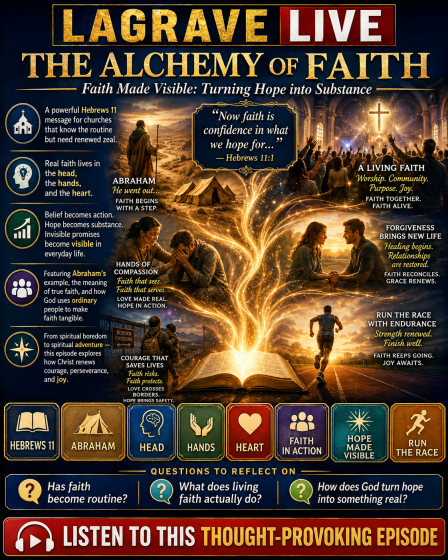
Faith Made Visible: Turning Hope into Substance
Summary
Faith in a Church That Knows the Routine
The service centers on Hebrews 11 and the challenge of sustaining vibrant faith over time. The preacher describes Hebrews as a message to a church that is not primarily battling persecution or false teaching, but weariness and spiritual boredom. He compares that situation to a long-established congregation where years of meetings, programs, volunteer recruitment, sermons, and familiar routines can make faith feel ordinary. Rather than condemning the church for this fatigue, he presents Hebrews as encouragement to recover joy and perseverance. The sermon repeatedly points listeners back to Jesus as the source and focus of renewed faith. The goal is not simply to maintain church activity, but to run the race of faith with fresh conviction.
Faith in the Head, Hands, and Heart
The sermon defines full-bodied faith through three dimensions: belief, action, and heartfelt assurance. Faith belongs in the head because Christians hold doctrines and truths drawn from Scripture, including belief in God, Jesus Christ, forgiveness, resurrection, and eternal life. Faith also belongs in the hands because what a person believes should lead to concrete action, such as comforting someone who is grieving or participating in the life and work of the church. Finally, faith belongs in the heart as a deep-rooted assurance and passion rather than merely an answer memorized for a test. The preacher argues that faith can become boring when one of these dimensions is missing. Robust faith engages the whole person - head, hands, and heart together.
The Substance of Things Hoped For
A central part of the message explores Hebrews 11:1 and the Greek word hypostasis, which the preacher says can carry the meaning of substance or essence. He prefers the image of faith as the "substance" of things hoped for because it suggests something concrete rather than merely an inward feeling of confidence. This becomes the sermon’s "spiritual alchemy" metaphor: faith takes hopes, beliefs, and ideas that seem intangible and makes them visible in the world. The preacher connects this idea to creation, describing God as bringing what was unseen into physical reality by His word. He also connects it to the opening of Hebrews, where Christ makes the unseen God known and visible. In the sermon’s framing, genuine faith similarly makes invisible hope tangible through faithful living.
Forgiveness as Faith Made Concrete
To show how faith becomes substantive in ordinary life, the preacher gives the example of a marriage damaged by infidelity. The couple may sincerely hope for reconciliation, but the hope remains abstract until forgiveness becomes an actual choice and practice. He describes a wife deciding not to define her husband only by what he has done, but to look at him in light of his identity in Jesus Christ. The preacher makes clear that forgiveness does not mean forgetting the betrayal. Instead, the act of forgiving becomes something solid on which the relationship may begin to rebuild. The illustration is offered as an example of faith turning an idea into visible, consequential action.
Courage That Gives Faith a Visible Form
The sermon then recounts the story of Swiss border official Paul Gruninger, whom the preacher portrays as an ordinary churchgoing man whose beliefs became concrete when he chose to help Jewish people seeking refuge during the Nazi era. According to the sermon, Gruninger defied instructions, altered documents, and helped many people enter Switzerland, eventually suffering arrest, disgrace, loss of position, and poverty. The preacher connects this costly action with the figures of Hebrews 11, many of whom acted faithfully without receiving an easy or immediate reward. He names biblical and historical figures alongside ordinary parents, teachers, and youth leaders as people whose choices can make faith visible. The point is that faith becomes compelling when hope and conviction take physical form in acts of courage, mercy, and obedience.
An Invitation to the Adventure of Faith
The service closes by calling the congregation away from spiritual boredom and toward what the preacher calls the adventure of faith. He emphasizes that believers do not create this transforming power independently; God is presented as the original source of the movement from unseen promise to visible reality. The closing prayer asks for a rich and robust faith expressed in heads, hearts, and hands, both individually and together as a church. Earlier prayers in the service connect this faith with congregational ministries, youth formation, people facing illness and grief, and outreach to the surrounding neighborhood. The final desire is that God's hope would become visible to a needy world through the church's life. The benediction sends the congregation into another week with a prayer for God's blessing, grace, presence, and peace.
LaGrave Live

If you’re looking for a warm church that commits to an intensely pertinent Gospel in the Reformed tradition of the Christian faith, we invite you to worship with us. Our 1,800 members come from across West Michigan and gather weekly in our sanctuary for relevant Biblical preaching, beautiful music, and inspiring worship. We expand our worship through intentional outreach in our community and world, attentive care for our members, and plenty of spiritual enrichment and social opportunities for everyone.
We focus on a living Savior who provides genuine solutions to the deep needs of a hurting world. We are committed to need-meeting ministry in His name, and we are committed to being real people who enjoy real life and who cry real tears. Because we are a fairly large and diverse group in terms of age, occupation, marital status, lifestyle, and physical ability; our members create many accessible opportunities for community service, Bible study, and small social groups.
We worship God, the Almighty Creator of heaven and earth, and we enjoy expressing our vision of His holiness through traditional music and formal liturgy.
Music plays an integral part of our weekly worship gatherings. Congregational singing—of both traditional hymns and newer ones—is typically supported by our pipe organ. Vocal choirs, handbell choirs, small ensembles, instrumentalists, and vocal soloists provide additional music offerings.
Led by the Holy Spirit, we seek to worship and serve God in all of life, transforming His world and being transformed to reflect the character of Christ.
Founded by 36 Dutch immigrants on February 24, 1887, LaGrave Avenue Christian Reformed Church has always been deeply committed to both this local community and worldwide missions. God has seen fit to guide and bless these commitments with sustained growth, spiritual gifting, and a continual stream of new work for our members.
Speaker Identification
Speaker 1 - Worship Leader / Preacher (Unidentified)
The same primary voice appears to lead the call to worship, welcome the congregation, introduce the Genesis and Heidelberg Catechism readings, offer the pastoral prayer, read and preach from Hebrews 11, lead the closing prayer, and give the benediction. The transcript does not state this speaker's name, so no identity is assigned beyond the role supported by the recording.
Speaker 2 - Congregation / Congregational Singing
The congregation gives liturgical responses such as "Thanks be to God" and "Amen" and appears to participate in sung portions of the service. The automated transcript badly duplicates or garbles several musical sections, so individual words are not assigned when they cannot be recovered confidently.
[Pre-service audio / music. Opening words are unintelligible in the automated transcript, followed by an obvious repeated-word transcription loop.]
Speaker 1 - Worship Leader / Preacher: Our call to worship comes from these words from Psalm 65:
"Blessed are those You choose and bring near to live in Your courts. We are filled with the good things of Your house, of Your holy temple. You answer us with awesome and righteous deeds, God our Savior, the hope of all the ends of the earth and of the farthest seas, who formed the mountains by Your power, having armed Yourself with strength, who stilled the roaring of the seas, the roaring of their waves, and the turmoil of the nations. The whole earth is filled with awe at Your wonders; where morning dawns, where evening fades, You call forth songs of joy."
Thanks be to God.
[Congregational singing / music. Exact words are not recoverable from the automated transcript.]
Speaker 1 - Worship Leader / Preacher: Congregation, where morning dawns and evening fades, our Lord surrounds us with His love, and He calls forth our songs of joy. And He greets us, saying: grace, mercy, and peace to you from God the Father, from Christ His Son, through the mighty and powerful work of His Holy Spirit. Amen.
Welcome, one and all, to our worship service, our vesper worship service here at LaGrave Avenue Christian Reformed Church. It is good to be here together with God's people. Welcome to those of you who are visiting. I hope you feel sincerely welcomed in this place and blessed by your time with us.
Tonight I will be preaching from Hebrews 11. Hebrews 11, I think many of you know, is that great chapter of faith where the preacher of Hebrews goes through all these people who are exemplars of faith in history. One of those people is Abraham, and so I've chosen for our reading tonight Genesis 12, verses 1 through 9. This is an example of the faith that Abram showed.
"The Lord had said to Abram, 'Go from your country, your people, and your father's household to the land that I will show you. I will make you into a great nation, and I will bless you. I will make your name great, and you will be a blessing. I will bless those who bless you, and whoever curses you I will curse; and all peoples on earth will be blessed through you.'
"So Abram went, as the Lord had told him; and Lot went with him. Abram was seventy-five years old when he set out from Harran. He took his wife Sarai, his nephew Lot, all the possessions they had accumulated, and the people they had acquired in Harran, and they set out for the land of Canaan, and they arrived there.
"Abram traveled through the land as far as the site of the great tree of Moreh at Shechem. At that time the Canaanites were in the land. The Lord appeared to Abram and said, 'To your offspring I will give this land.' So he built an altar there to the Lord, who had appeared to him.
"From there he went on toward the hills east of Bethel and pitched his tent, with Bethel on the west and Ai on the east. There he built an altar to the Lord and called on the name of the Lord. Then Abram set out and continued toward the Negev."
This is the Word of the Lord.
Speaker 2 - Congregation: Thanks be to God.
Speaker 1 - Worship Leader / Preacher: The preacher of Hebrews uses the story of Abram as an exemplar of faith. The Heidelberg Catechism summarizes the teaching of all of Scripture on the meaning of true faith. Let's rise and say this confession together responsively.
Congregation, what is true faith?
Speaker 2 - Congregation: True faith is not only a sure knowledge by which I hold as true all that God has revealed to us in Scripture; it is also a wholehearted trust which the Holy Spirit creates in me by the gospel, that God has freely granted, not only to others but to me also, forgiveness of sins, eternal righteousness, and salvation. These are gifts of sheer grace, granted solely by Christ's merit.
[Congregational hymn / singing. The automated transcript contains a repeated "We love you" loop and one garbled line; exact lyrics are not recoverable with confidence.]
Speaker 1 - Worship Leader / Preacher: Our pastoral prayer tonight will conclude with the two verses of the hymn printed in your liturgies. Before I pray, I also want to pray tonight for someone who was a member here long ago. I think some of you remember Bruce Quinn - Bruce and Jane Quinn. Bruce is familiar to the evening congregation because he actually came to evening services, and he used to do sound. He was often the sound man.
They've lived in Oregon, but they've live-streamed regularly and still feel very much a part of this community. Bruce went into hospice just last week, so I will pray for him and for Jane this evening. Let's pray.
Lord, tonight we thank You for the gift of faith. We thank You for the content of that faith, the amazing work that You've done with Your people throughout history, culminating in sending Your Son to die for us, to give up His life so that we could have hope. That's our faith, Father. That's our foundation.
And we thank You because that foundation is not just something that is in our minds, but You've also placed it in our hearts as a deep-rooted assurance. This isn't simply what we believe; this is our song. Thank You for this faith that allows us to live in the world with hope and generosity instead of fear and selfishness.
And so this evening we also pray that You continue to grow and nurture our faith in us and in Your world. Bless all the ways we nurture faith at LaGrave. I thank You and I pray for the Faith Formation Committee in all its work. Bless Chad and the rest of that committee as they help us grow in knowledge of faith and in our commitment to You. Thank You, too, for the way they bring us to prayer so that we can keep our faces turned toward You.
Thank You, too, for the Youth Education Committee and for the work of Rachel. Bless her as she thinks of how our youth can grow in their faith. We pray for all the youth programs as they soon start up this year, middle school and high school. We pray for our children's worship program, led by Anna. I pray for the ministry of GEMS. I pray for the ministry of Youth Outdoors.
Father, there are so many gifted people volunteering in this church to pass on the gift of faith to the next generation. Bless them, because this work cannot be successful without the power of Your Holy Spirit.
Father, we pray for all of us as individuals as we walk the road of faith. You know all the ways in which that road can be challenging. Sometimes we let busyness distract us. Sometimes the tragedies of our life put us under a cloud of sadness, and we have a hard time seeing out of that cloud. Sometimes doubts creep in. Sometimes we're derailed by temptations. There are so many ways in which our faith can be obscured and the road can be difficult. And again, Lord, we need Your Spirit and Your help to overcome.
You have promised that nothing in all creation can separate us from You. We claim that promise.
And finally, Father, I pray for this church as we share our faith with others in word and deed. May LaGrave make Your name glorious so that others may see Jesus and have the life of Jesus take up deep residence in their hearts. I pray for us as we consider how to use that building next door to minister to the neighborhood, to share Your gospel, and to share Your hope with this community and our neighbors.
And Lord, as always, remember all the names in our bulletin. We lift up those in hospice, and I think of Bruce Quinn and Jane tonight. We lift up those recovering from surgery. We lift up those struggling with cancer. We lift up those who are in mourning because they have just lost someone. I pray for our sister Sharon, [unclear phrase] in the loss of Nick, for the Vanderhardt family, and for Paul in the loss of Jerry.
Lord Jesus, guard the faith of all these people who are going through challenging times. You are stronger than what is facing them. Help them to know and feel that.
These are our prayers, Father. Hear them all. In Jesus' name we pray. Amen.
[Congregational response / music. Several repeated "Amen" entries in the automated transcript have been collapsed.]
Speaker 1 - Worship Leader / Preacher: As I said earlier, our Bible reading tonight is from the book of Hebrews, Hebrews chapter 11, and I will read the first twelve verses of Hebrews chapter 11.
The preacher of Hebrews says:
"Now faith is confidence in what we hope for and assurance about what we do not see. This is what the ancients were commended for.
"By faith we understand that the universe was formed at God's command, so that what is seen was not made out of what was visible.
"By faith Abel brought God a better offering than Cain did. By faith he was commended as righteous when God spoke well of his offerings. And by faith Abel still speaks, even though he is dead.
"By faith Enoch was taken from this life, so that he did not experience death. He could not be found because God had taken him away. For before he was taken, he was commended as one who pleased God. And without faith it is impossible to please God, because anyone who comes to Him must believe that He exists and that He rewards those who earnestly seek Him.
"By faith Noah, when warned about things not yet seen, in holy fear built an ark to save his family. By his faith he condemned the world and became heir of the righteousness that is in keeping with faith.
"By faith Abraham, when called to go to a place he would later receive as his inheritance, obeyed and went even though he did not know where he was going. By faith he made his home in the promised land like a stranger in a foreign country. He lived in tents, as did Isaac and Jacob, who were heirs with him of the same promise. For he was looking forward to the city with foundations, whose architect and builder is God.
"And by faith even Sarah, who was past childbearing age, was enabled to bear children because she considered Him faithful who had made the promise. And so from this one man, and he as good as dead, came descendants as numerous as the stars in the sky and as countless as the sand on the seashore."
This is the Word of the Lord.
Speaker 2 - Congregation: Thanks be to God.
Speaker 1 - Worship Leader / Preacher: You said it with more enthusiasm last time. I think you are so dutiful. If I mistakenly say, "This is the Word of the Lord," you just say, "Thanks be to God." You don't even stop to think about it. That's wonderful.
Let's talk about Hebrews.
Like many New Testament letters, Hebrews is written for a specific situation. There's something going on that the book of Hebrews is trying to address. That's pretty much true of all the New Testament letters. They're all generally trying to proclaim the gospel of Jesus and talk about Jesus, of course, but they're often addressed to some situation.
What's interesting about Hebrews is that I think it is addressed to a very unique situation, different from all those other letters. Persecution is not the reason for Hebrews. That's true of some of the other letters - First Peter, for instance - but we know it's not true of Hebrews because Hebrews says, "You have not yet resisted to the point of shedding blood."
Hebrews is not written to counter false teaching. Many of Paul's letters were written for that. The pastoral epistles all deal with that. Galatians deals with that. Colossians deals with that. That's not the issue in Hebrews.
What is the issue that Hebrews deals with? Well, the problem is more or less boredom. Hebrews is written to a church that is apparently not that excited about their faith anymore and is starting to lose interest.
Hebrews is written to a church that's not a new church. First Thessalonians, for example, is written to a church that's quite new, probably less than five years old, so it has a different tone. Hebrews is written to a church that most scholars think is at least forty years old. So, entering into middle age, you might say they're going through their midlife crisis.
Here's how Tom Long, in his commentary, describes it. He says after forty years they're tired of all the committee meetings, the education programs, the service projects, the planning for church picnics, the worship planning. The thrill is gone, and their zeal is lacking. They're starting to wear out.
Chapter 10 tells us that some of them have given up meeting together. They're just not showing up on Sunday morning. They're not that interested. Chapter 12 says that their knees are getting weak and their hands are getting limp. They're like runners at mile ten of the Fifth Third River Bank Run. For the first three miles they were going strong, and at mile ten their bodies are rebelling and they're thinking of dropping out.
That's the church that this letter is addressed to.
And then maybe that's why this letter, Hebrews, is a good letter for us. Is boredom a potential problem for the modern church in Grand Rapids, Michigan? I think that it is. Grand Rapids is a wonderful city. It's a great city to raise your children. I've raised all my children here. There are so many resources. There are so many wonderful institutions.
But sometimes, because so many people are Christians here, it is absolutely a place where faith can become run-of-the-mill. Ho-hum. Routine. Been there, done that.
At LaGrave we've been doing church for more than forty years. We've been doing it for 139. One hundred thirty-nine years of council meetings. One hundred thirty-nine Augusts of recruiting Sunday school teachers. One hundred thirty-nine years of sermons and all the routines of church work.
Hebrews is a good book for us so that we don't let this routine dull our minds and make our knees grow heavy, but instead run with joy the race set out for us.
How does Hebrews do that? The preacher of Hebrews does several things to restore our faith and to restore our zeal.
First of all, throughout the book, you'll know he reminds us of how wonderful Jesus is. He's saying Jesus is better than the prophets. He's better than the angels. And He has given you a better way into the courtrooms of heaven. So a lot of Hebrews is about extolling and reminding them what an exciting and amazing gift Jesus is.
But in chapter 11, that's when the preacher talks directly about the shape of faith. And that's what I want to concentrate on tonight.
I want to say two things about faith based on what we read. I want to say what faith is and what it does. What faith is, and especially, I think, what Hebrews is interested in: what it does.
So first, what does biblical faith look like? What is it? That's not spelled out systematically in the book, but if you look at all of Hebrews and if you look at all of Scripture, I think we can say pretty clearly what faith is.
Three things.
Faith is, first of all, belief. When you have faith, there are things that you believe. There are doctrines that you believe. I believe in God the Father Almighty. I believe in Jesus Christ, His Son. I believe in the forgiveness of sins, the resurrection of the body, and the life everlasting. I believe in the doctrines of the Heidelberg Catechism.
These are commitments that we have, truths that we hold that come from Scripture. These are things we have in our head. Belief is part of faith. Our head believes.
But faith is also action. That's the second part. It's not enough for us to know the truth. That truth has to lead us to do something.
It's not enough for you just to believe in your head that Jesus rose from the dead. When your friend loses someone, a spouse or someone dear to them, that belief ought to make you get up out of your chair and go visit your friend at the funeral home and say to them, "Christ is risen. There is hope."
It's not enough simply to believe in the holy catholic church and the communion of saints. You've got to join the communion of saints and show up for worship - as I don't need to tell you; here you are - and you've got to support the communion of saints through all of its programs and its works.
So, to continue the body metaphor, faith is something in your head, but it's also something in your hands.
And finally, full-bodied faith is also something in your heart. That's what the Catechism emphasizes. It's not just something we believe. It's a deep-rooted assurance. It's something that gets your attention. It's something that fills your passions.
Faith isn't just an answer that you memorized for a test. It's a passion that drives you. You don't just know that Jesus rose from the dead; it excites you. You don't just believe that Jesus forgives your sins. You want to understand forgiveness. You want to be good at forgiveness. You want to know what compassion is. These things excite your heart and mind, and you pursue them.
Put it all together, and full-bodied faith is in your head, it's in your hands, and it's in your heart.
And if faith, as you experience it, is feeling a little boring to you sometimes, a good way to look at that is to say: Am I firing on all three of those cylinders? Is faith just a doctrine in my head, and is it never something that comes out in my hands? Well, it's no wonder your faith is boring.
Or am I doing the work of faith, but am I doing it out of social pressure, just because that's what everyone expects me to do, and my heart isn't in it? Well, if that's true, it's no wonder faith is boring to you.
Real, robust faith has all three of these things.
So that's what faith is. The preacher's purpose here isn't so much to scold us. It's to encourage us about what faith can do - or, more precisely, what God can accomplish through full-bodied faith.
For me, the important verse, as we think about what faith can do, is verse 1 and this phrase: "Now faith is confidence in what we hope for." Faith is the confidence in what we hope for. That's his basic definition of faith.
And the word for "confidence" there is an interesting Greek word. It's hypostasis. If you're a theologian, you know that's a very important word. Faith is the hypostasis of things hoped for.
That gets translated as "confidence" in the NIV. It's a fine translation. But the typical meaning of the word is substance or essence. So faith is the substance of things hoped for.
That's different from confidence, right? "Faith is the confidence of things hoped for" sounds like a feeling. It sounds like something you feel inside. But "faith is the substance of things hoped for" sounds like something concrete. It's something you can see.
I like the substance translation better. If you think of it as substance, it's almost like the preacher is saying that faith is a kind of spiritual alchemy.
When you have full-bodied faith, you take something insubstantial - a misty hope, an idea in your head - and you make it real. You make it substantive. You take a concept and you make it concrete. You take something insubstantial, like an idea, and you make it into something physical that people can see.
And you can tell that's what the preacher means by the very first example he gives of faith, verse 3, which I mentioned when I was reading.
You know what faith is like, he says? When we have faith, it's almost like when God created the world. "By faith we understand that the universe was formed at God's command, so that what is seen was not made out of what was visible."
Now maybe when I read that, you thought, "Oh, what he's saying is that we all ought to have faith that God made the world out of nothing." He certainly does want us to believe that, but that's not what he's saying here.
He's saying that faith is like what happened when God created the world out of nothing. When God created the world out of nothing, He took something that was insubstantial and made it physical and made it real. Nothing existed. Life, the world, all of us were an idea in God's mind, and He spoke, "Let there be light." He spoke, "Let there be mountains," and the world came into physical existence.
That's what faith is like. When we act on our faith, we are able to take concepts and ideas and feelings and make them into something substantial that people can lean on, something that people can see, something they can build on.
Interestingly, if you're willing to go deeper with me, this is the same way the word is used earlier in Hebrews. At the very beginning of Hebrews, that word, hypostasis, is also used - that word for substance - when it talks about how God has spoken to us through His Son, and the Son is the radiance of God's glory and the exact representation of His being, His hypostasis, His substance.
And what the preacher is saying is: It's just like God. You can't see Him, but Jesus came, and now you can. Jesus makes concrete what we could not see, what was invisible.
In the same way, when we have faith, deep faith, we take misty hopes, big ideas, and we make them into something physical that people can lean on.
I know this sounds very technical and abstract and theological, but it is so important, and it is so real and everyday.
A husband and wife are having terrible marital problems because the husband has cheated on the wife. He's betrayed her and hurt her, hurt the children. And they say they want to make it better. They say, "No, we want to fix this." That's the idea they have. That's the hope they have.
But they're struggling because the hurt is so deep, and they just can't seem to get it going, until finally one day the wife just decides to forgive. She just does it. She's not going to look at her husband in the light of what he did. She's going to look at her husband in the light of who he is in Jesus Christ.
That doesn't mean she forgets what he did, but it's not how she's going to look at him anymore. She forgives him, and that forgiveness becomes something solid, something substantive, and that becomes the turning point on which they can start to rebuild their marriage.
Her faith turns something that's an idea into something substantive. This is real. I've seen it happen exactly like this. It happens all the time.
Another story. I heard this about this man years ago.
Paul Gruninger was a mid-level authority in the Swiss border guard. He guarded the border between Switzerland and Austria before and during the time of the Second World War. Paul Gruninger was just a regular dude, right? He had two kids. He went to church every Sunday. He probably learned his catechism when he was a kid. He believed. Most of it was in his head.
When the Nazis came to power, he finally decided that he needed to do something to make that faith substantive. And when he was told by the Swiss authorities, I presume, that he wasn't allowed to let anyone enter the country from Austria who was not Aryan - this was targeted, of course, especially at Jews - he decided that he would not listen to that.
When he received a Jewish passport, he would change it to Aryan. He did that once. He did it twice. He ended up doing it hundreds and hundreds of times. And as a result, this act of faith became something substantive that saved many, many lives. Something real. Something people could see.
Unfortunately, Gruninger was found out. He was arrested, disgraced, and stripped of his title, and he died penniless in Switzerland in 1972.
That's not a happy ending to the story. But it's not out of line with Hebrews 11, right? Many of them died without ever reaching what they were looking for. You remember when Hebrews 11 says that?
This is what faith looks like: taking hopes and ideas and making them concrete.
Abram, Noah, Samson, Ruth, Sarah, Rahab, Paul Gruninger, Dietrich Bonhoeffer - maybe your mom, maybe a youth leader you had - all these ordinary people who make faith real in our lives, make it something that we can see, who do this spiritual alchemy.
And you can do it too. You can help make concepts concrete in the lives of the people around you in small and large ways. And when you do it, it's not dull. It's exciting. It's the adventure of faith.
And it's not really you doing it, of course. It's God, because He's the original spiritual alchemist: creating this world out of nothing, taking Abram, who was as good as dead, and making him the father of salvation; taking a fourteen-year-old girl, making her pregnant, bringing us our Savior; and then taking a man dead three days in the grave and raising Him up again so that we could have hope eternal.
So, boredom be gone. Let us run with perseverance the race marked out for us, and set our eyes on Jesus, who is the author and perfecter of our faith. Amen.
Lord Jesus, we thank You for Your Holy Spirit and how Your Holy Spirit has created faith in our hearts. We pray that You would give us a faith that is rich and robust, faith in our heads, in our hearts, and in our hands.
We pray that this might not just be true of us as individuals, but that it may be true of us together as a church, so that the whole world may see the essence, the substance, of who You are, that Your hope may be made visible to a needy world.
In Jesus' name, amen.
[Congregational singing / closing music. The automated transcript repeats "We are the Holy Spirit" many times; exact lyrics cannot be confidently recovered.]
Speaker 1 - Worship Leader / Preacher: Receive God's blessing for another week.
The Lord bless you and keep you. The Lord make His face shine upon you and be gracious to you. The Lord turn His face toward you, smile upon you, and fill you with His peace, both now and forevermore. Amen.
[Closing congregational response / music. Repeated "Amen" transcription loop collapsed.]