
LaGrave Live, August 23, 2026

LaGrave Live
LIVE Morning Worship Service 08-23-2026
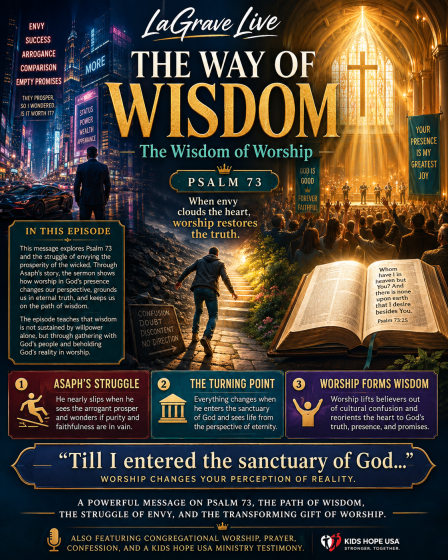
The Way of Wisdom: The Wisdom of Worship
About The Service:
We will conclude our Way of Wisdom sermon series. Pastor Jonker will preach on Psalm 73 which is considered a wisdom Psalm. His sermon is called “The Wisdom of Worship”
Order of Worship:
https://lagrave.org/wp-content/uploads/2026-8-23-AM-Order-of-Worship.pdf
About the Church:
We are a traditional CRC church in the middle of Downtown Grand Rapids, MI, worshipping at 8:40am, 11:00am, and 6:00pm. (10:00am and 6:00pm during the summer months)
We'd love to hear from you:
Connection: https://www.lagrave.org/contact
Let us pray for you:
Prayer: https://www.lagrave.org/prayerrequest/
Giving: https://www.elexiogiving.com/App/Giving/lagr107178
The August special offering is for Covenant House. Covenant House Michigan (CHMI) provides shelter and hope to young people aged 18-24 who are experiencing homelessness or victims of trafficking in Grand Rapids and Detroit. Their mission is to serve all youth who come to their doors with unconditional love, absolute respect, and relentless support.
Listen on the go:
Amazon Music: https://bit.ly/LGPodAmazonMusic
Apple Podcast: https://apple.co/3tuOdwQ
Google Podcast: https://bit.ly/LGPodGoogle
Soundcloud: / lagravecrc https://soundcloud.com/lagravecrc
Spotify: https://spoti.fi/3yXDFaT
Follow us!
Facebook: / lagravecrc https://www.facebook.com/lagravecrc
Instagram: / lagravecrc https://www.instagram.com/lagravecrc
Website: https://www.lagrave.org
#LaGrave #LaGraveCRC
When Worship Changes What You See: Wisdom for a World That Looks Upside Down
Summary
Wisdom Begins in the Life of Worship
The service frames wisdom not merely as intellectual knowledge but as a way of life formed through God's Word, confession, prayer, community, and worship. The opening readings from Colossians emphasize putting off the old self and putting on compassion, kindness, humility, gentleness, patience, and love. The prayers repeatedly identify God as the source of wisdom and ask for help in walking wisely in everyday life. This establishes the central theme that biblical wisdom must be practiced, not simply understood. Worship is presented as one of the primary ways believers are continually reoriented toward that path.
Mentoring as Wisdom Put Into Practice
A major congregational segment highlights the church's partnership with Kids Hope USA and Congress Elementary. Allison Klink describes how mentors give students consistent, individual attention and how children eagerly anticipate their weekly time together. She also explains the Blue Ticket Store, which rewards positive behavior and is supported by church volunteers and donations. The testimony stresses measurable changes in attitude, confidence, academic growth, and school behavior while also emphasizing that mentors themselves are changed by the relationships. The invitation to become a mentor presents service to children as a practical expression of Christian love and faithful community involvement.
The Spiritual Crisis of Psalm 73
The sermon turns to Psalm 73 and the struggle of Asaph, who nearly abandons the way of wisdom because he sees arrogant and wicked people prospering while his own faithful life seems difficult. The preacher illustrates that struggle through an imaginative modernized story in which Asaph is a hardworking, financially strained church musician who compares himself with an apparently carefree and successful former classmate named Biff. Biff represents a life of wealth, confidence, pleasure, attention, and worldly success that appears to contradict the claim that God is good to the pure in heart. Asaph's envy leads him to question whether keeping his heart pure has accomplished anything. The sermon argues that this ancient spiritual conflict remains recognizable in contemporary life.
Worship Changes the Perception of Reality
The turning point in Psalm 73 comes when Asaph enters the sanctuary of God. According to the sermon, worship changes his perception because it places his circumstances within a larger spiritual and eternal reality. What looked successful from the perspective of envy and comparison begins to look temporary, while the difficult way of wisdom begins to look meaningful and enduring. The preacher describes worship as something designed to lift people out of distorted cultural assumptions and help them see what is true. The lesson is that human willpower and knowledge alone are not sufficient to sustain a wise life; believers need the worship and communion of God's people.
The Sanctuary, God's Presence, and the Way of Wisdom
The sermon explains the tabernacle as a worship space that symbolically drew Israel into the holy presence of God and recalled Mount Sinai. Its courts, the Ark of the Covenant, and its sacred imagery are described as helping worshipers understand that they were approaching the throne room of God. From that perspective, ordinary judgments about power, success, status, and security are challenged. The preacher then connects this imagery to Christian worship by saying that the church building itself is not the tabernacle; Jesus is the tabernacle through whom believers enter God's presence. From that vantage point, the way of wisdom can be seen as the way of life even when it is difficult.
Worship as Freedom and Strength for the Week
The sermon closes with a story about worship at Celebration Fellowship Church in the Ionia prison. The preacher contrasts the guarded, distrustful atmosphere of the prison with the warmth, welcome, prayer, singing, and fellowship found inside the worshiping community. One inmate says that when he worships and prays with his brothers, he sometimes forgets that he is in prison and feels free. The preacher presents that experience as an example of what worship is meant to do: lift people out of fear, temptation, pressure, and distorted cultural messages so they can see that they belong to God. The closing prayer asks that the congregation leave worship ready to walk the way of wisdom for another week in the world.
LaGrave Live

If you’re looking for a warm church that commits to an intensely pertinent Gospel in the Reformed tradition of the Christian faith, we invite you to worship with us. Our 1,800 members come from across West Michigan and gather weekly in our sanctuary for relevant Biblical preaching, beautiful music, and inspiring worship. We expand our worship through intentional outreach in our community and world, attentive care for our members, and plenty of spiritual enrichment and social opportunities for everyone.
We focus on a living Savior who provides genuine solutions to the deep needs of a hurting world. We are committed to need-meeting ministry in His name, and we are committed to being real people who enjoy real life and who cry real tears. Because we are a fairly large and diverse group in terms of age, occupation, marital status, lifestyle, and physical ability; our members create many accessible opportunities for community service, Bible study, and small social groups.
We worship God, the Almighty Creator of heaven and earth, and we enjoy expressing our vision of His holiness through traditional music and formal liturgy.
Music plays an integral part of our weekly worship gatherings. Congregational singing—of both traditional hymns and newer ones—is typically supported by our pipe organ. Vocal choirs, handbell choirs, small ensembles, instrumentalists, and vocal soloists provide additional music offerings.
Led by the Holy Spirit, we seek to worship and serve God in all of life, transforming His world and being transformed to reflect the character of Christ.
Founded by 36 Dutch immigrants on February 24, 1887, LaGrave Avenue Christian Reformed Church has always been deeply committed to both this local community and worldwide missions. God has seen fit to guide and bless these commitments with sustained growth, spiritual gifting, and a continual stream of new work for our members.
Speaker Identification
Speaker 1 - Minister / Worship Leader / Preacher. The transcript does not state the speaker's name. The same primary voice appears to lead the greeting, announcements, confession, pastoral prayer, children's message, Scripture reading, sermon, closing prayer, and benediction. The text alone does not provide enough information to name this speaker confidently.
Speaker 2 - Allison Klink. She identifies herself by name and states that she has taught at Congress Elementary for eight years. She speaks about the school's partnership with Kids Hope USA and LaGrave.
Speaker 3 - Congregation / Congregational Singing. This label is used for brief congregational responses and for music sections when the automated transcript indicates singing. Several musical passages are too garbled to reconstruct word-for-word.
Speaker 3 - Congregation / Congregational Singing:
[Opening congregational hymn. The automated transcript is heavily garbled, and the exact lyrics cannot be reconstructed reliably from the transcript alone.]
Speaker 1 - Minister / Worship Leader / Preacher:
As we gather for worship this morning, let us come into God's presence with this prayer of greeting.
Heavenly Father, we pray that the grace of the Lord Jesus Christ, and the love of God the Father, and the fellowship of the Holy Spirit would be with us. Amen.
Good morning, everyone, and welcome to LaGrave Avenue Christian Reformed Church. We're in that time of year where we only have one service on Sunday mornings, and it's great to see all of your faces filling up the pews. Whether you're a member here or visiting with us for the first time, we just want you to know that we're happy to have you worshiping with us this morning.
We have a few announcements to share. First of all, each week we've been having the elder and deacon of a district host a time for coffee and fellowship in the parlor. This week it's the turn of District Eight. So, if you are in District Eight, feel free to head to the parlor after the service. This is a great time to get to know your elder, your deacon, and perhaps other members of your district whom you haven't run into yet.
Also, the African American History Museum has opened up just a few blocks away from us. There's going to be a tour conducted this Tuesday at 1:00 p.m. Your ticket is provided by LaGrave, but make sure you sign up today, because that's the deadline to get your ticket.
Today, for our call to confession, we'll be reading some words from Colossians 3. As we find the path of wisdom, Paul calls us to take off the clothing of the old self.
Speaker 1 - Minister / Worship Leader / Preacher:
Put to death, therefore, whatever belongs to your earthly nature: sexual immorality, impurity, lust, evil desires, and greed, which is idolatry. You must also rid yourselves of anger, rage, malice, slander, and filthy language from your lips. Do not lie to each other, since you have taken off your old self with its practices and have put on the new self, which is being renewed in knowledge in the image of its Creator.
As we seek the path of wisdom, Paul calls us to put on the clothing of the new self.
Speaker 1 - Minister / Worship Leader / Preacher:
Therefore, as God's chosen people, holy and dearly loved, clothe yourselves with compassion, kindness, humility, gentleness, and patience.
And over all these virtues put on love, which binds them all together in perfect unity.
Let us now come before God with this prayer of confession.
Lord, we thank You for the gift of Your Word and the insight it provides us. We thank You for Your law, even though it convicts us of our sins. We would not know what our sin was without it.
You tell us to remove from ourselves things like lust, malice, and greed, and we admit that these things have too much reign in our hearts. But, Lord, we also know that You have the power to cleanse us from our sins by the power of Your love granted to us through Christ Jesus, Your Son.
We pray that You would enable us to put on the new self, continually remaking us in Your image. Amen.
Hear these words of forgiveness from 2 Corinthians: Therefore, if anyone is in Christ, the new creation has come. The old is gone; the new is here. God made Him who had no sin to be sin for us, so that in Him we might become the righteousness of God.
Speaker 3 - Congregation / Congregational Singing:
Thanks be to God.
Speaker 3 - Congregation / Congregational Singing:
[Congregational music or singing follows. The automated transcript is too corrupted to reconstruct the words reliably.]
Speaker 1 - Minister / Worship Leader / Preacher:
[The beginning of the Kids Hope USA announcement is garbled in the automated transcript.]
Some of you here at LaGrave are already involved in this ministry. If you think that God might be calling you to work with students in our community, this could be a phenomenal way to do so. You can look at your bulletin or reach out to Kristen Bats for more information.
We actually have a teacher here from Congress Elementary. Her name is Allison Klink, and she's here to share more about Kids Hope USA.
Speaker 2 - Allison Klink:
Good morning. My name is Allison Klink. I've been a teacher at Congress Elementary for eight years, primarily teaching the middle grades. We are so blessed to have so many wonderful community partners who support us, with your church being one of our biggest blessings.
Kids Hope USA provides wonderful partnerships between caring, compassionate, attentive, gentle, and kind adults and students who desperately need them in their lives. Our students look forward to the day of the week that they get to meet with their mentor. I can't tell you how many times I've had one of my students literally jump for joy when they realize that it's their day of the week.
After lunch, our students can't wait to share what they did with their mentor that day - maybe a game of Uno or Guess Who, maybe painting, or going out for recess. I can't forget to mention how often we hear from other students, "I want a mentor," or, "How do I get a mentor?" We wish every student could experience this kind of relationship.
The attention and consistency our mentors provide is life-changing, reminding students that they are important, valued, and worthy of someone's undivided attention. Not only are we blessed with dedicated mentors from your congregation, but we're also blessed with your donations to supply our Blue Ticket Store, an incredibly successful motivational initiative that I had the pleasure of designing with Lisa and Elizabeth two years ago.
Our students earn blue tickets for showing positive behavior, and then, at the end of each month, they can visit the Blue Ticket Store, which is staffed by volunteers from your church. They spend their tickets on special snacks and drinks like Gatorade or Takis, small toys like slime or a journal, and larger-ticket items like Squishmallows and basketballs. Positive behavior has greatly increased throughout our school because of this.
Your church makes a meaningful difference in the lives of our staff and students every day. Through our Kids Hope program, we see incredible changes in the attitudes, confidence, and academic growth of our students who are blessed to have a mentor. Our students are grateful to have someone who gives them 40 minutes each week of undivided attention, encouragement, and support.
But the impact goes both ways. If you spoke with any Kids Hope mentor, I'm confident that they would tell you that the student they've been partnered with has also impacted their life just as much. It truly is a two-way street of positive impact. Imagine being able to make a lasting difference in a child's life while allowing that child to make a lasting difference in yours, all in just one lunch period a week.
I encourage you to prayerfully consider becoming a Kids Hope mentor and being a blessing to a child who needs someone in their corner. Thank you to Lisa and Elizabeth for allowing me the opportunity to speak to you this morning and to thank your congregation on behalf of Congress. Lisa and Elizabeth are so thoughtful in their mentor-student pairings and will match you with a student whom they believe will have a good connection with you.
Lisa and Elizabeth make being a community partner with LaGrave so easy and seamless. We can't thank those ladies enough for all the time and commitment they have put into our students and staff. Once again, to all our current mentors, future mentors, and the entire congregation, thank you for your time, donations, and prayers for Congress Elementary. Thank you.
Speaker 1 - Minister / Worship Leader / Preacher:
Thank you, Allison. Before we go into prayer, we want to take a moment to let you know that Nick Lanning passed away earlier this week. There's going to be a private graveside service held later this week. We'll be bringing Shannon Lanning and the rest of their family before the Lord this morning. So, would you please pray with me?
Heavenly Father, we praise You for being the source of all wisdom. You know that all of us look for wisdom. We want to know how to live our lives well, and we look for wisdom in all sorts of places. We look to books, experts, and anyone who claims to have knowledge in a particular area. Sometimes we find wisdom in the world; sometimes we find foolishness. We acknowledge that You are the true source of wisdom and that any wisdom we run across in this world is a gift from You.
It was by Your wisdom that You created all things, and through Your wisdom all things are sustained. We praise You that we can know wisdom personally through our Lord and Your Son, Jesus Christ. Today, help us to learn the way of wisdom through Your Word, treating it as the true authority when it comes to how we should live, and help us also to walk in wisdom throughout the week.
Lord, although Your wisdom is evident in the processes of this world, we also recognize that our world tries to reject wisdom and groans under the weight of sin. Because of this, we encounter pain. Please be with Dan Beemer and Ron Schumacher as they receive treatments in the hospital, as well as with Grace Shearer and Norma Tenholt, whose health is still recovering.
We also recognize the grief faced by the families of Ron Bunk and Reverend Jerry Vanderhardt, as well as the family of Nick Lanning. Please be with them in their time of mourning, offering to them Your comfort and peace.
As we remember that You're the source of all wisdom, we also celebrate the commitment fellow believers have made to walk in the path of wisdom. We praise You for the baptism of Cal and Richardson and the public professions of faith of Philip Blackport, Victoria Blackport, and Ashley Ponceine.
We pray that You would be with Uri and Carmen Al-Kivar as they serve as missionaries in Mexico City and are in talks about creating a long-term ministry for refugees in Spain. Please give them guidance and wisdom.
We also lift up the work of Kids Hope USA as they seek out students in vulnerable situations and attempt to be a light in their lives. We pray for the mentors who have dedicated their time and energy to those who need it, that You would give them wisdom and courage in the time they spend mentoring.
We also pray for the kids who are involved, that they will be receptive to the teaching of their mentors and encouraged by the love that is shown to them. We pray all of this in Your Son's name. Amen.
Speaker 3 - Congregation / Congregational Singing:
[Congregational hymn. The automated transcript contains recognizable fragments but is too garbled to reconstruct the exact lyrics reliably.]
Speaker 1 - Minister / Worship Leader / Preacher:
All right, children, it's time for the children's message. Come on forward and sit down around me, and I will tell you a story from my youth, from when I was young like you.
Oh, look at this. You can tell school's back, eh? Come on down, everyone. Have some of you started school already? Yeah, some of you are starting maybe Monday - starting tomorrow. Some of you have started; some of you haven't. That's kind of how it goes.
All right, have a seat. Listen up. So, when I was your age, I've got a confession to make. This is a hard thing for me to say because I'm a minister now, which I think you know: when I was little, I thought church was kind of boring. Yeah, I thought it was kind of boring. I thought, "Oh, the sermons are so long, and the prayers can be so long, and the service can go so long." Sometimes I was just trying to find a way to get through how long the service was.
I've told you about some of these things. My mom, at the beginning of the sermon, would give me a peppermint, and I would try to make that peppermint last through the whole sermon. I never made it because the sermon was too long.
Then one of my best friends was sitting just in front of me over there. I would stare at the back of his head and try to send him mind waves, because I thought if I stared hard enough at the back of his head, he would know that I was staring at him and he would turn around and look at me. Do you think it worked? No, it didn't work. He never turned around, but I tried.
And then, if all that failed, what I would do is poke my sister, and then she would poke me back. That was the most dangerous game, because if my mom caught me doing that, she would be really, really mad. You really shouldn't poke each other in church.
That's what I did. It was just hard for me to get through the service when I was young like you. And I know I'm not the only one, because there's a guy whose book I read. His name was Fred Craddock. He talked about how, when he was little, church was so boring to him and he could hardly wait to get through it.
But then something happened to him that changed him. One day he was in church - he was a teenager now, so he was older than you - and right in front of him in church there were two people, and they were kissing. They had an arm around each other, giving a smooch on the cheek, and they were lovey-dovey in church.
He was so mad. He said, "You should not be doing that in church. I'm trying to listen to the sermon. How can I concentrate on the sermon with you smooching in church?"
And all of a sudden he realized, "I'm trying to listen to the sermon. All of a sudden I care about what the minister is saying." Slowly, the Holy Spirit had changed him so that worship wasn't boring anymore. It was what he wanted. It's what he needed for his heart.
So I know that sometimes worship is hard and boring, but trust me: the Holy Spirit is working on you, and it's what you need for your heart. Now you have to go. You're absolutely right.
Congregation, what is our prayer for these children?
Speaker 3 - Congregation / Congregational Singing:
Go in peace.
Speaker 1 - Minister / Worship Leader / Preacher:
Our Bible reading this morning for our sermon is from Psalm 73. Psalm 73 is found on page 909 in your pew Bible. You can turn to it now, but before we read that Word, let's sing the hymn of preparation that we've been singing all summer. It's printed in your bulletins.
Speaker 3 - Congregation / Congregational Singing:
[Hymn of preparation. The automated transcript does not preserve the lyrics clearly enough for reliable reconstruction.]
Speaker 1 - Minister / Worship Leader / Preacher:
This is the last sermon in our Way of Wisdom series, which means that summer is almost over, as you know. Next week we'll have a guest preacher, and then we'll start a new series at the beginning of September. But this is the last in our wisdom series.
If you've been here, you know we spent most of this series in the book of Proverbs, because when you think of wisdom literature, Proverbs is the quintessential book of wisdom literature. Last week we went to Ecclesiastes, which was very different, but is also wisdom literature. Today we finish up in the Psalms.
We could have finished up in Job, which is wisdom literature, or Song of Solomon, which is wisdom literature, or, in the New Testament, James is also considered wisdom literature. We didn't get a chance to look at any of those this summer. We're going to finish up in the Psalms.
Not all Psalms are wisdom Psalms, but some of them are, and Psalm 73 definitely is. Psalm 73 is a really interesting Psalm. Some of you may have heard the name Walter Brueggemann. He's a very, very famous Old Testament scholar, and he's written a commentary on the Psalms. Here's the first sentence in his commentary on Psalm 73. He writes this: "We now come to what may be the most remarkable and satisfying of all the Psalms."
I thought that was interesting, because I'm sure that if I'd stopped those of you who are church people on the way into church and said, "Tell me your two favorite Psalms," I'll bet no one would have picked Psalm 73. Brueggemann does, and I hope we can see why.
We know it's a wisdom Psalm because, as I read it, the very first verse, I hope you'll hear, is like a proverb. Psalm 73, verse 1, is like a proverb, and then the rest of the Psalm is like evidence for the truth of that proverb. In fact, it's a story out of the life of Asaph. Asaph is the author of the Psalm. It's like an intimate story where he's revealing what's been going on in his heart, and all of that gives truth to the proverb at the beginning.
Let's read it and see how that goes.
Here's the proverb: "Surely God is good to Israel, to those who are pure in heart."
Now the story:
"But as for me, my feet had almost slipped; I'd nearly lost my foothold. For I envied the arrogant when I saw the prosperity of the wicked. They have no struggles; their bodies are healthy and strong. They're free from common human burdens; they are not plagued by human ills. Therefore pride is their necklace, and they clothe themselves with violence. From their callous hearts comes iniquity, and their evil imaginations have no limits.
"They scoff and speak with malice; with arrogance they threaten oppression. Their mouths lay claim to heaven, and their tongues take possession of the earth. Therefore people turn to them and drink up their waters in abundance. They say, 'How would God know? Does the Most High know anything?'
"This is what the wicked are like - always free of care, they go on amassing wealth.
"Surely in vain I have kept my heart pure and have washed my hands in innocence. All day long I've been afflicted, and every morning brings new punishments. If I had spoken out like that, I would have betrayed your children.
"When I tried to understand all this, it troubled me deeply, till I entered the sanctuary of God. Then I understood their final destiny. Surely You place them on slippery ground; You cast them down to ruin. How suddenly they are destroyed, completely swept away by terrors. They are like a dream when one awakes; when You arise, Lord, You will despise them as fantasies.
"When my heart was grieved and my spirit embittered, I was senseless and ignorant; I was a brute beast before You. Yet I am always with You; You hold me by my right hand. You guide me with Your counsel, and afterward You will take me into glory.
"Whom have I in heaven but You? And earth has nothing I desire besides You. My flesh and my heart may fail, but God is the strength of my heart and my portion forever.
"Those who are far from You will perish; You destroy all who are unfaithful to You. But as for me, it is good to be near God. I have made the Sovereign Lord my refuge; I will tell of all Your deeds."
This is the Word of the Lord.
I hope you heard that in the first half of this Psalm, through the first 14 verses, it is pretty clear that Asaph is worn out and that he is close to leaving the path of wisdom. We don't know exactly what put him in that frame of mind. We don't know what got Asaph to the place where he is ready to give up on the path of wisdom.
But we can know pretty clearly what sort of thing it would have been. I think Asaph says enough about his state of mind that we have a pretty good idea of what his spiritual struggle was like.
So let's imagine what Asaph might have been going through this morning. I imagine him as a young man living in Jerusalem, a few years out of college, who has just gotten his first job. He's got an apartment in the city, and he's working at a church because he's a church musician, after all, right? He likes to write Psalms. He's a church musician. He's got a job at a church. He's so excited.
Of course, it's only half-time church music. It's hard to get a full-time church music job. Half of it is doing other stuff in the church. But he wants to do the right thing with his life. His parents taught him to follow the path of wisdom. He wants to lead a meaningful life. So he's out there. He's doing it.
The hours are long. Any time you have a job that is two 50-50 components, it ends up being more like 75 and 75. He's working 60 hours a week, trying to keep up his volunteer work on the side. He's burning the midnight oil. He doesn't have much money. I mean, again, he's a church musician, after all. He can barely afford his apartment. He's paying off all those student loans, and all this has his chronic anxiety going, and that complicates things.
His days are not simple, but he's hanging in there. As long as his car doesn't break down, and if he keeps eating mac and cheese and hot dogs, he can make ends meet. He can survive - barely.
All this would be hard enough on its own if it weren't for the fact that right across the street from him in the city, a whole bunch of luxury condos have just been built. In one of those condos lives Biff.
Biff was a classmate of his in high school. They don't know each other very well. They moved in totally different circles in high school. Biff was one of those people who sort of skated through high school on charm and good looks. Asaph, though, was a nose-to-the-grindstone man. He's the one who, when the teacher asked a question, raised his hand. He showed up early once a week at school for the Bible study. He was a keener - not Biff so much.
Now Biff's life is still completely different from his. In the words of verse 5, Biff's life is free from common human burdens. Biff didn't go to college, so he doesn't have any student loans, and he already has a great job that pays him tons of money. He's working for his dad. His dad was a rich camel owner in town, and Biff is working for him - if Biff can call it working.
He works from nine to three every day, and then from three to five every day he's down at the gym working out. Biff likes to be buff. As Asaph says in verse 4, his body is healthy and strong. He drives a brand-new car; every year he upgrades. He gets his haircut every other week. He always has the latest clothes.
Most aggravating of all for Asaph, Biff goes out every weekend and parties at the clubs, and he comes home late at night, it seems, with a different girl every week. Asaph can hear them giggling in the street at two in the morning as they go into Biff's condo. It drives him crazy.
A few weeks ago, Asaph went down to the local pub to get himself a cheap sandwich, and who was at the bar? Biff.
What was Biff doing? He was holding forth, man. He was loudly proclaiming all his opinions about politics, about religion. He was speaking as a man who had absolute certainty and knew the answers to absolutely everything. His speech was crude. It was full of mockery. There were F-bombs flying every other sentence. The whole bar could hear him.
And the worst thing is, all the people at the bar were drinking it in like this was pearls of wisdom. They were nodding their heads.
"Pride is his necklace, and he clothes himself with violence. He scoffs and speaks with malice. His mouth lays claim to heaven, and his tongue takes possession of the earth." People turn to him and drink up his words in abundance.
Asaph looks at Biff and thinks, "This is what the wicked are like: always free of care, and they go on amassing wealth."
Then Asaph turns and looks at his own life, and there's a little voice inside that says, "What am I doing? What am I doing trying to be Mr. Good Guy? What am I doing spending all this time working so hard, making no money? What is this getting me?"
Verse 13: "Surely in vain I have kept my heart pure."
That's a remarkable thing for him to say. Look at the proverb at the beginning of the passage: "Surely God is good to Israel, to those who are pure in heart." Verse 13, Asaph is saying the opposite - or he's close to saying the opposite: "Surely in vain I have kept my heart pure."
He starts to imagine a different kind of life for himself, a life with a little less gentleness and a little more swagger. "Maybe I should just grab a piece of the action while I can." He starts daydreaming about money, power, sex.
Now, is this exactly what happened to Asaph in Psalm 73? Of course not. But is this exactly the spiritual struggle that Asaph had in Psalm 73? Absolutely yes. This is precisely the spiritual struggle that Asaph went through in this Psalm.
This Psalm may be 3,000 years old, but the spiritual struggle described in this Psalm is very, very present today, and it has been throughout history: this conflict between the way of wisdom and, for lack of a better word, the way of Biff.
So we get to verse 14, right? And Asaph says, "What did I gain from keeping my heart pure?" It sounds like he's about to pack it in.
Then, all of a sudden - I think you heard this - he changes in the second half of the Psalm. What is it that gets him to change? What is it that makes him suddenly see the light?
He goes to church. He goes to worship with God's people.
Verse 17: "When I tried to understand all this, it troubled me deeply till I entered the sanctuary of God; then I finally understood their destiny."
Asaph was changed by worship, by gathering together with God's people, hearing God's providence, and worshiping in God's place. Being together with God's people in His sanctuary completely changed his perception of reality and what was true. And that is precisely what worship is designed to do: to completely change your perception of reality.
How does worship accomplish this? All right, let's go deep for a second.
When Asaph was worshiping, where would Asaph have been worshiping in Jerusalem? What was the sanctuary? At that time, it would have been the tabernacle, right?
Those of you probably know, but I'll explain it anyway. The tabernacle was a big, fancy tent, and there were three parts to this very fancy tent. There was the big outer court, then an inner court called the Holy Place, which had some holy implements that God had put there, and then the very inner court called the Most Holy Place. That's where the Ark of the Covenant was. That was like the very throne room of God, right? That's where God was present.
There were rules about who could go to which place. In the outer court, anybody could come. We could all come. In the second level, only the priests could go, and in the Holy of Holies, only the high priest.
This was made to mimic Israel's experience on Mount Sinai. The tabernacle was made to be like a mini Mount Sinai, so that when the Israelites approached it, it was like they were approaching the foot of that mountain where God's presence burned with fire and smoke on the top of the mountain.
Remember Exodus 20 to 24. The people had to stay at the bottom of the mountain - level one. They couldn't go any further than the bottom. The elders could go halfway. Exodus 24: they have dinner with the Lord up there. Only one person could go all the way to the top: Moses.
So the whole construction of the tabernacle was made to make people like Asaph feel like they were coming to the foot of Mount Sinai and beholding the holy presence of God like the Israelites.
The tabernacle also had all kinds of iconography - pictures in it. See, all those curtains around the outside? They were all embroidered with color, and there was one creature that was repeatedly embroidered into those curtains. Do you know what that creature was?
Cherubim. Not a cherub, like those fat little angels - cherubim, six-winged creatures who are fierce and mighty and hold up the throne of God, embroidered into those curtains all the way around the outside.
There's another place in the tabernacle where the cherubim show up. Where's that? The Ark of the Covenant, right? Cherubim hover over the Ark of the Covenant with their wings forward.
What was that iconography about? What were those images about? It was meant to make you feel like, when you walked into the tent, you were in God's holy place. You were in the courtroom of God, right? You were lifted out of the wilderness and brought into God's holy presence, to Mount Sinai, to the very courtroom of the Almighty.
And from the perspective of that courtroom, everything looks different. Everything looks different.
Sitting in the bar, listening to Biff, watching how he attracts attention, how he attracts women, how he attracts money, looking at his nice haircut and his good appearance, it's easy to think, "This is how the world works." It's easy to be sucked into a certain kind of wisdom.
There are certain kinds of proverbs that start to spring up in your mind when you give your attention in that place. Proverbs like, "Nice guys finish last." "To the victor go the spoils." "If someone hits you, hit him back twice as hard." "Second place is the first loser." There's a certain kind of wisdom that seems to hold in that place.
But when you get to the throne room of God, the fog of that lifts. Asaph, all of a sudden, understands when he's with God's people in that place, when he looks around him and sees the tabernacle, when he hears the promises of God read, when he sings the songs, he realizes that no, this is not the way the world works. The way of Biff is an illusion.
And so, for the whole second half of the Psalm, he's saying, "The Lord is right beside me. I am not abandoned. All my work is meaningful." And the way of wickedness ends in destruction. The wicked are like a dream that evaporates in the morning.
In the sanctuary, Asaph sees, "God will guide me by His counsel and afterward take me into glory." From the perspective of the holy sanctuary, he can see all the way to eternity. The way of Biff seems small, and the way of wisdom, even though it is hard, seems eternal.
Wisdom needs to be grounded in the worship of God's people.
If all you do is go out there with those Proverbs that we've been studying, the book, and your brain and your will, you're not going to make it. It's not enough. Your brain and your will are not strong enough. It takes the communion of God's people. It takes worship to sustain you.
And here, every week in this place, we come into the tabernacle and enter into the presence of God. This building isn't our tabernacle. Jesus is our tabernacle. Hebrews 10. I can't explain it now. Look it up. But Jesus is our tabernacle, and through Him we enter into the very presence of God.
From that perspective, we can see that He is Lord, our lives are meaningful, and the way of wisdom is the way of life. Wisdom needs the worship of God's people.
We'll finish with an example of that. It comes from 13 years ago, very early in my time at LaGrave, when Mike Hogaboom was still our minister of outreach.
I went with Mike, with some of you who are here today too, to worship at Celebration Fellowship Church. That's in the Ionia prison. [The transcript contains an unclear sentence here about another Celebration Fellowship-related congregation for people who have been released from prison.] I went to the one that was in the prison.
We got in our car and drove down there in this church van. I don't know if you've ever been into a prison, but when you go in, there's a whole process for getting you in through the doors, and it's not a friendly process.
You meet the guards and they check you in. If you smile at them, they don't smile back. If you try to make small talk with them, they are not interested. And there's a reason for that, right? They're in an environment where they've learned not to trust anyone, where they've seen the worst of human behavior, where they know that people are trying to put something over on them.
And so there's a kind of wisdom that grows in them. The wisdom they live by is: "Trust no one. Watch your back." That was the vibe I got as I entered.
We got through. We got in, and we went into this room on the inside. It was just a cinder-block room. There were metal folding chairs. There were no windows to the outside, of course. So it was very cold and institutional.
But then the inmates started to come in, and they were friendly and warm, and they welcomed us. Some of them were effusive and outgoing, but even the introverts smiled and said, "Welcome. We're glad that you're here."
At the beginning of the service, there were some new inmates there, and they were asked to stand up and say what cell block they were from. Everyone said, "Welcome." Then we heard Scripture, and we sang some songs, and we broke up into these small groups. The atmosphere was completely joyful and loving and caring and accepting.
When I got into my little circle, one of the inmates said this - not to me, but to the group: "Man, I look forward to this all week. When I'm in here worshiping, when I'm in here with my brothers praying, I sometimes forget I'm in prison. When I'm worshiping, I feel free."
That young man was experiencing exactly what worship is always supposed to do: to lift you out of the culture that wants to push you in a different direction; to lift you out of the meanness and fear of the cell block; to lift you out of the temptations of Egypt; to lift you out of whatever it is that's afflicting you today, and bring you into the presence of God so you can see the truth.
You belong to God. [One short phrase is garbled in the automated transcript.] Nothing can shake you from His hand.
It's what happened to Asaph. It's what happens to us.
Praise God for the gift of worship, for the way it shows that this is our Father's world, and for the way it keeps us on the path of wisdom. Amen.
Lord, it's so good to be here. It's so good to be here in a full church. It's so good to sing Your songs and to have the sound fill up this place. It's so good to go to Your Word and realize that the struggle we're going through in our lives is a 3,000-year-old struggle and longer, and that Your Spirit is going to bring us through this struggle.
Lord, I pray that we may all leave this place ready to walk the way of wisdom for another week in the world. Amen.
Speaker 3 - Congregation / Congregational Singing:
[An extended response or musical section follows. The automated transcript repeats "Amen" hundreds of times; these repetitions are treated as transcription artifacts and are not reproduced individually.]
Speaker 1 - Minister / Worship Leader / Preacher:
Receive the blessing of your Lord.
The grace of our Lord Jesus Christ, the love of God, and the fellowship of the Holy Spirit be and abide with you all.
Speaker 3 - Congregation / Congregational Singing:
Amen.
[Closing music / postlude. The remaining automated transcript consists almost entirely of repeated "Amen" artifacts and contains no additional reliably recoverable spoken content.]