
LaGrave Live, August 2, 2026

LaGrave Live
LIVE Morning Worship Service 08-02-2026
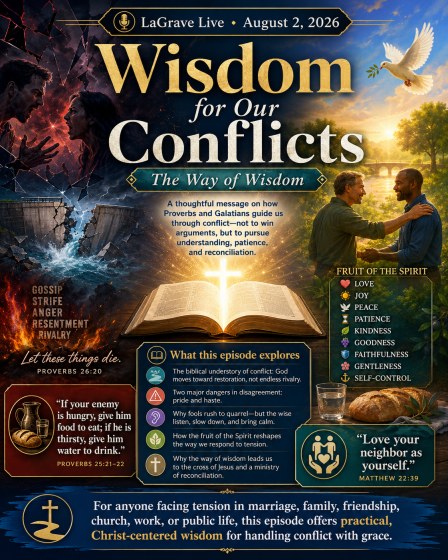
The Way of Wisdom: Wisdom for Our Conflicts
About The Service:
We continue our sermon series on Biblical wisdom called The Way of Wisdom. Pastor Jonker will preach on the theme of keeping peace between each other avoiding a quarrelsome spirit. That's a theme found in proverbs such as Proverbs 22:24-25.
Order of Worship:
https://lagrave.org/wp-content/uploads/2026-8-2-AM-Order-of-Worship.pdf
About the Church:
We are a traditional CRC church in the middle of Downtown Grand Rapids, MI, worshipping at 8:40am, 11:00am, and 6:00pm. (10:00am and 6:00pm during the summer months)
We'd love to hear from you:
Connection: https://www.lagrave.org/contact
Let us pray for you:
Prayer: https://www.lagrave.org/prayerrequest/
Giving: https://www.elexiogiving.com/App/Giving/lagr107178
The August special offering is for Covenant House. Covenant House Michigan (CHMI) provides shelter and hope to young people aged 18-24 who are experiencing homelessness or victims of trafficking in Grand Rapids and Detroit. Their mission is to serve all youth who come to their doors with unconditional love, absolute respect, and relentless support.
Listen on the go:
Amazon Music: https://bit.ly/LGPodAmazonMusic
Apple Podcast: https://apple.co/3tuOdwQ
Google Podcast: https://bit.ly/LGPodGoogle
Soundcloud: / lagravecrc https://soundcloud.com/lagravecrc
Spotify: https://spoti.fi/3yXDFaT
Follow us!
Facebook: / lagravecrc https://www.facebook.com/lagravecrc
Instagram: / lagravecrc https://www.instagram.com/lagravecrc
Website: https://www.lagrave.org
#LaGrave #LaGraveCRC
Winning Less, Reconciling More: The Wisdom of Proverbs in Conflict
Summary
Conflict Is Often About Process
The service frames conflict as a universal human experience and emphasizes that disagreements are shaped not only by the issue at stake but also by the way people engage one another. The preacher asks listeners to consider their personal conflict styles, including whether they avoid confrontation, rush toward resolution, become emotional, or rely heavily on logic. Drawing from premarital counseling and everyday relationships, he argues that the process of conflict often causes more harm than the original disagreement. Proverbs is presented as practical wisdom for keeping conflict from becoming destructive quarrels and for moving toward understanding or resolution.
A Different Story Beneath the Conflict
The sermon introduces the idea of an "understory," meaning the deeper view of life that shapes how people interpret conflict. The preacher contrasts Proverbs with ancient and modern works that focus on defeating opponents, gaining power, and winning at all costs. He argues that those approaches assume enemies and struggle are fundamental to existence. Proverbs, by contrast, is rooted in a biblical story in which conflict entered through sin but is not the ultimate structure of creation. God's work moves toward harmony, restoration, reconciliation, and the renewal made possible through Jesus Christ.
Enemies as People Made in God's Image
Because Proverbs rests on a different understory, its wisdom does not instruct people to crush their enemies. Instead, it calls them to feed a hungry enemy, give water to a thirsty enemy, and remain open to reconciliation. The preacher challenges listeners to consider whether they still see an opponent as a person made in God's image and as someone with whom restoration might someday be possible. When people treat others as permanent threats who must only be stopped or overcome, he says, they risk abandoning Scripture's larger story. Christian conflict is therefore meant to remain shaped by hope, grace, and the possibility of restored relationship.
The Danger of Pride
The first major danger in conflict is pride, illustrated through the preacher's memory of being argumentative as a young teenager and being warned by his mother not to act like a know-it-all. Proverbs teaches that fools delight in broadcasting their opinions, while wise people listen to advice and recognize the limits of their knowledge. The sermon holds conviction and humility together: Christians may believe deeply, make judgments, and speak against injustice, but they must also remember their own sinfulness and limited perspective. The preacher warns against copying Jesus' sharp confrontations without acknowledging that Jesus could see people's hearts with a clarity ordinary human beings do not possess.
The Danger of Haste
The second danger is haste, because conflict tends to accelerate quickly from an issue into a contest of wills. A playground example shows how one insult leads to another, then to a shove, a stronger shove, and finally a physical fight. The preacher compares the wisdom of Proverbs with de-escalation practices that call people to lower their emotional intensity, avoid answering insults, speak respectfully, pause before responding, and create space. Proverbs repeatedly describes the fool as quick-tempered and eager to quarrel, while the wise overlook insults, drop matters before they erupt, listen, remain patient, and bring calm.
Conflict Beneath the Cross
The sermon concludes by connecting wise conflict directly to God's character and the cross of Christ. God is described as slow to anger, rich in steadfast love, patient with human rebellion, and unwilling to repay people according to what their sins deserve. Jesus receives insult and rebellion, responds with sacrifice, and asks forgiveness for those who harm him. The preacher therefore calls listeners to let every disagreement begin under the shadow of the cross, remembering the grace they have received and extending restraint, humility, patience, and reconciliation toward their neighbors.
LaGrave Live

If you’re looking for a warm church that commits to an intensely pertinent Gospel in the Reformed tradition of the Christian faith, we invite you to worship with us. Our 1,800 members come from across West Michigan and gather weekly in our sanctuary for relevant Biblical preaching, beautiful music, and inspiring worship. We expand our worship through intentional outreach in our community and world, attentive care for our members, and plenty of spiritual enrichment and social opportunities for everyone.
We focus on a living Savior who provides genuine solutions to the deep needs of a hurting world. We are committed to need-meeting ministry in His name, and we are committed to being real people who enjoy real life and who cry real tears. Because we are a fairly large and diverse group in terms of age, occupation, marital status, lifestyle, and physical ability; our members create many accessible opportunities for community service, Bible study, and small social groups.
We worship God, the Almighty Creator of heaven and earth, and we enjoy expressing our vision of His holiness through traditional music and formal liturgy.
Music plays an integral part of our weekly worship gatherings. Congregational singing—of both traditional hymns and newer ones—is typically supported by our pipe organ. Vocal choirs, handbell choirs, small ensembles, instrumentalists, and vocal soloists provide additional music offerings.
Led by the Holy Spirit, we seek to worship and serve God in all of life, transforming His world and being transformed to reflect the character of Christ.
Founded by 36 Dutch immigrants on February 24, 1887, LaGrave Avenue Christian Reformed Church has always been deeply committed to both this local community and worldwide missions. God has seen fit to guide and bless these commitments with sustained growth, spiritual gifting, and a continual stream of new work for our members.
Speaker Identification
Speaker 1 - Worship Leader / Liturgist
This speaker introduces the summer sermon theme, reads from Galatians, leads congregational prayer, offers an assurance based on the fruit of the Spirit, shares church-family concerns, and leads the pastoral prayer. The transcript does not provide a name, and it is not certain whether this person is also the preacher.
Speaker 2 - Congregation / Choir
This label covers spoken congregational responses and sung portions of the service. Several musical passages were badly distorted by the automated transcription and could not be reconstructed reliably.
Speaker 3 - Children's Message Leader
This speaker concludes a partially captured Frog and Toad story, asks the congregation for its prayer for the children, and transitions toward the Scripture reading. The transcript does not provide a name.
Speaker 4 - Preacher, identified only as Peter
The sermon speaker refers to himself as Peter while recalling something his Dutch mother told him. No last name is stated in the transcript, so no further identity has been assumed.
Speaker 2 - Congregation / Choir:
[Opening congregational hymn. The automated transcript contains heavily garbled and repeatedly duplicated lyrics that cannot be reconstructed reliably from the transcript alone.]
Speaker 1 - Worship Leader / Liturgist:
We're continuing our summer sermon series, The Way of Wisdom, from the Book of Proverbs this morning. Our readings from Proverbs today give us pictures of better and worse ways to engage when we face conflict - something all of us are so eager to face.
In his letter to the Galatian church, the Apostle Paul writes to address a significant conflict about what Jesus' work on the cross means and what it accomplishes. Sometimes Paul's words are sharp in that letter. He also teaches about following Jesus, even in the middle of conflict. Listen to these words from Galatians 5:
"You, my brothers and sisters, were called to be free. But do not use your freedom to indulge your earthly nature; rather, serve one another humbly in love. For the entire law is fulfilled in keeping this one command: 'Love your neighbor as yourself.' If you bite and devour each other, watch out, or you will be destroyed by each other."
Let's go before our Lord, joining our voices and saying together:
Speaker 2 - Congregation:
God, in whom we live and move and have our being, before a word is on our lips, you know it completely. You see our moments of calm and easy harmony. You witness our inner turmoil and its outward effects. In a broken world, we have conflict with ourselves and with others.
Forgive us when, in anger, we sin against each other and against you. Make us quick to listen and slow to speak, more eager to honor your mercy than to insist on our rights. Advance the unity for which Jesus prayed through the bond of peace, and help us seek your kingdom together. In Jesus' name, amen.
Speaker 1 - Worship Leader / Liturgist:
It is possible that we are never more aware of our need for the peace Jesus brings than when we are at odds with the people around us. Today we rejoice because God's Spirit grows fruit in us. It is not something we accomplish all on our own. It is a gift of God's Spirit through the grace of Jesus.
Relying on God's Spirit shapes us to reflect something of who God is, even in the complicated places of our world. Hear the good news of the life made possible in Christ:
"The fruit of the Spirit is love, joy, peace, forbearance, kindness, goodness, faithfulness, gentleness, and self-control. Against these things there is no law."
Speaker 2 - Congregation:
Thanks be to God.
Speaker 2 - Congregation / Choir:
[Musical or spoken congregational response. The repeated wording in the automated transcript is not reliable enough to reconstruct.]
Speaker 1 - Worship Leader / Liturgist:
A couple of items of church-family concern to let you know about, in addition to what is printed in your bulletins this morning: Grace Shearer is at Mary Free Bed for rehabilitation after breaking a couple of bones in her pelvis, and Jerry Vander Hart is currently in the hospital for some tests.
Let's pray together.
Jesus, you are our Lord. You call, and we want to follow you. Help us to magnify your name, making the nature of your grace larger and easier for people to see. Help us live as clear magnifying glasses through which our neighbors, coworkers, children, and friends can see you come into focus in ways they may not have seen before.
When people ask for an explanation of the hope we have, help us answer thoughtfully and well. Help us magnify your name, Lord, so that you may be glorified everywhere.
Lord, our world could use more glimpses of your glory and fewer glimpses of the wreckage to which our sin so easily leads. In a world that seeks revenge, show the glory of grace. In a world that prefers lies, show the glory of truth. In a world that prizes self-advancement, show the glory of sacrificial love. In a world mired in death, show the glory of your resurrection life.
We acknowledge the uncountable blessings you have showered on us. So many of us woke up this morning with food in our cupboards and water available in our kitchens. We know this is not true for all of your image-bearers everywhere.
Jesus, you broke a little bread and fed so many. Gardener God, you made a garden and filled it with food. Multiply and renew the efforts of aid organizations, governments, and individuals to relieve human hunger and bring hope.
Thank you, Lord, for the food of the gospel and the persistent faithfulness of missionaries like Pastor Hera, serving in Nepal. Let him and others glimpse the fruit of your work through their efforts, and nurture the faith of those who are just beginning to walk with you.
Bless members of this congregation in their walks with you, Lord. Shine the light of your face on Anne, Max, and Grace Stecker as they continue their journey with Jesus and your people. Thank you for their faith commitment.
Thank you for the love and commitment that brought Lily Clap and Jeremiah Jones to their wedding day last weekend. Bless and strengthen them in their new marriage.
Bring joy and perseverance to Molly and Gazi Alec as they welcomed little Theo last week. Strengthen Theo and their whole family as they adjust to being a family of five.
Heal and bring peace to those who are sick among us, those who are hurting, and those who are sad. Comfort those who grieve losses, old and new, of people they love.
Support Eleanor Bolins and Jim and Debbie Viscer in the passing of Eleanor's sister, Lois. Bring healing and strength to those who are hospitalized or in rehabilitation: Jerry Vander Hart, Steve Palazzolo, Carol Hoffman, Dave Vander Ark, and Grace Shearer. Help each one know your present hope and help.
Show your faithfulness to Sandy Des Trump as she recently returned to Grand Rapids. Provide what she needs and help her feel at home here.
As we continue our worship, fill us with yourself as we sing, and lift us to yourself. As we give offerings of time, talent, and treasure, shape us into people who move in the rhythm of your generosity. As we turn to the Word, meet us with yourself.
As we consider our call as your body at La Grave Church, be glorified in us and in what we do. We pray in the name of Jesus, asking that he may be brightly seen among us. Amen.
Speaker 2 - Congregation / Choir:
[Congregational hymn, identified in the transcript by the opening phrase "Make me a channel of your peace." The remaining sung lyrics are not reproduced here because the automated transcription is unreliable.]
Speaker 3 - Children's Message Leader:
[The children's-message excerpt begins in the middle of a Frog and Toad story.]
"Hello, Frog."
"And then I took it because I had to rake my lawn. I'm sorry it isn't done yet. For some reason, it is taking longer than I expected."
Then Frog looked at Toad, and Toad looked at Frog. They forgave each other, went inside, and had [unintelligible] together. So they are still friends, and they are not fighting - at least, not today.
Congregation, what is our prayer for these children?
Speaker 2 - Congregation:
[Congregational response not intelligibly captured.]
Speaker 3 - Children's Message Leader:
Our Bible reading this morning is printed in your liturgies because it consists of discrete proverbs about conflict. Have those ready, but before we go to them, let's sing our hymn of preparation, the one also printed in your liturgies.
Speaker 2 - Congregation / Choir:
[Hymn of preparation.]
Speaker 4 - Preacher:
Before I read the proverbs printed in your bulletin, let me offer a little setup.
A number of you who are younger and married have been through my premarital counseling sessions, so you will know - and this will probably not surprise the rest of you - that I always include a section on conflict: how we do conflict.
In that session, I always ask the couple questions such as: How are you in conflict? Are you a person who runs away from conflict, does not like it, and tries to avoid it? Are you someone who says, "I want to deal with this conflict," steps into it, and wants to get it done? When conflict starts to become emotional, do your emotions rise to the surface, or are you very rational, reasonable, and logical in conflict? What are you? What is your conflict style?
I want people to think about that because, so often, when people fight - and this is not just true for married couples; it is true for anyone - we think the disagreement is all about the issue.
Why don't the two of you get along all the time? "We cannot agree about how to raise the children. We cannot agree about how to spend money. She is a night person; I am a morning person." They think about the issue.
Most of the time, however, more serious than the issue is the process: the way we do conflict and how we process it. What you see in marriage is what you see in every relationship - within your family, in your friendships, and at work. Who you are in conflict and how you process it with people are extremely important to achieving success in conflict.
If you listen to the proverbs I am going to read, they are all about the process. They are not about the issue; they are about the process. They do not want our conflicts to turn into quarrels. Those are two different things. They want our conflicts to be fruitful and, hopefully, lead to resolution or at least to understanding.
Let us listen to this wisdom of the Holy Spirit from the Book of Proverbs:
"It is to one's honor to avoid strife, but every fool is quick to quarrel.
"Like one who grabs a dog by the ears is someone who rushes into a quarrel not their own.
"Fools find no pleasure in understanding but delight in airing their own opinions.
"All a person's ways seem pure to them, but motives are weighed by the Lord.
"The way of fools seems right to them, but the wise listen to advice.
"Drive out the mocker, and out goes strife; quarrels and insults are ended.
"Without wood, a fire goes out; without gossip, a quarrel dies down.
"Fools give full vent to their rage, but the wise bring calm in the end.
"A hot-tempered person stirs up conflict, but the one who is patient calms a quarrel.
"Starting a quarrel is like breaching a dam, so drop the matter before a dispute breaks out.
"Fools show their annoyance at once, but the prudent overlook an insult.
"If your enemy is hungry, give him food to eat; if he is thirsty, give him water to drink. In doing this, you will heap burning coals on his head, and the Lord will reward you."
This is the Word of the Lord.
Speaker 2 - Congregation:
Thanks be to God.
Speaker 4 - Preacher:
After studying this week, I would like to summarize Proverbs' teaching on conflict, and the Bible's teaching on conflict, in - surprise - three points.
The first is a larger point about Proverbs and conflict. It is the understory of conflict in Proverbs, and I will explain what that means. The final two points concern dangers we face in conflict: pride and haste. So: the understory, pride, and haste.
The understory of conflict - what am I talking about?
One of the interesting things you find when you read through the many proverbs about conflict and engaging other people in disagreement is that not a single one is about winning. Not one of these proverbs is about overcoming your opponent, gaining an advantage, or coming out on top in a disagreement.
That is remarkable because ancient and modern conflict literature is full of advice about how to win. Consider two classics of conflict literature: The Art of War by Sun Tzu and The Prince by Niccolo Machiavelli. These famous books are still read by students of political science, philosophy, and business, as well as by soldiers. Their advice is about how to win and how to overcome your enemy.
Here is an example from The Art of War, which I admit I have never read. If you look online, you find ideas such as these: subdue your enemy; defeat him through strategy and psychology rather than brute force; use deception; strike when he is unprepared; plan thoroughly; and engage your enemy only when success is certain. All of that is about overcoming your opponent.
There is absolutely none of that kind of advice in Proverbs.
There are contemporary versions of this. About 20 years ago, a man named Robert Greene wrote a book called The 48 Laws of Power. It sold more than one million copies and was translated into 14 languages. It has been highly influential. You can still go online and find a poster displaying all 48 laws of power.
What are some of those laws? Law 11: keep people dependent. Law 2: never put too much trust, even in friends. Law 6: court attention at all costs. Law 15: crush your enemy; do not be gentle. Law 3: conceal your intentions.
According to the laws of power, this is how you win. This is how you overcome. It is all about winning. Again, there is absolutely nothing like that in the Book of Proverbs.
Why is that? Why is there nothing like it in Proverbs? Because Proverbs has a different understory.
The books I just discussed assume that conflict is essential to life. There will always be conflict, enemies, and people who oppose you. Therefore, you must overcome those people. The world is divided into winners and losers, and you want to be among the winners.
That is how the cultures around ancient Israel viewed the world. They thought conflict was fundamental, which can be seen in their creation stories. How did those cultures believe the world came into being? Through conflict. The gods fought, and the earth was produced. Conflict was built into the structure of the universe.
Everybody is talking about The Odyssey right now. Some of you have probably seen it. I have seen it. If you look at the original Odyssey - not the movie, which changes it a little - what is the understory? Conflict is essential. Life is about struggle. Life is about conflict in Homer's original Odyssey.
If you believe there will always be enemies and opponents, and that the wise person is the one who can overcome them, what kind of advice will you seek? You will seek advice on how to win.
There is none of that in Proverbs because we have a different understory. In the Bible, is conflict essential to the universe? There is a great deal of conflict in the Bible, but is it essential? No.
This world was created and loved by a loving God. When sin came into the world, conflict came into the world. But immediately, God began working to remove conflict, build harmony, and bring restoration. He sent Jesus to bring reconciliation, and he calls us to a ministry of reconciliation.
Is there conflict in the Bible? Yes, of course. Is that conflict sometimes violent? Are enemies subdued by violence in Scripture? Yes. But conflict is not essential to the structure of the world.
You see that different understory most clearly in the final proverb I read: "If your enemy is hungry, give him something to eat; if he is thirsty, give him something to drink." Does that sound familiar? That is in the New Testament, right? Paul quotes it in the New Testament.
That proverb is utterly unique in the ancient world. The Egyptians and Babylonians had other collections of proverbs, and they sometimes talked about enemies, but nobody talked about blessing enemies in this way.
Why? Because of the different understory. The Book of Proverbs is anchored in the gospel of grace and the story of Jesus Christ.
These days, when you hear people talk about conflict - I am sorry that I keep making that popping sound. I do not know what is going on. Yes, it is my book. You are just going to have to put up with it. I am sorry.
When people talk about conflict today, what is the understory? Do they look at their enemies and see people made in the image of God - brothers and sisters with whom they can be restored and for whom they can hope for restoration? Or do they see their enemies as fundamental opponents: people who threaten everything they hold dear, dangerous people who must be stopped?
If it is the latter - and in my reading of present-day culture, much of the time it is - then we are leaving Scripture's story.
Think of a public figure or someone you actually know with whom you are in serious conflict. If you cannot imagine being reconciled with that person through Jesus Christ, someday spending eternity with that person with your arm around them, and if you cannot imagine or hope for that, then you are in danger of leaving the understory of Scripture.
Why is Proverbs different? It has a different understory. That understory informs all our conflict with other human beings.
Speaker 4 - Preacher:
Now that we have established the understory of our conflict, let me address the two dangers Proverbs mentions. Let us begin with the danger of pride.
When I was younger - perhaps 13 years old - I was very argumentative. I was confident in my opinions and eager to share them with everyone who cared to listen. Sometimes I shared them with people who did not care to listen. I got into many arguments, and I was insufferable.
When I did that, my Dutch mother would sometimes say, "Peter, do not be eigenwijs." I am not 100 percent confident in my Dutch, but my understanding was that she was saying, "Do not be a know-it-all. Nobody likes a know-it-all."
There are no proverbs that say, "Do not be eigenwijs," but Proverbs 12:15 and 18:2 come close: "Fools find no pleasure in understanding but delight in airing their own opinions. The way of fools seems right to them, but the wise listen to advice." Thirteen-year-old Peter needed to hear that wisdom.
Proverbs points out that, in conflict, we must always understand the limits of our knowledge. Something in us enters a conflict and says, "I know the truth here because I have been reading about this. I have been studying it. I have been watching YouTube videos. I know what is going on. That person is clearly uninformed, so I am right and they are wrong."
Proverbs says that is the way of the fool. The wise person knows there is much to learn. In conflict, the wise person is always telling themselves, "I could be wrong." The wise person has a sense of their own sinfulness and the limits of their knowledge.
Proverbs 16:2 says, "All a person's ways seem pure to them, but motives are weighed by the Lord." Only God sees the truth clearly. You do not.
Scripture calls us to an interesting posture regarding our opinions. On the one hand, we are called to faith and conviction. We are called to believe with assurance. But we are also called to understand that we are sinners, to practice humility, and to recognize that there are things we do not know.
That is how we hold the balance in our opinions. On the one hand, we are called to have deep-rooted assurance that everything Scripture says is true, as the catechism teaches. On the other hand, we are sinful and limited, as Proverbs teaches us. This is how we approach one another in the world with our opinions.
I sometimes hear - and I suspect you do too - that Christians should be more combative with their opinions in the world. Some people say we should be more forceful in conflict because Jesus confronted the Pharisees, called them whitewashed tombs and hypocrites, and entered the temple and overturned the tables. If Jesus did those things, the argument goes, then we should flip a few tables and should not be afraid to call people names.
Here is the problem with that, and I have said this before, but it bears repeating: you are not Jesus. I am not Jesus.
Jesus loves you, and you belong to him, but you do not see things as clearly as Jesus does. John 2:25 says that Jesus knew what was in a person. Jesus could see what was in a person's heart. He knew. Therefore, Jesus could call the Pharisees hypocrites because he could see their hypocrisy. Jesus knew exactly what to do in the temple because he saw things clearly.
You do not.
We still need to make judgments in this world. We still need strong faith, and we still need to speak out against injustice. But in the background, there should always be an awareness of our own weakness and frailty.
There is one more danger in conflict. Proverbs repeatedly warns us not to be too hasty because, when we fight, something in us wants to move fast.
Noah and Henry are two first-graders playing on the playground. Noah thinks Henry has been playing unfairly, so he calls Henry a name. Henry does not like the name, so he calls Noah a worse name. Noah does not like being called that worse name, so he shoves Henry with one hand. Henry does not like being shoved with one hand, so he shoves Noah with two hands. Noah then tackles Henry, they begin wrestling, and the fight is on. All the teachers on playground duty come running.
That is a picture of thousands of first-grade conflicts since time began. It is also a picture of thousands - even millions - of human conflicts. Something in our fights wants to move fast.
Police officers deal with a great deal of conflict. They step directly into conflict, and they are trained to de-escalate it. They are trained to slow it down.
Here are some of the things they are taught: slow yourself down; do not match the other person's anger. If the other person is angry at one level, your reply should deliberately come in below that level of emotional intensity. If the person insults you, do not respond to the insult. Absorb it and keep speaking respectfully.
Here is another good instruction: slow down your response. If someone says something to you in conflict, do not respond instantly. Leave a little space. Leave a little air. Slow the situation down.
May I simply observe that this comes directly out of Proverbs? There is probably a police consultant being paid a great deal of money to give this advice, but you can find it all in Proverbs.
The foolish person is quick to quarrel, as Proverbs 20:3 teaches. The foolish person is hot-tempered, as Proverbs 15:18 says. The foolish person gives full vent to rage. The fool rushes in and shows annoyance at once, as Proverbs 12:16 teaches. The fool fights fast, and when we fight fast, bad things happen.
Think back to Noah and Henry. This is typical of human conflict: almost instantly, the issue disappears, and the fight becomes two people's wills crashing together. At the beginning, there was an issue they might have resolved. Very soon, however, neither wants the other to get the better of him. Each simply wants to stand up for himself and overcome the other.
Proverbs suggests a very different route. The wise overlook an insult, as Proverbs 12:16 teaches. They drop a matter, as Proverbs 17:14 says. The wise listen, as Proverbs 12:15 teaches. The wise are patient, as Proverbs 15:18 says. The wise bring calm, as Proverbs 29:11 teaches. The wise are not hasty. They move slowly.
That fits God's conflict style. Did you know God has a conflict style? He does.
How does God handle conflict? Is he hasty in his judgments? No. The Lord is slow to anger and abounding in steadfast love. The Lord is patient with us, wanting people to come to repentance, as 2 Peter 3:9 says. Our God does not repay us according to what our sins deserve.
In Jesus, he receives all the insults and all the rebellion, and he absorbs them. He receives our two-handed shove and opens his hand in sacrifice. He absorbs our rebellion and says, "Father, forgive them; they do not know what they are doing."
When you follow the way of wisdom in Proverbs regarding conflict, you arrive at Jesus. More than that, you arrive at the foot of the cross, which is exactly where you want to be when you are in conflict.
If we want to understand who we should be when we disagree with one another, let every conflict be overshadowed by the cross of Jesus Christ, our Lord. Amen.
Let us pray.
Lord, we thank you that you are slow to anger and abounding in steadfast love. We recognize that we do not always mirror that in our conflicts, even though we are deeply grateful for it when it comes to our own sins and offenses.
Lord Jesus, keep us close to your cross. Help us always remember the grace we found there and exercise that same restraint as we deal with our neighbors. Amen.
Speaker 2 - Congregation / Choir:
[Closing hymn or musical response. The automated transcript contains repeated, unreliable fragments and does not preserve the lyrics clearly enough for responsible reconstruction.]
Speaker 1 - Worship Leader / Liturgist:
As you go from this place, go with the blessing of your Lord. The grace of our Lord Jesus Christ, the love of God, and the fellowship of the Holy Spirit be and abide with you all.
Speaker 2 - Congregation / Choir:
[Closing musical response continues.]


