
Basketball Culture, August 29, 2026
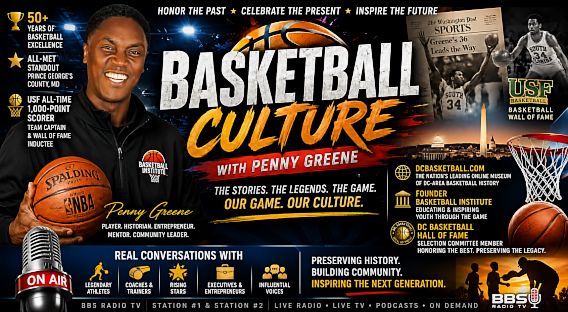

Basketball Culture with Pennington "Penny" Greene
From PG County to the Garden: Becoming the Noise in New York Basketball
From Difficult Beginnings to Basketball Opportunity
Penny Green opens the episode by tracing his journey from Southeast Washington, D.C., through West Baltimore and eventually to Greenbelt, Maryland, in PG County. He describes childhood environments that could be dangerous and credits his mother with recognizing when the family needed a different setting. The move into PG County exposed him to recreation centers and a strong basketball culture where he says he developed competitiveness, mental toughness, and scoring ability. He presents basketball not simply as a sport but as a structure that helped shape his life. His progression through those communities becomes the foundation for the episode’s larger story about opportunity, discipline, and identity. The narrative establishes that the bright lights of Madison Square Garden were preceded by years of neighborhood basketball and difficult life experiences.
Becoming an All-Metropolitan Player
Green describes the prestige of earning All-Metropolitan recognition in the Washington area and places his own achievement within a tradition that included major basketball figures. He references Elgin Baylor, Dave Bing, Austin Carr, and Adrian Dantley while explaining how meaningful All-Met status was to young players in the region. Green then recounts attending the University of South Florida, where he says he became the first player in school history to reach 1,000 career points. He also discusses an opportunity with the Hawks after college and insists that, even though he was cut, he possessed a professional-level game. His description of his playing style emphasizes physicality, intimidation, toughness, and a desire to impose his will on opponents. He later transformed his lifelong involvement with basketball into historical work, DCBasketball.com, documentary participation, and Basketball Culture.
Discovering the Mythology of New York Basketball
A major portion of the episode explores Green’s fascination with New York City basketball. He credits Pete Axthelm’s The City Game with helping him understand the mythology surrounding New York playgrounds, players, rivalries, and basketball personalities. Green recalls legendary figures including Connie Hawkins, Bob Cousy, Lew Alcindor, Earl “The Goat” Manigault, Julius Erving, Walt Frazier, and Earl Monroe. He describes seeing basketball everywhere in New York, from Chinatown courts to workers spending lunch breaks watching games in Manhattan. To Green, basketball is not merely entertainment in New York but part of the city’s daily rhythm and identity. His memories of Gus Williams and Lloyd “World B.” Free further reinforce his admiration for the confidence, creativity, style, and individual expression associated with New York guards.
The Road to Madison Square Garden
Green then brings the story full circle by describing how his University of South Florida team received an opportunity to play at Madison Square Garden after a strong season. He recalls the excitement of realizing that a player whose basketball life began in Washington and Maryland would now compete in the arena he had viewed as basketball’s grandest stage. The event also carried personal pressure because his mother was attending and his coach had told her that Green was not playing up to his potential. After what he describes as a mediocre first half, Green says he recognized that he needed to make something happen. He began attacking, including a memorable airborne 360-degree move finished with a finger roll. That play became the entrance point into an experience he describes throughout the episode as “the zone.”
Inside the Zone and Becoming the Noise
Green describes the zone as a state in which the game seems to slow down, the basket appears larger, instincts take control, and movements happen without conscious planning. He says the energy of the crowd, his body, his mind, his creativity, and the game itself seemed to become one. Even opposing players acknowledged his performance, which Green sees as an example of New York fans and players respecting exceptional basketball regardless of who produces it. He states that he finished 13 of 17 from the floor and three for three at the foul line before fouling out with just over a minute remaining. As he headed toward the bench, he says thousands of people in Madison Square Garden rose and gave him a standing ovation. The episode’s produced spoken-word segment turns that experience into the phrase “I became the noise,” describing a player moving beyond merely blocking out a crowd and instead becoming the source of its energy.
Basketball Culture Beyond Statistics
The episode closes by explaining what Green wants Basketball Culture to represent. He says the program is not intended to focus only on statistics or endless debates about which player is better. Instead, he wants to tell stories about playgrounds, neighborhoods, characters, legends, rivalries, styles, and the people who cause generations to fall in love with basketball. His Madison Square Garden story becomes an example of that philosophy because its meaning extends beyond the box score into memory, place, community, preparation, and the emotional relationship between players and fans. The produced closing piece emphasizes the unseen work behind moments of public recognition: bus rides, practices, empty gyms, failures, early mornings, and nights spent developing a craft. Green ends by expressing respect for New York City’s passion for basketball and inviting listeners to return for the next episode while staying focused, staying on point, and living their best lives.
SEO Keywords / Key Phrases
New York City basketball, Madison Square Garden basketball, PG County basketball, Washington DC basketball history, basketball culture, the zone in basketball, playground basketball legends, college basketball journey, basketball mental toughness, New York basketball history
Basketball Culture
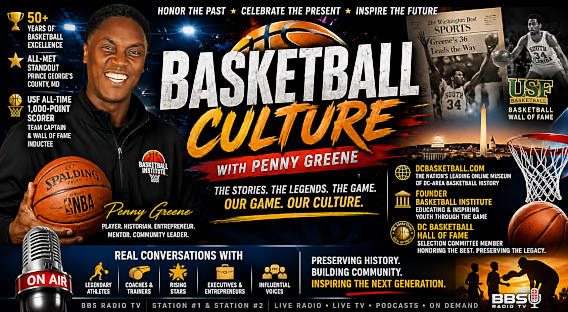

Basketball Culture with Penny Greene is a bi-weekly television, radio, and podcast program dedicated to celebrating every level of the game.
From neighborhood playgrounds and recreation centers to AAU basketball, high school, college, the NBA, and the WNBA, the show brings together the players, coaches, executives, officials, and visionaries who have shaped basketball's past, present, and future.
Each episode features exclusive interviews, inspiring personal stories, basketball history, player development, recruiting, leadership, and insightful conversations about the issues impacting today's game.
Basketball extends far beyond the court. It influences fashion, music, business, education, politics, and communities around the world. Basketball Culture explores how the sport continues to unite people while inspiring generations of athletes and fans.
Whether you're a lifelong basketball enthusiast or discovering the game for the first time, Basketball Culture with Penny Greene delivers authentic conversations with the people who have lived the game and continue to shape its future.
This is more than basketball. This is Basketball Culture.
Executive Producers:
Pennington Greene • Jeremy Harris • Christian Swann
From PG County to the Garden: Becoming the Noise in New York Basketball
Speaker Identification
Speaker 1 – Penny Green, Host / Narrator
The host identifies himself near the beginning as “Penny Green” and again near the close. He narrates the autobiographical basketball story and the discussion of New York basketball culture.
Speaker 2 – Prerecorded Program Intro / Produced Spoken-Word Voice
The opening branding and the later Madison Square Garden production have a stylized, produced quality distinct from the main narration. The transcript does not establish whether this is Penny Green, another performer, or a composite recording, so the identity is not assumed.
Speaker 3 – Prerecorded Advertisement Voice
The DCBasketball.com advertising segment is treated separately because it functions as a commercial break. The transcript does not establish whether Penny Green or another announcer voices the advertisement.
........................
Speaker 2 – Prerecorded Program Intro / Produced Spoken-Word Voice:
From the back alleys and the rec centers of PG County to the bright lights of Madison Square Garden, this game gave me a blueprint for life. So fasten your seat belt and take this ride with me through the players, the legends, the history, and the future.
This is Basketball Culture with Penny Green. It’s more than just a game. It’s a culture.
“You’re killing them, Slim. You’re killing them.”
Basketball Culture. The champion in you.
Speaker 1 – Penny Green:
Hello, my global basketball community. It’s your boy, Penny Green, and I’m back. This is show number two.
The title of this show is “The City Game.” If you’re wondering what city, there’s only one city when it comes to the city game, and that’s New York City, the Big Apple. You know: Jay-Z, Alicia Keys, Frank Sinatra—New York, New York.
Okay, listen. They won the NBA championship after a couple of decades. The city went crazy. Every celebrity in the city was out for the celebration, and last time I checked, there were parties everywhere. There were parties for the parties. Last time I checked, they’re still partying.
There’s a special kind of love for basketball in New York City, and I’ve known it all my life. Growing up in Washington, D.C., it was another level. Folks would take it to another level.
So anyway, I’m going to talk about my journey from Southeast Washington, D.C., to Madison Square Garden. It’s a crazy, crazy journey.
My childhood begins—my life begins—in Southeast Washington, D.C., a pretty challenging community. My mother then moved us up to Emerson Village in West Baltimore, [descriptive phrase unclear].
You learn at a very early age in the village how to run. That’s the number-one key component for success: know when to run and how to become a runner early in life.
There was a park where I played a little baseball called Lincoln Park. My mother always said, “Don’t hang out at Lincoln Park. [Unclear warning.] So don’t do it. Make sure you leave.”
Everyone thought it was kind of mystical, weird, [several words unclear], but I went back and did some research later in life. Back in those days, around the time I was there, four young people [event unclear] in the same woods that I played in on a regular basis.
So listen to your mother, okay? When she tells you something, listen. Thank God I made it through that episode.
Later in life, I’m watching HBO, the acclaimed show The Wire, and [unclear reference to Lincoln Park and four bodies]. I found out later, when I did research, that they called it “Murder Park.”
So thank God my mother got me out of that environment. She kind of saw the writing on the wall, wanted a different picture for me, and moved us to Greenbelt, Maryland.
A breath of fresh air.
PG County was different. They had recreation centers every place, and that’s where I got a chance to really develop my basketball game. I learned how to compete. I learned mental toughness. I really became a bucket-getter, okay?
Everyone knows Kevin Durant came from PG County. That’s how far it goes back. Generations before Kevin Durant, PG County already had a very solid basketball culture, and I was fortunate to be able to develop my skills in that environment.
Now I get to high school. Things are going good. I’m at Parkville High School. In Washington, the most prestigious thing you can do as a player is become what they call All-Metropolitan—make All-Met.
So I was All-Metropolitan in The Washington Post, which was one of the most famous papers in the world. In those days, it probably had about 600,000 circulation. And there was The Washington Star.
What does that mean? People would call you up and say, “Penny Green, are you going to be in the picture this year?”
“A picture?”
Yeah. It was critical. It was like the most critical thing you could do as a ballplayer—to become All-Metropolitan.
Just to give you an idea of the distinction, let me give you a few names of people who were All-Met and came out of Washington.
Elgin Baylor. Hall of Fame. First Black superstar. He’s got a statue outside the stadium.
Dave Bing. Hall of Fame. [Additional description unclear in source.]
Austin Carr, college player of the year in ’71, number-one pick in ’71. He still holds the NCAA record for most points in a single game with 61. Crazy. The whole team didn’t score 61. He scored 61 by himself.
The last person I want to reference is Adrian Dantley, who I played with a lot. Olympic gold medalist, NBA, over 23,000 points. He’s tied for the record for most free throws in a single game. He had 28 free throws, and he’s tied with Michael Jordan and Wilt Chamberlain.
That’s quite a distinction.
So those are some of the individuals who were All-Met. I like to say being an All-Metropolitan is like having a badge of honor. It’s a really prestigious thing to come out of Washington and accomplish that.
From PG County, I went off to college at the University of South Florida. I became the first player to score 1,000 points in the school’s history, and today my picture and my name hang on the school’s Wall of Fame.
But numbers don’t tell it all.
Basketball gave me experiences that I never thought I would have experienced coming out of Southeast Washington and West Baltimore. Those experiences happened.
One of those experiences happened in one of the world’s most famous basketball venues. That was Madison Square Garden. We’ll get back to that stuff.
After college, I had an opportunity with the Hawks. Hubie Brown. I got cut. But I just want you to understand one thing, and that is: I had a pro game. Trust and believe, I had a pro game.
When I say that I was a physical guard, I wanted to punish my opponent physically. If you guarded me, you would feel me. You know what I’m saying?
When you left the gym, I wanted to have a piece of your spirit. I wanted to make sure you were thinking about me after you left the gym. I wanted you to remember every drive, every collision, every possession—everything.
I wanted you to earn it.
If you scored, I could score the basket, but I was more interested in other things. I wanted to impose my will on you. I wanted to make you feel uncomfortable. I wanted to challenge you physically and mentally.
I didn’t want to just beat my opponents. I wanted them to feel like they had been in a war.
So, yeah, I did have a pro game.
From player, I became a historian. Over the decades, I became a student and a historian of the game.
The late, great D.C. coach and radio celebrity Butch McAdams called me the Wikipedia of D.C. basketball. Quite a compliment.
I created a website, DCBasketball.com. I appeared in Kevin Durant’s documentary Basketball County: In the Water. And I’m part of the Washington Basketball Hall of Fame.
I started this show, Basketball Culture.
So I played it. I studied it. I lived it. I’ve been around people who made the game. I’ve spent my life trying to understand what makes this game just so very special.
That journey qualifies me to talk about the game of basketball, just so you know.
Now we’re getting ready to get to the meat and potatoes of this storyline: New York City, the city game.
The first book I ever read in my whole life was The City Game by Pete Axthelm, and I was feeling it. It was like the most beautiful thing I ever had. To this day, I believe it’s the greatest basketball book I’ve ever read.
The book helped me understand the magic of basketball. Axthelm wrote about the playgrounds, the battles, the characters who made New York basketball mythical.
Connie Hawkins, with the one hand swooping through the air. [Name and description unclear.] Bob Cousy, the first guard to start throwing behind-the-back passes, who came out of a tough Irish neighborhood. The great Lew Alcindor with the skyhook.
Lew Alcindor says the greatest player he ever played against? Earl “The Goat” Manigault.
Of course, Julius Erving.
All New York legends.
You didn’t just read about these players. You could almost hear them bouncing the ball. You could feel the crowds surrounding the court. You could feel New York City.
This is amazing.
There’s something about New York that is difficult to explain. If you haven’t experienced it, and I try to tell you these things, you might not really feel it.
The game becomes part of you when you’re young and never completely leaves you. When you get married to a woman, basketball still feels like your first love.
That’s New York City.
Your wife is there, but your first love? It’s New York City basketball.
The book follows the championship Knicks, and my two favorite players played for the Knicks: Walt Frazier and Earl Monroe. They had a special something. They had that swag and they had that confidence.
New York basketball has its own personality. I got to experience it firsthand.
Basketball is everywhere in New York.
When I was in junior high school, they took us on a field trip. We go to Radio City Music Hall. We go to Chinatown. I’m looking off in the distance and see some Asian brothers playing basketball. They all had handles like Kemba Walker and Kyrie Irving. All of the guys could really handle the ball.
This is a whole other culture that I’m not familiar with, but they’re handling the ball better than anybody I know. It’s crazy.
I remember another experience. I was in New York, in Manhattan, and people were coming out of skyscrapers. They had their go-bag lunches. Instead of going to the park, they were going to the basketball court. They were sitting in the stands watching guys play basketball.
Only in New York do you get that kind of vibe.
It’s not simply entertainment. Basketball is part of the rhythm of the city.
My favorite two players coming out of high school and going into college were two New Yorkers.
One was a guy named Gus Williams. Gus Williams was from Money Earnin’ Mount Vernon. Gus Williams was clever. He was quick. He was always under control, and he had that sauce.
What was even more unique about him, he tied his shoestrings on the back of his ankle. The strings would come around and tie up on the back side of the shoe. It was pretty unique. It was a little different style.
I remember him coming to the Urban Coalition in Washington, dropping 63, and running out of the gym. “I showed you what I had. I gave you the buckets this time.”
The other guy that I was in love with back in those days was a guy named Lloyd Free. They called him World B. Free.
The nice thing about Lloyd is he was explosive. He got up nice and high on his jumper. He scored points in bunches. He had supreme confidence.
I took that from him. You’ve got to feel confident, be confident, and be successful.
When he came to D.C., I got a call from one of my buddies. He was like, “Hey, get to the gym immediately.”
I’m like, “What’s the problem?”
He said, “There’s a guy at the gym, and he looks like Mighty Mouse.”
He was a big [unclear description]. He had big bowling-ball shoulders, and he was going to the basket. He was kicking people.
I said, “Oh, I get it. He looks like Mighty Mouse.”
So, very interesting, the New York experience.
As a Washingtonian, New York set the bar. It set the standard.
I think we’re going to take a break now, and then we’re going to be right back at you.
Speaker 3 – Prerecorded Advertisement Voice:
Every business wants more visibility, more customers, and more opportunities to grow.
Now you can put your brand in front of one of the most passionate sports audiences in the Washington, D.C., Maryland, and Virginia region.
Advertise with DCBasketball.com, the trusted online home for the history, culture, players, coaches, and traditions of basketball throughout the DMV.
In 2025 alone, DCBasketball.com generated more than 37,000 unique visitors, 52,000 website visits, over 81,000 page views, and more than 800,000 website hits.
That’s year-round exposure to athletes, coaches, families, alumni, and basketball fans who are actively engaged with our community.
Whether you’re in real estate, healthcare, legal services, restaurants, automotive, education, retail, financial services, or sports and fitness, your next customer could be just one click away.
Reserve your banner advertising space today and put your business where the DMV basketball community comes together.
Contact Penny Green, founder and CEO of DCBasketball.com. Email pengreene@gmail.com. That’s P-E-N-G-R-E-E-N-E at gmail.com.
And visit DCBasketball.com, where the game lives on and your business gets seen.
Speaker 1 – Penny Green:
It’s your boy, Penny Green, and I’m back at you.
I’m telling you about my New York experience, telling you that there’s a certain special kind of love for the game, with a passion that you can’t find in many cities when it comes to basketball.
So now life has a funny way of coming full circle.
I had experienced the action in New York City from a distance, and now, come to find out, Penny Green is actually going to be playing in the Garden.
Like, what?
So, Coach—we had our best season. We were 19 and 8, and we thought we were going to receive an invitation to the NIT, but unfortunately it never happened.
My coach, Bill Gibson, developed a friendship with New York Yankees owner George Steinbrenner, and he got us connected.
We were going to play Madison Square Garden.
Crazy, right?
When I graduated high school, the Knicks had actually won the championship around ’74. I had gotten to see the magic, the Garden action.
Now we’re going to play there.
A full day of basketball.
The tournament: Iona against South Florida, Cincinnati against Rutgers, Charlotte against Seton Hall, and that night the Knicks and the Nets played.
So it’s a day of basketball in Madison Square Garden.
Yeah, I’m kind of psyched up a little bit. I get a chance to experience the world’s most famous sports arena.
Because I played basketball in Tampa, my family didn’t really get to see me play. Now my mother is coming to the game, and of course she’s sharp. I mean sharp—foxy, looking like a runway model out of New York.
People were like, “That’s your mother?”
Yeah. My mother.
And my uncle was there in a new Benz. He had just gotten back from, you know, places you don’t want to go. So he was in a brand-new Mercedes.
And there was another twist.
The coach had been telling my mother I wasn’t playing up to my potential, and I’m causing conflict. I mean, D.C. guys are independent. We don’t like [unclear phrase]. The nerve of me, as a young man, questioning the coach.
So, you know, that had me in the doghouse.
Now my mother’s in Madison Square Garden.
The first half, I’m mediocre.
The second half, I’m realizing, if I don’t get moving, he’s going to be able to say, “I told you.”
So I had to make my move.
And that’s when it happened.
I started making the big-boy moves on the New York City boys.
I went left, jumped in the air, spun 360 while I was airborne, came up on the other side and laid it in—the finger roll.
[Short visualization reference unclear in source.]
There are a lot of those 360 spins.
All of a sudden, I realized something was happening.
Wait a second.
I’m not going to tell anybody.
It’s called the zone.
If you’ve ever had the experience of the zone, it’s almost impossible to explain.
It’s an experience in which you almost observe the game from outside of your own body. Your spirit takes on a heightened sense of creativity and accuracy. You’re seeing things before they even happen.
That’s the zone.
You’re no longer thinking about the next move. You just know.
The game slows. The basket gets bigger. The instincts take over, and suddenly you’re doing things that you didn’t plan to do.
It just happens.
That 360 spin—it just came to me naturally. I didn’t plan it. I just jumped, spun 360 in the air, and laid it in.
Just beautiful.
It just happened.
That’s the zone.
And once I made that move, I knew I had something going strong.
I could hear the brothers from Iona whispering as I went down:
“Good shot, money.”
What?
You’re my opponent, and you’re complimenting me in the middle of the game?
Only in New York.
That could happen nowhere else.
Only in New York City.
Because of the love of the game, the appreciation of what I was doing was bigger than the game itself.
I scored again. And again. I came down six consecutive times. I was [unclear phrase]. You know what I mean? I was feeling my goodness.
Thirteen points. Fifteen points. [Exact scoring burst and time reference unclear.]
Everything had slowed down. It was a beautiful experience. The basket looked large. I wasn’t thinking anymore. I was just playing.
That’s what I’ve learned about the zone.
You can either block out the noise, or you can become part of it.
That afternoon, I became part of it.
The crowd, the energy, the basketball, the moment—it all became one.
The zone is a high in that the crowd, mind, body, and your creativity all become one. Your spirit takes over.
The zone is a high.
It’s hard to describe.
I like to call it the Holy Ghost.
Tampa broadcaster Jack Harris, a media icon in Tampa, described what he witnessed as one of the greatest basketball performances he had ever seen.
I finished the game 13 of 17 from the floor—76 percent—and three for three from the line, 100 percent.
And then, with one minute and 12 seconds remaining, I fouled out.
A little dejected, my head dropped. I’m heading to the bench.
All of a sudden—wow.
I’m like, “What?”
More than 5,000 people in Madison Square Garden gave this kid from Southeast Washington, D.C., by way of West Baltimore, by way of PG County, by way of South Florida, a standing ovation.
Think about that.
To have received a standing ovation from the opposing crowd—especially at Madison Square Garden.
At that time, I didn’t fully understand what happened. It took me about 20 years to grasp what happened.
Every time I turned on the TV to watch a ballgame, they would say, “The world’s most famous sports arena.”
I’d say, “Wait. Did I actually have my best game [unclear phrase]?”
Yeah.
That was the reality of the situation.
I call it God. [Short phrase unclear.] In those next few minutes, I was consciously—I was unconsciously creating those moves. The moves were coming from somewhere.
I would say I was slipping into darkness.
The noise disappeared. The game slowed down. Creativity took hold.
That’s what they call the zone.
And I’ll never forget how that felt.
Madison Square Garden is so different.
Kobe Bryant described it as the Mecca of basketball. He went into the building and dropped 61.
Michael Jordan understood the Garden, too. He talked about the history and basketball knowledge of New York fans. He went into the Garden and dropped 55.
LeBron also expressed his experience. He said New York basketball fans will cheer for you, even as an opponent, when they’re witnessing something special.
So LeBron, Mike, Kobe—all of them bring to light what’s special about Madison Square Garden.
They understood the game.
So, yeah, I feel pretty good to be part of that fraternity.
It’s not just statistics. That’s Basketball Culture.
We’re not looking to just talk about statistics. We’re not just talking about who’s better than who.
We want to talk about the culture: the playgrounds, the neighborhoods, the characters, the legends.
Most importantly, we want to have the best stories.
The places, the rivals, the styles, and the people who helped us fall in love with the game.
I’m going to play a little song for you that my buddy from Kingdom Life Media Group put together describing my experience at Madison Square Garden.
Then we’re going to close this narrative out.
Speaker 2 – Prerecorded Program Intro / Produced Spoken-Word Voice:
Madison Square Garden.
The world’s most famous arena.
And that young man became the noise.
Madison Square Garden.
Bright lights shining.
Twenty thousand screaming.
History hanging from the rafters.
Legends built their names in this building.
Champions earned their respect here.
But on this night, something different was happening.
My O.G. always said:
Most players hear the noise.
Great players block out the noise.
But every once in a while,
a special player becomes the noise.
That night,
I became the noise.
Every dribble echoed through the building.
Every shot raised the volume.
Every basket made the Garden shake.
The crowd wasn’t watching me.
The crowd became part of me.
I became the noise.
The roar.
The thunder.
The sound of basketball heaven.
Madison Square Garden.
The world’s most famous arena.
I wasn’t playing in the Garden.
I was part of the Garden.
I became the noise.
The roar.
The thunder.
The sound bouncing off the ceiling.
I became the noise.
PG County raised me.
Twenty-five point seven every night.
All-Met.
Three-level scorer.
Deep range.
Midrange.
Attack mode.
Whatever the game needed.
Defenders looking lost.
One look that meant:
“The only person stopping you is you.”
Another told me:
I became the one.
I became the one.
I became the one.
I became the one.
I became the one.
The thunder.
The sound of basketball heaven.
Madison Square Garden.
I wasn’t playing in the Garden.
I became the one.
The thunder.
The sound of basketball heaven.
Madison Square Garden.
The thunder.
The thunder.
The sound of basketball heaven.
Madison Square Garden.
Madison Square Garden.
I wasn’t playing in the Garden.
I became the one.
The thunder.
The thunder.
The thunder.
The thunder.
The thunder.
The thunder.
The thunder.
The thunder.
The thunder.
The thunder.
The thunder.
The thunder.
The thunder.
The thunder.
The thunder.
The thunder.
A 360 spin move.
Finger roll.
Crowd losing their minds.
Even opponents smiling.
“Good shot, money.”
Only New York.
Only New York respects greatness while it’s happening,
because New York understands basketball.
New York respects basketball.
New York loves basketball.
See, everybody saw Madison Square Garden,
but they didn’t see the road that got me there.
They didn’t see the bus rides
and long practices,
the empty gyms,
the days when nobody knew my name,
the nights I shot until my hands hurt,
the mornings I woke up before the sun,
the losses that taught me,
the failures that shaped me,
the pressure that forged me.
Greatness ain’t born under bright lights.
Greatness is built in the dark,
when nobody’s clapping,
when nobody’s posting,
when nobody’s watching.
That’s where the feelings are made.
So when the Garden started shaking,
I wasn’t surprised.
I had already lived this moment
a thousand times in my mind.
The crowd was finally catching up
to the world I already knew.
I became the noise.
The thunder.
The sound of basketball heaven.
Madison Square Garden.
The world’s most famous arena.
I wasn’t playing in the Garden.
I was part of the Garden.
I became the noise.
One minute remained.
Whistle blew.
I fouled out.
Thought my night was over.
Then it happened.
One section stood.
Then another.
Then another.
Until the entire Garden was standing.
A standing salute and celebration.
Not just the performance.
The moment.
The zone we experienced.
The fire.
The journey.
My, my, my, my, my greatest game
in the world’s most famous arena.
Madison Square Garden.
I didn’t block out the noise.
I became the noise.
I became the noise.
I slipped into the darkness.
I took a bite out of the Apple,
and it was delicious.
For one unforgettable night,
Madison Square Garden belonged to me.
And for one unforgettable night,
I became the noise.
[Final identification line unclear; transcribed approximately as “My O.G. name is Pinnington Penny Green.”]
Speaker 1 – Penny Green:
And we’re back with Basketball Culture. Penny Green.
As we close out the show, I just want to say I’ve got nothing but respect for New York City and their passion and their love for the game of basketball, because I love the game just as much.
As we close out, I just want to say thank you for spending time with Penny Green and Basketball Culture.
And for all you guys out there, please make sure you join us for the next episode. Please make sure you tune in to our next episode.
Stay focused.
Stay on point.
And live your best life.
Thank you so much.