
All The Way Live, August 26, 2026
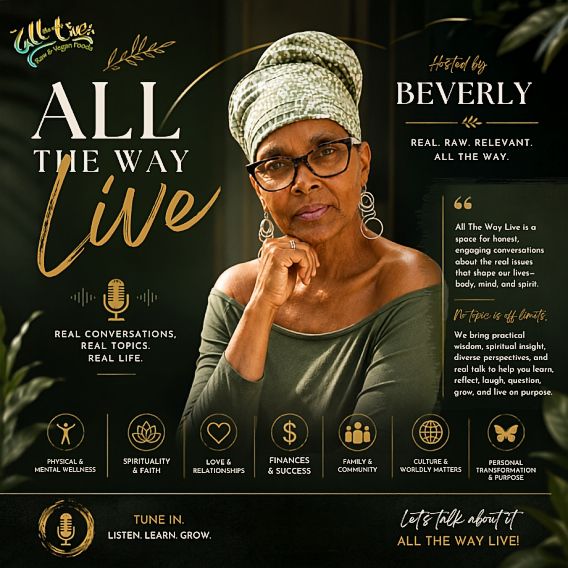

All The Way Live with Beverly Medley
The Journey to Right Now: Health, Family, Fear, and Living Fully Present
A First Show Built Around a Personal Journey — Beverly opens her first broadcast by introducing the program as a space for exploring life, health, and the experience of being on this planet. She frames the hour around her own journey and invites listeners to travel with her as she reflects on the experiences that shaped her. Rather than beginning with outside experts or abstract ideas, she starts with autobiography. Her story becomes the foundation for the themes she says the program will continue exploring. The overall tone is reflective, grateful, and conversational.
Childhood, Family, and the Beginning of Change — Beverly describes growing up in Philadelphia after her parents migrated from Virginia, recalling a childhood filled with family, neighborhood life, chores, games, and home-cooked meals. She remembers her mother as a homemaker and excellent cook and her father as a highly capable construction worker despite having limited formal schooling. After graduating from high school, beginning clerical work as a teenager, and marrying at 20, Beverly says her lifestyle shifted toward more fast food and less home cooking. A Muslim neighbor repeatedly encouraged her to reconsider her eating habits, but Beverly says the message initially did not register. Her turning point came when she borrowed a Dick Gregory book and decided to try a major dietary change.
Thirty Days That Redirected Her Life — Beverly says she followed a 30-day vegan regimen that required no cooking, despite knowing virtually nothing about veganism or vegetarianism when she began. She reports losing about 25 pounds during that period and, more importantly to her, noticing a change in how she thought and felt. Family members were concerned about her weight loss, while Beverly says she felt amazing and decided to continue on the path. That experience became the beginning of a much longer commitment to a raw-food vegan lifestyle. She later raised her two children with many of the same eating practices, while emphasizing that her husband’s support made that possible even though he continued eating a more conventional American diet.
Family, Food, and the Restaurant Journey — Beverly connects the name of the radio program to the restaurant she started with her daughter in 2008. She says the restaurant was her daughter’s idea and describes being hesitant because of the work involved, but her daughter persuaded her that they could do it together. Beverly presents the restaurant as a practical expression of her belief that people can choose different ways of living and eating. She stresses that everyone has an individual path and that not everyone will choose veganism. She also hopes to interview her adult children in future episodes to learn, alongside the audience, how being raised with an unconventional diet affected their childhood, school experiences, and later lives.
Presence, Fear, and the Highway Lesson — A major philosophical theme of the episode is Beverly’s emphasis on being present. She says meditation helped her recognize that the past is gone, the future is not promised, and the only moment actually available is the present one. To illustrate the point, she describes anxiety about changing lanes near a highway exit and her habit of crossing a solid line early because she feared she would otherwise miss the exit. After deciding to trust the road design and wait until the lane marking allowed her to merge, she says she repeatedly reached the exit without a problem. For Beverly, the experience became an example of fear as “false evidence appearing real” and of how imagined future problems can pull a person away from the present.
Synchronicity, Judgment, and a Bittersweet Life — Beverly closes by broadening the discussion from fear to her belief that life is synchronized and that events are not simply accidental. She says this perspective has changed how she thinks about mistakes, encounters, regret, and the way people treat one another. Being present, in her view, creates more opportunity to pause before speaking or acting in ways one might later regret. She also explains that she has become less quick to blame or judge people because individuals act according to what they are capable or incapable of doing at a given stage of life, and those capacities can change. Her final reflection is that life is bittersweet, containing both difficult and beautiful experiences, and she invites listeners to continue exploring those experiences with her in future programs.
SEO Keywords / Key Phrases
vegan diet, raw food vegan diet, healthy eating, plant-based lifestyle, mindfulness and presence, overcoming fear, meditation and self-awareness, family nutrition habits, vegan restaurant, personal growth journey
All The Way Live
Support my show
$5.99/mo or $9.99/mo or more
Click HERE
SUBSCRIBE TO TALK SHOW
All The Way Live with Beverly Medley
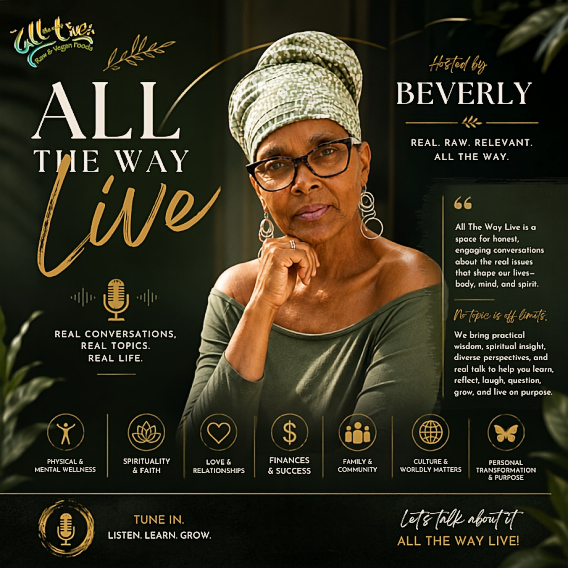
All The Way Live is a dynamic radio show dedicated to exploring the full human experience: body, mind, and spirit. The show creates space for real, engaging conversations about the issues that shape our everyday lives, from personal growth, health, relationships, family, and purpose to culture, community, and worldly matters.
No topic is off limits. All The Way Live brings together practical wisdom, spiritual insight, diverse perspectives, and honest conversation to examine what is happening within us and in the world around us.
Listeners can expect thought provoking discussions about physical and mental wellness, spirituality, love and relationships, finances, success, social issues, personal transformation, faith, purpose, and the challenges and victories that come with simply being human.
All The Way Live is about the whole person and the whole life. It is a place to learn, reflect, laugh, question, grow, and have conversations that matter. Whether the topic is physical, mental, spiritual, personal, or worldly, we are talking about it All The Way Live.
The Journey to Right Now: Health, Family, Fear, and Living Fully Present
Speaker Identification
Speaker 1 – Beverly, Host: Identified because she introduces herself by first name at the beginning, states that this is her first show, describes her personal history throughout the episode, and closes the program.
Speaker 2 – Prerecorded Theme / Promo Voice: The final lines shift from Beverly’s conversational closing into short lyrical or promotional phrases. The transcript does not identify the performer or announcer by name.
-----------------------
Speaker 1 – Beverly, Host:
Greetings, greetings, everyone. This is Beverly, and the name of this show is All the Way Live. This is my first show, and I’m so grateful to be here with you.
We’re going to cover, during this hour, many, many things about life, health, and just being on this planet. I hope you will join me on this journey, because we all have one. I’m going to tell you a little bit about my journey and where life has taken me.
I was born in Philadelphia, Pennsylvania, in 1952. My parents migrated from Virginia. They were sharecroppers. I had a simply wonderful childhood. My memories of childhood are ones of loveliness because so much of it had a purity to it.
Most days, after chores were done, I jumped Double Dutch, played jacks, and ran races. It was such a beautiful time, and I think back a lot on those days.
My world was relegated to a small area because I only went to businesses that were in my neighborhood, usually within walking distance. I had five siblings, along with my mother and father. When I was younger, my mother was a homemaker, and she was the best cook ever. My father did construction work. Not only could he do construction work, but he could do almost everything. He only went to the third grade in school, but he could do anything that had to do with building, cement work, or masonry. And my mother was a wonderful cook.
Thinking back on those times, the discipline was firm and could be a little severe. Back then, if you didn’t follow the rules you were given and do what you were told, you would get punished, and you might get a [specific punishment term unclear]. I look back on the discipline I was given, and I don’t really see any scars from it.
I went to school, graduated from high school, and started working in clerical work when I was 15, almost 16. I got married when I was 20. I was married for 30 years and then got divorced. We had two beautiful children. We bought a property, and then I had my daughter.
But before having my daughter is when my life changed, in that I began to be interested in health. I had a neighbor who was Muslim who would tell me about my eating habits and how bad they were. I remember thinking that I couldn’t hear anything she was telling me. It went in one ear and out the other. Nothing she was saying really registered because I loved eating and doing what I was doing, which was a lot of fast food, without really knowing what healthy eating was.
When I was growing up, my mother cooked every day. We sat down at dinner as a family every day, except maybe one day a week when my father would let us go get something, like a sandwich from one of the stores in the neighborhood.
But when I got married, it was just me and my husband, so I didn’t really cook as much. We had a lot of fast food and things like that. I did cook, but not a lot at home.
So when this neighbor, a friend of mine, started talking about my diet, I couldn’t really hear her. I would look at her while she was talking to me, but it didn’t register.
One day I was at her house. I’m an avid reader and always have been, and she had a lot of books. I was looking at her books, and I kept seeing this one little paperback. It was called Cooking with Mother Nature by the author and activist Dick Gregory.
For some reason, and I don’t even know why, I said, “Could I borrow this book?”
She said, “Sure.”
So I went home. I’ll never forget it: my husband was watching a basketball game, and I went straight to the back bedroom in our apartment. I read the book in about an hour—an hour and a half or something like that.
For some reason, after I read that book, I said, “I want to change my diet.” The book was explaining in very simple language how that could change your life. I saw the things he was talking about, and I felt those changes would be welcome in my life. That’s how my journey started—becoming more involved in myself. That’s how it started.
He explained in the book how to do it, and that’s what I did. I remember going into the living room and saying to my husband, “I’m changing my diet.”
He was like, “What are you talking about?”
I said, “I don’t know. I want to change my diet, and I’m excited.”
So he said, “It doesn’t make any sense to me, but if that’s what you want to do...” And then I started.
It was a vegan diet, and it also required no cooking. I looked at it and thought, I don’t really know if this is something I’m going to continue to do, but I’m going to try it.
Mind you, I didn’t know anything about veganism. I didn’t know anything about vegetarianism. I didn’t know anything about any of this. Why was I attracted to it? I don’t know. I didn’t know anybody doing it.
So I followed the 30-day regimen. When I came out of it after 30 days, I was about—I don’t know—25 pounds lighter. But I was different. I just was. I started paying attention to myself and realizing that I was thinking about things differently.
The people around me were worried. Of course, I had lost this weight, and I wasn’t really the same in my thinking. My sisters, my mother, and my father didn’t say too much, but they just couldn’t understand it.
And, of course, people were going to comment on the fact that I was so thin: “You’re so thin. Are you okay?”
When I looked at myself, I didn’t think I looked particularly frail, but I felt amazing. So I said, “I’m going to stick with this as long as I can.”
I’m starting out my first show by telling you a little bit about myself. That was years ago, and I’ve been on this path ever since. It’s been wonderful. Amazing.
So here I am. Years later, as the show goes on, I’ll probably fill in some of the blanks. The name of the show is All the Way Live, which is also the name of a restaurant started by me and my daughter.
That’s interesting as well because my two children were raised on the same type of diet I was on—the raw-food vegan diet. My husband stayed on the diet he was already on, which was a regular American diet. But it worked. I must say that I wouldn’t have been able to raise the children that way if he hadn’t been supportive.
The All the Way Live restaurant has been in existence since August of 2008. It was the brainchild of my daughter and was also inspired by the late, great Dr. Sebi [name spelling to verify].
At first, I didn’t know if I wanted to do it because I was thinking a restaurant was going to be very cumbersome and a lot of work. But my daughter convinced me: “Mom, we can do this.”
So that’s what we did, and it has been a beautiful ride. It’s like being on this journey—you don’t really know. We didn’t know anything about running a restaurant, but we learned as we went along the way. I’m so glad that I did it and that I’m a part of it, because it’s our contribution to showing that there are other ways to do things.
Making certain changes in your life can bring more positive things into your life. It can bring more balance, and it just changes things.
For me, everybody has this journey. Everybody is not going to be vegan. Everybody is not going to be a meat eater. Everybody has their path. This was my path. Out of the five children, I was the only one who took this path [family count to verify]. If you look at it, there’s no rhyme or reason why I took this path. However, it was meant to be the way for me, and I see how it helped me for the good.
During this hour, the All the Way Live hour, we’re going to discuss a lot of different things. Sometimes I’ll have guests come on. One day, I also want to interview my children on the show.
The reason for that is that they were raised in a very—how can I say it? Their environment was such that their father watched them during the day because he worked at night, while I worked during the day. I took over maybe after four o’clock. Then, at one point, I only worked part time, so I would take over maybe at one p.m. or something like that.
They were raised only by their mother and father until they started going to school. Everything, including the food, was prepared by me. Their father backed me up to make sure they partook of the things I had laid out for them.
However, I never actually talked to them about how this affected them in school. Their father and I did talk to them and teach them that they were fine the way they were, including the way they ate and things of that nature. They were pretty strong in what they were doing, so they wouldn’t be easily swayed by others.
On one of the shows, I do want to interview my children. A lot of the things you’ll be finding out, I’ll be finding out myself—how living this type of lifestyle was for them.
Every family and everybody around them was eating the things people normally eat, things that I ate growing up. But they didn’t develop some of those habits that I saw in myself. I did it differently with them. I taught them different habits as far as eating and things like that.
It’s been very interesting, and I know they would probably say the same thing about how it affected them. At this point in their lives, they still eat healthy. I see that a lot of the habits they were raised with are habits they still have today. They have their own families, and they’re on their own.
One of the main things I’ve learned along the way—and you’ll hear me talk about this a lot—is how to be present. The importance of being present is a game changer.
It’s not that easy. It’s not a very easy thing to do for most people because we usually want to live in the past, where you can always say how things were, what you didn’t like about it, or whom you disliked because of it.
The past has a place, but I’ve realized how to keep it in its place, for lack of a better way to express that. What I realized is that the past is dead, and there is no future. It’s just right now. It’s all that I have.
That’s one of the most important lessons I’ve learned, and I learned it through meditating: all you have is this moment. What do you want to do with it? You really don’t have time to put everything off, because the next moment isn’t promised to you.
Now, do you have a chance to fix things that you don’t see in the present? Maybe. But you don’t know that. What I’ve found is that everything feels better when I’m present.
We’ll spend more time on that subject. There are a lot of things involved in being present.
One of the things I have realized lately is being more aware of fear, which, as the saying goes, represents “false evidence appearing real.”
I was helping my children in their business, and when I was coming home, I was on the highway. Where my exit is, it’s very close to where the lane marking tells me not to merge. You know how you have a broken line and a solid line. As long as that line is solid, you’re not supposed to change lanes.
But I would be fearful that if I didn’t change lanes earlier than I was allowed to, I might not be able to make it over and get off at my exit. Why did I think that way? Because the point where they allow me to change lanes is very close to my exit. It’s a very short area.
So I would always change lanes while there was still a solid line, which I wasn’t supposed to do.
Then one day, I started looking at the highway in a lot of different ways—the genius of how highways are put together. I know that, for some people, that might be boring, but what I realized was how amazing highway systems are. Everything is mathematical, just like the universe. Everything is mathematical.
So I said, the geniuses who constructed these highways know what they’re doing. Why am I fretting over when I’m going to get off, like I’m the expert? Why do I think I have to change lanes now because I might not be able to merge down the road if other cars are coming?
One day I said, “No. I’m going to follow it exactly the way they designed it.”
That was maybe six months ago, at least. Since then, I don’t change lanes to get off at my exit until that solid line breaks. There has not been one day when there’s been an issue with me getting off at my exit. Not one. Not one.
For all that time, I had this strange fear—false evidence appearing real—that it would be a problem because I was living in the future. I wasn’t present.
“Oh, I might not be able to get off. Maybe cars will be coming, and I won’t be able to merge.”
I was just making up stuff in my head. It was all false.
“Just relax, Beverly, and follow the rules. These people who designed this knew what they were doing.”
So I’m at a stage in my life where I’m realizing things that some people might think are quite simple. One of the main things I’m seeing is synchronization—that everything is always the way it’s supposed to be.
At one time in my life, I would think things should be different from how they are now. “That shouldn’t have happened that way. If this hadn’t happened, then that wouldn’t have happened, and then this wouldn’t be the way it is right now.”
No. Everything is as it should be at all times. That was something I had to realize: there are no mistakes, as much as I might want something to have been a mistake. No, because every moment is synchronized.
When you leave your house, when you leave for your destination, what you run into on your journey to that destination, whom you may meet on the street when they leave their destination and you meet up at a checkpoint—all of that is synchronized. It is not by chance.
All of these things are amazing to me because I used to think things were just by chance, by coincidence. “It’s just a coincidence that you were leaving your house, and three blocks away there you are, meeting whoever it is that day.”
No. That’s not a coincidence. It just is. That’s all.
At this point, I’m beginning to see things that I never thought about before. I’m seeing that you have to be aware of how you do things and how you treat people because sometimes, if you err, you may not be able to fix it. And I guess you could say that’s okay, too.
However, when you’re more present, you can—not all the time, but a lot of the time—look before you leap. Everything that comes up doesn’t have to come out. You can pause and reflect before you say something you regret or do something you may regret. That’s being present.
When you’re not present and the mind is a monkey mind going everywhere—here, there, everywhere—you’re thinking about this, thinking about that, what somebody did last week, why you have to do this, and then you act in a way you may regret later. You may say, “I could have handled that better.”
But now that’s the past. You can’t correct that. What I’m seeing more and more is that the more I’m present, the fewer things I have to regret or try to go back and fix.
So this time that we’re going to have together, from seven o’clock to eight o’clock Eastern—that’s my time, Eastern Time—I want you to go on these journeys with me.
There were times in my life when I would blame this one and blame that one, whether it was my parents or this, that, and the other. Whose fault is this? Whose fault is that?
It is nobody’s fault. It just is. Everybody has a story. I see now that it was nobody’s fault, because what I realized—even with myself—is that people do, or don’t do, what they’re capable or incapable of doing at that time.
You can judge it to be right, wrong, or indifferent. People do what they can do based on where they are in their life at that time. You can judge it if you want to. You can decide what’s right or wrong, how right it is, or how wrong it is. Maybe you have a sliding scale.
But people do what they’re capable—or incapable—of doing at that time. And that can change. It can change, because what they do at one time in their life may be completely different the next day or the next year. They may be thinking differently. They may be a whole different person, for whatever reason.
So I’m not quick to judge. It is what it is, and then you act accordingly.
Life is bittersweet. Very bittersweet. There are some bitter things you’re going to have to go through and some sweet things. That’s our journey here on this planet, Planet Earth.
Yes, the show came on a little later. I was a few minutes past my time, which is seven o’clock, because today there were a lot of twists and turns—things that had to be done.
When I finally was ready, my daughter actually called me and said, “You’re supposed to be on the radio now, aren’t you?”
Yeah. Okay.
I love this time that I’ve spent with you today. This is All the Way Live Radio, which is also the name of our restaurant in Philadelphia.
If you’re ever in the area, or you just want to visit and see what we’re doing, it’s at 108 Germantown Avenue [street number to verify], ZIP code 1914[unclear]. The phone number is 215-821-7298 [number to verify].
We’re open from Thursday to Sunday: Thursday from 12 to 7, Friday and Saturday from 12 to 9, and Sunday from 2 to 7.
It’s a warm, beautiful place, and we have a lot of fun there. It’s a vegan restaurant, but you don’t have to be vegan to eat there because our customers are from all walks of life, and they’re not all vegan.
Thank you so much for listening. We’re going to have a lot of fun and learn a lot of things. Soon, I hope you’ll call in, and I’ll learn from you as well.
It’s been beautiful. Be well.
Speaker 2 – Prerecorded Theme / Promo Voice:
From love and money to the soul underneath,
we ask the questions, take off the mask.
Real conversation.
[Lyric unclear.]
All the Way Live.
Mind and spirit in the same room.
All the Way Live.
[Closing lyric unclear.]